warning TOYOTA YARIS 2016 Owners Manual
[x] Cancel search | Manufacturer: TOYOTA, Model Year: 2016, Model line: YARIS, Model: TOYOTA YARIS 2016Pages: 592, PDF Size: 10.44 MB
Page 437 of 592
435
YARIS_SEDAN_OM_OM99M18z_(U)
5-3. Owner Maintenance
5
Maintenance and Care
Window Washer Fluid
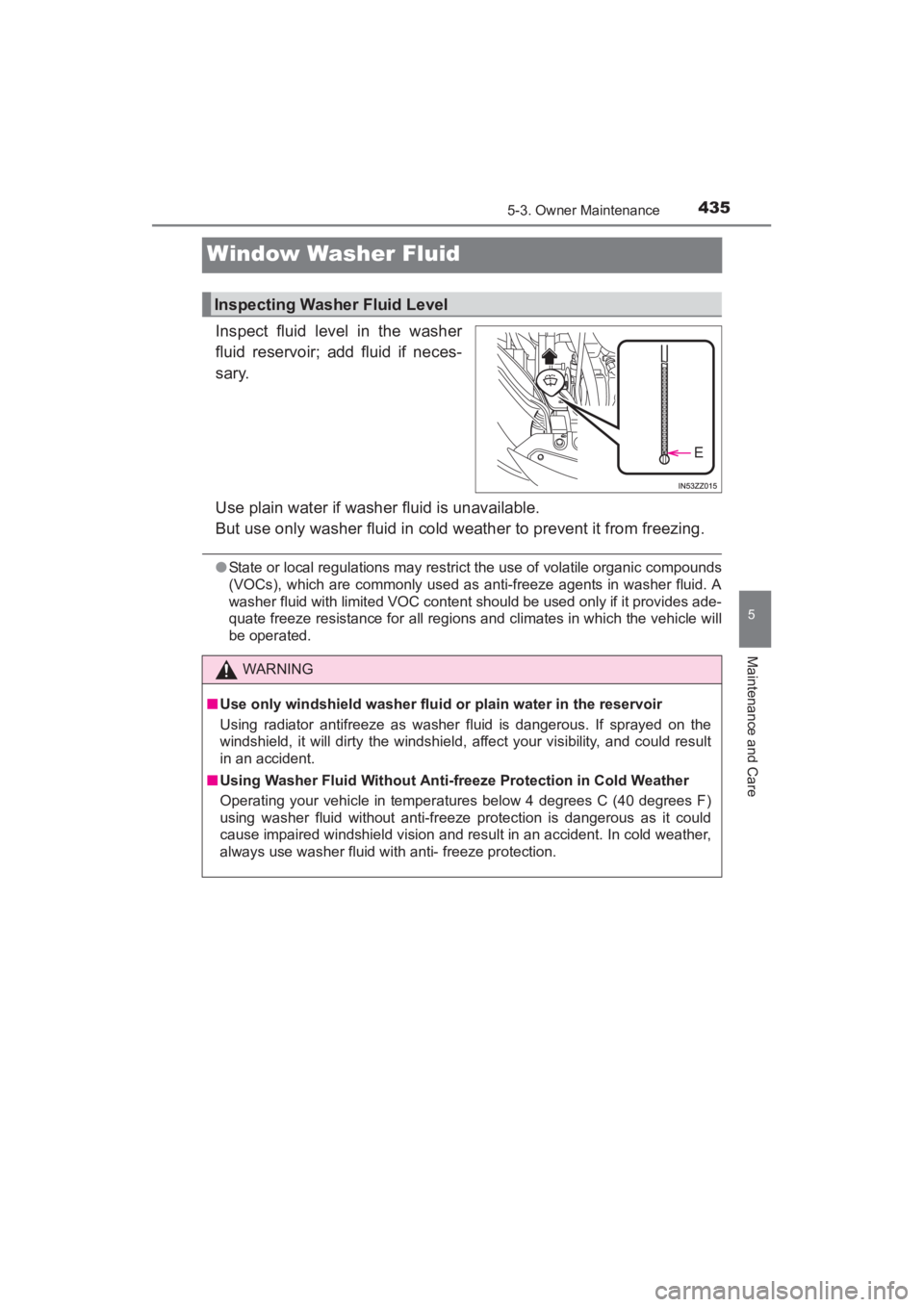
Inspect fluid level in the washer
fluid reservoir; add fluid if neces-
sary.
Use plain water if washer fluid is unavailable.
But use only washer fluid in cold weather to prevent it from freezing.
●State or local regulations may restrict the use of volatile organic compounds
(VOCs), which are commonly used as anti-freeze agents in washer fluid. A
washer fluid with limited VOC content should be used only if it provides ade-
quate freeze resistance for all regions and climates in which the vehicle will
be operated.
Inspecting Washer Fluid Level
E
WARNING
■Use only windshield washer fluid or plain water in the reservoir
Using radiator antifreeze as washer fluid is dangerous. If sprayed on the
windshield, it will dirty the windshield, affect your visibility, and could result
in an accident.
■ Using Washer Fluid Without Anti-freeze Protection in Cold Weather
Operating your vehicle in temperat ures below 4 degrees C (40 degrees F)
using washer fluid without anti-freeze protection is dangerous as it could
cause impaired windshield vision and result in an accident. In cold weather,
always use washer fluid with anti- freeze protection.
YARIS_SEDAN_OM_OM99M18z_(U).book Page 435 Monday, June 1, 2015 9:22 PM
Page 443 of 592
YARIS_SEDAN_OM_OM99M18z_(U)
4415-3. Owner Maintenance
5
Maintenance and Care
WARNING
■Wash hands after handling the battery and related accessories
Battery posts, terminals and related accessories contain lead and lead com-
pounds, chemicals known to the State of California to cause cancer and
reproductive harm.
■ Read the following precautions carefully before using the bat-
tery or inspecting to ensu re safe and correct handling
■ Always wear eye protection when working near the battery
Working without eye protection is dangerous. Battery fluid contains SULFU-
RIC ACID which could cause blindness if splashed into your eyes. Also,
hydrogen gas produced during normal battery operation, could ignite and
cause the battery to explode.
■ Wear eye protection and protective gloves to prevent contact
with battery fluid
Spilled battery fluid is dangerous.
Battery fluid contains SULFURIC ACID which could cause serious injuries if
it gets in eyes, or on the skin or clothing. If this happens, immediately flush
your eyes with water for 15 minutes or wash your skin thoroughly and get
medical attention.
■ Always keep batteries out of the reach of children
Allowing children to play near batteries is dangerous. Battery fluid could
cause serious injuries if it gets in the eyes or on the skin.
■ Keep flames and sparks away from open battery cells and do
not allow metal tools to contact the positive (+) or negative (-) terminal
of the battery when working near a battery. Do not allow the positive (+)
terminal to contact the vehicle body
Flames and sparks near open battery cells are dangerous. Hydrogen gas,
produced during normal battery operation, could ignite and cause the bat-
tery to explode. An exploding battery can cause serious burns and injuries.
Keep all flames including cigarettes and sparks away from open battery
cells.
YARIS_SEDAN_OM_OM99M18z_(U).book Page 441 Monday, June 1, 2015 9:22 PM
Page 444 of 592
4425-3. Owner Maintenance
YARIS_SEDAN_OM_OM99M18z_(U)
WARNING
■ Keep all flames, including cigarettes, and sparks away from
open battery cells
Flames and sparks near open battery cells are dangerous. Hydrogen gas,
produced during normal battery operation, could ignite and cause the bat-
tery to explode. An exploding battery can cause serious burns and injuries.
YARIS_SEDAN_OM_OM99M18z_(U).book Page 442 Monday, June 1, 2015 9:22 PM
Page 448 of 592
446
YARIS_SEDAN_OM_OM99M18z_(U)
5-3. Owner Maintenance
Tires
Inspect all tire pressures monthly (including the spare) when the tires
are cold. Maintain recommended pressures for the best ride, han-
dling, and minimum tire wear.
Refer to the specification charts
(→P. 5 7 0).
Vehicles with tire pressure monitoring system:
After adjusting the tire pressure, initialization of the tire pressure mon-
itoring system is necessary to make the system operate normally.
Refer to Tire Pressure Monitoring System Initialization on P. 221.
●Always check tire pressure when tires are cold.
●Warm tires normally exceed recommended pressures. Do not release
air from warm tires to adjust the pressure.
●Underinflation can cause reduced fuel economy, uneven and acceler-
ated tire wear, and poor sealing of the tire bead, which will deform the
wheel and cause separation of tire from rim.
●Overinflation can produce a harsh ride, uneven and accelerated tire
wear, and a greater possibility of damage from road hazards.
For reasons of proper performance, safety, and better fuel econ-
omy, always maintain recommended tire inflation pressures and
stay within the recommended load limits and weight distribu-
tion.
WARNING
■Using Different Tire Types
Driving your vehicle with different types of tires is dangerous. It could
cause poor handling and poor braking; leading to loss of control.
Except for the limited use of the temporary spare tire, use only the same
type tires (radial, bias-belted, bias-type) on all four wheels.
■Using Wrong-Sized Tires
Using any other tire size than what is specified for the vehicle ( →P. 570)
is dangerous. It could seriously affect ride, handling, ground clearance,
tire clearance, and speedometer calibration. This could cause you to
have an accident. Use only tires that are the correct size specified for
the vehicle.
Tire Inflation Pressure
YARIS_SEDAN_OM_OM99M18z_(U).book Page 446 Monday, June 1, 2015 9:22 PM
Page 449 of 592
YARIS_SEDAN_OM_OM99M18z_(U)
4475-3. Owner Maintenance
5
Maintenance and Care
Keep your tire pressure at the correct levels. If one frequently needs
inflating, have it inspected.
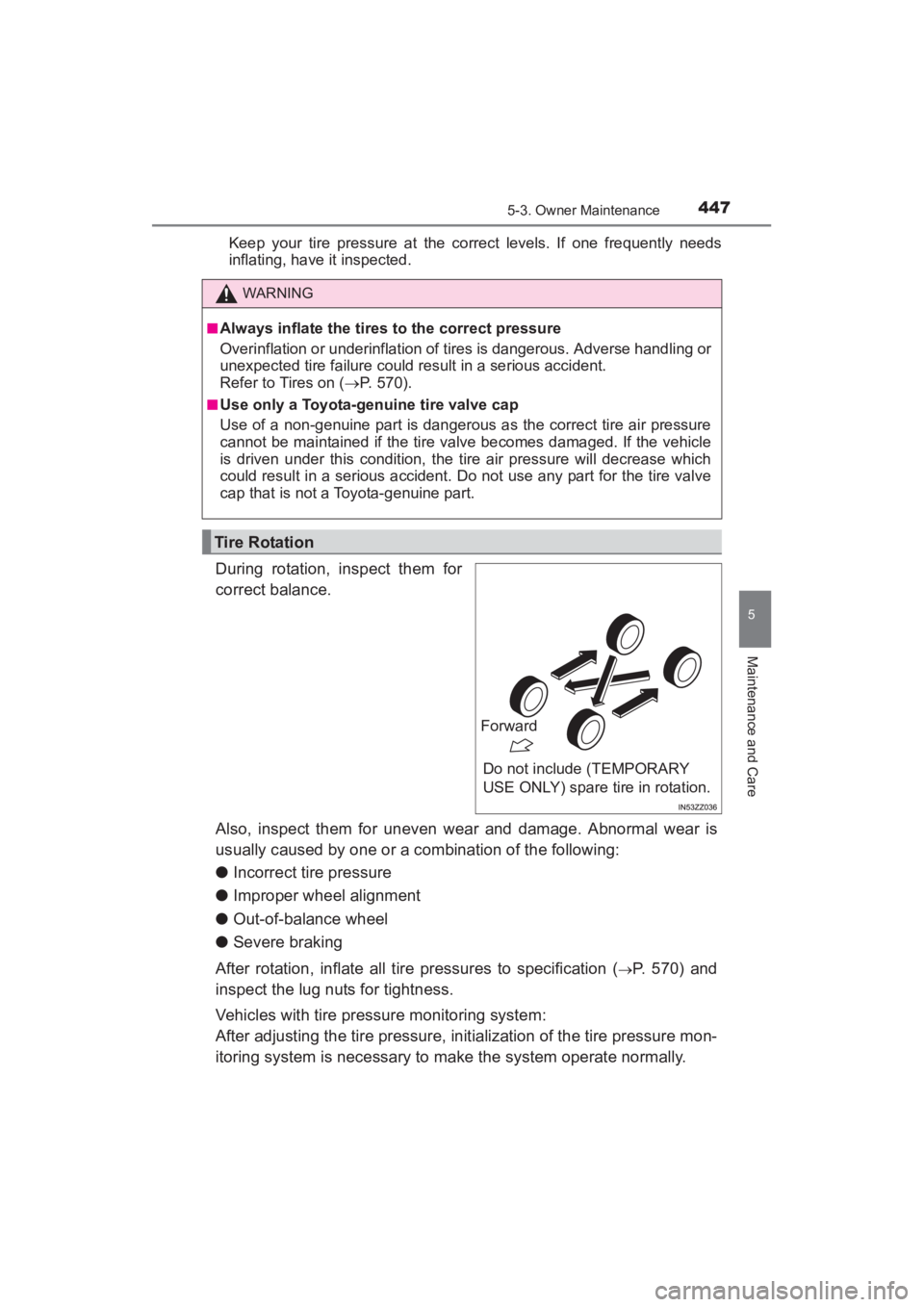
During rotation, inspect them for
correct balance.
Also, inspect them for uneven wear and damage. Abnormal wear is
usually caused by one or a combination of the following:
●Incorrect tire pressure
● Improper wheel alignment
● Out-of-balance wheel
● Severe braking
After rotation, inflate all tire pressures to specification (
→P. 570) and
inspect the lug nuts for tightness.
Vehicles with tire pressure monitoring system:
After adjusting the tire pressure, initialization of the tire pressure mon-
itoring system is necessary to make the system operate normally.
WARNING
■Always inflate the tires to the correct pressure
Overinflation or underinflation of tires is dangerous. Adverse handling or
unexpected tire failure could result in a serious accident.
Refer to Tires on ( →P. 570).
■Use only a Toyota-genuine tire valve cap
Use of a non-genuine part is dangerous as the correct tire air pressure
cannot be maintained if the tire valve becomes damaged. If the vehicle
is driven under this condition, the tire air pressure will decrease which
could result in a serious accident. Do not use any part for the tire valve
cap that is not a Toyota-genuine part.
Tire Rotation
Forward
Do not include (TEMPORARY
USE ONLY) spare tire in rotation.
YARIS_SEDAN_OM_OM99M18z_(U).book Page 447 Monday, June 1, 2015 9:22 PM
Page 450 of 592
4485-3. Owner Maintenance
YARIS_SEDAN_OM_OM99M18z_(U)
Refer to Tire Pressure Monitoring System Initialization on P. 221.
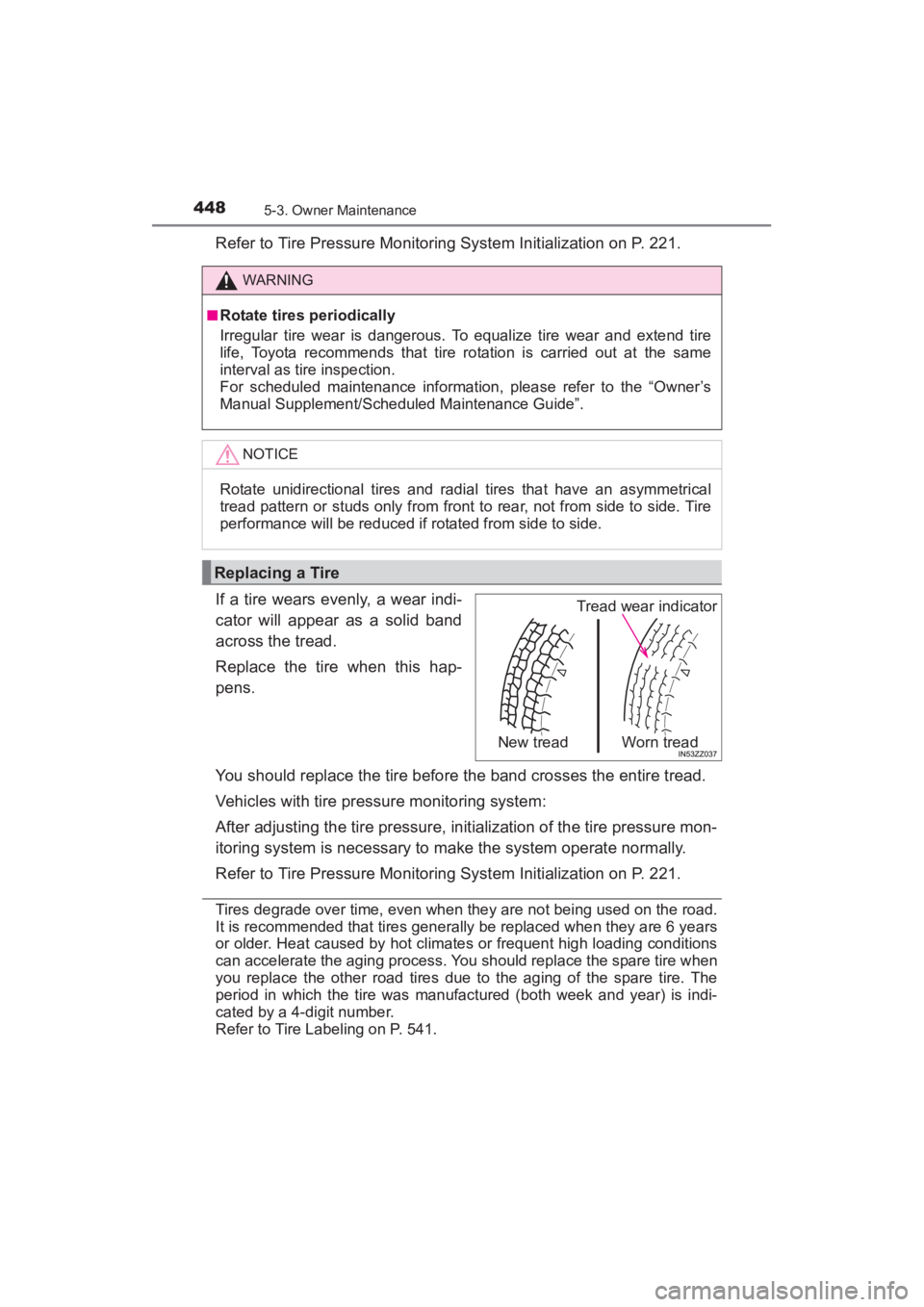
If a tire wears evenly, a wear indi-
cator will appear as a solid band
across the tread.
Replace the tire when this hap-
pens.
You should replace the tire before the band crosses the entire tread.
Vehicles with tire pressure monitoring system:
After adjusting the tire pressure, initialization of the tire pressure mon-
itoring system is necessary to make the system operate normally.
Refer to Tire Pressure Monitoring System Initialization on P. 221.
Tires degrade over time, even when they are not being used on the road.
It is recommended that tires generally be replaced when they are 6 years
or older. Heat caused by hot climates or frequent high loading conditions
can accelerate the aging process. You should replace the spare tire when
you replace the other road tires due to the aging of the spare tire. The
period in which the tire was manufactured (both week and year) is indi-
cated by a 4-digit number.
Refer to Tire Labeling on P. 541.
WARNING
■Rotate tires periodically
Irregular tire wear is dangerous. To equalize tire wear and extend tire
life, Toyota recommends that tire rotation is carried out at the same
interval as tire inspection.
For scheduled maintenance information, please refer to the “Owner’s
Manual Supplement/Scheduled Maintenance Guide”.
NOTICE
Rotate unidirectional tires and radial tires that have an asymmetrical
tread pattern or studs only from front to rear, not from side to side. Tire
performance will be reduced if rotated from side to side.
Replacing a Tire
Tread wear indicator
New tread Worn tread
YARIS_SEDAN_OM_OM99M18z_(U).book Page 448 Monday, June 1, 2015 9:22 PM
Page 451 of 592
YARIS_SEDAN_OM_OM99M18z_(U)
4495-3. Owner Maintenance
5
Maintenance and Care
Inspect the temporary spare tire at least monthly to make sure it is
properly inflated and stored.
The temporary spare tire is easier to handle because of its construc-
tion which is lighter and smaller than a conventional tire. This tire
should be used only for an emergency and only for a short distance.
Use the temporary spare tire only until the conventional tire is
repaired, which should be as soon as possible.
Refer to Tires on P. 570.
●The temporary spare tire condition gradually deteriorates even if it has
not been used.
●Tires degrade over time, even when they are not being used on the
road. It is recommended that tires generally be replaced when they are
6 years or older. Heat caused by hot climates or frequent high loading
conditions can accelerate the aging process. You should replace the
spare tire when you replace the other road tires due to the aging of the
spare tire. The period in which the tire was manufactured (both week
and year) is indicated by a 4-digit number.
Refer to Tire Labeling on P. 541.
WARNING
■Always use tires that are in good condition
Driving with worn tires is dangerous. Reduced braking, steering, and
traction could result in an accident.
■Replace all four tires at the same time
Replacing just one tire is dangerous. It could cause poor handling and
poor braking resulting in loss of vehicle control. Toyota strongly recom-
mends that you replace all four tires at the same time. If you replace
only two tires, the new tires should be installed on the rear of the vehi-
cle.
Temporary Spare Tire
YARIS_SEDAN_OM_OM99M18z_(U).book Page 449 Monday, June 1, 2015 9:22 PM
Page 452 of 592
4505-3. Owner Maintenance
YARIS_SEDAN_OM_OM99M18z_(U)
Proper tire balancing provides the best riding comfort and helps
reduce tread wear. Out-of-balance tires can cause vibration and
uneven wear, such as cupping and flat spots.
When replacing a wheel, make sure the new one is the same as the orig-
inal factory wheel in diameter, rim width, and offset (inset/outset).
NOTICE
●Do not use your temporary spare tire rim with a snow tire or a conven-
tional tire. Neither will properly fit and could damage both tire and rim.
●The temporary spare tire has a tread life of less than 3,000 miles
(5,000 km). The tread life may be shorter depending on driving condi-
tions.
●The temporary spare tire is for limited use, however, if the tread wear
solid- band indicator appears, replace the tire with the same type of
temporary spare (→P. 450).
Replacing a Wheel
WARNING
■Always use wheels of the correct size on your vehicle
Using a wrong-sized wheel is dangerous. Braking and handling could
be affected, leading to loss of control and an accident.
NOTICE
A wrong-sized wheel may adversely affect:
●Tire fit
●Wheel and bearing life
●Ground clearance
●Snow-chain clearance
●Speedometer calibration
●Headlight aim
●Bumper height
●Tire Pressure Monitoring System (if equipped)
YARIS_SEDAN_OM_OM99M18z_(U).book Page 450 Monday, June 1, 2015 9:22 PM
Page 461 of 592
YARIS_SEDAN_OM_OM99M18z_(U)
4595-3. Owner Maintenance
5
Maintenance and Care
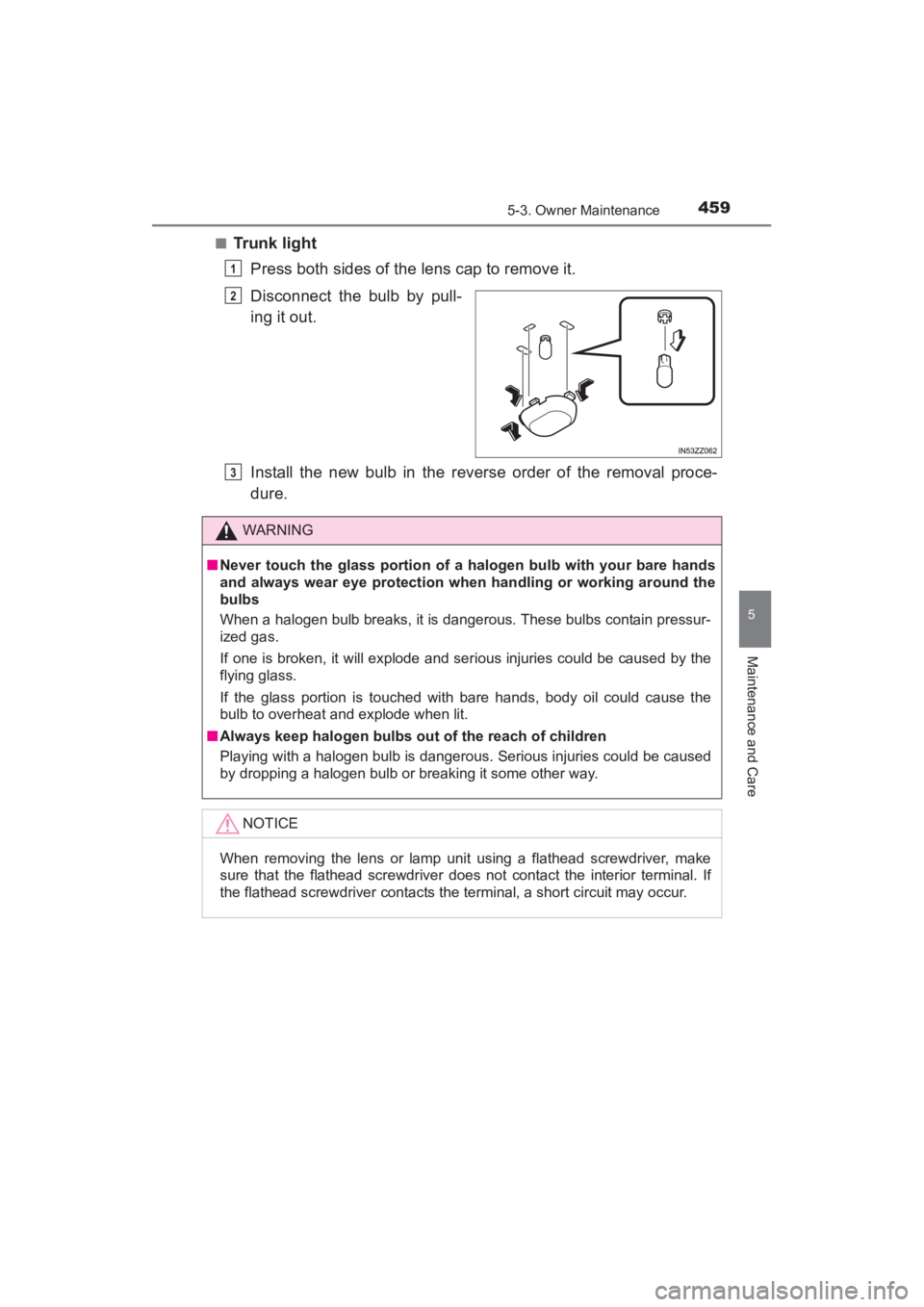
■Trunk lightPress both sides of the lens cap to remove it.
Disconnect the bulb by pull-
ing it out.
Install the new bulb in the reverse order of the removal proce-
dure.
1
2
WARNING
■Never touch the glass portion of a halogen bulb with your bare hands
and always wear eye protection when handling or working around the
bulbs
When a halogen bulb breaks, it is dangerous. These bulbs contain pressur-
ized gas.
If one is broken, it will explode and serious injuries could be caused by the
flying glass.
If the glass portion is touched with bare hands, body oil could cause the
bulb to overheat and explode when lit.
■ Always keep halogen bulbs out of the reach of children
Playing with a halogen bulb is dangerous. Serious injuries could be caused
by dropping a halogen bulb or breaking it some other way.
NOTICE
When removing the lens or lamp unit using a flathead screwdriver, make
sure that the flathead screwdriver does not contact the interior terminal. If
the flathead screwdriver contacts the terminal, a short circuit may occur.
3
YARIS_SEDAN_OM_OM99M18z_(U).book Page 459 Monday, June 1, 2015 9:22 PM
Page 464 of 592
4625-3. Owner Maintenance
YARIS_SEDAN_OM_OM99M18z_(U)
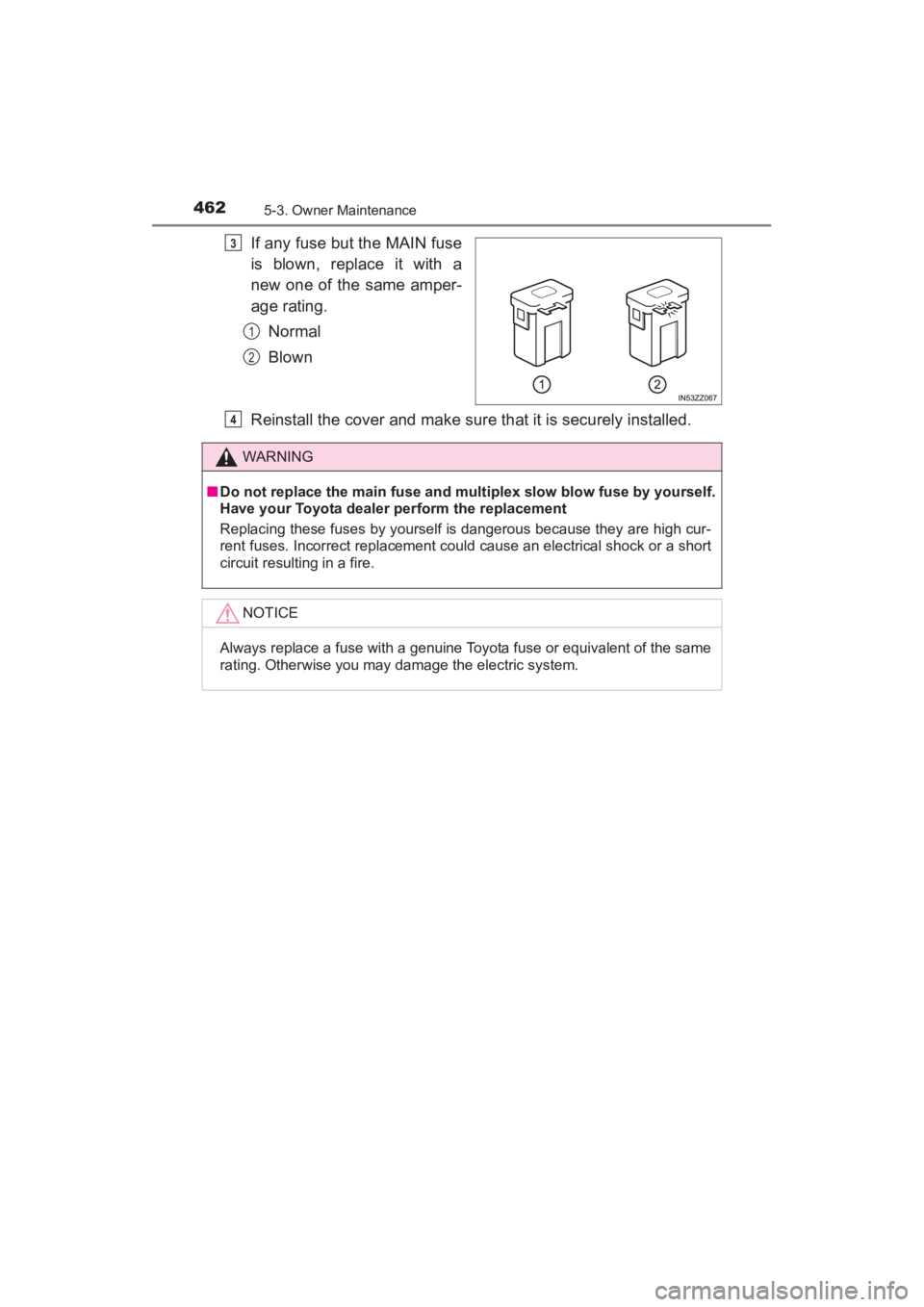
If any fuse but the MAIN fuse
is blown, replace it with a
new one of the same amper-
age rating.Normal
Blown
Reinstall the cover and make sure that it is securely installed.3
1
2
WARNING
■ Do not replace the main fuse and multiplex slow blow fuse by yourself.
Have your Toyota dealer perform the replacement
Replacing these fuses by yourself is dangerous because they are high cur-
rent fuses. Incorrect replacement coul d cause an electrical shock or a short
circuit resulting in a fire.
NOTICE
Always replace a fuse with a genuine Toyota fuse or equivalent of the same
rating. Otherwise you may damage the electric system.
4
YARIS_SEDAN_OM_OM99M18z_(U).book Page 462 Monday, June 1, 2015 9:22 PM