tire TOYOTA YARIS 2016 Manual Online
[x] Cancel search | Manufacturer: TOYOTA, Model Year: 2016, Model line: YARIS, Model: TOYOTA YARIS 2016Pages: 592, PDF Size: 10.44 MB
Page 554 of 592

552
YARIS_SEDAN_OM_OM99M18z_(U)
7-7. Tire Information (U.S.A.)
NOTICE
If you feel a sudden vibration or ride disturbance while driving or you
suspect your tire or vehicle has been damaged, immediately reduce
your speed. Drive with caution until you can safely pull off the road. Stop
and inspect the tire for damage. If the tire is under-inflated or damaged,
deflate it, remove the tire and rim and replace it with your spare tire. If
you cannot detect a cause, have the vehicle towed to the nearest vehi-
cle or tire dealer to have the vehicle inspected.
YARIS_SEDAN_OM_OM99M18z_(U).book Page 552 Monday, June 1, 2015 9:22 PM
Page 555 of 592
553
YARIS_SEDAN_OM_OM99M18z_(U)
7-7. Tire Information (U.S.A.)
7
Customer Information and Reporting Safety Defects
Vehicle Loading
This section will guide you in the proper loading of your vehicle, to
keep your loaded vehicle weight within its design rating capability.
Properly loading your vehicle will provide maximum return of vehicle
design performance. Before loading your vehicle, familiarize yourself
with the following terms for determining your vehicle’s weight ratings,
from the vehicle’s Safety Certification Label and Tire and Load Infor-
mation Label:
Base Curb Weight is the weight of the vehicle including a full tank of
fuel and all standard equipment. It does not include passengers,
cargo, or optional equipment.
Vehicle Curb Weight is the weight of your new vehicle when you
picked it up from your dealer plus any aftermarket equipment.
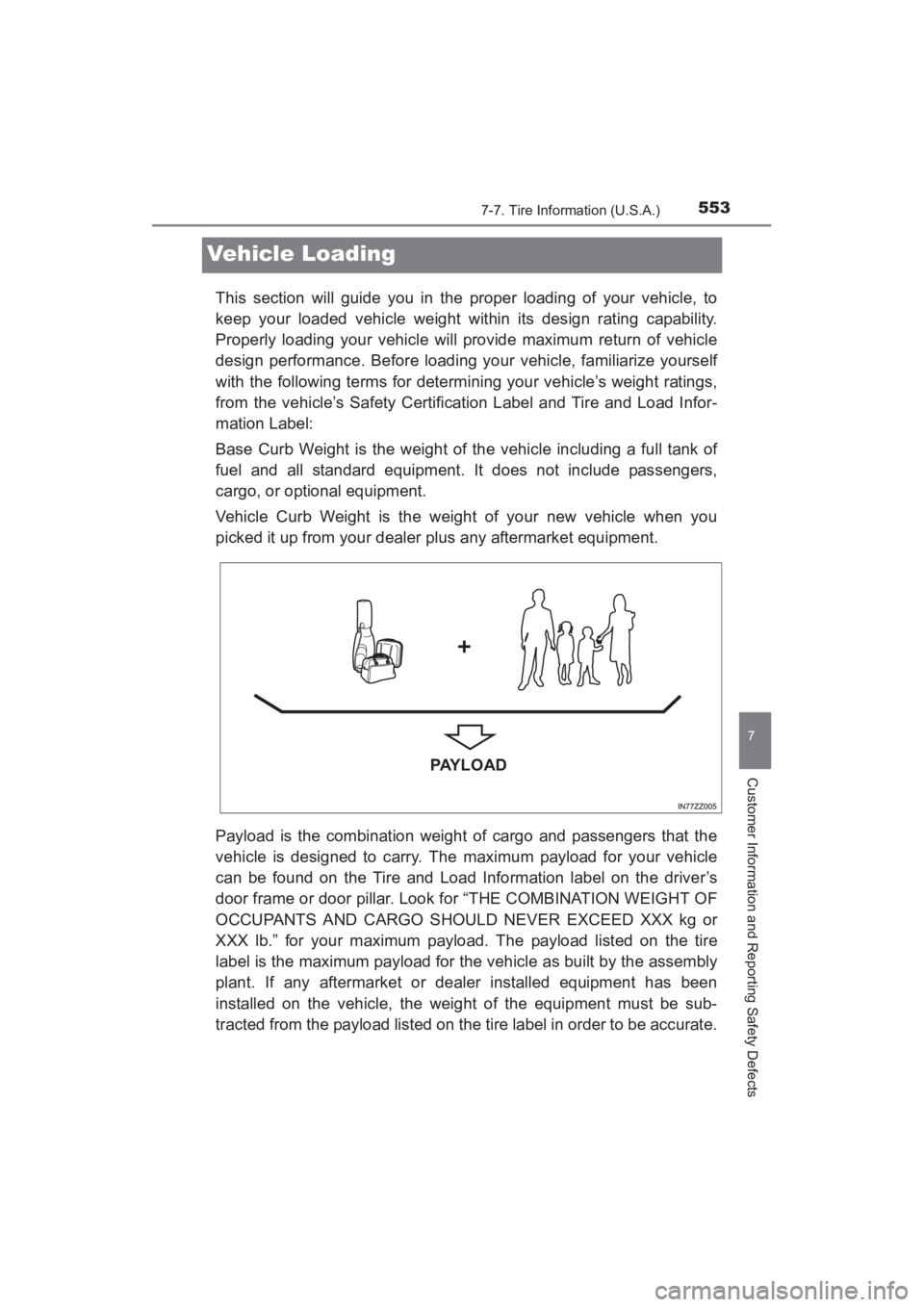
Payload is the combination weight of cargo and passengers that the
vehicle is designed to carry. The maximum payload for your vehicle
can be found on the Tire and Load Information label on the driver’s
door frame or door pillar. Look for “THE COMBINATION WEIGHT OF
OCCUPANTS AND CARGO SHOULD NEVER EXCEED XXX kg or
XXX lb.” for your maximum payload. The payload listed on the tire
label is the maximum payload for the vehicle as built by the assembly
plant. If any aftermarket or dealer installed equipment has been
installed on the vehicle, the weight of the equipment must be sub-
tracted from the payload listed on the tire label in order to be accurate.
PAY L O A D
YARIS_SEDAN_OM_OM99M18z_(U).book Page 553 Monday, June 1, 2015 9:22 PM
Page 556 of 592
554
YARIS_SEDAN_OM_OM99M18z_(U)
7-7. Tire Information (U.S.A.)
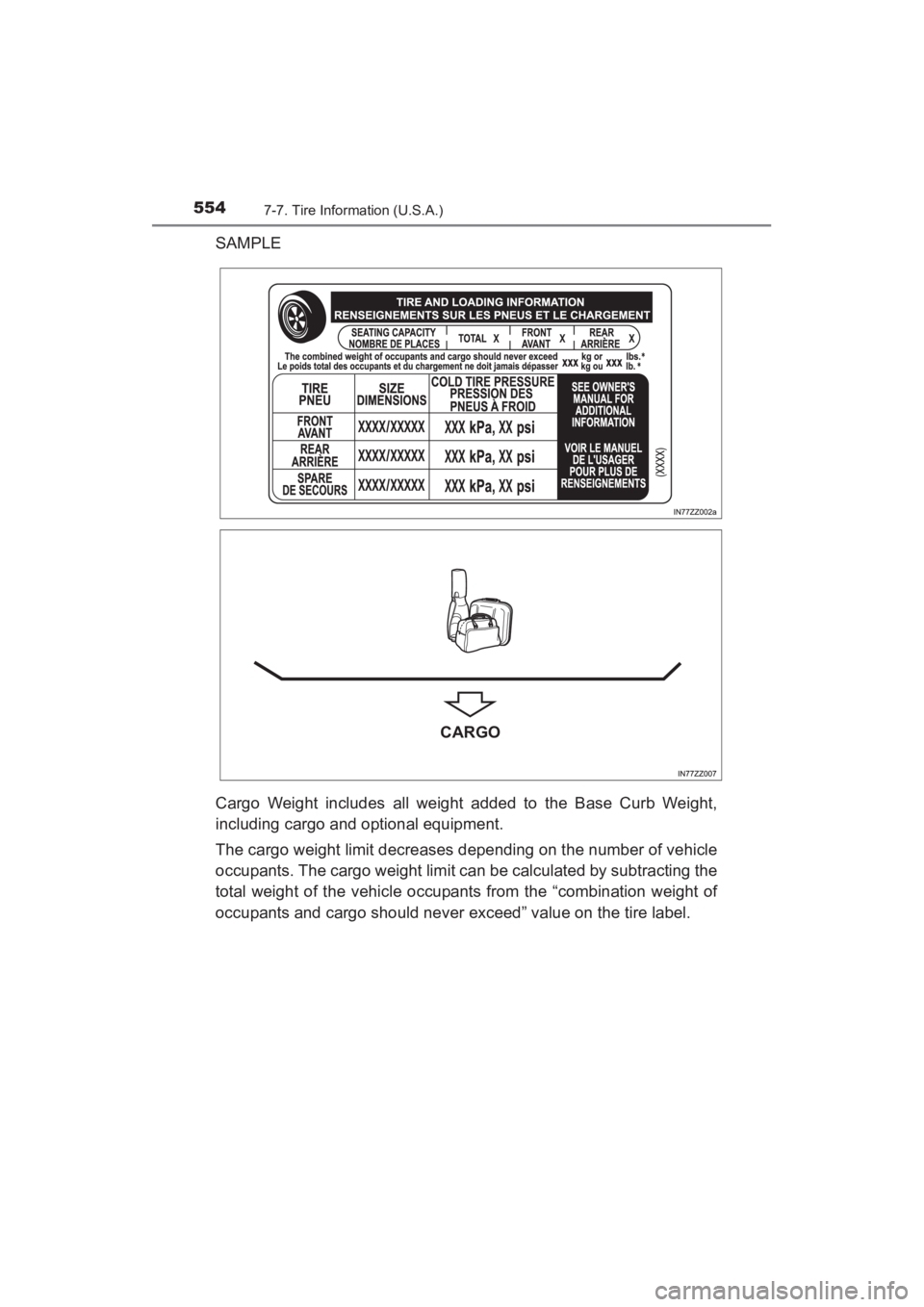
SAMPLE
Cargo Weight includes all weight added to the Base Curb Weight,
including cargo and optional equipment.
The cargo weight limit decreases depending on the number of vehicle
occupants. The cargo weight limit can be calculated by subtracting the
total weight of the vehicle occupants from the “combination weight of
occupants and cargo should never exceed” value on the tire label.
CARGO
YARIS_SEDAN_OM_OM99M18z_(U).book Page 554 Monday, June 1, 2015 9:22 PM
Page 557 of 592
YARIS_SEDAN_OM_OM99M18z_(U)
5557-7. Tire Information (U.S.A.)
7
Customer Information and Reporting Safety Defects
Examples: Based on a single occupant weight of 150 lb. (68 kg), and
a value of 849 lb. (385 kg) for the “combination weight of occupants
and cargo should never exceed”:
The cargo weight limit with one occupant is 849 lb. (385 kg) - 150 lb.
(68 kg) = 699 lb. (317 kg)
The cargo weight limit with two occupants is 849 lb. (385 kg) - (150 x
2) lb. ((68 x 2) kg) = 549 lb. (249 kg)
If the weight of the occupant increases, the cargo weight limit
decreases by that much.
GAW (Gross Axle Weight) is the total weight placed on each axle
(front and rear) - including vehicle curb weight and all payload.
GAWR (Gross Axle Weight Rating) is the maximum allowable weight
that can be carried by a single axle (front or rear). These numbers are
shown on the Safety Compliance Certification Label located on the
driver’s door frame or door pillar. The total load on each axle must
never exceed its GAWR.
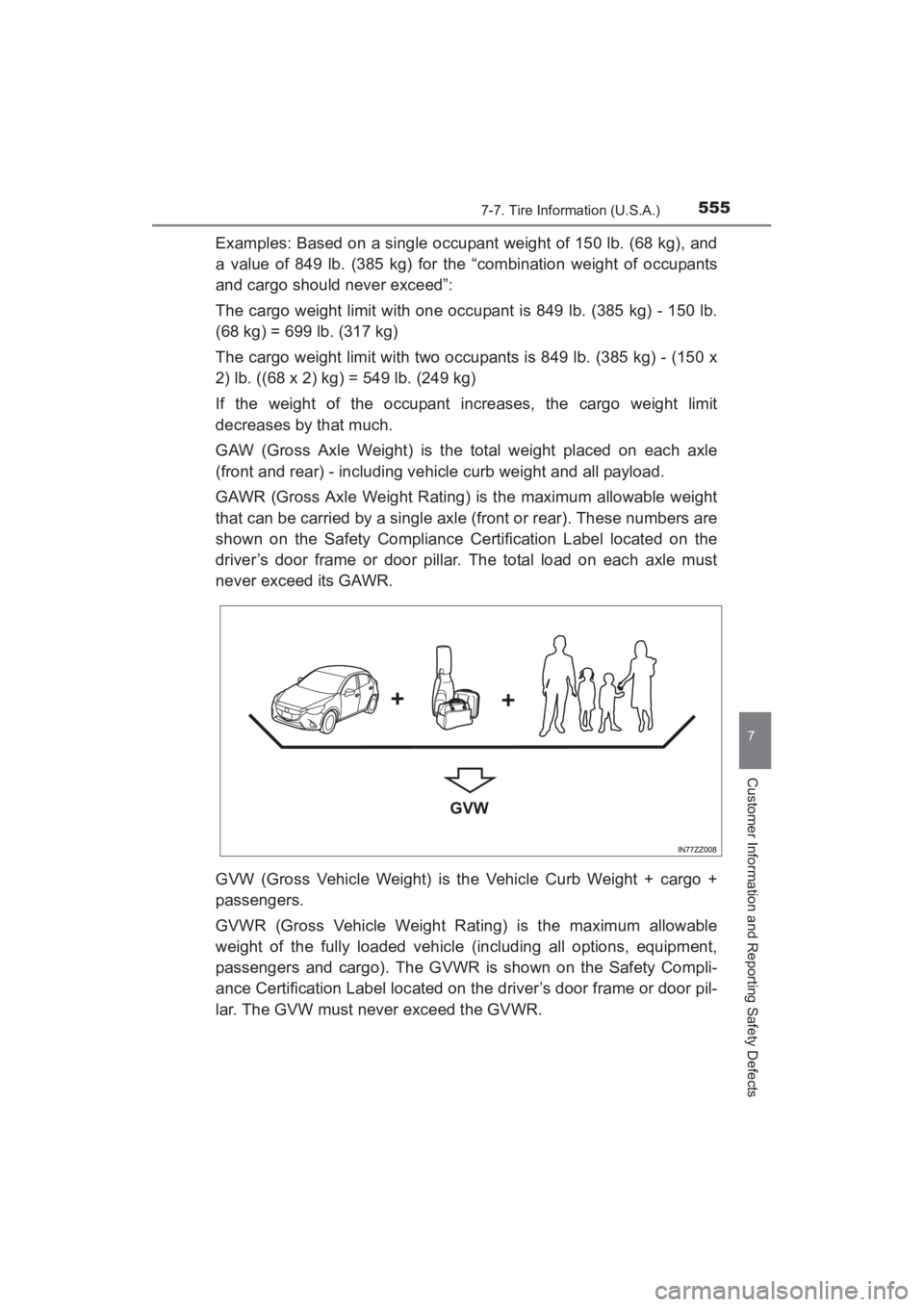
GVW (Gross Vehicle Weight) is the Vehicle Curb Weight + cargo +
passengers.
GVWR (Gross Vehicle Weight Rating) is the maximum allowable
weight of the fully loaded vehicle (including all options, equipment,
passengers and cargo). The GVWR is shown on the Safety Compli-
ance Certification Label located on the driver’s door frame or door pil-
lar. The GVW must never exceed the GVWR.
GVW
YARIS_SEDAN_OM_OM99M18z_(U).book Page 555 Monday, June 1, 2015 9:22 PM
Page 558 of 592
556
YARIS_SEDAN_OM_OM99M18z_(U)
7-7. Tire Information (U.S.A.)
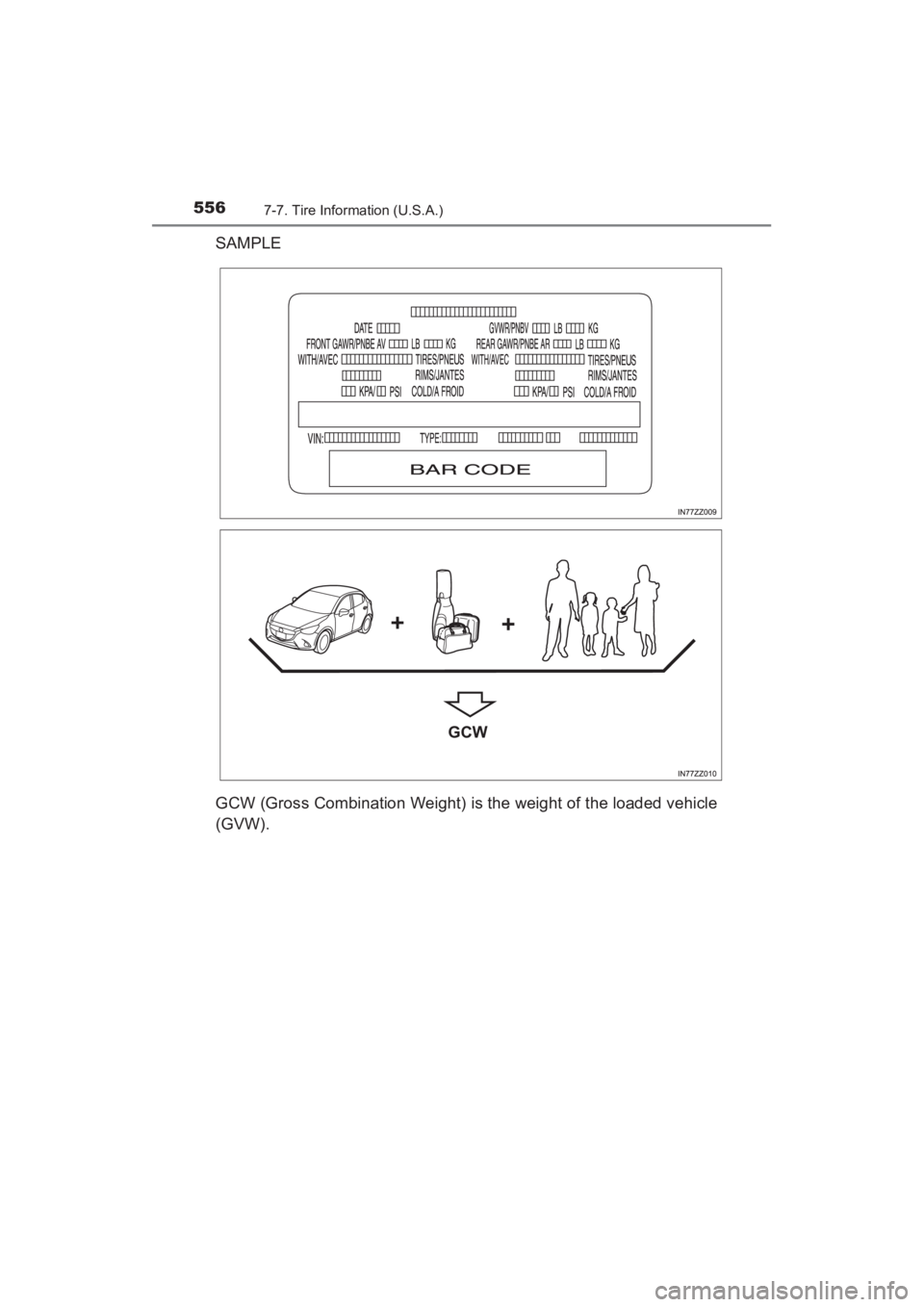
SAMPLE
GCW (Gross Combination Weight) is the weight of the loaded vehicle
(GVW).
GCW
YARIS_SEDAN_OM_OM99M18z_(U).book Page 556 Monday, June 1, 2015 9:22 PM
Page 559 of 592
YARIS_SEDAN_OM_OM99M18z_(U)
5577-7. Tire Information (U.S.A.)
7
Customer Information and Reporting Safety Defects
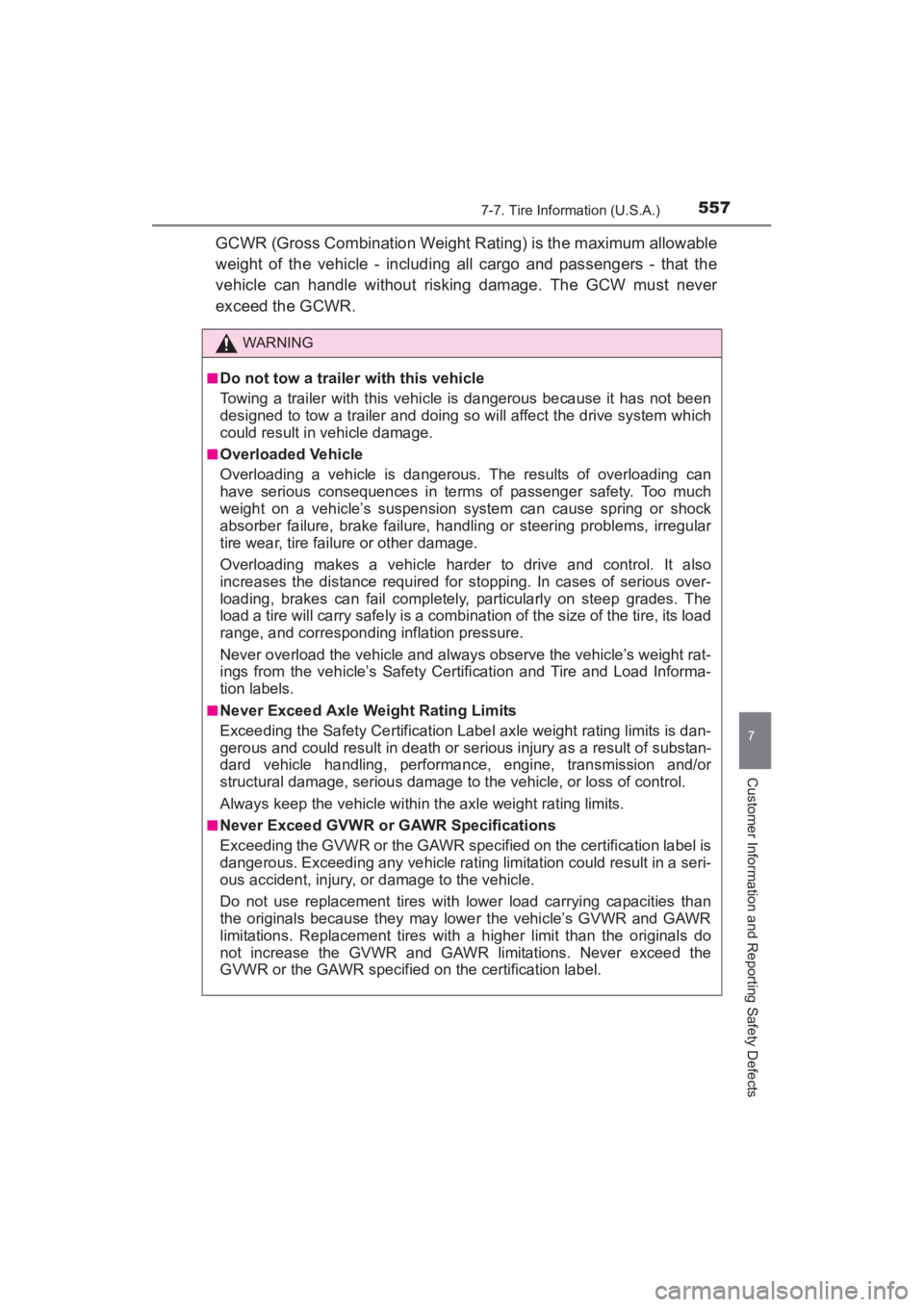
GCWR (Gross Combination Weight Rating) is the maximum allowable
weight of the vehicle - including all cargo and passengers - that the
vehicle can handle without risking damage. The GCW must never
exceed the GCWR.
WARNING
■Do not tow a trailer with this vehicle
Towing a trailer with this vehicle is dangerous because it has not been
designed to tow a trailer and doing so will affect the drive system which
could result in vehicle damage.
■Overloaded Vehicle
Overloading a vehicle is dangerous. The results of overloading can
have serious consequences in terms of passenger safety. Too much
weight on a vehicle’s suspension system can cause spring or shock
absorber failure, brake failure, handling or steering problems, irregular
tire wear, tire failure or other damage.
Overloading makes a vehicle harder to drive and control. It also
increases the distance required for stopping. In cases of serious over-
loading, brakes can fail completely, particularly on steep grades. The
load a tire will carry safely is a combination of the size of the tire, its load
range, and corresponding inflation pressure.
Never overload the vehicle and always observe the vehicle’s weight rat-
ings from the vehicle’s Safety Certification and Tire and Load Informa-
tion labels.
■Never Exceed Axle Weight Rating Limits
Exceeding the Safety Certification Label axle weight rating limits is dan-
gerous and could result in death or serious injury as a result of substan-
dard vehicle handling, performance, engine, transmission and/or
structural damage, serious damage to the vehicle, or loss of control.
Always keep the vehicle within the axle weight rating limits.
■Never Exceed GVWR or GAWR Specifications
Exceeding the GVWR or the GAWR specified on the certification label is
dangerous. Exceeding any vehicle rating limitation could result in a seri-
ous accident, injury, or damage to the vehicle.
Do not use replacement tires with lower load carrying capacities than
the originals because they may lower the vehicle’s GVWR and GAWR
limitations. Replacement tires with a higher limit than the originals do
not increase the GVWR and GAWR limitations. Never exceed the
GVWR or the GAWR specified on the certification label.
YARIS_SEDAN_OM_OM99M18z_(U).book Page 557 Monday, June 1, 2015 9:22 PM
Page 560 of 592
558
YARIS_SEDAN_OM_OM99M18z_(U)
7-7. Tire Information (U.S.A.)
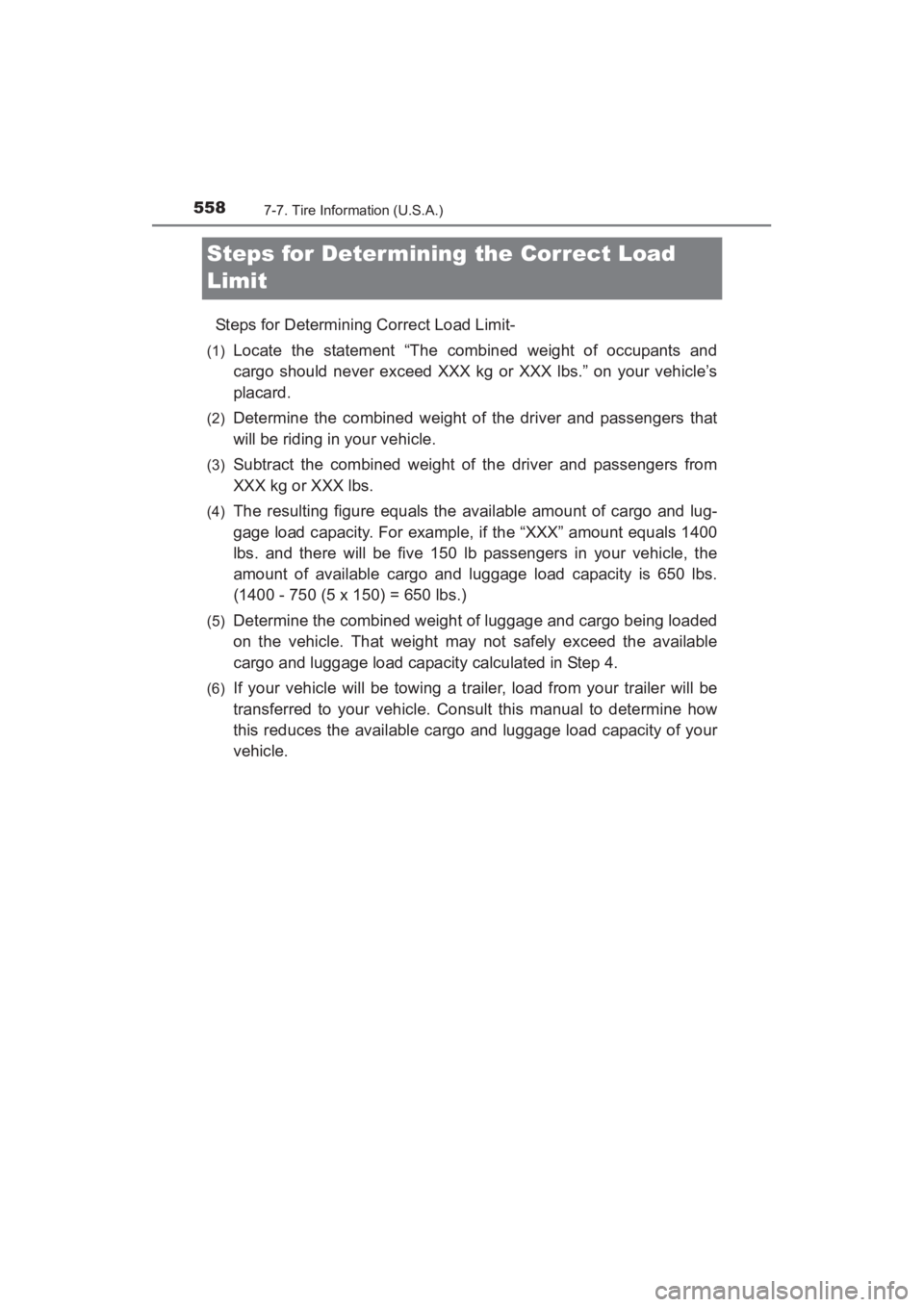
Steps for Determining the Correct Load
Limit
Steps for Determining Correct Load Limit-
(1)Locate the statement “The combined weight of occupants and
cargo should never exceed XXX kg or XXX lbs.” on your vehicle’s
placard.
(2)Determine the combined weight of the driver and passengers that
will be riding in your vehicle.
(3)Subtract the combined weight of the driver and passengers from
XXX kg or XXX lbs.
(4)The resulting figure equals the available amount of cargo and lug-
gage load capacity. For example, if the “XXX” amount equals 1400
lbs. and there will be five 150 lb passengers in your vehicle, the
amount of available cargo and luggage load capacity is 650 lbs.
(1400 - 750 (5 x 150) = 650 lbs.)
(5)Determine the combined weight of luggage and cargo being loaded
on the vehicle. That weight may not safely exceed the available
cargo and luggage load capacity calculated in Step 4.
(6)If your vehicle will be towing a trailer, load from your trailer will be
transferred to your vehicle. Consult this manual to determine how
this reduces the available cargo and luggage load capacity of your
vehicle.
YARIS_SEDAN_OM_OM99M18z_(U).book Page 558 Monday, June 1, 2015 9:22 PM
Page 567 of 592
5658-1. Identification Numbers
YARIS_SEDAN_OM_OM99M18z_(U)
8
Specifications
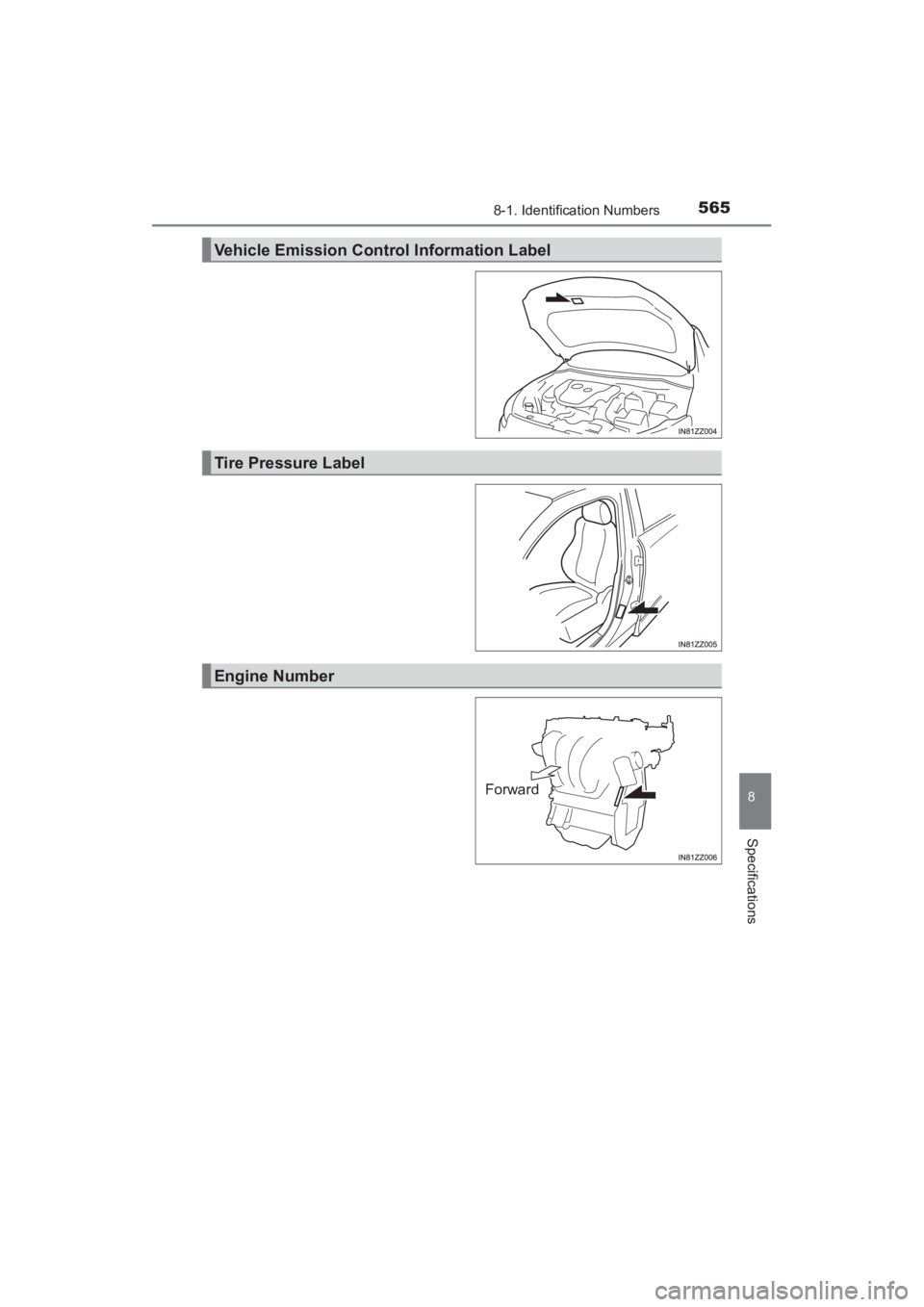
Vehicle Emission Control Information Label
Tire Pressure Label
Engine Number
Forward
YARIS_SEDAN_OM_OM99M18z_(U).book Page 565 Monday, June 1, 2015 9:22 PM
Page 572 of 592
5708-2. Specifications
YARIS_SEDAN_OM_OM99M18z_(U)
XFor Interior light
*1 UNECE stands for United Nations Economic Commission for Europe.
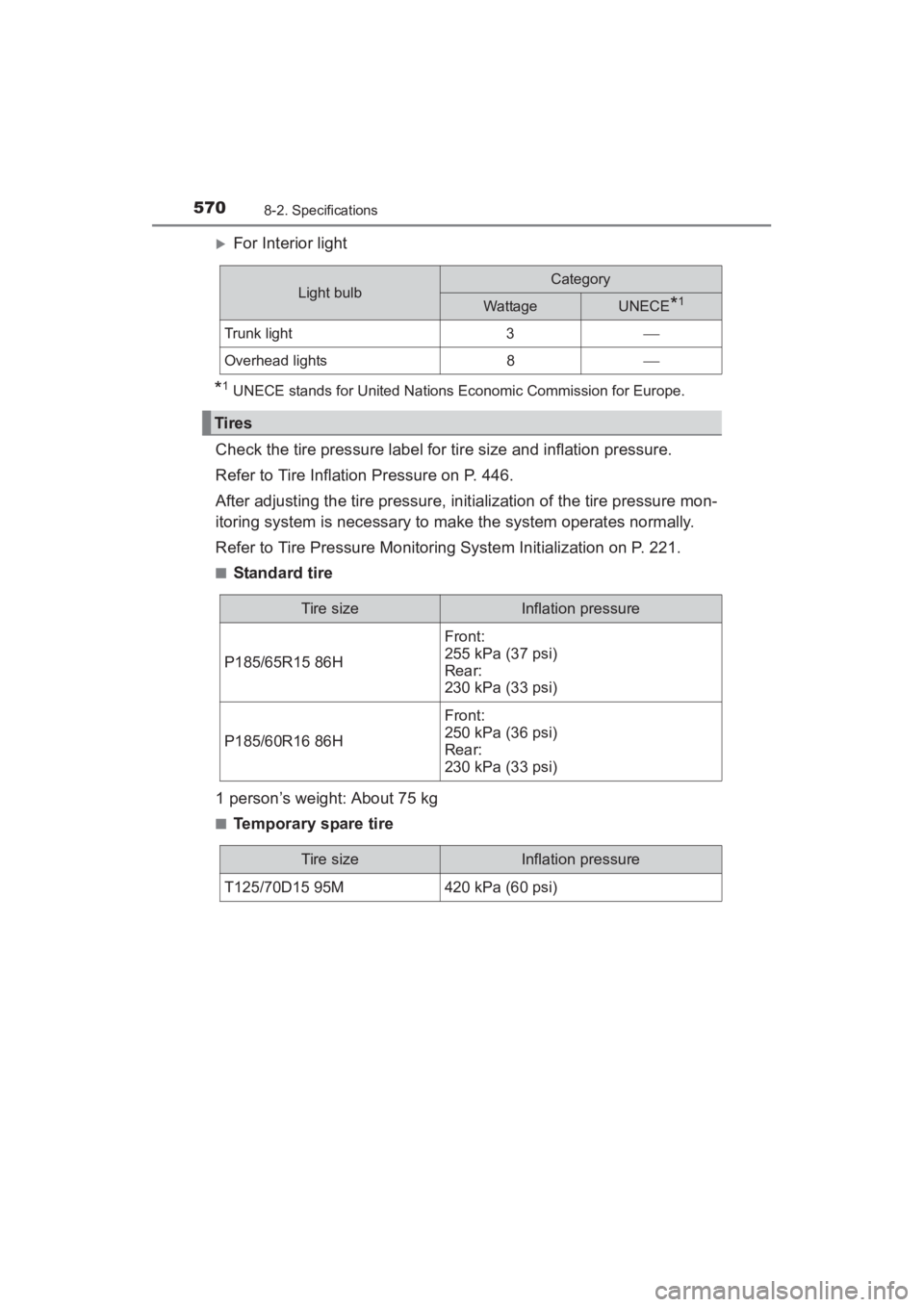
Check the tire pressure label for tire size and inflation pressure.
Refer to Tire Inflation Pressure on P. 446.
After adjusting the tire pressure, initialization of the tire pressure mon-
itoring system is necessary to make the system operates normally.
Refer to Tire Pressure Monitoring System Initialization on P. 221.
■Standard tire
1 person’s weight: About 75 kg
■Temporary spare tire
Light bulbCategory
WattageUNECE*1
Trunk light 3
Overhead lights8
Tires
Tire sizeInflation pressure
P185/65R15 86H
Front:
255 kPa (37 psi)
Rear:
230 kPa (33 psi)
P185/60R16 86H
Front:
250 kPa (36 psi)
Rear:
230 kPa (33 psi)
Tire sizeInflation pressure
T125/70D15 95M420 kPa (60 psi)
YARIS_SEDAN_OM_OM99M18z_(U).book Page 570 Monday, June 1, 2015 9:22 PM
Page 573 of 592
5718-2. Specifications
YARIS_SEDAN_OM_OM99M18z_(U)
8
Specifications
■Lug nut tightening torque
When installing a tire, tighten the lug nut to the following torque.
80-108 ft
•lbf (108-147 N•m, 12-14 kgf•m)
The tires have been optimally matched with the chassis of your vehicle.
When replacing tires, Toyota recommends that you replace tires of the
same type originally fitted to your vehicle. For details, contact your Toyota
dealer.
Refer to Fuses on P. 460.
Fuses
YARIS_SEDAN_OM_OM99M18z_(U).book Page 571 Monday, June 1, 2015 9:22 PM