spare wheel TOYOTA YARIS 2016 Owners Manual
[x] Cancel search | Manufacturer: TOYOTA, Model Year: 2016, Model line: YARIS, Model: TOYOTA YARIS 2016Pages: 592, PDF Size: 10.44 MB
Page 135 of 592
YARIS_SEDAN_OM_OM99M18z_(U)
1332-8. Driving Tips
2
Before Driving
WARNING
■Driving with tire chains
●Chains may affect handling.
● Do not go faster than 30 mph (50 km/h) or the chain manufacturer’s rec-
ommended limit, whichever is lower.
● Drive carefully and avoid bumps, holes, and sharp turns.
● Avoid locked-wheel braking.
NOTICE
● Do not use chains on a temporary spare tire; it may result in damage to the
vehicle and to the tire.
● Do not use chains on roads that are free of snow or ice. The tires and
chains could be damaged.
● Chains may scratch or chip aluminum wheels.
YARIS_SEDAN_OM_OM99M18z_(U).book Page 133 Monday, June 1, 2015 9:22 PM
Page 198 of 592
196
YARIS_SEDAN_OM_OM99M18z_(U)
3-6. ABS/TCS/DSC
Dynamic Stability Control (DSC)
DSC operation is possible at speeds greater than 12 mph (20 km/h).
The warning light turns on when the system has a malfunction.
Refer to Warning Lights on P. 157.
The Dynamic Stability Control (DSC) automatically controls
braking and engine torque in conjunction with systems such as
ABS and TCS to help control side slip when driving on slippery
surfaces, or during sudden or evasive maneuvering, enhancing
vehicle safety.
Refer to ABS (→P. 193) and TCS ( →P. 194).
WARNING
■Do not rely on the Dynamic Stability Control as a substitute for safe
driving
The Dynamic Stability Control (DSC) cannot compensate for unsafe and
reckless driving, excessive speed, tailgating (following another vehicle too
closely), and hydroplaning (reduced tire friction and road contact because
of water on the road surface). You can still have an accident.
NOTICE
●The DSC may not operate correctly unless the following are observed:
• Use tires of the correct size specified for your Toyota on all four wheels.
• Use tires of the same manufacturer, brand and tread pattern on all four
wheels.
• Do not mix worn tires.
● The DSC may not operate correctly when tire chains are used or a tempo-
rary spare tire is installed because the tire diameter changes.
YARIS_SEDAN_OM_OM99M18z_(U).book Page 196 Monday, June 1, 2015 9:22 PM
Page 210 of 592
208
YARIS_SEDAN_OM_OM99M18z_(U)
3-10. Active Safety System
WARNING
■Do not rely on the Smart City Brake Support System (SCBS) as a sub-
stitute for safer driving
The Smart City Brake Support (SCBS) system cannot compensate for
unsafe and reckless driving, excessive speed, tailgating (following another
vehicle too closely), and driving on slippery roads such as wet, snowy, and
icy roads (reduced tire friction and road contact because of water on the
road surface). You can still have an accident.
■ Do not rely completely on the Smart City Brake Support (SCBS) system
●The Smart City Brake Support (SCBS) system is only designed to reduce
damage in the event of a collision. Over reliance on the system leading to
the accelerator pedal or brake pedal being mistakenly operated could
result in an accident.
● The Smart City Brake Support (SCBS) is a system which operates in
response to a vehicle ahead. The system may not be able to detect or
react to two-wheeled vehicles or pedestrians.
● The laser sensor for the Smart Ci ty Brake Support (SCBS) system is
installed near the rearview mirror. To assure the correct operation of the
Smart City Brake Support (SCBS), heed the following cautions.
• Do not apply stickers to the surface of the windshield near the laser sensor (including transparent stickers). Otherwise, the laser sensor
may not be able to detect vehicles ahead which could result in an acci-
dent.
• Do not apply coating agent to the windshield. Otherwise, the laser sen- sor may not be able to detect vehicles or obstructions in front which
could result in an accident.
• Do not disassemble the laser sensor.
• If cracks or damage caused by flying gravel or debris is visible near the laser sensor, stop using the Smart City Brake Support (SCBS)
system immediately and have your vehicle inspected by your Toyota
dealer. If the vehicle continues to be driven with cracks or scratch
marks left on the windshield near the laser sensor, the system may
operate unnecessarily and cause an unexpected accident.
Refer to Stopping The Smart City Brake Support (SCBS) System
Operation on P. 210.
• When replacing the windshield wipers or windshield, consult your Toyota dealer.
● The laser sensor includes a functi on for detecting a soiled windshield and
informing the driver, however, depending on the conditions, it may not
detect plastic shopping bags, ice or snow on the windshield. In such
cases, the system cannot accurately determine a vehicle ahead and may
not be able to operate normally. Always drive carefully and pay attention to
the road ahead.
YARIS_SEDAN_OM_OM99M18z_(U).book Page 208 Monday, June 1, 2015 9:22 PM
Page 222 of 592
220
YARIS_SEDAN_OM_OM99M18z_(U)
3-12. Tire Pressure Monitoring System
NOTICE
●Each tire, including the spare (if provided), should be checked monthly
when cold and inflated to the inflation pressure recommended by the
vehicle manufacturer on the vehicle placard or tire inflation pressure
label. (If your vehicle has tires of a different size than the size indicated
on the vehicle placard or tire inflation pressure label, you should deter-
mine the proper tire inflation pressure for those tires.)
As an added safety feature, your vehicle has been equipped with a tire
pressure monitoring system (TPMS) that illuminates a low tire pres-
sure telltale when one or more of your tires is significantly under-
inflated. Accordingly, when the low tire pressure telltale illuminates,
you should stop and check your tires as soon as possible, and inflate
them to the proper pressure. Driving on a significantly under-inflated
tire causes the tire to overheat and can lead to tire failure. Under-infla-
tion also reduces fuel efficiency and tire tread life, and may affect the
vehicle’s handling and stopping ability.
Please note that the TPMS is not a substitute for proper tire mainte-
nance, and it is the driver’s responsibility to maintain correct tire pres-
sure, even if under-inflation has not reached the level to trigger
illumination of the TPMS low tire pressure telltale.
Your vehicle has also been equipped with a TPMS malfunction indica-
tor to indicate when the system is not operating properly.
The TPMS malfunction indicator is combined with the low tire pressure
telltale. When the system detects a malfunction, the telltale will flash
for approximately one minute and then remain continuously illumi-
nated. This sequence will continue upon subsequent vehicle start-ups
as long as the malfunction exists. When the malfunction indicator is
illuminated, the system may not be able to detect or signal low tire
pressure as intended. TPMS malfunctions may occur for a variety of
reasons, including the installation of replacement or alternate tires or
wheels on the vehicle that prevent the TPMS from functioning properly.
Always check the TPMS malfunction telltale after replacing one or
more tires or wheels on your vehicle to ensure that the replacement or
alternate tires and wheels allow the TPMS to continue to function prop-
erly.
●To avoid false readings, the system samples for a little while before
indicating a problem. As a result it will not instantaneously register a
rapid tire deflation or blow out.
YARIS_SEDAN_OM_OM99M18z_(U).book Page 220 Monday, June 1, 2015 9:22 PM
Page 448 of 592
446
YARIS_SEDAN_OM_OM99M18z_(U)
5-3. Owner Maintenance
Tires
Inspect all tire pressures monthly (including the spare) when the tires
are cold. Maintain recommended pressures for the best ride, han-
dling, and minimum tire wear.
Refer to the specification charts
(→P. 5 7 0).
Vehicles with tire pressure monitoring system:
After adjusting the tire pressure, initialization of the tire pressure mon-
itoring system is necessary to make the system operate normally.
Refer to Tire Pressure Monitoring System Initialization on P. 221.
●Always check tire pressure when tires are cold.
●Warm tires normally exceed recommended pressures. Do not release
air from warm tires to adjust the pressure.
●Underinflation can cause reduced fuel economy, uneven and acceler-
ated tire wear, and poor sealing of the tire bead, which will deform the
wheel and cause separation of tire from rim.
●Overinflation can produce a harsh ride, uneven and accelerated tire
wear, and a greater possibility of damage from road hazards.
For reasons of proper performance, safety, and better fuel econ-
omy, always maintain recommended tire inflation pressures and
stay within the recommended load limits and weight distribu-
tion.
WARNING
■Using Different Tire Types
Driving your vehicle with different types of tires is dangerous. It could
cause poor handling and poor braking; leading to loss of control.
Except for the limited use of the temporary spare tire, use only the same
type tires (radial, bias-belted, bias-type) on all four wheels.
■Using Wrong-Sized Tires
Using any other tire size than what is specified for the vehicle ( →P. 570)
is dangerous. It could seriously affect ride, handling, ground clearance,
tire clearance, and speedometer calibration. This could cause you to
have an accident. Use only tires that are the correct size specified for
the vehicle.
Tire Inflation Pressure
YARIS_SEDAN_OM_OM99M18z_(U).book Page 446 Monday, June 1, 2015 9:22 PM
Page 449 of 592
YARIS_SEDAN_OM_OM99M18z_(U)
4475-3. Owner Maintenance
5
Maintenance and Care
Keep your tire pressure at the correct levels. If one frequently needs
inflating, have it inspected.
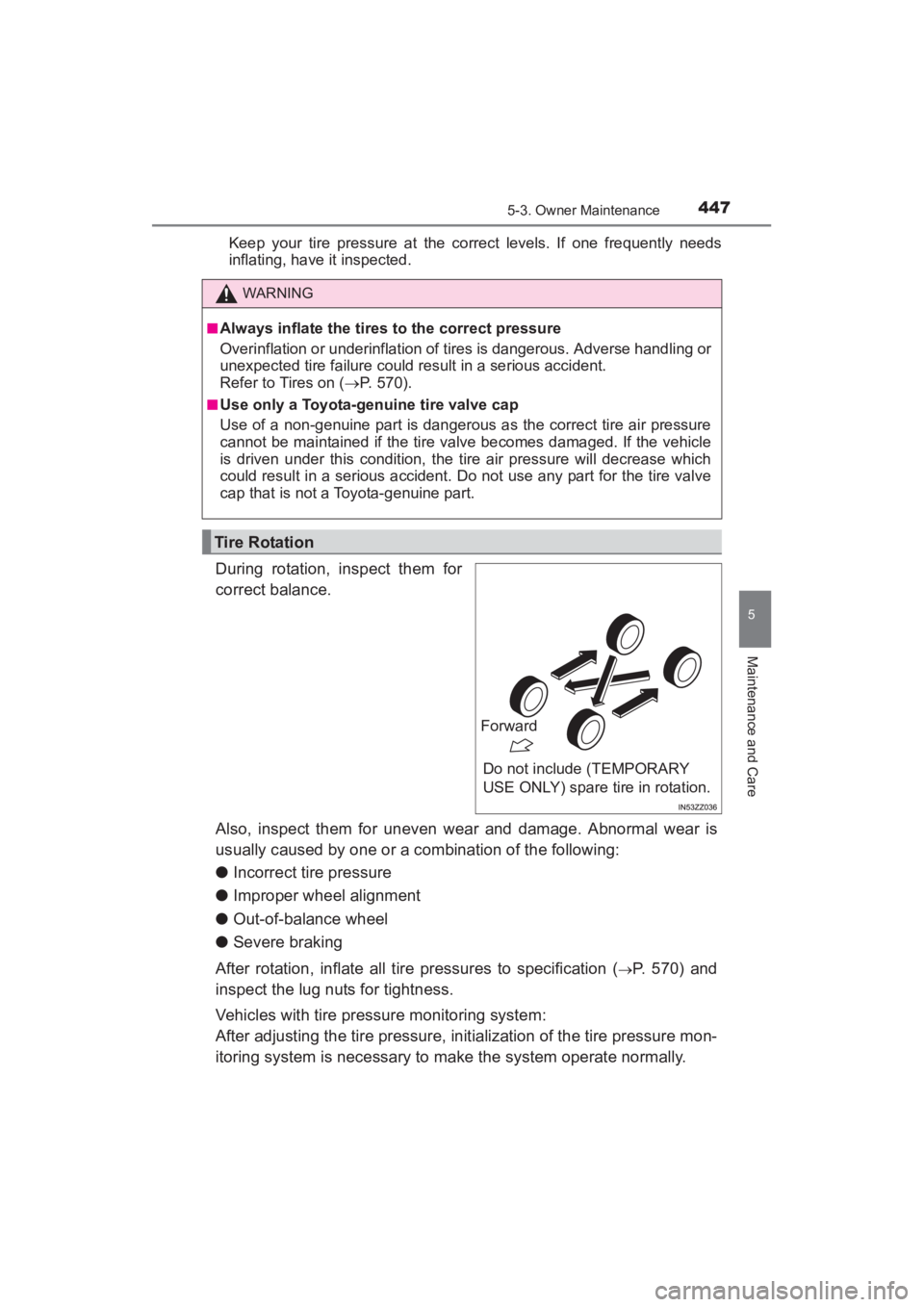
During rotation, inspect them for
correct balance.
Also, inspect them for uneven wear and damage. Abnormal wear is
usually caused by one or a combination of the following:
●Incorrect tire pressure
● Improper wheel alignment
● Out-of-balance wheel
● Severe braking
After rotation, inflate all tire pressures to specification (
→P. 570) and
inspect the lug nuts for tightness.
Vehicles with tire pressure monitoring system:
After adjusting the tire pressure, initialization of the tire pressure mon-
itoring system is necessary to make the system operate normally.
WARNING
■Always inflate the tires to the correct pressure
Overinflation or underinflation of tires is dangerous. Adverse handling or
unexpected tire failure could result in a serious accident.
Refer to Tires on ( →P. 570).
■Use only a Toyota-genuine tire valve cap
Use of a non-genuine part is dangerous as the correct tire air pressure
cannot be maintained if the tire valve becomes damaged. If the vehicle
is driven under this condition, the tire air pressure will decrease which
could result in a serious accident. Do not use any part for the tire valve
cap that is not a Toyota-genuine part.
Tire Rotation
Forward
Do not include (TEMPORARY
USE ONLY) spare tire in rotation.
YARIS_SEDAN_OM_OM99M18z_(U).book Page 447 Monday, June 1, 2015 9:22 PM
Page 452 of 592
4505-3. Owner Maintenance
YARIS_SEDAN_OM_OM99M18z_(U)
Proper tire balancing provides the best riding comfort and helps
reduce tread wear. Out-of-balance tires can cause vibration and
uneven wear, such as cupping and flat spots.
When replacing a wheel, make sure the new one is the same as the orig-
inal factory wheel in diameter, rim width, and offset (inset/outset).
NOTICE
●Do not use your temporary spare tire rim with a snow tire or a conven-
tional tire. Neither will properly fit and could damage both tire and rim.
●The temporary spare tire has a tread life of less than 3,000 miles
(5,000 km). The tread life may be shorter depending on driving condi-
tions.
●The temporary spare tire is for limited use, however, if the tread wear
solid- band indicator appears, replace the tire with the same type of
temporary spare (→P. 450).
Replacing a Wheel
WARNING
■Always use wheels of the correct size on your vehicle
Using a wrong-sized wheel is dangerous. Braking and handling could
be affected, leading to loss of control and an accident.
NOTICE
A wrong-sized wheel may adversely affect:
●Tire fit
●Wheel and bearing life
●Ground clearance
●Snow-chain clearance
●Speedometer calibration
●Headlight aim
●Bumper height
●Tire Pressure Monitoring System (if equipped)
YARIS_SEDAN_OM_OM99M18z_(U).book Page 450 Monday, June 1, 2015 9:22 PM
Page 487 of 592
YARIS_SEDAN_OM_OM99M18z_(U)
4856-2. Flat Tire
6
If Trouble Arises
Your Toyota has a temporary spare tire. The temporary spare tire is
lighter and smaller than a conventional tire, and is designed only for
emergency use and should be used only for VERY short periods.
Temporary spare tires should NEVER be used for long drives or
extended periods.
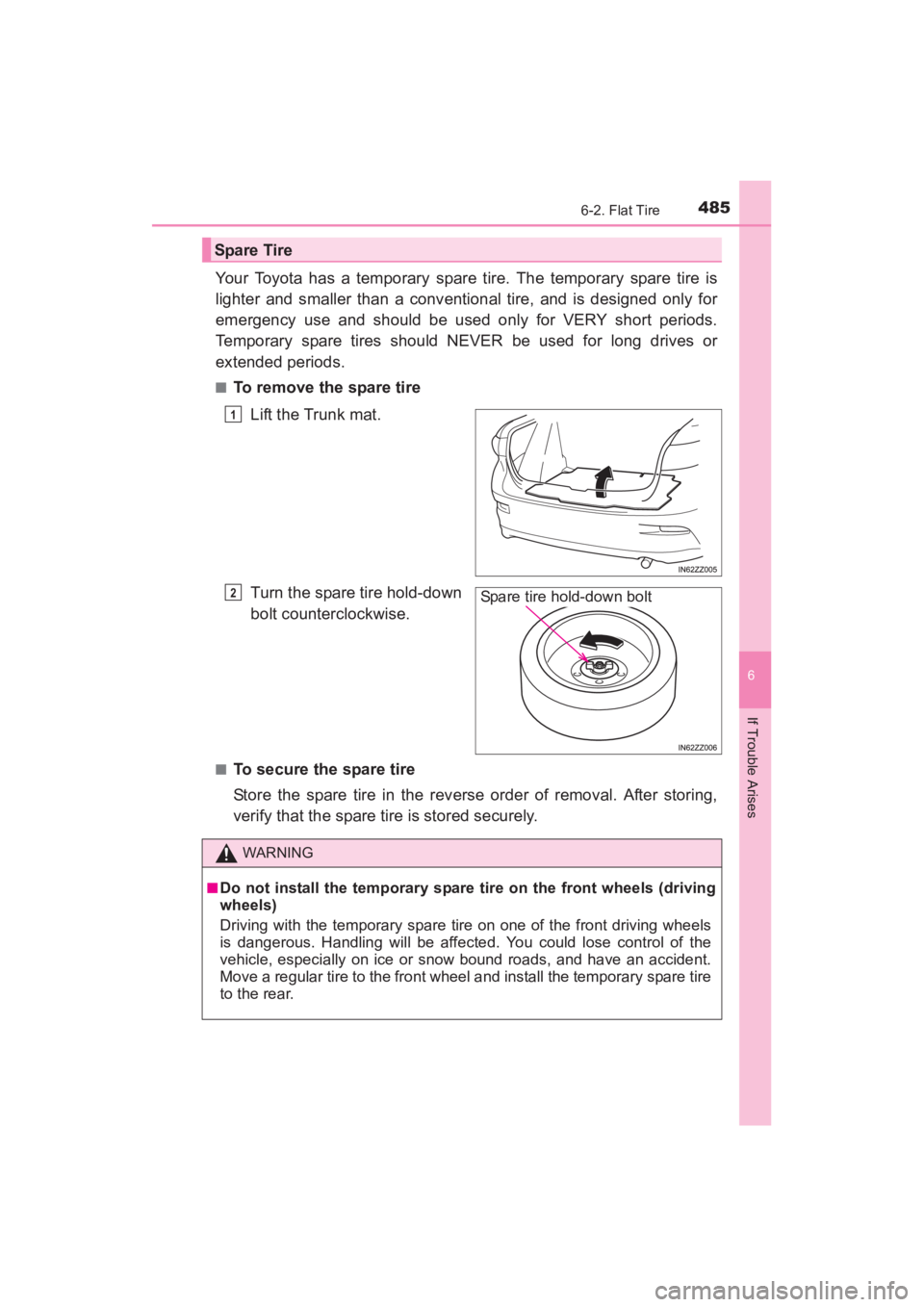
■To remove the spare tireLift the Trunk mat.
Turn the spare tire hold-down
bolt counterclockwise.
■To secure the spare tire
Store the spare tire in the reverse order of removal. After storing,
verify that the spare tire is stored securely.
Spare Tire
1
Spare tire hold-down bolt2
WARNING
■Do not install the temporary spare tire on the front wheels (driving
wheels)
Driving with the temporary spare tire on one of the front driving wheels
is dangerous. Handling will be affected. You could lose control of the
vehicle, especially on ice or snow bound roads, and have an accident.
Move a regular tire to the front wheel and install the temporary spare tire
to the rear.
YARIS_SEDAN_OM_OM99M18z_(U).book Page 485 Monday, June 1, 2015 9:22 PM
Page 489 of 592
487
YARIS_SEDAN_OM_OM99M18z_(U)
6-2. Flat Tire
6
If Trouble Arises
Changing a Flat Tire
Park on a level surface off the right-of-way and firmly set the park-
ing brake.
Put a vehicle with an automatic transaxle in Park (P), a manual
transaxle in Reverse (R) or 1, and turn off the engine.
Turn on the hazard warning flasher.
Have everyone get out of the vehicle and away from the vehicle
and traffic.
Remove the jack, tool, and spare tire (→P. 483).
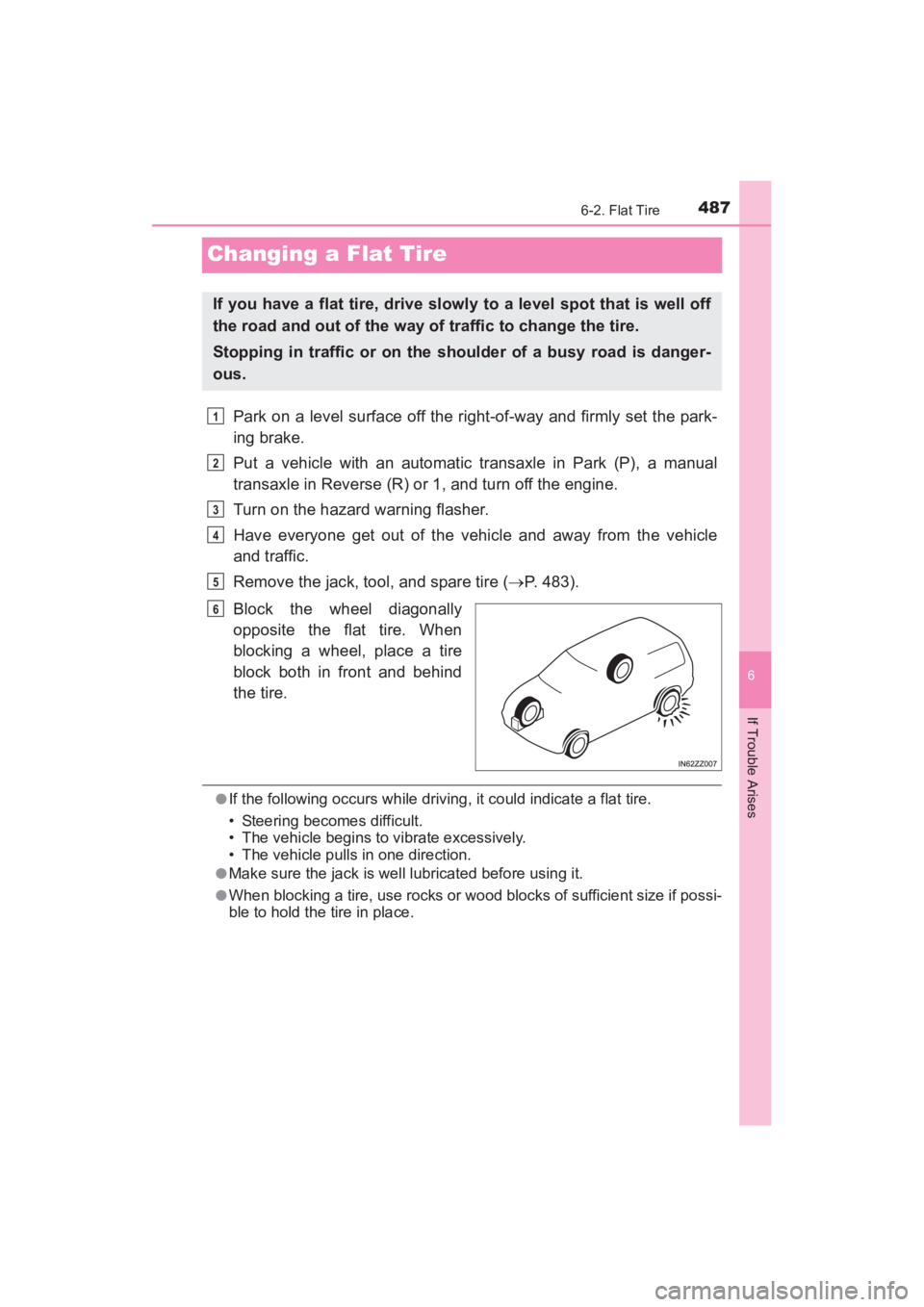
Block the wheel diagonally
opposite the flat tire. When
blocking a wheel, place a tire
block both in front and behind
the tire.
●If the following occurs while driving, it could indicate a flat tire.
• Steering becomes difficult.
• The vehicle begins to vibrate excessively.
• The vehicle pulls in one direction.
●Make sure the jack is well lubricated before using it.
●When blocking a tire, use rocks or wood blocks of sufficient size if possi-
ble to hold the tire in place.
If you have a flat tire, drive slowly to a level spot that is well off
the road and out of the way of traffic to change the tire.
Stopping in traffic or on the shoulder of a busy road is danger-
ous.
1
2
3
4
5
6
YARIS_SEDAN_OM_OM99M18z_(U).book Page 487 Monday, June 1, 2015 9:22 PM
Page 492 of 592
4906-2. Flat Tire
YARIS_SEDAN_OM_OM99M18z_(U)
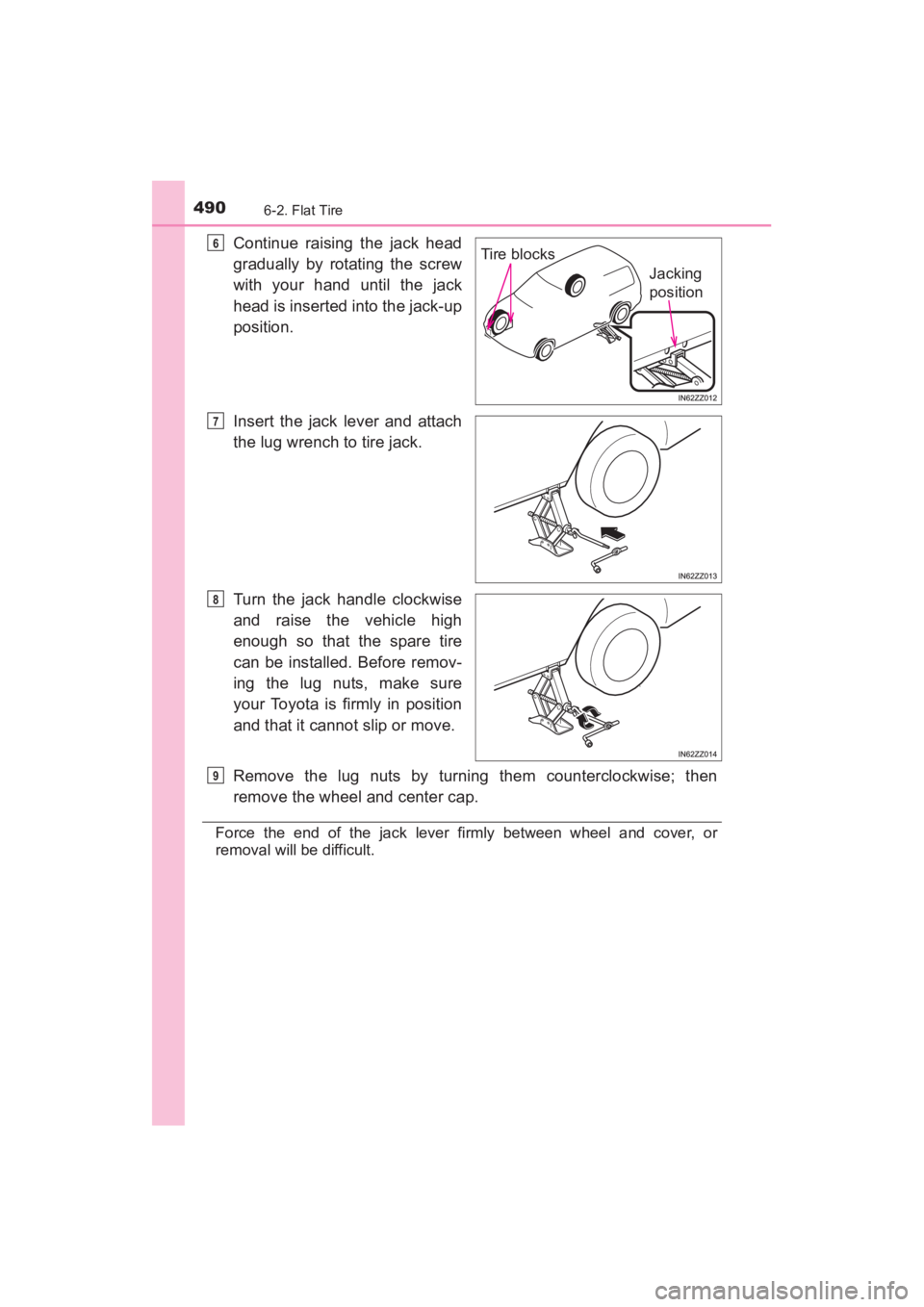
Continue raising the jack head
gradually by rotating the screw
with your hand until the jack
head is inserted into the jack-up
position.
Insert the jack lever and attach
the lug wrench to tire jack.
Turn the jack handle clockwise
and raise the vehicle high
enough so that the spare tire
can be installed. Before remov-
ing the lug nuts, make sure
your Toyota is firmly in position
and that it cannot slip or move.
Remove the lug nuts by turning them counterclockwise; then
remove the wheel and center cap.
Force the end of the jack lever firmly between wheel and cover, or
removal will be difficult.
Tire blocksJacking
position6
7
8
9
YARIS_SEDAN_OM_OM99M18z_(U).book Page 490 Monday, June 1, 2015 9:22 PM