Head TOYOTA YARIS 2017 3.G User Guide
[x] Cancel search | Manufacturer: TOYOTA, Model Year: 2017, Model line: YARIS, Model: TOYOTA YARIS 2017 3.GPages: 396, PDF Size: 7.08 MB
Page 56 of 396
561-1. For safe use
WARNING
■Child restraint precautions
● Do not allow the child to lean his/her head or any part of his/her body
against the door or the area of the seat, front and rear pillars or roof side
rails from which the SRS side airbags or SRS curtain shield airbags deploy
even if the child is seated in the child restraint system. It is dangerous if
the SRS side airbags and curtain shield airbags inflate, and the impact
could cause death or serious injury to the child.
● Make sure you have complied with all installation instructions provided by
the child restraint manufacturer and that the system is properly secured. If
it is not secured properly, it may cause death or serious injury to the child
in the event of a sudden stop, sudden swerve or an accident.
■ When children are in the vehicle
Do not allow children to play with the seat belt. If the seat belt becomes
twisted around a child’s neck, it may lead to choking or other serious injuries
that could result in death.
If this occurs and the buckle cannot be unfastened, scissors should be used
to cut the belt.
■ When the child restraint system is not in use
● Keep the child restraint system properly secured on the seat even if it is
not in use. Do not store the child restraint system unsecured in the pas-
senger compartment.
● If it is necessary to detach the child restraint system, remove it from the
vehicle or store it securely in the luggage compartment. This will prevent it
from injuring passengers in the event of a sudden stop, sudden swerve or
an accident.
Page 60 of 396
601-1. For safe use
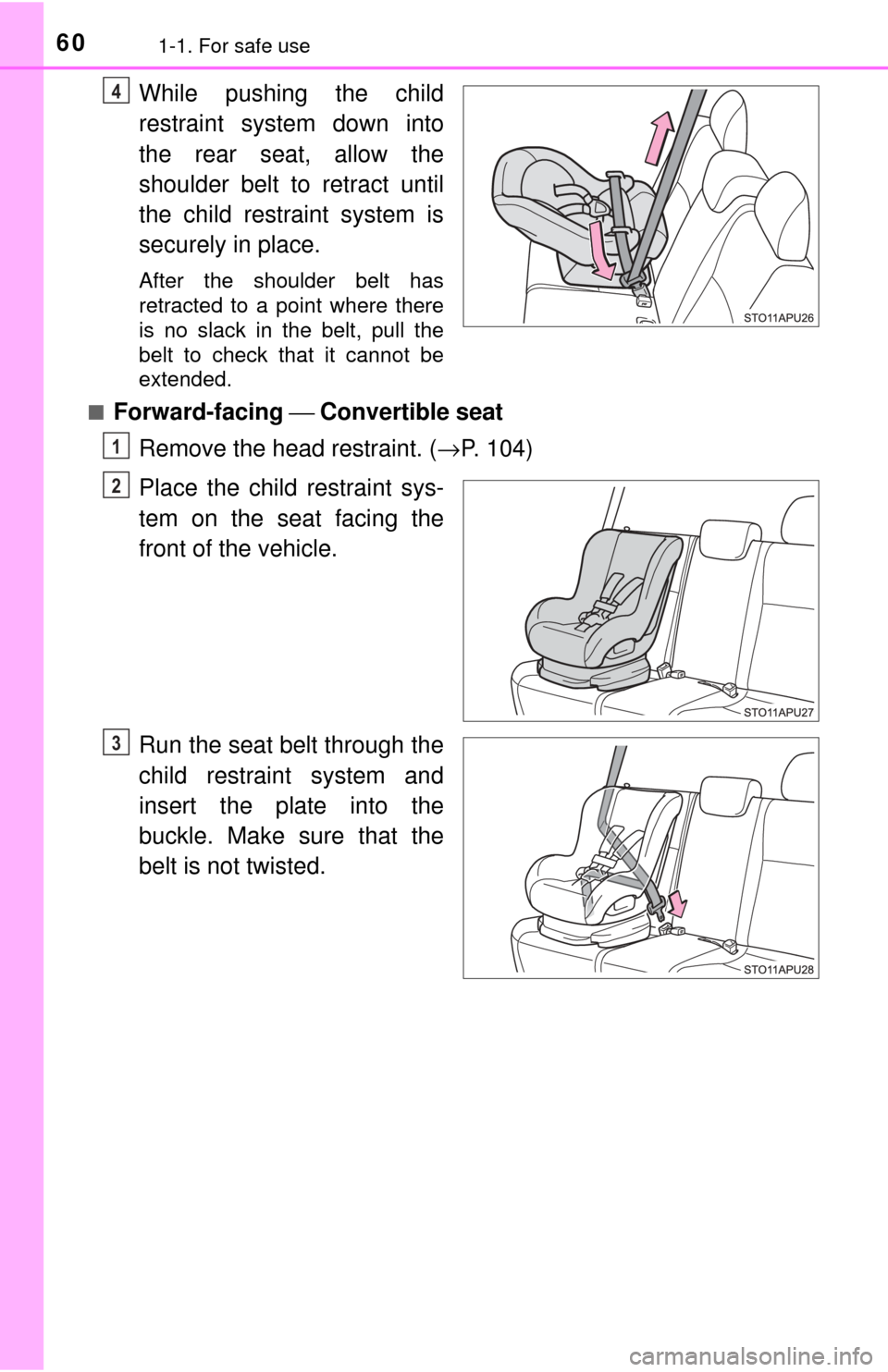
While pushing the child
restraint system down into
the rear seat, allow the
shoulder belt to retract until
the child restraint system is
securely in place.
After the shoulder belt has
retracted to a point where there
is no slack in the belt, pull the
belt to check that it cannot be
extended.
■
Forward-facing ⎯ Convertible seat
Remove the head restraint. ( →P. 104)
Place the child restraint sys-
tem on the seat facing the
front of the vehicle.
Run the seat belt through the
child restraint system and
insert the plate into the
buckle. Make sure that the
belt is not twisted.
4
1
2
3
Page 63 of 396
631-1. For safe use
1
For safety and security
Remove the luggage cover. (→P. 218)
Remove the head restraint. ( →P. 104)
Secure the child restraint syst em using the LATCH anchors or a
seat belt.
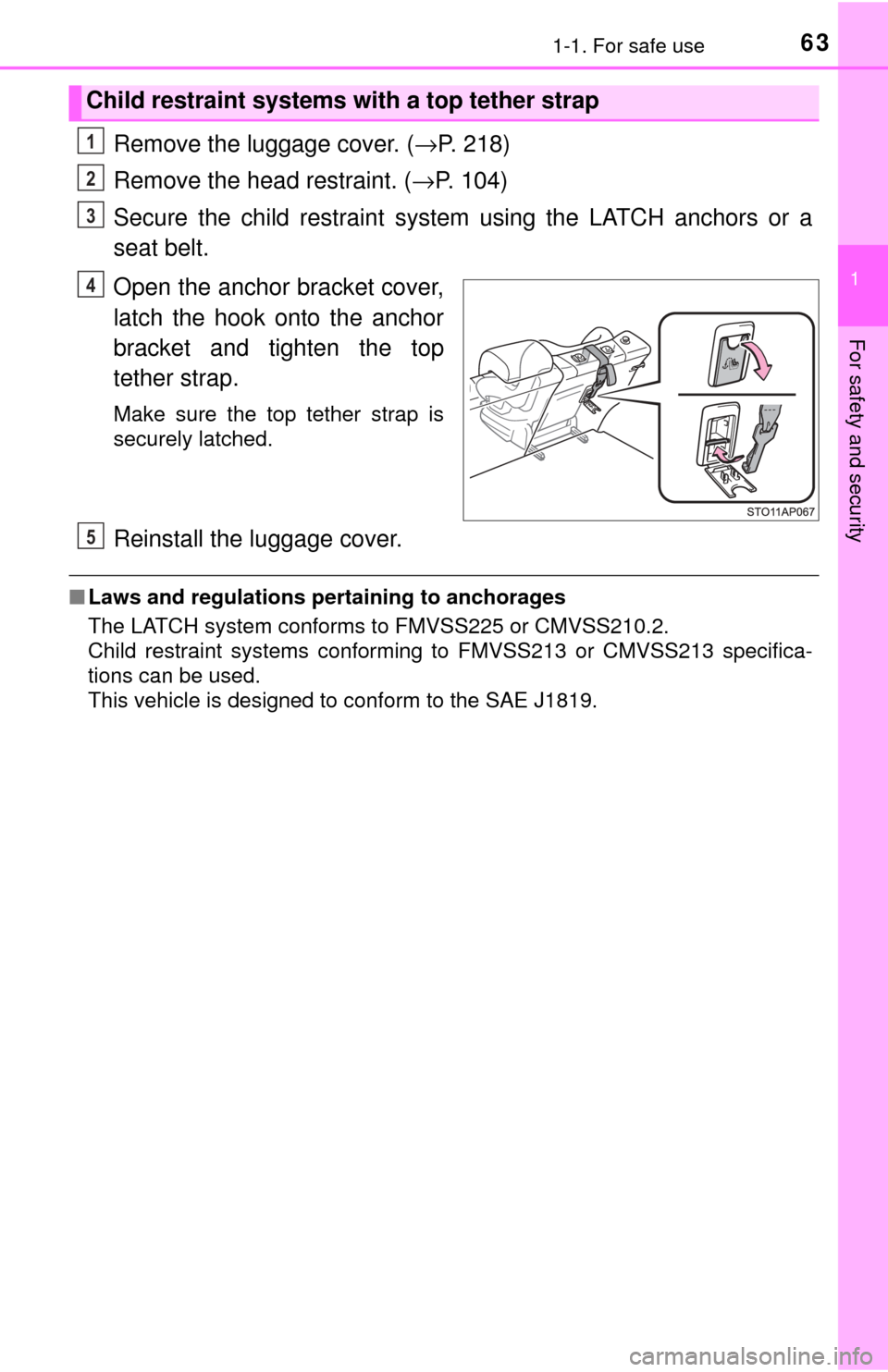
Open the anchor bracket cover,
latch the hook onto the anchor
bracket and tighten the top
tether strap.
Make sure the top tether strap is
securely latched.
Reinstall the luggage cover.
■ Laws and regulations pertaining to anchorages
The LATCH system conforms to FMVSS225 or CMVSS210.2.
Child restraint systems conforming to FMVSS213 or CMVSS213 specifica-
tions can be used.
This vehicle is designed to conform to the SAE J1819.
Child restraint systems with a top tether strap
1
2
3
4
5
Page 65 of 396
651-1. For safe use
1
For safety and security
WARNING
■When installing a child restraint system
● Ensure that the belt and plate are securely locked and the seat belt is not
twisted.
● Shake the child restraint system left and right, and forward and backward
to ensure that it has been securely installed.
● After securing a child restraint system, never adjust the seat.
● Follow all installation instructions provided by the child restraint system
manufacturer.
● When a child restraint system with a top tether strap is installed, do not
install the head restraint. The head restraint may interfere with the top
tether strap preventing secure installation of the child restraint system.
● Make sure to properly store the removed head restraint in a secure place
when you use the child restraint system on the rear seat.
● When securing some types of child restraint systems in rear seats, it may
not be possible to properly use the seat belts in positions next to the child
restraint without interfering with it or affecting seat belt effectiveness. Be
sure your seat belt fits snugly across your shoulder and low on your hips. If
it does not, or if it interferes with the child restraint, move to a different
position. Failure to do so may result in death or serious injury.
■ Do not use a seat belt extender
If a seat belt extender is used when installing a child restraint system, the
seat belt will not securely hold the child restraint system, which could cause
death or serious injury to the child or other passengers in the event of sud-
den braking, sudden swerving or an accident.
■ To correctly attach a child r estraint system to the anchors
When using the LATCH anchors, be sure that there are no foreign objects
around the anchors and that the seat belt is not caught behind the child
restraint system. Make sure the child restraint system is securely attached,
or it may cause death or serious injury to the child or other passengers in
the event of a sudden braking, sudden swerve or an accident.
Page 66 of 396
661-1. For safe use
Exhaust gas precautions
Harmful substances to the human body are included in exhaust
gases if inhale.
WARNING
Exhaust gases contain harmful carbon monoxide (CO), which is colorless and
odorless. Observe the following precautions.
Failure to do so may cause exhaust gases enter the vehicle and may lead to
an accident caused by light-headedness, or may lead to death or a serious
health hazard.
■ Important points while driving
● Keep the back door closed.
● If you smell exhaust gases in the vehicle even when the back door is
closed, open the windows and have the vehicle inspected at your Toyota
dealer as soon as possible.
■ When parking
● If the vehicle is in a poorly ventilated area or a closed area, such as a
garage, stop the engine.
● Do not leave the vehicle with the engine running for a long time.
If such a situation cannot be avoided, park the vehicle in an open space
and ensure that exhaust fumes do not enter the vehicle interior.
● Do not leave the engine running in an area with snow build-up, or where it
is snowing. If snowbanks build up around the vehicle while the engine is
running, exhaust gases may collect and enter the vehicle.
■ Exhaust pipe
The exhaust system needs to be checked periodically. If there is a hole or
crack caused by corrosion, damage to a joint or abnormal exhaust noise, be
sure to have the vehicle inspected and repaired by your Toyota dealer.
Page 74 of 396
742. Instrument cluster
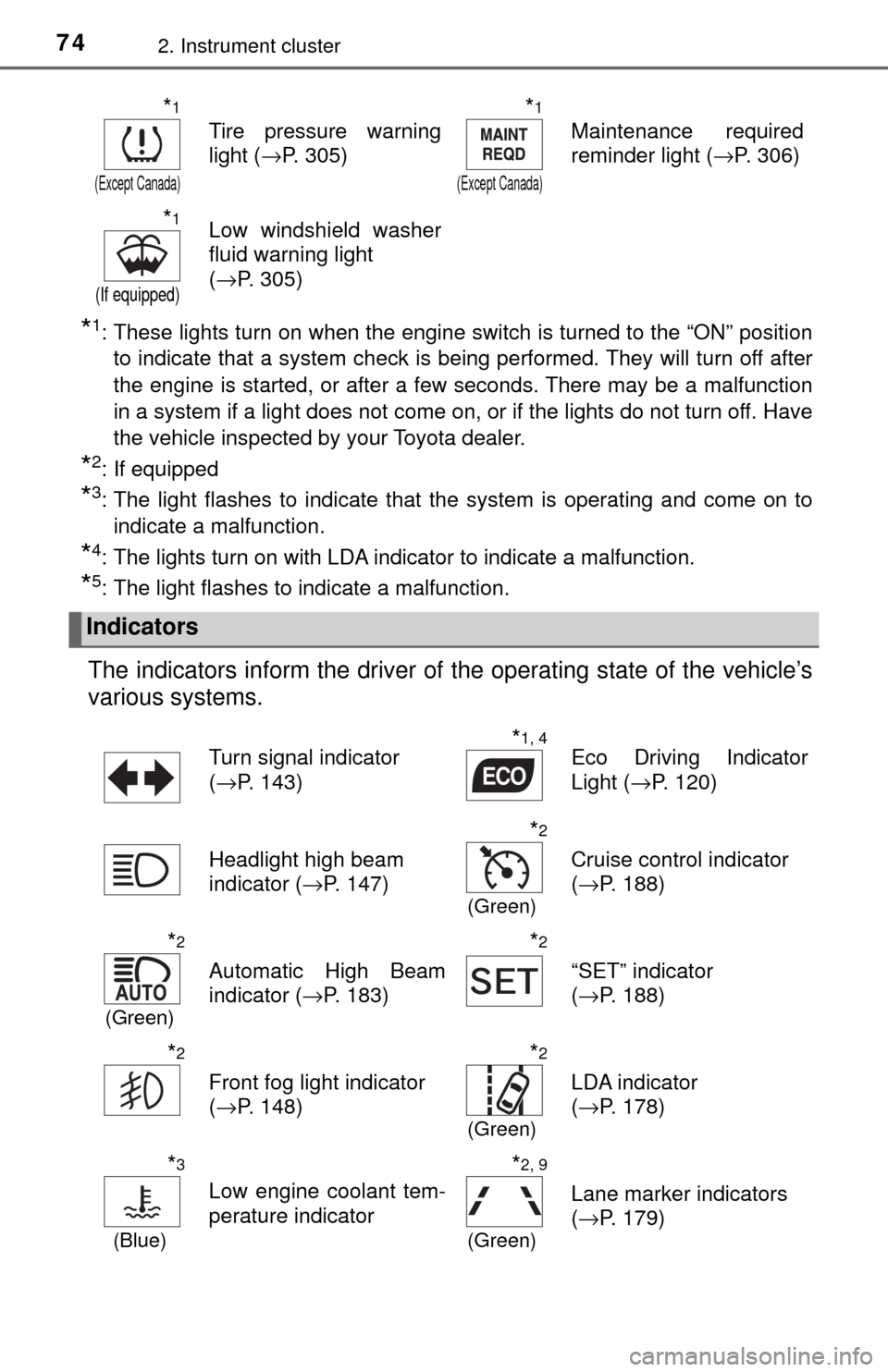
*1: These lights turn on when the engine switch is turned to the “ON” positionto indicate that a system check is being performed. They will turn off after
the engine is started, or after a few seconds. There may be a malfunction
in a system if a light does not come on, or if the lights do not turn off. Have
the vehicle inspected by your Toyota dealer.
*2: If equipped
*3: The light flashes to indicate that the system is operating and come on toindicate a malfunction.
*4: The lights turn on with LDA indicator to indicate a malfunction.
*5: The light flashes to indicate a malfunction.
The indicators inform the driver of the operating state of the vehicle’s
various systems.
*1
(Except Canada)
Tire pressure warning
light ( →P. 305)
*1
(Except Canada)
Maintenance required
reminder light ( →P. 306)
*1
(If equipped)
Low windshield washer
fluid warning light
(→P. 305)
Indicators
Turn signal indicator
(→P. 143)*1, 4Eco Driving Indicator
Light ( →P. 120)
Headlight high beam
indicator ( →P. 147)
*2
(Green)
Cruise control indicator
(→P. 188)
*2
(Green)
Automatic High Beam
indicator ( →P. 183)
*2
“SET” indicator
(→P. 188)
*2
Front fog light indicator
(→P. 148)
*2
(Green)
LDA indicator
(→P. 178)
*3
(Blue)
Low engine coolant tem-
perature indicator
*2, 9
(Green)
Lane marker indicators
(→P. 179)
Page 83 of 396
83
3
Operation of
each component
3-1. Key information
Keys .................................... 84
3-2. Opening, closing and locking the doors
Side doors ........................... 89
Back door ............................ 94
3-3. Adjusting the seats Front seats .......................... 98
Rear seats......................... 101
Head restraints.................. 104
3-4. Adjusting the steering wheel and mirrors
Steering wheel .................. 107
Inside rear view mirror ...... 109
Outside rear view mirrors ............................. 111
3-5. Opening and closing the windows
Power windows ................. 113
Page 95 of 396
953-2. Opening, closing and locking the doors
3
Operation of each component
■Operation signals (vehicles with a wireless remote control)
→P. 9 0
■ Security feature (vehicles with a wireless remote control)
→P. 9 0
■ Luggage compartment light
The luggage compartment lights turn on when the back door is opened.
WARNING
Observe the following precautions.
Failure to do so may result in death or serious injury.
■Before driving
● Make sure that the back door is fully closed. If the back door is not fully
closed, it may open unexpectedly while driving and hit near-by objects or
luggage in the luggage compartment may be thrown out, causing an acci-
dent.
● Do not allow children to play in the luggage compartment.
If a child is accidentally locked in the luggage compartment, they could
have heat exhaustion or other injuries.
● Do not allow a child to open or close the back door.
Doing so may cause the back door to open unexpectedly, or cause the
child’s hands, head, or neck to be caught by the closing back door.
■ Important points while driving
● Keep the back door closed while driving.
If the back door is left open, it may hit near-by objects or luggage in the
luggage compartment may be thrown out, causing an accident.
● Never let anyone sit in the luggage compartment. In the event of sudden
braking or a collision, they are susceptible to death or serious injury.
Page 96 of 396
963-2. Opening, closing and locking the doors
WARNING
■Operating the back door
Observe the following precautions.
Failure to do so may cause parts of the body to be caught, resulting in death
or serious injury.
● Remove any heavy loads, such as snow and ice, from the back door
before opening it. Failure to do so may cause the back door to suddenly
shut again after it is opened.
● When opening or closing the back door, thoroughly check to make sure
the surrounding area is safe.
● If anyone is in the vicinity, make sure they are safe and let them know that
the back door is about to open or close.
● Use caution when opening or closing the back door in windy weather as it
may move abruptly in strong wind.
● Do not pull on the back door damper stay to close the back door, and do
not hang on the back door damper stay.
Doing so may cause hands to be caught or the back door damper stay to
break, causing an accident.
● If a bicycle carrier or similar heavy object is attached to the back door, it
may suddenly shut again after being opened, causing someone’s hands,
head or neck to be caught and injured. When installing an accessory part
to the back door, using a genuine Toyota part is recommended.
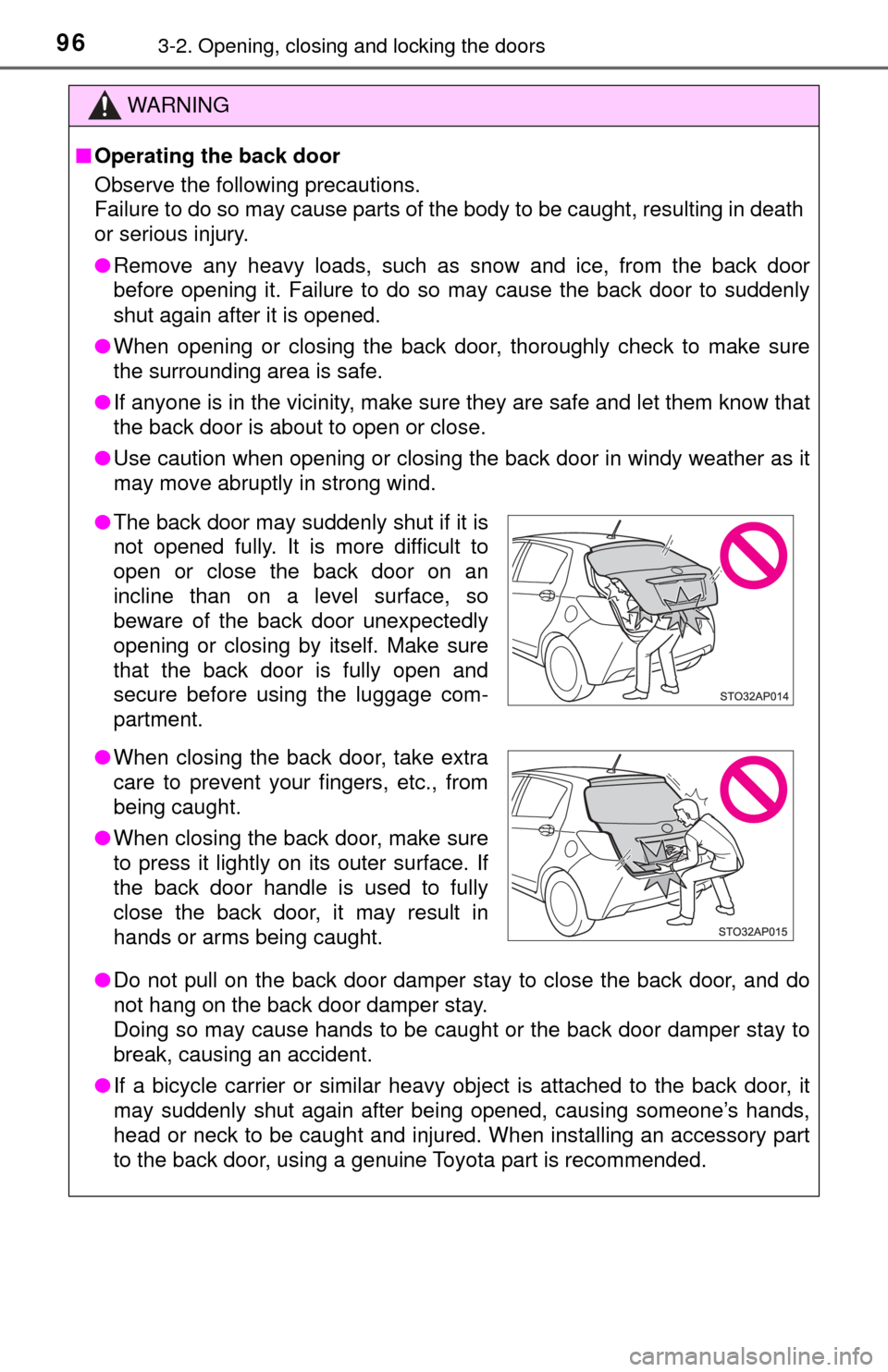
●The back door may suddenly shut if it is
not opened fully. It is more difficult to
open or close the back door on an
incline than on a level surface, so
beware of the back door unexpectedly
opening or closing by itself. Make sure
that the back door is fully open and
secure before using the luggage com-
partment.
● When closing the back door, take extra
care to prevent your fingers, etc., from
being caught.
● When closing the back door, make sure
to press it lightly on its outer surface. If
the back door handle is used to fully
close the back door, it may result in
hands or arms being caught.
Page 101 of 396
1013-3. Adjusting the seats
3
Operation of each component
Rear seats
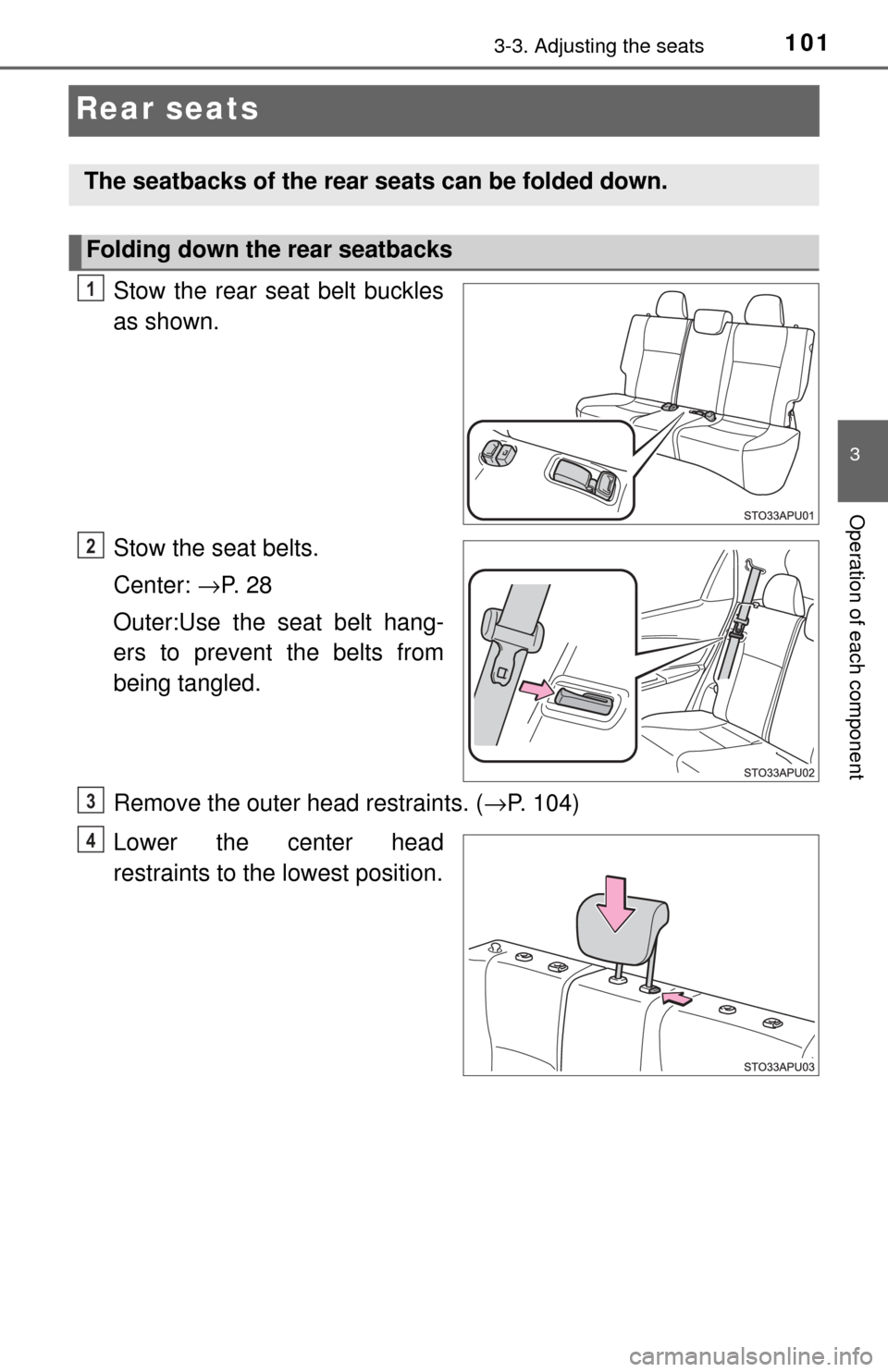
Stow the rear seat belt buckles
as shown.
Stow the seat belts.
Center: →P. 2 8
Outer:Use the seat belt hang-
ers to prevent the belts from
being tangled.
Remove the outer head restraints. ( →P. 104)
Lower the center head
restraints to the lowest position.
The seatbacks of the rear seats can be folded down.
Folding down the rear seatbacks
1
2
3
4