Head TOYOTA YARIS 2017 3.G Owner's Manual
[x] Cancel search | Manufacturer: TOYOTA, Model Year: 2017, Model line: YARIS, Model: TOYOTA YARIS 2017 3.GPages: 396, PDF Size: 7.08 MB
Page 102 of 396
1023-3. Adjusting the seats
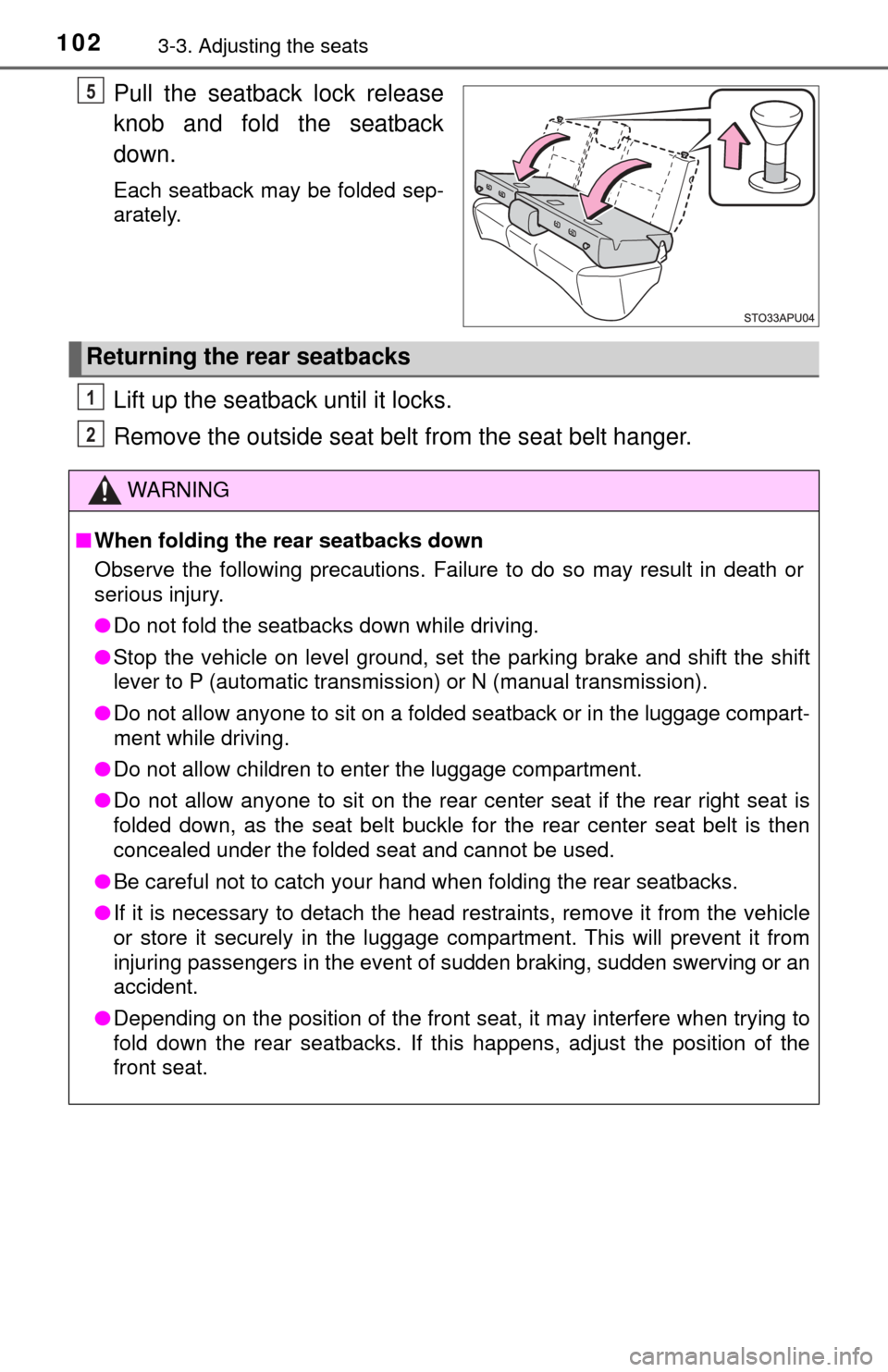
Pull the seatback lock release
knob and fold the seatback
down.
Each seatback may be folded sep-
arately.
Lift up the seatback until it locks.
Remove the outside seat belt from the seat belt hanger.
5
Returning the rear seatbacks
WARNING
■When folding the rear seatbacks down
Observe the following precautions. Failure to do so may result in death or
serious injury.
● Do not fold the seatbacks down while driving.
● Stop the vehicle on level ground, set the parking brake and shift the shift
lever to P (automatic transmission) or N (manual transmission).
● Do not allow anyone to sit on a folded seatback or in the luggage compart-
ment while driving.
● Do not allow children to enter the luggage compartment.
● Do not allow anyone to sit on the rear center seat if the rear right seat is
folded down, as the seat belt buckle for the rear center seat belt is th\
en
concealed under the folded seat and cannot be used.
● Be careful not to catch your hand when folding the rear seatbacks.
● If it is necessary to detach the head restraints, remove it from the vehicle
or store it securely in the luggage compartment. This will prevent it from
injuring passengers in the event of sudden braking, sudden swerving or an
accident.
● Depending on the position of the front seat, it may interfere when trying to
fold down the rear seatbacks. If this happens, adjust the position of the
front seat.
1
2
Page 104 of 396
1043-3. Adjusting the seats
Head restraints
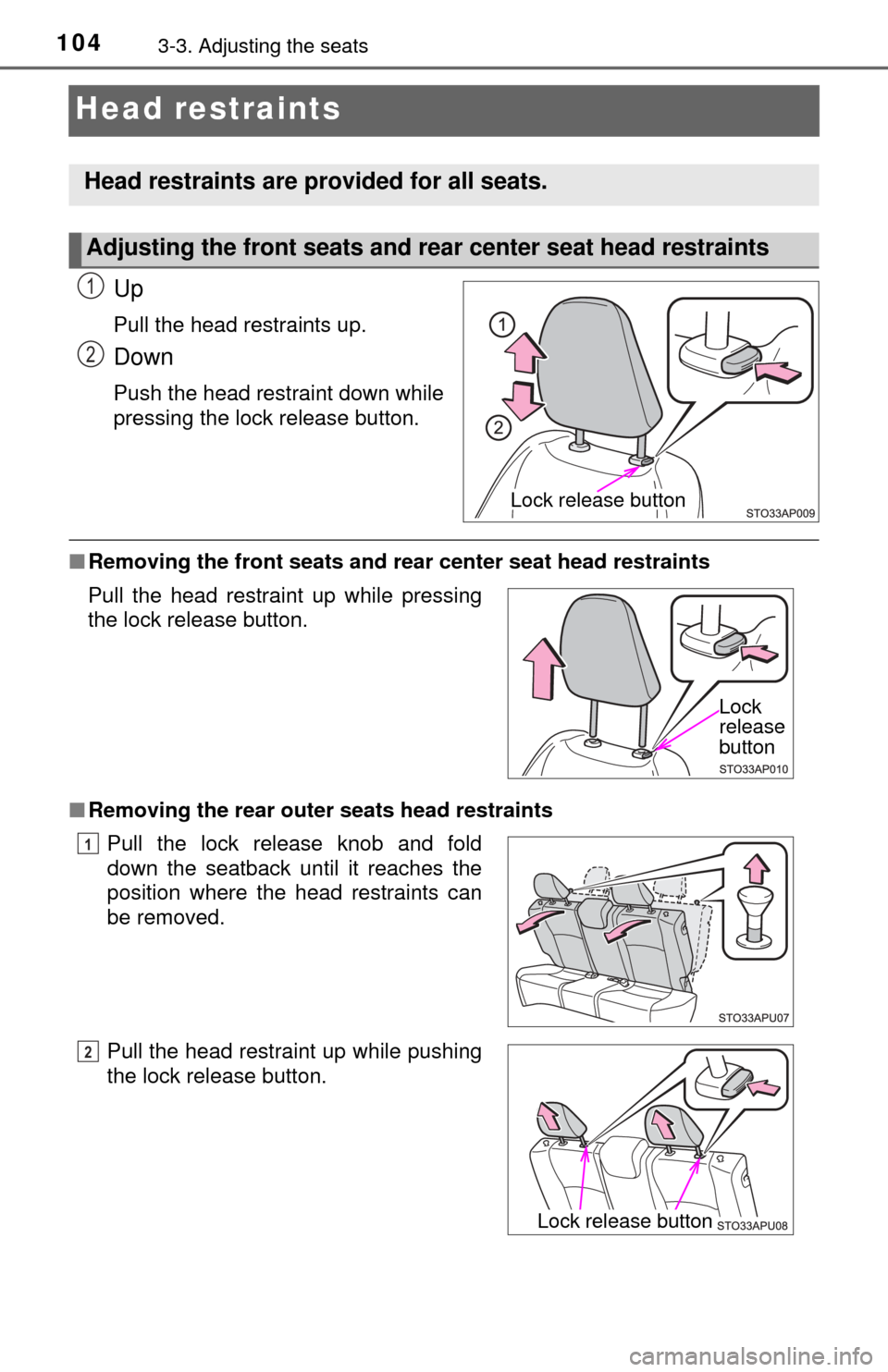
Up
Pull the head restraints up.
Down
Push the head restraint down while
pressing the lock release button.
■Removing the front seats and re ar center seat head restraints
■ Removing the rear oute r seats head restraints
Head restraints are provided for all seats.
Adjusting the front seats and rear center seat head restraints
Lock release button
1
2
Pull the head restraint up while pressing
the lock release button.
Pull the lock release knob and fold
down the seatback until it reaches the
position where the head restraints can
be removed.
Pull the head restraint up while pushing
the lock release button.
Lock
release
button
1
2
Lock release button
Page 105 of 396
1053-3. Adjusting the seats
3
Operation of each component
■Installing the front seats and r ear center seat head restraints
■ Installing the rear outer seats head restraints
■ Adjusting the height of the head restraints
■ Adjusting the rear center seat head restraint
Always raise the head restraint one level from the stowed position when in
use.
■ Rear outer seats head restraints
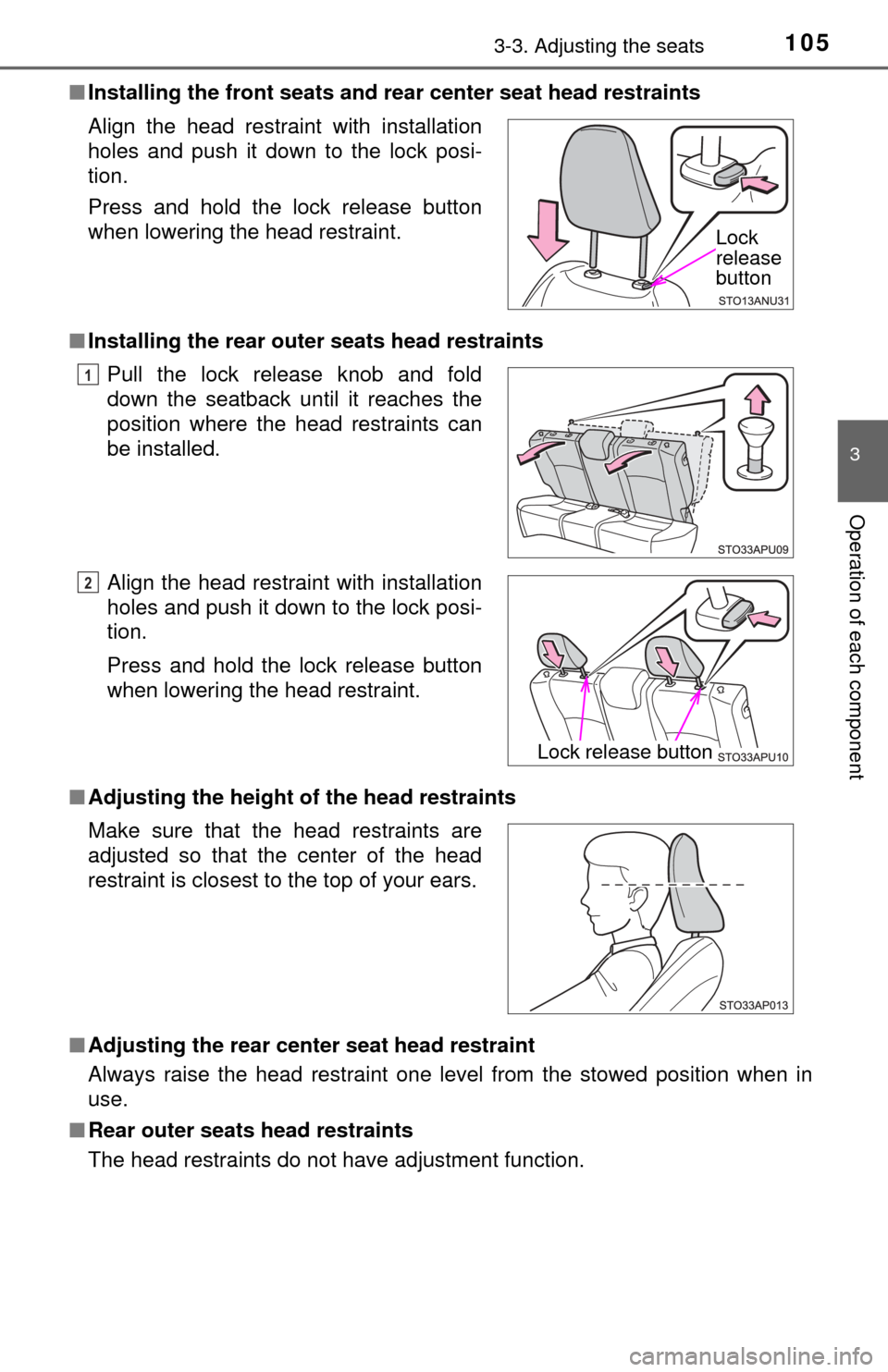
The head restraints do not have adjustment function. Align the head restraint with installation
holes and push it down to the lock posi-
tion.
Press and hold the lock release button
when lowering the head restraint.
Pull the lock release knob and fold
down the seatback until it reaches the
position where the head restraints can
be installed.
Align the head restraint with installation
holes and push it down to the lock posi-
tion.
Press and hold the lock release button
when lowering the head restraint.
Make sure that the head restraints are
adjusted so that the center of the head
restraint is closest to the top of your ears.
Lock
release
button
1
2
Lock release button
Page 106 of 396

1063-3. Adjusting the seats
WARNING
■Head restraint precautions
Observe the following precautions regarding the head restraints. Failure to
do so may result in death or serious injury.
● Use the head restraints designed for each respective seat.
● Adjust the head restraints to the correct position at all times.
● After adjusting the head restraints, push down on them and make sure
they are locked in position.
● Do not drive with the head restraints removed.
Page 109 of 396
1093-4. Adjusting the steering wheel and mirrors
3
Operation of each component
Inside rear view mirror
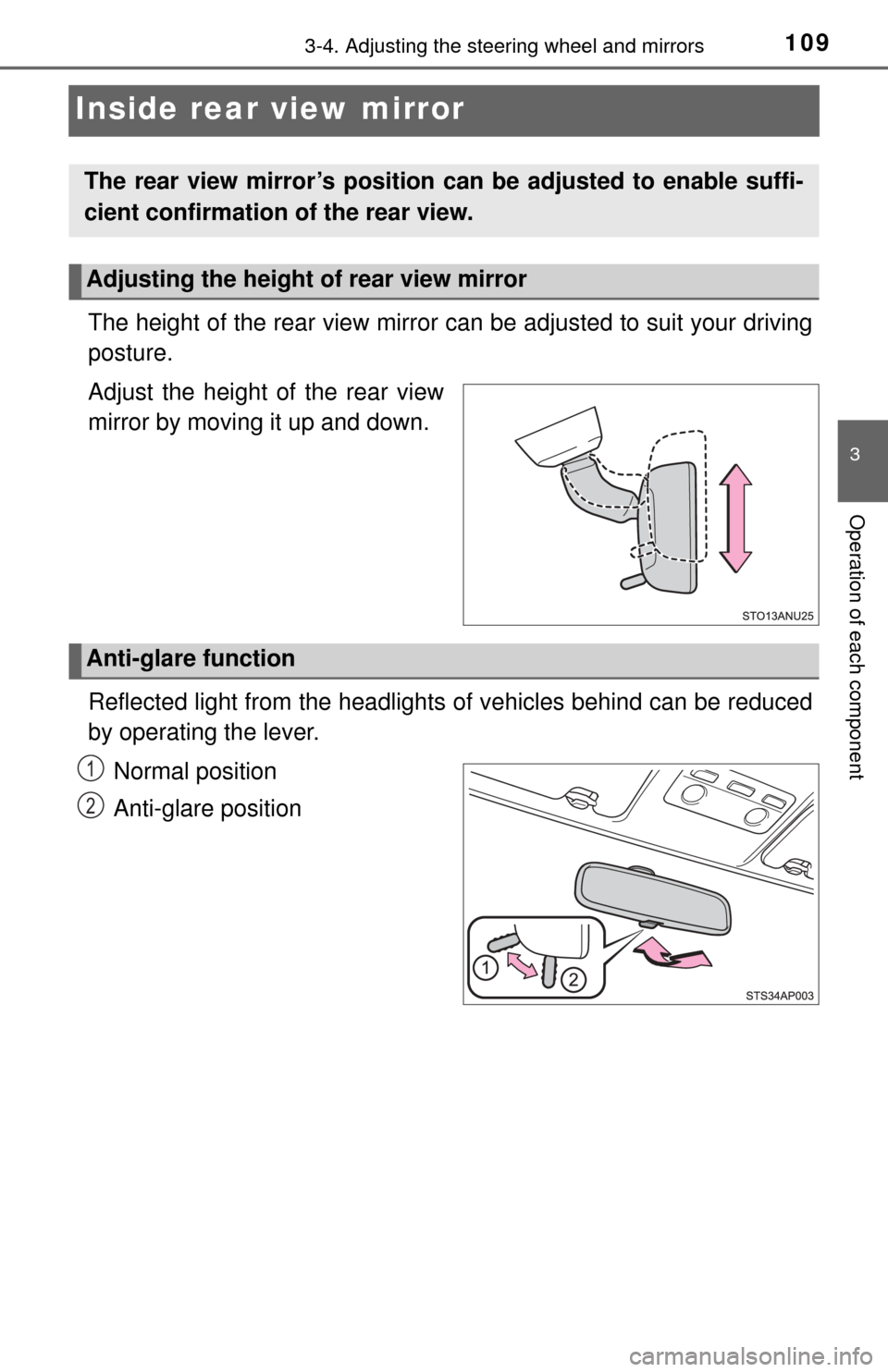
The height of the rear view mirror can be adjusted to suit your driving
posture.
Adjust the height of the rear view
mirror by moving it up and down.
Reflected light from the headlights of vehicles behind can be reduced
by operating the lever.
Normal position
Anti-glare position
The rear view mirror’s position can be adjusted to enable suffi-
cient confirmation of the rear view.
Adjusting the height of rear view mirror
Anti-glare function
1
2
Page 115 of 396

115
4Driving
4-1. Before drivingDriving the vehicle ............. 116
Cargo and luggage ........... 127
Vehicle load limits ............. 131
Trailer towing..................... 132
Dinghy towing (vehicles with an automatic
transmission)................... 133
Dinghy towing (vehicles with a manual
transmission)................... 134
4-2. Driving procedures Engine (ignition) switch ..... 136
Automatic transmission ..... 139
Manual transmission ......... 142
Turn signal lever................ 143
Parking brake .................... 144 4-3. Operating the lights
and wipers
Headlight switch ................ 145
Fog light switch ................. 148
Windshield wipers and washer ..................... 150
Rear window wiper and washer ..................... 153
4-4. Refueling Opening the fuel tank cap .................................. 156
4-5. Toyota Safety Sense C Toyota Safety Sense C ..... 159
PCS (Pre-Collision System) .... 165
LDA (Lane Departure Alert) .... 178
Automatic High Beam ....... 183
4-6. Using the driving support systems
Cruise control .................... 188
Driving assist systems ...... 192
4-7. Driving tips Winter driving tips ............. 197
Page 121 of 396

1214-1. Before driving
4
Driving
WARNING
Observe the following precautions.
Failure to do so may result in death or serious injury.● Do not drive the vehicle over or stop the vehicle near flammable materials.
The exhaust system and exhaust gases can be extremely hot. These hot
parts may cause a fire if there is any flammable material nearby.
● During normal driving, do not turn off the engine. Turning the engine off
while driving will not cause loss of steering or braking control, but the
power assist to these systems will be lost. This will make it more difficult to
steer and brake, so you should pull over and stop the vehicle as soon as it
is safe to do so.
However, in the event of an emergency, such as if it becomes impossible
to stop the vehicle in the normal way: →P. 293
● Use engine braking (downshift) to maintain a safe speed when driving
down a steep hill.
Using the brakes continuously may cause the brakes to overheat and lose
effectiveness. ( →P. 139, 142)
● Do not adjust the positions of the steering wheel, the seat, or the inside or
outside rear view mirrors while driving.
Doing so may result in a loss of vehicle control.
● Always check that all passengers’ arms, heads or other parts of their body
are not outside the vehicle.
● Do not drive in excess of the speed limit. Even if the legal speed limit per-
mits it, do not drive over 85 mph (140 km/h) unless your vehicle has h\
igh-
speed capability tires. Driving over 85 mph (140 km/h) may result in tire
failure, loss of control and possible injury. Be sure to consult a tire dealer
to determine whether the tires on your vehicle are high-speed capability
tires or not before driving at such speeds.
Page 140 of 396
1404-2. Driving procedures
■Downshift restriction
The maximum allowable speeds are as follows.
■ AI-SHIFT
AI-SHIFT automatically selects the suitable gear according to driver perfor-
mance and driving conditions.
AI-SHIFT automatically operates when the shift lever is in the D position.
■ When driving with cruise cont rol activated (if equipped)
Even when performing the following actions with the intent of enabling engine
braking, engine braking will not activate while downshifting to 3 because
cruise control will not be canceled. ( →P. 190)
■ Shift lock system
The shift lock system is a system to prevent accidental operation of the shift
lever in starting.
The shift lever can be shifted from P only when the engine switch is in the
“ON” position and the brake pedal is being depressed.
■ If the shift lever canno t be shifted from P
First, check whether the brake pedal is being depressed.
If the shift lever cannot be shifted with your foot on the brake pedal, there may
be a problem with the shift lock system. Have the vehicle inspected by y\
our
Toyota dealer immediately.
The following steps may be used as an emergency measure to ensure that
the shift lever can be shifted.
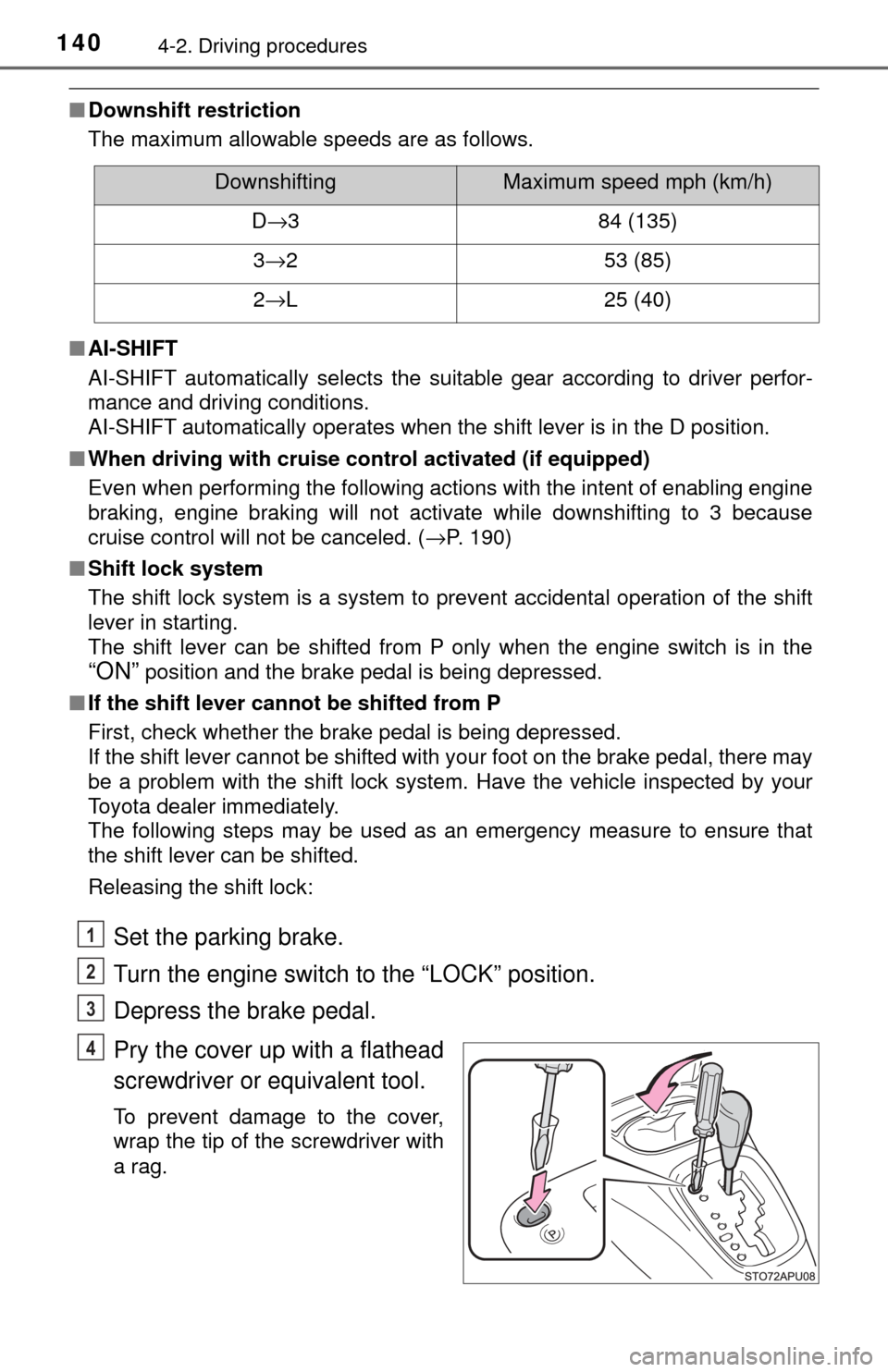
Releasing the shift lock:
Set the parking brake.
Turn the engine switch to the “LOCK” position.
Depress the brake pedal.
Pry the cover up with a flathead
screwdriver or equivalent tool.
To prevent damage to the cover,
wrap the tip of the screwdriver with
a rag.
DownshiftingMaximum speed mph (km/h)
D →384 (135)
3→253 (85)
2→L25 (40)
1
2
3
4
Page 145 of 396
1454-3. Operating the lights and wipers
4
Driving
Headlight switch
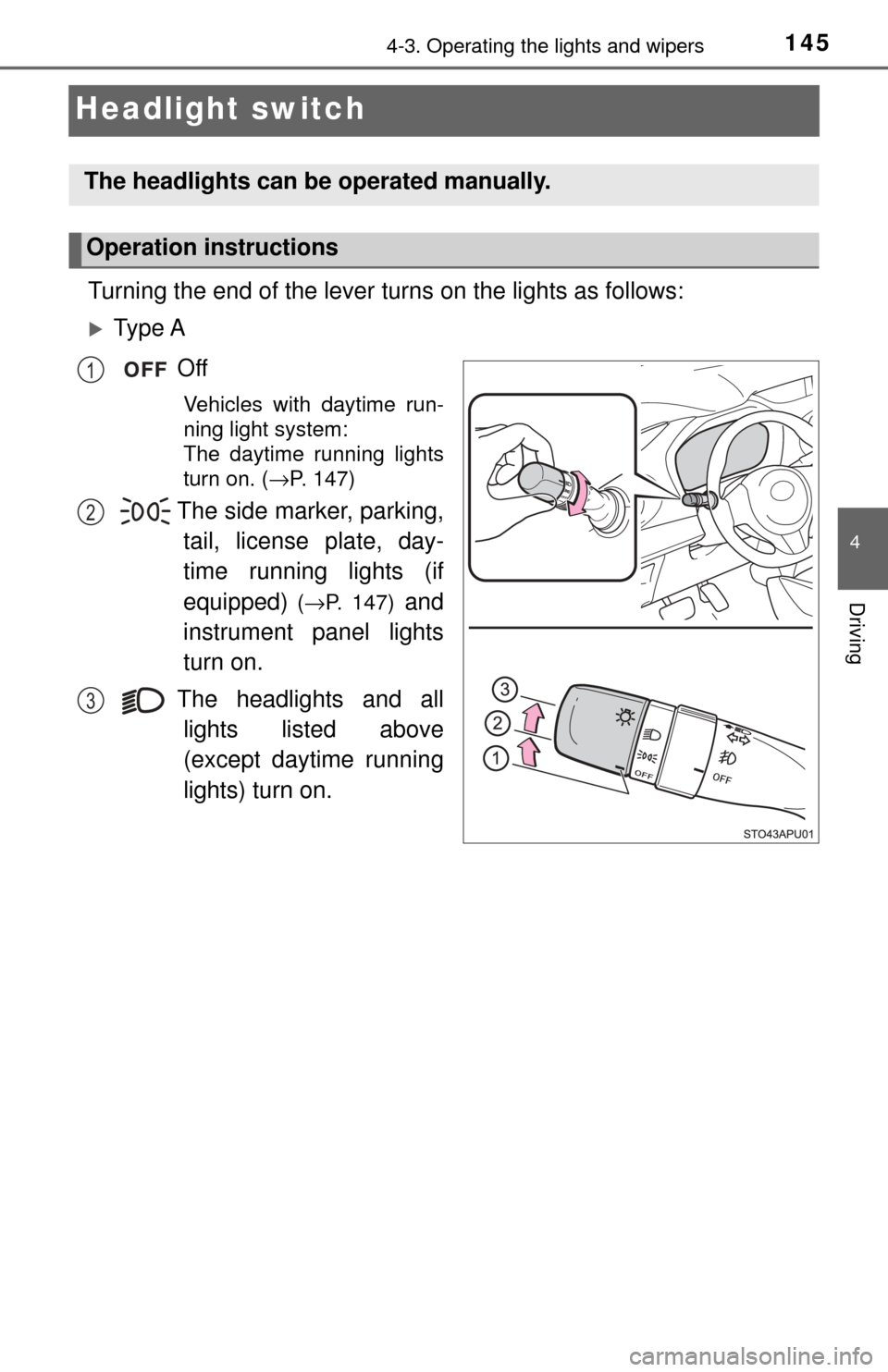
Turning the end of the lever turns on the lights as follows:
Ty p e AOff
Vehicles with daytime run-
ning light system:
The daytime running lights
turn on. ( →P. 147)
The side marker, parking,
tail, license plate, day-
time running lights (if
equipped)
( →P. 147) and
instrument panel lights
turn on.
The headlights and all lights listed above
(except daytime running
lights) turn on.
The headlights can be operated manually.
Operation instructions
1
2
3
Page 146 of 396
1464-3. Operating the lights and wipers
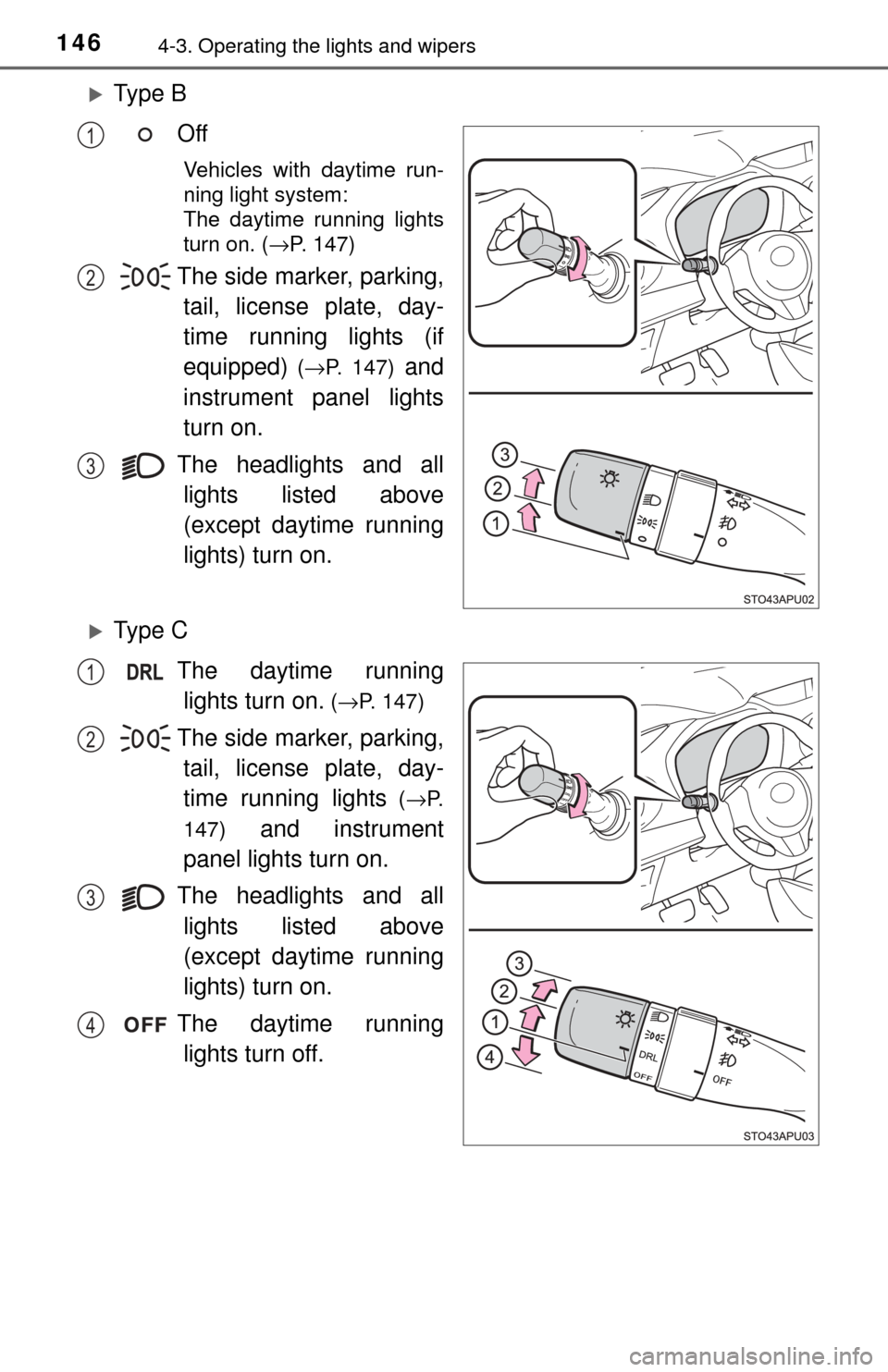
Ty p e BOff
Vehicles with daytime run-
ning light system:
The daytime running lights
turn on. ( →P. 147)
The side marker, parking,
tail, license plate, day-
time running lights (if
equipped)
( →P. 147) and
instrument panel lights
turn on.
The headlights and all lights listed above
(except daytime running
lights) turn on.
Ty p e C
The daytime runninglights turn on.
( →P. 147)
The side marker, parking,
tail, license plate, day-
time running lights
( →P.
147)
and instrument
panel lights turn on.
The headlights and all lights listed above
(except daytime running
lights) turn on.
The daytime running lights turn off.
1
2
3
1
2
3
4