warning TOYOTA YARIS 2017 Owners Manual
[x] Cancel search | Manufacturer: TOYOTA, Model Year: 2017, Model line: YARIS, Model: TOYOTA YARIS 2017Pages: 549, PDF Size: 33.09 MB
Page 377 of 549
3777-3. Do-it-yourself maintenance
7
Maintenance and care
YARIS_F_OM_Europe_OM52J20E
■Before recharging
When recharging, the battery produces hydrogen gas which is flammable and
explosive. Therefore, observe the following before recharging:
● If recharging with the battery installed on the vehicle, be sure to disconnect
the ground cable.
● Make sure the power switch on the charger is off when connecting and dis-
connecting the charger cables to the battery.
■ After recharging/reconnecting the battery (vehicles with a smart entry &
start system)
● Unlocking the doors using the smart entry & start system may not be possi-
ble immediately after reconnecting the battery. If this happens, use the wire-
less remote control or the mechanical key to lock/unlock the doors.
● Start the engine with the engine switch in ACCESSORY mode. The engine
may not start with the engine switch turned off. However, the engine will
operate normally from the second attempt.
● The engine switch mode is recorded by the vehicle. If the battery is recon-
nected, the vehicle will return the engine switch mode to the status it was in
before the battery was disconnected. Make sure to turn off the engine
before disconnect the battery. Take extra care when connecting the battery
if the engine switch mode prior to discharge is unknown.
If the engine will not start even after multiple attempts, contact any authorized
Toyota dealer or repairer, or another duly qualified and equipped profes-
sional.
WARNING
■ Chemicals in the battery
Batteries contain poisonous and corrosive sulfuric acid and may produce
hydrogen gas which is flammable and explosive. To reduce the risk of death
or serious injury, take the following precautions while working on or near the
battery:
● Do not cause sparks by touching the battery terminals with tools.
● Do not smoke or light a match near the battery.
● Avoid contact with eyes, skin and clothes.
● Never inhale or swallow electrolyte.
● Wear protective safety glasses when working near the battery.
● Keep children away from the battery.
Page 378 of 549
3787-3. Do-it-yourself maintenance
YARIS_F_OM_Europe_OM52J20E
WARNING
■Where to safely charge the battery
Always charge the battery in an open area. Do not charge the battery in a
garage or closed room w here there is insufficient ventilation.
■ Emergency measures regarding electrolyte
● If electrolyte gets in your eyes
Flush your eyes with clean water for at least 15 minutes and get immedi-
ate medical attention. If possible, continue to apply water with a sponge or
cloth while traveling to the nearest medical facility.
● If electrolyte gets on your skin
Wash the affected area thoroughly. If you feel pain or burning, get medical
attention immediately.
● If electrolyte gets on your clothes
It can soak through clothing on to your skin. Immediately take off the cloth-
ing and follow the procedure above if necessary.
● If you accidentally swallow electrolyte
Drink a large quantity of water or milk. Get emergency medical attention
immediately.
NOTICE
■ When recharging the battery
Never recharge the battery while the engine is running. Also, be sure all
accessories are turned off.
Page 379 of 549
3797-3. Do-it-yourself maintenance
7
Maintenance and care
YARIS_F_OM_Europe_OM52J20E
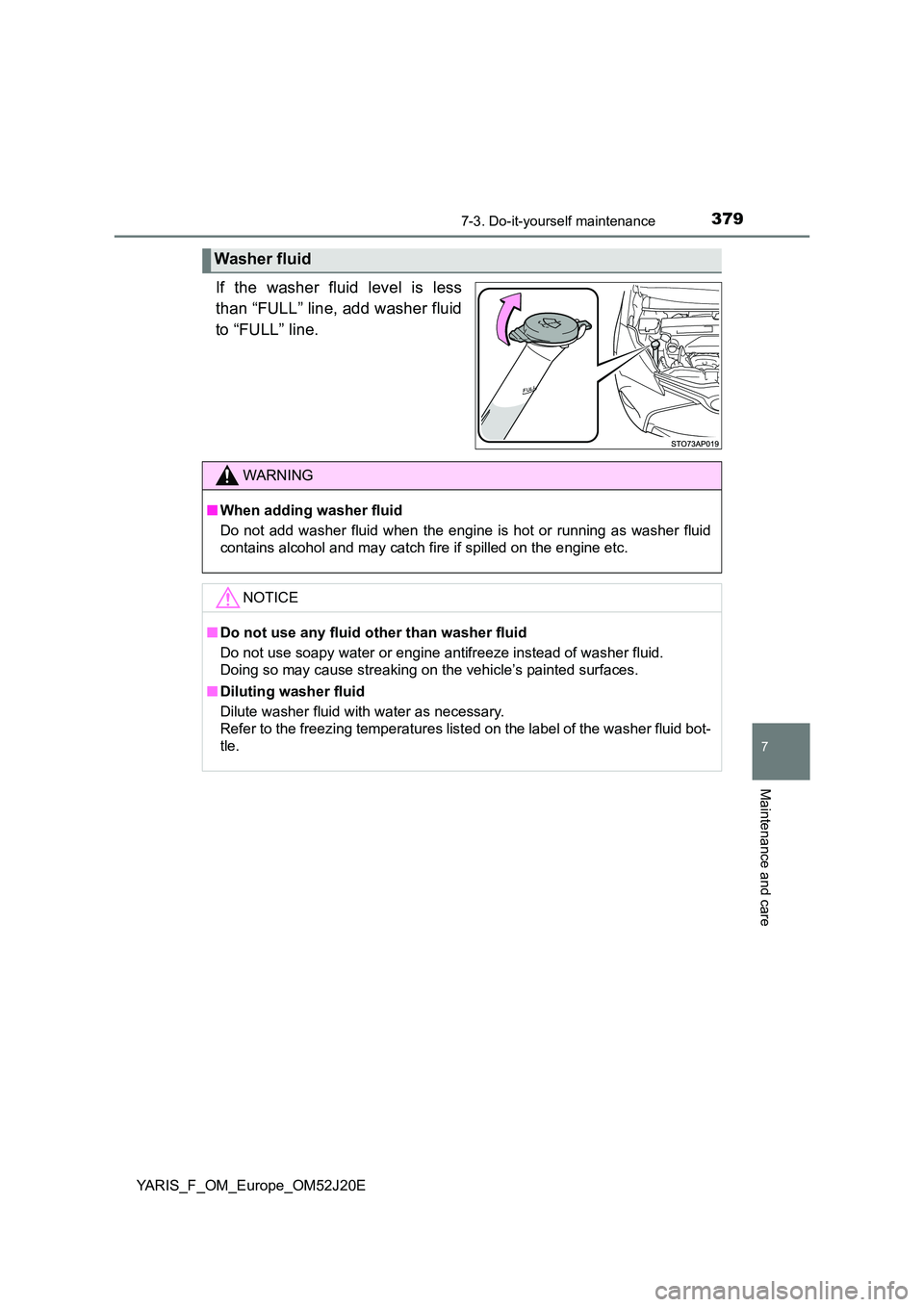
If the washer fluid level is less
than “FULL” line, add washer fluid
to “FULL” line.
Washer fluid
WARNING
■ When adding washer fluid
Do not add washer fluid when the engine is hot or running as washer fluid
contains alcohol and may catch fire if spilled on the engine etc.
NOTICE
■ Do not use any fluid other than washer fluid
Do not use soapy water or engine antifreeze instead of washer fluid.
Doing so may cause streaking on the vehicle’s painted surfaces.
■ Diluting washer fluid
Dilute washer fluid with water as necessary.
Refer to the freezing temperatures list ed on the label of the washer fluid bot-
tle.
Page 380 of 549
3807-3. Do-it-yourself maintenance
YARIS_F_OM_Europe_OM52J20E
You may drain the fuel filter yourself. However, as the operation is dif-
ficult, we recommend having it drained by any authorized Toyota
dealer or repairer, or another duly qualified and equipped profes-
sional. Even if you decide to drain it yourself, contact any authorized
Toyota dealer or repairer, or another duly qualified and equipped pro-
fessional.
The water in the fuel filter needs to be drained if the fuel filter warning
light comes on. (P. 442)
Turn the engine switch to the “LOCK” position (vehicles without a
smart entry & start system) or off (vehicles with a smart entry &
start system).
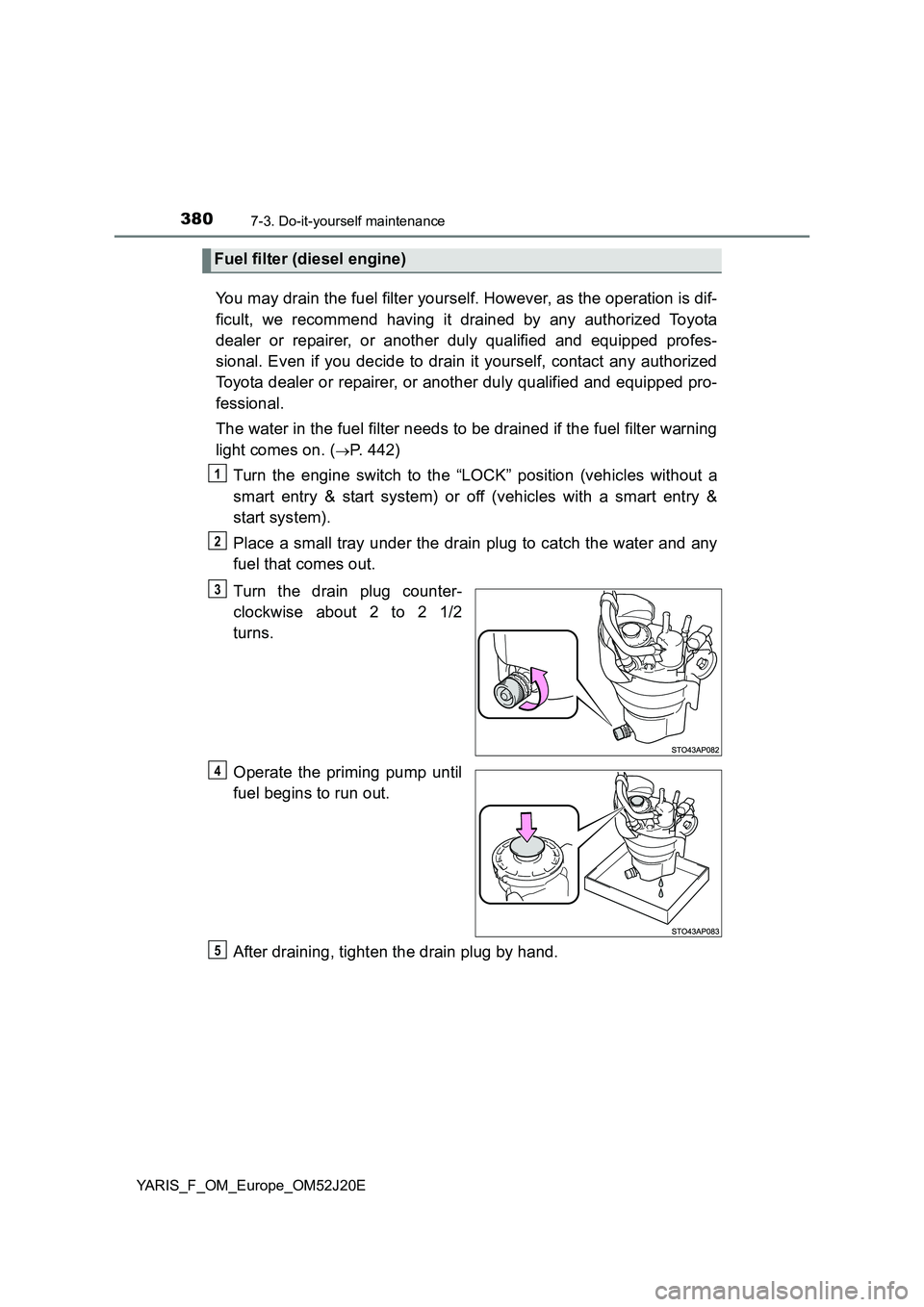
Place a small tray under the drain plug to catch the water and any
fuel that comes out.
Turn the drain plug counter-
clockwise about 2 to 2 1/2
turns.
Operate the priming pump until
fuel begins to run out.
After draining, tighten the drain plug by hand.
Fuel filter (diesel engine)
1
2
3
4
5
Page 382 of 549
3827-3. Do-it-yourself maintenance
YARIS_F_OM_Europe_OM52J20E
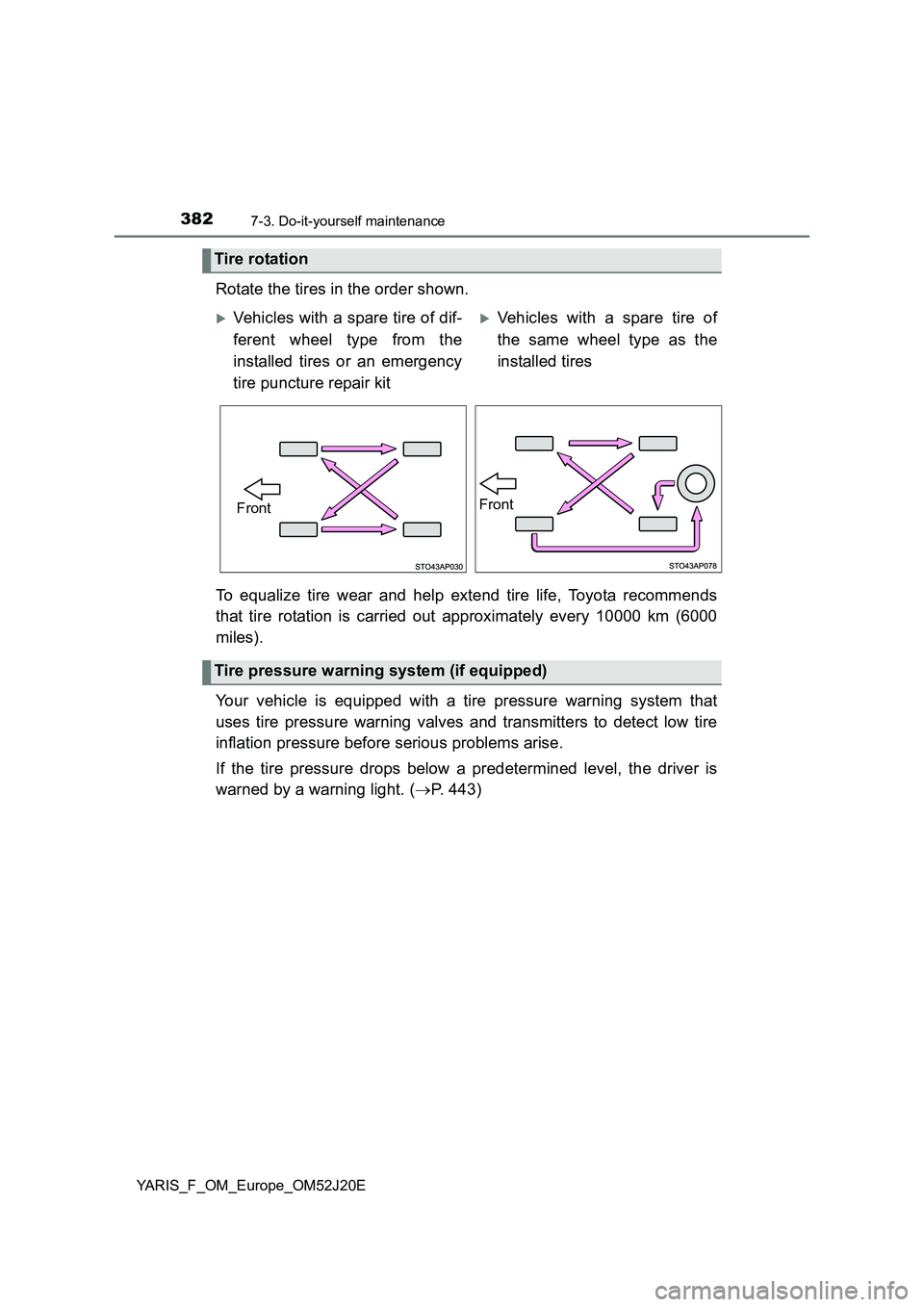
Rotate the tires in the order shown.
To equalize tire wear and help extend tire life, Toyota recommends
that tire rotation is carried out approximately every 10000 km (6000
miles).
Your vehicle is equipped with a tire pressure warning system that
uses tire pressure warning valves and transmitters to detect low tire
inflation pressure before serious problems arise.
If the tire pressure drops below a predetermined level, the driver is
warned by a warning light. ( P. 443)
Tire rotation
Vehicles with a spare tire of dif-
ferent wheel type from the
installed tires or an emergency
tire puncture repair kit
Vehicles with a spare tire of
the same wheel type as the
installed tires
FrontFront
Tire pressure warning system (if equipped)
Page 383 of 549
3837-3. Do-it-yourself maintenance
7
Maintenance and care
YARIS_F_OM_Europe_OM52J20E
When replacing tires or wheels, tire pressure warning valves and
transmitters must also be installed.
When new tire pressure warning valves and transmitters are installed,
new ID codes must be registered in the tire pressure warning com-
puter and the tire pressure warning system must be initialized. Have
tire pressure warning valve and transmitter ID codes registered by
any authorized Toyota dealer or repairer, or another duly qualified and
equipped professional. ( P. 385)
■The tire pressure warning system must be initialized in the fol-
lowing circumstances:
● When rotating front and rear tires which have different tire infla-
tion pressures
● When the tire inflation pressure is changed such as when chang-
ing traveling speed
● When changing the tire size
When the tire pressure warning system is initialized, the current tire
inflation pressure is set as the benchmark pressure.
Installing tire pressure warning valves and transmitters (vehicles
with a tire pressure warning system)
Initializing the tire pressure warning system (vehicles with a tire
pressure warning system)
Page 384 of 549
3847-3. Do-it-yourself maintenance
YARIS_F_OM_Europe_OM52J20E
■How to initialize the tire pressure warning system (vehicles
with a tire pressure warning system)
Park the vehicle in a safe place and turn the engine switch to the
“LOCK” position (vehicles without a smart entry & start system)
or off (vehicles with a smart entry & start system).
Initialization cannot be performed while the vehicle is moving.
Adjust the tire inflation pressure to the specified cold tire inflation
pressure level. ( P. 518)
Make sure to adjust the tire pressure to the specified cold tire inflation
pressure level. The tire pressure warning system will operate based on
this pressure level.
Turn the engine switch to the “ON” position (vehicles without a
smart entry & start system) or IGNITION ON mode (vehicles with
a smart entry & start system).
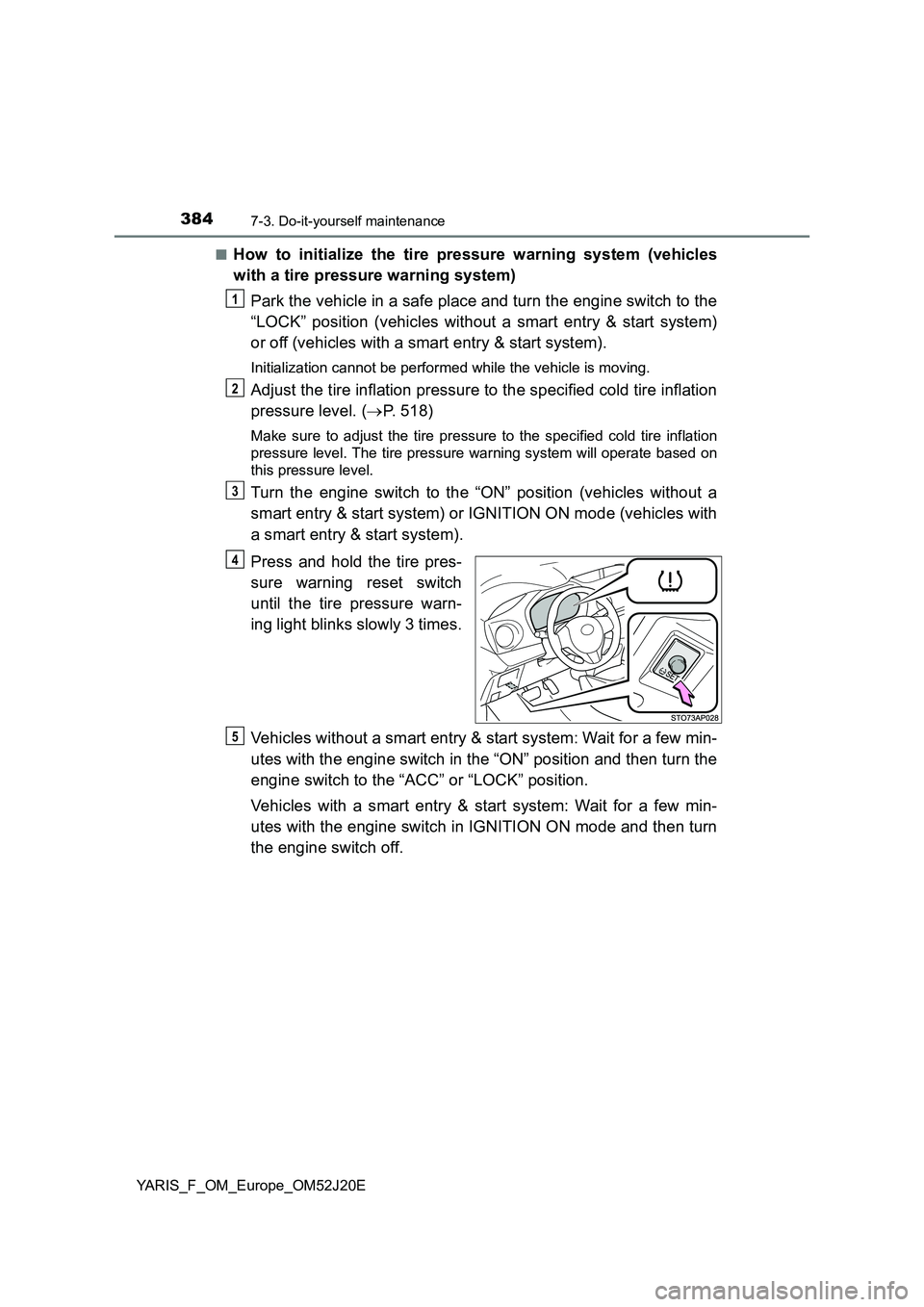
Press and hold the tire pres-
sure warning reset switch
until the tire pressure warn-
ing light blinks slowly 3 times.
Vehicles without a smart entry & start system: Wait for a few min-
utes with the engine switch in the “ON” position and then turn the
engine switch to the “ACC” or “LOCK” position.
Vehicles with a smart entry & start system: Wait for a few min-
utes with the engine switch in IGNITION ON mode and then turn
the engine switch off.
1
2
3
4
5
Page 385 of 549
3857-3. Do-it-yourself maintenance
7
Maintenance and care
YARIS_F_OM_Europe_OM52J20E
The tire pressure warning valve and transmitter is equipped with a
unique ID code. When replacing a tire pressure warning valve and
transmitter, it is necessary to register the ID code. Have the ID code
registered by any authorized Toyota dealer or repairer, or another
duly qualified and equipped professional.
■ When to replace your vehicle’s tires
Tires should be replaced if:
● The treadwear indicators are showing on a tire.
● You have tire damage such as cuts, splits, cracks deep enough to expose
the fabric, and bulges indicating internal damage
● A tire goes flat repeatedly or cannot be properly repaired due to the size or
location of a cut or other damage
If you are not sure, consult with any authorized Toyota dealer or repairer, or
another duly qualified and equipped professional.
■ Replacing tire and wheels (vehicles with a tire pressure warning system)
If the ID code of the tire pressure warning valve and transmitter is not regis-
tered, the tire pressure warning system will not work properly. After driving for
about 10 minutes, the tire pressure warning light blinks for 1 minute and stays
on to indicate a system malfunction.
■ Tire life
Any tire over 6 years old must be checked by a qualified technician even if it
has seldom or never been used or damage is not obvious.
■ Low profile tires (vehicles with 195/50R16 tires)
Generally, low profile tires will wear more rapidly and tire grip performance
will be reduced on snowy and/or icy roads when compared to standard tires.
Be sure to use snow tires or tire chains on snowy and/or icy roads and drive
carefully at a speed appropriate for road and weather conditions.
Registering ID codes (vehicles with a tire pressure warning sys-
tem)
Page 386 of 549
3867-3. Do-it-yourself maintenance
YARIS_F_OM_Europe_OM52J20E
■ Routine tire inflation pressure checks (vehicles with a tire pressure
warning system)
The tire pressure warning system does not replace routine tire inflation pres-
sure checks. Make sure to check tire inflation pressure as part of your routine
of daily vehicle checks.
■ Initializing the tire pressure warning system (vehicles with a tire pres-
sure warning system)
Initialize the system with the tire inflation pressure adjusted to the specified
level.
■ If the tread on snow tires wears down below 4 mm (0.16 in.)
The effectiveness of the tires as snow tires is lost.
■ When initialization of the tire pressure warning system has failed (vehi-
cles with a tire pressure warning system)
Initialization can be completed in a few minutes. However, in the following
cases, the settings have not been recorded and the system will not operate
properly. If repeated attempts to record tire inflation pressure settings are
unsuccessful, have the vehicle inspected by any authorized Toyota dealer or
repairer, or another duly qualified and equipped professional.
● When operating the tire pressure warning reset switch, the tire pressure
warning light does not blink 3 times.
● After driving for a certain period of time since the initialization has been
completed, the warning light comes on after blinking for 1 minute.
Page 387 of 549
3877-3. Do-it-yourself maintenance
7
Maintenance and care
YARIS_F_OM_Europe_OM52J20E
■ Certification for the tire pressure warning system
The latest “DECLARATION of CONFORMITY” (DoC) is available at the fol-
lowing address:
http://www.globaldenso.com/en/products/oem/index.html