light TOYOTA YARIS 2017 Owners Manual
[x] Cancel search | Manufacturer: TOYOTA, Model Year: 2017, Model line: YARIS, Model: TOYOTA YARIS 2017Pages: 549, PDF Size: 33.09 MB
Page 458 of 549
4588-2. Steps to take in an emergency
YARIS_F_OM_Europe_OM52J20E
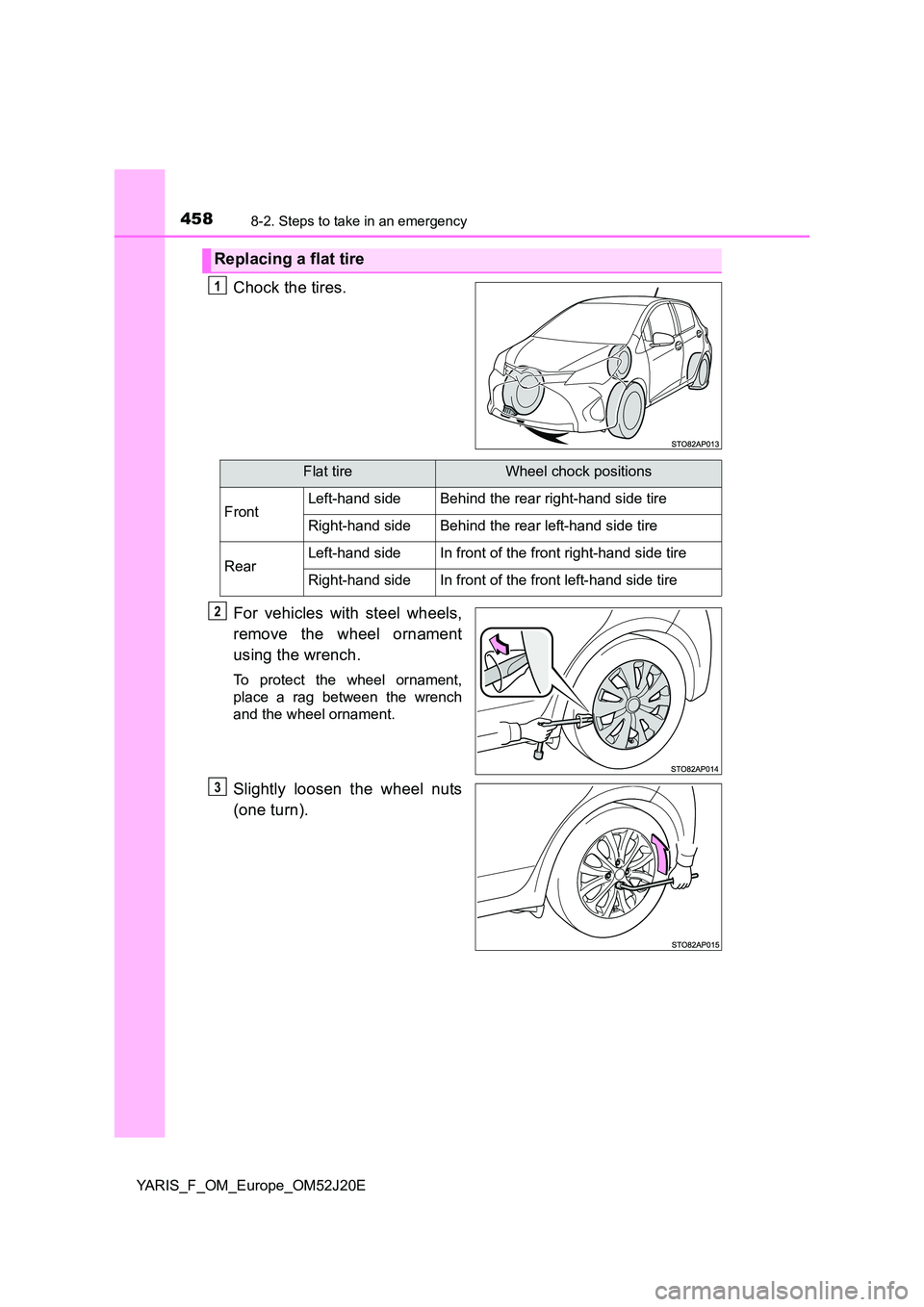
Chock the tires.
For vehicles with steel wheels,
remove the wheel ornament
using the wrench.
To protect the wheel ornament,
place a rag between the wrench
and the wheel ornament.
Slightly loosen the wheel nuts
(one turn).
Replacing a flat tire
1
Flat tireWheel chock positions
FrontLeft-hand sideBehind the rear right-hand side tire
Right-hand sideBehind the rear left-hand side tire
RearLeft-hand sideIn front of the front right-hand side tire
Right-hand sideIn front of the front left-hand side tire
2
3
Page 459 of 549
4598-2. Steps to take in an emergency
8
When trouble arises
YARIS_F_OM_Europe_OM52J20E
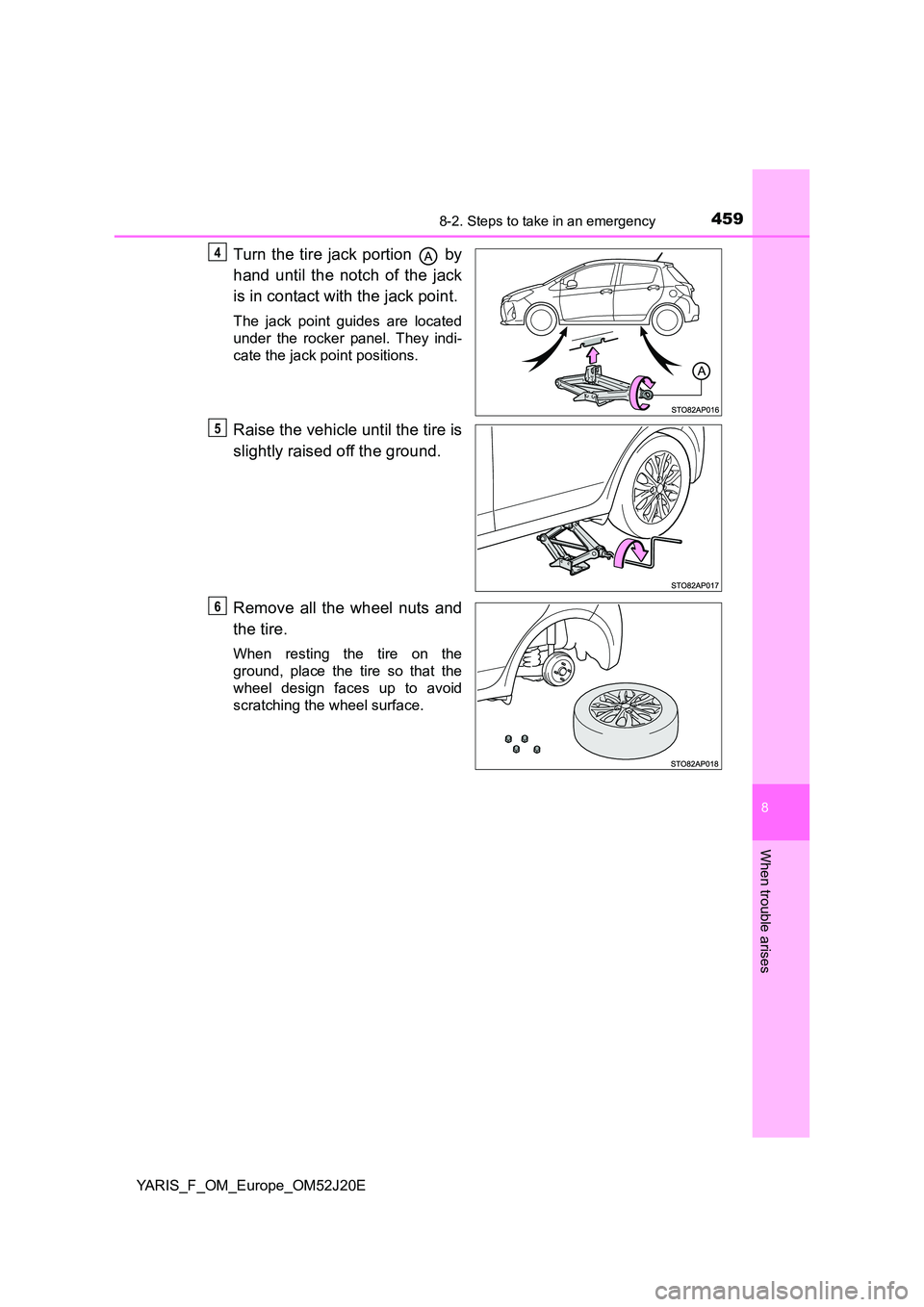
Turn the tire jack portion by
hand until the notch of the jack
is in contact with the jack point.
The jack point guides are located
under the rocker panel. They indi-
cate the jack point positions.
Raise the vehicle until the tire is
slightly raised off the ground.
Remove all the wheel nuts and
the tire.
When resting the tire on the
ground, place the tire so that the
wheel design faces up to avoid
scratching the wheel surface.
4
5
6
Page 463 of 549
4638-2. Steps to take in an emergency
8
When trouble arises
YARIS_F_OM_Europe_OM52J20E
■The compact spare tire
● The compact spare tire is identified by the label “TEMPORARY USE ONLY”
on the tire sidewall.
Use the compact spare tire temporarily, and only in an emergency.
● Make sure to check the tire inflation pressure of the compact spare tire.
( P. 518)
■ After completing the tire change (vehicles with a tire pressure warning
system)
The tire pressure warning system must be reset. ( P. 383)
■ When using the spare tire (include compact spare tire) (vehicles with a
tire pressure warning system)
As the spare tire is not equipped with a tire pressure warning valve and trans-
mitter, low inflation pressure of the spare tire will not be indicated by the tire
pressure warning system. Also, if you r eplace a flat tire with the spare tire
after the tire pressure warning light comes on, the light remains on.
■ If you have a flat front tire on a road covered with snow or ice
Install the compact spare tire on one of the rear wheels of the vehicle. Per-
form the following steps and fit tire chains to the front tires:
Replace a rear tire with the compact spare tire.
Replace the flat front tire with the tire removed from the rear of the vehi-
cle.
Fit tire chains to the front tires.
1
2
3
Page 474 of 549
4748-2. Steps to take in an emergency
YARIS_F_OM_Europe_OM52J20E
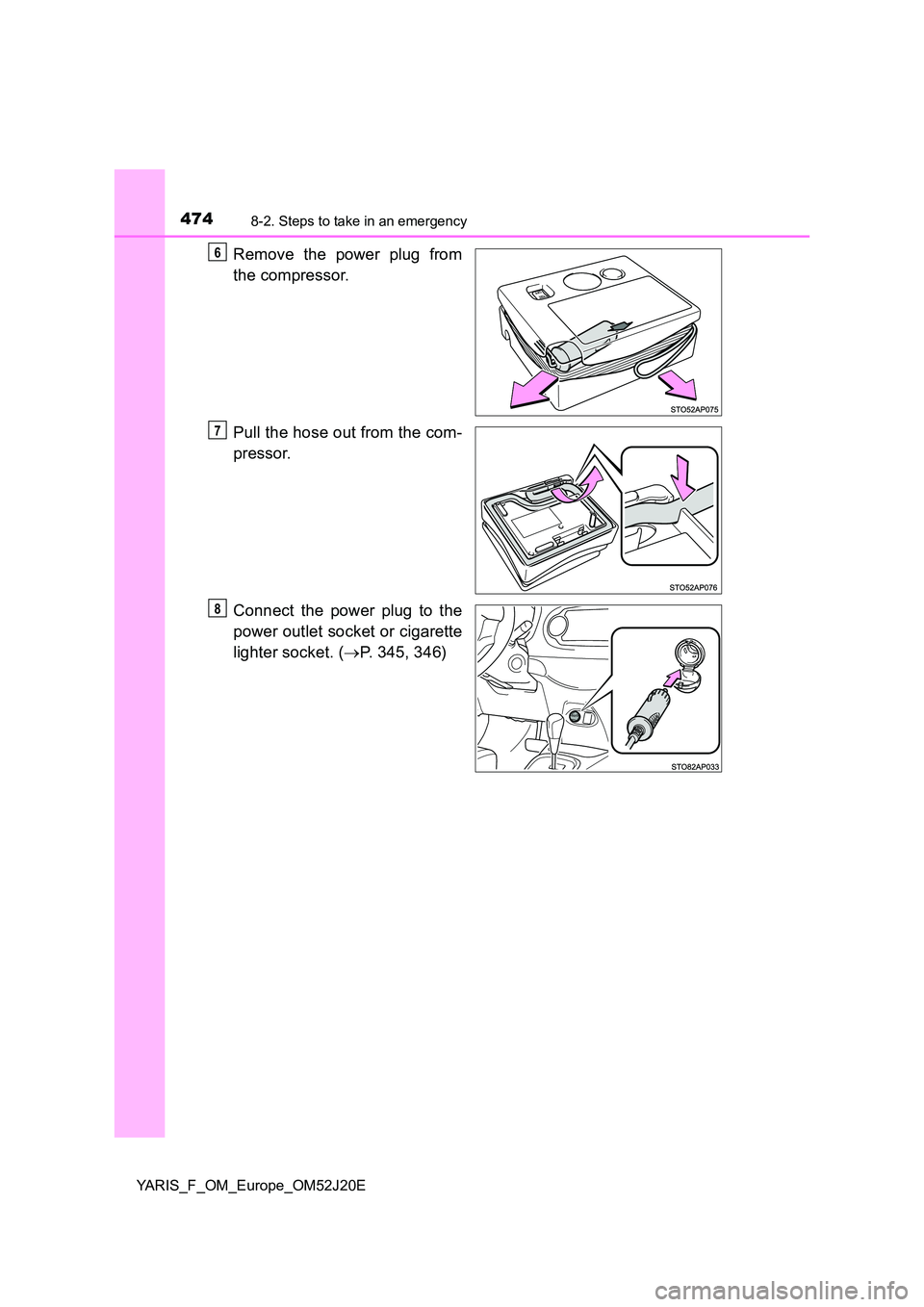
Remove the power plug from
the compressor.
Pull the hose out from the com-
pressor.
Connect the power plug to the
power outlet socket or cigarette
lighter socket. ( P. 345, 346)
6
7
8
Page 477 of 549
4778-2. Steps to take in an emergency
8
When trouble arises
YARIS_F_OM_Europe_OM52J20E
With the compressor switch off, disconnect the nozzle from the
valve on the tire and then pull out the power plug from the power
outlet socket or cigarette lighter.
Some sealant may leak when the hose is removed.
Install the valve cap onto the valve of the emergency repaired tire.
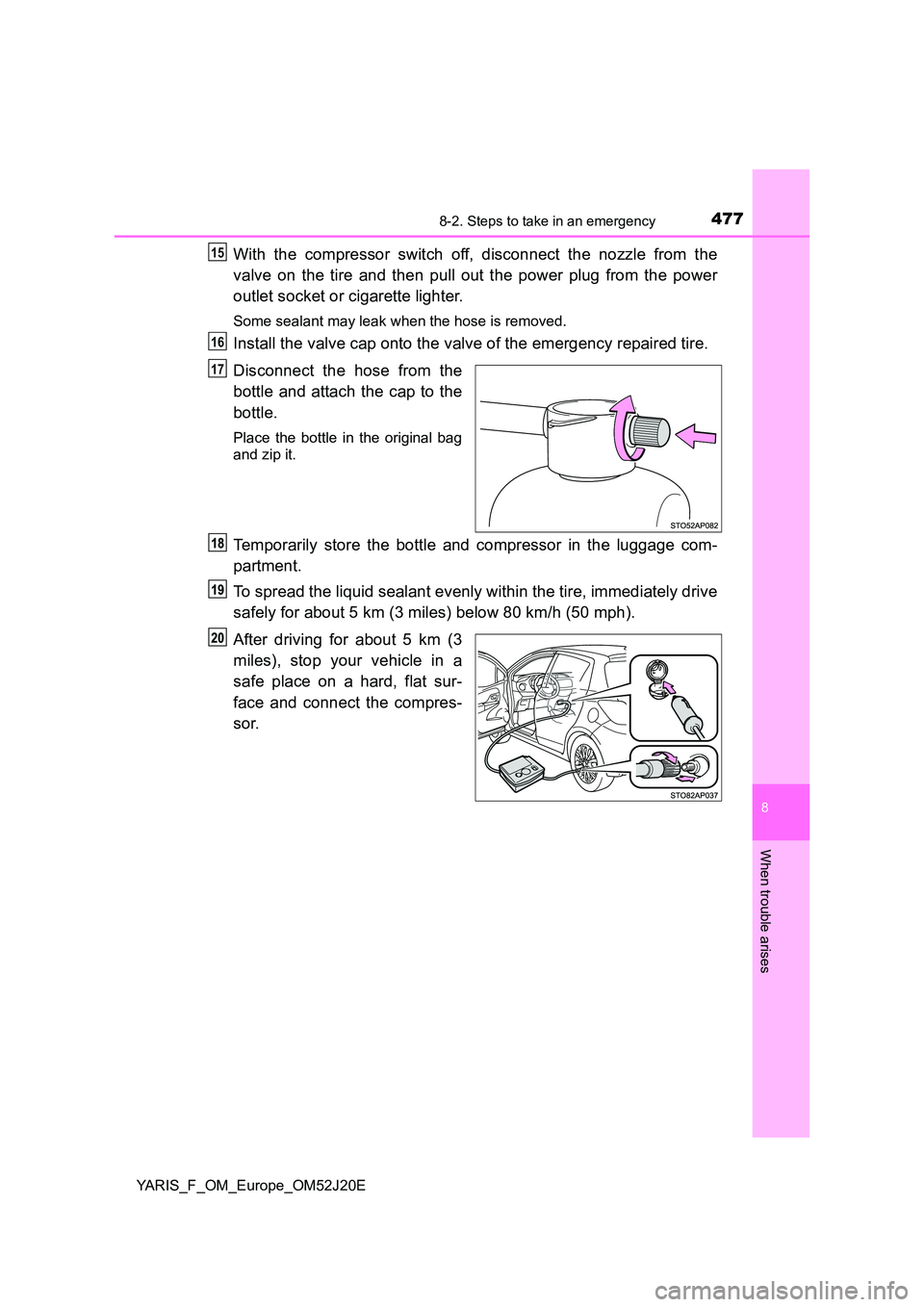
Disconnect the hose from the
bottle and attach the cap to the
bottle.
Place the bottle in the original bag
and zip it.
Temporarily store the bottle and compressor in the luggage com-
partment.
To spread the liquid sealant evenly within the tire, immediately drive
safely for about 5 km (3 miles) below 80 km/h (50 mph).
After driving for about 5 km (3
miles), stop your vehicle in a
safe place on a hard, flat sur-
face and connect the compres-
sor.
15
16
17
Page 479 of 549
4798-2. Steps to take in an emergency
8
When trouble arises
YARIS_F_OM_Europe_OM52J20E
■If the tire is inflated to more than the specified air pressure
Check that the air pressure indicator shows the specified air pressure.
If the air pressure is under the designated pressure, turn the compressor
switch on again and repeat the inflation procedure until the specified air
pressure is reached.
■ After a tire is repaired with the emergency tire puncture repair kit
● The tire pressure warning valve and transmitter should be replaced.
● Even if the tire inflation pressure is at the recommended level, the tire pres-
sure warning light may come on/flash.
■ Note for checking the emergency tire puncture repair kit
Check the sealant expiry date occasionally.
The expiry date is shown on the bottle. Do not use sealant whose expiry date
has already passed. Otherwise, repairs conducted using the emergency tire
puncture repair kit may not be performed properly.
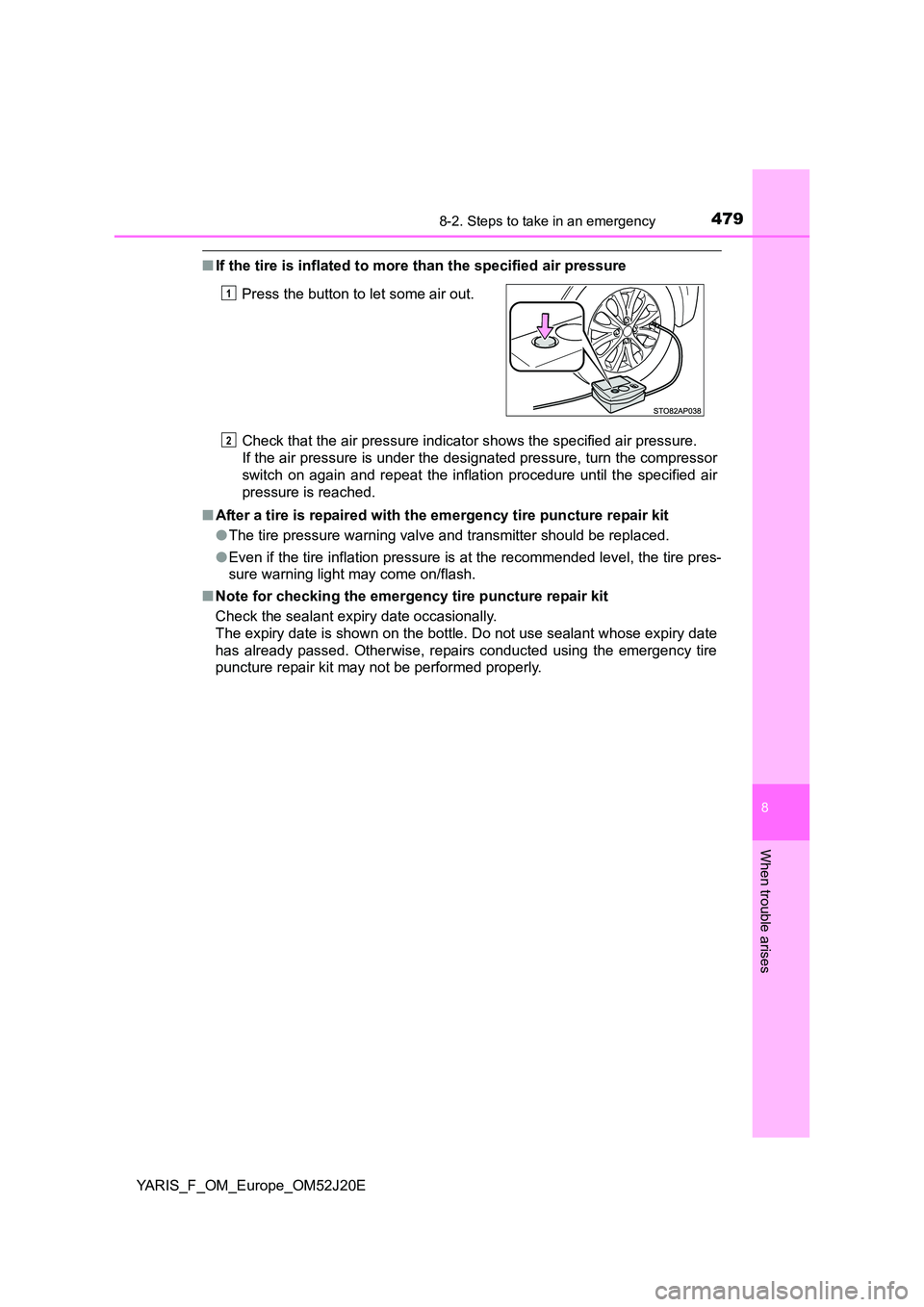
Press the button to let some air out.1
2
Page 484 of 549
4848-2. Steps to take in an emergency
YARIS_F_OM_Europe_OM52J20E
If the engine will not star t
One of the following may be the cause of the problem:
● There may not be sufficient fuel in the vehicle’s tank.
Gasoline engine: Refuel the vehicle.
Diesel engine: P. 4 9 7
● The engine may be flooded. (gasoline engine)
Try to restart the engine again following correct starting procedures.
( P. 182, 185)
● There may be a malfunction in the engine immobilizer system.
( P. 7 6 )
One of the following may be the cause of the problem:
● The battery may be discharged. (P. 488)
● The battery terminal connections may be loose or corroded.
The engine starting system may be malfunctioning due to an electrical
problem such as an open circuit or a blown fuse. However, an interim
measure is available to start the engine. ( P. 485)
If the engine will not start even though correct starting proce-
dures are being followed ( P. 182, 185), consider each of the fol-
lowing points:
The engine will not start even though the starter motor operates
normally.
The starter motor turns over slowly, the interior lights and head-
lights are dim, or the horn does not sound or sounds at a low
volume.
The starter motor does not turn over (vehicles with a smart entry
& start system).
Page 485 of 549
4858-2. Steps to take in an emergency
8
When trouble arises
YARIS_F_OM_Europe_OM52J20E
One of the following may be the cause of the problem:
● One or both of the battery terminals may be disconnected.
● The battery may be discharged. (P. 488)
● There may be a malfunction in the steering lock system (vehicles
with a smart entry & start system).
Contact any authorized Toyota dealer or repairer, or another duly qualified
and equipped professional, if the problem cannot be repaired, or if repair
procedures are unknown.
When the engine does not start, the following steps can be used as an
interim measure to start the engine if the engine switch is functioning
normally:
Set the parking brake.
Shift the shift lever to P (Multidrive) or N (manual transmission).
Turn the engine switch to ACCESSORY mode.
Press and hold the engine switch for about 15 seconds while
depressing the brake pedal (Multidrive) or brake pedal and clutch
pedal (manual transmission) firmly.
Even if the engine can be started using the above steps, the system
may be malfunctioning. Have the vehicle inspected by any authorized
Toyota dealer or repairer, or another duly qualified and equipped pro-
fessional.
The starter motor does not turn over, the interior lights and
headlights do not turn on, or the horn does not sound.
Emergency start function (vehicles with a smart entry & start
system)
1
2
3
4
Page 490 of 549
4908-2. Steps to take in an emergency
YARIS_F_OM_Europe_OM52J20E
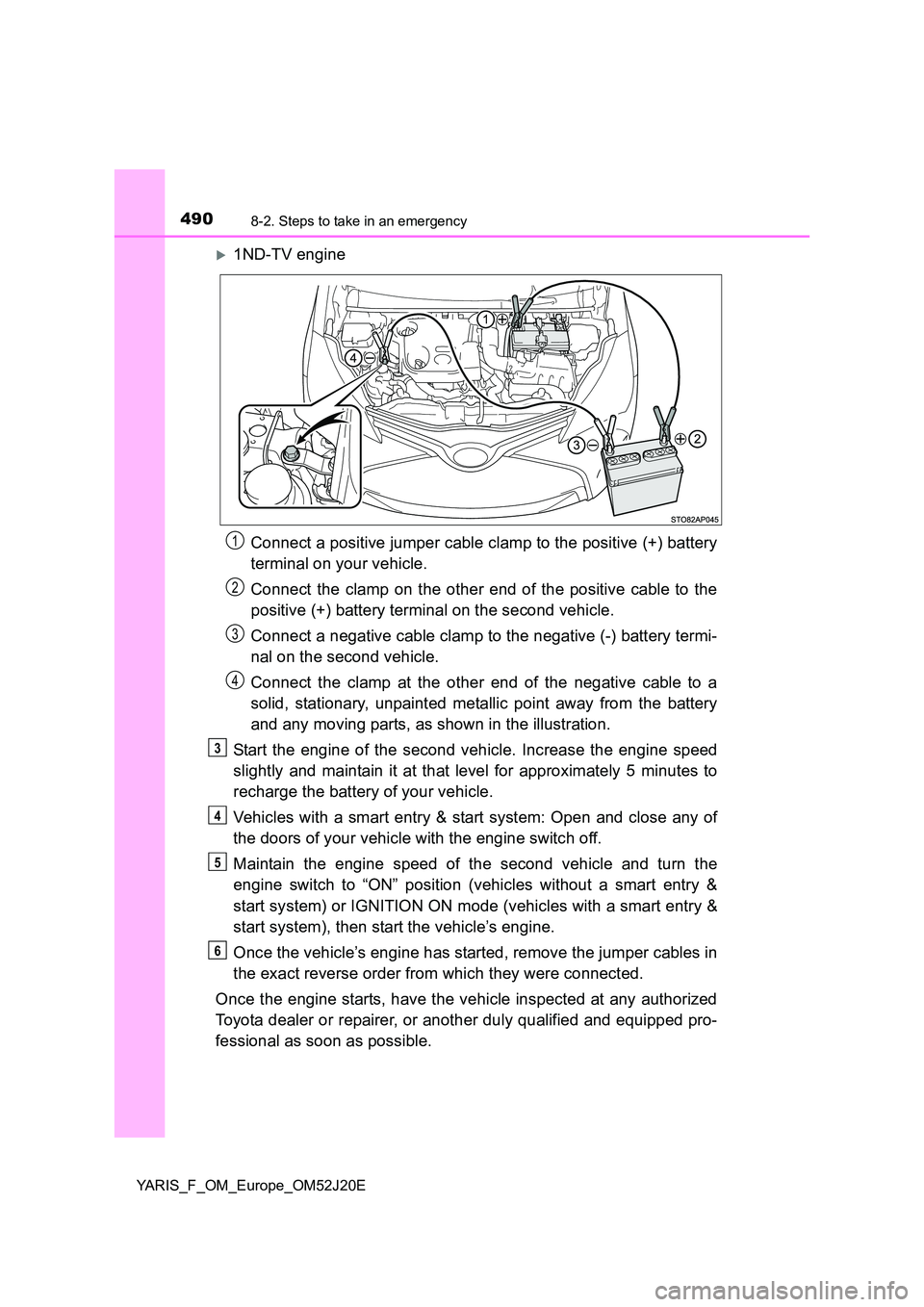
1ND-TV engine
Connect a positive jumper cable clamp to the positive (+) battery
terminal on your vehicle.
Connect the clamp on the other end of the positive cable to the
positive (+) battery terminal on the second vehicle.
Connect a negative cable clamp to the negative (-) battery termi-
nal on the second vehicle.
Connect the clamp at the other end of the negative cable to a
solid, stationary, unpainted metallic point away from the battery
and any moving parts, as shown in the illustration.
Start the engine of the second vehicle. Increase the engine speed
slightly and maintain it at that level for approximately 5 minutes to
recharge the battery of your vehicle.
Vehicles with a smart entry & start system: Open and close any of
the doors of your vehicle with the engine switch off.
Maintain the engine speed of the second vehicle and turn the
engine switch to “ON” position (vehicles without a smart entry &
start system) or IGNITION ON mode (vehicles with a smart entry &
start system), then start the vehicle’s engine.
Once the vehicle’s engine has started, remove the jumper cables in
the exact reverse order from which they were connected.
Once the engine starts, have the vehicle inspected at any authorized
Toyota dealer or repairer, or another duly qualified and equipped pro-
fessional as soon as possible.
1
2
3
4
3
4
5
6
Page 491 of 549
4918-2. Steps to take in an emergency
8
When trouble arises
YARIS_F_OM_Europe_OM52J20E
■Starting the engine when the battery is discharged (vehicles with a
Multidrive)
The engine cannot be started by push-starting.
■ To prevent battery discharge
● Turn off the headlights and the audio system while the engine is off.
● Turn off any unnecessary electrical components when the vehicle is running
at a low speed for an extended period, such as in heavy traffic.
■ Charging the battery
The electricity stored in the battery will discharge gradually even when the
vehicle is not in use, due to natural discharge and the draining effects of cer-
tain electrical appliances. If the vehicle is left for a long time, the battery may
discharge, and the engine may be unable to start. (The battery recharges
automatically during driving.)
■ Precautions when the battery is discharged (vehicles with a smart entry
& start system)
● In some cases, it may not be possible to unlock the doors using the smart
entry & start system when the battery is discharged. Use the wireless
remote control or the mechanical key to lock or unlock the doors.
● The engine may not start on the first attempt after the battery has recharged
but will start normally after the second attempt. This is not a malfunction.
● The engine switch mode is memorized by the vehicle. When the battery is
reconnected, the system will return to the mode it was in before the battery
was discharged. Before disconnecting the battery, turn the engine switch off.
If you are unsure what mode the engine switch was in before the battery dis-
charged, be especially careful when reconnecting the battery.