Fuel system TOYOTA YARIS 2017 User Guide
[x] Cancel search | Manufacturer: TOYOTA, Model Year: 2017, Model line: YARIS, Model: TOYOTA YARIS 2017Pages: 549, PDF Size: 33.09 MB
Page 99 of 549
992. Instrument cluster
2
Instrument cluster
YARIS_F_OM_Europe_OM52J20E
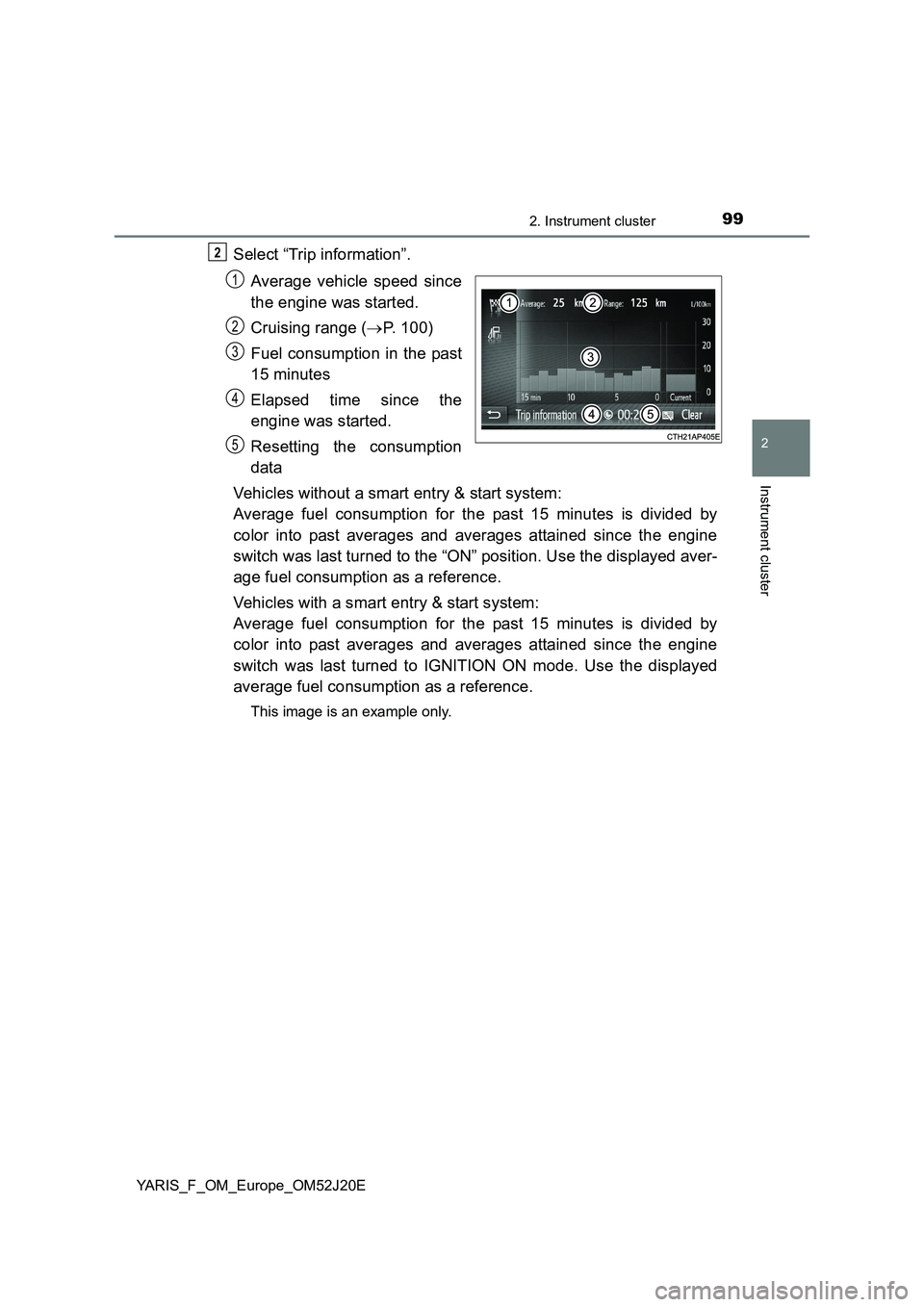
Select “Trip information”.
Average vehicle speed since
the engine was started.
Cruising range ( P. 100)
Fuel consumption in the past
15 minutes
Elapsed time since the
engine was started.
Resetting the consumption
data
Vehicles without a smart entry & start system:
Average fuel consumption for the past 15 minutes is divided by
color into past averages and averages attained since the engine
switch was last turned to the “ON” position. Use the displayed aver-
age fuel consumption as a reference.
Vehicles with a smart entry & start system:
Average fuel consumption for the past 15 minutes is divided by
color into past averages and averages attained since the engine
switch was last turned to IGNITION ON mode. Use the displayed
average fuel consumption as a reference.
This image is an example only.
2
1
2
3
4
5
Page 100 of 549
1002. Instrument cluster
YARIS_F_OM_Europe_OM52J20E
Press the button on the
navigation/multimedia system.
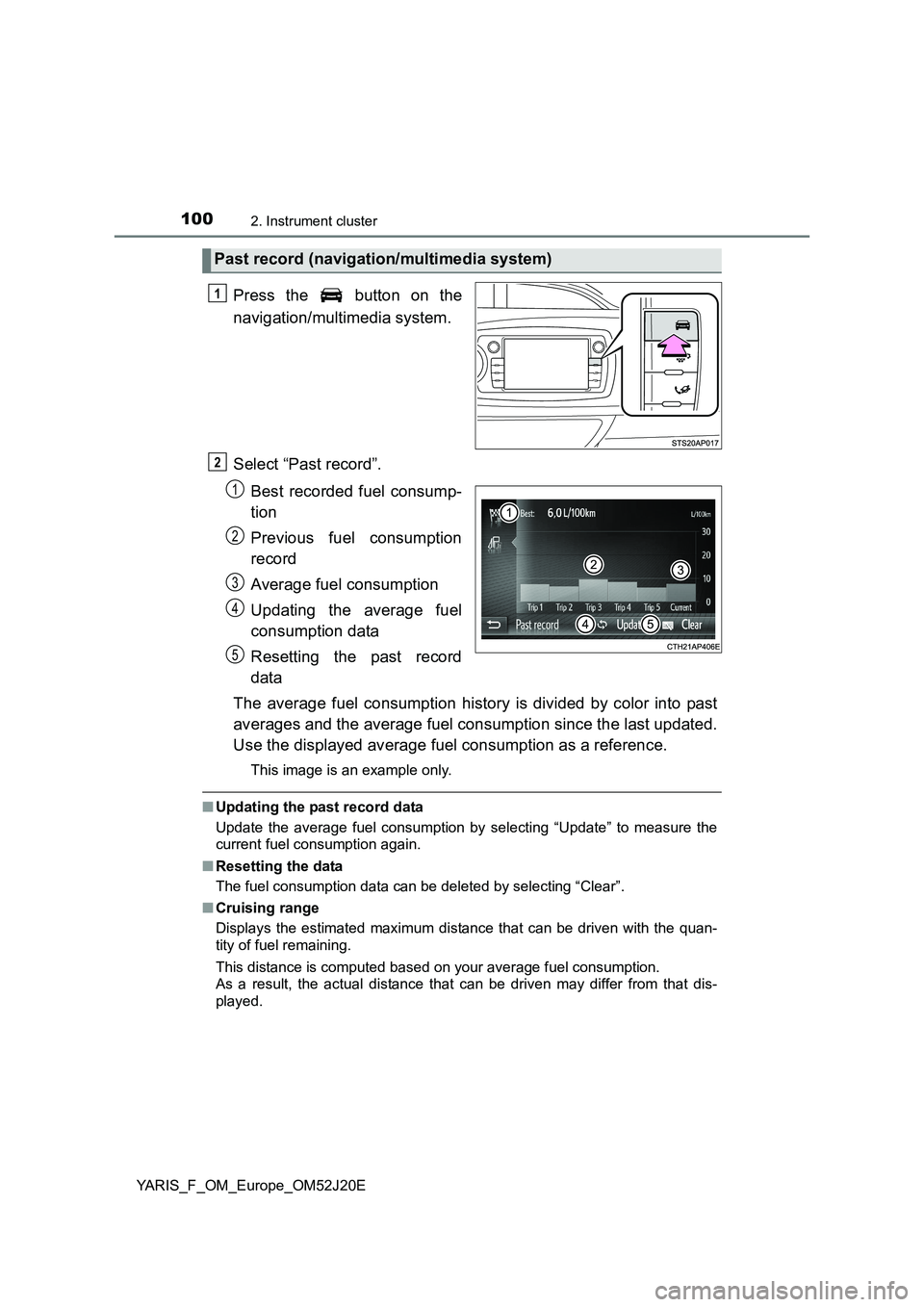
Select “Past record”.
Best recorded fuel consump-
tion
Previous fuel consumption
record
Average fuel consumption
Updating the average fuel
consumption data
Resetting the past record
data
The average fuel consumption history is divided by color into past
averages and the average fuel consumption since the last updated.
Use the displayed average fuel consumption as a reference.
This image is an example only.
■ Updating the past record data
Update the average fuel consumption by selecting “Update” to measure the
current fuel consumption again.
■ Resetting the data
The fuel consumption data can be deleted by selecting “Clear”.
■ Cruising range
Displays the estimated maximum distance that can be driven with the quan-
tity of fuel remaining.
This distance is computed based on your average fuel consumption.
As a result, the actual distance that can be driven may differ from that dis-
played.
Past record (navigation/multimedia system)
1
2
1
2
3
4
5
Page 159 of 549
159
4Driving
YARIS_F_OM_Europe_OM52J20E
4-1. Before driving
Driving the vehicle ............. 160
Cargo and luggage ............ 171
Trailer towing ..................... 173
4-2. Driving procedures
Engine (ignition) switch
(vehicles without
a smart entry &
start system) .................... 182
Engine (ignition) switch
(vehicles with
a smart entry &
start system) .................... 185
Multidrive ........................... 191
Manual transmission.......... 197
Turn signal lever ................ 201
Parking brake .................... 202
4-3. Operating the lights
and wipers
Headlight switch ................ 203
Fog light switch .................. 209
Windshield wiper and
washer ............................. 211
Rear window wiper and
washer ............................. 215
4-4. Refueling
Opening the fuel tank
cap ................................... 217
4-5. Toyota Safety Sense
Toyota Safety Sense ......... 220
PCS
(Pre-Crash Safety
system) ............................ 226
LDA
(Lane Departure Alert) ..... 240
Automatic High Beam ........ 245
4-6. Using the driving support
systems
Cruise control..................... 249
Speed limiter ...................... 253
Stop & start system............ 257
Driving assist systems ....... 265
Diesel particulate filter
system ............................. 270
4-7. Driving tips
Winter driving tips .............. 272
Page 217 of 549
217
4
4-4. Refueling
Driving
YARIS_F_OM_Europe_OM52J20E
Opening the fuel tank cap
●Vehicles without a smart entry & start system
Turn the engine switch to the “LOCK” position and ensure that all
the doors and windows are closed.
● Vehicles with a smart entry & start system
Turn the engine switch off and ensure that all the doors and win-
dows are closed.
● Confirm the type of fuel.
■Fuel types
P. 522
Perform the following steps to open the fuel tank cap:
Before refueling the vehicle
Page 218 of 549
2184-4. Refueling
YARIS_F_OM_Europe_OM52J20E
WARNING
■When refueling the vehicle
Observe the following precautions while refueling the vehicle. Failure to do
so may result in death or serious injury.
● After exiting the vehicle and before opening the fuel door, touch an
unpainted metal surface to discharge any static electricity. It is important to
discharge static electricity before refueling because sparks resulting from
static electricity can cause fuel vapors to ignite while refueling.
● Always hold the grips on the fuel tank cap and turn it slowly to remove it.
A whooshing sound may be heard when the fuel tank cap is loosened.
Wait until the sound cannot be heard before fully removing the cap. In hot
weather, pressurized fuel may spray out the filler neck and cause injury.
● Do not allow anyone that has not discharged static electricity from their
body to come close to an open fuel tank.
● Do not inhale vaporized fuel.
Fuel contains substances that are harmful if inhaled.
● Do not smoke while refueling the vehicle.
Doing so may cause the fuel to ignite and cause a fire.
● Do not return to the vehicle or touch any person or object that is statically
charged.
This may cause static electricity to build up, resulting in a possible ignition
hazard.
■ When refueling
Observe the following precautions to pr event fuel overflowing from the fuel
tank:
● Securely insert the fuel nozzle into the fuel filler neck.
● Stop filling the tank after the fuel nozzle automatically clicks off.
● Do not top off the fuel tank.
NOTICE
■Refueling
Do not spill fuel during refueling.
Doing so may damage the vehicle, such as causing the emission control
system to operate abnormally or damaging fuel system components or the
vehicle’s painted surface.
Page 271 of 549
2714-6. Using the driving support systems
4
Driving
YARIS_F_OM_Europe_OM52J20E
WARNING
■Exhaust pipe
Do not touch the exhaust pipe during cleaning, as the exhaust pipe and
exhaust gases will become particularly hot. Also, make sure that there are
no people or flammable materials near the exhaust pipe while the vehicle is
stopped.
Failure to do so may cause injury by burning or a fire.
NOTICE
■ To prevent the DPF system from failing
● Do not use fuel other than the specified type
● Do not use engine oil other than the recommended type
● Do not modify the exhaust pipe
Page 328 of 549
3286-1. Using the air conditioning system and defogger
YARIS_F_OM_Europe_OM52J20E
Power heater
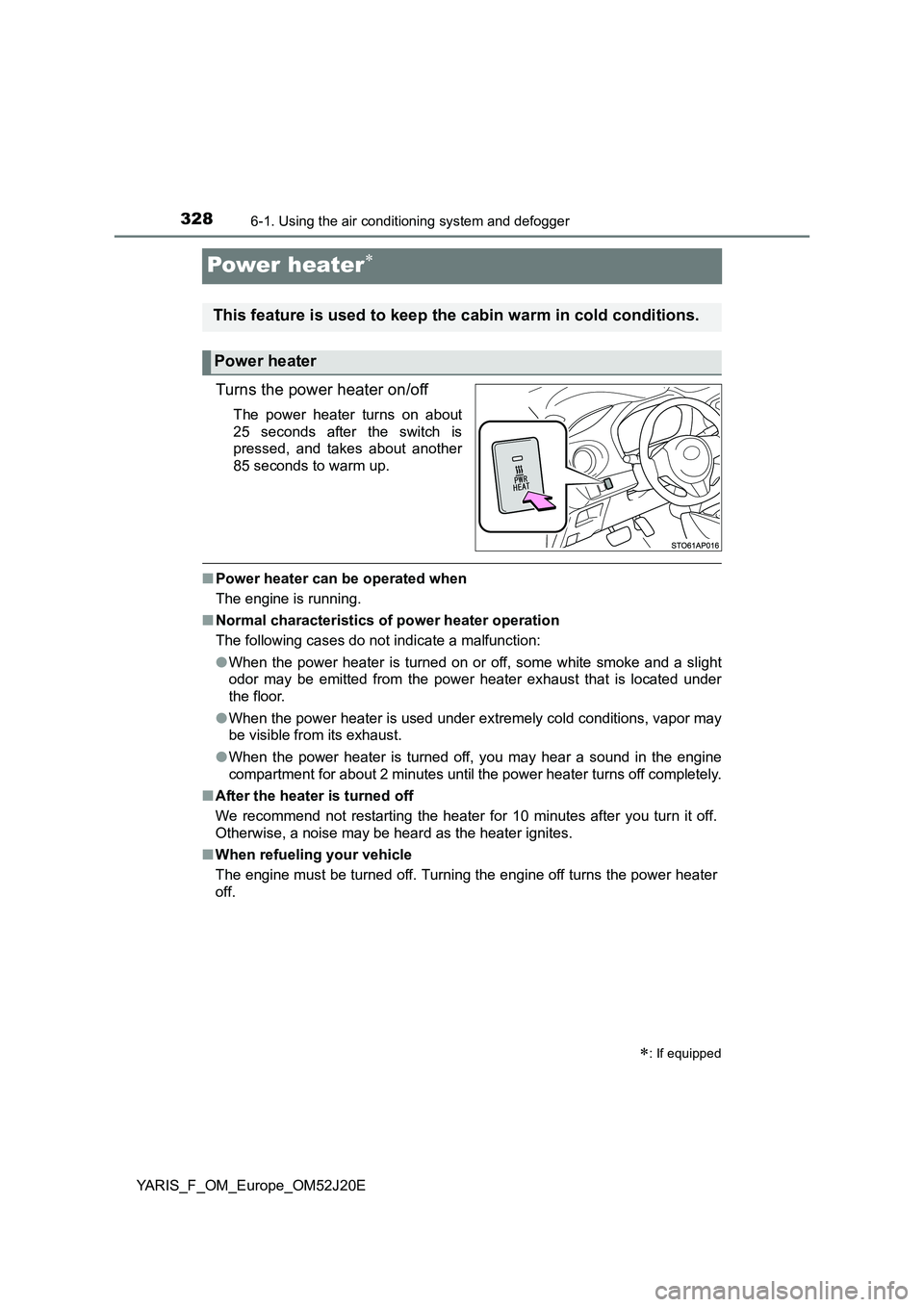
Turns the power heater on/off
The power heater turns on about
25 seconds after the switch is
pressed, and takes about another
85 seconds to warm up.
■ Power heater can be operated when
The engine is running.
■ Normal characteristics of power heater operation
The following cases do not indicate a malfunction:
● When the power heater is turned on or off, some white smoke and a slight
odor may be emitted from the power heater exhaust that is located under
the floor.
● When the power heater is used under extremely cold conditions, vapor may
be visible from its exhaust.
● When the power heater is turned off, you may hear a sound in the engine
compartment for about 2 minutes until the power heater turns off completely.
■ After the heater is turned off
We recommend not restarting the heater for 10 minutes after you turn it off.
Otherwise, a noise may be heard as the heater ignites.
■ When refueling your vehicle
The engine must be turned off. Turning the engine off turns the power heater
off.
: If equipped
This feature is used to keep the cabin warm in cold conditions.
Power heater
Page 329 of 549
3296-1. Using the air conditioning system and defogger
6
Interior features
YARIS_F_OM_Europe_OM52J20E
WARNING
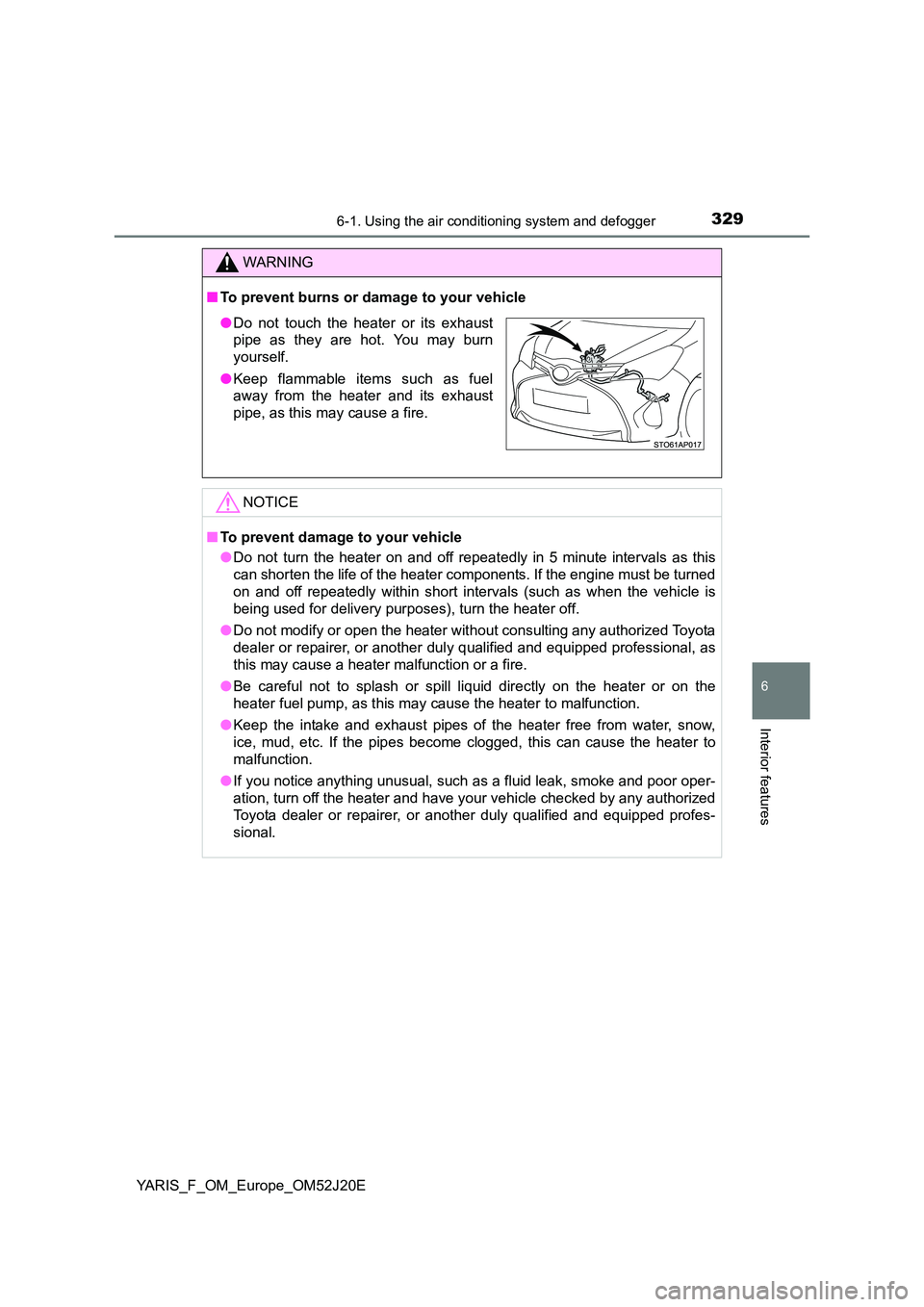
■To prevent burns or damage to your vehicle
NOTICE
■To prevent damage to your vehicle
● Do not turn the heater on and off repeatedly in 5 minute intervals as this
can shorten the life of the heater components. If the engine must be turned
on and off repeatedly within short intervals (such as when the vehicle is
being used for delivery purposes), turn the heater off.
● Do not modify or open the heater without consulting any authorized Toyota
dealer or repairer, or another dul y qualified and equipped professional, as
this may cause a heater malfunction or a fire.
● Be careful not to splash or spill liquid directly on the heater or on the
heater fuel pump, as this may cause the heater to malfunction.
● Keep the intake and exhaust pipes of the heater free from water, snow,
ice, mud, etc. If the pipes become clogged, this can cause the heater to
malfunction.
● If you notice anything unusual, such as a fluid leak, smoke and poor oper-
ation, turn off the heater and have your vehicle checked by any authorized
Toyota dealer or repairer, or another duly qualified and equipped profes-
sional.
● Do not touch the heater or its exhaust
pipe as they are hot. You may burn
yourself.
● Keep flammable items such as fuel
away from the heater and its exhaust
pipe, as this may cause a fire.
Page 350 of 549
3507-1. Maintenance and care
YARIS_F_OM_Europe_OM52J20E
Cleaning and protecting the vehicle exterior
●Working from top to bottom, liberally apply water to the vehicle
body, wheel wells and underside of the vehicle to remove any dirt
and dust.
● Wash the vehicle body using a sponge or soft cloth, such as a
chamois.
● For hard-to-remove marks, use car wash soap and rinse thoroughly
with water.
● Wipe away any water.
● Wax the vehicle when the waterproof coating deteriorates.
If water does not bead on a clean surface, apply wax when the vehicle
body is cool.
■ Automatic car washes
● Fold the mirrors and remove the antenna before washing the vehicle. Start
washing from the front of the vehicle. Make sure to re-install the antenna
and extend the mirrors before driving.
● Brushes used in automatic car washes may scratch the vehicle surface and
harm your vehicle’s paint.
● Rear spoiler (if equipped) may not be washable in some automatic car
washes. There may also be an increased risk of damage to vehicle.
■ High pressure car washes
● Do not allow the nozzles of the car wash to come within close proximity of
the windows and door borders, and high mounted stoplight.
● Before using the car wash, check that the fuel filler door on your vehicle is
closed properly.
■ When using a car wash (vehicles with a smart entry & start system)
If the door handle becomes wet while the electronic key is within the effective
range, the door may lock and unlock repeatedly. Place the key in a position
2 m (6 ft.) or more separate from the vehicle while the vehicle is being
washed. (Take care to ensure that the key is not stolen.)
Perform the following to protect the vehicle and maintain it in
prime condition:
Page 360 of 549
3607-3. Do-it-yourself maintenance
YARIS_F_OM_Europe_OM52J20E
WARNING
The engine compartment contains many mechanisms and fluids that may
move suddenly, become hot, or become electrically energized. To avoid
death or serious injury, observe the following precautions.
■ When working on the engine compartment
● Keep hands, clothing and tools away from the moving fan and engine
drive belt.
● Be careful not to touch the engine, radiator, exhaust manifold, etc. right
after driving as they may be hot. Oil and other fluids may also be hot.
● Do not leave anything that may burn easily, such as paper and rags, in the
engine compartment.
● Do not smoke, cause sparks or expose an open flame to fuel on the bat-
tery. Fuel and battery fumes are flammable.
● Be extremely cautious when working on the battery. It contains poisonous
and corrosive sulfuric acid.
● Take care because brake fluid can harm your hands or eyes and damage
painted surfaces. If fluid gets on your hands or in your eyes, flush the
affected area with clean water immediately.
If you still experience discomfort, consult a doctor.
■ When working near the electric cooling fan or radiator grille
Vehicles without a smart entry & start system
Be sure the engine switch is in the “LOCK” position.
With the engine switch in the “ON” position, the electric cooling fan may
automatically start to run if the air conditioning is on and/or the coolant tem-
perature is high. ( P. 375)
Vehicles with a smart entry & start system
Be sure the engine switch is off.
With the engine switch in IGNITION ON mode, the electric cooling fan may
automatically start to run if the air conditioning is on and/or the coolant tem-
perature is high. ( P. 375)
■ Safety glasses
Wear safety glasses to prevent flying or falling material, fluid spray, etc.
from getting in your eyes.