tires TOYOTA YARIS 2017 Owner's Guide
[x] Cancel search | Manufacturer: TOYOTA, Model Year: 2017, Model line: YARIS, Model: TOYOTA YARIS 2017Pages: 549, PDF Size: 33.09 MB
Page 455 of 549
4558-2. Steps to take in an emergency
8
When trouble arises
YARIS_F_OM_Europe_OM52J20E
WARNING
■Using the tire jack
Observe the following precautions.
Improper use of the tire jack may cause the vehicle to suddenly fall off the
jack, leading to death or serious injury.
● Do not use the tire jack for any purpose other than replacing tires or install-
ing and removing tire chains.
● Only use the tire jack that comes with this vehicle for replacing a flat tire.
Do not use it on other vehicles, and do not use other tire jacks for replac-
ing tires on this vehicle.
● Put the jack properly in its jack point.
● Do not put any part of your body under the vehicle while it is supported by
the jack.
● Do not start the engine or drive the vehicle while the vehicle is supported
by the jack.
● Do not raise the vehicle while someone is inside.
● When raising the vehicle, do not put an object on or under the jack.
● Do not raise the vehicle to a height greater than that required to replace
the tire.
● Use a jack stand if it is necessary to get under the vehicle.
● When lowering the vehicle, make sure that there is no-one near the vehi-
cle. If there are people nearby, warn them vocally before lowering.
Page 458 of 549
4588-2. Steps to take in an emergency
YARIS_F_OM_Europe_OM52J20E
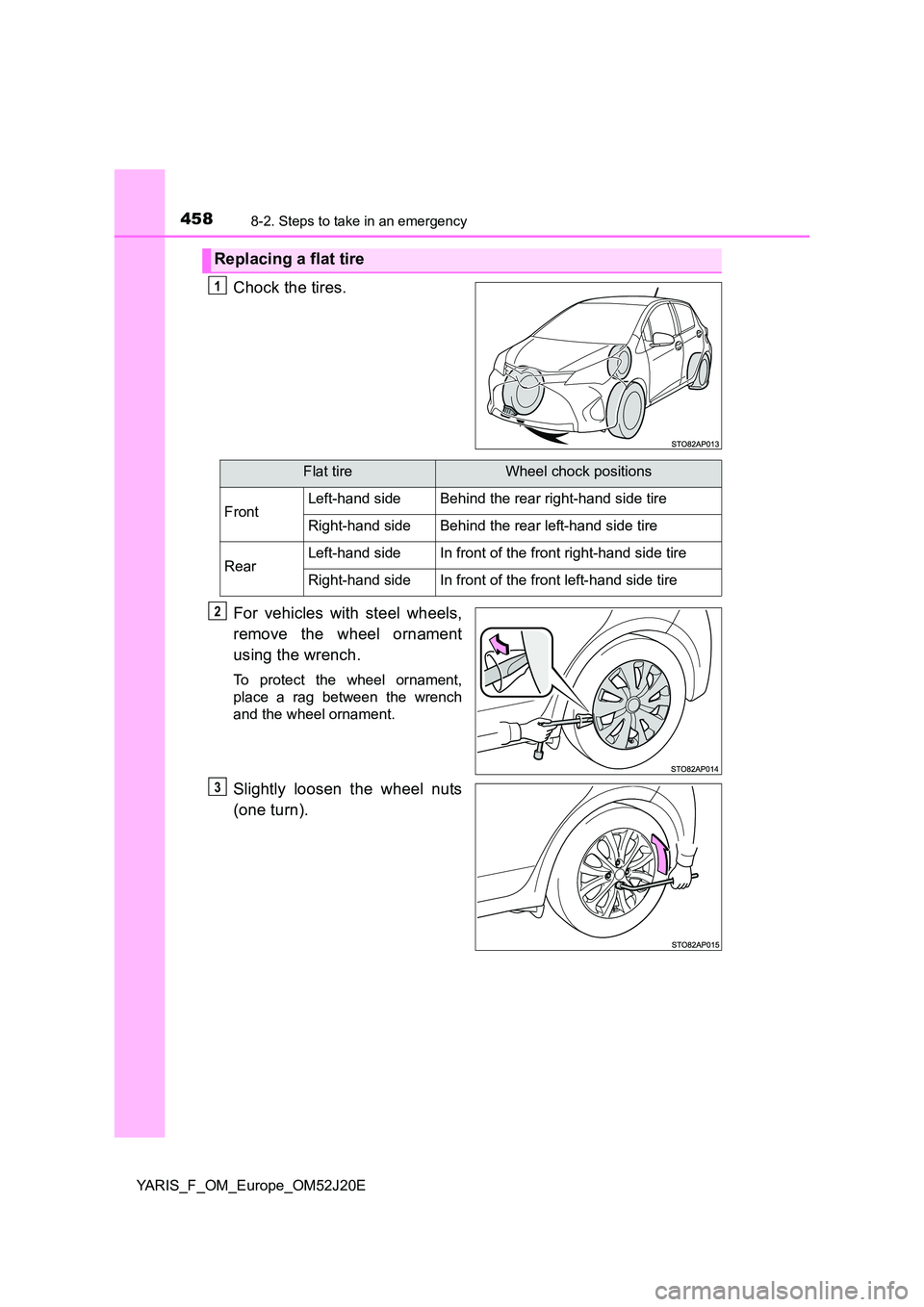
Chock the tires.
For vehicles with steel wheels,
remove the wheel ornament
using the wrench.
To protect the wheel ornament,
place a rag between the wrench
and the wheel ornament.
Slightly loosen the wheel nuts
(one turn).
Replacing a flat tire
1
Flat tireWheel chock positions
FrontLeft-hand sideBehind the rear right-hand side tire
Right-hand sideBehind the rear left-hand side tire
RearLeft-hand sideIn front of the front right-hand side tire
Right-hand sideIn front of the front left-hand side tire
2
3
Page 463 of 549
4638-2. Steps to take in an emergency
8
When trouble arises
YARIS_F_OM_Europe_OM52J20E
■The compact spare tire
● The compact spare tire is identified by the label “TEMPORARY USE ONLY”
on the tire sidewall.
Use the compact spare tire temporarily, and only in an emergency.
● Make sure to check the tire inflation pressure of the compact spare tire.
( P. 518)
■ After completing the tire change (vehicles with a tire pressure warning
system)
The tire pressure warning system must be reset. ( P. 383)
■ When using the spare tire (include compact spare tire) (vehicles with a
tire pressure warning system)
As the spare tire is not equipped with a tire pressure warning valve and trans-
mitter, low inflation pressure of the spare tire will not be indicated by the tire
pressure warning system. Also, if you r eplace a flat tire with the spare tire
after the tire pressure warning light comes on, the light remains on.
■ If you have a flat front tire on a road covered with snow or ice
Install the compact spare tire on one of the rear wheels of the vehicle. Per-
form the following steps and fit tire chains to the front tires:
Replace a rear tire with the compact spare tire.
Replace the flat front tire with the tire removed from the rear of the vehi-
cle.
Fit tire chains to the front tires.
1
2
3
Page 467 of 549
4678-2. Steps to take in an emergency
8
When trouble arises
YARIS_F_OM_Europe_OM52J20E
NOTICE
■Do not drive the vehicle with a flat tire
Do not continue driving with a flat tire.
Driving even a short distance with a flat tire can damage the tire and the
wheel beyond repair.
■ Be careful when driving over bumps with the compact spare tire
installed on the vehicle
The vehicle becomes lower when driving with the compact spare tire com-
pared to when driving with standard tires. Be careful when driving over
uneven road surfaces.
■ Driving with tire chains and the compact spare tire
Do not fit tire chains to the compact spare tire.
Tire chains may damage the vehicle body and adversely affect driving per-
formance.
■ When replacing the tires (vehicles with a tire pressure warning system)
When removing or fitting the wheels, tire s or the tire pressure warning valve
and transmitter, contact any authorized Toyota dealer or repairer, or
another duly qualified and equipped professional as the tire pressure warn-
ing valve and transmitter may be damaged if not handled correctly.
Page 469 of 549
4698-2. Steps to take in an emergency
8
When trouble arises
YARIS_F_OM_Europe_OM52J20E
●Stop the vehicle in a safe place on a hard, flat surface.
● Set the parking brake.
● Shift the shift lever to P (Multidrive) or N (manual transmission).
● Stop the engine.
● Turn on the emergency flashers. (P. 428)
● Check the degree of the tire damage.
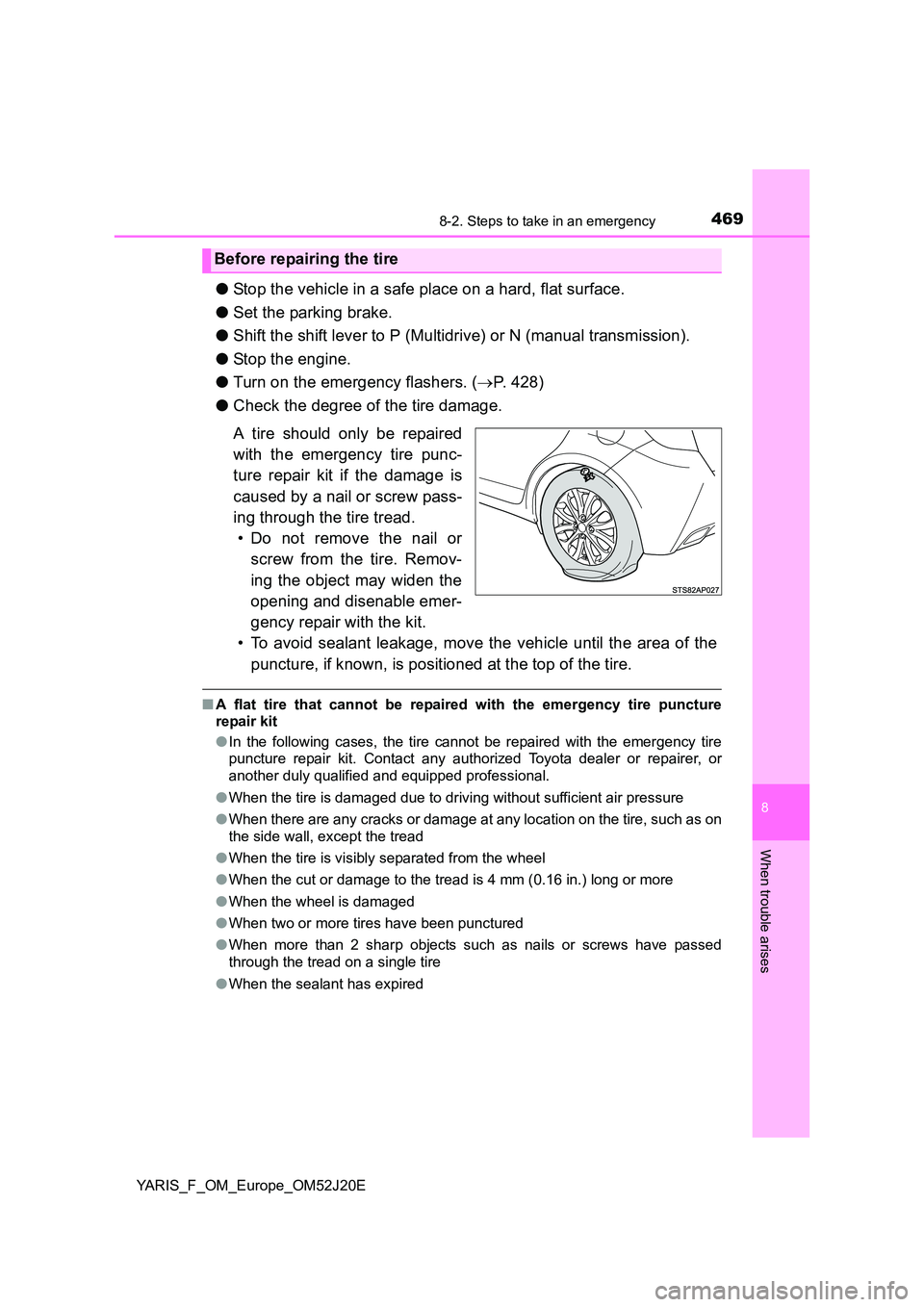
A tire should only be repaired
with the emergency tire punc-
ture repair kit if the damage is
caused by a nail or screw pass-
ing through the tire tread.
• Do not remove the nail or
screw from the tire. Remov-
ing the object may widen the
opening and disenable emer-
gency repair with the kit.
• To avoid sealant leakage, move the vehicle until the area of the
puncture, if known, is positioned at the top of the tire.
■ A flat tire that cannot be repaired with the emergency tire puncture
repair kit
● In the following cases, the tire cannot be repaired with the emergency tire
puncture repair kit. Contact any authorized Toyota dealer or repairer, or
another duly qualified and equipped professional.
● When the tire is damaged due to driving without sufficient air pressure
● When there are any cracks or damage at any location on the tire, such as on
the side wall, except the tread
● When the tire is visibly separated from the wheel
● When the cut or damage to the tread is 4 mm (0.16 in.) long or more
● When the wheel is damaged
● When two or more tires have been punctured
● When more than 2 sharp objects such as nails or screws have passed
through the tread on a single tire
● When the sealant has expired
Before repairing the tire
Page 480 of 549
4808-2. Steps to take in an emergency
YARIS_F_OM_Europe_OM52J20E
■ Emergency tire puncture repair kit
● The sealant stored in the emergency tire puncture repair kit can be used
only once to temporarily repair a single tire. If the sealant has been used
and needs to be replaced, purchase a new bottle at any authorized Toyota
dealer or repairer, or another duly qualified and equipped professional. The
compressor is reusable.
● The sealant can be used when the outside temperature is from -30°C
(-22°F) to 60°C (140°F).
● The repair kit is exclusively designed for size and type of tires originally
installed on your vehicle. Do not use it for tires that a different size than the
original ones, or for any other purposes.
● The sealant has a limited lifespan. The expiry date is marked on the bottle.
The bottle of sealant should be replaced with a new bottle before the expiry
date. Contact any authorized Toyota dealer or repairer, or another duly
qualified and equipped professional for replacement.
● If the sealant gets on your clothes, it may stain.
● If the sealant adheres to a wheel or the surface of the vehicle body, the stain
may not be removable if it is not cleaned at once. Immediately wipe away
the sealant with a wet cloth.
● During operation of the repair kit, a loud operation noise is produced. This
does not indicate a malfunction.
● Do not use to check or to adjust the tire pressure.
WARNING
■Do not drive the vehicle with a flat tire
Do not continue driving with a flat tire.
Driving even a short distance with a flat tire can damage the tire and the
wheel beyond repair.
Driving with a flat tire may cause a circumferential groove on the side wall.
In such a case, the tire may explode when using a repair kit.
■ Caution while driving
● Store the repair kit in the luggage room.
Injuries may result in the event of an accident or sudden braking.
● The repair kit is exclusively only for your vehicle.
Do not use repair kit on other vehicles, which could lead to an accident
causing death or serious injury.
● Do not use repair kit for tires that are different size than the original ones,
or for any other purpose. If the tires have not been completely repaired, it
could lead to an accident causing death or serious injury.
Page 499 of 549
4998-2. Steps to take in an emergency
8
When trouble arises
YARIS_F_OM_Europe_OM52J20E
If the vehicle becomes stuck
Stop the engine. Set the parking brake and shift the shift lever to P
(Multidrive) or N (manual transmission).
Remove the mud, snow or sand from around the front wheels.
Place wood, stones or some other material under the front wheels
to help provide traction.
Restart the engine.
Shift the shift lever to D or R (Multidrive) or 1 or R (manual trans-
mission) and release the parking brake. Then, while exercising cau-
tion, depress the accelerator pedal.
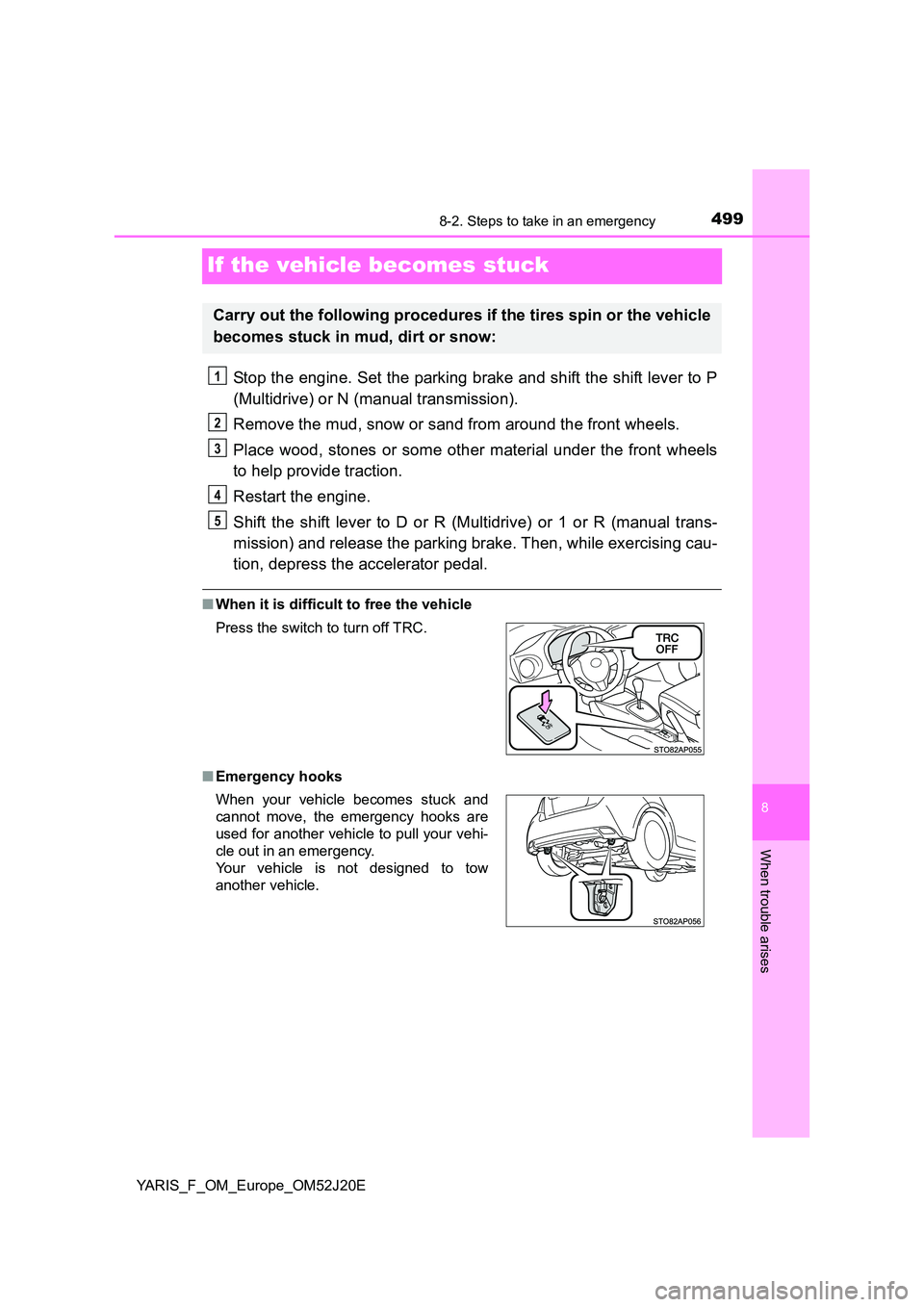
■ When it is difficult to free the vehicle
■ Emergency hooks
Carry out the following procedures if the tires spin or the vehicle
becomes stuck in mud, dirt or snow:
Press the switch to turn off TRC.
When your vehicle becomes stuck and
cannot move, the emergency hooks are
used for another vehicle to pull your vehi-
cle out in an emergency.
Your vehicle is not designed to tow
another vehicle.
1
2
3
4
5
Page 503 of 549
5039-1. Specifications
9
Vehicle specifications
YARIS_F_OM_Europe_OM52J20E
*1: Unladen vehicles
*2: Vehicles with rough road package (without raised vehicle height)
*3: Vehicles with rough road package (with raised vehicle height)
*4: 175/65R14, 175/70R14 or 175/65R15 tires
*5: 185/60R15 tires
*6: 195/50R16 tires
*7: Vehicle category N1 models
*8: Vehicle category M1 models
Towing capacity
with brake
1KR-FE engine
730 kg (1609 lb.)
1NR-FE engine
880 kg (1940 lb.)
1ND-TV engine
780 kg (1719 lb.)
without brake
1KR-FE engine
510 kg (1124 lb.)*7
520 kg (1146 lb.)*8
1NR-FE and 1ND-TV engines
550 kg (1212 lb.)
Maximum permissible mass for tow-
ing hitch/bracket*719 kg (41 lb.)
Page 518 of 549
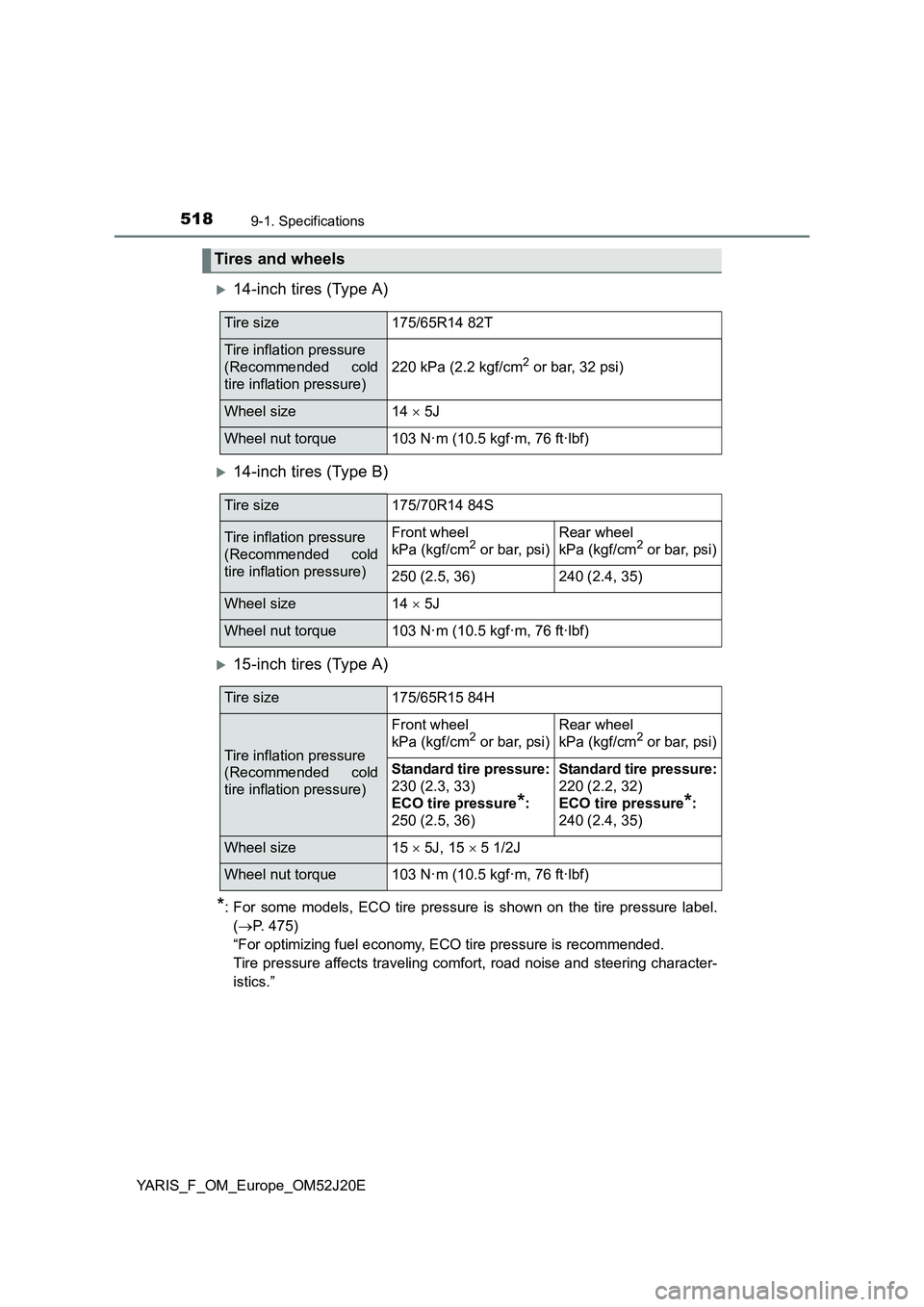
5189-1. Specifications
YARIS_F_OM_Europe_OM52J20E
14-inch tires (Type A)
14-inch tires (Type B)
15-inch tires (Type A)
*: For some models, ECO tire pressure is shown on the tire pressure label.
( P. 475)
“For optimizing fuel economy, ECO tire pressure is recommended.
Tire pressure affects traveling comfort, road noise and steering character-
istics.”
Tires and wheels
Tire size175/65R14 82T
Tire inflation pressure
(Recommended cold
tire inflation pressure)
220 kPa (2.2 kgf/cm2 or bar, 32 psi)
Wheel size14 5J
Wheel nut torque103 N·m (10.5 kgf·m, 76 ft·lbf)
Tire size175/70R14 84S
Tire inflation pressure
(Recommended cold
tire inflation pressure)
Front wheel
kPa (kgf/cm2 or bar, psi)
Rear wheel
kPa (kgf/cm2 or bar, psi)
250 (2.5, 36)240 (2.4, 35)
Wheel size14 5J
Wheel nut torque103 N·m (10.5 kgf·m, 76 ft·lbf)
Tire size175/65R15 84H
Tire inflation pressure
(Recommended cold
tire inflation pressure)
Front wheel
kPa (kgf/cm2 or bar, psi)
Rear wheel
kPa (kgf/cm2 or bar, psi)
Standard tire pressure:
230 (2.3, 33)
ECO tire pressure*:
250 (2.5, 36)
Standard tire pressure:
220 (2.2, 32)
ECO tire pressure*:
240 (2.4, 35)
Wheel size15 5J, 15 5 1/2J
Wheel nut torque103 N·m (10.5 kgf·m, 76 ft·lbf)
Page 519 of 549
5199-1. Specifications
9
Vehicle specifications
YARIS_F_OM_Europe_OM52J20E
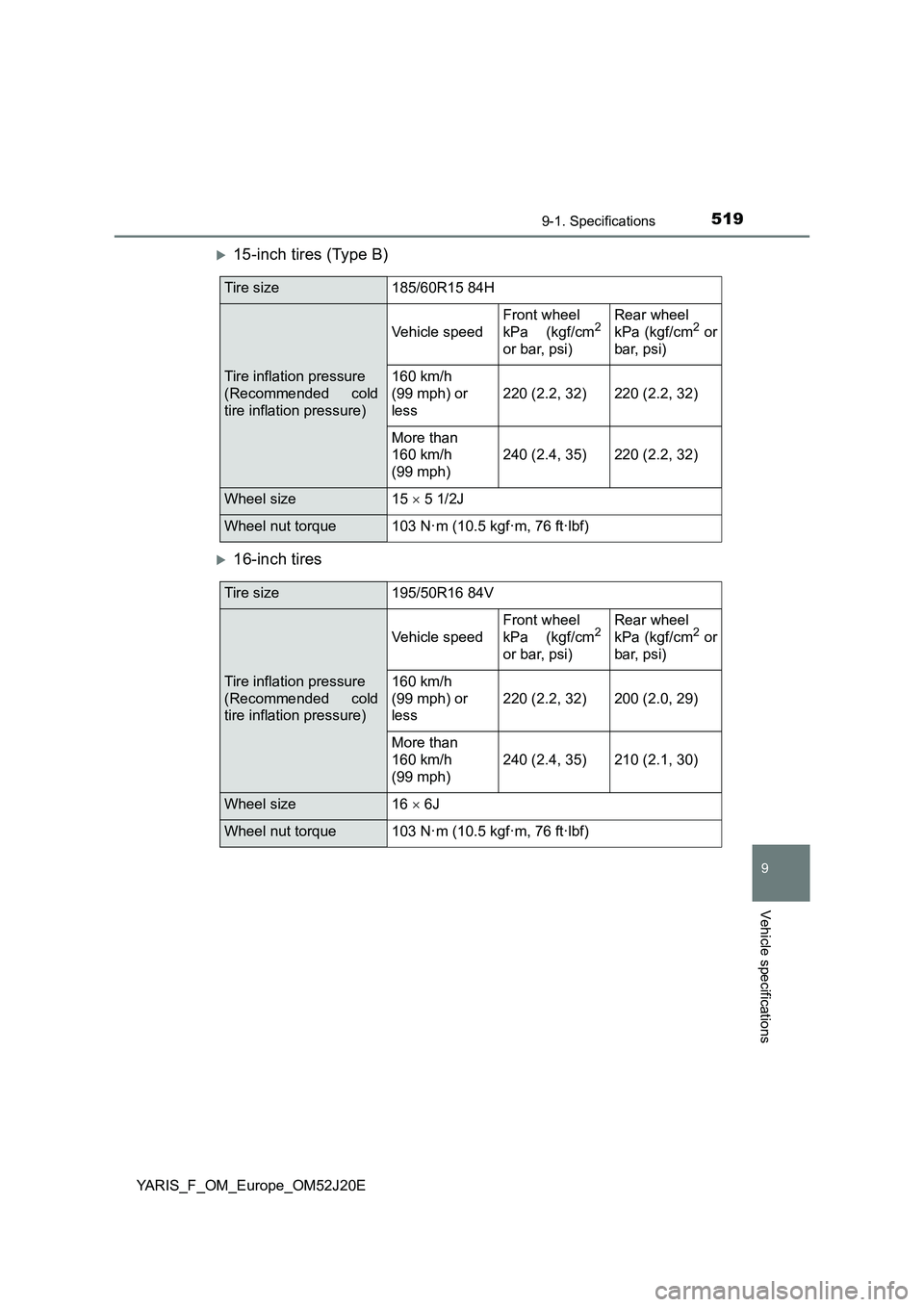
15-inch tires (Type B)
16-inch tires
Tire size185/60R15 84H
Tire inflation pressure
(Recommended cold
tire inflation pressure)
Vehicle speed
Front wheel
kPa (kgf/cm2
or bar, psi)
Rear wheel
kPa (kgf/cm2 or
bar, psi)
160 km/h
(99 mph) or
less
220 (2.2, 32)220 (2.2, 32)
More than
160 km/h
(99 mph)
240 (2.4, 35)220 (2.2, 32)
Wheel size15 5 1/2J
Wheel nut torque103 N·m (10.5 kgf·m, 76 ft·lbf)
Tire size195/50R16 84V
Tire inflation pressure
(Recommended cold
tire inflation pressure)
Vehicle speed
Front wheel
kPa (kgf/cm2
or bar, psi)
Rear wheel
kPa (kgf/cm2 or
bar, psi)
160 km/h
(99 mph) or
less
220 (2.2, 32)200 (2.0, 29)
More than
160 km/h
(99 mph)
240 (2.4, 35)210 (2.1, 30)
Wheel size16 6J
Wheel nut torque103 N·m (10.5 kgf·m, 76 ft·lbf)