light TOYOTA YARIS 2017 Service Manual
[x] Cancel search | Manufacturer: TOYOTA, Model Year: 2017, Model line: YARIS, Model: TOYOTA YARIS 2017Pages: 549, PDF Size: 33.09 MB
Page 149 of 549
1493-4. Adjusting the steering wheel and mirrors
3
Operation of each component
YARIS_F_OM_Europe_OM52J20E
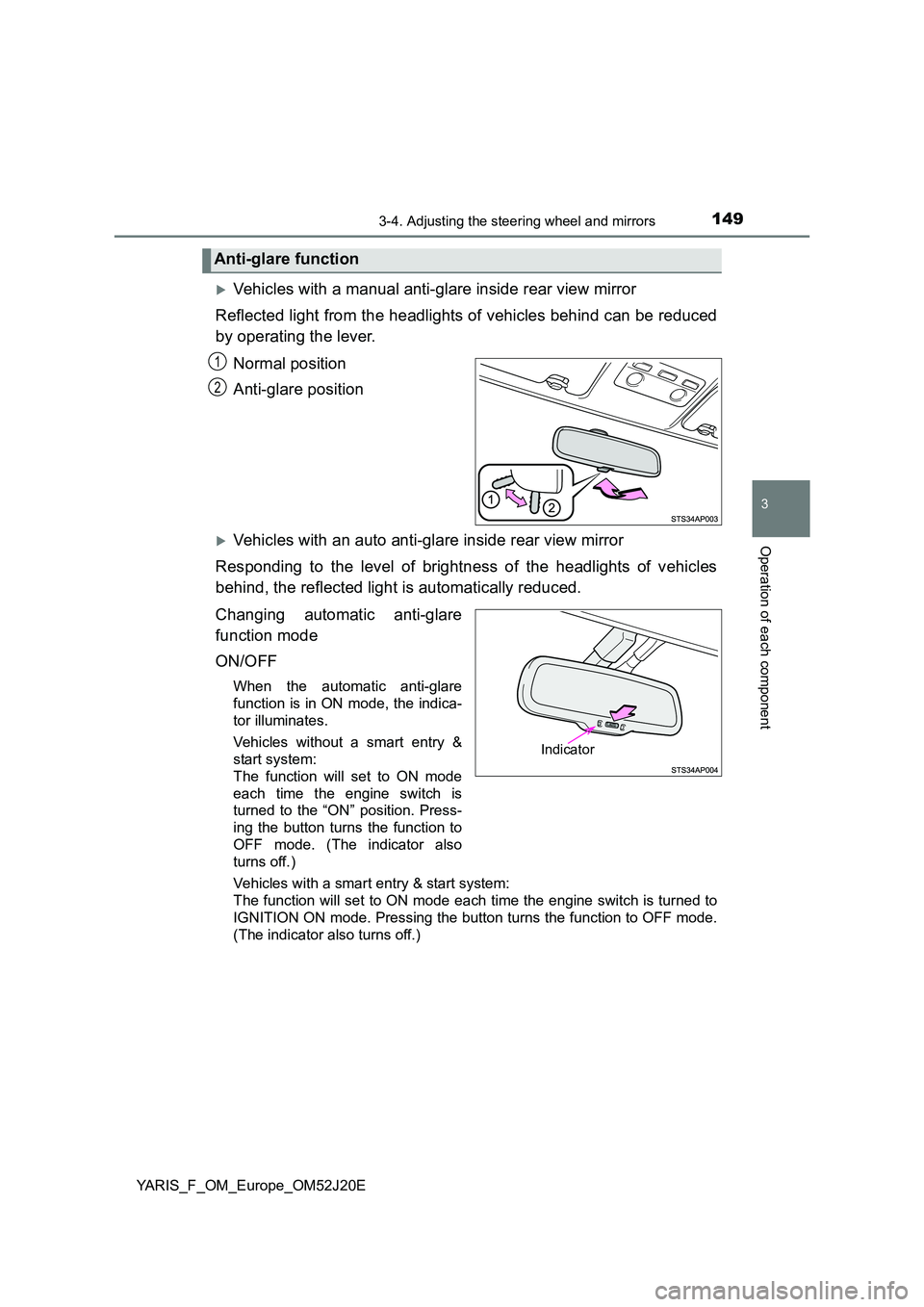
Vehicles with a manual anti-glare inside rear view mirror
Reflected light from the headlights of vehicles behind can be reduced
by operating the lever.
Normal position
Anti-glare position
Vehicles with an auto anti-glare inside rear view mirror
Responding to the level of brightness of the headlights of vehicles
behind, the reflected light is automatically reduced.
Changing automatic anti-glare
function mode
ON/OFF
When the automatic anti-glare
function is in ON mode, the indica-
tor illuminates.
Vehicles without a smart entry &
start system:
The function will set to ON mode
each time the engine switch is
turned to the “ON” position. Press-
ing the button turns the function to
OFF mode. (The indicator also
turns off.)
Vehicles with a smart entry & start system:
The function will set to ON mode each time the engine switch is turned to
IGNITION ON mode. Pressing the button turns the function to OFF mode.
(The indicator also turns off.)
Anti-glare function
1
2
Indicator
Page 155 of 549
1553-5. Opening and closing the windows
3
Operation of each component
YARIS_F_OM_Europe_OM52J20E
■The power windows can be operated when
Vehicles without a smart entry & start system
The engine switch is in the “ON” position.
Vehicles with a smart entry & start system
The engine switch is in IGNITION ON mode.
■ Operating the power windows after turning the engine off
Vehicles without a smart entry & start system
The power windows can be operated for approximately 45 seconds even
after the engine switch is turned to the “ACC” or “LOCK” position. They can-
not, however, be operated once either front door is opened.
Vehicles with a smart entry & start system
The power windows can be operated for approximately 45 seconds even
after the engine switch is turned to ACCESSORY mode or turned off. They
cannot, however, be operated once either front door is opened.
■ Jam protection function (driver’s window only)
If an object becomes caught between the window and the window frame, win-
dow travel is stopped and the window is opened slightly.
Page 156 of 549
1563-5. Opening and closing the windows
YARIS_F_OM_Europe_OM52J20E
■ When the power window does not close normally
If the jam protection function is operating abnormally and a window cannot be
closed, perform the following operations using the power window switch on
the driver’s door.
● After stopping the vehicle, the window can be closed by holding the power
window switch in the one-touch closing position while the engine switch is
turned to the “ON” position (vehicles without a smart entry & start system) or
IGNITION ON mode (vehicles with a smart entry & start system).
● If the window still cannot be closed even by carrying out the operation as
explained above, initialize the function by performing the following proce-
dure.
Hold the power window switch in the one-touch closing position. Continue
holding the switch for a further 6 seconds after the window has closed.
Hold the power window switch in the one-touch opening position. Con-
tinue holding the switch for a further 2 seconds after the window has
opened completely.
Hold the power window switch in the one-touch closing position once
again. Continue holding the switch for a further 2 seconds after the win-
dow has closed.
If you release the switch while the window is moving, start again from the
beginning.
If the window continues to close but then re-open slightly even after perform-
ing the above procedure correctly, have the vehicle inspected by any autho-
rized Toyota dealer or repairer, or another duly qualified and equipped
professional.
1
2
3
Page 159 of 549
159
4Driving
YARIS_F_OM_Europe_OM52J20E
4-1. Before driving
Driving the vehicle ............. 160
Cargo and luggage ............ 171
Trailer towing ..................... 173
4-2. Driving procedures
Engine (ignition) switch
(vehicles without
a smart entry &
start system) .................... 182
Engine (ignition) switch
(vehicles with
a smart entry &
start system) .................... 185
Multidrive ........................... 191
Manual transmission.......... 197
Turn signal lever ................ 201
Parking brake .................... 202
4-3. Operating the lights
and wipers
Headlight switch ................ 203
Fog light switch .................. 209
Windshield wiper and
washer ............................. 211
Rear window wiper and
washer ............................. 215
4-4. Refueling
Opening the fuel tank
cap ................................... 217
4-5. Toyota Safety Sense
Toyota Safety Sense ......... 220
PCS
(Pre-Crash Safety
system) ............................ 226
LDA
(Lane Departure Alert) ..... 240
Automatic High Beam ........ 245
4-6. Using the driving support
systems
Cruise control..................... 249
Speed limiter ...................... 253
Stop & start system............ 257
Driving assist systems ....... 265
Diesel particulate filter
system ............................. 270
4-7. Driving tips
Winter driving tips .............. 272
Page 162 of 549
1624-1. Before driving
YARIS_F_OM_Europe_OM52J20E
Vehicles with a manual transmission
While depressing the clutch pedal, depress the brake pedal.
Set the parking brake. ( P. 202)
Shift the shift lever to N. ( P. 197)
If parking on a hill, shift the shift lever to 1 or R and block the wheels as
needed.
Vehicles without a smart entry & start system: Turn the engine
switch to the “LOCK” position to stop the engine.
Vehicles with a smart entry & start system: Press the engine switch
to stop the engine.
Lock the door, making sure that you have the key on your person.
Vehicles with a Multidrive
Firmly set the parking brake with the brake pedal depressed, and
then shift the shift lever to D.
Release the brake pedal and gently depress the accelerator pedal.
Release the parking brake.
Vehicles with a manual transmission
With the parking brake firmly set and the clutch pedal fully
depressed, shift the shift lever to 1.
Lightly depress the accelerator pedal at the same time as gradually
releasing the clutch pedal.
Release the parking brake.
Starting off on a steep uphill
1
2
3
4
5
1
2
3
1
2
3
Page 164 of 549
1644-1. Before driving
YARIS_F_OM_Europe_OM52J20E
■ Idling time before stopping the diesel engine
To prevent damage to the turbocharger, allow the engine to idle immediately
after high-speed driving or driving up a hill.
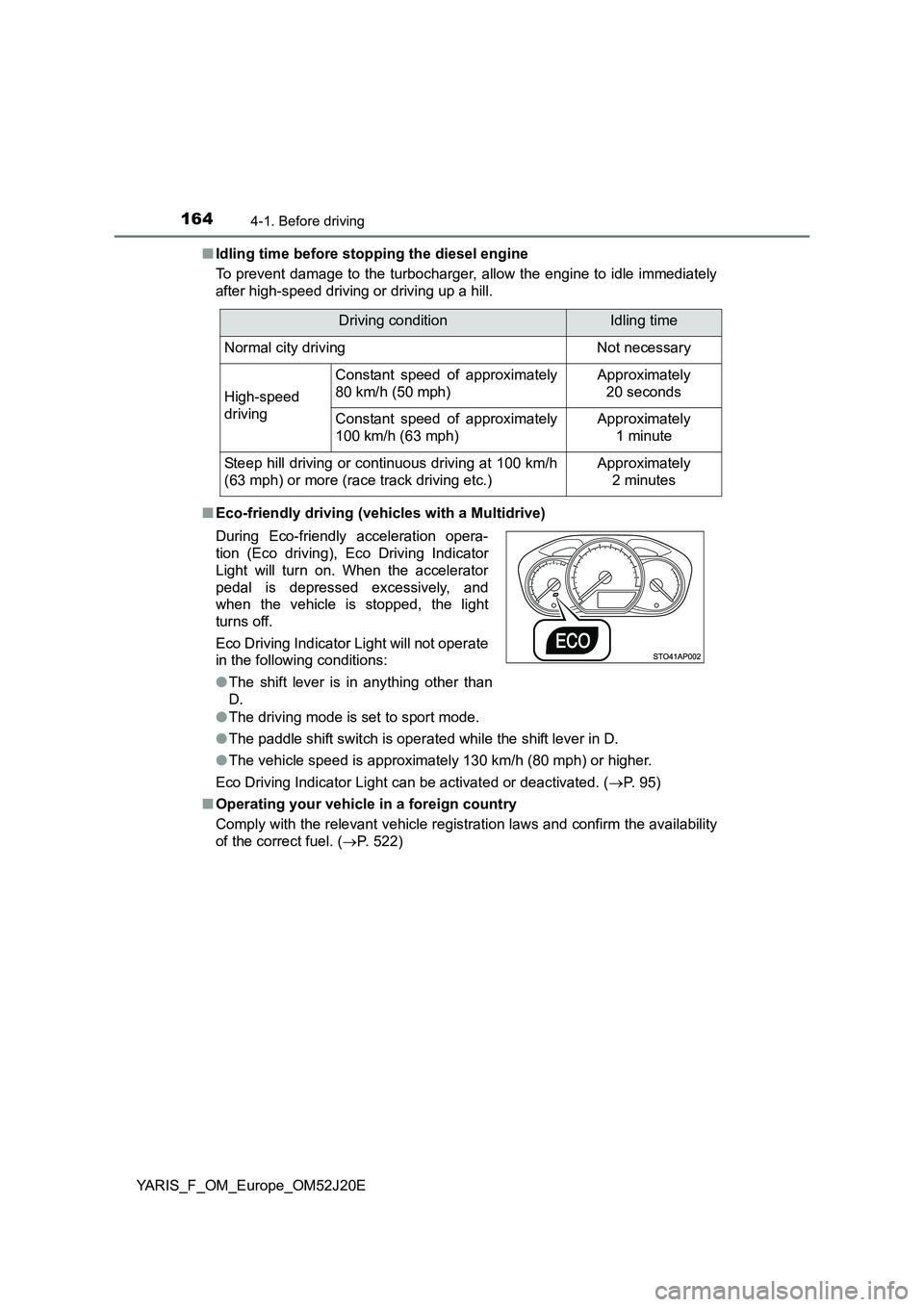
■ Eco-friendly driving (vehicles with a Multidrive)
● The driving mode is set to sport mode.
● The paddle shift switch is operated while the shift lever in D.
● The vehicle speed is approximately 130 km/h (80 mph) or higher.
Eco Driving Indicator Light can be activated or deactivated. ( P. 95)
■ Operating your vehicle in a foreign country
Comply with the relevant vehicle registration laws and confirm the availability
of the correct fuel. ( P. 522)
Driving conditionIdling time
Normal city drivingNot necessary
High-speed
driving
Constant speed of approximately
80 km/h (50 mph)
Approximately
20 seconds
Constant speed of approximately
100 km/h (63 mph)
Approximately
1 minute
Steep hill driving or continuous driving at 100 km/h
(63 mph) or more (race track driving etc.)
Approximately
2 minutes
During Eco-friendly acceleration opera-
tion (Eco driving), Eco Driving Indicator
Light will turn on. When the accelerator
pedal is depressed excessively, and
when the vehicle is stopped, the light
turns off.
Eco Driving Indicator Light will not operate
in the following conditions:
● The shift lever is in anything other than
D.
Page 165 of 549
1654-1. Before driving
4
Driving
YARIS_F_OM_Europe_OM52J20E
WARNING
Observe the following precautions.
Failure to do so may result in death or serious injury.
■ When starting the vehicle
On vehicles with a Multidrive, always keep your foot on the brake pedal
while stopped with the engine running. This prevents the vehicle from
creeping.
■ When driving the vehicle
● Do not drive if you are unfamiliar with the location of the brake and accel-
erator pedals to avoid depressing the wrong pedal.
• Accidentally depressing the accelerator pedal instead of the brake
pedal will result in sudden acceleration that may lead to an accident.
• When backing up, you may twist your body around, leading to difficulty
in operating the pedals. Make su re to operate the pedals properly.
• Make sure to keep a correct driving posture even when moving the
vehicle only slightly. This allows you to depress the brake and accelera-
tor pedals properly.
• Depress the brake pedal using your right foot. Depressing the brake
pedal using your left foot may delay response in an emergency, result-
ing in an accident.
● Do not drive the vehicle over or stop the vehicle near flammable materials.
The exhaust system and exhaust gases can be extremely hot. These hot
parts may cause a fire if there is any flammable material nearby.
● During normal driving, do not turn off the engine. Turning the engine off
while driving will not cause loss of steering or braking control, but the
power assist to these systems will be lost. This will make it more difficult to
steer and brake, so you should pull over and stop the vehicle as soon as it
is safe to do so.
However, in the event of an emergency, such as if it becomes impossible
to stop the vehicle in the normal way: P. 429
● Use engine braking (downshift) to maintain a safe speed when driving
down a steep hill.
Using the brakes continuously may cause the brakes to overheat and lose
effectiveness. ( P. 191, 197)
● Do not adjust the positions of the steering wheel, the seat, or the inside or
outside rear view mirrors while driving.
Doing so may result in a loss of vehicle control.
● Always check that all passengers’ arms, heads or other parts of their body
are not outside the vehicle.
Page 167 of 549
1674-1. Before driving
4
Driving
YARIS_F_OM_Europe_OM52J20E
WARNING
■If you hear a squealing or scraping noise (brake pad wear indicators)
Have the brake pads checked and replaced by any authorized Toyota
dealer or repairer, or another dul y qualified and equipped professional as
soon as possible.
Rotor damage may result if the pads are not replaced when needed.
It is dangerous to drive the vehicle when the wear limits of the brake pads
and/or those of the brake discs are exceeded.
■ When the vehicle is stopped
● Do not race the engine.
If the vehicle is in any gear other than P (Multidrive) or N, the vehicle may
accelerate suddenly and unexpectedly, causing an accident.
● On vehicles with a Multidrive, in order to prevent accidents due to the vehi-
cle rolling away, always keep depressing the brake pedal while the engine
is running, and apply the parking brake as necessary.
● If the vehicle is stopped on an incline, in order to prevent accidents caused
by the vehicle rolling forward or backward, always depress the brake pedal
and securely apply the parking brake as needed.
● Avoid revving or racing the engine.
Running the engine at high speed while the vehicle is stopped may cause
the exhaust system to overheat, which could result in a fire if combustible
material is nearby.
■ When the vehicle is parked
● Do not leave glasses, cigarette lighters, spray cans, or soft drink cans in
the vehicle when it is in the sun.
Doing so may result in the following:
• Gas may leak from a cigarette lighter or spray can, and may lead to a
fire.
• The temperature inside the vehicle may cause the plastic lenses and
plastic material of glasses to deform or crack.
• Soft drink cans may rupture, causing the contents to spray over the
interior of the vehicle, and may also cause a short circuit in the vehicle’s
electrical components.
● Do not leave cigarette lighters in the vehicle. If a cigarette lighter is in a
place such as the glove box or on the floor, it may be lit accidentally when
luggage is loaded or the seat is adjusted, causing a fire.
Page 168 of 549
1684-1. Before driving
YARIS_F_OM_Europe_OM52J20E
WARNING
●Do not attach adhesive discs to the windshield or windows. Do not place
containers such as air fresheners on the instrument panel or dashboard.
Adhesive discs or containers may act as lenses, causing a fire in the vehi-
cle.
● Do not leave a door or window open if the curved glass is coated with a
metallized film such as a silver-colored one. Reflected sunlight may cause
the glass to act as a lens, causing a fire.
● On vehicles with a Multidrive, always apply the parking brake, shift the
shift lever to P, stop the engine and lock the vehicle.
Do not leave the vehicle unattended while the engine is running.
When the vehicle is left without applying the parking brake even if the shift
lever is in P, it may start to move, leading to an accident.
● Do not touch the exhaust pipes while the engine is running or immediately
after turning the engine off.
Doing so may cause burns.
■ When taking a nap in the vehicle
Always turn the engine off. Otherwise, if you accidentally move the shift
lever or depress the accelerator pedal, this could cause an accident or fire
due to engine overheating. Additionally, if the vehicle is parked in a poorly
ventilated area, exhaust gases may collect and enter the vehicle, leading to
death or a serious health hazard.
■ When braking
● When the brakes are wet, drive more cautiously.
Braking distance increases when the brakes are wet, and this may cause
one side of the vehicle to brake differently than the other side. Also, the
parking brake may not securely hold the vehicle.
● If the power brake assist function does not operate, do not follow other
vehicles closely and avoid hills or sharp turns that require braking.
In this case, braking is still possible, but the brake pedal should be
depressed more firmly than usual. Also, the braking distance will increase.
Have your brakes fixed immediately.
● Do not pump the brake pedal if the engine stalls.
Each push on the brake pedal uses up the reserve for the power-assisted
brakes.
● The brake system consists of 2 individual hydraulic systems; if one of the
systems fails, the other will still operate. In this case, the brake pedal
should be depressed more firmly than usual and the braking distance will
increase.
Have your brakes fixed immediately.
Page 178 of 549
1784-1. Before driving
YARIS_F_OM_Europe_OM52J20E
■Tire information
● Increase the tire inflation pressure to 20.0 kPa (0.2 kgf/cm2 or bar, 3 psi)
greater than the recommended value when towing. ( P. 518)
● Increase the air pressure of the trailer tires in accordance with the total
trailer weight and according to the values recommended by the manufac-
turer of your trailer.
■ Tr a i l e r l i g h ts
Check that the turn signal lights and stoplights are operating correctly every
time you hitch up the trailer. Direct ly wiring up to your vehicle may damage
the electrical system and stop the lights from functioning correctly.
■ Break-in schedule
Toyota recommends that vehicles fitted with new power train components
should not be used for towing trailers for the first 800 km (500 miles).
■ Safety checks before towing
● Check that the maximum load limit for the towing hitch/bracket and hitch ball
is not exceeded. Bear in mind that the coupling weight of the trailer will add
to the load exerted on the vehicle. Also make sure that the total load exerted
on the vehicle is within the range of the weight limits. ( P. 174)
● Ensure that the trailer load is secure.
● Supplementary outside rear view mirrors should be added to the vehicle if
the traffic behind cannot be clearly seen with standard mirrors. Adjust the
extending arms of these mirrors on both sides of the vehicle so that they
always provide maximum visibility of the road behind.
■ Maintenance
● Maintenance must be performed more frequently when using the vehicle for
towing due to the greater weight burden placed on the vehicle compared to
normal driving.
● Retighten all bolts securing the hitching ball and bracket after towing for
approximately 1000 km (600 miles).
NOTICE
■ When the rear bumper strengthening material is aluminum
Ensure the steel bracket part does not come directly in contact with that
area.
When steel and aluminum come into contact, there is a reaction similar to
corrosion, which will weaken the section concerned and may result in dam-
age. Apply a rust inhibitor to parts that will come in contact when attaching a
steel bracket.