chain TOYOTA YARIS 2017 Owners Manual
[x] Cancel search | Manufacturer: TOYOTA, Model Year: 2017, Model line: YARIS, Model: TOYOTA YARIS 2017Pages: 549, PDF Size: 33.09 MB
Page 11 of 549
11Pictorial index
YARIS_F_OM_Europe_OM52J20E
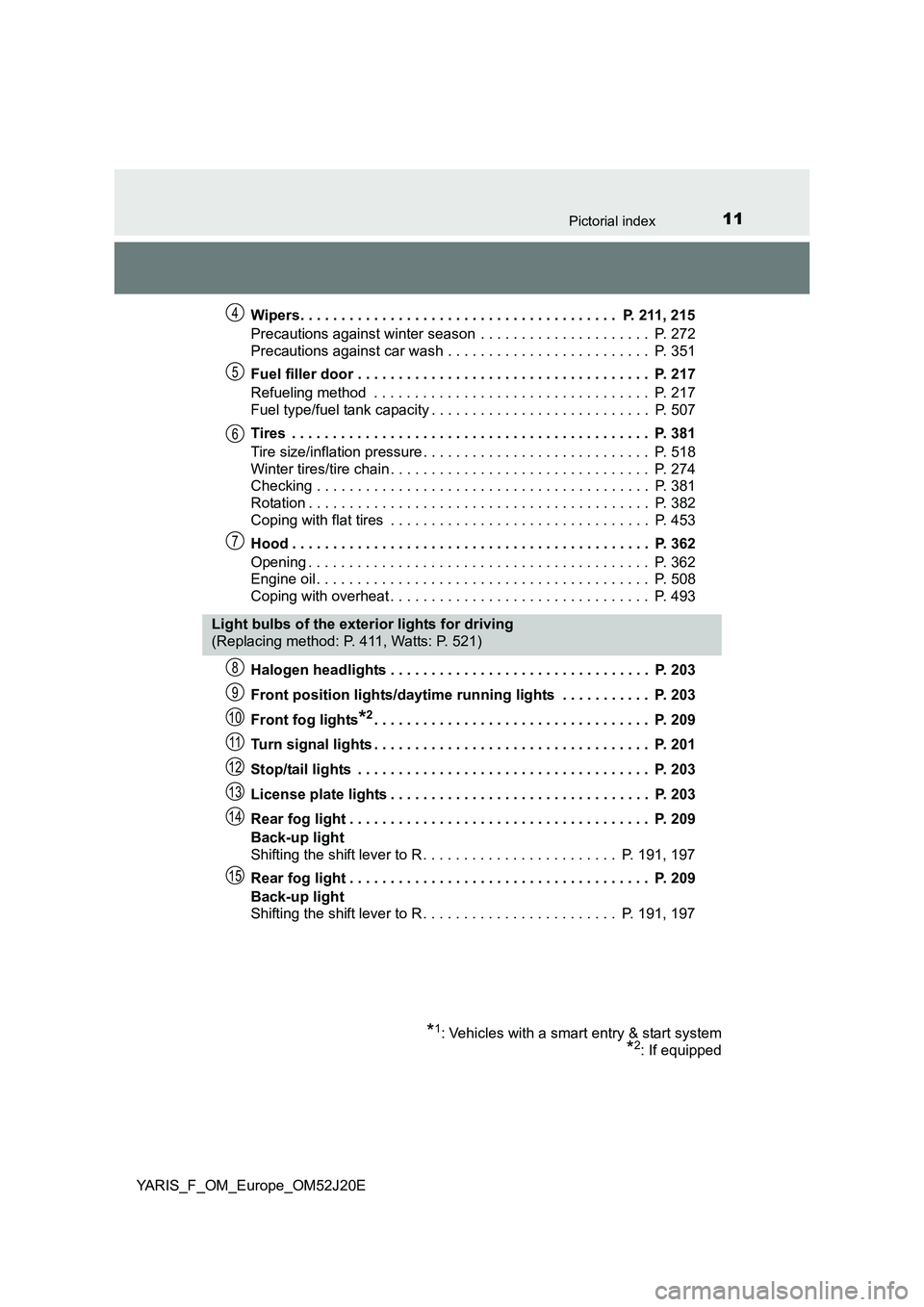
Wipers. . . . . . . . . . . . . . . . . . . . . . . . . . . . . . . . . . . . . . . P. 211, 215
Precautions against winter season . . . . . . . . . . . . . . . . . . . . . P. 272
Precautions against car wash . . . . . . . . . . . . . . . . . . . . . . . . . P. 351
Fuel filler door . . . . . . . . . . . . . . . . . . . . . . . . . . . . . . . . . . . . P. 217
Refueling method . . . . . . . . . . . . . . . . . . . . . . . . . . . . . . . . . . P. 217
Fuel type/fuel tank capacity . . . . . . . . . . . . . . . . . . . . . . . . . . . P. 507
Tires . . . . . . . . . . . . . . . . . . . . . . . . . . . . . . . . . . . . . . . . . . . . P. 381
Tire size/inflation pressure . . . . . . . . . . . . . . . . . . . . . . . . . . . . P. 518
Winter tires/tire chain . . . . . . . . . . . . . . . . . . . . . . . . . . . . . . . . P. 274
Checking . . . . . . . . . . . . . . . . . . . . . . . . . . . . . . . . . . . . . . . . . P. 381
Rotation . . . . . . . . . . . . . . . . . . . . . . . . . . . . . . . . . . . . . . . . . . P. 382
Coping with flat tires . . . . . . . . . . . . . . . . . . . . . . . . . . . . . . . . P. 453
Hood . . . . . . . . . . . . . . . . . . . . . . . . . . . . . . . . . . . . . . . . . . . . P. 362
Opening . . . . . . . . . . . . . . . . . . . . . . . . . . . . . . . . . . . . . . . . . . P. 362
Engine oil . . . . . . . . . . . . . . . . . . . . . . . . . . . . . . . . . . . . . . . . . P. 508
Coping with overheat . . . . . . . . . . . . . . . . . . . . . . . . . . . . . . . . P. 493
Halogen headlights . . . . . . . . . . . . . . . . . . . . . . . . . . . . . . . . P. 203
Front position lights/daytime running lights . . . . . . . . . . . P. 203
Front fog lights*2. . . . . . . . . . . . . . . . . . . . . . . . . . . . . . . . . . P. 209
Turn signal lights . . . . . . . . . . . . . . . . . . . . . . . . . . . . . . . . . . P. 201
Stop/tail lights . . . . . . . . . . . . . . . . . . . . . . . . . . . . . . . . . . . . P. 203
License plate lights . . . . . . . . . . . . . . . . . . . . . . . . . . . . . . . . P. 203
Rear fog light . . . . . . . . . . . . . . . . . . . . . . . . . . . . . . . . . . . . . P. 209
Back-up light
Shifting the shift lever to R. . . . . . . . . . . . . . . . . . . . . . . . P. 191, 197
Rear fog light . . . . . . . . . . . . . . . . . . . . . . . . . . . . . . . . . . . . . P. 209
Back-up light
Shifting the shift lever to R. . . . . . . . . . . . . . . . . . . . . . . . P. 191, 197
4
5
6
7
Light bulbs of the exterior lights for driving
(Replacing method: P. 411, Watts: P. 521)
*1: Vehicles with a smart entry & start system
*2: If equipped
8
9
10
11
12
13
14
15
Page 228 of 549
2284-5. Toyota Safety Sense
YARIS_F_OM_Europe_OM52J20E
WARNING
●While driving, such as when driving through a railway crossing, the system
may determine that the possibility of a collision with an object, such as rail-
way crossing barrier, is high and operate the pre-crash braking function.
To move the vehicle in an emergency, such as if the system operates in a
railway crossing, perform the following operations and then take the nec-
essary measures to ensure your safety.
• If the vehicle has been stopped, depress the accelerator pedal.
•If the vehicle is decelerating, fully depress the accelerator pedal.
( P. 231)
• Disable the pre-crash safety system. ( P. 229)
■ When to disable the pre-crash safety system In the following situations, disable the system, as it may not operate prop-
erly, possibly leading to an accident resulting in death or serious injury:
● When the vehicle is being towed
● When your vehicle is towing another vehicle
● When transporting the vehicle via truck, boat, train or similar means of
transportation
● When the vehicle is raised on a lift with the engine running and the tires
are allowed to rotate freely
● When inspecting the vehicle using a drum tester such as a chassis dyna-
mometer or speedometer tester, or when using an on vehicle wheel bal-
ancer
● If the vehicle cannot be driven in a stable manner, such as when the vehi-
cle has been in an accident or is malfunctioning
● When the vehicle is driven in a sporty manner or off-road
● When the condition of the tires is poor and they do not perform well
( P. 381)
● When tires of a size other than specified are installed
● When tire chains are installed
● When a compact spare tire or an emergency tire puncture repair kit is
used
Page 268 of 549
2684-6. Using the driving support systems
YARIS_F_OM_Europe_OM52J20E
■ If the slip indicator comes on
It may indicate a malfunction in the systems. Contact any authorized Toyota
dealer or repairer, or another duly qualified and equipped professional.
■ Operating conditions of emergency brake signal
When the following three conditions are met, the emergency brake signal will
operate:
● The emergency flashers are off.
● Actual vehicle speed is over 55 km/h (35 mph).
● The brake pedal is depressed in a manner that cause the system to judge
from the vehicle deceleration that this is a sudden braking operation.
■ Automatic system cancelation of emergency brake signal
The emergency brake signal will turn off in any of the following situations:
● The emergency flashers are turned on.
● The brake pedal is released.
● The system judges from the vehicle deceleration that is not a sudden brak-
ing operation.
WARNING
■ The ABS does not operate effectively when
● The limits of tire gripping performance have been exceeded (such as
excessively worn tires on a snow covered road).
● The vehicle hydroplanes while driving at high speed on wet or slick roads.
■ Stopping distance when the ABS is operating may exceed that of nor-
mal conditions
The ABS is not designed to shorten t he vehicle’s stopping distance. Always
maintain a safe distance from the vehicle in front of you, especially in the
following situations:
● When driving on dirt, gravel or snow-covered roads
● When driving with tire chains
● When driving over bumps in the road
● When driving over roads with potholes or roads with uneven surfaces
■ TRC may not operate effectively when
Directional control and power may not be achievable while driving on slip-
pery road surfaces, even if the TRC system is operating.
Drive the vehicle carefully in conditions where stability and power may be
lost.
Page 272 of 549
2724-7. Driving tips
YARIS_F_OM_Europe_OM52J20E
Winter driving tips
●Use fluids that are appropriate to the prevailing outside tempera-
tures.
• Engine oil
• Engine coolant
• Washer fluid
● Have a service technician inspect the condition of the battery.
● Have the vehicle fitted with four snow tires or purchase a set of tire
chains for the front tires.
Ensure that all tires are the same size and brand, and that their wear level
is not noticeably different with each other. Also make sure that chains
match the size of the tires.
Perform the following according to the driving conditions:
● Do not try to forcibly open a window or move a wiper that is frozen.
Pour warm water over the frozen area to melt the ice. Wipe away
the water immediately to prevent it from freezing.
● To ensure proper operation of the climate control system fan,
remove any snow that has accumulated on the air inlet vents in
front of the windshield.
● Check for and remove any excess ice or snow that may have accu-
mulated on the exterior lights, vehicle’s roof, chassis, around the
tires or on the brakes.
● Remove any snow or mud from the bottom of your shoes before
getting in the vehicle.
Carry out the necessary preparations and inspections before
driving the vehicle in winter. Always drive the vehicle in a man-
ner appropriate to the prevailing weather conditions.
Preparation for winter
Before driving the vehicle
Page 274 of 549
2744-7. Driving tips
YARIS_F_OM_Europe_OM52J20E
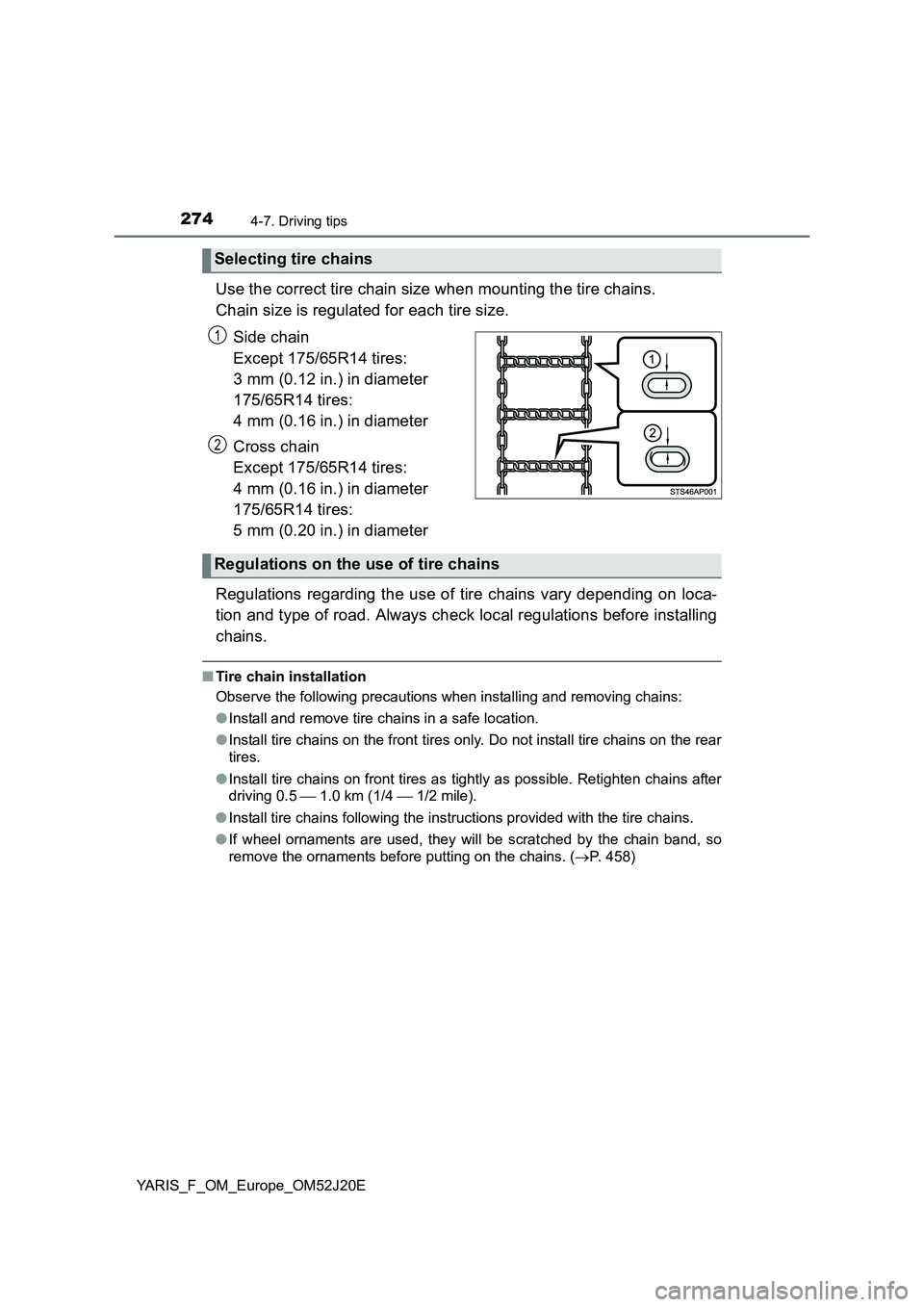
Use the correct tire chain size when mounting the tire chains.
Chain size is regulated for each tire size.
Side chain
Except 175/65R14 tires:
3 mm (0.12 in.) in diameter
175/65R14 tires:
4 mm (0.16 in.) in diameter
Cross chain
Except 175/65R14 tires:
4 mm (0.16 in.) in diameter
175/65R14 tires:
5 mm (0.20 in.) in diameter
Regulations regarding the use of tire chains vary depending on loca-
tion and type of road. Always check local regulations before installing
chains.
■ Tire chain installation
Observe the following precautions when installing and removing chains:
● Install and remove tire chains in a safe location.
● Install tire chains on the front tires only. Do not install tire chains on the rear
tires.
● Install tire chains on front tires as tightly as possible. Retighten chains after
driving 0.5 1.0 km (1/4 1/2 mile).
● Install tire chains following the instructions provided with the tire chains.
● If wheel ornaments are used, they will be scratched by the chain band, so
remove the ornaments before putting on the chains. ( P. 458)
Selecting tire chains
1
2
Regulations on the use of tire chains
Page 275 of 549
2754-7. Driving tips
4
Driving
YARIS_F_OM_Europe_OM52J20E
WARNING
■Driving with snow tires
Observe the following precautions to reduce the risk of accidents.
Failure to do so may result in a loss of vehicle control and cause death or
serious injury.
● Use tires of the specified size.
● Maintain the recommended level of air pressure.
● Do not drive at speeds in excess of the speed limit or the speed limit spec-
ified for the snow tires being used.
● Use snow tires on all, not just some wheels.
● Do not use tires of noticeably different wear level.
■ Driving with tire chains
Observe the following precautions to reduce the risk of accidents.
Failure to do so may result in the vehicle being unable to be driven safely,
and may cause death or serious injury.
● Do not drive in excess of the speed limit specified for the tire chains being
used, or 50 km/h (30 mph), whichever is lower.
● Avoid driving on bumpy road surfaces or over potholes.
● Avoid sudden acceleration, abrupt steering, sudden braking and shifting
operations that cause sudden engine braking.
● Slow down sufficiently before entering a curve to ensure that vehicle con-
trol is maintained.
● Do not use LDA (Lane Departure Alert) (if equipped).
Page 385 of 549
3857-3. Do-it-yourself maintenance
7
Maintenance and care
YARIS_F_OM_Europe_OM52J20E
The tire pressure warning valve and transmitter is equipped with a
unique ID code. When replacing a tire pressure warning valve and
transmitter, it is necessary to register the ID code. Have the ID code
registered by any authorized Toyota dealer or repairer, or another
duly qualified and equipped professional.
■ When to replace your vehicle’s tires
Tires should be replaced if:
● The treadwear indicators are showing on a tire.
● You have tire damage such as cuts, splits, cracks deep enough to expose
the fabric, and bulges indicating internal damage
● A tire goes flat repeatedly or cannot be properly repaired due to the size or
location of a cut or other damage
If you are not sure, consult with any authorized Toyota dealer or repairer, or
another duly qualified and equipped professional.
■ Replacing tire and wheels (vehicles with a tire pressure warning system)
If the ID code of the tire pressure warning valve and transmitter is not regis-
tered, the tire pressure warning system will not work properly. After driving for
about 10 minutes, the tire pressure warning light blinks for 1 minute and stays
on to indicate a system malfunction.
■ Tire life
Any tire over 6 years old must be checked by a qualified technician even if it
has seldom or never been used or damage is not obvious.
■ Low profile tires (vehicles with 195/50R16 tires)
Generally, low profile tires will wear more rapidly and tire grip performance
will be reduced on snowy and/or icy roads when compared to standard tires.
Be sure to use snow tires or tire chains on snowy and/or icy roads and drive
carefully at a speed appropriate for road and weather conditions.
Registering ID codes (vehicles with a tire pressure warning sys-
tem)
Page 397 of 549
3977-3. Do-it-yourself maintenance
7
Maintenance and care
YARIS_F_OM_Europe_OM52J20E
Wheels
When replacing wheels, care should be taken to ensure that they are
equivalent to those removed in load capacity, diameter, rim width and
inset*.
Replacement wheels are available at any authorized Toyota dealer or
repairer, or another duly qualified and equipped professional.
*: Conventionally referred to as “offset”.
Toyota does not recommend using the following:
● Wheels of different sizes or types
● Used wheels
● Bent wheels that have been straightened
● Use only Toyota wheel nuts and wrenches designed for use with
your aluminum wheels.
● When rotating, repairing or changing your tires, check that the
wheel nuts are still tight after driving 1600 km (1000 miles).
● Be careful not to damage the aluminum wheels when using tire
chains.
● Use only Toyota genuine balance weights or equivalent and use a
plastic or rubber hammer when balancing your wheels.
If a wheel is bent, cracked or heavily corroded, it should be
replaced. Otherwise, the tire may separate from the wheel or
cause a loss of handling control.
Wheel selection
Aluminum wheel precautions (if equipped)
Page 431 of 549
4318-2. Steps to take in an emergency
8
When trouble arises
YARIS_F_OM_Europe_OM52J20E
If your vehicle needs to be towed
The following may indicate a problem with your transmission. Contact
any authorized Toyota dealer or repairer, or another duly qualified and
equipped professional or commercial towing service before towing.
● The engine is running but the vehicle does not move.
● The vehicle makes an abnormal sound.
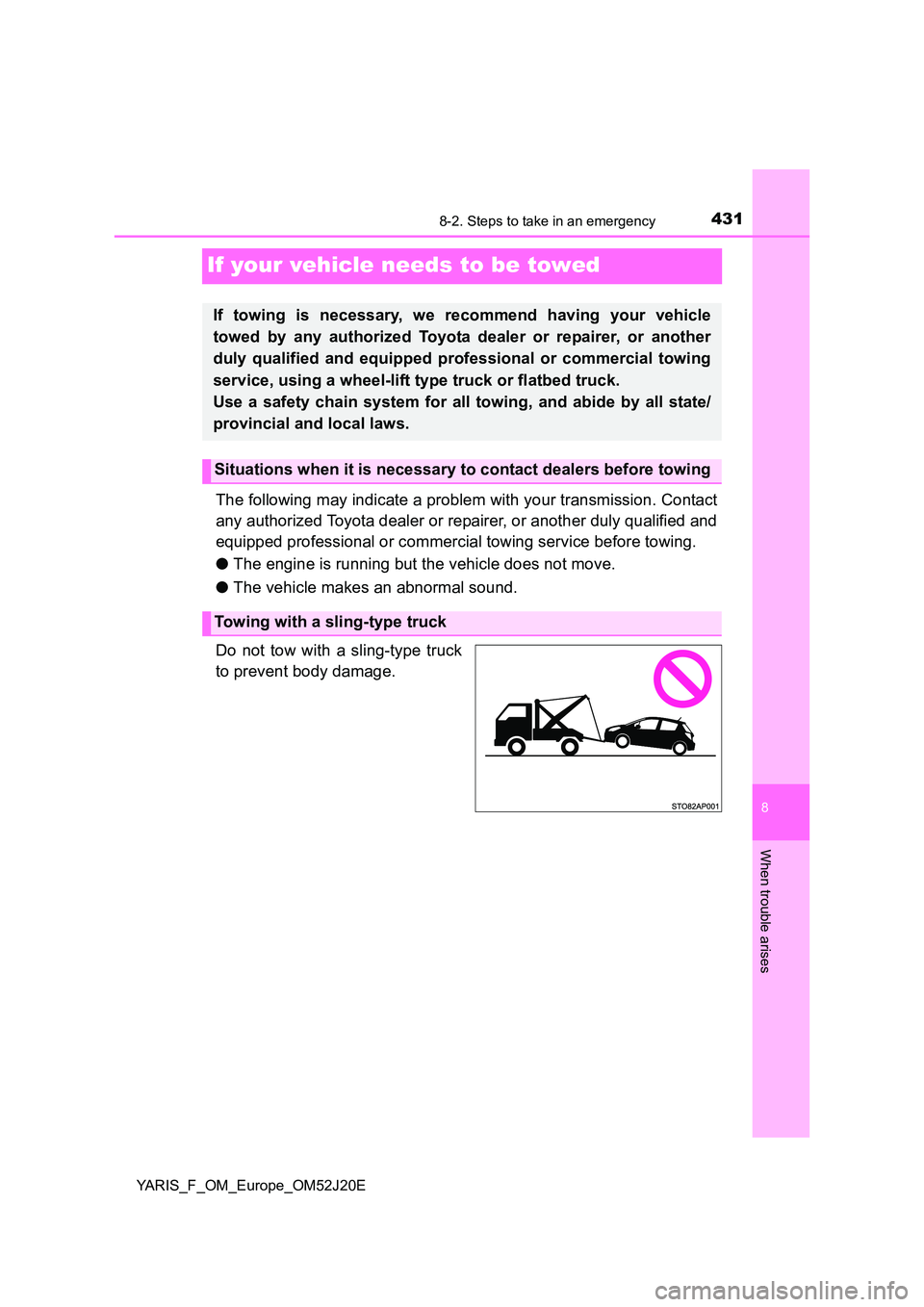
Do not tow with a sling-type truck
to prevent body damage.
If towing is necessary, we recommend having your vehicle
towed by any authorized Toyota dealer or repairer, or another
duly qualified and equipped professional or commercial towing
service, using a wheel-lift type truck or flatbed truck.
Use a safety chain system for all towing, and abide by all state/
provincial and local laws.
Situations when it is necessary to contact dealers before towing
Towing with a sling-type truck
Page 432 of 549
4328-2. Steps to take in an emergency
YARIS_F_OM_Europe_OM52J20E
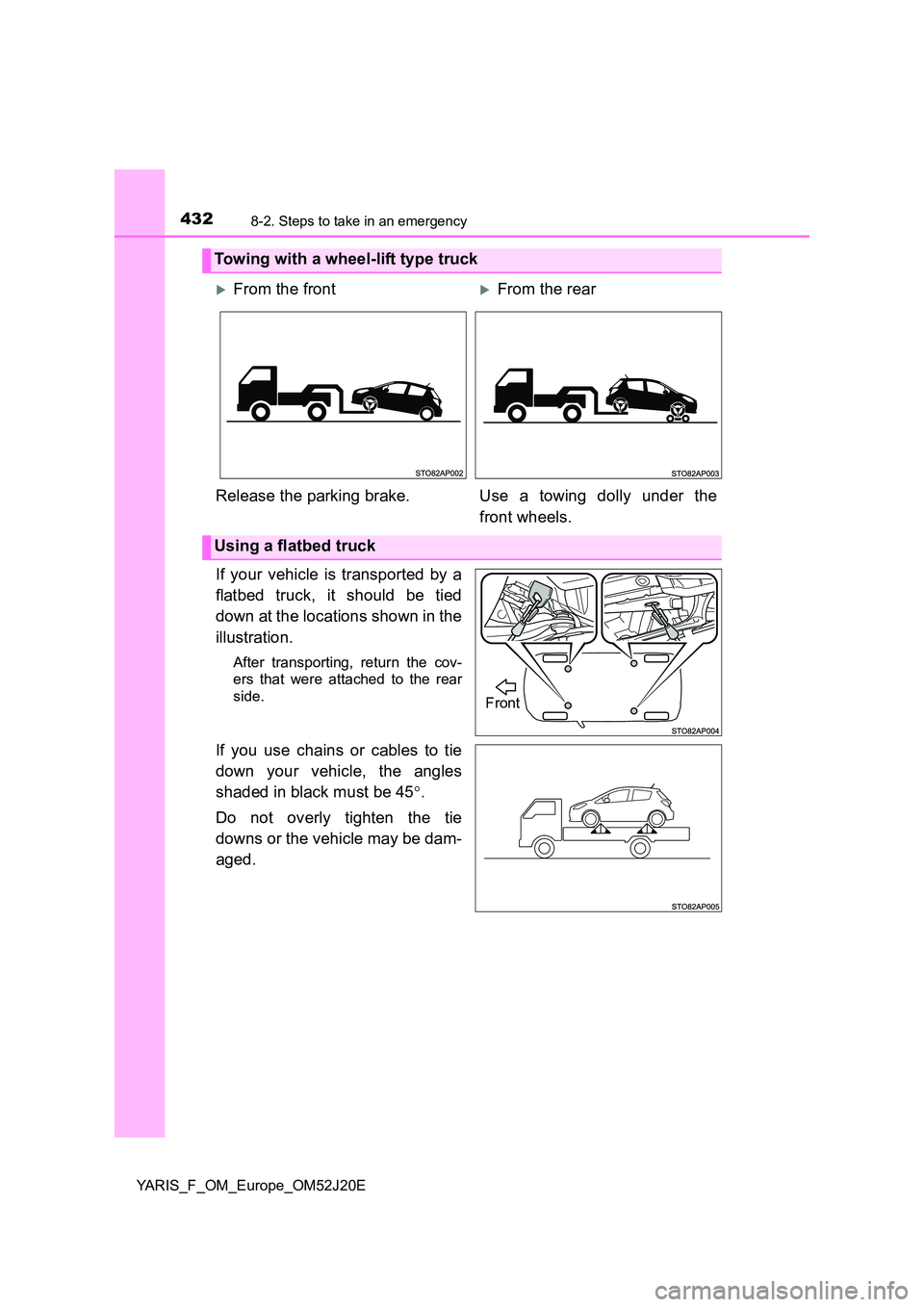
If your vehicle is transported by a
flatbed truck, it should be tied
down at the locations shown in the
illustration.
After transporting, return the cov-
ers that were attached to the rear
side.
If you use chains or cables to tie
down your vehicle, the angles
shaded in black must be 45 .
Do not overly tighten the tie
downs or the vehicle may be dam-
aged.
Towing with a wheel-lift type truck
From the frontFrom the rear
Release the parking brake. Use a towing dolly under the
front wheels.
Using a flatbed truck
Front