check engine TOYOTA YARIS 2017 Owners Manual
[x] Cancel search | Manufacturer: TOYOTA, Model Year: 2017, Model line: YARIS, Model: TOYOTA YARIS 2017Pages: 549, PDF Size: 33.09 MB
Page 4 of 549
TABLE OF CONTENTS4
YARIS_F_OM_Europe_OM52J20E
6-1. Using the air conditioning
system and defogger
Manual air conditioning
system .............................312
Automatic air conditioning
system .............................320
Power heater .....................328
Seat heaters ......................330
6-2. Using the interior lights
Interior lights list .................332
• Interior light ....................332
• Personal lights ...............333
6-3. Using the storage features
List of storage features ......334
• Glove box ......................335
• Cup holders ...................336
• Bottle holders ................337
• Auxiliary box ..................338
Luggage compartment
features............................339
6-4. Using the other interior
features
Other interior features ........342
• Sun visors ......................342
• Vanity mirrors ................342
• Portable ashtray ............344
• Cigarette lighter .............345
• Power outlet ..................346
• Armrest ..........................347
• Panoramic roof shade ...347
• Assist grips ....................348
7-1. Maintenance and care
Cleaning and protecting
the vehicle exterior .......... 350
Cleaning and protecting
the vehicle interior ........... 353
7-2. Maintenance
Maintenance
requirements ................... 356
7-3. Do-it-yourself maintenance
Do-it-yourself service
precautions ..................... 359
Hood.................................. 362
Positioning a floor jack ...... 364
Engine compartment ......... 366
Tires .................................. 381
Tire inflation pressure........ 395
Wheels .............................. 397
Air conditioning filter .......... 400
Wireless remote control/
electronic key battery ...... 402
Checking and replacing
fuses ............................... 405
Light bulbs ......................... 411
6Interior features7Maintenance and care
Page 11 of 549
11Pictorial index
YARIS_F_OM_Europe_OM52J20E
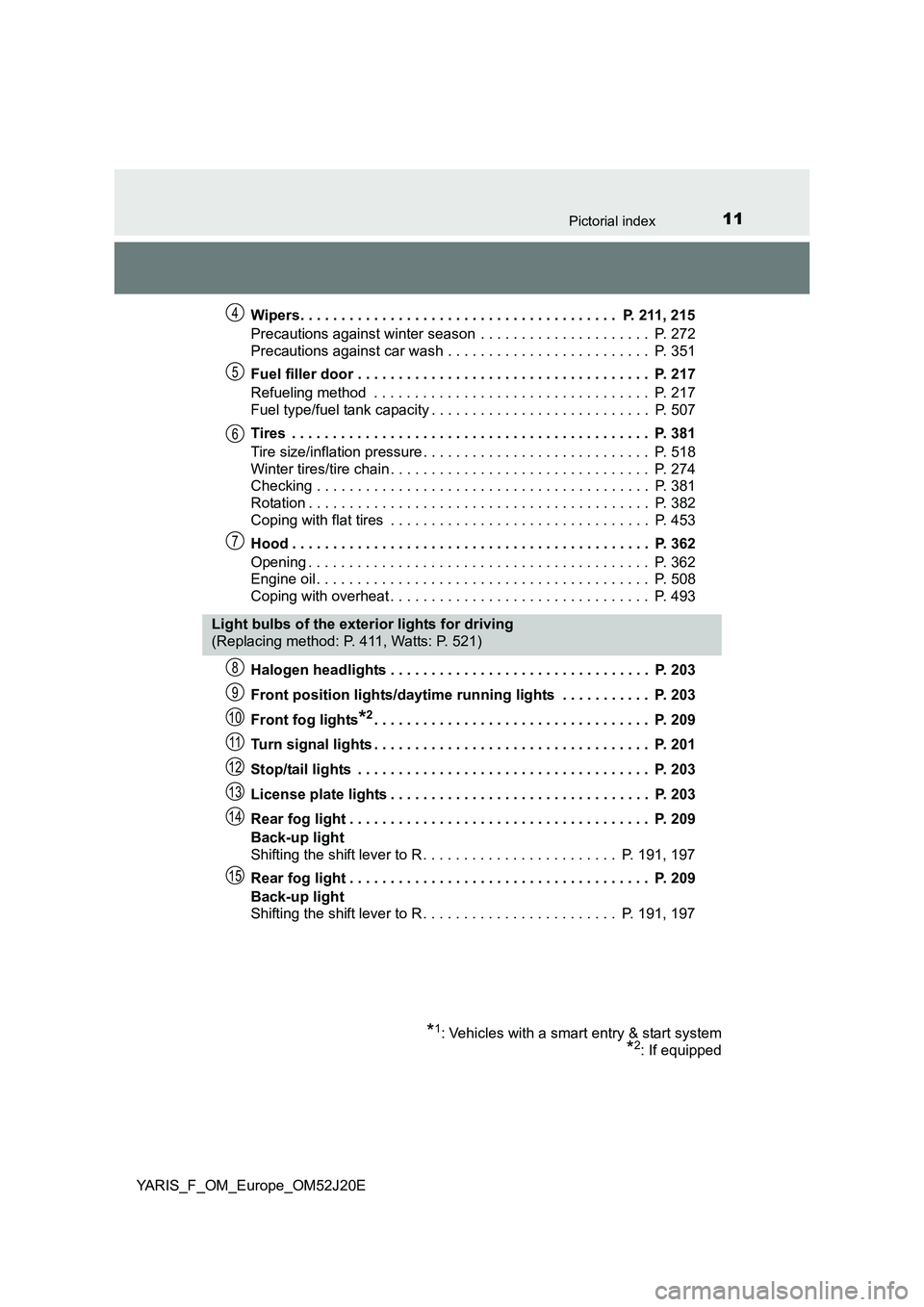
Wipers. . . . . . . . . . . . . . . . . . . . . . . . . . . . . . . . . . . . . . . P. 211, 215
Precautions against winter season . . . . . . . . . . . . . . . . . . . . . P. 272
Precautions against car wash . . . . . . . . . . . . . . . . . . . . . . . . . P. 351
Fuel filler door . . . . . . . . . . . . . . . . . . . . . . . . . . . . . . . . . . . . P. 217
Refueling method . . . . . . . . . . . . . . . . . . . . . . . . . . . . . . . . . . P. 217
Fuel type/fuel tank capacity . . . . . . . . . . . . . . . . . . . . . . . . . . . P. 507
Tires . . . . . . . . . . . . . . . . . . . . . . . . . . . . . . . . . . . . . . . . . . . . P. 381
Tire size/inflation pressure . . . . . . . . . . . . . . . . . . . . . . . . . . . . P. 518
Winter tires/tire chain . . . . . . . . . . . . . . . . . . . . . . . . . . . . . . . . P. 274
Checking . . . . . . . . . . . . . . . . . . . . . . . . . . . . . . . . . . . . . . . . . P. 381
Rotation . . . . . . . . . . . . . . . . . . . . . . . . . . . . . . . . . . . . . . . . . . P. 382
Coping with flat tires . . . . . . . . . . . . . . . . . . . . . . . . . . . . . . . . P. 453
Hood . . . . . . . . . . . . . . . . . . . . . . . . . . . . . . . . . . . . . . . . . . . . P. 362
Opening . . . . . . . . . . . . . . . . . . . . . . . . . . . . . . . . . . . . . . . . . . P. 362
Engine oil . . . . . . . . . . . . . . . . . . . . . . . . . . . . . . . . . . . . . . . . . P. 508
Coping with overheat . . . . . . . . . . . . . . . . . . . . . . . . . . . . . . . . P. 493
Halogen headlights . . . . . . . . . . . . . . . . . . . . . . . . . . . . . . . . P. 203
Front position lights/daytime running lights . . . . . . . . . . . P. 203
Front fog lights*2. . . . . . . . . . . . . . . . . . . . . . . . . . . . . . . . . . P. 209
Turn signal lights . . . . . . . . . . . . . . . . . . . . . . . . . . . . . . . . . . P. 201
Stop/tail lights . . . . . . . . . . . . . . . . . . . . . . . . . . . . . . . . . . . . P. 203
License plate lights . . . . . . . . . . . . . . . . . . . . . . . . . . . . . . . . P. 203
Rear fog light . . . . . . . . . . . . . . . . . . . . . . . . . . . . . . . . . . . . . P. 209
Back-up light
Shifting the shift lever to R. . . . . . . . . . . . . . . . . . . . . . . . P. 191, 197
Rear fog light . . . . . . . . . . . . . . . . . . . . . . . . . . . . . . . . . . . . . P. 209
Back-up light
Shifting the shift lever to R. . . . . . . . . . . . . . . . . . . . . . . . P. 191, 197
4
5
6
7
Light bulbs of the exterior lights for driving
(Replacing method: P. 411, Watts: P. 521)
*1: Vehicles with a smart entry & start system
*2: If equipped
8
9
10
11
12
13
14
15
Page 29 of 549
291-1. For safe use
1
For safety and security
YARIS_F_OM_Europe_OM52J20E
WARNING
Observe the following precautions.
Failure to do so may cause the driver’s floor mat to slip, possibly interfering
with the pedals while driving. An unexpectedly high speed may result or it may
become difficult to stop the vehicle. This could lead to an accident, resulting in
death or serious injury.
■ When installing the driver’s floor mat
● Do not use floor mats designed for other models or different model year
vehicles, even if they are Toyota Genuine floor mats.
● Only use floor mats designed for the driver’s seat.
● Always install the floor mat securely using the retaining hooks (clips) pro-
vided.
● Do not use two or more floor mats on top of each other.
● Do not place the floor mat bottom-side up or upside-down.
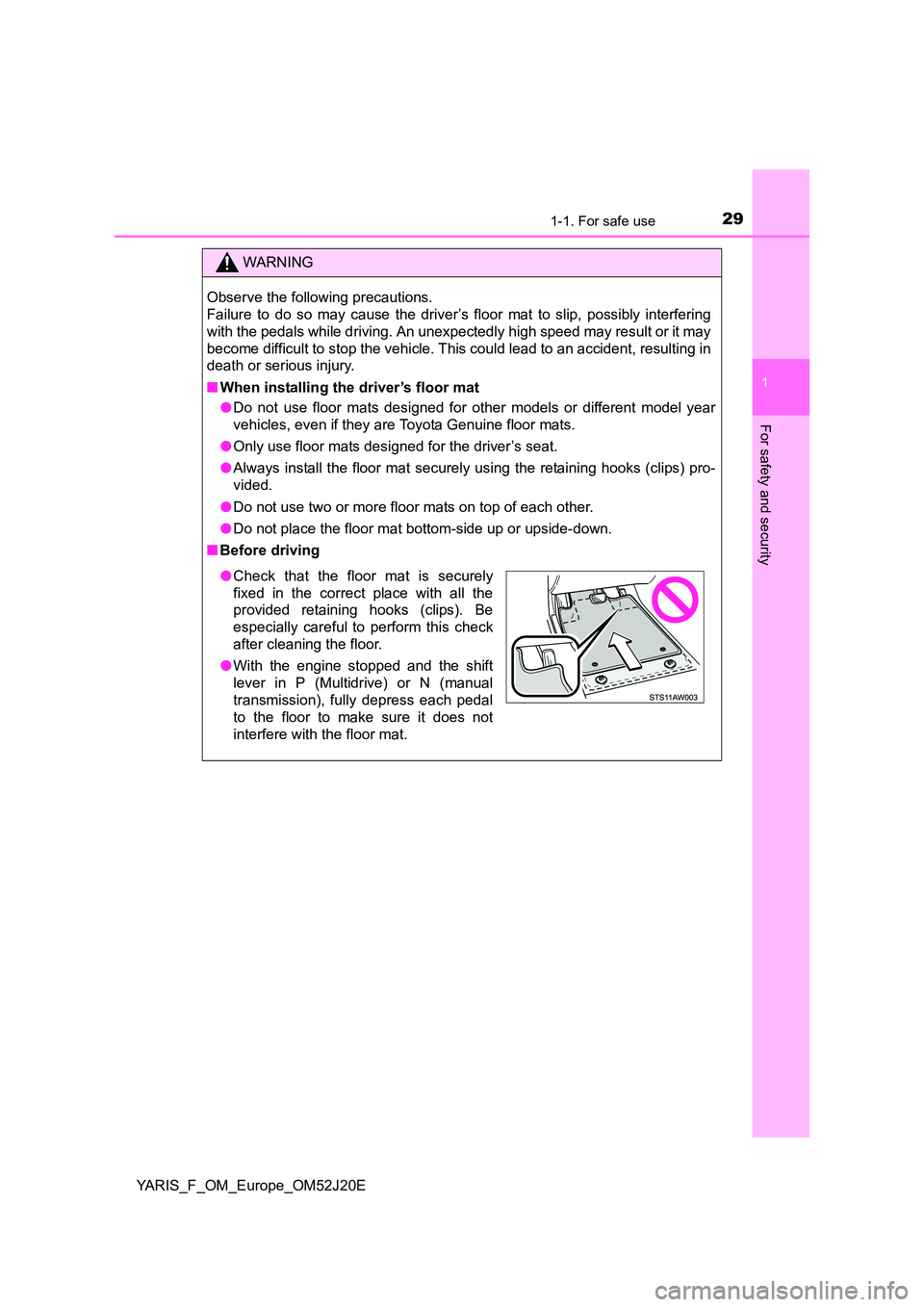
■ Before driving
●Check that the floor mat is securely
fixed in the correct place with all the
provided retaining hooks (clips). Be
especially careful to perform this check
after cleaning the floor.
● With the engine stopped and the shift
lever in P (Multidrive) or N (manual
transmission), fully depress each pedal
to the floor to make sure it does not
interfere with the floor mat.
Page 75 of 549
751-1. For safe use
1
For safety and security
YARIS_F_OM_Europe_OM52J20E
Exhaust gas precautions
Harmful substances to the human body are included in exhaust
gases if inhale.
WARNING
Exhaust gases contain harmful carbon monoxide (CO), which is colorless and
odorless. Observe the following precautions.
Failure to do so may cause exhaust gases enter the vehicle and may lead to
an accident caused by light-headedness, or may lead to death or a serious
health hazard.
■ Important points while driving
● Keep the back door closed.
● If you smell exhaust gases in the vehicle even when the back door is
closed, open the windows and have the vehicle inspected at any autho-
rized Toyota dealer or repairer, or another duly qualified and equipped pro-
fessional as soon as possible.
■ When parking
● If the vehicle is in a poorly ventilated area or a closed area, such as a
garage, stop the engine.
● Do not leave the vehicle with the engine running for a long time.
If such a situation cannot be avoided, park the vehicle in an open space
and ensure that exhaust fumes do not enter the vehicle interior.
● Do not leave the engine running in an area with snow build-up, or where it
is snowing. If snowbanks build up around the vehicle while the engine is
running, exhaust gases may collect and enter the vehicle.
■ Exhaust pipe
The exhaust system needs to be checked periodically. If there is a hole or
crack caused by corrosion, damage to a joint or abnormal exhaust noise, be
sure to have the vehicle inspected and repaired by any authorized Toyota
dealer or repairer, or another duly qualified and equipped professional.
Page 86 of 549
862. Instrument cluster
YARIS_F_OM_Europe_OM52J20E
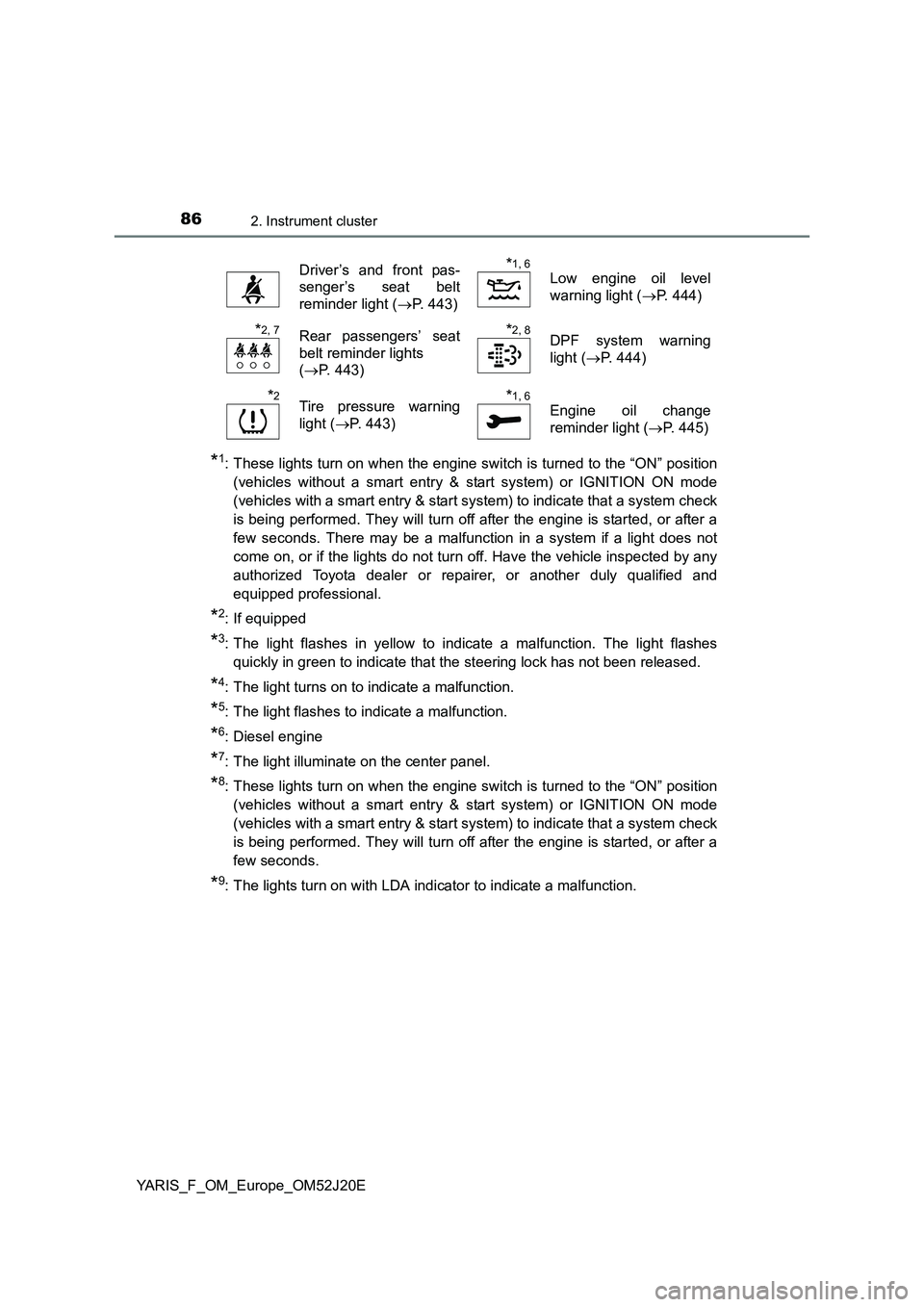
*1: These lights turn on when the engine switch is turned to the “ON” position
(vehicles without a smart entry & start system) or IGNITION ON mode
(vehicles with a smart entry & start system) to indicate that a system check
is being performed. They will turn off after the engine is started, or after a
few seconds. There may be a malfunction in a system if a light does not
come on, or if the lights do not turn off. Have the vehicle inspected by any
authorized Toyota dealer or repairer, or another duly qualified and
equipped professional.
*2: If equipped
*3: The light flashes in yellow to indicate a malfunction. The light flashes
quickly in green to indicate that the steering lock has not been released.
*4: The light turns on to indicate a malfunction.
*5: The light flashes to indicate a malfunction.
*6: Diesel engine
*7: The light illuminate on the center panel.
*8: These lights turn on when the engine switch is turned to the “ON” position
(vehicles without a smart entry & start system) or IGNITION ON mode
(vehicles with a smart entry & start system) to indicate that a system check
is being performed. They will turn off after the engine is started, or after a
few seconds.
*9: The lights turn on with LDA indicator to indicate a malfunction.
Driver’s and front pas-
senger’s seat belt
reminder light ( P. 443)
*1, 6
Low engine oil level
warning light ( P. 444)
*2, 7Rear passengers’ seat
belt reminder lights
( P. 443)
*2, 8DPF system warning
light ( P. 444)
*2Tire pressure warning
light ( P. 443)
*1, 6
Engine oil change
reminder light ( P. 445)
Page 88 of 549
882. Instrument cluster
YARIS_F_OM_Europe_OM52J20E
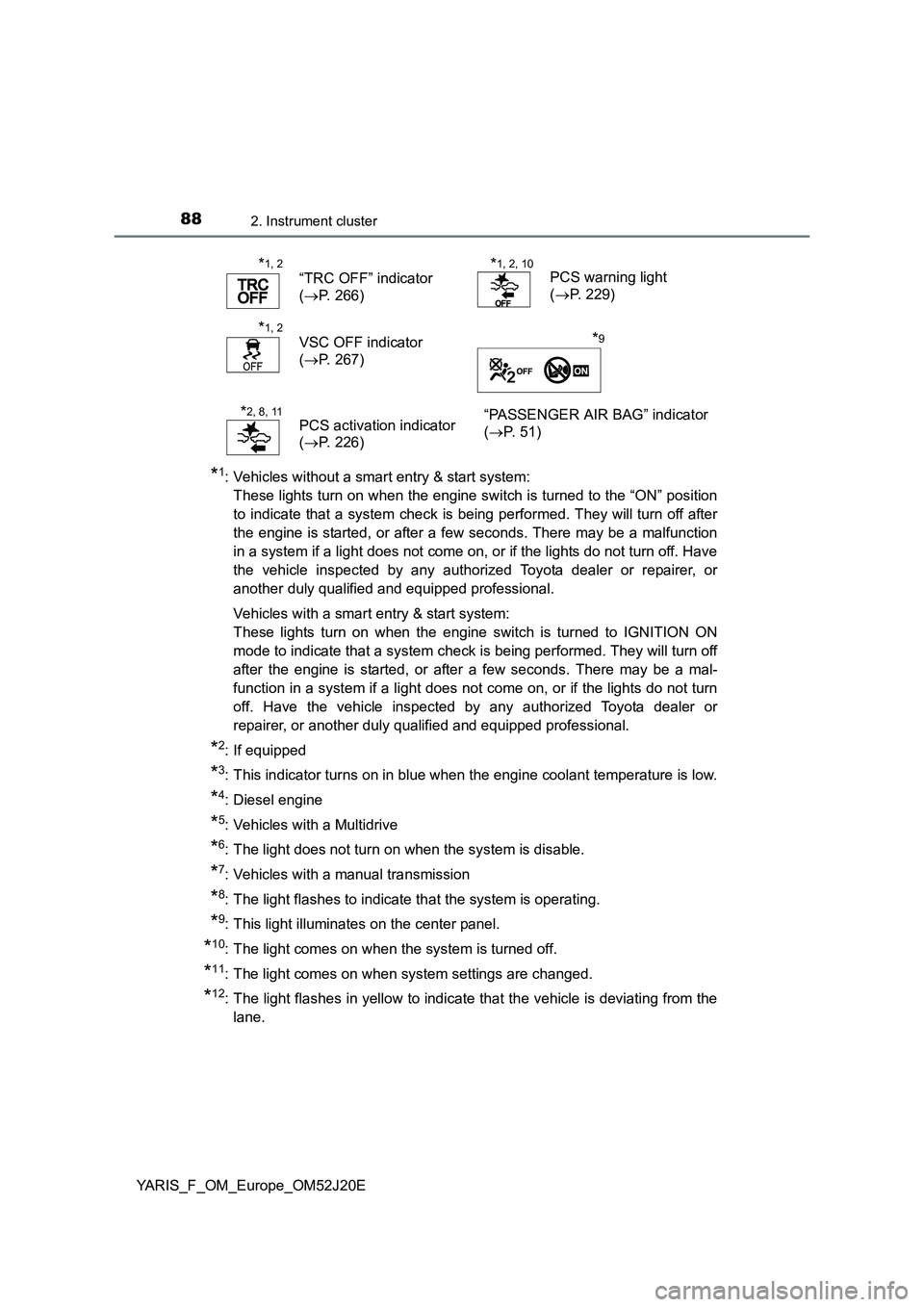
*1: Vehicles without a smart entry & start system:
These lights turn on when the engine switch is turned to the “ON” position
to indicate that a system check is being performed. They will turn off after
the engine is started, or after a few seconds. There may be a malfunction
in a system if a light does not come on, or if the lights do not turn off. Have
the vehicle inspected by any authorized Toyota dealer or repairer, or
another duly qualified and equipped professional.
Vehicles with a smart entry & start system:
These lights turn on when the engine switch is turned to IGNITION ON
mode to indicate that a system check is being performed. They will turn off
after the engine is started, or after a few seconds. There may be a mal-
function in a system if a light does not come on, or if the lights do not turn
off. Have the vehicle inspected by any authorized Toyota dealer or
repairer, or another duly qualified and equipped professional.
*2: If equipped
*3: This indicator turns on in blue when the engine coolant temperature is low.
*4: Diesel engine
*5: Vehicles with a Multidrive
*6: The light does not turn on when the system is disable.
*7: Vehicles with a manual transmission
*8: The light flashes to indicate that the system is operating.
*9: This light illuminates on the center panel.
*10: The light comes on when the system is turned off.
*11: The light comes on when system settings are changed.
*12: The light flashes in yellow to indicate that the vehicle is deviating from the
lane.
*1, 2
“TRC OFF” indicator
( P. 266)
*1, 2, 10PCS warning light
( P. 229)
*1, 2
VSC OFF indicator
( P. 267)
*9
*2, 8, 11PCS activation indicator
( P. 226)
“PASSENGER AIR BAG” indicator
( P. 51)
Page 89 of 549
892. Instrument cluster
2
Instrument cluster
YARIS_F_OM_Europe_OM52J20E
WARNING
■If a safety system warning light does not come on
Should a safety system light such as the ABS and SRS warning light not
come on when you start the engine, this could mean that these systems are
not available to help protect you in an accident, which could result in death
or serious injury. Have the vehicle inspected by any authorized Toyota
dealer or repairer, or another duly qualified and equipped professional
immediately if this occurs.
NOTICE
■ To prevent damage to the engine and its components
The engine may be overheating if the high engine coolant temperature
warning light flashes or turns on. In this case, immediately stop the vehicle
in a safe place, and check the engine after it has cooled completely.
( P. 493)
Page 131 of 549
1313-2. Opening, closing and locking the doors
3
Operation of each component
YARIS_F_OM_Europe_OM52J20E
■ Notes for the entry function
● Even when the electronic key is within the effective range (detection areas),
the system may not operate properly in the following cases:
• The electronic key is too close to the window or outside door handle, near
the ground, or in a high place w hen the doors are locked or unlocked.
• The electronic key is on the inst rument panel, luggage cover (if equipped)
or floor, or in the door pockets, glove box, accessory box of the instru-
ment panel, or in/near the front cup holder when the engine is started or
engine switch modes are changed.
● Do not leave the electronic key on top of the instrument panel or near the
door pockets when exiting the vehicle. Depending on the radio wave recep-
tion conditions, it may be detected by the antenna outside the cabin and the
door will become lockable from the outside, possibly trapping the electronic
key inside the vehicle.
● As long as the electronic key is within the effective range, the doors may be
locked or unlocked by anyone.
● Even if the electronic key is not inside the vehicle, it may be possible to start
the engine if the electronic key is near the window.
● The doors may unlock if a large amount of water splashes on the door han-
dle, such as in the rain or in a car wash when the electronic key is within the
effective range. (The door will automatically be locked after approximately
30 seconds if the doors are not opened and closed.)
● Gripping the door handle when wearing a glove may not unlock the door.
● If the wireless remote control is used to lock the doors when the electronic
key is near the vehicle, there is a possibility that the door may not be
unlocked by the entry function. (Use the wireless remote control to unlock
the doors.)
● A sudden approach to the effective range or door handle may prevent the
doors from being unlocked. In this case, return the door handle to the origi-
nal position and check that the doors unlock before pulling the door handle
again.
■ Notes for locking the doors
● Touching the door lock sensor while wearing gloves may delay or prevent
lock operation. Remove the gloves and touch the lock sensor again.
● If the door handle becomes wet while the electronic key is within the effec-
tive range, the door may lock and unlock repeatedly. Place the key in a posi-
tion 2 m (6 ft.) or more separate from the vehicle while the vehicle is being
washed. (Take care to ensure that the key is not stolen.)
● If the electronic key is inside the vehicle and a door handle becomes wet
during a car wash, a buzzer will sound outside the vehicle. To turn off the
alarm, lock all the doors.
● The lock sensor may not work properly if it comes into contact with ice,
snow, mud, etc. Clean the lock sensor and attempt to operate it again.
Page 132 of 549
1323-2. Opening, closing and locking the doors
YARIS_F_OM_Europe_OM52J20E
■ Notes for the unlocking function
● A sudden approach to the effective range or door handle may prevent the
doors from being unlocked. In this case, return the door handle to the origi-
nal position and check that the doors unlock before pulling the door handle
again.
● Gripping the door handle when wearing a glove may not unlock the door.
Remove the gloves and touch the sensor on the back of the handle again.
● If the door handle becomes wet while the electronic key is within the effec-
tive range, the door may lock and unlock repeatedly. Place the key in a posi-
tion 2 m (6 ft.) or more separate from the vehicle while the vehicle is being
washed. (Take care to ensure that the key is not stolen.)
● If there is another electronic key in the detection area, it may take slightly
longer to unlock the doors after the door handle is gripped.
■ When the vehicle is not driven for extended periods
● To prevent theft of the vehicle, do not leave the electronic key within 2 m
(6 ft.) of the vehicle.
● The smart entry & start system can be deactivated in advance. (P. 524)
■ To operate the system properly
Make sure to carry the electronic key when operating the system. Do not get
the electronic key too close to the vehicle when operating the system from the
outside of the vehicle.
Depending on the position and holding condition of the electronic key, the key
may not be detected correctly and the system may not operate properly. (The
alarm may go off accidentally, or the door lock prevention function may not
operate.)
■ If the smart entry & start system does not operate properly
● Locking and unlocking the doors: Use the mechanical key. (P. 486)
● Starting the engine: P. 486
■ Customization
Settings (e. g. smart entry & start system) can be changed.
(Customizable features: P. 524)
■ If the smart entry & start system has been deactivated in a customized
setting
● Locking and unlocking the doors:
Use the wireless remote control or mechanical key. ( P. 115, 486)
● Starting the engine and changing engine switch modes: P. 486
● Stopping the engine: P. 186
Page 157 of 549
1573-5. Opening and closing the windows
3
Operation of each component
YARIS_F_OM_Europe_OM52J20E
WARNING
Observe the following precautions.
Failure to do so may result in death or serious injury.
■ Closing the windows
● The driver is responsible for all the power window operations, including the
operation for the passengers. In order to prevent accidental operation,
especially by a child, do not let a child operate the power windows. It is
possible for children and other passengers to have body parts caught in
the power window. Also, when riding with a child, it is recommended to
use the window lock switch. ( P. 154)
● Check to make sure that all passengers do not have any part of their body
in a position where it could be caught when a window is being operated.
● When exiting the vehicle, turn the engine switch off, carry the key and exit
the vehicle along with the child. T here may be accidental operation, due to
mischief, etc., that may possibly lead to an accident.
■ Jam protection function (driver’s window only)
● Never use any part of your body to intentionally activate the jam protection
function.
● The jam protection function may not work if something gets caught just
before the window fully closes.