inflation pressure TOYOTA YARIS 2017 Owners Manual
[x] Cancel search | Manufacturer: TOYOTA, Model Year: 2017, Model line: YARIS, Model: TOYOTA YARIS 2017Pages: 549, PDF Size: 33.09 MB
Page 4 of 549
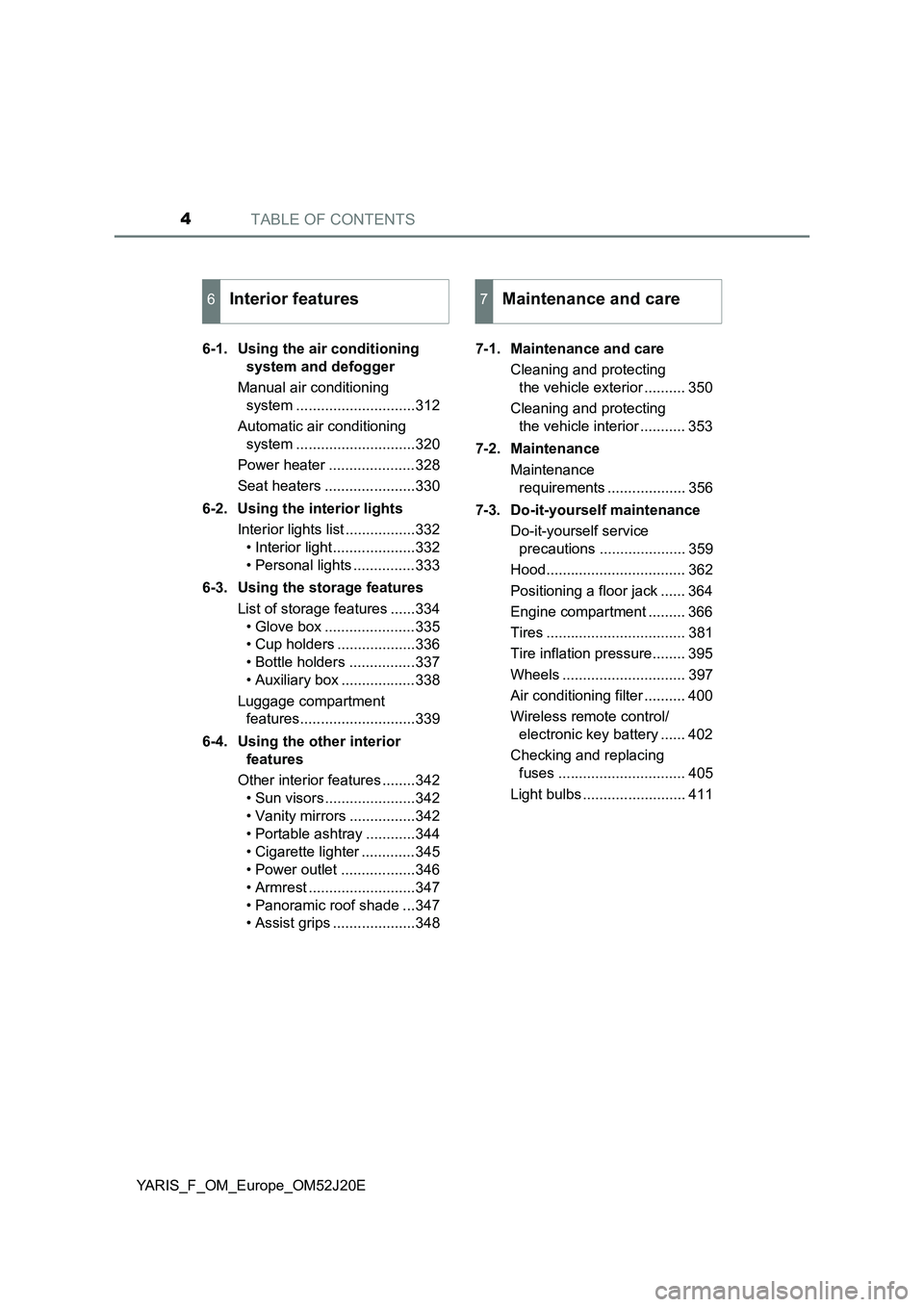
TABLE OF CONTENTS4
YARIS_F_OM_Europe_OM52J20E
6-1. Using the air conditioning
system and defogger
Manual air conditioning
system .............................312
Automatic air conditioning
system .............................320
Power heater .....................328
Seat heaters ......................330
6-2. Using the interior lights
Interior lights list .................332
• Interior light ....................332
• Personal lights ...............333
6-3. Using the storage features
List of storage features ......334
• Glove box ......................335
• Cup holders ...................336
• Bottle holders ................337
• Auxiliary box ..................338
Luggage compartment
features............................339
6-4. Using the other interior
features
Other interior features ........342
• Sun visors ......................342
• Vanity mirrors ................342
• Portable ashtray ............344
• Cigarette lighter .............345
• Power outlet ..................346
• Armrest ..........................347
• Panoramic roof shade ...347
• Assist grips ....................348
7-1. Maintenance and care
Cleaning and protecting
the vehicle exterior .......... 350
Cleaning and protecting
the vehicle interior ........... 353
7-2. Maintenance
Maintenance
requirements ................... 356
7-3. Do-it-yourself maintenance
Do-it-yourself service
precautions ..................... 359
Hood.................................. 362
Positioning a floor jack ...... 364
Engine compartment ......... 366
Tires .................................. 381
Tire inflation pressure........ 395
Wheels .............................. 397
Air conditioning filter .......... 400
Wireless remote control/
electronic key battery ...... 402
Checking and replacing
fuses ............................... 405
Light bulbs ......................... 411
6Interior features7Maintenance and care
Page 11 of 549
11Pictorial index
YARIS_F_OM_Europe_OM52J20E
Wipers. . . . . . . . . . . . . . . . . . . . . . . . . . . . . . . . . . . . . . . P. 211, 215
Precautions against winter season . . . . . . . . . . . . . . . . . . . . . P. 272
Precautions against car wash . . . . . . . . . . . . . . . . . . . . . . . . . P. 351
Fuel filler door . . . . . . . . . . . . . . . . . . . . . . . . . . . . . . . . . . . . P. 217
Refueling method . . . . . . . . . . . . . . . . . . . . . . . . . . . . . . . . . . P. 217
Fuel type/fuel tank capacity . . . . . . . . . . . . . . . . . . . . . . . . . . . P. 507
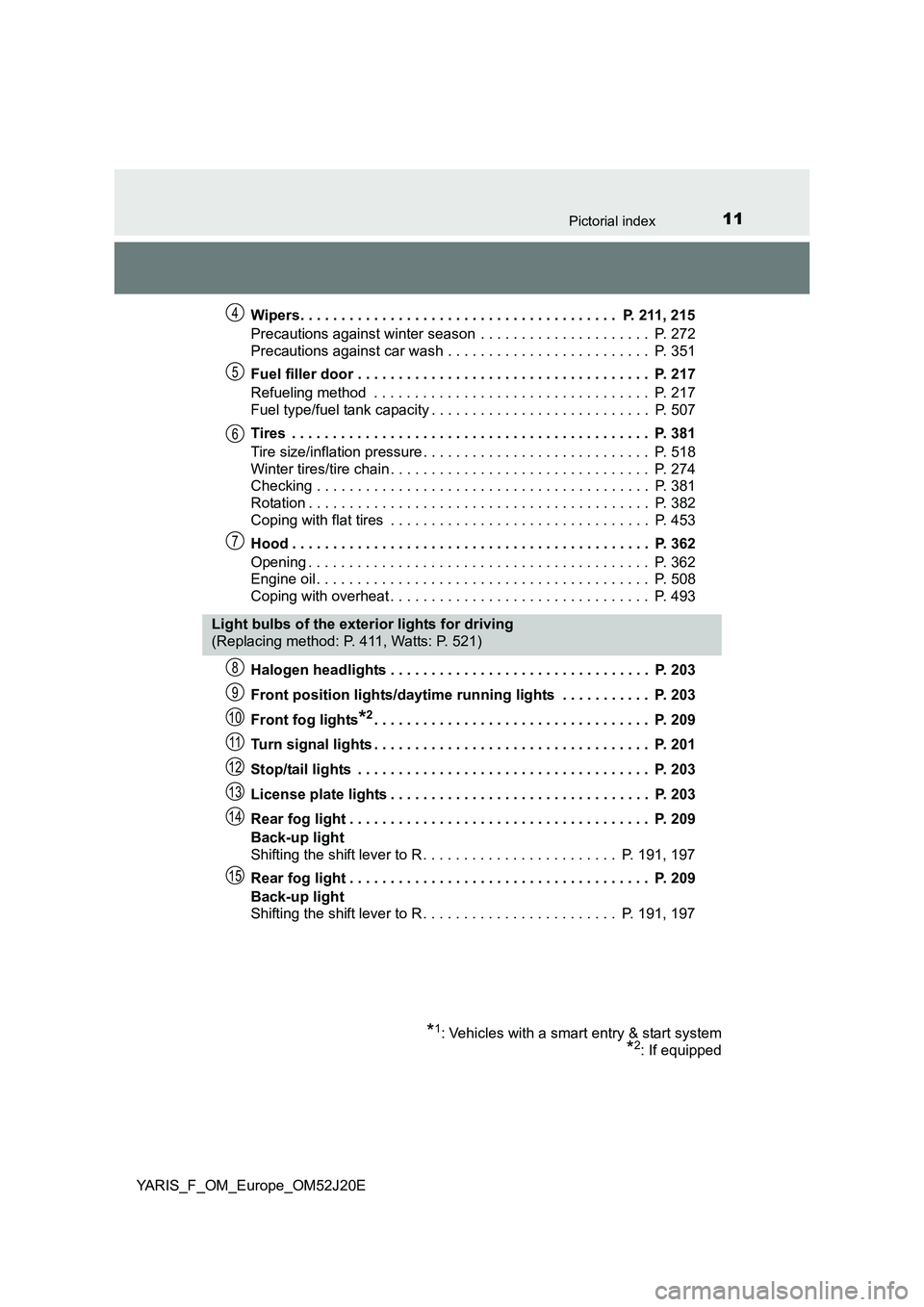
Tires . . . . . . . . . . . . . . . . . . . . . . . . . . . . . . . . . . . . . . . . . . . . P. 381
Tire size/inflation pressure . . . . . . . . . . . . . . . . . . . . . . . . . . . . P. 518
Winter tires/tire chain . . . . . . . . . . . . . . . . . . . . . . . . . . . . . . . . P. 274
Checking . . . . . . . . . . . . . . . . . . . . . . . . . . . . . . . . . . . . . . . . . P. 381
Rotation . . . . . . . . . . . . . . . . . . . . . . . . . . . . . . . . . . . . . . . . . . P. 382
Coping with flat tires . . . . . . . . . . . . . . . . . . . . . . . . . . . . . . . . P. 453
Hood . . . . . . . . . . . . . . . . . . . . . . . . . . . . . . . . . . . . . . . . . . . . P. 362
Opening . . . . . . . . . . . . . . . . . . . . . . . . . . . . . . . . . . . . . . . . . . P. 362
Engine oil . . . . . . . . . . . . . . . . . . . . . . . . . . . . . . . . . . . . . . . . . P. 508
Coping with overheat . . . . . . . . . . . . . . . . . . . . . . . . . . . . . . . . P. 493
Halogen headlights . . . . . . . . . . . . . . . . . . . . . . . . . . . . . . . . P. 203
Front position lights/daytime running lights . . . . . . . . . . . P. 203
Front fog lights*2. . . . . . . . . . . . . . . . . . . . . . . . . . . . . . . . . . P. 209
Turn signal lights . . . . . . . . . . . . . . . . . . . . . . . . . . . . . . . . . . P. 201
Stop/tail lights . . . . . . . . . . . . . . . . . . . . . . . . . . . . . . . . . . . . P. 203
License plate lights . . . . . . . . . . . . . . . . . . . . . . . . . . . . . . . . P. 203
Rear fog light . . . . . . . . . . . . . . . . . . . . . . . . . . . . . . . . . . . . . P. 209
Back-up light
Shifting the shift lever to R. . . . . . . . . . . . . . . . . . . . . . . . P. 191, 197
Rear fog light . . . . . . . . . . . . . . . . . . . . . . . . . . . . . . . . . . . . . P. 209
Back-up light
Shifting the shift lever to R. . . . . . . . . . . . . . . . . . . . . . . . P. 191, 197
4
5
6
7
Light bulbs of the exterior lights for driving
(Replacing method: P. 411, Watts: P. 521)
*1: Vehicles with a smart entry & start system
*2: If equipped
8
9
10
11
12
13
14
15
Page 176 of 549
1764-1. Before driving
YARIS_F_OM_Europe_OM52J20E
■Maximum permissible rear axle capacity
Vehicle category M1 models*
The weight borne by the rear axle should not exceed the maximum
permissible rear axle capacity by 15% or more. Exceeding this
weight is dangerous.
Vehicle category N1 models*
The weight borne by the rear axle should not exceed the maximum
permissible rear axle capacity. Exceeding this weight is dangerous.
The values for towing capacity were derived from testing conducted
at sea level. Take note that engine output and towing capacity will
be reduced at high altitudes.
*: To distinguish the vehicle category, ask any authorized Toyota dealer or
repairer, or another duly qualified and equipped professional.
WARNING
■ When the gross vehicle mass or maximum permissible axle capacity is
exceeded (vehicle category M1 models*)
Failing to observe this precaution may lead to an accident causing death or
serious injury.
● Add an additional 20.0 kPa (0.2 kgf/cm2 or bar, 3 psi) to the tire inflation
pressure.
● Do not exceed the established speed limit for towing a trailer in built-up
areas or 100 km/h (62 mph), whichever is lower.
Page 178 of 549
1784-1. Before driving
YARIS_F_OM_Europe_OM52J20E
■Tire information
● Increase the tire inflation pressure to 20.0 kPa (0.2 kgf/cm2 or bar, 3 psi)
greater than the recommended value when towing. ( P. 518)
● Increase the air pressure of the trailer tires in accordance with the total
trailer weight and according to the values recommended by the manufac-
turer of your trailer.
■ Tr a i l e r l i g h ts
Check that the turn signal lights and stoplights are operating correctly every
time you hitch up the trailer. Direct ly wiring up to your vehicle may damage
the electrical system and stop the lights from functioning correctly.
■ Break-in schedule
Toyota recommends that vehicles fitted with new power train components
should not be used for towing trailers for the first 800 km (500 miles).
■ Safety checks before towing
● Check that the maximum load limit for the towing hitch/bracket and hitch ball
is not exceeded. Bear in mind that the coupling weight of the trailer will add
to the load exerted on the vehicle. Also make sure that the total load exerted
on the vehicle is within the range of the weight limits. ( P. 174)
● Ensure that the trailer load is secure.
● Supplementary outside rear view mirrors should be added to the vehicle if
the traffic behind cannot be clearly seen with standard mirrors. Adjust the
extending arms of these mirrors on both sides of the vehicle so that they
always provide maximum visibility of the road behind.
■ Maintenance
● Maintenance must be performed more frequently when using the vehicle for
towing due to the greater weight burden placed on the vehicle compared to
normal driving.
● Retighten all bolts securing the hitching ball and bracket after towing for
approximately 1000 km (600 miles).
NOTICE
■ When the rear bumper strengthening material is aluminum
Ensure the steel bracket part does not come directly in contact with that
area.
When steel and aluminum come into contact, there is a reaction similar to
corrosion, which will weaken the section concerned and may result in dam-
age. Apply a rust inhibitor to parts that will come in contact when attaching a
steel bracket.
Page 238 of 549
2384-5. Toyota Safety Sense
YARIS_F_OM_Europe_OM52J20E
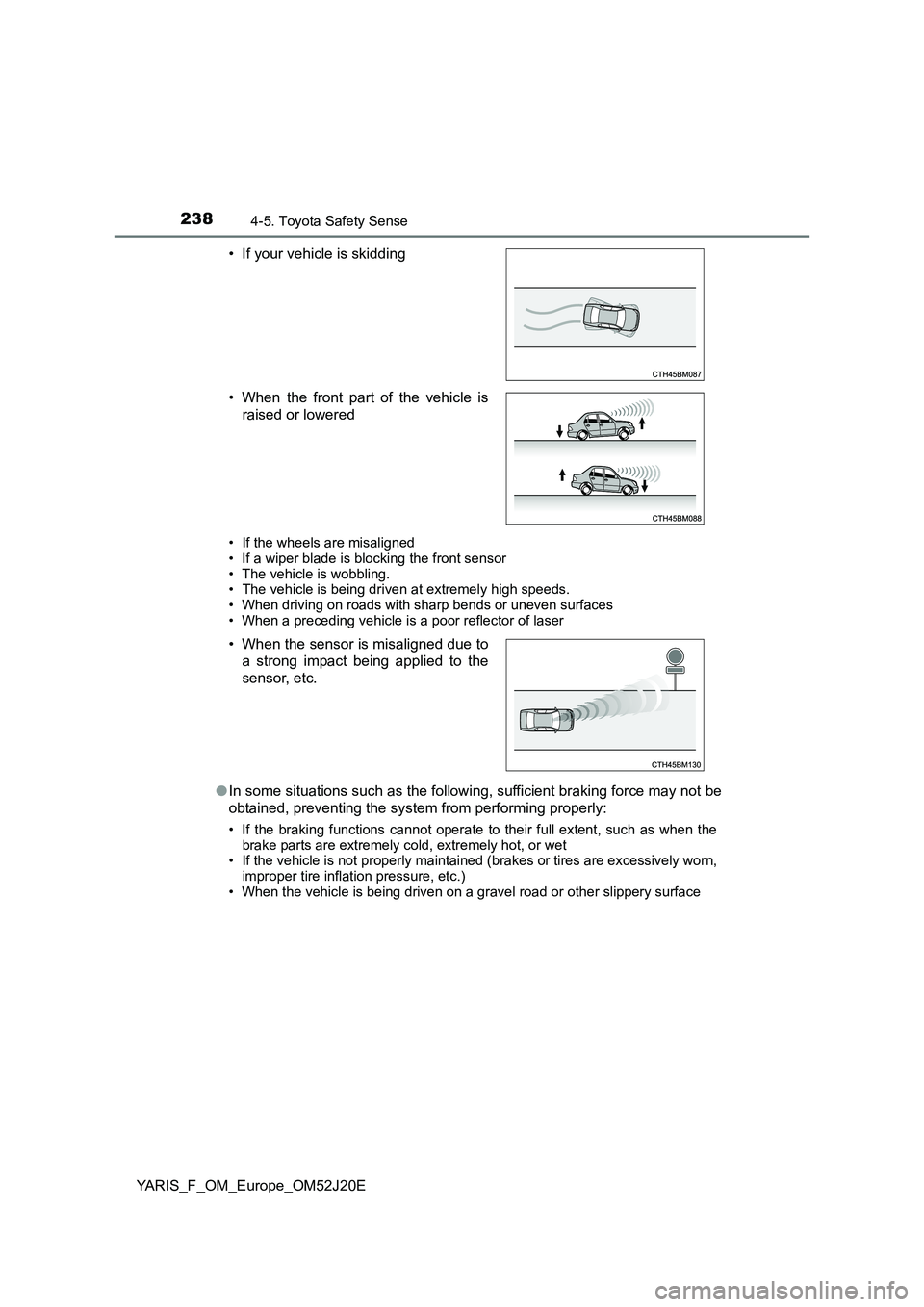
• If the wheels are misaligned
• If a wiper blade is blocking the front sensor • The vehicle is wobbling.• The vehicle is being driven at extremely high speeds.
• When driving on roads with sharp bends or uneven surfaces • When a preceding vehicle is a poor reflector of laser
● In some situations such as the following, sufficient braking force may not be
obtained, preventing the system from performing properly:
• If the braking functions cannot operate to their full extent, such as when the brake parts are extremely cold, extremely hot, or wet• If the vehicle is not properly maintained (brakes or tires are excessively worn,
improper tire inflation pressure, etc.) • When the vehicle is being driven on a gravel road or other slippery surface
• If your vehicle is skidding
• When the front part of the vehicle is
raised or lowered
• When the sensor is misaligned due to
a strong impact being applied to the
sensor, etc.
Page 242 of 549
2424-5. Toyota Safety Sense
YARIS_F_OM_Europe_OM52J20E
■Temporary cancelation of the LDA system functions
If any of the following occurs, the LDA system functions will be temporarily
canceled. The functions will resume after the necessary operating conditions
have returned.
● The turn signal lever is operated.
● The vehicle speed deviates from the operating range of the LDA system
functions.
● When the lane lines cannot be recognized while driving.
● When the lane departure warning sounds.
The lane departure warning function will not operate again for a several sec-
onds after it has been activated, even if the vehicle leaves the lane again.
■ The lane departure warning
Depending on the audio system sound level or air conditioning fan noise
while the audio system or air conditioning sy stem is in use, it may be difficult
to hear the warning sound.
■ After the vehicle has been parked in the sun
The LDA system may not be immediatel y available. When the temperature in
the cabin decreases and the temperature around the front sensor ( P. 240)
becomes suitable for its operation, the functions will begin to operate.
■ If there are lane markers on only one side of the vehicle
The lane departure warning will not operate for the side on which lane mark-
ers could not be recognized.
■ Conditions in which the function may not operate correctly
In the following situations, the front sensor may be unable to recognize lane
markers causing the lane departure warning function to operate incorrectly.
However, this does not indicate a malfunction.
● When driving through an area, such as a tollbooth, a crossing or before a
ticket checkpoint
● When driving on a sharp curve
● When lane markers are extremely narrow or extremely wide
● When the vehicle leans to one side an unusual amount due to a heavy load
or improper tire inflation pressure
● When the following distance between your vehicle and the vehicle ahead is
extremely short
● When the lane markers are yellow (These may be more difficult for the sys-
tem to recognize compared to white markers.)
● When the lane markers are broken, Botts’ dots (raised pavement markers)
or stones
Page 269 of 549
2694-6. Using the driving support systems
4
Driving
YARIS_F_OM_Europe_OM52J20E
WARNING
■When the VSC is activated
The slip indicator flashes. Always drive carefully. Reckless driving may
cause an accident. Exercise particular care when the indicator light flashes.
■ When the TRC/VSC systems are turned off
Be especially careful and drive at a speed appropriate to the road condi-
tions. As these are the systems to help ensure vehicle stability and driving
force, do not turn the TRC/VSC systems off unless unnecessary.
■ Replacing tires
Make sure that all tires are of the specified size, brand, tread pattern and
total load capacity. In addition, make sure that the tires are inflated to the
recommended tire inflation pressure level.
The ABS, TRC and VSC systems will not function correctly if different tires
are installed on the vehicle.
Contact any authorized Toyota dealer or repairer, or another duly qualified
and equipped professional for further in formation when replacing tires or
wheels.
■ Handling of tires and the suspension
Using tires with any kind of problem or modifying the suspension will affect
the driving assist systems, and may cause a system to malfunction.
Page 349 of 549
349
7Maintenance and care
YARIS_F_OM_Europe_OM52J20E
7-1. Maintenance and care
Cleaning and protecting
the vehicle exterior .......... 350
Cleaning and protecting
the vehicle interior ........... 353
7-2. Maintenance
Maintenance
requirements.................... 356
7-3. Do-it-yourself maintenance
Do-it-yourself service
precautions ...................... 359
Hood .................................. 362
Positioning a floor jack ....... 364
Engine compartment.......... 366
Tires ................................... 381
Tire inflation pressure ........ 395
Wheels ............................... 397
Air conditioning filter .......... 400
Wireless remote control/
electronic key battery....... 402
Checking and replacing
fuses ................................ 405
Light bulbs ......................... 411
Page 359 of 549
3597-3. Do-it-yourself maintenance
7
Maintenance and care
YARIS_F_OM_Europe_OM52J20E
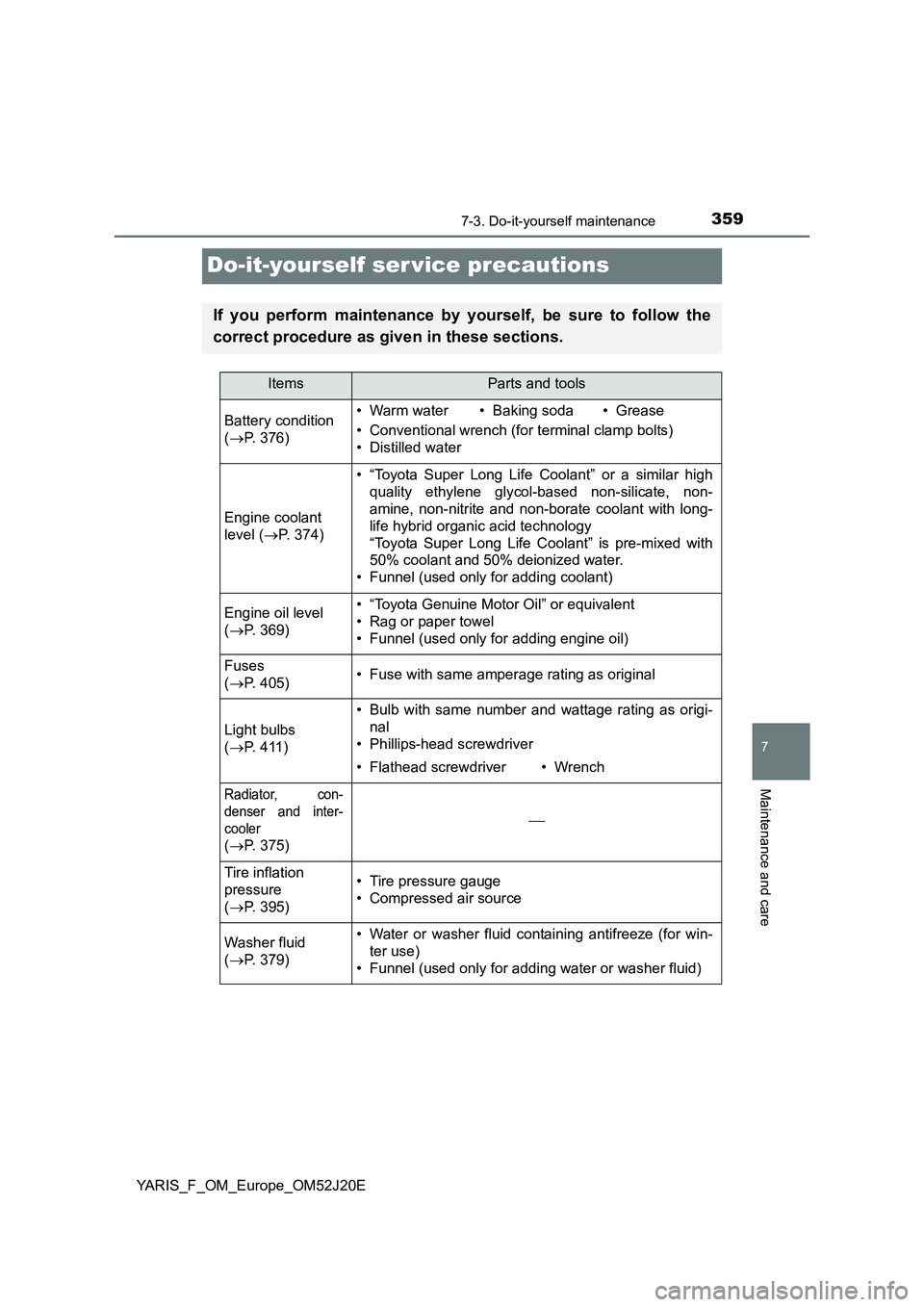
Do-it-yourself ser vice precautions
If you perform maintenance by yourself, be sure to follow the
correct procedure as given in these sections.
ItemsParts and tools
Battery condition
( P. 376)
•Warm water• Baking soda•Grease
• Conventional wrench (for terminal clamp bolts)
• Distilled water
Engine coolant
level ( P. 374)
• “Toyota Super Long Life Coolant” or a similar high
quality ethylene glycol-based non-silicate, non-
amine, non-nitrite and non-borate coolant with long-
life hybrid organic acid technology
“Toyota Super Long Life Coolant” is pre-mixed with
50% coolant and 50% deionized water.
• Funnel (used only for adding coolant)
Engine oil level
( P. 369)
• “Toyota Genuine Motor Oil” or equivalent
• Rag or paper towel
• Funnel (used only for adding engine oil)
Fuses
( P. 405)• Fuse with same amperage rating as original
Light bulbs
( P. 411)
• Bulb with same number and wattage rating as origi-
nal
• Phillips-head screwdriver
• Flathead screwdriver•Wrench
Radiator, con-
denser and inter-
cooler
( P. 375)
Tire inflation
pressure
( P. 395)
• Tire pressure gauge
• Compressed air source
Washer fluid
( P. 379)
• Water or washer fluid containing antifreeze (for win-
ter use)
• Funnel (used only for adding water or washer fluid)
Page 382 of 549
3827-3. Do-it-yourself maintenance
YARIS_F_OM_Europe_OM52J20E
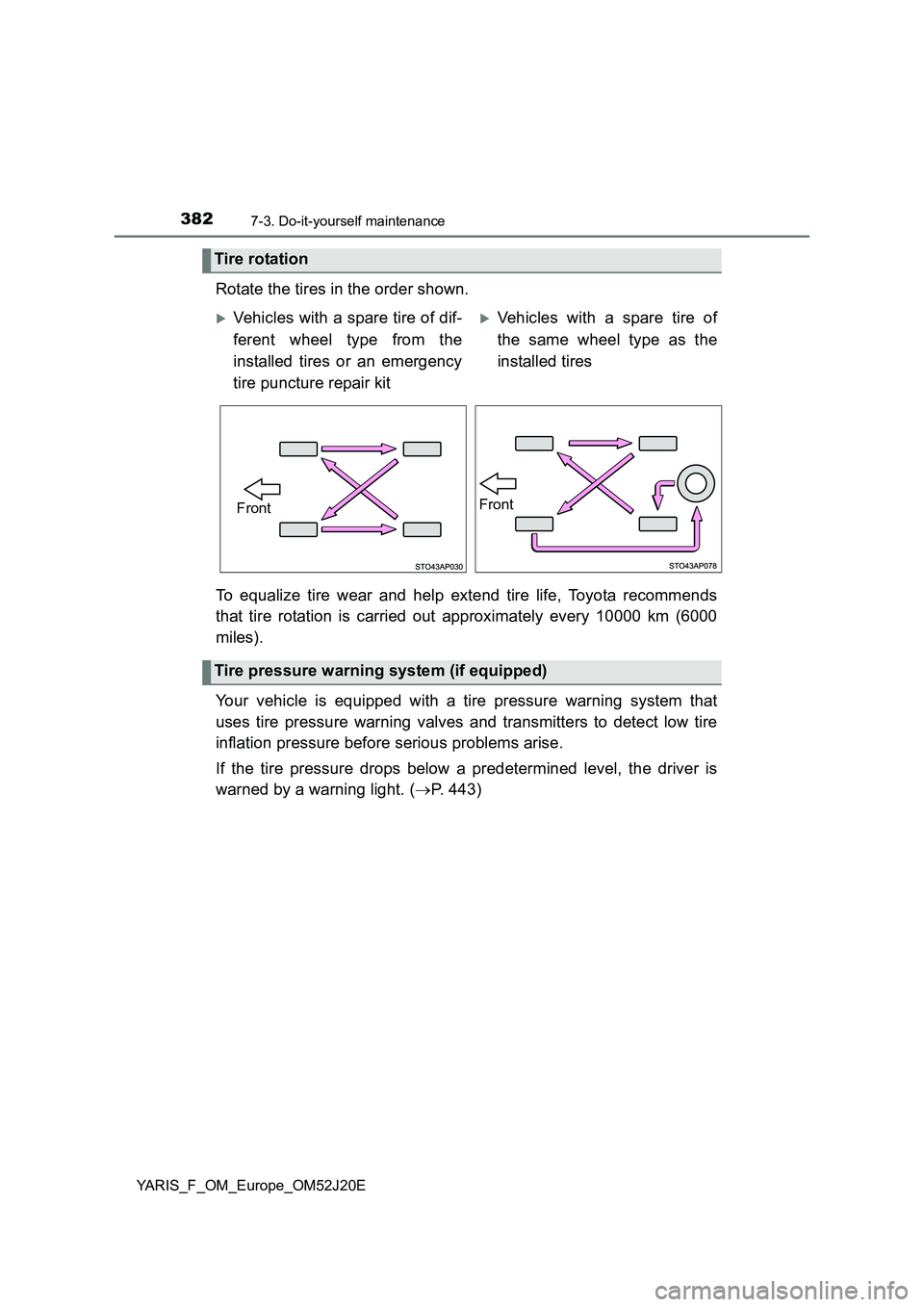
Rotate the tires in the order shown.
To equalize tire wear and help extend tire life, Toyota recommends
that tire rotation is carried out approximately every 10000 km (6000
miles).
Your vehicle is equipped with a tire pressure warning system that
uses tire pressure warning valves and transmitters to detect low tire
inflation pressure before serious problems arise.
If the tire pressure drops below a predetermined level, the driver is
warned by a warning light. ( P. 443)
Tire rotation
Vehicles with a spare tire of dif-
ferent wheel type from the
installed tires or an emergency
tire puncture repair kit
Vehicles with a spare tire of
the same wheel type as the
installed tires
FrontFront
Tire pressure warning system (if equipped)