tow bar TOYOTA YARIS 2017 Owners Manual
[x] Cancel search | Manufacturer: TOYOTA, Model Year: 2017, Model line: YARIS, Model: TOYOTA YARIS 2017Pages: 549, PDF Size: 33.09 MB
Page 173 of 549
173
4
4-1. Before driving
Driving
YARIS_F_OM_Europe_OM52J20E
Trailer towing
◆Weight limits
Check the allowable towing capacity, GVM (Gross Vehicle Mass),
MPAC (Maximum Permissible Axle Capacity), and permissible
drawbar load before towing. ( P. 502)
◆Towing hitch/bracket
Toyota recommends the use of the Toyota hitch/bracket for your
vehicle. Other products of a suitable nature and comparable quality
may also be used.
Your vehicle is designed primarily as a passenger carrying vehi-
cle. Towing a trailer will have an adverse effect on handling, per-
formance, braking, durability, and fuel consumption. Your safety
and satisfaction depend on the proper use of correct equipment
and cautions driving habits. For your safety and the safety of
others, do not overload the vehicle or trailer.
To tow a trailer safely, use extreme care and drive the vehicle in
accordance with the trailer’s characteristics and operating con-
ditions.
Toyota warranties do not apply to damage or malfunction
caused by towing a trailer for commercial purposes.
Ask your local authorized Toyota dealer or repairer, or another
duly qualified and equipped professional, for further details
before towing, as there are additional legal requirements in
some countries.
Page 174 of 549
1744-1. Before driving
YARIS_F_OM_Europe_OM52J20E
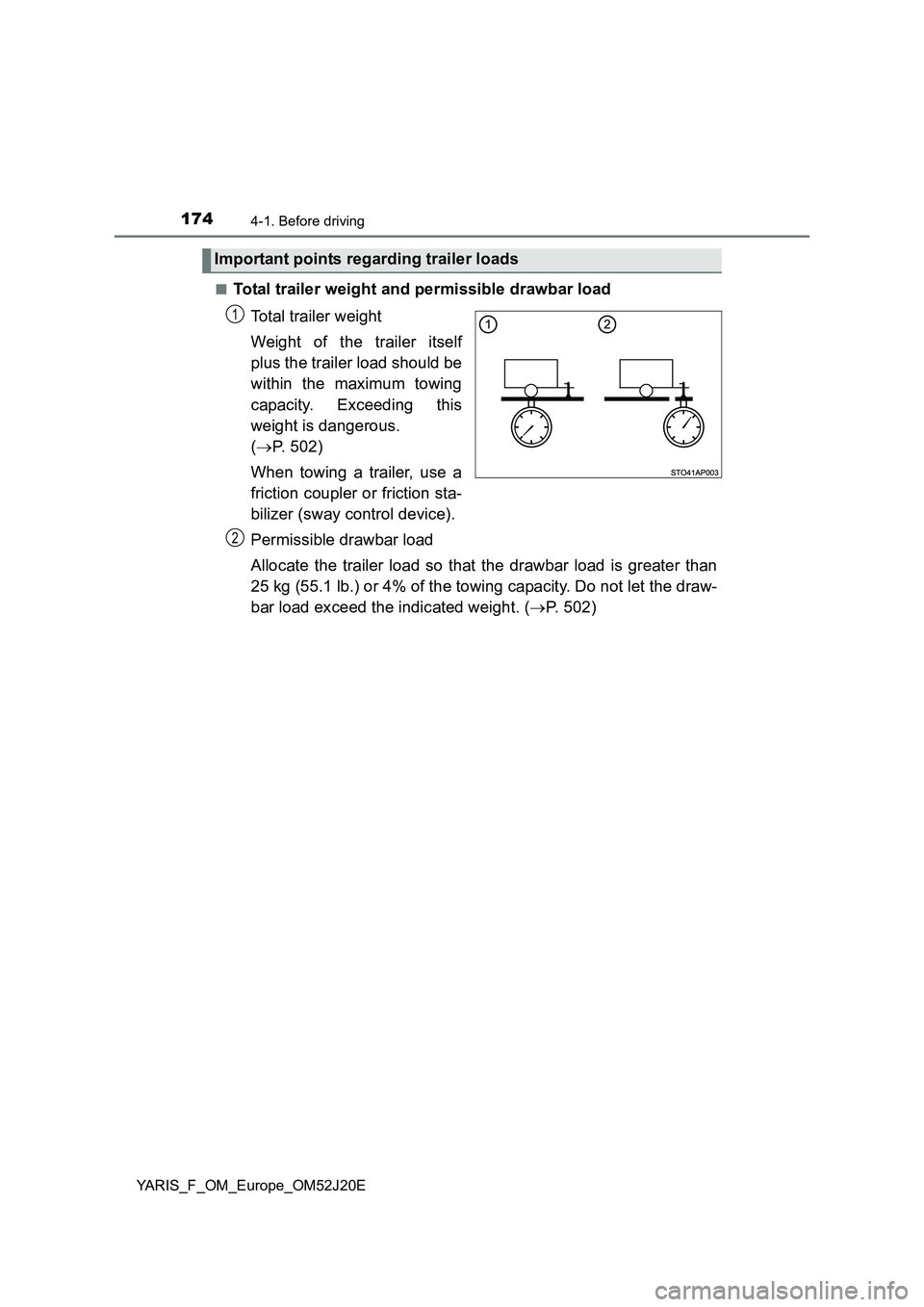
■Total trailer weight and permissible drawbar load
Total trailer weight
Weight of the trailer itself
plus the trailer load should be
within the maximum towing
capacity. Exceeding this
weight is dangerous.
( P. 502)
When towing a trailer, use a
friction coupler or friction sta-
bilizer (sway control device).
Permissible drawbar load
Allocate the trailer load so that the drawbar load is greater than
25 kg (55.1 lb.) or 4% of the towing capacity. Do not let the draw-
bar load exceed the indicated weight. ( P. 502)
Important points regarding trailer loads
1
2
Page 175 of 549
1754-1. Before driving
4
Driving
YARIS_F_OM_Europe_OM52J20E
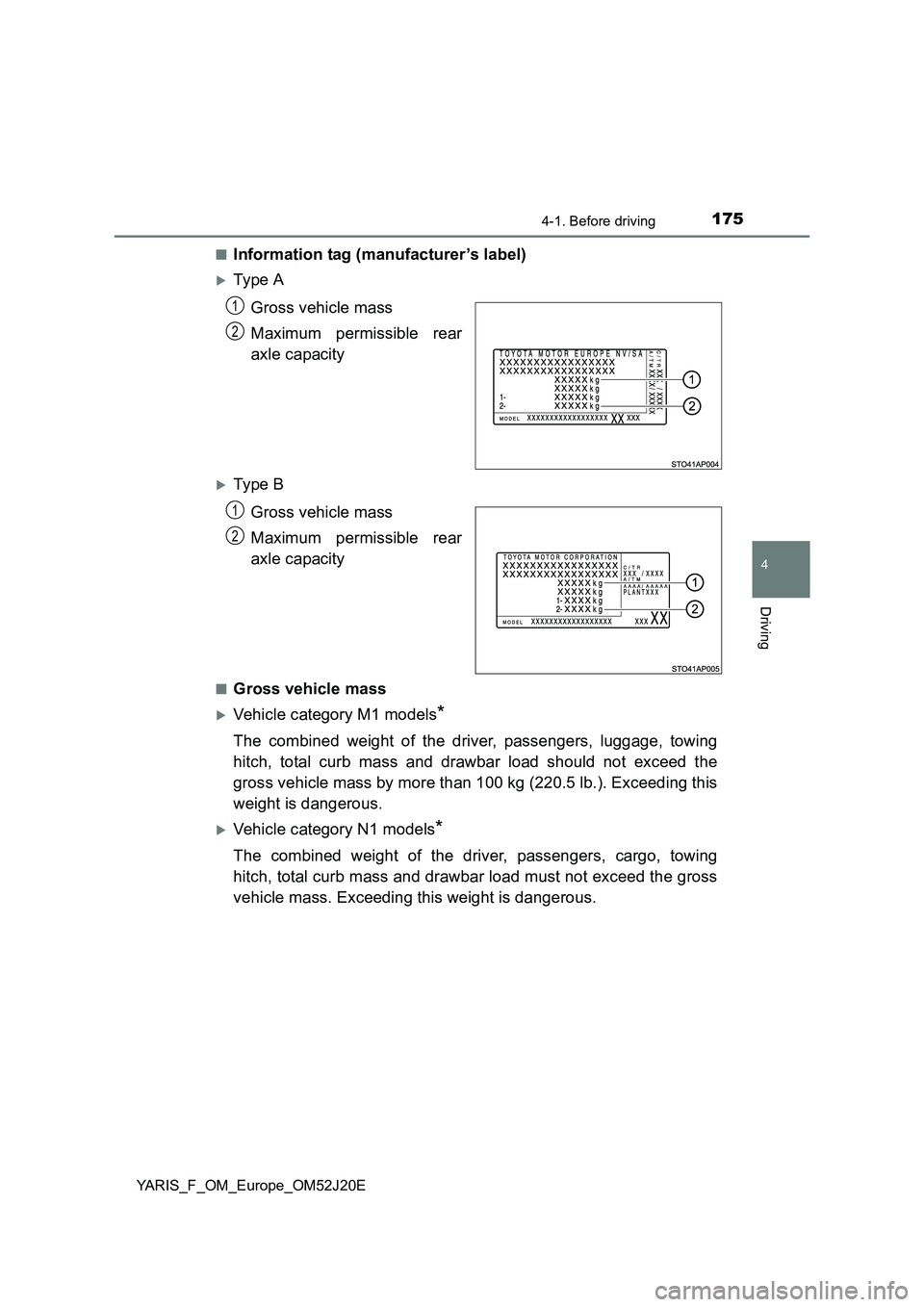
■Information tag (manufacturer’s label)
Ty pe A
Gross vehicle mass
Maximum permissible rear
axle capacity
Ty pe B
Gross vehicle mass
Maximum permissible rear
axle capacity
■Gross vehicle mass
Vehicle category M1 models*
The combined weight of the driver, passengers, luggage, towing
hitch, total curb mass and drawbar load should not exceed the
gross vehicle mass by more than 100 kg (220.5 lb.). Exceeding this
weight is dangerous.
Vehicle category N1 models*
The combined weight of the driver, passengers, cargo, towing
hitch, total curb mass and drawbar load must not exceed the gross
vehicle mass. Exceeding this weight is dangerous.
1
2
1
2
Page 176 of 549
1764-1. Before driving
YARIS_F_OM_Europe_OM52J20E
■Maximum permissible rear axle capacity
Vehicle category M1 models*
The weight borne by the rear axle should not exceed the maximum
permissible rear axle capacity by 15% or more. Exceeding this
weight is dangerous.
Vehicle category N1 models*
The weight borne by the rear axle should not exceed the maximum
permissible rear axle capacity. Exceeding this weight is dangerous.
The values for towing capacity were derived from testing conducted
at sea level. Take note that engine output and towing capacity will
be reduced at high altitudes.
*: To distinguish the vehicle category, ask any authorized Toyota dealer or
repairer, or another duly qualified and equipped professional.
WARNING
■ When the gross vehicle mass or maximum permissible axle capacity is
exceeded (vehicle category M1 models*)
Failing to observe this precaution may lead to an accident causing death or
serious injury.
● Add an additional 20.0 kPa (0.2 kgf/cm2 or bar, 3 psi) to the tire inflation
pressure.
● Do not exceed the established speed limit for towing a trailer in built-up
areas or 100 km/h (62 mph), whichever is lower.
Page 178 of 549
1784-1. Before driving
YARIS_F_OM_Europe_OM52J20E
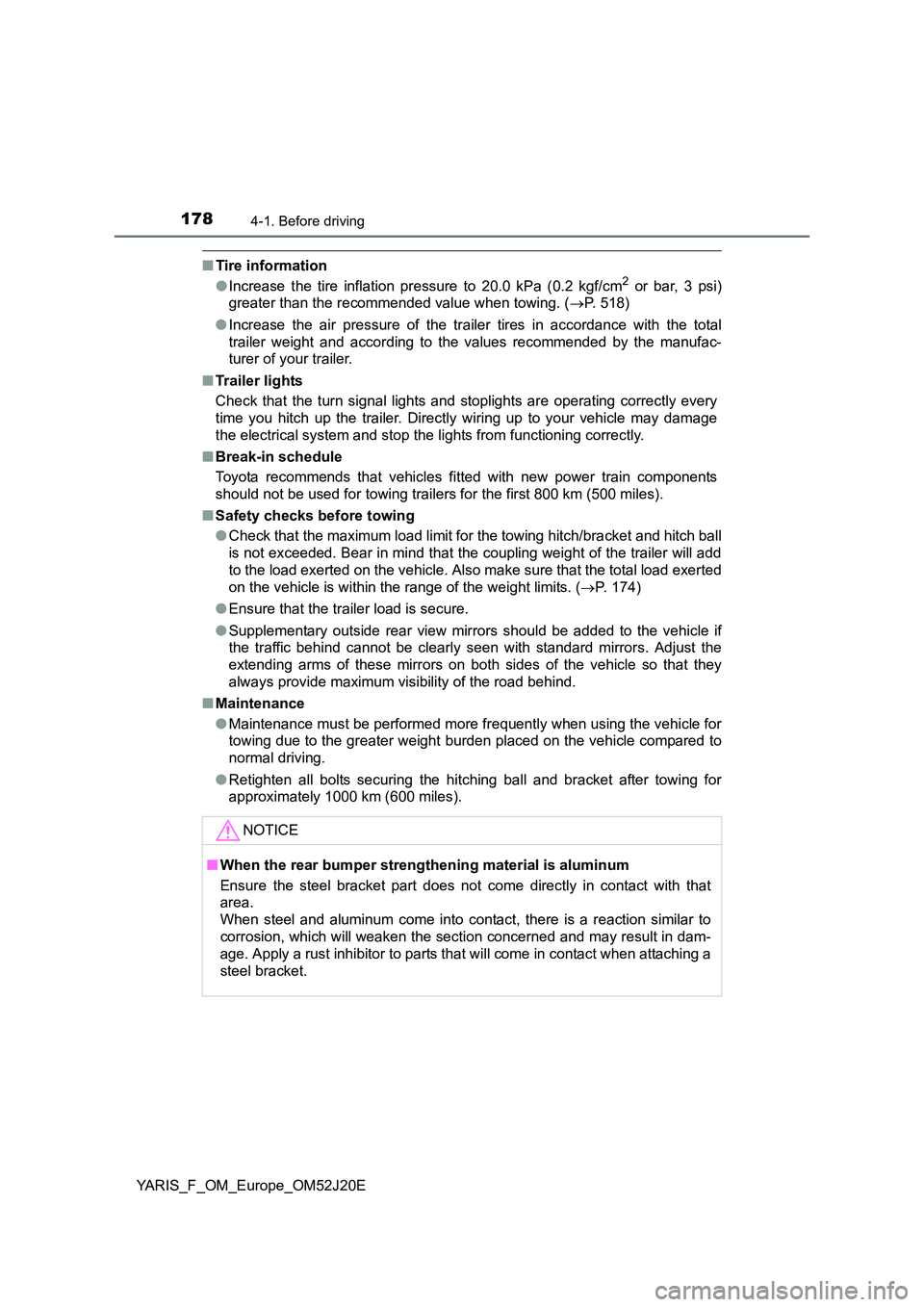
■Tire information
● Increase the tire inflation pressure to 20.0 kPa (0.2 kgf/cm2 or bar, 3 psi)
greater than the recommended value when towing. ( P. 518)
● Increase the air pressure of the trailer tires in accordance with the total
trailer weight and according to the values recommended by the manufac-
turer of your trailer.
■ Tr a i l e r l i g h ts
Check that the turn signal lights and stoplights are operating correctly every
time you hitch up the trailer. Direct ly wiring up to your vehicle may damage
the electrical system and stop the lights from functioning correctly.
■ Break-in schedule
Toyota recommends that vehicles fitted with new power train components
should not be used for towing trailers for the first 800 km (500 miles).
■ Safety checks before towing
● Check that the maximum load limit for the towing hitch/bracket and hitch ball
is not exceeded. Bear in mind that the coupling weight of the trailer will add
to the load exerted on the vehicle. Also make sure that the total load exerted
on the vehicle is within the range of the weight limits. ( P. 174)
● Ensure that the trailer load is secure.
● Supplementary outside rear view mirrors should be added to the vehicle if
the traffic behind cannot be clearly seen with standard mirrors. Adjust the
extending arms of these mirrors on both sides of the vehicle so that they
always provide maximum visibility of the road behind.
■ Maintenance
● Maintenance must be performed more frequently when using the vehicle for
towing due to the greater weight burden placed on the vehicle compared to
normal driving.
● Retighten all bolts securing the hitching ball and bracket after towing for
approximately 1000 km (600 miles).
NOTICE
■ When the rear bumper strengthening material is aluminum
Ensure the steel bracket part does not come directly in contact with that
area.
When steel and aluminum come into contact, there is a reaction similar to
corrosion, which will weaken the section concerned and may result in dam-
age. Apply a rust inhibitor to parts that will come in contact when attaching a
steel bracket.
Page 228 of 549
2284-5. Toyota Safety Sense
YARIS_F_OM_Europe_OM52J20E
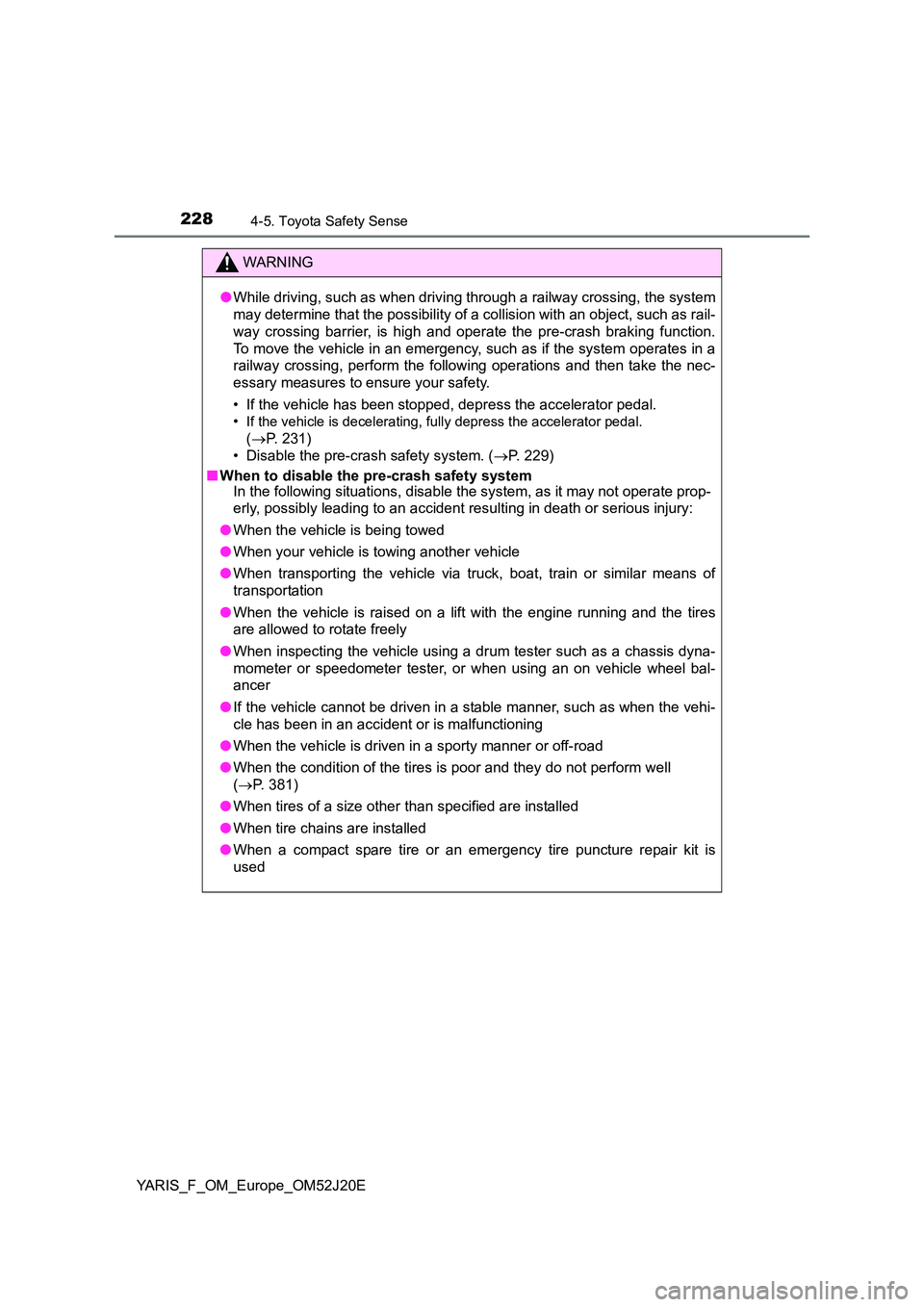
WARNING
●While driving, such as when driving through a railway crossing, the system
may determine that the possibility of a collision with an object, such as rail-
way crossing barrier, is high and operate the pre-crash braking function.
To move the vehicle in an emergency, such as if the system operates in a
railway crossing, perform the following operations and then take the nec-
essary measures to ensure your safety.
• If the vehicle has been stopped, depress the accelerator pedal.
•If the vehicle is decelerating, fully depress the accelerator pedal.
( P. 231)
• Disable the pre-crash safety system. ( P. 229)
■ When to disable the pre-crash safety system In the following situations, disable the system, as it may not operate prop-
erly, possibly leading to an accident resulting in death or serious injury:
● When the vehicle is being towed
● When your vehicle is towing another vehicle
● When transporting the vehicle via truck, boat, train or similar means of
transportation
● When the vehicle is raised on a lift with the engine running and the tires
are allowed to rotate freely
● When inspecting the vehicle using a drum tester such as a chassis dyna-
mometer or speedometer tester, or when using an on vehicle wheel bal-
ancer
● If the vehicle cannot be driven in a stable manner, such as when the vehi-
cle has been in an accident or is malfunctioning
● When the vehicle is driven in a sporty manner or off-road
● When the condition of the tires is poor and they do not perform well
( P. 381)
● When tires of a size other than specified are installed
● When tire chains are installed
● When a compact spare tire or an emergency tire puncture repair kit is
used
Page 434 of 549
4348-2. Steps to take in an emergency
YARIS_F_OM_Europe_OM52J20E
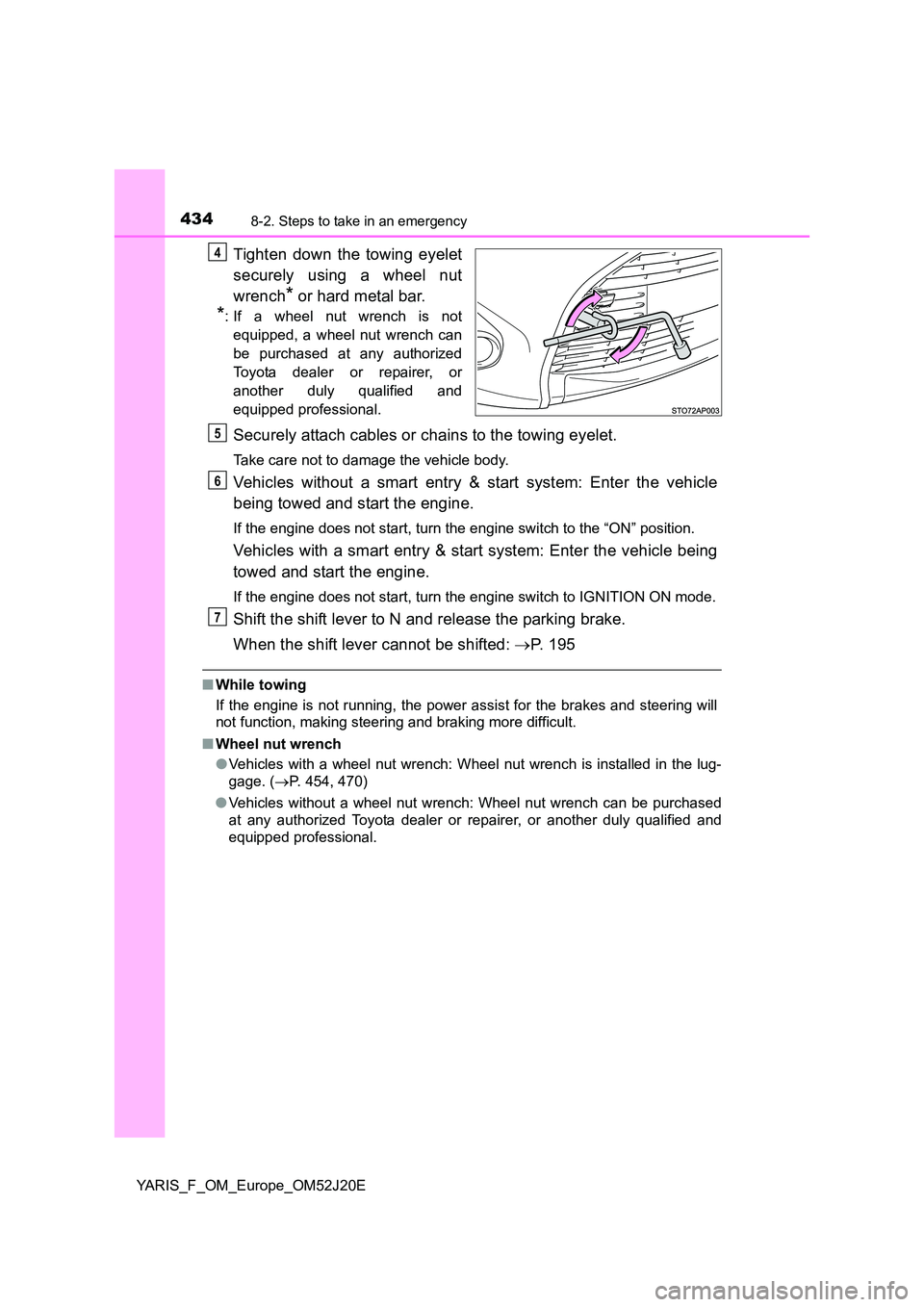
Tighten down the towing eyelet
securely using a wheel nut
wrench* or hard metal bar.
*: If a wheel nut wrench is not
equipped, a wheel nut wrench can
be purchased at any authorized
Toyota dealer or repairer, or
another duly qualified and
equipped professional.
Securely attach cables or chains to the towing eyelet.
Take care not to damage the vehicle body.
Vehicles without a smart entry & start system: Enter the vehicle
being towed and start the engine.
If the engine does not start, turn the engine switch to the “ON” position.
Vehicles with a smart entry & start system: Enter the vehicle being
towed and start the engine.
If the engine does not start, turn the engine switch to IGNITION ON mode.
Shift the shift lever to N and release the parking brake.
When the shift lever cannot be shifted: P. 195
■While towing
If the engine is not running, the power assist for the brakes and steering will
not function, making steering and braking more difficult.
■ Wheel nut wrench
● Vehicles with a wheel nut wrench: Wheel nut wrench is installed in the lug-
gage. ( P. 454, 470)
● Vehicles without a wheel nut wrench: Wheel nut wrench can be purchased
at any authorized Toyota dealer or repairer, or another duly qualified and
equipped professional.
4
5
6
7
Page 520 of 549
5209-1. Specifications
YARIS_F_OM_Europe_OM52J20E
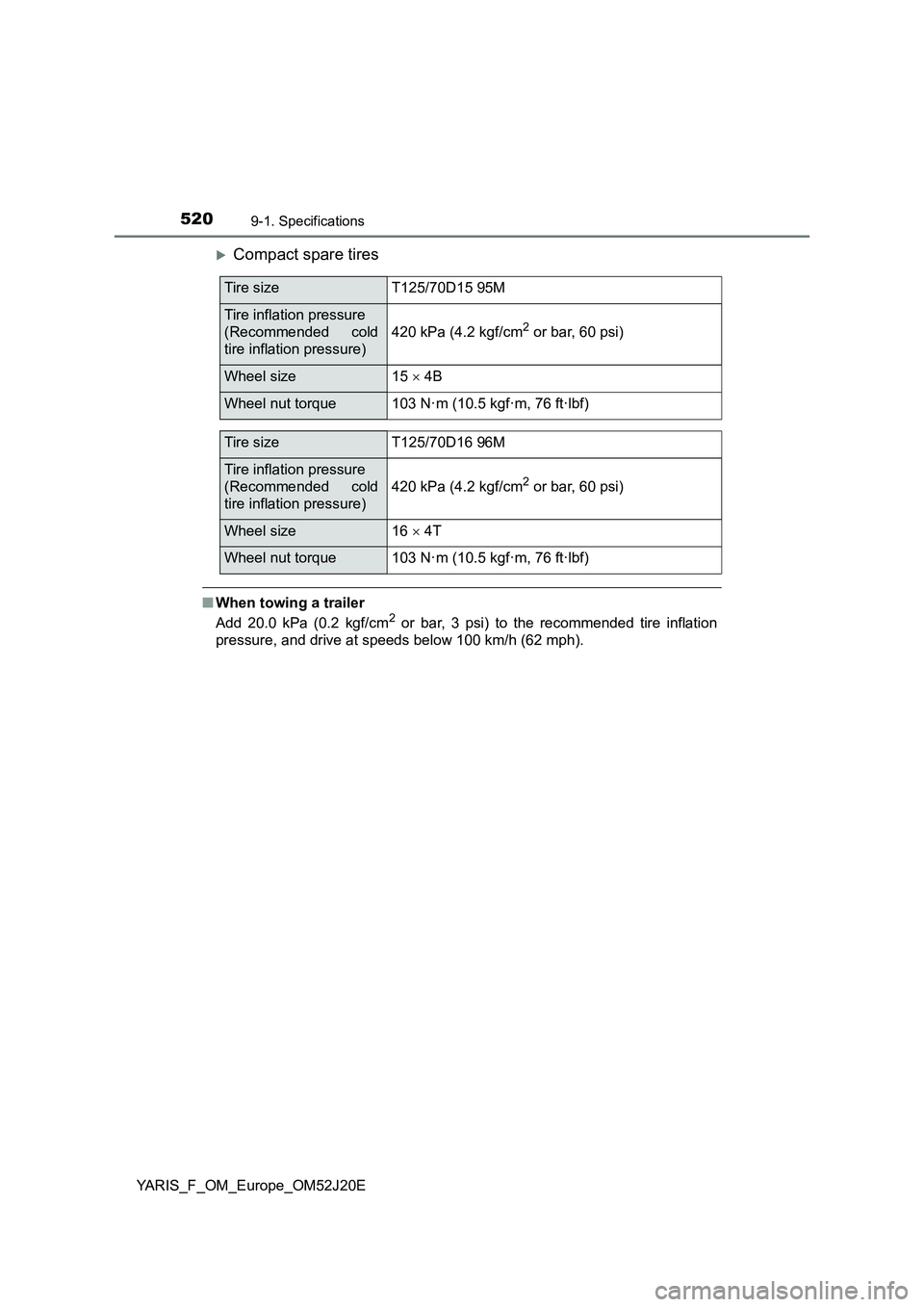
Compact spare tires
■When towing a trailer
Add 20.0 kPa (0.2 kgf/cm2 or bar, 3 psi) to the recommended tire inflation
pressure, and drive at speeds below 100 km/h (62 mph).
Tire sizeT125/70D15 95M
Tire inflation pressure
(Recommended cold
tire inflation pressure)
420 kPa (4.2 kgf/cm2 or bar, 60 psi)
Wheel size15 4B
Wheel nut torque103 N·m (10.5 kgf·m, 76 ft·lbf)
Tire sizeT125/70D16 96M
Tire inflation pressure
(Recommended cold
tire inflation pressure)
420 kPa (4.2 kgf/cm2 or bar, 60 psi)
Wheel size16 4T
Wheel nut torque103 N·m (10.5 kgf·m, 76 ft·lbf)