warning TOYOTA YARIS 2018 Manual Online
[x] Cancel search | Manufacturer: TOYOTA, Model Year: 2018, Model line: YARIS, Model: TOYOTA YARIS 2018Pages: 632, PDF Size: 44.1 MB
Page 231 of 632
2314-2. Driving procedures
4
Driving
YARIS_HV_OM_Europe_OM52J66E
WARNING
■Caution while driving
When driving in EV drive mode, pay special attention to the area around the
vehicle. Because there is no engine noise, pedestrians, people riding bicy-
cles or other people and vehicles in the area may not be aware of the vehi-
cle starting off or approaching them, so take extra care while driving.
Page 235 of 632
2354-2. Driving procedures
4
Driving
YARIS_HV_OM_Europe_OM52J66E
WARNING
■When driving on slippery road surfaces
Do not accelerate or shift gears suddenly.
Sudden changes in engine braking may cause the vehicle to spin or skid,
resulting in an accident.
■ To prevent an accident when releasing the shift lock
Before pressing the shift lock override button, make sure to set the parking
brake and depress the brake pedal.
If the accelerator pedal is accidentally depressed instead of the brake pedal
when the shift lock override button is pressed and the shift lever is shifted
out of P, the vehicle may suddenly start leading to an accident which may
result in death or serious injury.
NOTICE
■ Hybrid battery (traction battery) charge
If the shift lever is in N, the hybrid battery (traction battery) will not be
charged. To help prevent the battery fr om discharging, avoid leaving the N
position selected for an extended period of time.
Page 237 of 632
237
4
4-2. Driving procedures
Driving
YARIS_HV_OM_Europe_OM52J66E
Parking brake
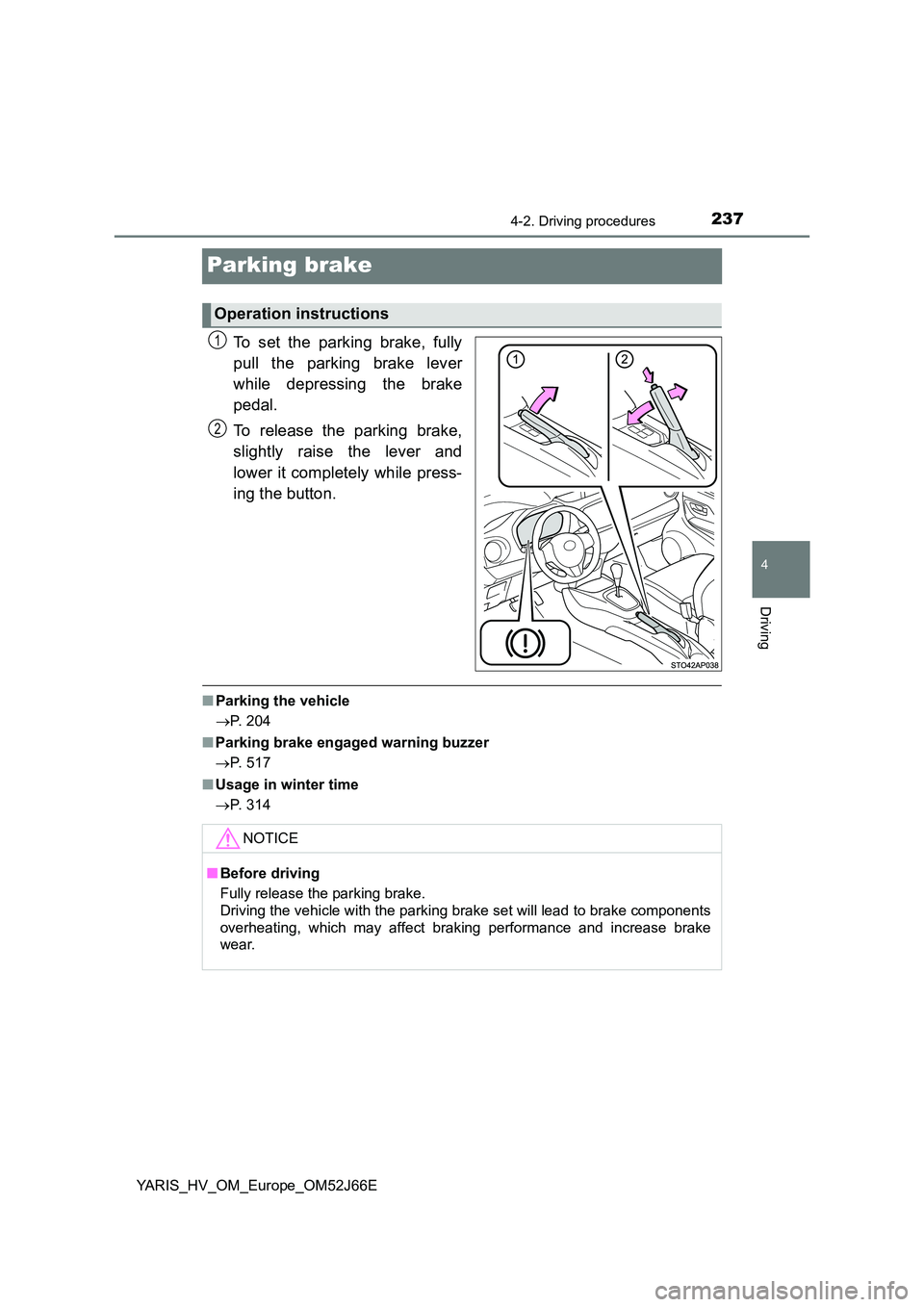
To set the parking brake, fully
pull the parking brake lever
while depressing the brake
pedal.
To release the parking brake,
slightly raise the lever and
lower it completely while press-
ing the button.
■ Parking the vehicle
P. 204
■ Parking brake engaged warning buzzer
P. 517
■ Usage in winter time
P. 314
Operation instructions
1
2
NOTICE
■Before driving
Fully release the parking brake.
Driving the vehicle with the parking brake set will lead to brake components
overheating, which may affect braking performance and increase brake
wear.
Page 249 of 632
2494-3. Operating the lights and wipers
4
Driving
YARIS_HV_OM_Europe_OM52J66E
■ If no windshield washer fluid sprays
Check that the washer nozzle is not blocked, if there is washer fluid in the
windshield washer fluid reservoir.
WARNING
■ Caution regarding the use of windshield wiper in “AUTO” mode (vehi-
cles with a rain-sensing windshield wiper)
The windshield wiper may operate unexpectedly if the sensor is touched or
the windshield is subject to vibration in “AUTO” mode. Take care that your
fingers, etc., do not become caught in the windshield wiper.
■ Caution regarding the use of washer fluid
When it is cold, do not use the washer fluid until the windshield becomes
warm. The fluid may freeze on the windshield and cause low visibility. This
may lead to an accident, resulting in death or serious injury.
NOTICE
■ When the windshield is dry
Do not use the wiper, as they may damage the windshield.
■ When there is no washer fluid spray from the nozzle
Damage to the washer fluid pump may be caused if the lever is pulled
toward you and held continually.
■ When a nozzle becomes blocked
In this case, contact any authorized Toyota retailer or Toyota authorized
repairer, or any reliable repairer.
Do not try to clear it with a pin or other object. The nozzle will be damaged.
Page 253 of 632
2534-4. Refueling
4
Driving
YARIS_HV_OM_Europe_OM52J66E
WARNING
■When refueling the vehicle
Observe the following precautions while refueling the vehicle. Failure to do
so may result in death or serious injury.
● After exiting the vehicle and before opening the fuel door, touch an
unpainted metal surface to discharge any stat ic electricity. It is important to
discharge static electricity before re fueling because sparks resulting from
static electricity can cause fuel vapors to ignite while refueling.
● Always hold the grips on the fuel tank cap and turn it slowly to remove it.
A whooshing sound may be heard when the fuel tank cap is loosened.
Wait until the sound cannot be heard before fully removing the cap. In hot
weather, pressurized fuel may spray out the filler neck and cause injury.
● Do not allow anyone that has not discharged static electricity from their
body to come close to an open fuel tank.
● Do not inhale vaporized fuel.
Fuel contains substances that are harmful if inhaled.
● Do not smoke while refueling the vehicle.
Doing so may cause the fuel to ignite and cause a fire.
● Do not return to the vehicle or touch any person or object that is statically
charged.
This may cause static electricity to build up, resulting in a possible ignition
hazard.
■ When refueling
Observe the following precautions to pr event fuel overflowing from the fuel
tank:
● Securely insert the fuel nozzle into the fuel filler neck.
● Stop filling the tank after the fuel nozzle automatically clicks off.
● Do not top off the fuel tank.
■ When replacing the fuel tank cap
Do not use anything but a genuine Toyota fuel tank cap designed for your
vehicle. Doing so may cause a fire or other incident which may result in
death or serious injury.
Page 255 of 632
255
4
4-5. Toyota Safety Sense
Driving
YARIS_HV_OM_Europe_OM52J66E
Toyota Safety Sense
◆PCS (Pre-Crash Safety system)
P. 2 6 2
◆LDA (Lane Departure Alert)
P. 2 7 9
◆Automatic High Beam
P. 2 8 7
◆Road Sign Assist
P. 2 9 3
: If equipped
The Toyota Safety Sense consists of the following drive assist
systems and contributes to a safe and comfortable driving expe-
rience:
WARNING
■ Toyota Safety Sense
The Toyota Safety Sense is designed to operate under the assumption that
the driver will drive safely, and is designed to help reduce the impact to the
occupants and the vehicle in the case of a collision or assist the driver in
normal driving conditions.
As there is a limit to the degree of recognition accuracy and control perfor-
mance that this system can provide, do not overly rely on this system. The
driver is always responsible for paying attention to the vehicle’s surround-
ings and driving safely.
Page 257 of 632
2574-5. Toyota Safety Sense
4
Driving
YARIS_HV_OM_Europe_OM52J66E
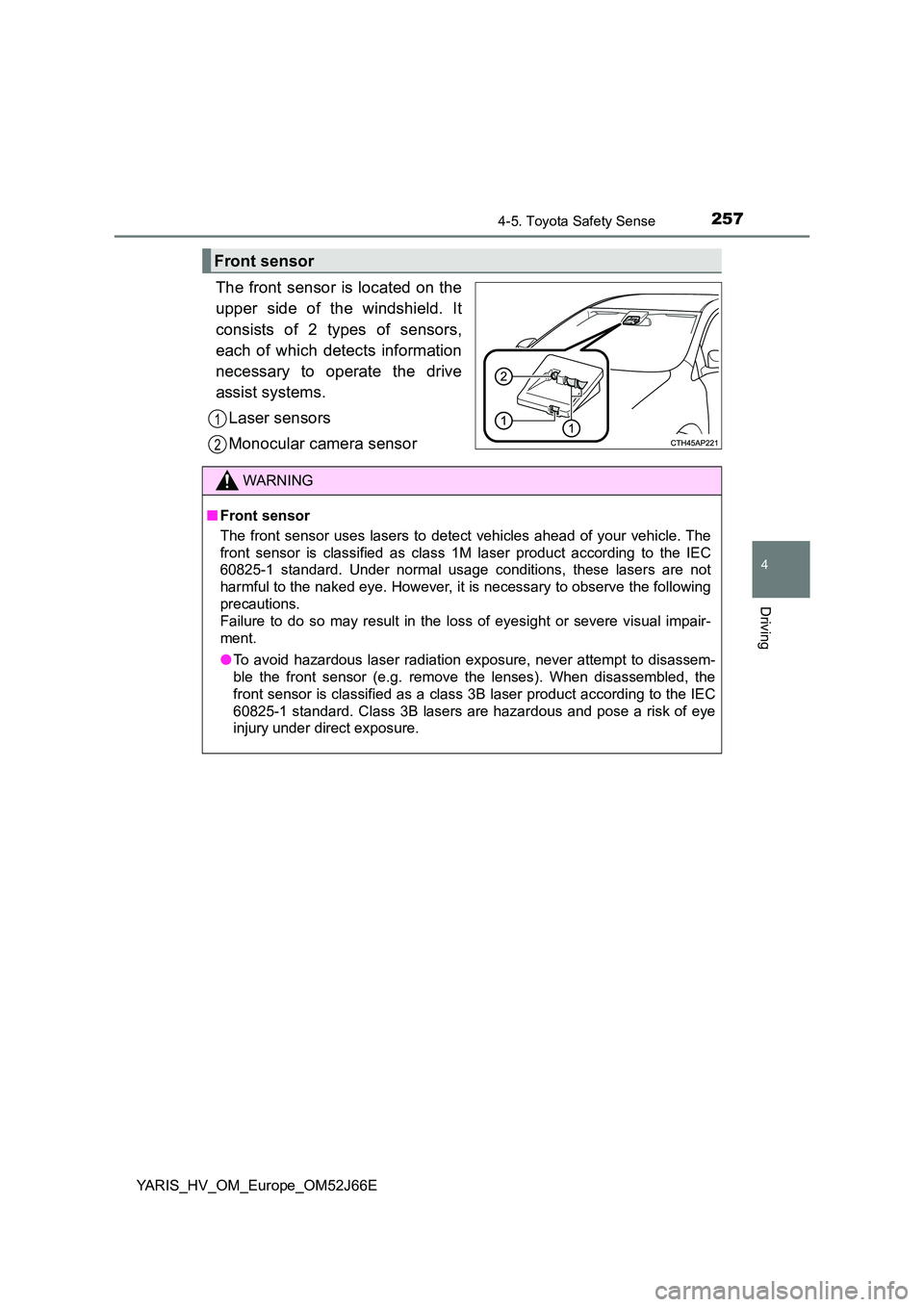
The front sensor is located on the
upper side of the windshield. It
consists of 2 types of sensors,
each of which detects information
necessary to operate the drive
assist systems.
Laser sensors
Monocular camera sensor
Front sensor
1
2
WARNING
■ Front sensor
The front sensor uses lasers to detect vehicles ahead of your vehicle. The
front sensor is classified as class 1M laser product according to the IEC
60825-1 standard. Under normal usage conditions, these lasers are not
harmful to the naked eye. However, it is necessary to observe the following
precautions.
Failure to do so may result in the loss of eyesight or severe visual impair-
ment.
● To avoid hazardous laser radiation exposure, never attempt to disassem-
ble the front sensor (e.g. remove the lenses). When disassembled, the
front sensor is classified as a class 3B laser product according to the IEC
60825-1 standard. Class 3B lasers are hazardous and pose a risk of eye
injury under direct exposure.
Page 258 of 632
2584-5. Toyota Safety Sense
YARIS_HV_OM_Europe_OM52J66E
WARNING
●Do not attempt to look into the front sensor with a magnifying glass, micro-
scope or other optical instrument within a distance of less than 100 mm
(3.9 in.).
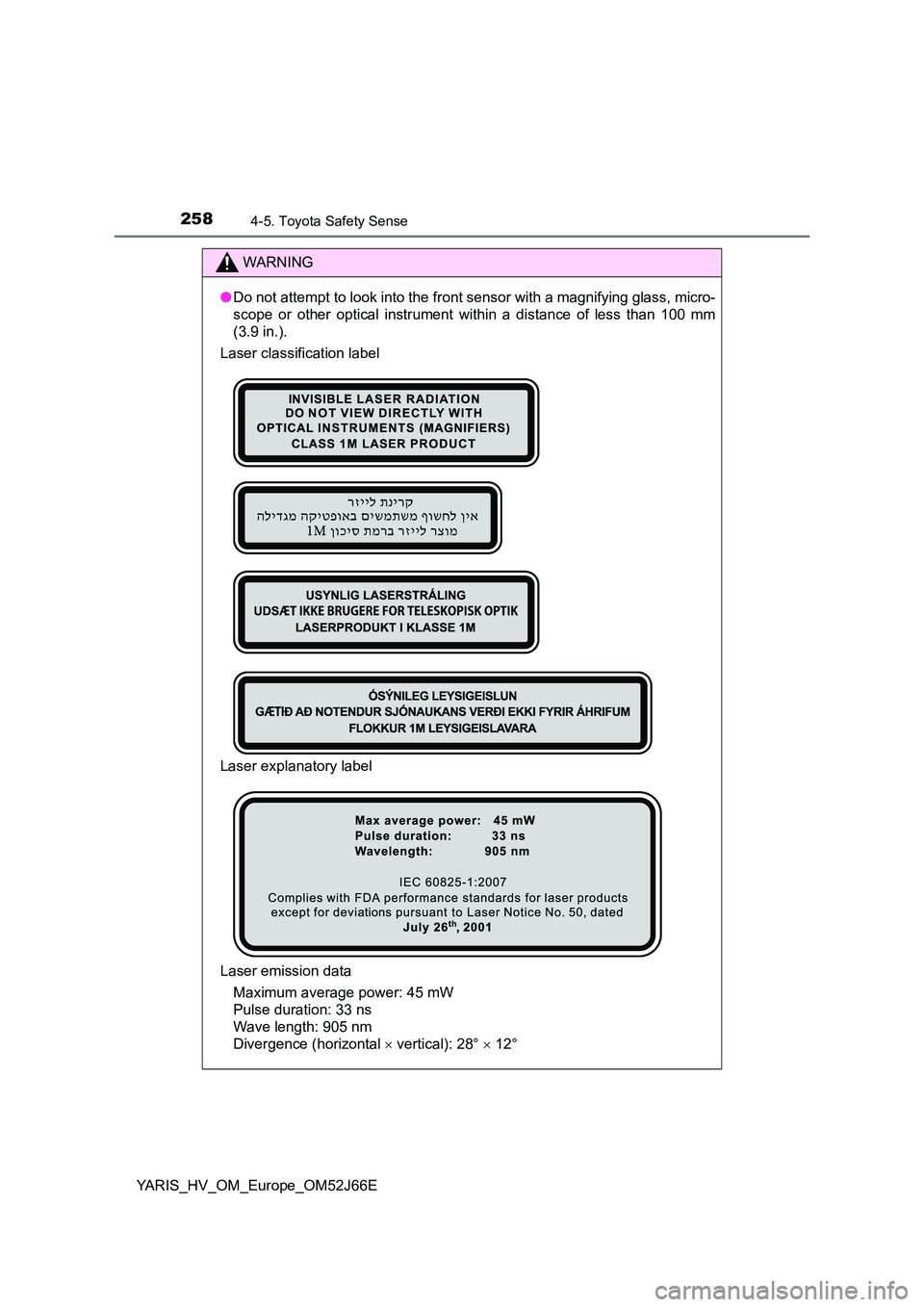
Laser classification label
Laser explanatory label
Laser emission data
Maximum average power: 45 mW
Pulse duration: 33 ns
Wave length: 905 nm
Divergence (horizontal vertical): 28° 12°
Page 259 of 632
2594-5. Toyota Safety Sense
4
Driving
YARIS_HV_OM_Europe_OM52J66E
WARNING
■To avoid malfunction of the front sensor
Observe the following precautions.
Otherwise, the front sensor may not operate properly, possibly leading to an
accident resulting in death or serious injury.
● Keep the windshield clean at all times. If the windshield is dirty or covered
with an oily film, water droplets, snow, etc., clear the windshield. If the
inner side of the windshield in front of the front sensor is dirty, contact any
authorized Toyota retailer or Toyota authorized repairer, or any reliable
repairer.
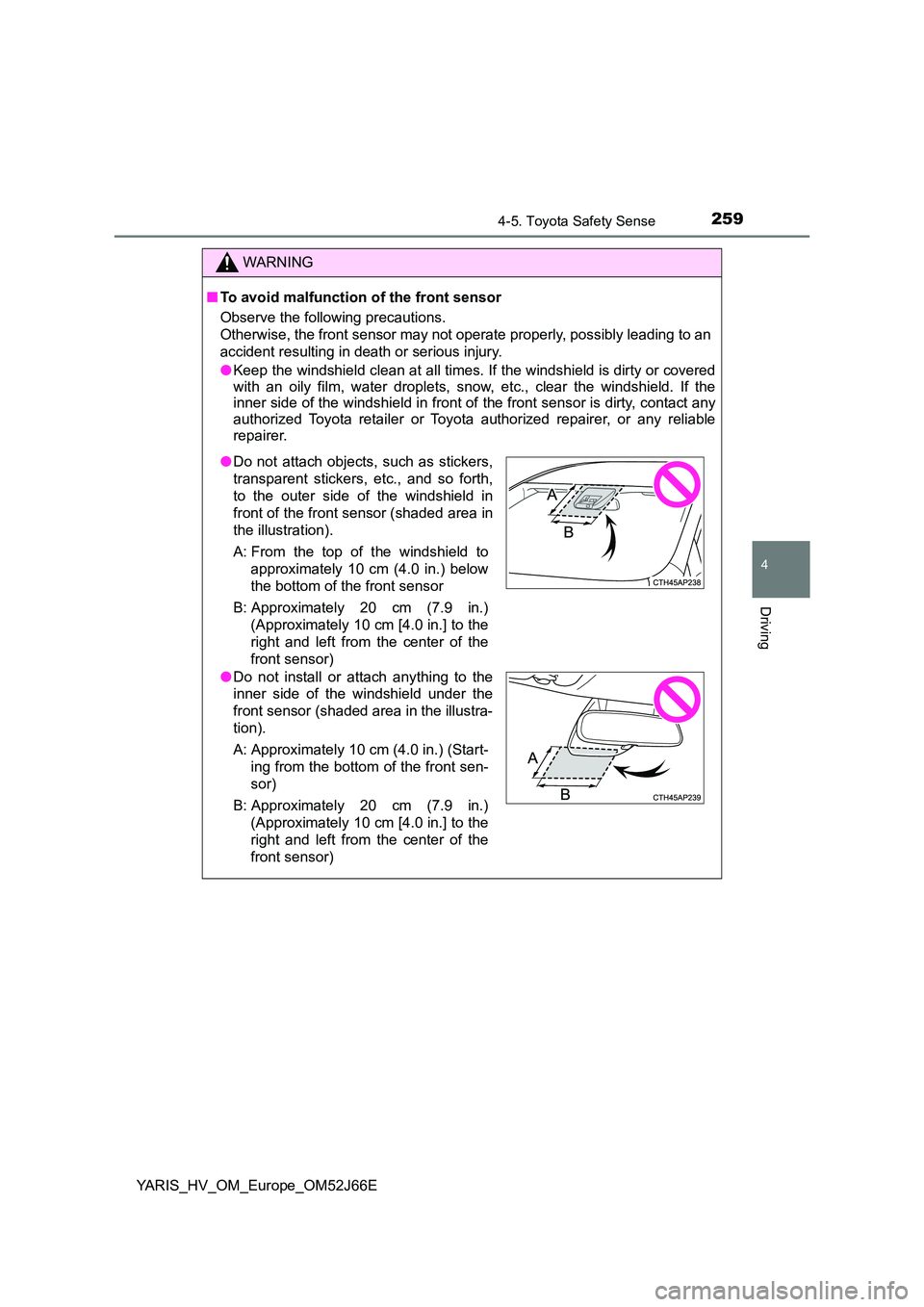
● Do not attach objects, such as stickers,
transparent stickers, etc., and so forth,
to the outer side of the windshield in
front of the front sensor (shaded area in
the illustration).
A: From the top of the windshield to
approximately 10 cm (4.0 in.) below
the bottom of the front sensor
B: Approximately 20 cm (7.9 in.)
(Approximately 10 cm [4.0 in.] to the
right and left from the center of the
front sensor)
● Do not install or attach anything to the
inner side of the windshield under the
front sensor (shaded area in the illustra-
tion).
A: Approximately 10 cm (4.0 in.) (Start-
ing from the bottom of the front sen-
sor)
B: Approximately 20 cm (7.9 in.)
(Approximately 10 cm [4.0 in.] to the
right and left from the center of the
front sensor)
Page 260 of 632
2604-5. Toyota Safety Sense
YARIS_HV_OM_Europe_OM52J66E
WARNING
●If there is a large difference in temperature between the inside and outside
of the vehicle, such as in winter, t he windshield is likely to fog up easily. If
the part of the windshield in front of the front sensor is fogged up or cov-
ered with condensation or ice, the PCS warning light may illuminate and
the system may be temporarily disabled. In this case, use the windshield
defogger to remove the fog, etc. ( P. 390)
● If the area of the windshield in front of the front sensor is covered with
water droplets, use the windshield wipers to remove them.
If the water droplets are not sufficiently removed, the performance of the
front sensor may be reduced.
● If water droplets cannot be properly removed from the area of the wind-
shield in front of the front sensor by the windshield wipers, replace the
wiper insert or wiper blade.
If the wiper inserts or wiper blades need to be replaced, contact any autho-
rized Toyota retailer or Toyota authorized repairer, or any reliable repairer.
● Do not attach window tinting to the windshield.
● Replace the windshield if it is damaged or cracked.
If the windshield needs to be replaced, contact any authorized Toyota
retailer or Toyota authorized repairer, or any reliable repairer.
● Do not install an antenna in front of the sensor.
● Do not get the front sensor wet.
● Do not allow bright lights to shine into the front sensor.
● Do not dirty or damage the front sensor.
When cleaning the inside of the windshi eld, do not allow glass cleaner to
contact the lens. Also, do not touch the lens.
If the lens is dirty or damaged, contact any authorized Toyota retailer or
Toyota authorized repairer, or any reliable repairer.