height TOYOTA YARIS 2018 Owners Manual
[x] Cancel search | Manufacturer: TOYOTA, Model Year: 2018, Model line: YARIS, Model: TOYOTA YARIS 2018Pages: 632, PDF Size: 44.1 MB
Page 63 of 632
631-2. Child safety
1
For safety and security
YARIS_HV_OM_Europe_OM52J66E
Install the available child restraint system in vehicle upon confirming
the following items.
■Standards for child restraint systems
Use a child restraint system that conforms to ECE R44*1 or ECE
R129*1, 2.
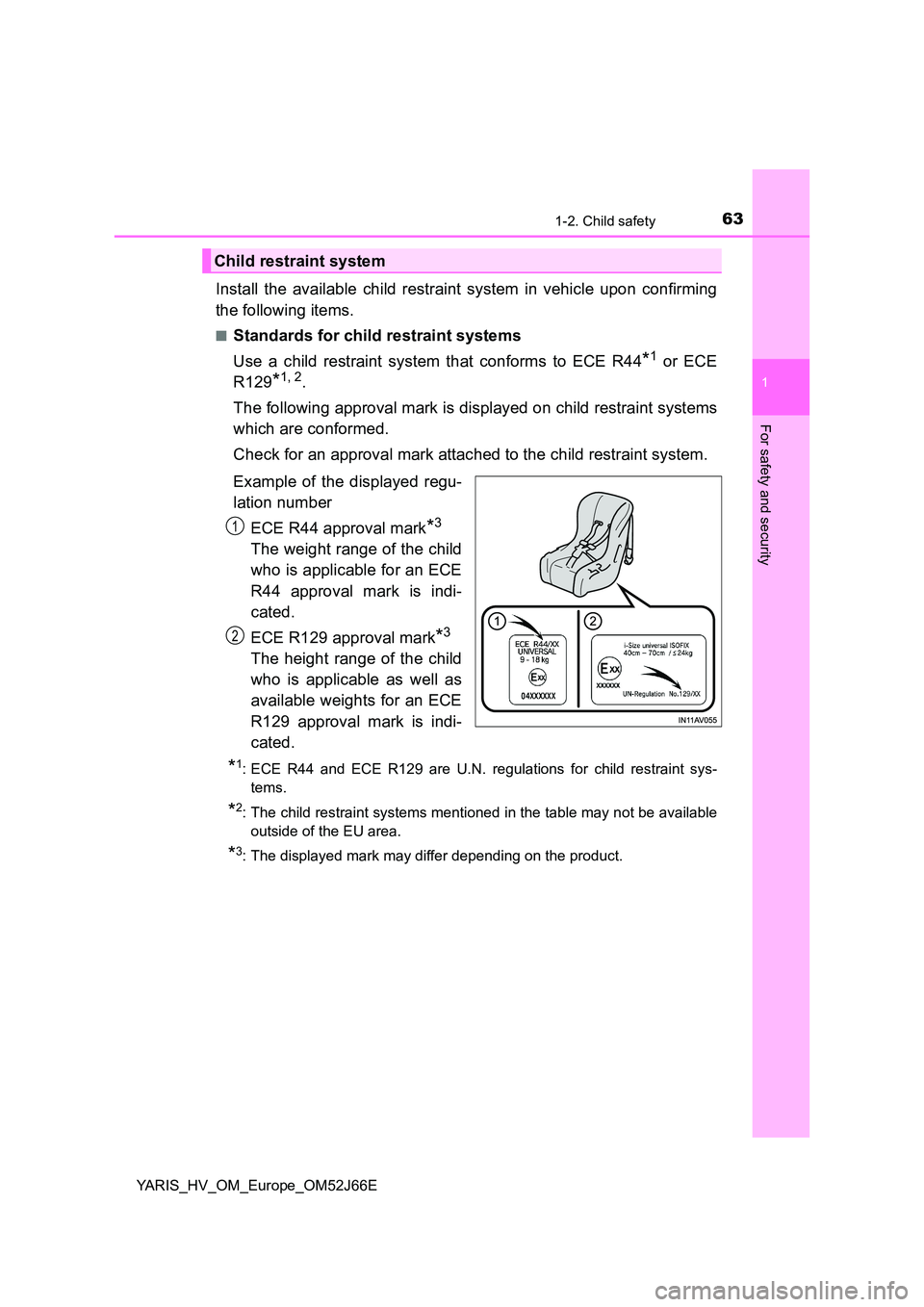
The following approval mark is displayed on child restraint systems
which are conformed.
Check for an approval mark attached to the child restraint system.
Example of the displayed regu-
lation number
ECE R44 approval mark*3
The weight range of the child
who is applicable for an ECE
R44 approval mark is indi-
cated.
ECE R129 approval mark*3
The height range of the child
who is applicable as well as
available weights for an ECE
R129 approval mark is indi-
cated.
*1: ECE R44 and ECE R129 are U.N. regulations for child restraint sys-
tems.
*2: The child restraint systems mentioned in the table may not be available
outside of the EU area.
*3: The displayed mark may differ depending on the product.
Child restraint system
1
2
Page 72 of 632
721-2. Child safety
YARIS_HV_OM_Europe_OM52J66E
Key of letters inserted in the above table:
X: Not suitable seat position for children in this mass group.
U: Suitable for “universal” category child restraint systems approved
for use in this mass group.
UF: Suitable for forward-facing “universal” category child restraint sys-
tems approved for use in this mass group.
L: Suitable for “specific vehicles”, “restricted”, or “semi-universal”,
category child restraint systems approved for use in this mass
group.
*1: Adjust the seatback angle to the most upright position. Move the front seat
fully rearward. If the passenger seat height can be adjusted, move it to the
upper most position.
*2: If the head restraint interferes with your child restraint system, and the
head restraint can be removed, remove the head restraint.
Otherwise, put the head restraint in the upper most position.
When securing some types of child restraint systems in rear seat, it
may not be possible to properly use the seat belts in positions next
to the child restraint without interfering with it or affecting seat belt
effectiveness. Be sure your seat belt fits snugly across your shoul-
der and low on your hips. If it does not, or if it interferes with the
child restraint, move to a different position. Failure to do so may
result in death or serious injury.
The child restraint systems mentioned in the table may not be avail-
able outside the EU area.
● When installing a child restraint in the rear seats, adjust the front
seat so that it does not interfere with the child or child restraint
system.
● When installing a child seat with support base, if the child seat
interferes with the seatback when latching it into the support
base, adjust the seatback rearward until there is no interference.
Page 78 of 632
781-2. Child safety
YARIS_HV_OM_Europe_OM52J66E
■Child restraint systems fastened with ISOFIX (ECE R44) - Com-
patibility and Recommended child restraint systems table
ISOFIX child restraint systems are divided in different “size class”.
According to this “size class”, you will be allowed to use it in the
vehicle seating position mentioned in the table below. To know your
child restraint system “size class” and “mass group”, please refer to
the child restraint system manual.
If your child restraint system has no “size class” (or if you cannot
find information in the table below), please refer to the child
restraint system “vehicle list” for compatibility information or ask the
retailer of your child seat.
Size classDescription
A Full-height, forward-facing child restraint systems
B Reduced-height forward-facing child restraint systems
B1 Reduced-height forward-facing child restraint systems
C Full-size rearward-facing child restraint systems
D Reduced-size rearward-facing child restraint systems
E Rearward-facing infant seat
F Left lateral-facing (carrycot) infant seat
G Right lateral-facing (carrycot) infant seat
Page 182 of 632
1823-3. Adjusting the seats
YARIS_HV_OM_Europe_OM52J66E
Front seats
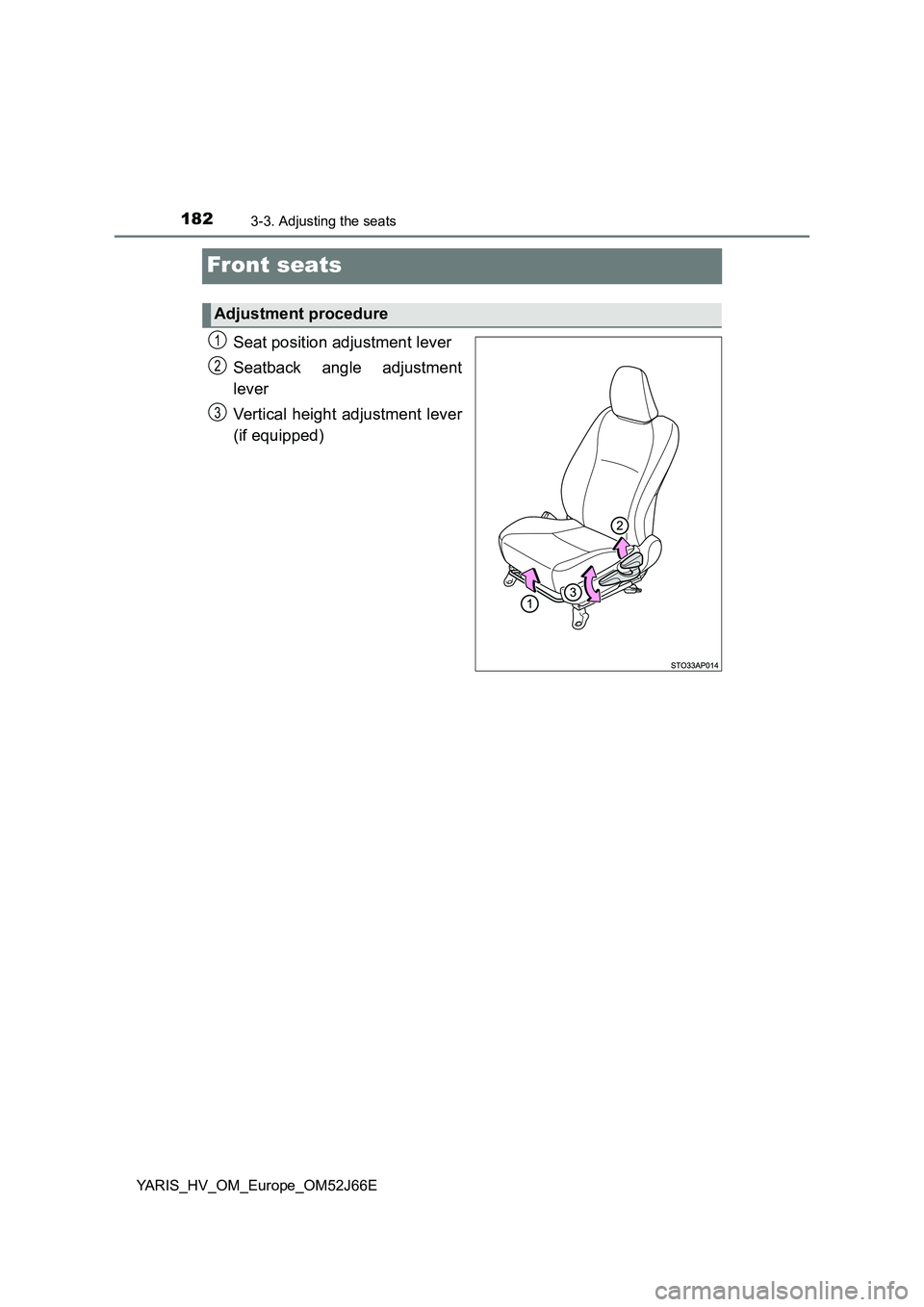
Seat position adjustment lever
Seatback angle adjustment
lever
Vertical height adjustment lever
(if equipped)
Adjustment procedure
1
2
3
Page 190 of 632
1903-3. Adjusting the seats
YARIS_HV_OM_Europe_OM52J66E
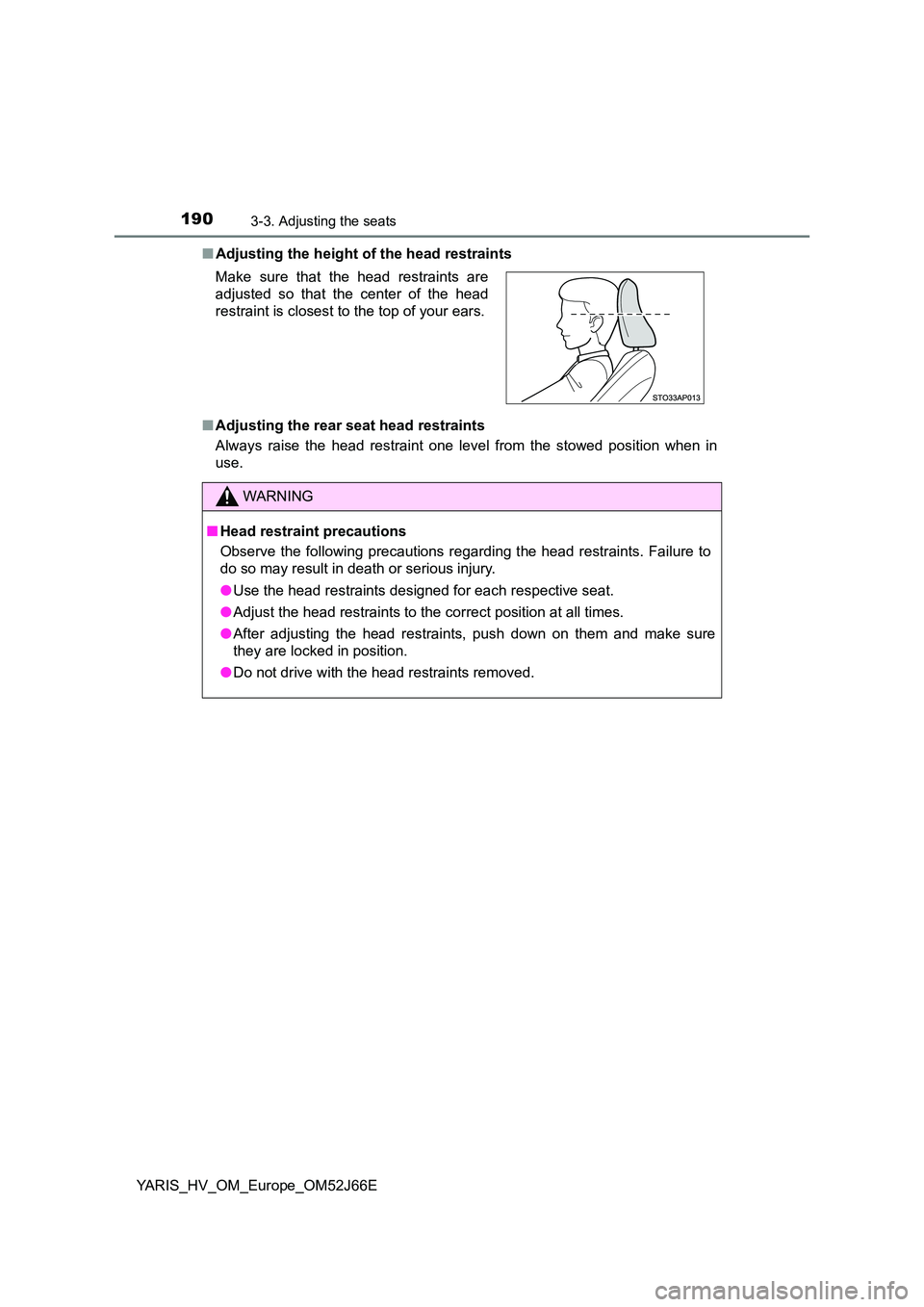
■ Adjusting the height of the head restraints
■ Adjusting the rear seat head restraints
Always raise the head restraint one level from the stowed position when in
use.
Make sure that the head restraints are
adjusted so that the center of the head
restraint is closest to the top of your ears.
WARNING
■ Head restraint precautions
Observe the following precautions regarding the head restraints. Failure to
do so may result in death or serious injury.
● Use the head restraints designed for each respective seat.
● Adjust the head restraints to the correct position at all times.
● After adjusting the head restraints, push down on them and make sure
they are locked in position.
● Do not drive with the head restraints removed.
Page 193 of 632
193
3
3-4. Adjusting the steering wheel and mirrors
Operation of each component
YARIS_HV_OM_Europe_OM52J66E
Inside rear view mirror
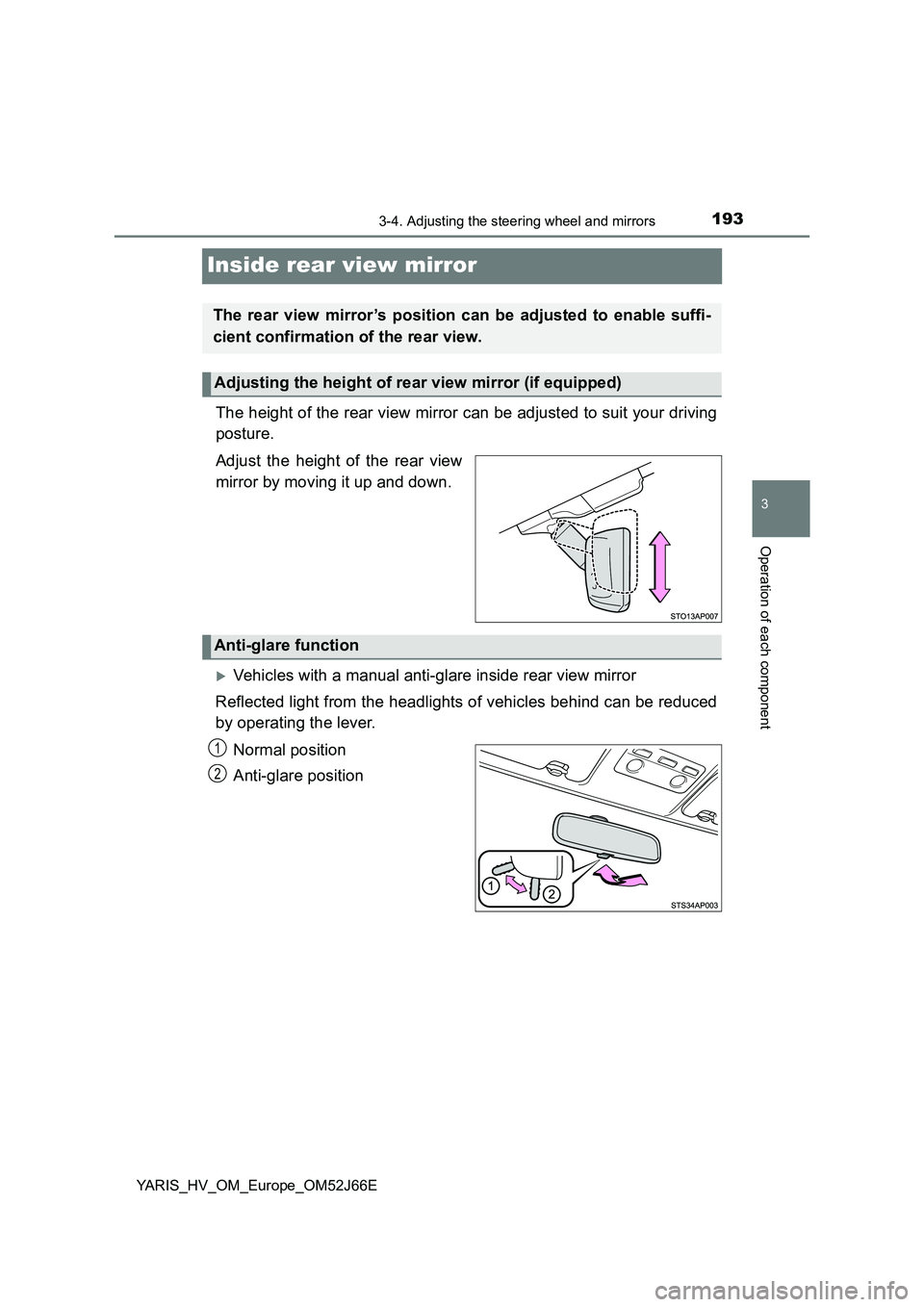
The height of the rear view mirror can be adjusted to suit your driving
posture.
Adjust the height of the rear view
mirror by moving it up and down.
Vehicles with a manual anti-glare inside rear view mirror
Reflected light from the headlights of vehicles behind can be reduced
by operating the lever.
Normal position
Anti-glare position
The rear view mirror’s position can be adjusted to enable suffi-
cient confirmation of the rear view.
Adjusting the height of rear view mirror (if equipped)
Anti-glare function
1
2
Page 273 of 632
2734-5. Toyota Safety Sense
4
Driving
YARIS_HV_OM_Europe_OM52J66E
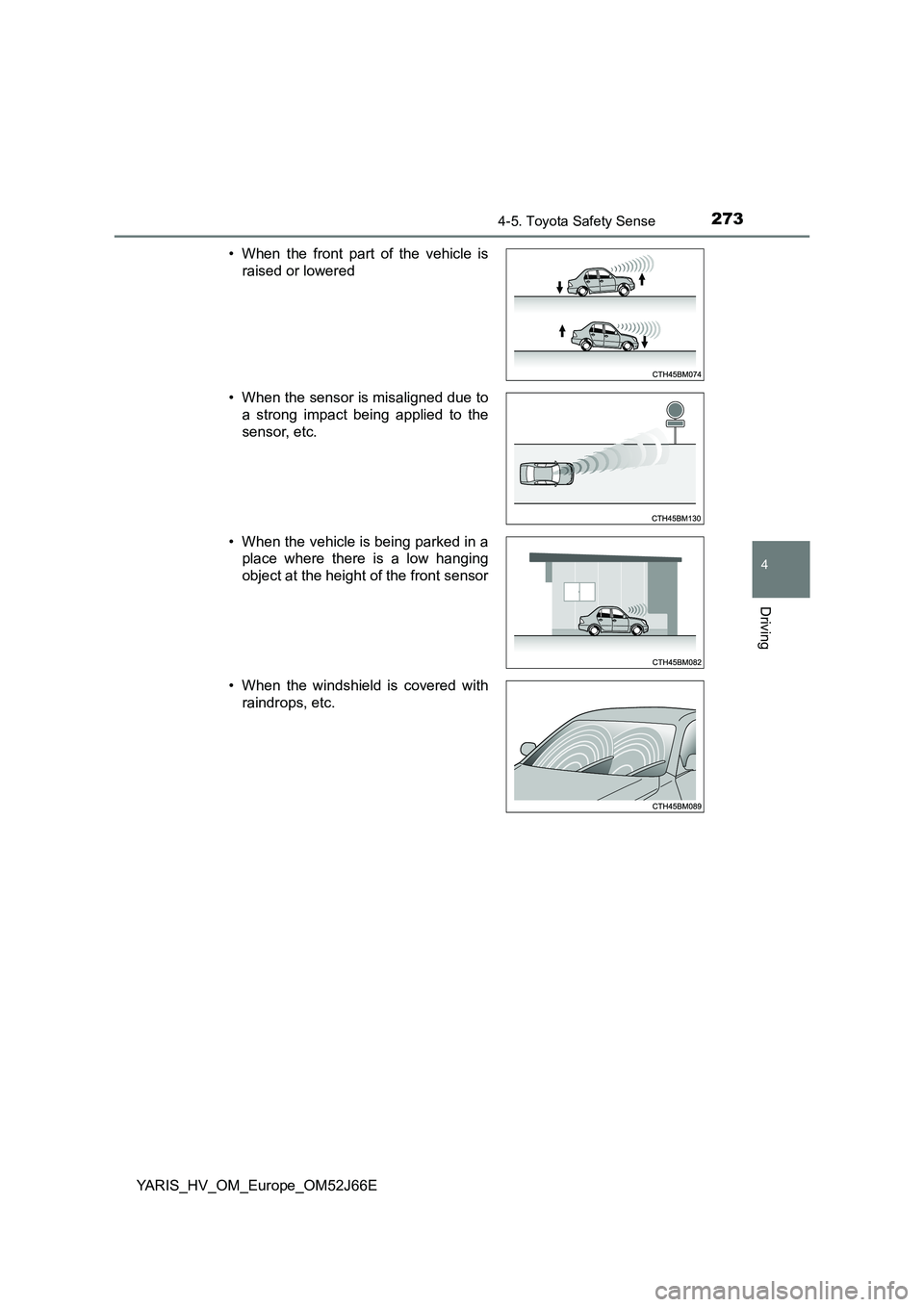
• When the front part of the vehicle is
raised or lowered
• When the sensor is misaligned due to
a strong impact being applied to the
sensor, etc.
• When the vehicle is being parked in a
place where there is a low hanging
object at the height of the front sensor
• When the windshield is covered with
raindrops, etc.
Page 405 of 632
4056-3. Using the storage features
6
Interior features
YARIS_HV_OM_Europe_OM52J66E
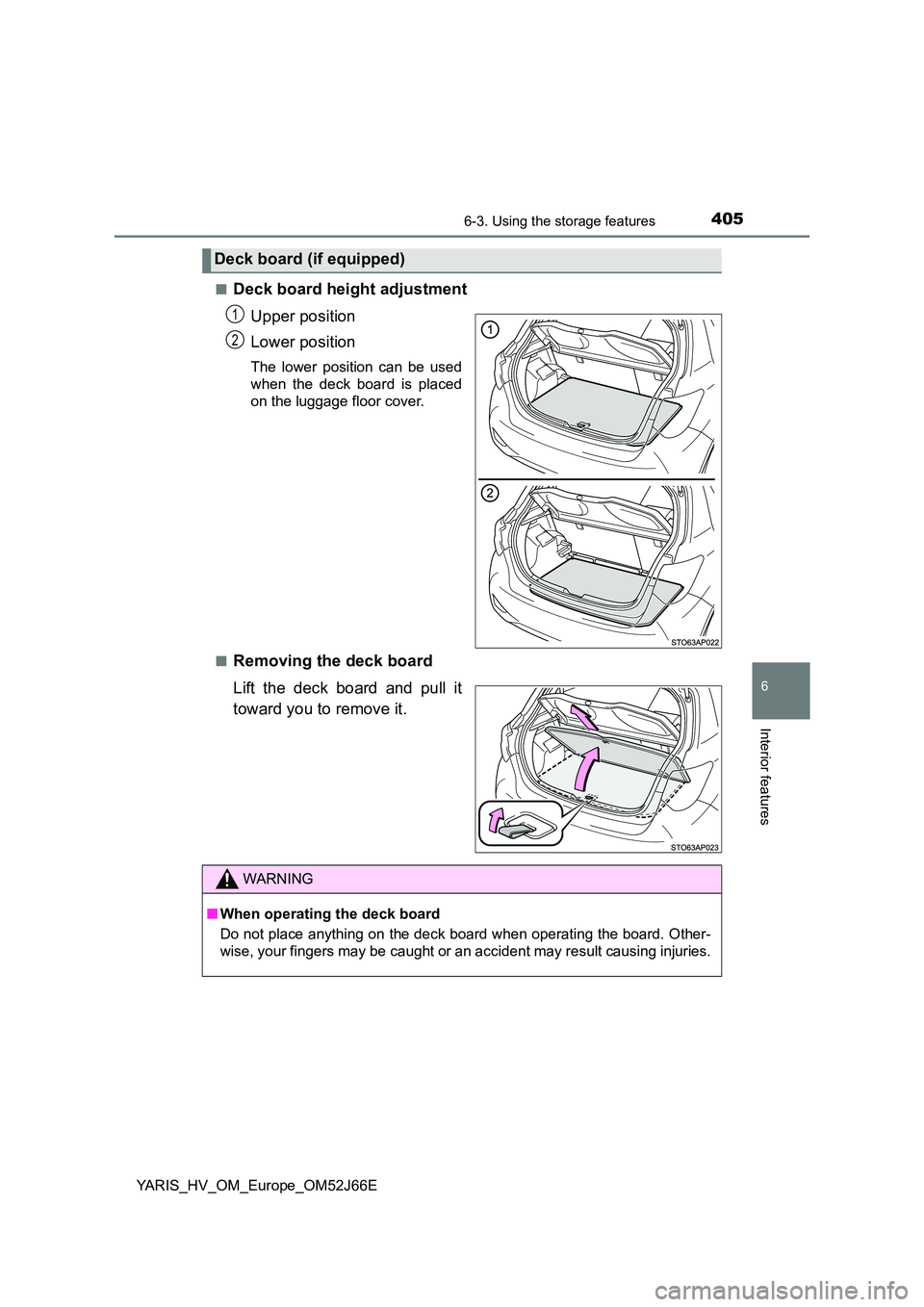
■Deck board height adjustment
Upper position
Lower position
The lower position can be used
when the deck board is placed
on the luggage floor cover.
■Removing the deck board
Lift the deck board and pull it
toward you to remove it.
Deck board (if equipped)
1
2
WARNING
■ When operating the deck board
Do not place anything on the deck board when operating the board. Other-
wise, your fingers may be caught or an accident may result causing injuries.
Page 558 of 632
5588-2. Steps to take in an emergency
YARIS_HV_OM_Europe_OM52J66E
WARNING
■Using the tire jack
Observe the following precautions.
Improper use of the tire jack may cause the vehicle to suddenly fall off the
jack, leading to death or serious injury.
● Do not use the tire jack for any purpose other than replacing tires or install-
ing and removing tire chains.
● Only use the tire jack that comes with this vehicle for replacing a flat tire.
Do not use it on other vehicles, and do not use other tire jacks for replac-
ing tires on this vehicle.
● Put the jack properly in its jack point.
● Do not put any part of your body under the vehicle while it is supported by
the jack.
● Do not start the hybrid system or drive the vehicle while the vehicle is sup-
ported by the jack.
● Do not raise the vehicle while someone is inside.
● When raising the vehicle, do not put an object on or under the jack.
● Do not raise the vehicle to a height greater than that required to replace
the tire.
● Use a jack stand if it is necessary to get under the vehicle.
● When lowering the vehicle, make sure that there is no-one near the vehi-
cle. If there are people nearby, warn them vocally before lowering.
Page 566 of 632
5668-2. Steps to take in an emergency
YARIS_HV_OM_Europe_OM52J66E
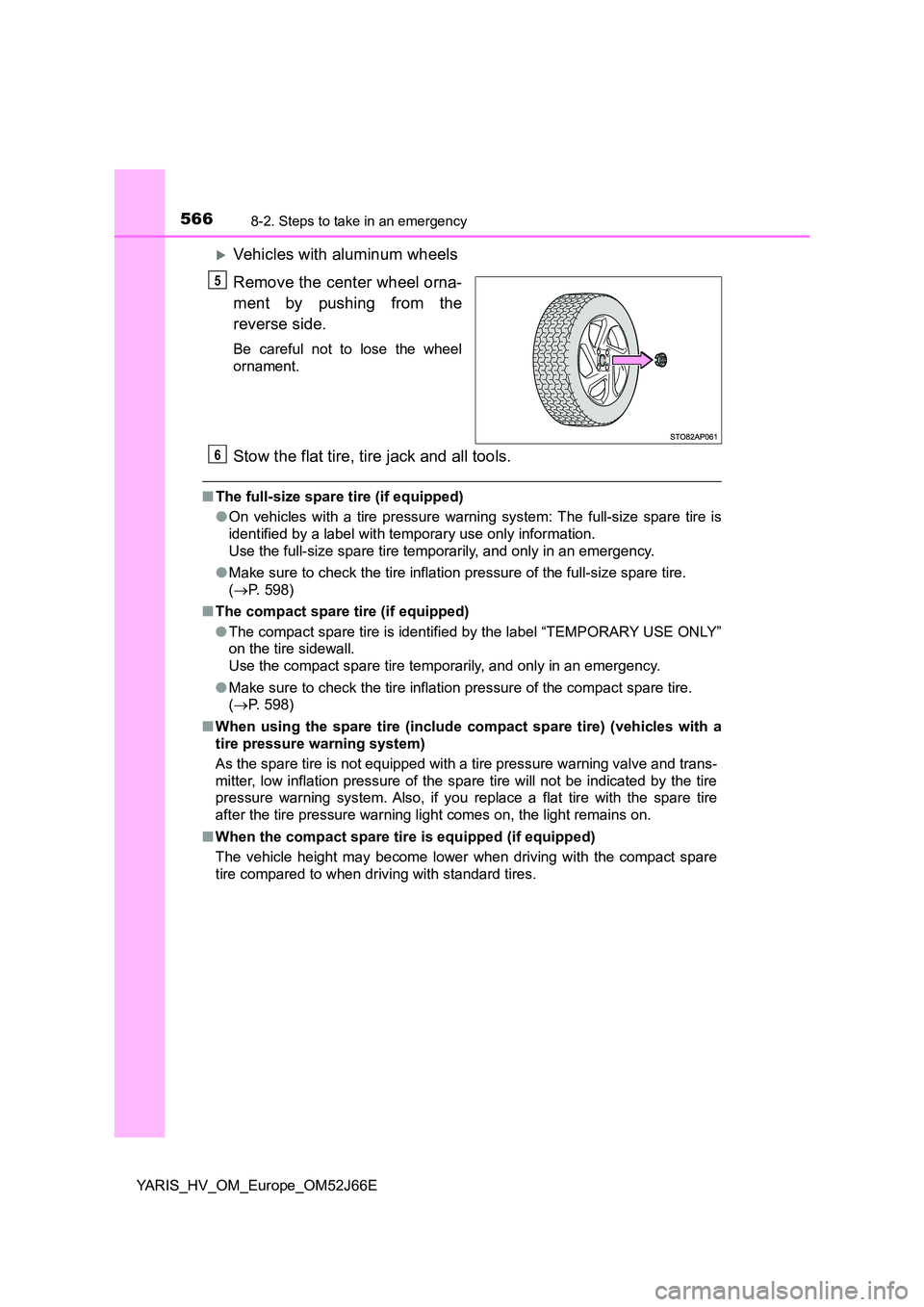
Vehicles with aluminum wheels
Remove the center wheel orna-
ment by pushing from the
reverse side.
Be careful not to lose the wheel
ornament.
Stow the flat tire, tire jack and all tools.
■ The full-size spare tire (if equipped)
● On vehicles with a tire pressure warning system: The full-size spare tire is
identified by a label with temporary use only information.
Use the full-size spare tire temporarily, and only in an emergency.
● Make sure to check the tire inflation pressure of the full-size spare tire.
( P. 598)
■ The compact spare tire (if equipped)
● The compact spare tire is identified by the label “TEMPORARY USE ONLY”
on the tire sidewall.
Use the compact spare tire temporarily, and only in an emergency.
● Make sure to check the tire inflation pressure of the compact spare tire.
( P. 598)
■ When using the spare tire (include compact spare tire) (vehicles with a
tire pressure warning system)
As the spare tire is not equipped with a tire pressure warning valve and trans-
mitter, low inflation pressure of the spare tire will not be indicated by the tire
pressure warning system. Also, if you replace a flat tire with the spare tire
after the tire pressure warning light comes on, the light remains on.
■ When the compact spare tire is equipped (if equipped)
The vehicle height may become lower when driving with the compact spare
tire compared to when driving with standard tires.
5
6