o2 sen TOYOTA YARIS 2018 Owners Manual
[x] Cancel search | Manufacturer: TOYOTA, Model Year: 2018, Model line: YARIS, Model: TOYOTA YARIS 2018Pages: 632, PDF Size: 44.1 MB
Page 3 of 632
3
1
7
8
6
5
4
3
2
9
YARIS_HV_OM_Europe_OM52J66E
3-3. Adjusting the seats
Front seats .........................182
Rear seats .........................184
Head restraints ..................188
3-4. Adjusting the steering
wheel and mirrors
Steering wheel ...................191
Inside rear view mirror .......193
Outside rear view
mirrors .............................196
3-5. Opening and closing
the windows
Power windows ..................199
4-1. Before driving
Driving the vehicle .............204
Cargo and luggage ............213
Trailer towing .....................215
4-2. Driving procedures
Power (ignition) switch
(vehicles without a smart
entry & start system)........216
Power (ignition) switch
(vehicles with a smart
entry & start system)........220
EV drive mode ...................229
Hybrid transmission ...........232
Turn signal lever ................236
Parking brake.....................237
4-3. Operating the lights
and wipers
Headlight switch ................ 238
Fog light switch ................. 244
Windshield wiper
and washer ..................... 246
Rear window wiper
and washer ..................... 250
4-4. Refueling
Opening the fuel tank
cap .................................. 252
4-5. Toyota Safety Sense
Toyota Safety Sense ......... 255
PCS (Pre-Crash Safety
system) ........................... 262
LDA (Lane Departure
Alert) ............................... 279
Automatic High Beam ....... 287
RSA (Road Sign Assist) .... 293
4-6. Using the driving support
systems
Cruise control .................... 299
Driving assist systems....... 303
4-7. Driving tips
Hybrid vehicle driving
tips .................................. 310
Winter driving tips.............. 313
4Driving
Page 6 of 632
TABLE OF CONTENTS6
YARIS_HV_OM_Europe_OM52J66E
8-1. Essential information
Emergency flashers ...........506
If your vehicle has to
be stopped in
an emergency ..................507
8-2. Steps to take in
an emergency
If your vehicle needs to
be towed ..........................509
If you think something is
wrong ...............................516
If a warning light turns on
or a warning buzzer
sounds .............................517
If a warning message is
displayed (vehicles with
color display) ...................531
If you have a flat tire
(vehicles with
an emergency tire
puncture repair kit)...........537
If you have a flat tire
(vehicles with
a spare tire) .....................556
If the hybrid system will
not start ........................... 571
If the electronic key does
not operate properly
(vehicles with a smart
entry & start system) ....... 573
If the vehicle 12-volt
battery is discharged ....... 576
If your vehicle overheats ... 581
If the vehicle becomes
stuck................................ 587
8When trouble arises
Page 9 of 632
9
YARIS_HV_OM_Europe_OM52J66E
The installation of an RF-transmitter system in your vehicle could affect elec-
tronic systems such as:
● Multiport fuel injection system/sequential multiport fuel injection system
● Cruise control system (if equipped)
● Anti-lock brake system
● SRS airbag system
● Seat belt pretensioner system
● Toyota Safety Sense (if equipped)
Be sure to check with any authorized Toyota retailer or Toyota authorized
repairer, or any reliable repairer for precautionary measures or special
instructions regarding installation of an RF-transmitter system.
Further information regarding frequency bands, power levels, antenna posi-
tions and installation provisions for the installation of RF-transmitters, is avail-
able on request at any authorized Toyota retailer or Toyota authorized
repairer, or any reliable repairer.
High voltage parts and cables on the hybrid vehicles emit approximately the
same amount of electromagnetic waves as the conventional gasoline pow-
ered vehicles or home electronic appli ances despite of their electromagnetic
shielding.
Unwanted noise may occur in the reception of the radio frequency transmitter
(RF-transmitter).
Installation of an RF-transmitter system
Page 35 of 632
351-1. For safe use
1
For safety and security
YARIS_HV_OM_Europe_OM52J66E
WARNING
Observe the following precautions.
Failure to do so may result in death or serious injury.
● Do not adjust the position of the driver’s seat while driving.
Doing so could cause the driver to lose control of the vehicle.
● Do not place a cushion between the driver or passenger and the seatback.
A cushion may prevent correct posture from being achieved, and reduce
the effectiveness of the seat belt and head restraint.
● Do not place anything under the front seats.
Objects placed under the front seats may become jammed in the seat
tracks and stop the seat from locking in place. This may lead to an acci-
dent and the adjustment mechanism may also be damaged.
● Always observe the legal speed limit when driving on public roads.
● When driving over long distances, take regular breaks before you start to
feel tired.
Also, if you feel tired or sleepy while driving, do not force yourself to con-
tinue driving and take a break immediately.
Page 40 of 632
401-1. For safe use
YARIS_HV_OM_Europe_OM52J66E
WARNING
Observe the following precautions to reduce the risk of injury in the event of
sudden braking, sudden swerving or an accident.
Failure to do so may cause death or serious injury.
■ Wearing a seat belt
● Ensure that all passengers wear a seat belt.
● Always wear a seat belt properly.
● Each seat belt should be used by one person only. Do not use a seat belt
for more than one person at once, including children.
● Toyota recommends that children be seated in the rear seat and always
use a seat belt and/or an appropriate child restraint system.
● To achieve a proper seating position, do not recline the seat more than
necessary. The seat belt is most effective when the occupants are sitting
up straight and well back in the seats.
● Do not wear the shoulder belt under your arm.
● Always wear your seat belt low and snug across your hips.
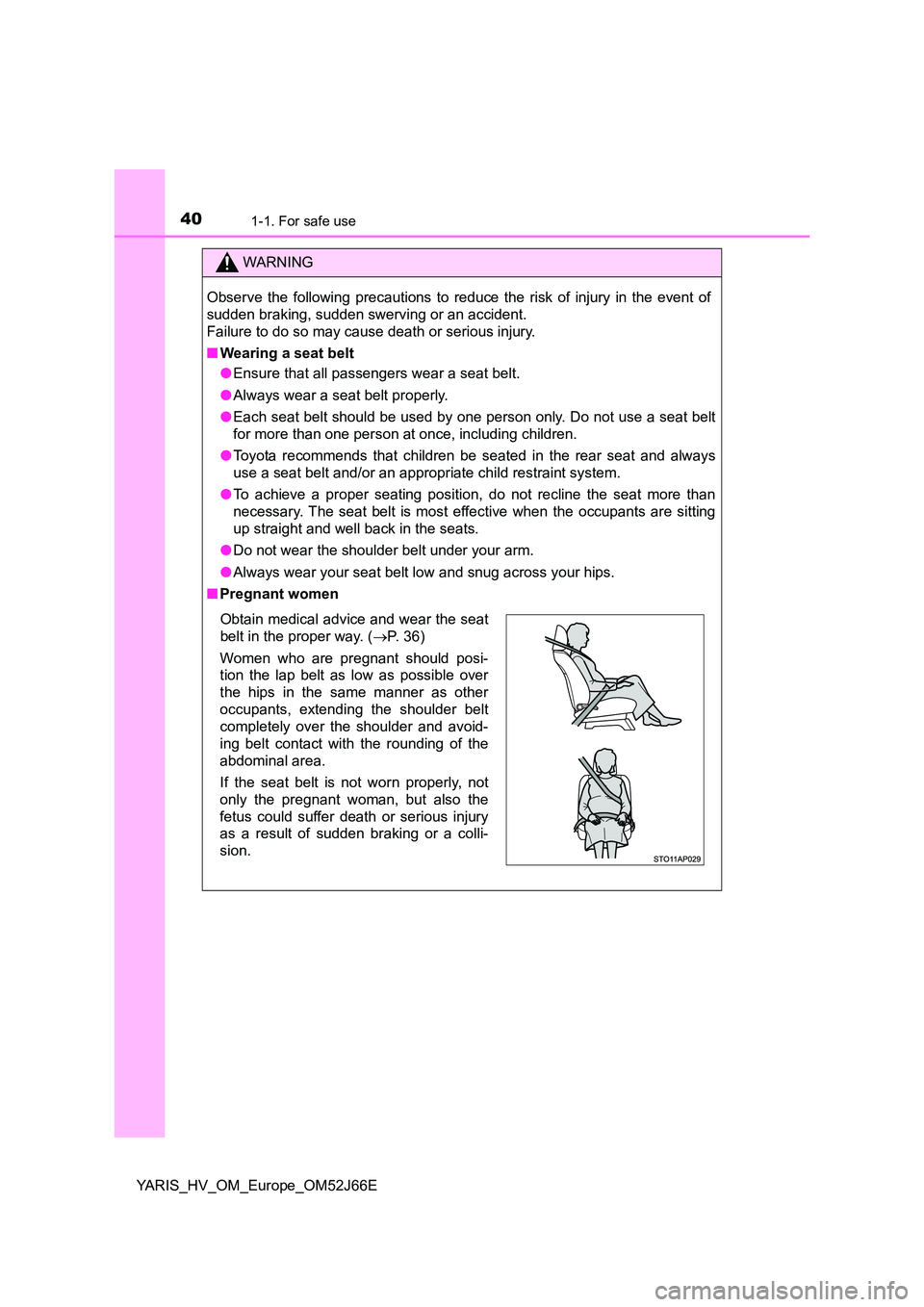
■ Pregnant women
Obtain medical advice and wear the seat
belt in the proper way. ( P. 36)
Women who are pregnant should posi-
tion the lap belt as low as possible over
the hips in the same manner as other
occupants, extending the shoulder belt
completely over the shoulder and avoid-
ing belt contact with the rounding of the
abdominal area.
If the seat belt is not worn properly, not
only the pregnant woman, but also the
fetus could suffer death or serious injury
as a result of sudden braking or a colli-
sion.
Page 43 of 632
431-1. For safe use
1
For safety and security
YARIS_HV_OM_Europe_OM52J66E
SRS airbags
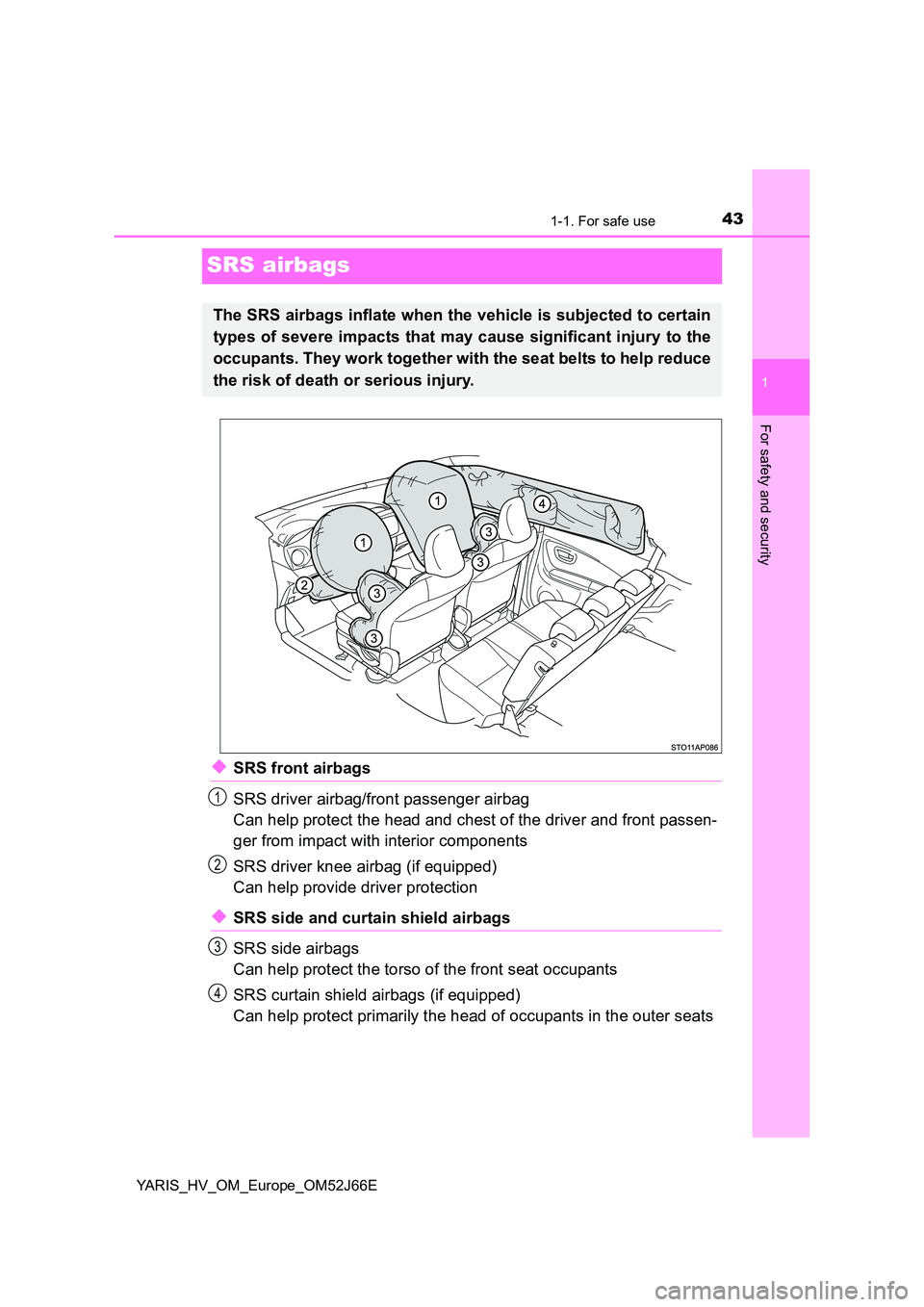
◆SRS front airbags
SRS driver airbag/front passenger airbag
Can help protect the head and chest of the driver and front passen-
ger from impact with interior components
SRS driver knee airbag (if equipped)
Can help provide driver protection
◆SRS side and curtain shield airbags
SRS side airbags
Can help protect the torso of the front seat occupants
SRS curtain shield airbags (if equipped)
Can help protect primarily the head of occupants in the outer seats
The SRS airbags inflate when the vehicle is subjected to certain
types of severe impacts that may cause significant injury to the
occupants. They work together with the seat belts to help reduce
the risk of death or serious injury.
1
2
3
4
Page 44 of 632
441-1. For safe use
YARIS_HV_OM_Europe_OM52J66E
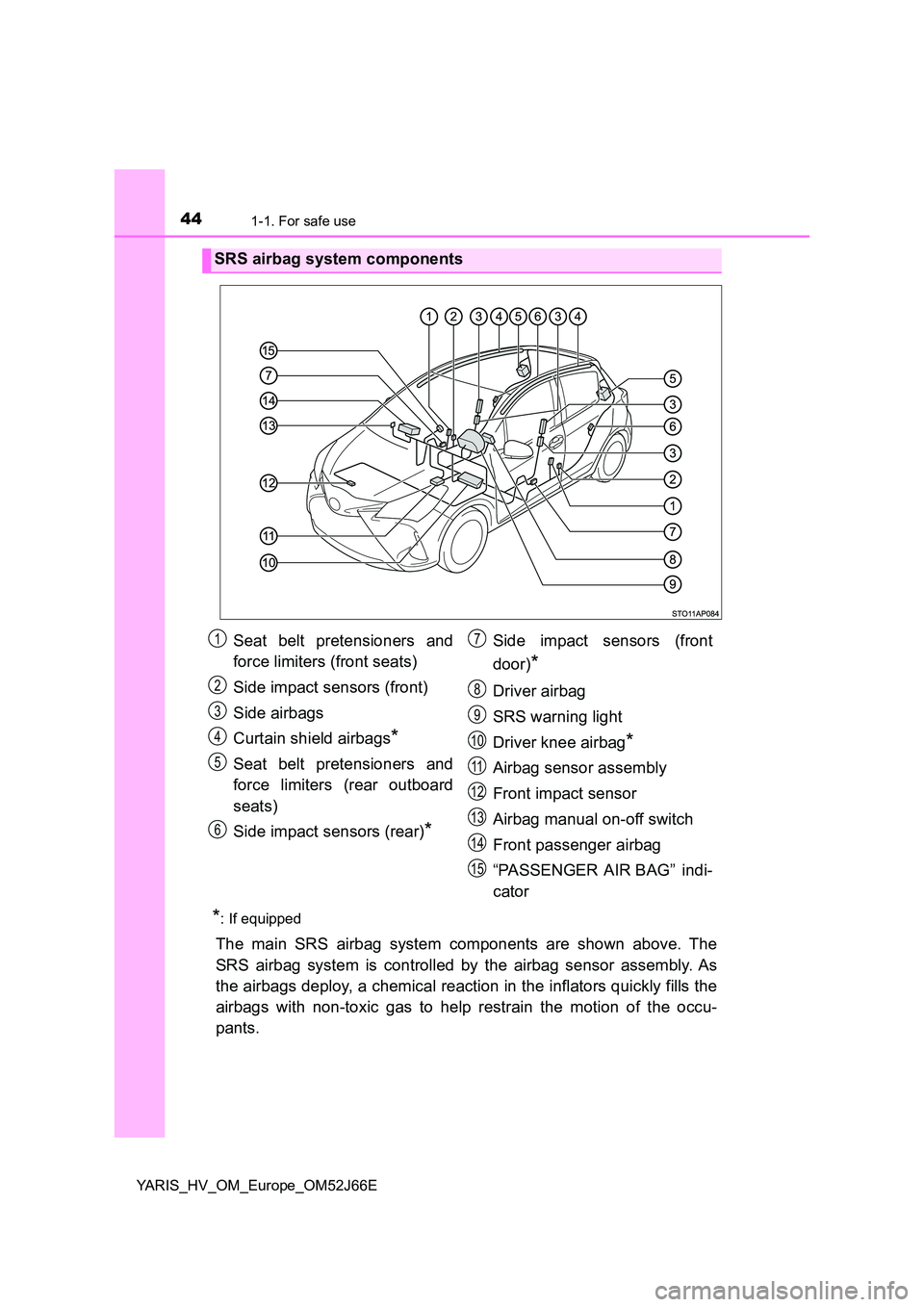
*: If equipped
The main SRS airbag system components are shown above. The
SRS airbag system is controlled by the airbag sensor assembly. As
the airbags deploy, a chemical reaction in the inflators quickly fills the
airbags with non-toxic gas to help restrain the motion of the occu-
pants.
SRS airbag system components
Seat belt pretensioners and
force limiters (front seats)
Side impact sensors (front)
Side airbags
Curtain shield airbags*
Seat belt pretensioners and
force limiters (rear outboard
seats)
Side impact sensors (rear)*
Side impact sensors (front
door)*
Driver airbag
SRS warning light
Driver knee airbag*
Airbag sensor assembly
Front impact sensor
Airbag manual on-off switch
Front passenger airbag
“PASSENGER AIR BAG” indi-
cator
1
2
3
4
5
6
7
8
9
10
11
12
13
14
15
Page 45 of 632
451-1. For safe use
1
For safety and security
YARIS_HV_OM_Europe_OM52J66E
WARNING
■SRS airbag precautions
Observe the following precautions regarding the SRS airbags.
Failure to do so may cause death or serious injury.
● The driver and all passengers in the vehicle must wear their seat belts
properly.
The SRS airbags are supplemental devic es to be used with the seat belts.
● The SRS driver airbag deploys with considerable force, and can cause
death or serious injury especially if the driver is very close to the airbag.
Since the risk zone for the driver’s airbag is the first 50 - 75 mm (2 - 3 in.)
of inflation, placing yourself 250 mm ( 10 in.) from your driver airbag pro-
vides you with a clear margin of safety. This distance is measured from
the center of the steering wheel to your breastbone. If you sit less than
250 mm (10 in.) away now, you can change your driving position in sev-
eral ways:
• Move your seat to the rear as far as you can while still reaching the ped-
als comfortably.
• Slightly recline the back of the seat. Although vehicle designs vary,
many drivers can achieve the 250 mm (10 in.) distance, even with the
driver seat all the way forward, simply by reclining the back of the seat
somewhat. If reclining the back of your seat makes it hard to see the
road, raise yourself by using a firm, non-slippery cushion, or raise the
seat if your vehicle has that feature.
• If your steering wheel is adjustable, tilt it downward. This points the air-
bag toward your chest instead of your head and neck.
The seat should be adjusted as recommended above, while still maintain-
ing control of the foot pedals, steering wheel, and your view of the instru-
ment panel controls.
Page 46 of 632
461-1. For safe use
YARIS_HV_OM_Europe_OM52J66E
WARNING
■SRS airbag precautions
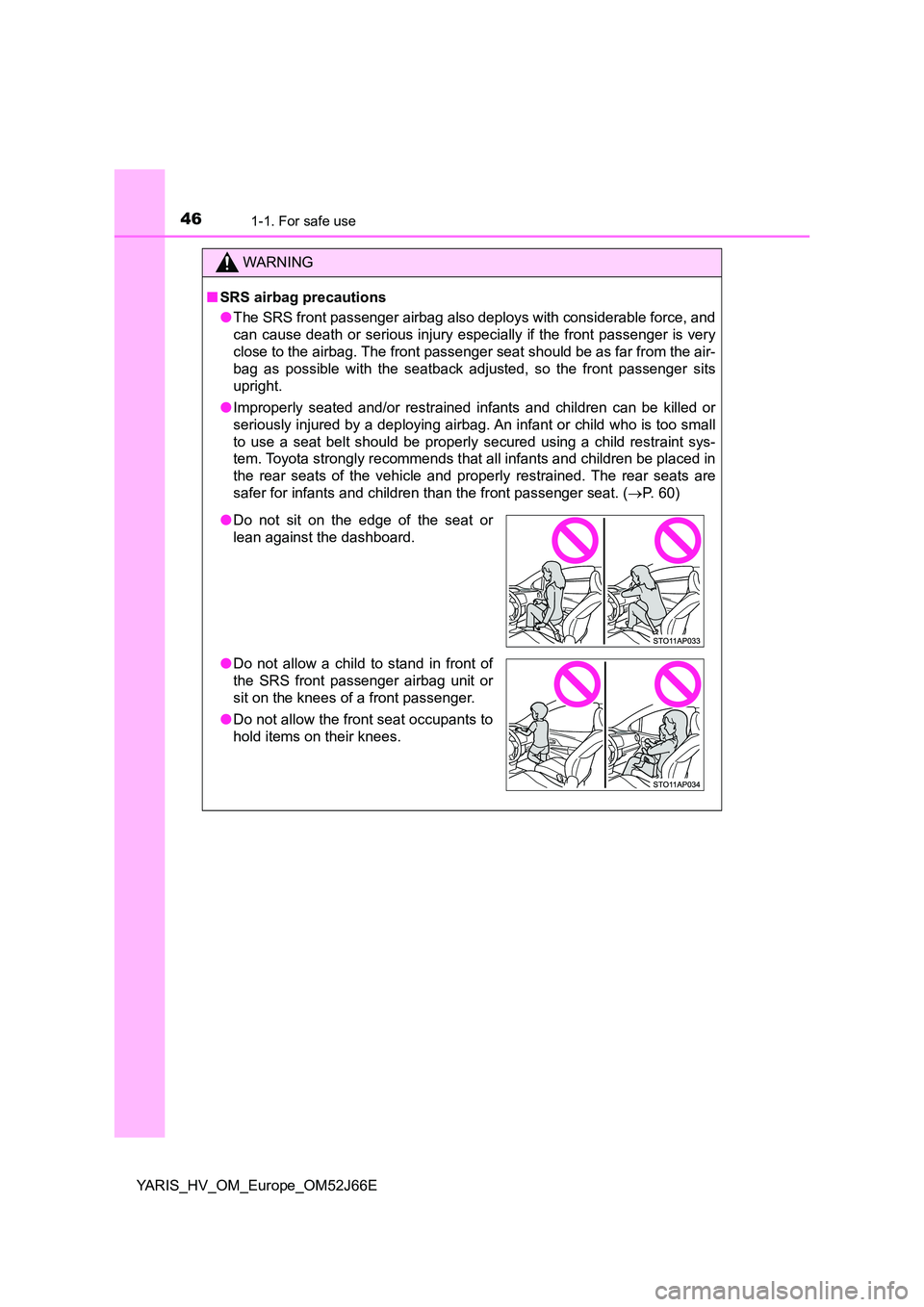
● The SRS front passenger airbag also deploys with considerable force, and
can cause death or serious injury especially if the front passenger is very
close to the airbag. The front passenger seat should be as far from the air-
bag as possible with the seatback adjusted, so the front passenger sits
upright.
● Improperly seated and/or restrained infants and children can be killed or
seriously injured by a deploying airbag. An infant or child who is too small
to use a seat belt should be properly secured using a child restraint sys-
tem. Toyota strongly recommends that all infants and children be placed in
the rear seats of the vehicle and proper ly restrained. The rear seats are
safer for infants and children than the front passenger seat. ( P. 60)
●Do not sit on the edge of the seat or
lean against the dashboard.
● Do not allow a child to stand in front of
the SRS front passenger airbag unit or
sit on the knees of a front passenger.
● Do not allow the front seat occupants to
hold items on their knees.
Page 47 of 632
471-1. For safe use
1
For safety and security
YARIS_HV_OM_Europe_OM52J66E
WARNING
■SRS airbag precautions
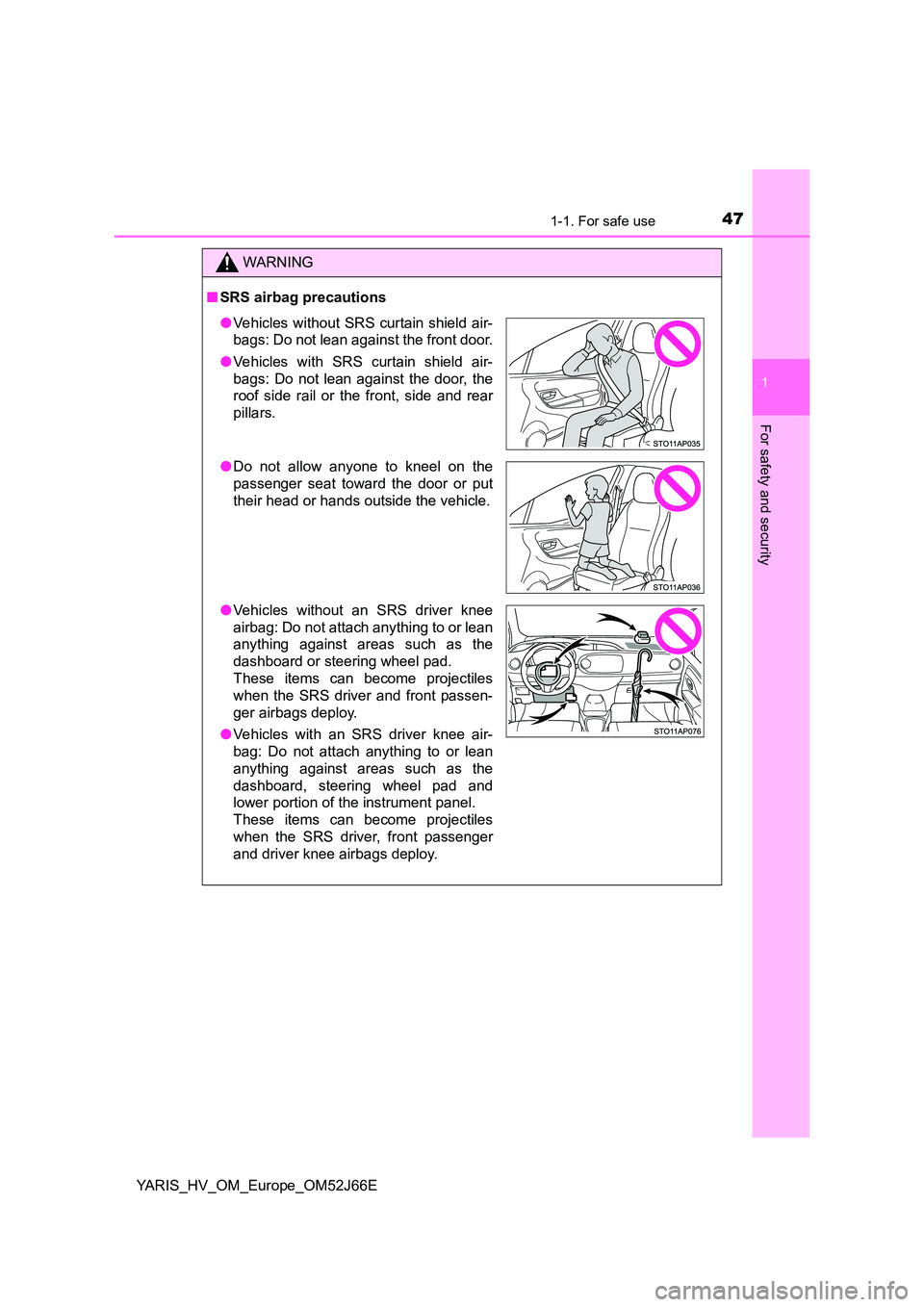
●Vehicles without SRS curtain shield air-
bags: Do not lean against the front door.
● Vehicles with SRS curtain shield air-
bags: Do not lean against the door, the
roof side rail or the front, side and rear
pillars.
● Do not allow anyone to kneel on the
passenger seat toward the door or put
their head or hands outside the vehicle.
● Vehicles without an SRS driver knee
airbag: Do not attach anything to or lean
anything against areas such as the
dashboard or steering wheel pad.
These items can become projectiles
when the SRS driver and front passen-
ger airbags deploy.
● Vehicles with an SRS driver knee air-
bag: Do not attach anything to or lean
anything against areas such as the
dashboard, steering wheel pad and
lower portion of the instrument panel.
These items can become projectiles
when the SRS driver, front passenger
and driver knee airbags deploy.