tires TOYOTA YARIS 2018 Owners Manual
[x] Cancel search | Manufacturer: TOYOTA, Model Year: 2018, Model line: YARIS, Model: TOYOTA YARIS 2018Pages: 632, PDF Size: 44.1 MB
Page 5 of 632
5
1
7
8
6
5
4
3
2
9
YARIS_HV_OM_Europe_OM52J66E
6-1. Using the air conditioning
system and defogger
Automatic air conditioning
system .............................386
Seat heaters ......................396
6-2. Using the interior lights
Interior lights list .................398
• Interior light ....................398
• Personal lights ...............399
6-3. Using the storage features
List of storage features ......400
• Glove box ......................401
• Cup holders ...................402
• Bottle holders ................403
• Auxiliary box ..................403
Luggage compartment
features............................404
6-4. Using the other interior
features
Other interior features ........407
• Sun visors ......................407
• Vanity mirrors ................407
• Portable ashtray ............408
• Cigarette lighter .............409
• Power outlet ..................410
• Armrest ..........................411
• Panoramic roof shade ...411
• Assist grips ....................412
7-1. Maintenance and care
Cleaning and protecting
the vehicle exterior .......... 414
Cleaning and protecting
the vehicle interior ........... 419
7-2. Maintenance
Maintenance
requirements ................... 427
7-3. Do-it-yourself maintenance
Do-it-yourself service
precautions ..................... 430
Hood.................................. 433
Positioning a floor jack ...... 435
Engine compartment ......... 437
12-volt battery ................... 445
Tires .................................. 451
Tire inflation pressure........ 468
Wheels .............................. 470
Air conditioning filter .......... 474
Wireless remote control/
electronic key battery ...... 477
Checking and replacing
fuses ............................... 481
Light bulbs ......................... 486
6Interior features7Maintenance and care
Page 15 of 632

15Pictorial index
YARIS_HV_OM_Europe_OM52J66E
Wipers. . . . . . . . . . . . . . . . . . . . . . . . . . . . . . . . . . . . . . . P. 246, 250
Precautions against winter season . . . . . . . . . . . . . . . . . . . . . P. 313
Precautions against car wash . . . . . . . . . . . . . . . . . . . . . . . . . P. 416
Fuel filler door . . . . . . . . . . . . . . . . . . . . . . . . . . . . . . . . . . . . P. 252
Refueling method . . . . . . . . . . . . . . . . . . . . . . . . . . . . . . . . . . P. 252
Fuel type/fuel tank capacity . . . . . . . . . . . . . . . . . . . . . . . . . . . P. 592
Tires . . . . . . . . . . . . . . . . . . . . . . . . . . . . . . . . . . . . . . . . . . . . P. 451
Tire size/inflation pressure . . . . . . . . . . . . . . . . . . . . . . . . . . . . P. 598
Winter tires/tire chain . . . . . . . . . . . . . . . . . . . . . . . . . . . . . . . . P. 313
Checking/rotation/tire pressure warning system*3 . . . . . . . . . P. 451
Coping with flat tires . . . . . . . . . . . . . . . . . . . . . . . . . . . . P. 537, 556
Hood . . . . . . . . . . . . . . . . . . . . . . . . . . . . . . . . . . . . . . . . . . . . P. 433
Opening . . . . . . . . . . . . . . . . . . . . . . . . . . . . . . . . . . . . . . . . . . P. 433
Engine oil . . . . . . . . . . . . . . . . . . . . . . . . . . . . . . . . . . . . . . . . . P. 593
Coping with overheat . . . . . . . . . . . . . . . . . . . . . . . . . . . . . . . . P. 581
Headlights/front position lights/daytime running lights/
front turn signal lights . . . . . . . . . . . . . . . . . . . . . . . . . P. 236, 238
Front fog lights*3. . . . . . . . . . . . . . . . . . . . . . . . . . . . . . . . . . P. 244
Side turn signal lights . . . . . . . . . . . . . . . . . . . . . . . . . . . . . . P. 236
Rear turn signal lights. . . . . . . . . . . . . . . . . . . . . . . . . . . . . . P. 236
Back-up lights/tail lights (LED type) . . . . . . . . . . . . . . . . . . P. 238
Shifting the shift lever to R. . . . . . . . . . . . . . . . . . . . . . . . . . . . P. 232
Stop/tail lights . . . . . . . . . . . . . . . . . . . . . . . . . . . . . . . . . . . . P. 238
Rear fog light . . . . . . . . . . . . . . . . . . . . . . . . . . . . . . . . . . . . . P. 244
License plate lights . . . . . . . . . . . . . . . . . . . . . . . . . . . . . . . . P. 238
4
5
6
7
Light bulbs of the exterior lights for driving
(Replacing method: P. 486, Watts: P. 600)
*1: Vehicles with a smart entry & start system
*2: Vehicles with monochrome display
*3: If equipped
8
9
10
11
12
13
14
15
Page 205 of 632
2054-1. Before driving
4
Driving
YARIS_HV_OM_Europe_OM52J66E
Firmly set the parking brake with the brake pedal depressed, and
then shift the shift lever to D.
Release the brake pedal and gently depress the accelerator pedal.
Release the parking brake.
■ When starting off on an uphill
The hill-start assist control will activate. ( P. 303)
■ For fuel-efficient driving
Keep in mind that hybrid vehicles are similar to conventional vehicles, and it
is necessary to refrain from activities such as sudden acceleration. ( P. 310)
■ Driving in the rain
● Drive carefully when it is raining, because visibility will be reduced, the win-
dows may become fogged-up, and the road will be slippery.
● Drive carefully when it starts to rain, because the road surface will be espe-
cially slippery.
● Refrain from high speeds when driving on an expressway in the rain,
because there may be a layer of water between the tires and the road sur-
face, preventing the steering and brakes from operating properly.
■ Breaking in your new Toyota
To extend the life of the vehicle, observing the following precautions is recom-
mended:
● For the first 300 km (200 miles):
Avoid sudden stops.
● For the first 1600 km (1000 miles):
• Do not drive at extremely high speeds.
• Avoid sudden acceleration.
• Do not drive at a constant speed for extended periods.
■ Operating your vehicle in a foreign country
Comply with the relevant vehicle registration laws and confirm the availability
of the correct fuel. ( P. 601)
Starting off on a steep uphill
1
2
3
Page 265 of 632
2654-5. Toyota Safety Sense
4
Driving
YARIS_HV_OM_Europe_OM52J66E
WARNING
■When to disable the pre-crash safety system
In the following situations, disable the system, as it may not operate prop-
erly, possibly leading to an accident resulting in death or serious injury:
● When the vehicle is being towed
● When your vehicle is towing another vehicle
● When transporting the vehicle via truck, boat, train or similar means of
transportation
● When the vehicle is raised on a lift with the hybrid system on and the tires
are allowed to rotate freely
● When inspecting the vehicle using a drum tester such as a chassis dyna-
mometer or speedometer tester, or when using an on vehicle wheel bal-
ancer
● If the vehicle cannot be driven in a stable manner, such as when the vehi-
cle has been in an accident or is malfunctioning
● When the vehicle is driven in a sporty manner or off-road
● When the condition of the tires is poor and they do not perform well
P. 451, 469)
● When tires of a size other than specified are installed
● When tire chains are installed
● When a compact spare tire or an emergency tire puncture repair kit is used
Page 276 of 632
2764-5. Toyota Safety Sense
YARIS_HV_OM_Europe_OM52J66E
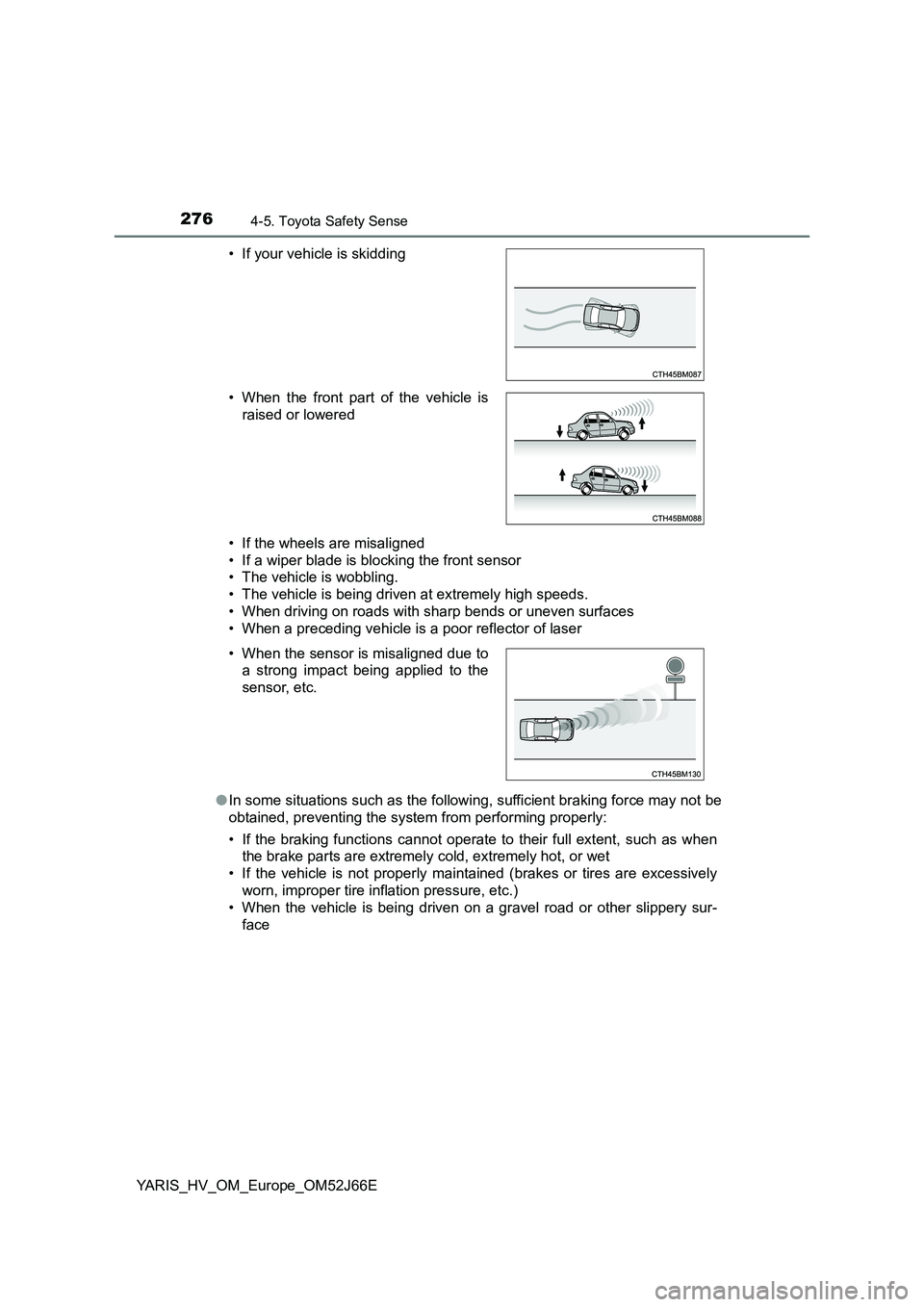
• If the wheels are misaligned
• If a wiper blade is blocking the front sensor
• The vehicle is wobbling.
• The vehicle is being driven at extremely high speeds.
• When driving on roads with sharp bends or uneven surfaces
• When a preceding vehicle is a poor reflector of laser
● In some situations such as the following, sufficient braking force may not be
obtained, preventing the system from performing properly:
• If the braking functions cannot operate to their full extent, such as when
the brake parts are extremely cold, extremely hot, or wet
• If the vehicle is not properly maintained (brakes or tires are excessively
worn, improper tire inflation pressure, etc.)
• When the vehicle is being driven on a gravel road or other slippery sur-
face
• If your vehicle is skidding
• When the front part of the vehicle is
raised or lowered
• When the sensor is misaligned due to
a strong impact being applied to the
sensor, etc.
Page 285 of 632
2854-5. Toyota Safety Sense
4
Driving
YARIS_HV_OM_Europe_OM52J66E
■ When changing the tires
Depending on the tires used, sufficient performance may not be maintainable.
■ If the LDA indicator comes on in yellow (vehicles with monochrome dis-
play)
It may indicate a malfunction in the system. Contact any authorized Toyota
retailer or Toyota authorized repairer, or any reliable repairer.
■ Warning messages for the LDA system (vehicles with color display)
Warning messages are used to indicate a system malfunction or to inform the
driver of the need for caution while driving.
■ Customization
P. 607
WARNING
■Before using the LDA system
Do not rely solely on the LDA system. The LDA system does not drive the
vehicle automatically, nor does it reduce the amount of care you need to
take. As such, the driver must always assume full responsibility for under-
standing his/her surroundings, for operati ng the steering wheel to correct
the driving line, and for driving safely.
Inappropriate or negligent driving could lead to an accident.
■ To avoid operating the LDA by mistake
Switch the LDA system off using the LDA switch when not in use.
Page 308 of 632
3084-6. Using the driving support systems
YARIS_HV_OM_Europe_OM52J66E
WARNING
■The ABS does not operate effectively when
● The limits of tire gripping performance have been exceeded (such as
excessively worn tires on a snow covered road).
● The vehicle hydroplanes while driving at high speed on wet or slick roads.
■ Stopping distance when the ABS is operating may exceed that of nor-
mal conditions
The ABS is not designed to shorten t he vehicle’s stopping distance. Always
maintain a safe distance from the vehicle in front of you, especially in the
following situations:
● When driving on dirt, gravel or snow-covered roads
● When driving with tire chains
● When driving over bumps in the road
● When driving over roads with potholes or uneven surfaces
■ TRC/VSC may not operate effectively when
Directional control and power may not be achievable while driving on slip-
pery road surfaces, even if the TRC/VSC system is operating.
Drive the vehicle carefully in conditions where stability and power may be
lost.
■ Hill-start assist control does not operate effectively when
● Do not overly rely on hill-start assist control. Hill-start assist control may
not operate effectively on steep inclines and roads covered with ice.
● Unlike the parking brake, hill-start assist control is not intended to hold the
vehicle stationary for an extended period of time. Do not attempt to use
hill-start assist control to hold the vehicle on an incline, as doing so may
lead to an accident.
■ When the VSC is activated
The slip indicator light flashes. Always drive carefully. Reckless driving may
cause an accident. Exercise particular care when the indicator light flashes.
Page 309 of 632
3094-6. Using the driving support systems
4
Driving
YARIS_HV_OM_Europe_OM52J66E
WARNING
■When the TRC/VSC systems are turned off
Be especially careful and drive at a speed appropriate to the road condi-
tions. As these are the systems to help ensure vehicle stability and driving
force, do not turn the TRC/VSC systems off unless necessary.
■ Replacing tires
Make sure that all tires are of the specified size, brand, tread pattern and
total load capacity. In addition, make sure that the tires are inflated to the
recommended tire inflation pressure level.
The ABS, TRC and VSC systems will not function correctly if different tires
are installed on the vehicle.
Contact any authorized Toyota retailer or Toyota authorized repairer, or any
reliable repairer for further information when replacing tires or wheels.
■ Handling of tires and the suspension
Using tires with any kind of problem or modifying the suspension will affect
the driving assist systems, and may cause a system to malfunction.
Page 312 of 632
3124-7. Driving tips
YARIS_HV_OM_Europe_OM52J66E
◆Air conditioning
Use the air conditioning only when necessary. Doing so can help
reduce excessive gasoline consumption.
In summer: When the ambient temperature is high, use the recircu-
lated air mode. Doing so will help to reduce the burden on the air
conditioning system and reduce fuel consumption as well.
In winter: Because the gasoline engine will not automatically cut out
until it and the interior of the vehicle are warm, it will consume fuel.
Also, fuel consumption can be improved by avoiding overuse of the
heater.
◆Checking tire inflation pressure
Make sure to check the tire inflation pressure frequently. Improper
tire inflation pressure can cause poor fuel economy.
Also, as snow tires can cause large amounts of friction, their use on
dry roads can lead to poor fuel economy. Use tires that are appro-
priate for the season.
◆Luggage
Carrying heavy luggage will lead to poor fuel economy. Avoid carry-
ing unnecessary luggage. Installing a large roof rack will also cause
poor fuel economy.
◆Warming up before driving
Since the gasoline engine starts up and cuts out automatically
when cold, warming up the engine is unnecessary. Moreover, fre-
quently driving short distances will cause the engine to repeatedly
warm up, which can lead to excess fuel consumption.
Page 313 of 632
313
4
4-7. Driving tips
Driving
YARIS_HV_OM_Europe_OM52J66E
Winter driving tips
●Use fluids that are appropriate to the prevailing outside tempera-
tures.
• Engine oil
• Engine/power control unit coolant
• Washer fluid
● Have a service technician inspect the condition of the 12-volt bat-
tery.
● Have the vehicle fitted with four snow tires or purchase a set of tire
chains for the front tires.
Ensure that all tires are the specified size and brand, and that chains
match the size of the tires.
Perform the following according to the driving conditions:
● Do not try to forcibly open a window or move a wiper that is frozen.
Pour warm water over the frozen area to melt the ice. Wipe away
the water immediately to prevent it from freezing.
● To ensure proper operation of the climate control system fan,
remove any snow that has accumulated on the air inlet vents in
front of the windshield.
● Check for and remove any excess ice or snow that may have accu-
mulated on the exterior lights, vehicle’s roof, chassis, around the
tires or on the brakes.
● Remove any snow or mud from the bottom of your shoes before
getting in the vehicle.
Carry out the necessary preparations and inspections before
driving the vehicle in winter. Always drive the vehicle in a man-
ner appropriate to the prevailing weather conditions.
Preparation for winter
Before driving the vehicle