child restraint TOYOTA YARIS 2020 (in English) User Guide
[x] Cancel search | Manufacturer: TOYOTA, Model Year: 2020, Model line: YARIS, Model: TOYOTA YARIS 2020Pages: 572, PDF Size: 7.94 MB
Page 46 of 572
46
YARIS_YARIS HATCHBACK_OM_OM99V59z_(U)
1-3. Child Restraint
WARNING
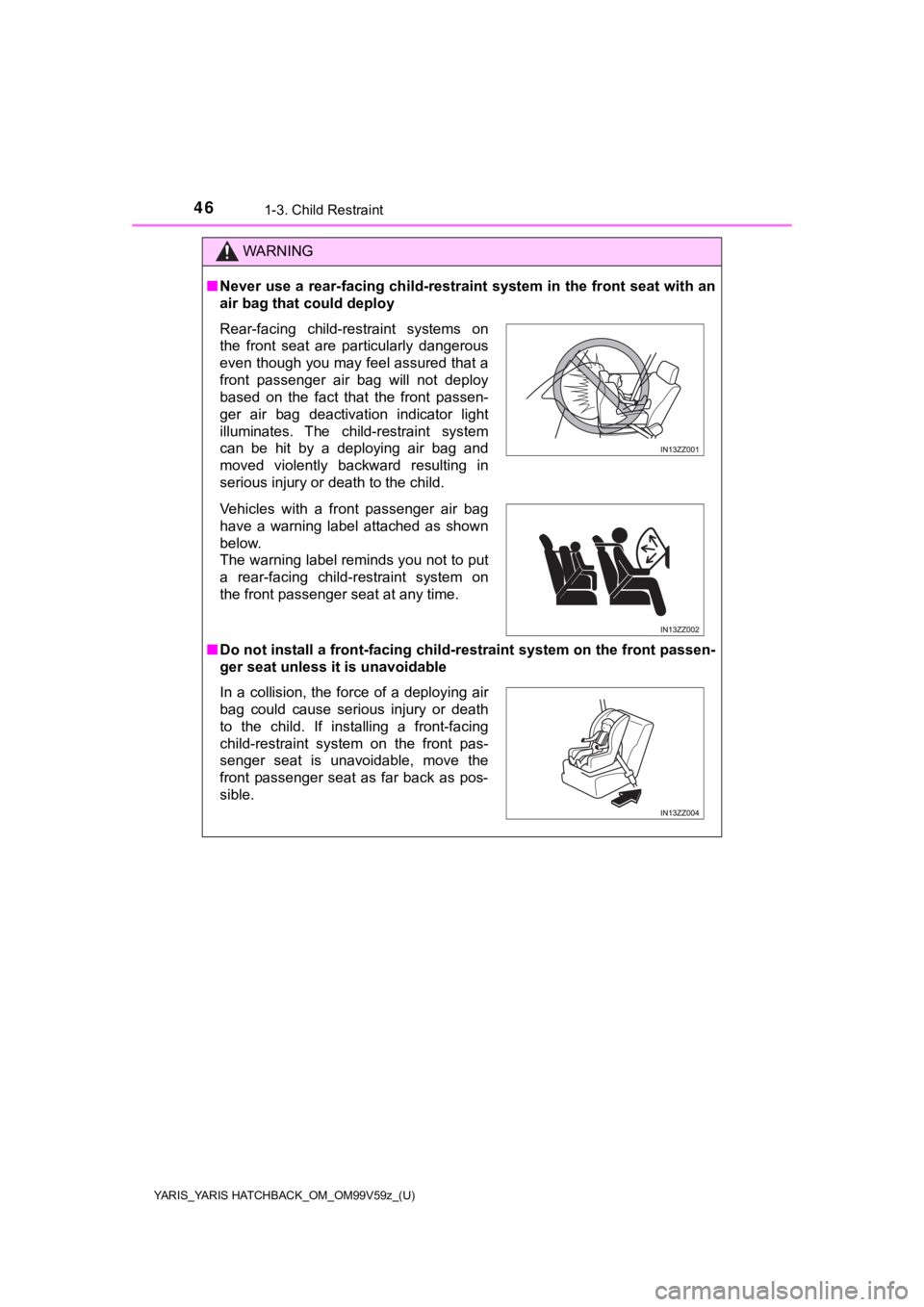
■Never use a rear-facing child-restraint system in the front sea t with an
air bag that could deploy
■ Do not install a front-facing c hild-restraint system on the fro nt passen-
ger seat unless it is unavoidable
Rear-facing child-restraint systems on
the front seat are particularly dangerous
even though you may feel assured that a
front passenger air bag will not deploy
based on the fact that the front passen-
ger air bag deactivation indicator light
illuminates. The child-restraint system
can be hit by a deploying air bag and
moved violently backward resulting in
serious injury or death to the child.
Vehicles with a front passenger air bag
have a warning label attached as shown
below.
The warning label reminds you not to put
a rear-facing child-restraint system on
the front passenger seat at any time.
In a collision, the force of a deploying air
bag could cause serious injury or death
to the child. If installing a front-facing
child-restraint system on the front pas-
senger seat is unavoidable, move the
front passenger seat as far back as pos-
sible.
Page 47 of 572
YARIS_YARIS HATCHBACK_OM_OM99V59z_(U)
471-3. Child Restraint
1
Essential Safety Equipment
WARNING
■Seating a child in a child-restraint system on the front passen ger seat
is dangerous under certain conditions
Your vehicle is equipped with front passenger occupant classifi cation sen-
sor. Even with the front passenger occupant classification sensor, if you
must use the front passenger seat to seat a child, using a chil d-restraint
system on the front passenger seat under the following conditio ns
increases the danger of the front passenger air bag deploying a nd could
result in serious injury or death to the child.
● The front passenger air bag deactivation indicator light does not illuminate
when seating a child in the child-restraint system.
● Luggage or other items are placed on the seat with the child in the child-
restraint system.
● A rear passenger or luggage pushing or pulling down on the front passen-
ger seatback.
● Luggage or other items are placed on the seatback or hung on the head
restraint.
● The seat is washed.
● Liquids are spilled on the seat.
● The front passenger seat is moved backward, pushing into luggag e or
other items placed behind it.
● The front passenger seatback contacts the rear seat.
● Luggage or other items are placed between the front passenger s eat and
driver seat.
● An electric device is put on the front passenger’s seat.
● An additional electrical device, such as a seat warmer is installed to the
surface of the front passenger seat.
The designated positions with seat belts on the rear seats are the safest
places for children. Always use seat belts and child restraints .
Page 48 of 572
48
YARIS_YARIS HATCHBACK_OM_OM99V59z_(U)
1-3. Child Restraint
WARNING
■Do not allow a child or anyone to lean over or against the side window
of a vehicle with side and curtain air bags
It is dangerous to allow anyone to lean over or against the sid e window, the
area of the front passenger seat, the front and rear window pil lars and the
roof edge along both sides from which the side and curtain air bags deploy,
even if a child-restraint system is used. The impact of inflati on from a side or
curtain air bag could cause serious injury or death to an out of position child.
Furthermore, leaning over or agai nst the front door could block the side and
curtain air bags and eliminate the advantages of supplemental p rotection.
With the front air bag and the additional side air bag that comes out of the
front seat, the rear seat is always a better location for child ren. Take special
care not to allow a child to lean over or against the side wind ow, even if the
child is seated in a child-restraint system.
■ Never use one seat belt on more than one person at a time
Using one seat belt for more than one person at a time is dangerous. A seat
belt used in this way cannot spread the impact forces properly and the two
passengers could be crushed together and seriously injured or even killed.
Never use one belt for more than one person at a time and alway s operate
the vehicle with each occupant properly restrained.
■ To prevent burns
A seat belt or child-restraint system can become very hot in a closed vehicle
during warm weather. To avoid burning yourself or a child, check them
before you or your child touches them.
Page 49 of 572
49
YARIS_YARIS HATCHBACK_OM_OM99V59z_(U)
1-3. Child Restraint
1
Essential Safety Equipment
Child-Restraint System Installation
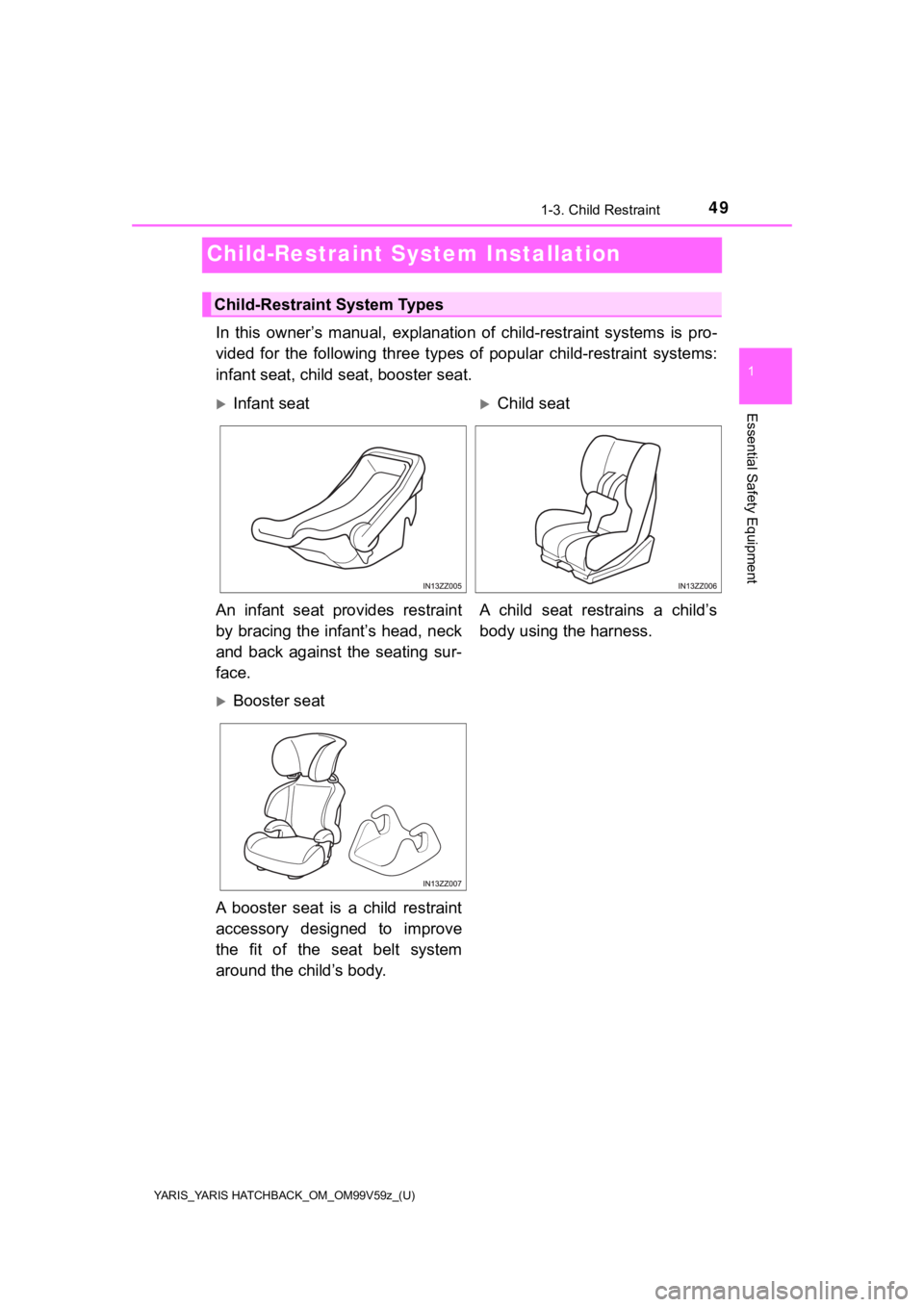
In this owner’s manual, explanat ion of child-restraint systems is pro-
vided for the following three types of popular child-restraint systems:
infant seat, child seat, booster seat.
Child-Restraint System Types
Infant seatChild seat
An infant seat provides restraint
by bracing the infant’s head, neck
and back against the seating sur-
face. A child seat restrains a child’s
body using the harness.
Booster seat
A booster seat is a child restraint
accessory designed to improve
the fit of the seat belt system
around the child’s body.
Page 50 of 572
50
YARIS_YARIS HATCHBACK_OM_OM99V59z_(U)
1-3. Child Restraint
●Installation position is determined by the type of child-restra int system.
Always read the manufacturer’s instructions and this owner’s ma nual care-
fully.
● Due to variations in the design of child-restraint systems, veh icle seats and
seat belts, all child-restraint systems may not fit all seating positions. Before
purchasing a child-restraint system, it should be tested in the specific vehi-
cle seating position (or positions) where it is intended to be used. If a previ-
ously purchased child-restraint system does not fit, you may ne ed to
purchase a different one that will.
Page 51 of 572
51
YARIS_YARIS HATCHBACK_OM_OM99V59z_(U)
1-3. Child Restraint
1
Essential Safety Equipment
Installing Child-Restraint Systems
Some child-restraint systems now come with tethers and therefore
must be installed on the seats that take tethers to be effectiv e. In your
Toyota, tethered child-restraint systems can only be accommodat ed in
the three positions on the rear seat.
Some child-restraint systems also employ specially designed LATCH
attachments; refer to “Usin g LATCH Lower Anchor” (P. 6 1 ) .
Even if your vehicle is equipped with front passenger occupant classification
sensor ( P. 82), which automatically deactivates the front passenger air bag,
a rear seat is the safest place for a child of any age or size.
Accident statistics reveal that a child is safer in the rear se at.
The front passenger’s seat is clearly the worst choice for any
child under 12, and with rear-f acing child-restraint systems it is
clearly unsafe due to air bags.
WARNING
■ Tethered Child-Restraint Systems Work Only on Tether-Equipped Rear
Seats
Installation of a tether equipped child-restraint system in the front passen-
ger’s seat defeats the safety design of the system and will res ult in an
increased chance of serious injury if the child-restraint syste m goes forward
without benefit of being tethered.
Place tether equipped child-restraint systems where there are tether
anchors.
Page 52 of 572
52
YARIS_YARIS HATCHBACK_OM_OM99V59z_(U)
1-3. Child Restraint
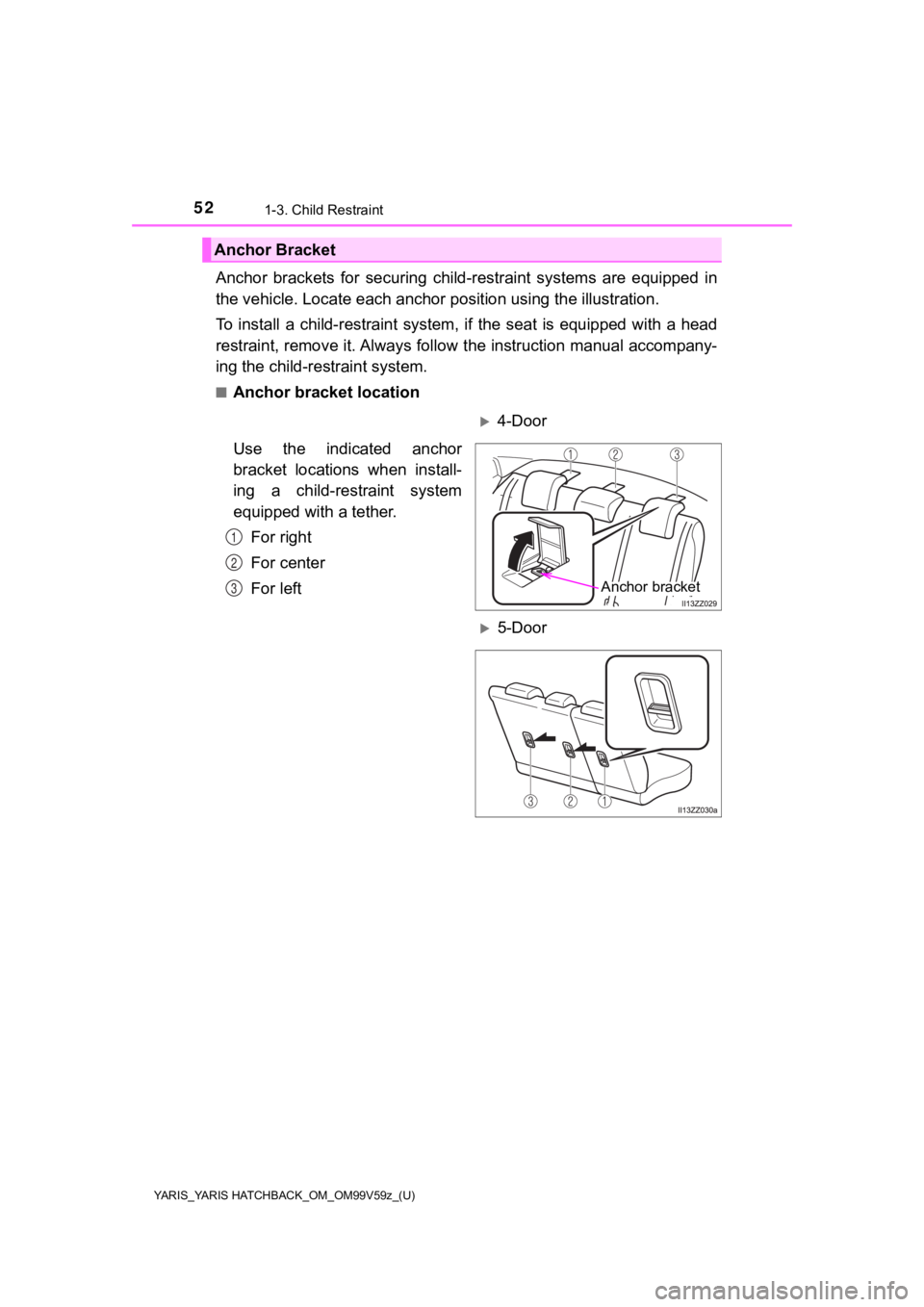
Anchor brackets for securing child-restraint systems are equipped in
the vehicle. Locate each anchor position us ing the illustration.
To install a child-restraint system, if the seat is equipped wi th a head
restraint, remove it. Always fol low the instruction manual acco mpany-
ing the child-re straint system.
■Anchor bracket location
Anchor Bracket
4-Door
Use the indicated anchor
bracket locations when install-
ing a child-restraint system
equipped with a tether. For right
For center
For left
5-Door
1
2
3Anchor bracket
Page 53 of 572
YARIS_YARIS HATCHBACK_OM_OM99V59z_(U)
531-3. Child Restraint
1
Essential Safety Equipment
WARNING
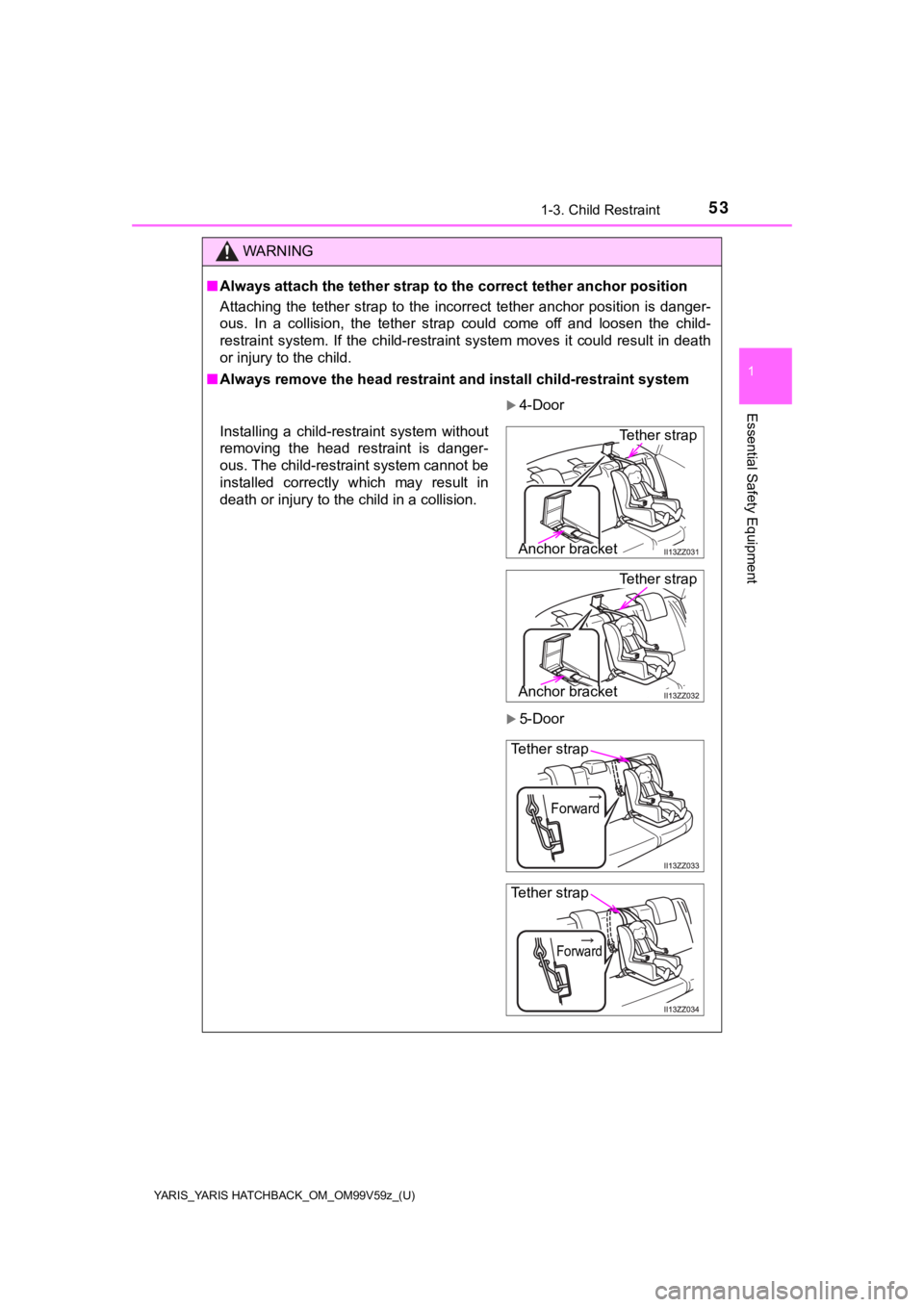
■Always attach the tether strap to the correct tether anchor pos ition
Attaching the tether strap to the incorrect tether anchor position is danger-
ous. In a collision, the tether strap could come off and loosen the child-
restraint system. If the child-restraint system moves it could result in death
or injury to the child.
■ Always remove the head restraint and install child-restraint sy stem
4-Door
Installing a child-restraint system without
removing the head restraint is danger-
ous. The child-restraint system cannot be
installed correctly which may result in
death or injury to the child in a collision.
5-Door
Tether strap
Anchor bracket
Anchor bracket
Tether strap
Tether strap
Forward
Tether strap
Forward
Page 54 of 572
54
YARIS_YARIS HATCHBACK_OM_OM99V59z_(U)
1-3. Child Restraint
Follow these instructions when using a child-restraint system, unless
you are attaching a LATCH-equipped child-restraint system to th e rear
LATCH lower anchors. Refer to “Using LATCH Lower Anchor”
( P. 61).
Make sure the seatback is securely latched by pushing it back u ntil
it is fully locked.
Remove the head restraint.
Refer to Head Restraints on P. 30.
Secure the child-restraint system with the lap portion of the l ap/
shoulder belt.
See the manufacturer’s instructions on the child-restraint system for
belt routing instructions.
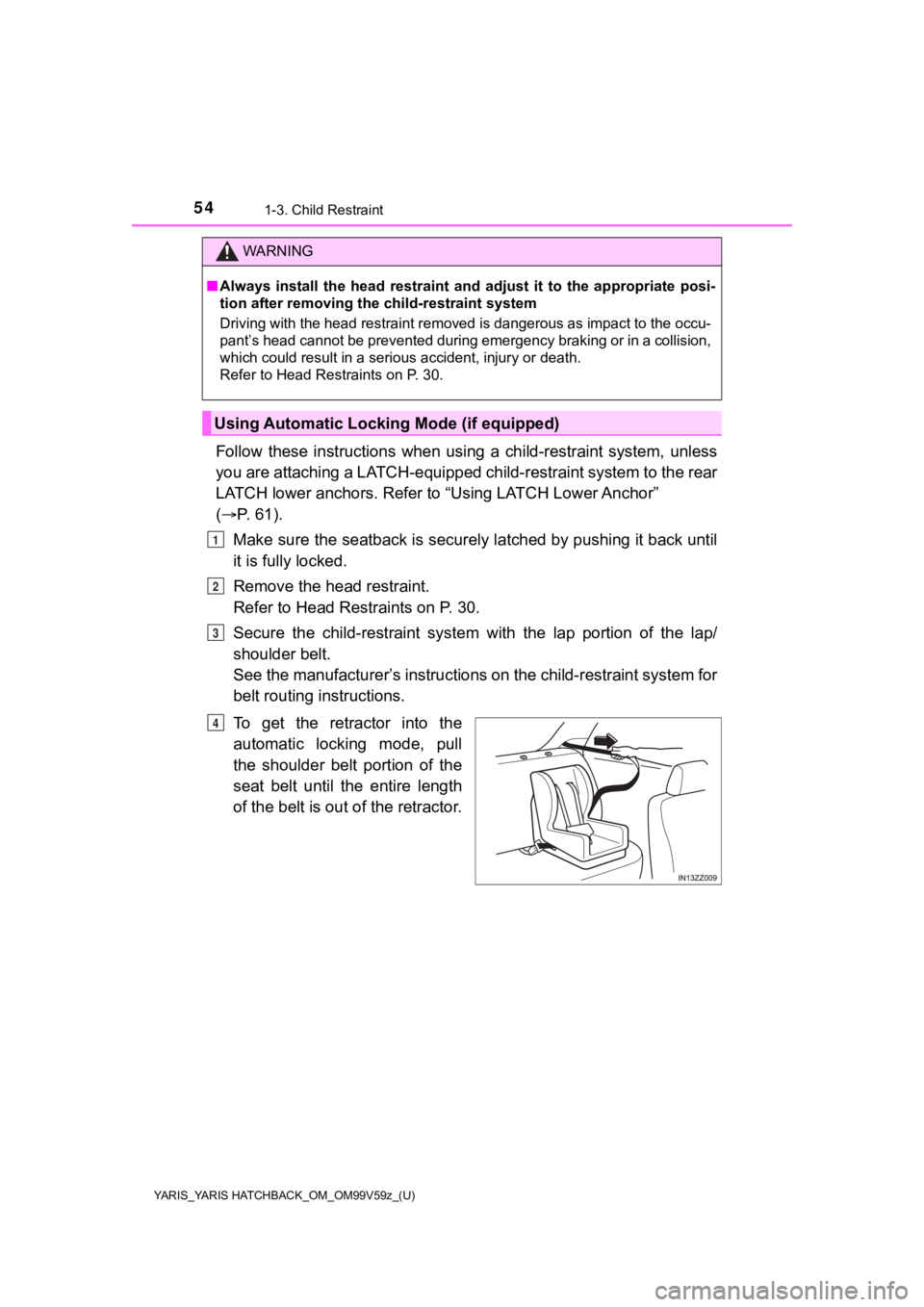
To get the retractor into the
automatic locking mode, pull
the shoulder belt portion of the
seat belt until the entire length
of the belt is ou t of the retractor.
WARNING
■Always install the head restraint and adjust it to the appropriate posi-
tion after removing the child-restraint system
Driving with the head restraint removed is dangerous as impact to the occu-
pant’s head cannot be prevented during emergency braking or in a collision,
which could result in a serious accident, injury or death.
Refer to Head Restraints on P. 30.
Using Automatic Locking Mode (if equipped)
1
2
3
4
Page 55 of 572
YARIS_YARIS HATCHBACK_OM_OM99V59z_(U)
551-3. Child Restraint
1
Essential Safety Equipment
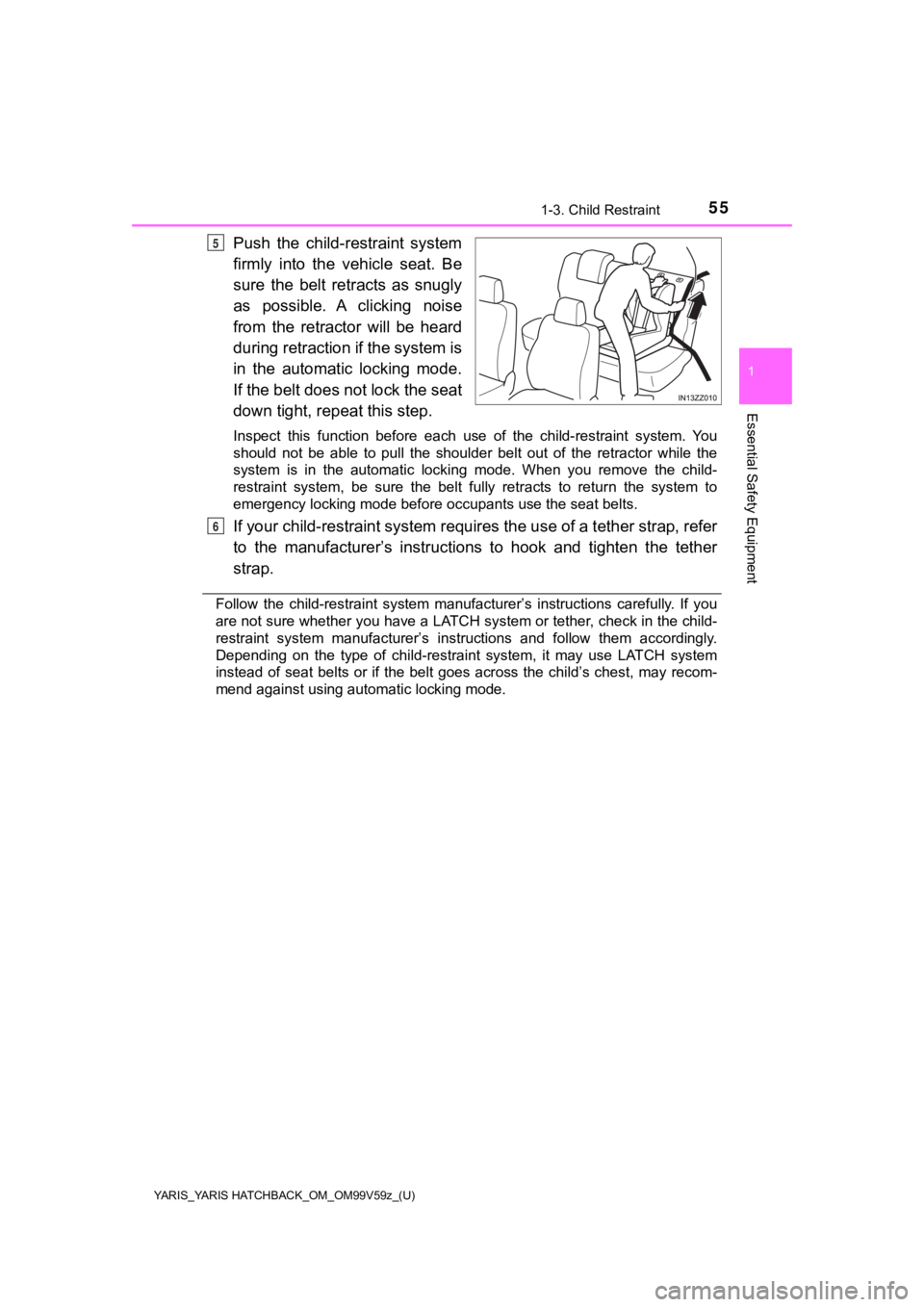
Push the child-restraint system
firmly into the vehicle seat. Be
sure the belt retracts as snugly
as possible. A clicking noise
from the retractor will be heard
during retraction if the system is
in the automatic locking mode.
If the belt does not lock the seat
down tight, repeat this step.
Inspect this function before each use of the child-restraint system. You
should not be able to pull the shoulder belt out of the retract or while the
system is in the automatic locking mode. When you remove the ch ild-
restraint system, be sure the belt fully retracts to return the system to
emergency locking mode before occupants use the seat belts.
If your child-restraint system requires the use of a tether str ap, refer
to the manufacturer’s instructions to hook and tighten the teth er
strap.
Follow the child-restraint system manufacturer’s instructions carefully. If you
are not sure whether you have a LATCH system or tether, check i n the child-
restraint system manufacturer’s instructions and follow them ac cordingly.
Depending on the type of child-restraint system, it may use LAT CH system
instead of seat belts or if the belt goes across the child’s chest, may recom-
mend against using automatic locking mode.
5
6