Light TOYOTA YARIS 2020 Owner's Manual
[x] Cancel search | Manufacturer: TOYOTA, Model Year: 2020, Model line: YARIS, Model: TOYOTA YARIS 2020Pages: 692, PDF Size: 68.71 MB
Page 47 of 692
471-1. For safe use
1
For safety and security
YARIS_F_OM_Europe_OM52A54E
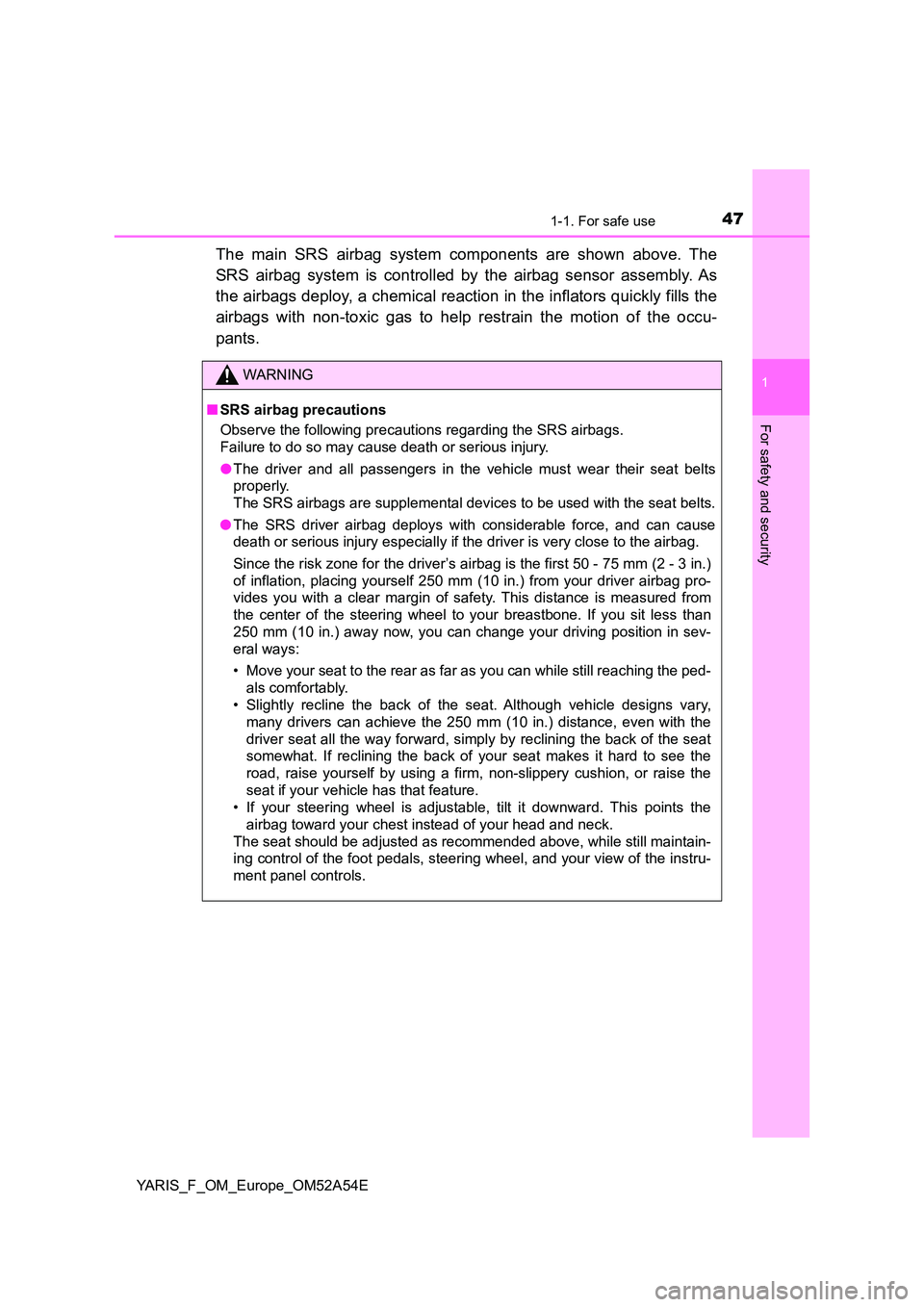
The main SRS airbag system components are shown above. The
SRS airbag system is controlled by the airbag sensor assembly. As
the airbags deploy, a chemical reaction in the inflators quickly fills the
airbags with non-toxic gas to help restrain the motion of the occu-
pants.
WARNING
■ SRS airbag precautions
Observe the following precautions regarding the SRS airbags.
Failure to do so may cause death or serious injury.
● The driver and all passengers in the vehicle must wear their seat belts
properly.
The SRS airbags are supplemental devic es to be used with the seat belts.
● The SRS driver airbag deploys with considerable force, and can cause
death or serious injury especially if the driver is very close to the airbag.
Since the risk zone for the driver’s airbag is the first 50 - 75 mm (2 - 3 in.)
of inflation, placing yourself 250 mm ( 10 in.) from your driver airbag pro-
vides you with a clear margin of safety. This distance is measured from
the center of the steering wheel to your breastbone. If you sit less than
250 mm (10 in.) away now, you can change your driving position in sev-
eral ways:
• Move your seat to the rear as far as you can while still reaching the ped-
als comfortably.
• Slightly recline the back of the seat. Although vehicle designs vary,
many drivers can achieve the 250 mm (10 in.) distance, even with the
driver seat all the way forward, simply by reclining the back of the seat
somewhat. If reclining the back of your seat makes it hard to see the
road, raise yourself by using a firm, non-slippery cushion, or raise the
seat if your vehicle has that feature.
• If your steering wheel is adjustable, tilt it downward. This points the
airbag toward your chest instead of your head and neck.
The seat should be adjusted as recommended above, while still maintain-
ing control of the foot pedals, steering wheel, and your view of the instru-
ment panel controls.
Page 52 of 692
521-1. For safe use
YARIS_F_OM_Europe_OM52A54E
■If the SRS airbags deploy (inflate)
● Slight abrasions, burns, bruising, etc., may be sustained from SRS airbags,
due to the extremely high speed deployment (inflation) by hot gases.
● A loud noise and white powder will be emitted.
● Vehicles without SRS curtain shield airbags: Parts of the airbag module
(steering wheel hub, airbag cover and inflator) as well as the front seats may
be hot for several minutes. The airbag itself may also be hot.
● Vehicles with SRS curtain shield airbags: Parts of the airbag module (steer-
ing wheel hub, airbag cover and inflator) as well as the front seats, parts of
the front and rear pillars, and roof side rails, may be hot for several minutes.
The airbag itself may also be hot.
● The windshield may crack.
■ SRS airbag deployment conditions (SRS front airbags)
● The SRS front airbags will deploy in the event of an impact that exceeds
the set threshold level (the level of force corresponding to an approximately
20 - 30 km/h [12 - 18 mph] frontal collision with a fixed wall that does not
move or deform).
However, this threshold velocity will be considerably higher in the following
situations:
• If the vehicle strikes an object, such as a parked vehicle or sign pole,
which can move or deform on impact
• If the vehicle is involved in an underride collision, such as a collision in
which the front of the vehicle “underrides”, or goes under, the bed of a
truck
● Depending on the type of collision, it is possible that only the seat belt pre-
tensioners will activate.
■ SRS airbag deployment conditions (SRS side airbags and SRS curtain
shield airbags [if equipped])
● The SRS side airbags and SRS curtain shield airbags will deploy in the
event of an impact that exceeds the set threshold level (the level of force
corresponding to the impact force produced by an approximately 1500 kg
[3300 lb.] vehicle colliding with the vehicle cabin from a direction perpendic-
ular to the vehicle orientation at an approximate speed of 20 - 30 km/h
[12 - 18 mph]).
● The SRS curtain shield airbags may also deploy in the event of a severe
frontal collision.
Page 57 of 692
571-1. For safe use
1
For safety and security
YARIS_F_OM_Europe_OM52A54E
Exhaust gas precautions
Harmful substance to the human body is included in exhaust
gases if inhale.
WARNING
Exhaust gases include harmful carbon monoxide (CO), which is colorless and
odorless. Observe the following precautions.
Failure to do so may cause exhaust gases enter the vehicle and may lead to
an accident caused by light-headedness, or may lead to death or a serious
health hazard.
■ Important points while driving
● Keep the back door closed.
● If you smell exhaust gases in the vehicle even when the back door is
closed, open the windows and have the vehicle inspected at any autho-
rized Toyota retailer or Toyota authorized repairer, or any reliable repairer
as soon as possible.
■ When parking
● If the vehicle is in a poorly ventilated area or a closed area, such as a
garage, stop the engine.
● Do not leave the vehicle with the engine running for a long time.
If such a situation cannot be avoided, park the vehicle in an open space
and ensure that exhaust fumes do not enter the vehicle interior.
● Do not leave the engine running in an area with snow build-up, or where it
is snowing. If snowbanks build up around the vehicle while the engine is
running, exhaust gases may collect and enter the vehicle.
■ Exhaust pipe
The exhaust system needs to be checked periodically. If there is a hole or
crack caused by corrosion, damage to a joint or abnormal exhaust noise, be
sure to have the vehicle inspected and repaired by any authorized Toyota
retailer or Toyota authorized repairer, or any reliable repairer.
Page 58 of 692
581-2. Child safety
YARIS_F_OM_Europe_OM52A54E
Airbag manual on-off system
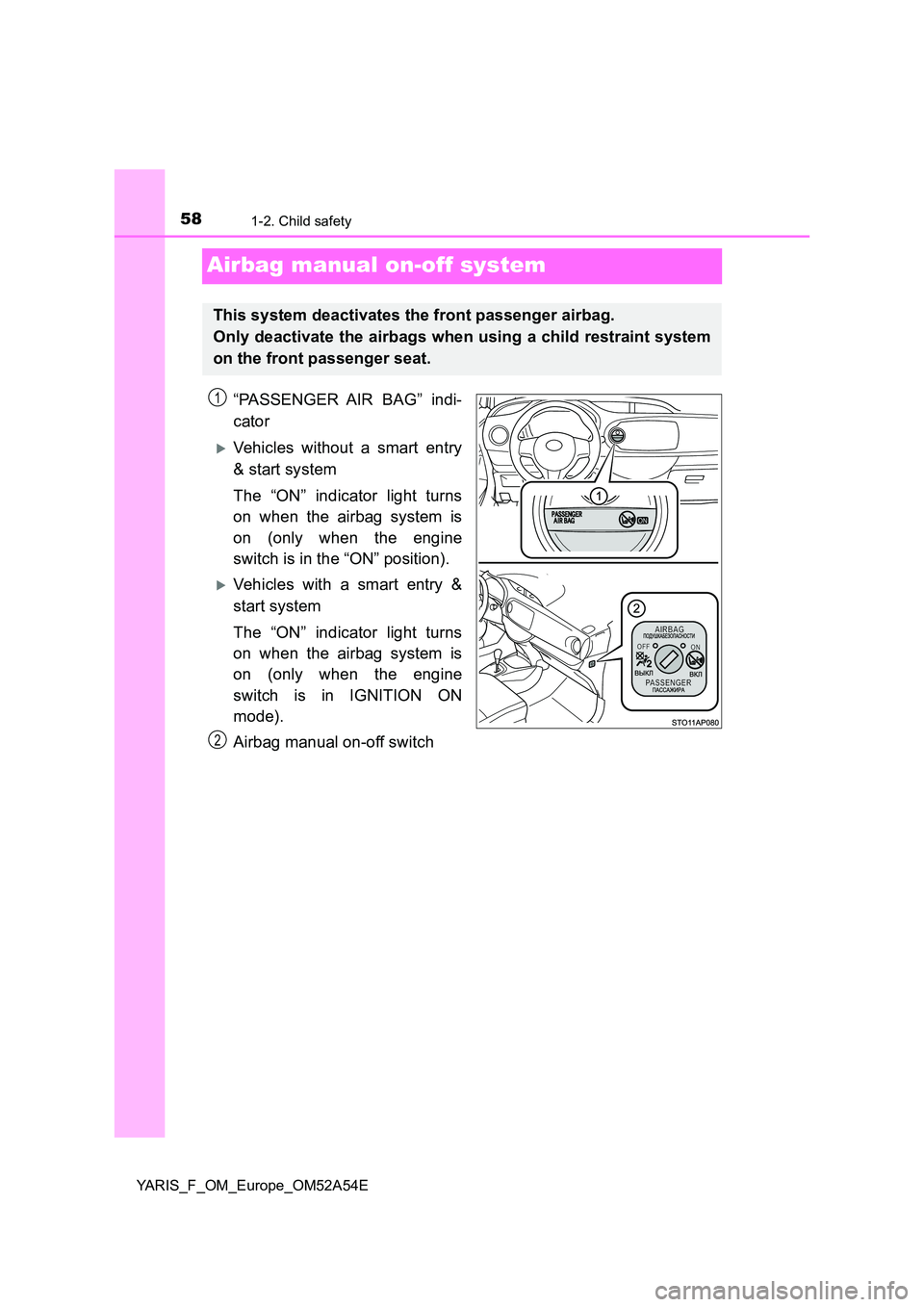
“PASSENGER AIR BAG” indi-
cator
Vehicles without a smart entry
& start system
The “ON” indicator light turns
on when the airbag system is
on (only when the engine
switch is in the “ON” position).
Vehicles with a smart entry &
start system
The “ON” indicator light turns
on when the airbag system is
on (only when the engine
switch is in IGNITION ON
mode).
Airbag manual on-off switch
This system deactivates the front passenger airbag.
Only deactivate the airbags when using a child restraint system
on the front passenger seat.
1
2
Page 59 of 692
591-2. Child safety
1
For safety and security
YARIS_F_OM_Europe_OM52A54E
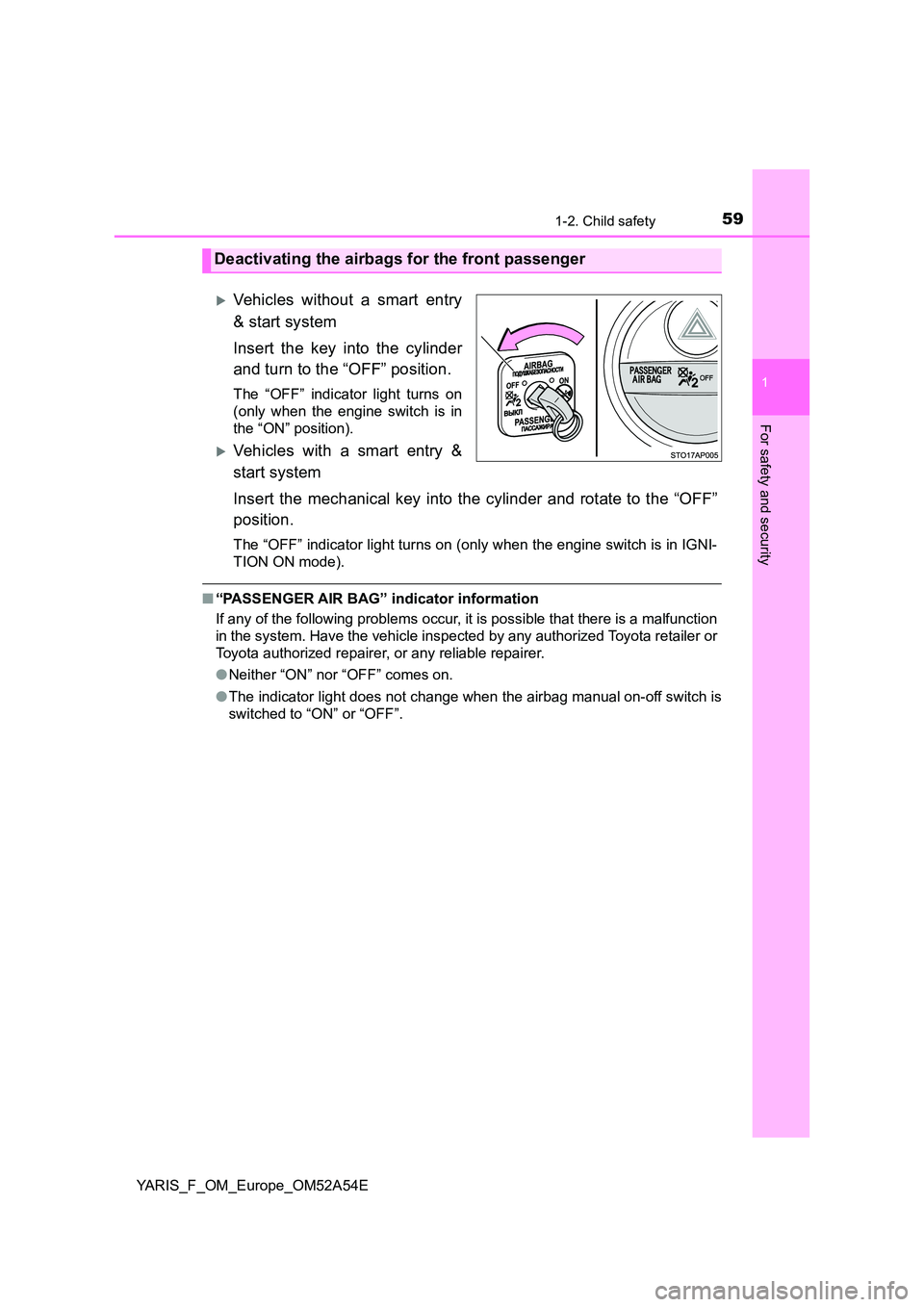
Vehicles without a smart entry
& start system
Insert the key into the cylinder
and turn to the “OFF” position.
The “OFF” indicator light turns on
(only when the engine switch is in
the “ON” position).
Vehicles with a smart entry &
start system
Insert the mechanical key into the cylinder and rotate to the “OFF”
position.
The “OFF” indicator light turns on (only when the engine switch is in IGNI-
TION ON mode).
■ “PASSENGER AIR BAG” indicator information
If any of the following problems occur, it is possible that there is a malfunction
in the system. Have the vehicle inspected by any authorized Toyota retailer or
Toyota authorized repairer, or any reliable repairer.
● Neither “ON” nor “OFF” comes on.
● The indicator light does not change when the airbag manual on-off switch is
switched to “ON” or “OFF”.
Deactivating the airbags for the front passenger
Page 107 of 692
107
2Instrument cluster
YARIS_F_OM_Europe_OM52A54E2. Instrument cluster
Warning lights and
indicators ......................... 108
Gauges and meters
(vehicles with
monochrome display) ...... 115
Gauges and meters
(vehicles with
color display) ................... 118
Multi-information display
(vehicles with
monochrome display) ...... 122
Multi-information display
(vehicles with
color display) ................... 127
Fuel consumption
information ....................... 137
Page 108 of 692
1082. Instrument cluster
YARIS_F_OM_Europe_OM52A54E
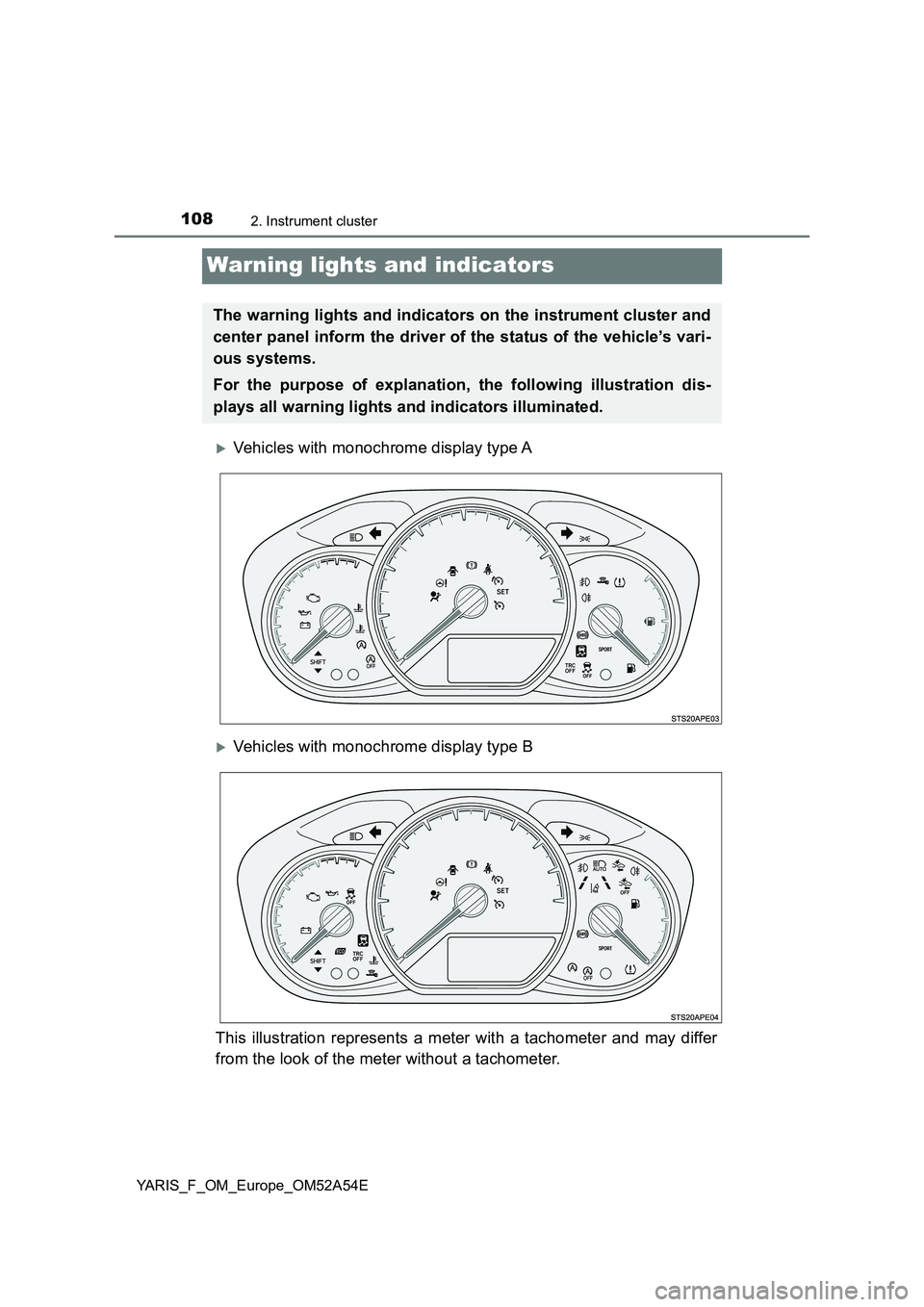
Warning lights and indicators
Vehicles with monochrome display type A
Vehicles with monochrome display type B
This illustration represents a meter with a tachometer and may differ
from the look of the meter without a tachometer.
The warning lights and indicators on the instrument cluster and
center panel inform the driver of the status of the vehicle’s vari-
ous systems.
For the purpose of explanation, the following illustration dis-
plays all warning lights and indicators illuminated.
Page 110 of 692
1102. Instrument cluster
YARIS_F_OM_Europe_OM52A54E
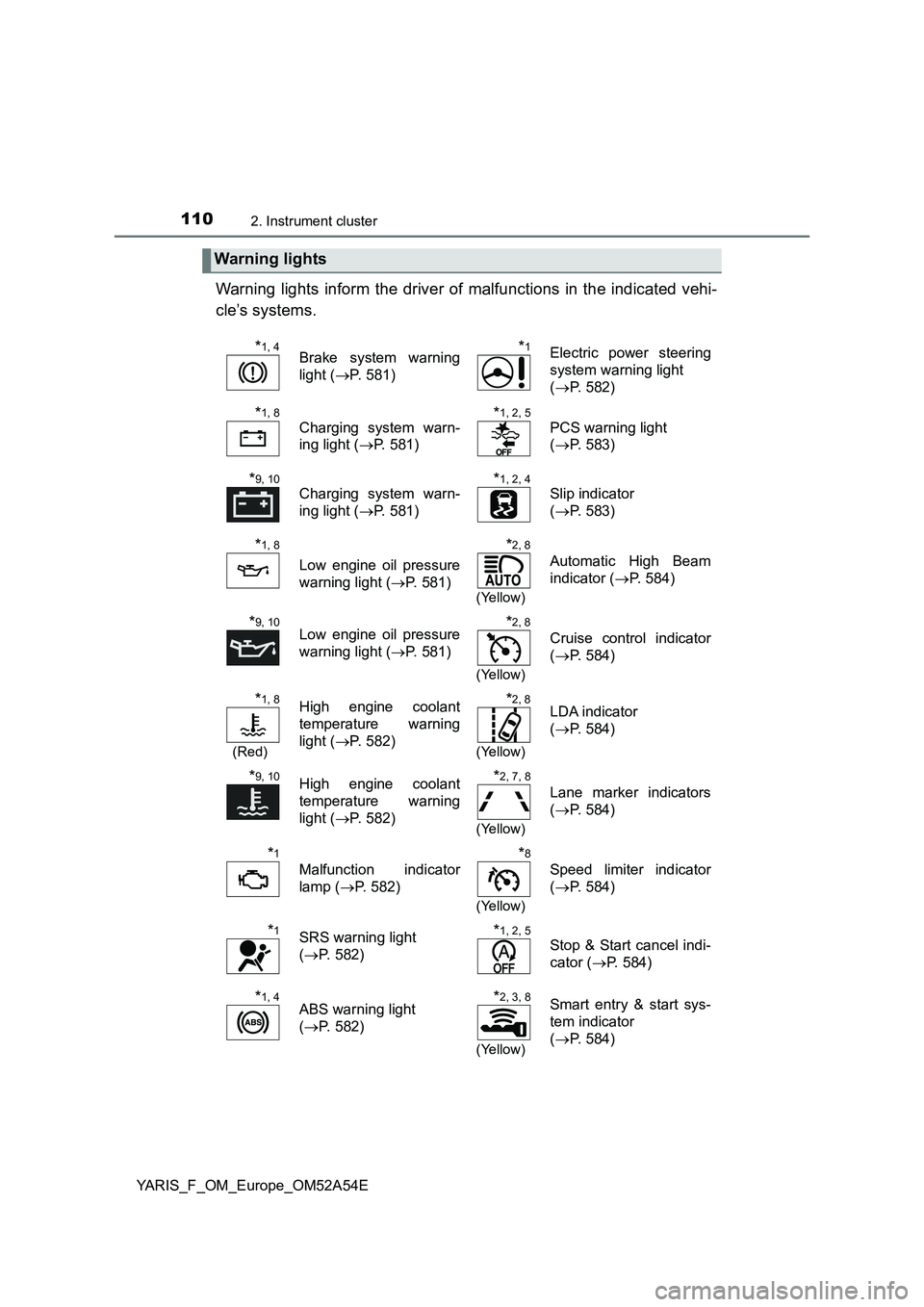
Warning lights inform the driver of malfunctions in the indicated vehi-
cle’s systems.
Warning lights
*1, 4Brake system warning
light ( P. 581)
*1Electric power steering
system warning light
( P. 582)
*1, 8
Charging system warn-
ing light ( P. 581)
*1, 2, 5
PCS warning light
( P. 583)
*9, 10
Charging system warn-
ing light ( P. 581)
*1, 2, 4
Slip indicator
( P. 583)
*1, 8
Low engine oil pressure
warning light ( P. 581)
*2, 8
(Yellow)
Automatic High Beam
indicator ( P. 584)
*9, 10Low engine oil pressure
warning light ( P. 581)
*2, 8
(Yellow)
Cruise control indicator
( P. 584)
*1, 8
(Red)
High engine coolant
temperature warning
light ( P. 582)
*2, 8
(Yellow)
LDA indicator
( P. 584)
*9, 10High engine coolant
temperature warning
light ( P. 582)
*2, 7, 8
(Yellow)
Lane marker indicators
( P. 584)
*1
Malfunction indicator
lamp ( P. 582)
*8
(Yellow)
Speed limiter indicator
( P. 584)
*1SRS warning light
( P. 582)
*1, 2, 5
Stop & Start cancel indi-
cator ( P. 584)
*1, 4ABS warning light
( P. 582)
*2, 3, 8
(Yellow)
Smart entry & start sys-
tem indicator
( P. 584)
Page 111 of 692
1112. Instrument cluster
2
Instrument cluster
YARIS_F_OM_Europe_OM52A54E
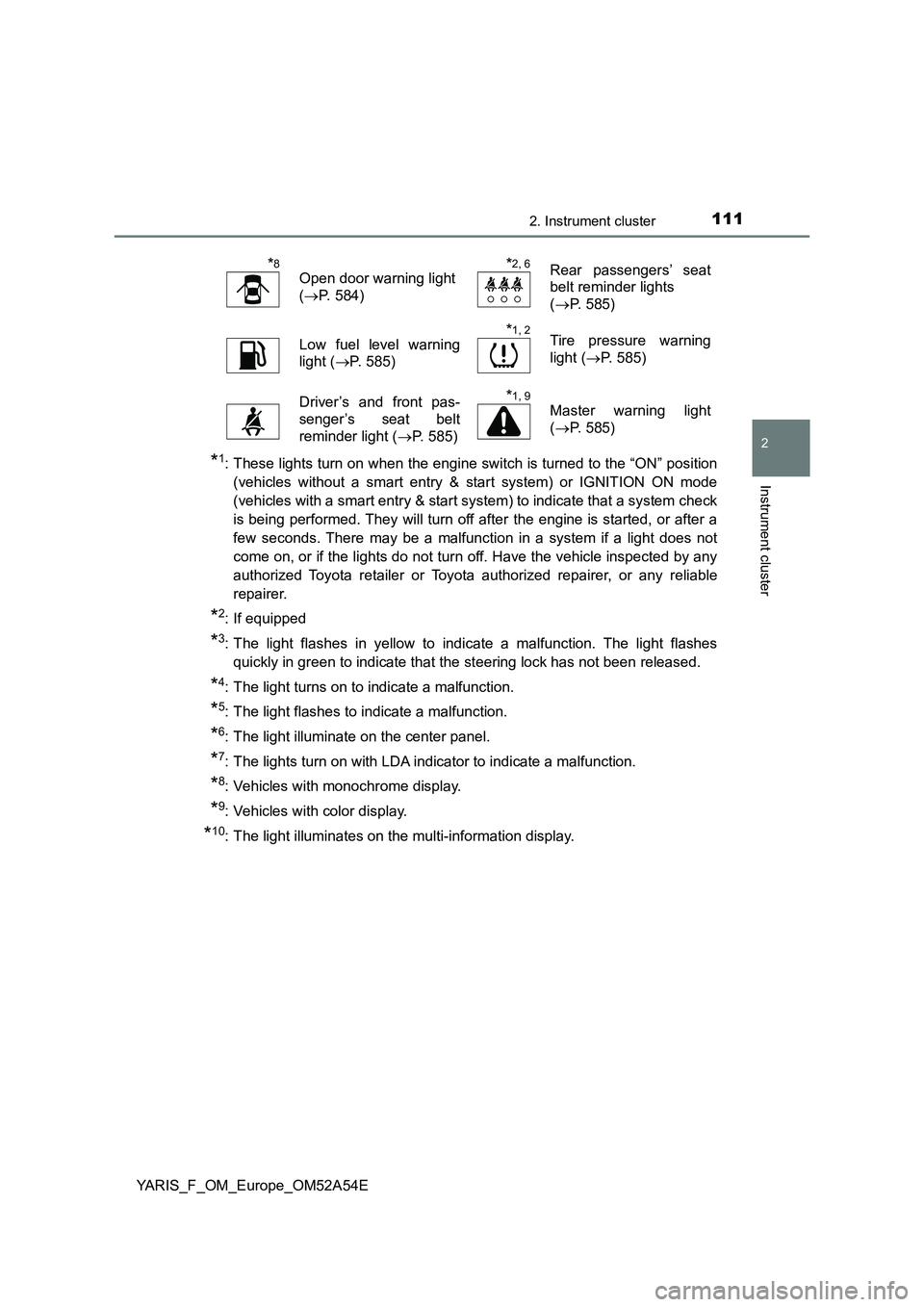
*1: These lights turn on when the engine switch is turned to the “ON” position
(vehicles without a smart entry & start system) or IGNITION ON mode
(vehicles with a smart entry & start system) to indicate that a system check
is being performed. They will turn off after the engine is started, or after a
few seconds. There may be a malfunction in a system if a light does not
come on, or if the lights do not turn off. Have the vehicle inspected by any
authorized Toyota retailer or Toyota authorized repairer, or any reliable
repairer.
*2: If equipped
*3: The light flashes in yellow to indicate a malfunction. The light flashes
quickly in green to indicate that the steering lock has not been released.
*4: The light turns on to indicate a malfunction.
*5: The light flashes to indicate a malfunction.
*6: The light illuminate on the center panel.
*7: The lights turn on with LDA indicator to indicate a malfunction.
*8: Vehicles with monochrome display.
*9: Vehicles with color display.
*10: The light illuminates on the multi-information display.
*8
Open door warning light
(P. 584)*2, 6Rear passengers’ seat
belt reminder lights
(P. 585)
Low fuel level warning
light (P. 585)*1, 2Tire pressure warning
light (P. 585)
Driver’s and front pas-
senger’s seat belt
reminder light (P. 585)*1, 9
Master warning light
(P. 585)
Page 112 of 692
1122. Instrument cluster
YARIS_F_OM_Europe_OM52A54E
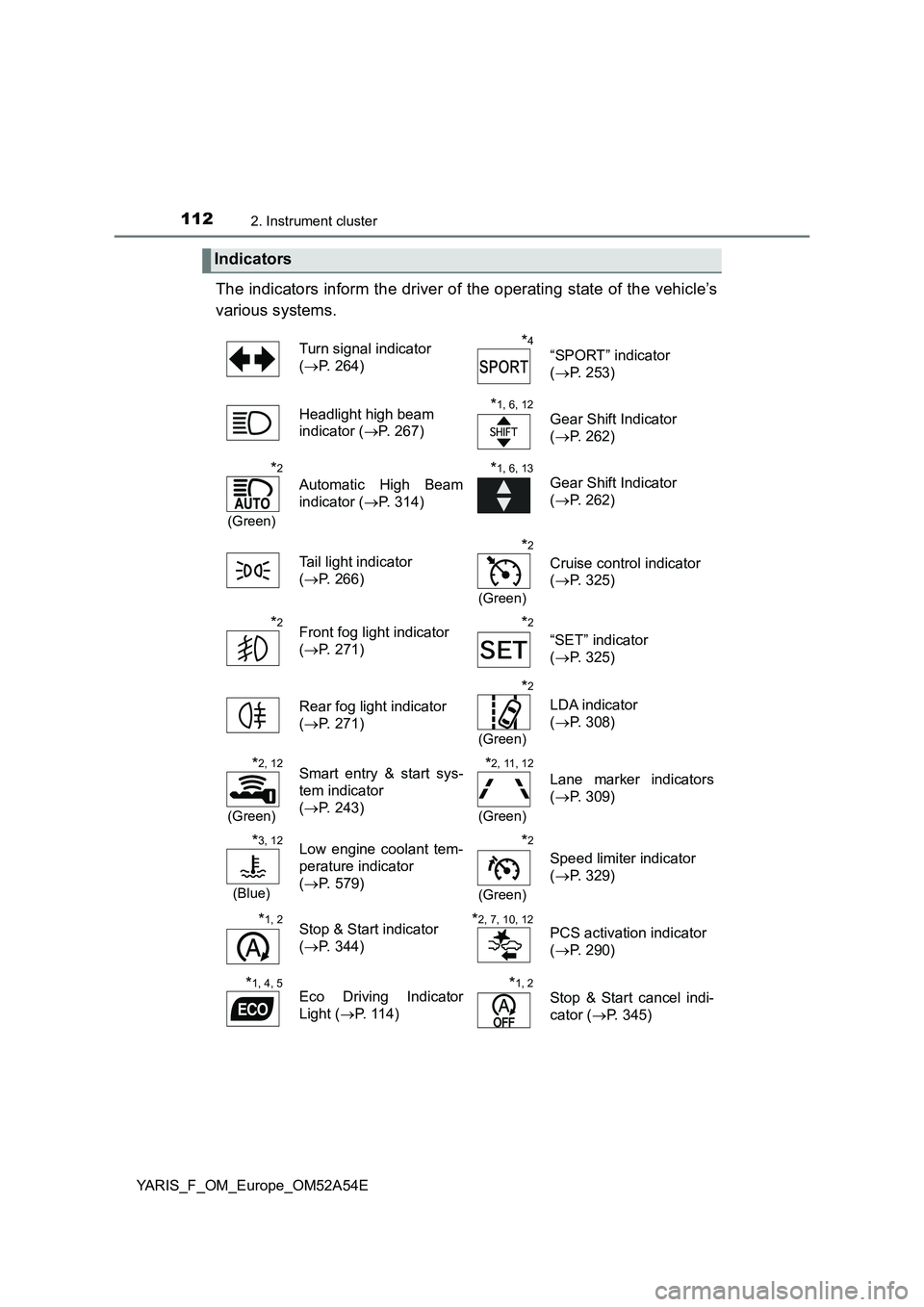
The indicators inform the driver of the operating state of the vehicle’s
various systems.
Indicators
Turn signal indicator
( P. 264)
*4
“SPORT” indicator
( P. 253)
Headlight high beam
indicator ( P. 267)
*1, 6, 12
Gear Shift Indicator
( P. 262)
*2
(Green)
Automatic High Beam
indicator ( P. 314)
*1, 6, 13
Gear Shift Indicator
( P. 262)
Tail light indicator
( P. 266)
*2
(Green)
Cruise control indicator
( P. 325)
*2Front fog light indicator
( P. 271)
*2
“SET” indicator
( P. 325)
Rear fog light indicator
( P. 271)
*2
(Green)
LDA indicator
( P. 308)
*2, 12
(Green)
Smart entry & start sys-
tem indicator
( P. 243)
*2, 11, 12
(Green)
Lane marker indicators
( P. 309)
*3, 12
(Blue)
Low engine coolant tem-
perature indicator
( P. 579)
*2
(Green)
Speed limiter indicator
( P. 329)
*1, 2Stop & Start indicator
( P. 344)
*2, 7, 10, 12PCS activation indicator
( P. 290)
*1, 4, 5Eco Driving Indicator
Light ( P. 114)
*1, 2
Stop & Start cancel indi-
cator ( P. 345)