parking brake TOYOTA YARIS 2020 Owner's Manual
[x] Cancel search | Manufacturer: TOYOTA, Model Year: 2020, Model line: YARIS, Model: TOYOTA YARIS 2020Pages: 692, PDF Size: 68.71 MB
Page 342 of 692
3424-6. Using the driving support systems
YARIS_F_OM_Europe_OM52A54E
WARNING
■When using the rear view monitor system
The rear view monitor system is a supplemental device intended to assist
the driver when backing up. When backing up, be sure to visually check all
around the vehicle both directly and using the mirrors before proceeding.
Observe the following precautions to avoid an accident that could result in
death or serious injuries.
● Never depend on the rear view monitor system entirely when backing up.
The image and the position of the guide lines displayed on the screen may
differ from the actual state.
Use caution, just as you would when backing up any vehicle.
● Be sure to back up slowly, depressing the brake pedal to control vehicle
speed.
● The instructions given are only guide lines.
When and how much to turn the steering wheel will vary according to traf-
fic conditions, road surface conditions , vehicle condition, etc. when park-
ing. It is necessary to be fully aware of this before using the rear view
monitor system.
● When parking, be sure to check that the parking space will accommodate
your vehicle before maneuvering into it.
● Do not use the rear view monitor system in the following cases:
• On icy or slick road surfaces, or in snow
• When using tire chains or emergency tires
• When the back door is not closed completely
• On roads that are not flat or straight, such as curves or slopes.
● In low temperatures, the screen may darken or the image may become
faint. The image could distort when the vehicle is moving, or you may
become unable to see the image on the screen. Be sure to visually check
all around the vehicle both directly and using the mirrors before proceed-
ing.
● If the tire sizes are changed, the position of the fixed guide lines displayed
on the screen may change.
● The camera uses a special lens. The distances between objects and
pedestrians that appear in the image displayed on the screen will differ
from the actual distances. ( P. 337)
Page 353 of 692
3534-6. Using the driving support systems
4
Driving
YARIS_F_OM_Europe_OM52A54E
■ Air conditioning system operation while the engine is stopped by the
Stop & Start system
● If the air conditioning system is being used in automatic mode, the fan
speed may be reduced or the fan may be stopped while the engine is
stopped by the Stop & Start system in order to reduce changes in the cabin
temperature.
● To ensure air conditioning system performance when the vehicle is stopped,
disable the Stop & Start system by pressing the Stop & Start cancel switch.
■ The Stop & Start system operation time and Stop & Start system total
operation time display
P. 123
■ When replacing the battery
P. 637
WARNING
■When the Stop & Start system is operating
● Keep the shift lever in N (manual transmission) and apply the brake pedal
or parking brake for safety while the engine is stopped due to the Stop &
Start system (while the Stop & Start indicator is on).
Unexpected accidents may occur due to the automatic engine start func-
tion.
● Do not leave the vehicle while the engine is stopped due to the Stop &
Start system (while the Stop & Start indicator is on).
Unexpected accidents may occur due to the automatic engine start func-
tion.
● Ensure that the engine is not stopped by the Stop & Start system while the
vehicle is in a poorly ventilated area. The engine may restart due to the
automatic engine start function, causing exhaust gases to collect and
enter the vehicle and resulting in death or a serious health hazard.
Page 358 of 692
3584-6. Using the driving support systems
YARIS_F_OM_Europe_OM52A54E■Operating conditions of hill-start assist control
When the following four conditions are met, the hill-start assist control will
operate:
●Vehicles with Multidrive: The shift lever is in a position other than P or N
(when starting off forward/backward on an upward incline).
●Vehicles with manual transmission: The shift lever is in a position other than
R when starting off forward on an upward incline, or the shift lever is in R
when starting off backward on an upward incline.
●The vehicle is stopped.
●The accelerator pedal is not depressed.
●The parking brake is not engaged.
■Automatic system cancelation of hill-start assist control
The hill-start assist control will turn off in any of the following situations:
●Vehicles with Multidrive: The shift lever is shifted to P or N.
●Vehicles with manual transmission: The shift lever is shifted to R when start-
ing off forward on an upward incline, or the shift lever is shifted to other than
R when starting off backward on an upward incline.
●The accelerator pedal is depressed.
●Approximately 2 seconds elapse.
●2 seconds at maximum elapsed after the brake pedal is released.
■Sounds and vibrations caused by the ABS, brake assist, VSC, TRC, and
hill-start assist control systems
●A sound may be heard from the engine compartment when the brake pedal
is depressed repeatedly, when the engine is started or just after the vehicle
begins to move. This sound does not indicate that a malfunction has
occurred in any of these systems.
●Any of the following conditions may occur when the above systems are
operating. None of these indicates that a malfunction has occurred.
• Vibrations may be felt through the vehicle body and steering.
• A motor sound may be heard also after the vehicle comes to a stop.
• The brake pedal may pulsate slightly after the ABS is activated.
• The brake pedal may move down slightly after the ABS is activated.
Page 360 of 692
3604-6. Using the driving support systems
YARIS_F_OM_Europe_OM52A54E
WARNING
■The ABS does not operate effectively when
● The limits of tire gripping performance have been exceeded (such as
excessively worn tires on a snow covered road).
● The vehicle hydroplanes while driving at high speed on wet or slick roads.
■ Stopping distance when the ABS is operating may exceed that of nor-
mal conditions
The ABS is not designed to shorten t he vehicle’s stopping distance. Always
maintain a safe distance from the vehicle in front of you, especially in the
following situations:
● When driving on dirt, gravel or snow-covered roads
● When driving with tire chains
● When driving over bumps in the road
● When driving over roads with potholes or uneven surfaces
■ TRC/VSC may not operate effectively when
Directional control and power may not be achievable while driving on slip-
pery road surfaces, even if the TRC/VSC system is operating.
Drive the vehicle carefully in conditions where stability and power may be
lost.
■ Hill-start assist control does not operate effectively when
● Do not overly rely on hill-start assist control. Hill-start assist control may
not operate effectively on steep inclines and roads covered with ice.
● Unlike the parking brake, hill-start assist control is not intended to hold the
vehicle stationary for an extended period of time. Do not attempt to use
hill-start assist control to hold the vehicle on an incline, as doing so may
lead to an accident.
Page 363 of 692
3634-7. Driving tips
4
Driving
YARIS_F_OM_Europe_OM52A54E
Accelerate the vehicle slowly, keep a safe distance between you and
the vehicle ahead, and drive at a reduced speed suitable to road con-
ditions.
●Park the vehicle and move the shift lever to P (Multidrive) 1 or R
(manual transmission) without setting the parking brake. The park-
ing brake may freeze up, preventing it from being released. If the
vehicle is parked without setting the parking brake, make sure to
block the wheels.
Failure to do so may be dangerous because it may cause the vehi-
cle to move unexpectedly, possibly leading to an accident.
●On vehicles with a Multidrive, if the vehicle is parked without setting
the parking brake, confirm that the shift lever cannot be moved out
of P
*.
*: The shift lever will be locked if it is attempted to be shifted from P to any
other position without depressing the brake pedal. If the shift lever can be
shifted from P, there may be a problem with the shift lock system. Have the
vehicle inspected by any authorized Toyota retailer or Toyota authorizes
repairer, or any reliable repairer.
When driving the vehicle
When parking the vehicle
Page 573 of 692
5738-2. Steps to take in an emergency
8
When trouble arises
YARIS_F_OM_Europe_OM52A54E
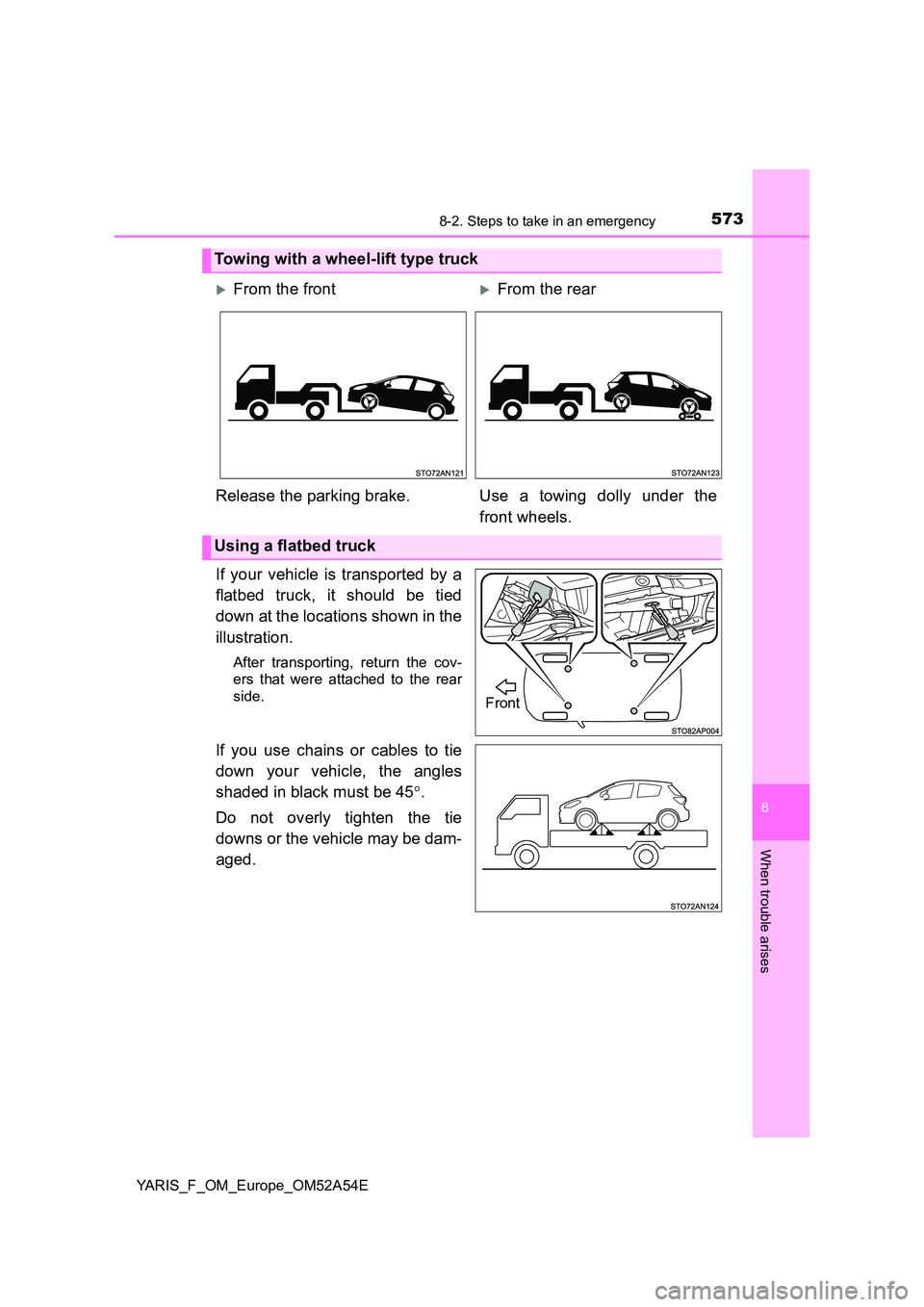
If your vehicle is transported by a
flatbed truck, it should be tied
down at the locations shown in the
illustration.
After transporting, return the cov-
ers that were attached to the rear
side.
If you use chains or cables to tie
down your vehicle, the angles
shaded in black must be 45 .
Do not overly tighten the tie
downs or the vehicle may be dam-
aged.
Towing with a wheel-lift type truck
From the frontFrom the rear
Release the parking brake. Use a towing dolly under the
front wheels.
Using a flatbed truck
Front
Page 576 of 692
5768-2. Steps to take in an emergency
YARIS_F_OM_Europe_OM52A54E
Securely attach cables or chains to the towing eyelet.
Take care not to damage the vehicle body.
Vehicles without a smart entry & start system: Enter the vehicle
being towed and start the engine.
If the engine does not start, turn the engine switch to the “ON” position.
Vehicles with a smart entry & start system: Enter the vehicle being
towed and start the engine.
If the engine does not start, turn the engine switch to IGNITION ON mode.
Shift the shift lever to N and release the parking brake.
When the shift lever cannot be shifted: P. 2 5 7
■While towing
If the engine is not running, the power assist for the brakes and steering will
not function, making steering and braking more difficult.
■ Wheel nut wrench
● Vehicles with a wheel nut wrench: Wheel nut wrench is installed in the lug-
gage. ( P. 599, 615)
● Vehicles without a wheel nut wrench: Wheel nut wrench can be purchased
at any authorized Toyota retailer or Toyota authorized repairer, or any reli-
able repairer.
5
6
7
Page 581 of 692
5818-2. Steps to take in an emergency
8
When trouble arises
YARIS_F_OM_Europe_OM52A54E
If a warning light turns on or a warning
buzzer sounds
Calmly perform the following actions if any of the warning lights
comes on or flashes. If a light comes on or flashes, but then
goes off, this does not necessarily indicate a malfunction in the
system. However, if this continues to occur, have the vehicle
inspected by any authorized Toyota retailer or Toyota authorized
repairer, or any reliable repairer.
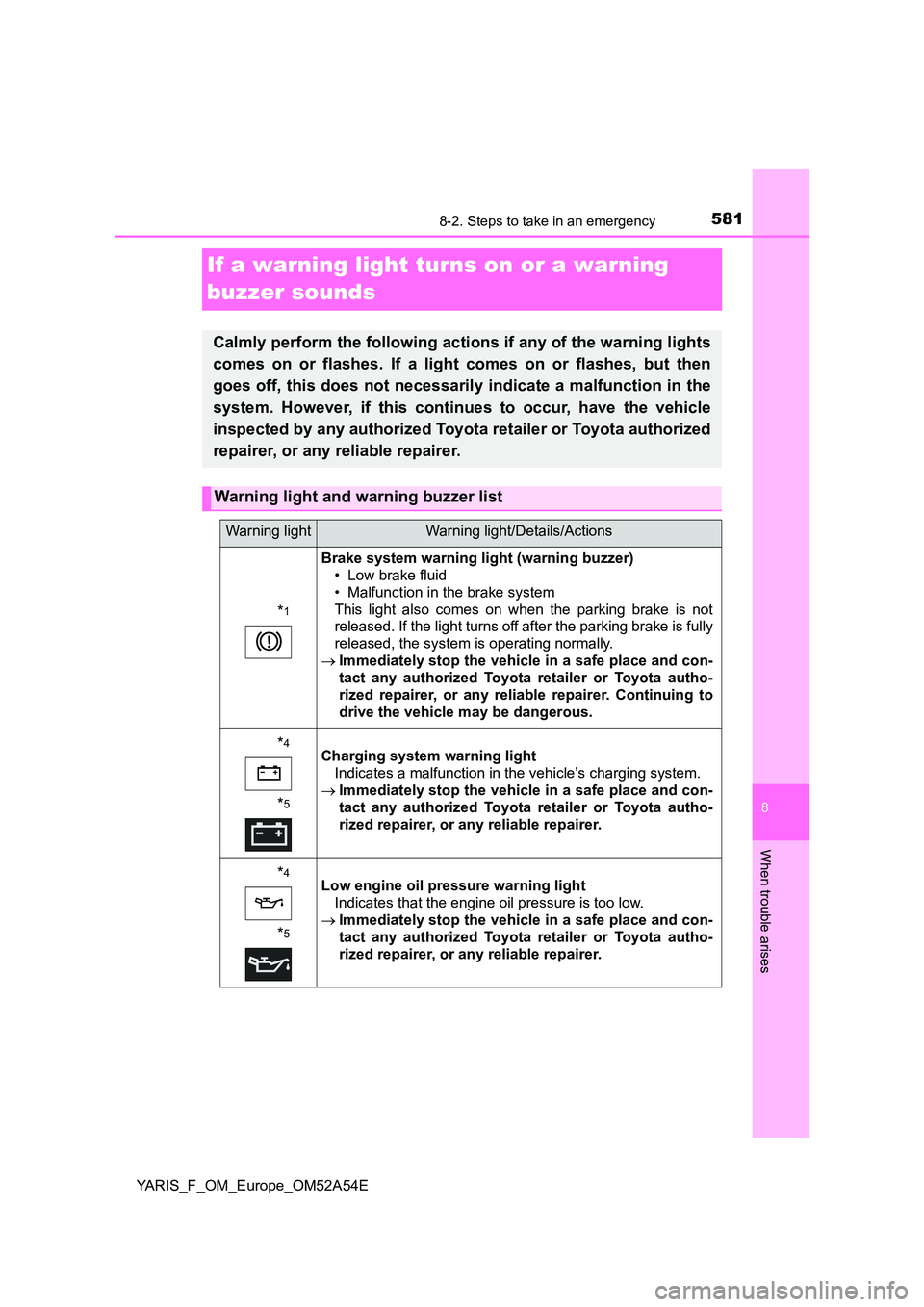
Warning light and warning buzzer list
Warning lightWarning light/Details/Actions
*1
Brake system warning light (warning buzzer)
• Low brake fluid
• Malfunction in the brake system
This light also comes on when the parking brake is not
released. If the light turns off after the parking brake is fully
released, the system is operating normally.
Immediately stop the vehicle in a safe place and con-
tact any authorized Toyota retailer or Toyota autho-
rized repairer, or any reliable repairer. Continuing to
drive the vehicle may be dangerous.
*4
*5
Charging system warning light
Indicates a malfunction in the vehicle’s charging system.
Immediately stop the vehicle in a safe place and con-
tact any authorized Toyota retailer or Toyota autho-
rized repairer, or any reliable repairer.
*4
*5
Low engine oil pressure warning light
Indicates that the engine oil pressure is too low.
Immediately stop the vehicle in a safe place and con-
tact any authorized Toyota retailer or Toyota autho-
rized repairer, or any reliable repairer.
Page 586 of 692
5868-2. Steps to take in an emergency
YARIS_F_OM_Europe_OM52A54E
*1: Parking brake engaged warning buzzer:
The buzzer sounds to indicate that the parking brake is still engaged (with
the vehicle having reached a speed of 5 km/h [3 mph]).
*2: Open door warning buzzer:
A buzzer will sound if the vehicle reaches a speed of 5 km/h (3 mph) or
more with any door open.
*3: Driver’s and passenger’s seat belt buzzer:
The driver’s and passenger’s seat belt buzzer sounds to alert the driver
and passenger that his or her seat belt is not fastened. The buzzer sounds
for 30 seconds after the vehicle reaches a speed of at least 20 km/h
(12 mph). Then, if the seat belt is still unfastened, the buzzer will sound in
a different tone for 90 more seconds.
*4: Vehicles with monochrome display.
*5: Vehicles with color display.
Page 597 of 692
5978-2. Steps to take in an emergency
8
When trouble arises
YARIS_F_OM_Europe_OM52A54E
●Stop the vehicle in a safe place on a hard, flat surface.
● Set the parking brake.
● Shift the shift lever to P (Multidrive) or N (manual transmission).
● Stop the engine.
● Turn on the emergency flashers. (P. 568)
● Check the degree of the tire damage.
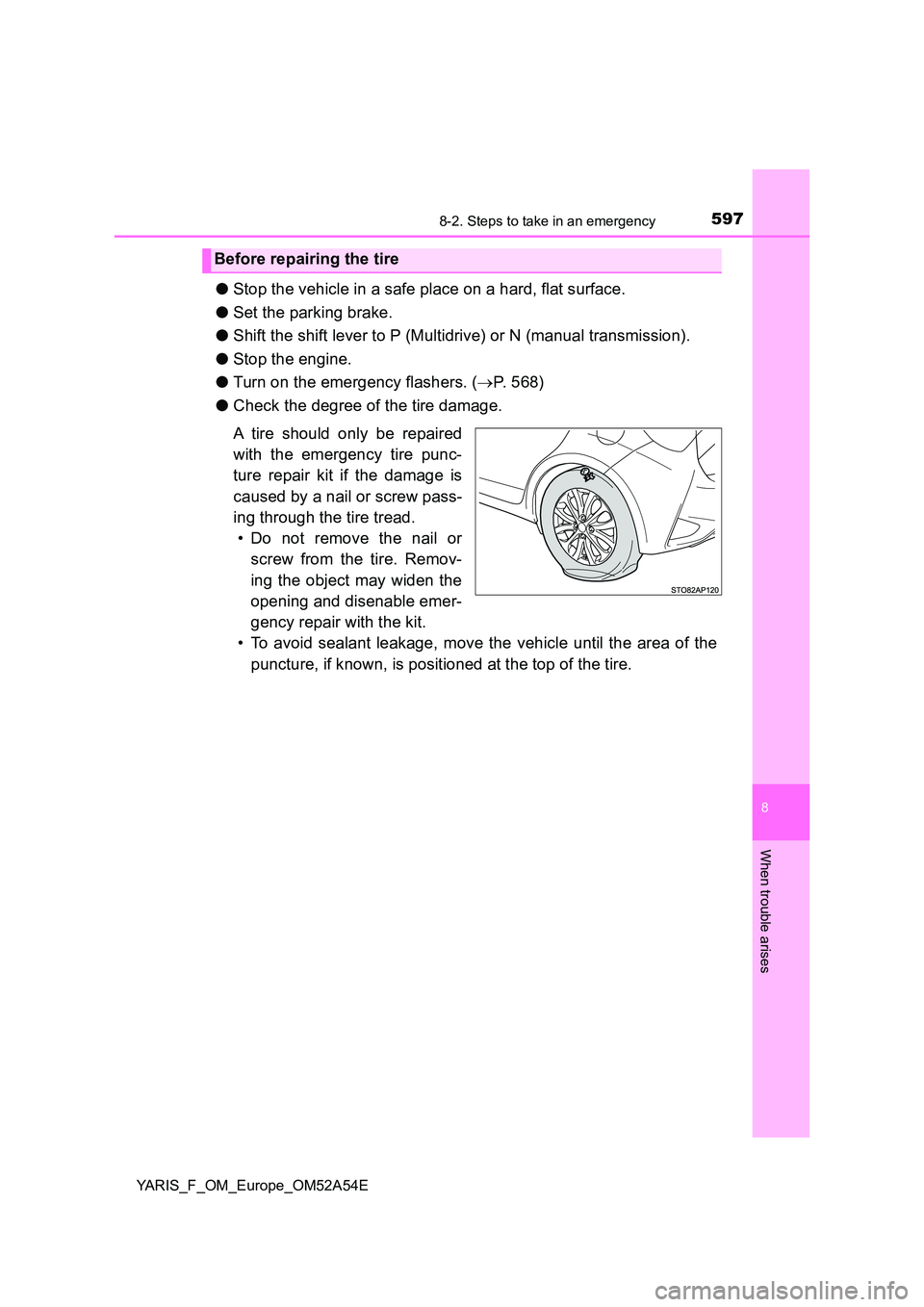
A tire should only be repaired
with the emergency tire punc-
ture repair kit if the damage is
caused by a nail or screw pass-
ing through the tire tread.
• Do not remove the nail or
screw from the tire. Remov-
ing the object may widen the
opening and disenable emer-
gency repair with the kit.
• To avoid sealant leakage, move the vehicle until the area of the
puncture, if known, is positioned at the top of the tire.
Before repairing the tire