braking power low TOYOTA YARIS CROSS 2021 Owners Manual
[x] Cancel search | Manufacturer: TOYOTA, Model Year: 2021, Model line: YARIS CROSS, Model: TOYOTA YARIS CROSS 2021Pages: 650, PDF Size: 132.86 MB
Page 78 of 650
76
YARIS CROSS Owner's Manual_Europe_M52K60_en
1-4. Hybrid system
motor) drives the vehicle. At slow
speeds or when traveling down a
gentle slope, the engine is stopped*
and the electric motor (traction
motor) is used.
When the shift lever is in N, the
hybrid battery (traction battery) is
not being charged.
*: When the hybrid battery (traction bat-
tery) requires charging or the engine
is warming up, etc., the gasoline
engine will not automatically stop.
( P. 7 6 )
■During normal driving
The gasoline engine is predomi-
nantly used. The electric motor
(traction motor) charges the hybrid
battery (traction battery) as neces-
sary.
■When accelerating sharply
When the accelerator pedal is
depressed heavily, the power of the
hybrid battery (traction battery) is
added to that of the gasoline engine
via the electric motor (traction
motor).
■When braking (regenerative
braking)
The wheels operate the electric
motor (traction motor) as a power
generator, and the hybrid battery
(traction battery) is charged.
■Regenerative braking
●In the following situations, kinetic
energy is converted to electric energy and deceleration force can be obtained in conjunction with the
recharging of the hybrid battery (trac-
tion battery). • The accelerator pedal is released while driving with the shift lever in D or
B. • The brake pedal is depressed while driving with the shift lever in D or B.
●Vehicles with GPF system: While the GPF system ( P.335) is operating to
regenerate the exhaust gas filter, the hybrid battery (traction battery) may not be recharged.
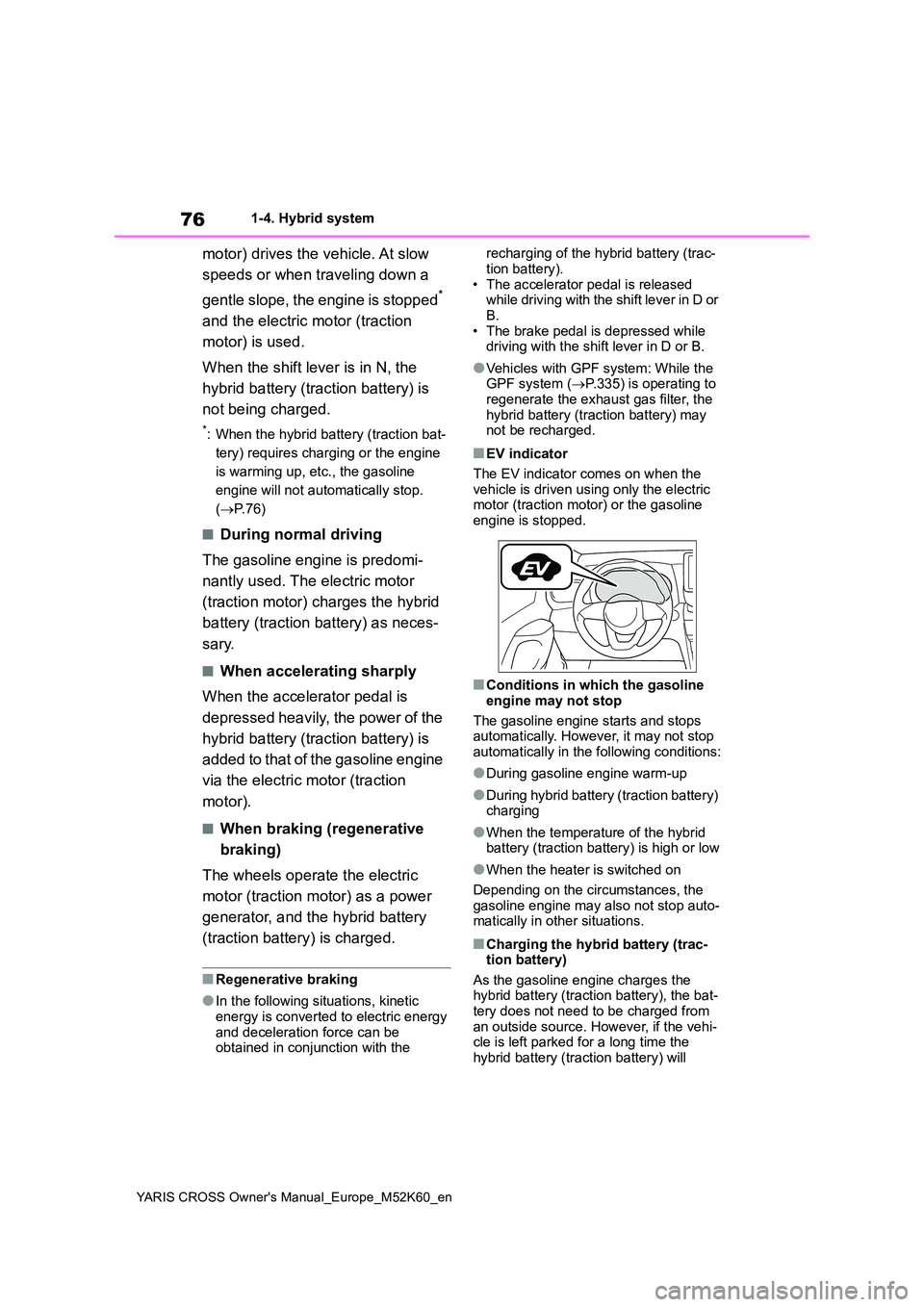
■EV indicator
The EV indicator comes on when the vehicle is driven using only the electric motor (traction motor) or the gasoline
engine is stopped.
■Conditions in which the gasoline
engine may not stop
The gasoline engine starts and stops automatically. However, it may not stop
automatically in the following conditions:
●During gasoline engine warm-up
●During hybrid battery (traction battery) charging
●When the temperature of the hybrid battery (traction battery) is high or low
●When the heater is switched on
Depending on the circumstances, the
gasoline engine may also not stop auto- matically in other situations.
■Charging the hybrid battery (trac-tion battery)
As the gasoline engine charges the hybrid battery (traction battery), the bat-tery does not need to be charged from
an outside source. However, if the vehi- cle is left parked for a long time the hybrid battery (traction battery) will
Page 99 of 650
97
2
YARIS CROSS Owner's Manual_Europe_M52K60_en
2-1. Instrument cluster
Vehicle status information and indicators
• When the outside temperature has
changed suddenly (at the entrance/exit of a garage, tunnel, etc.)
●When “--” is displayed, the system may be malfunctioning. Take your vehicle to any authorized Toyota
retailer or Toyota authorized repairer, or any reliable repairer.
■Fuel gauge and driving range dis-play
The fuel gauge and driving range dis- play are linked. If the fuel gauge and driving range display do not update after
refueling a small amount, they can be updated by performing the following pro-cedure:
1 Stop the vehicle on a level surface.
Wait until the fuel in the fuel tank stabi- lizes.
2 Press the display change button to change the odometer and trip meter
display to the odometer.
3 Turn the power switch off.
4 While pressing and holding the dis- play change button, turn the power switch to ON.
5 Continue holding the display change
button for approximately 5 seconds.
Release the button when the odometer begins blinking.
Updating will be complete when the odometer blinks for approximately 5 seconds and then returns to the normal
display.
■Liquid crystal display
P. 1 0 6
■Customization
The gauges and meters can be custom-
ized in of the multi-information dis-
play. ( P.498)
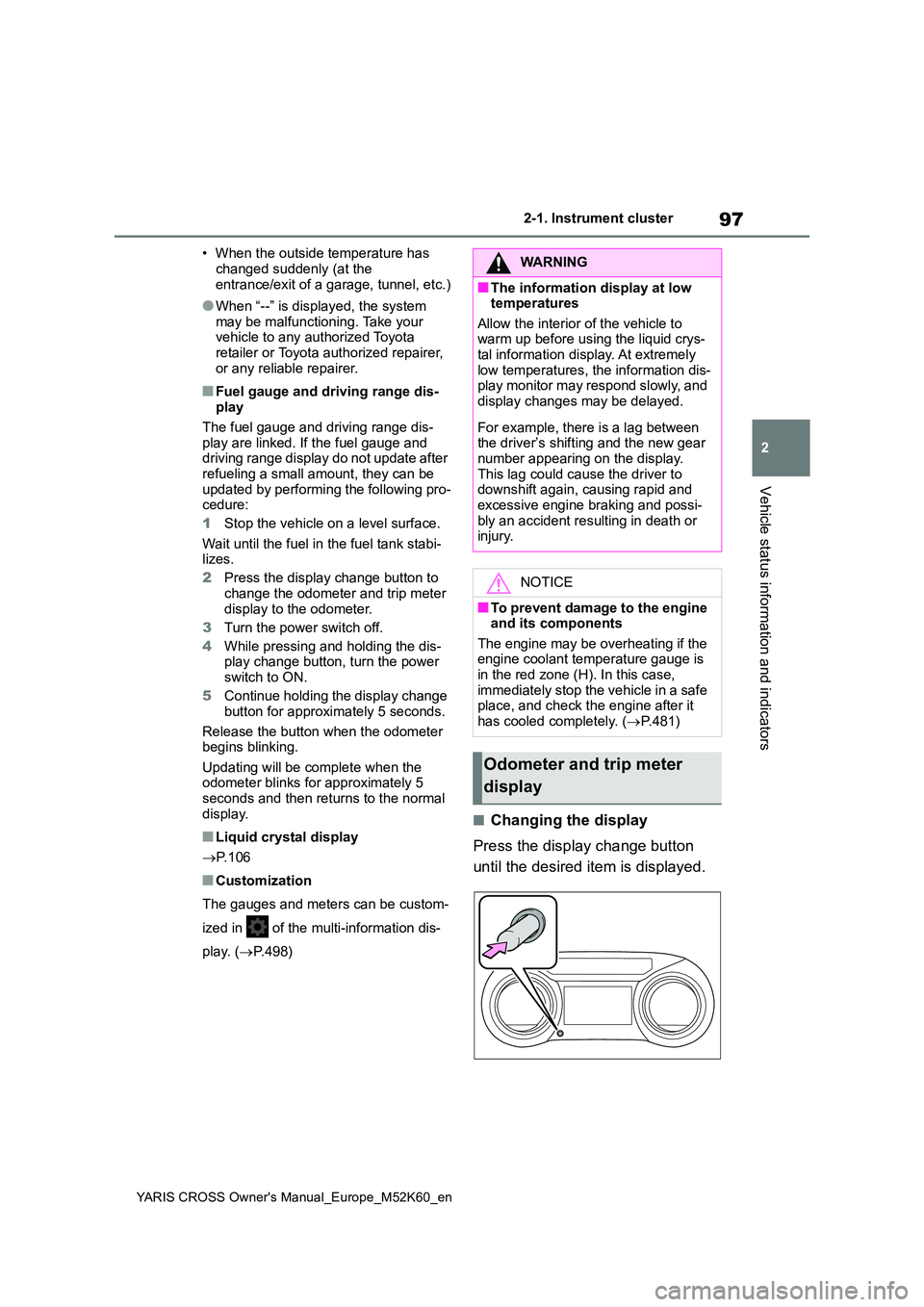
■Changing the display
Press the display change button
until the desired item is displayed.
WARNING
■The information display at low temperatures
Allow the interior of the vehicle to warm up before using the liquid crys-tal information display. At extremely
low temperatures, the information dis- play monitor may respond slowly, and display changes may be delayed.
For example, there is a lag between the driver’s shifting and the new gear
number appearing on the display. This lag could cause the driver to downshift again, causing rapid and
excessive engine braking and possi- bly an accident resulting in death or injury.
NOTICE
■To prevent damage to the engine and its components
The engine may be overheating if the engine coolant temperature gauge is in the red zone (H). In this case,
immediately stop the vehicle in a safe place, and check the engine after it
has cooled completely. ( P.481)
Odometer and trip meter
display
Page 105 of 650
103
2
YARIS CROSS Owner's Manual_Europe_M52K60_en
2-1. Instrument cluster
Vehicle status information and indicators
Shows that an Eco-friendly driving range
is being exceeded (during full power
driving, etc.)
*: When used in this manual, regenera-
tion refers to the conversion of energy
created by the movement of the vehi-
cle into electrical energy.
In the following situation, the Hybrid
System Indicator does not operate.
●“READY” indicator is not illuminated.
●The shift position is in a range other than D or B.
■Outside temperature display
●In the following situations, the correct outside temperature may not be dis-
played, or the display may take longer than normal to change:• When stopped, or driving at low
speeds (less than 25 km/h [16 mph]) • When the outside temperature has changed suddenly (at the
entrance/exit of a garage, tunnel, etc.)
●When “--” is displayed, the system
may be malfunctioning. Take your vehicle to any authorized Toyota retailer or Toyota authorized repairer,
or any reliable repairer.
■Fuel gauge and driving range dis- play
The fuel gauge and driving range dis-
play are linked. If the fuel gauge and driving range display do not update after refueling a small amount, they can be
updated by performing the following pro- cedure:
1 Stop the vehicle on a level surface.
Wait until the fuel in the fuel tank stabi-
lizes.
2 Press the display change button to change the odometer and trip meter display to the odometer.
3 Turn the power switch off.
4 While pressing and holding the dis-
play change button, turn the power switch to ON.
5 Continue holding the display change
button for approximately 5 seconds.
Release the button when the odometer begins blinking.
Updating will be complete when the odometer blinks for approximately 5 seconds and then returns to the normal
display.
■Liquid crystal display
P. 1 1 3
■Customization
The gauges and meters can be custom-
ized in of the multi-information dis-
play. ( P.498)
WARNING
■The information display at low temperatures
Allow the interior of the vehicle to warm up before using the liquid crys-tal information display. At extremely
low temperatures, the information dis- play monitor may respond slowly, and display changes may be delayed.
For example, there is a lag between the driver’s shifting and the new gear
number appearing on the display. This lag could cause the driver to downshift again, causing rapid and
excessive engine braking and possi- bly an accident resulting in death or injury.
NOTICE
■To prevent damage to the engine
and its components
The engine may be overheating if the engine coolant temperature gauge is
in the red zone (H). In this case, immediately stop the vehicle in a safe place, and check the engine after it
has cooled completely. ( P.481)
Page 200 of 650
198
YARIS CROSS Owner's Manual_Europe_M52K60_en
4-2. Driving procedures
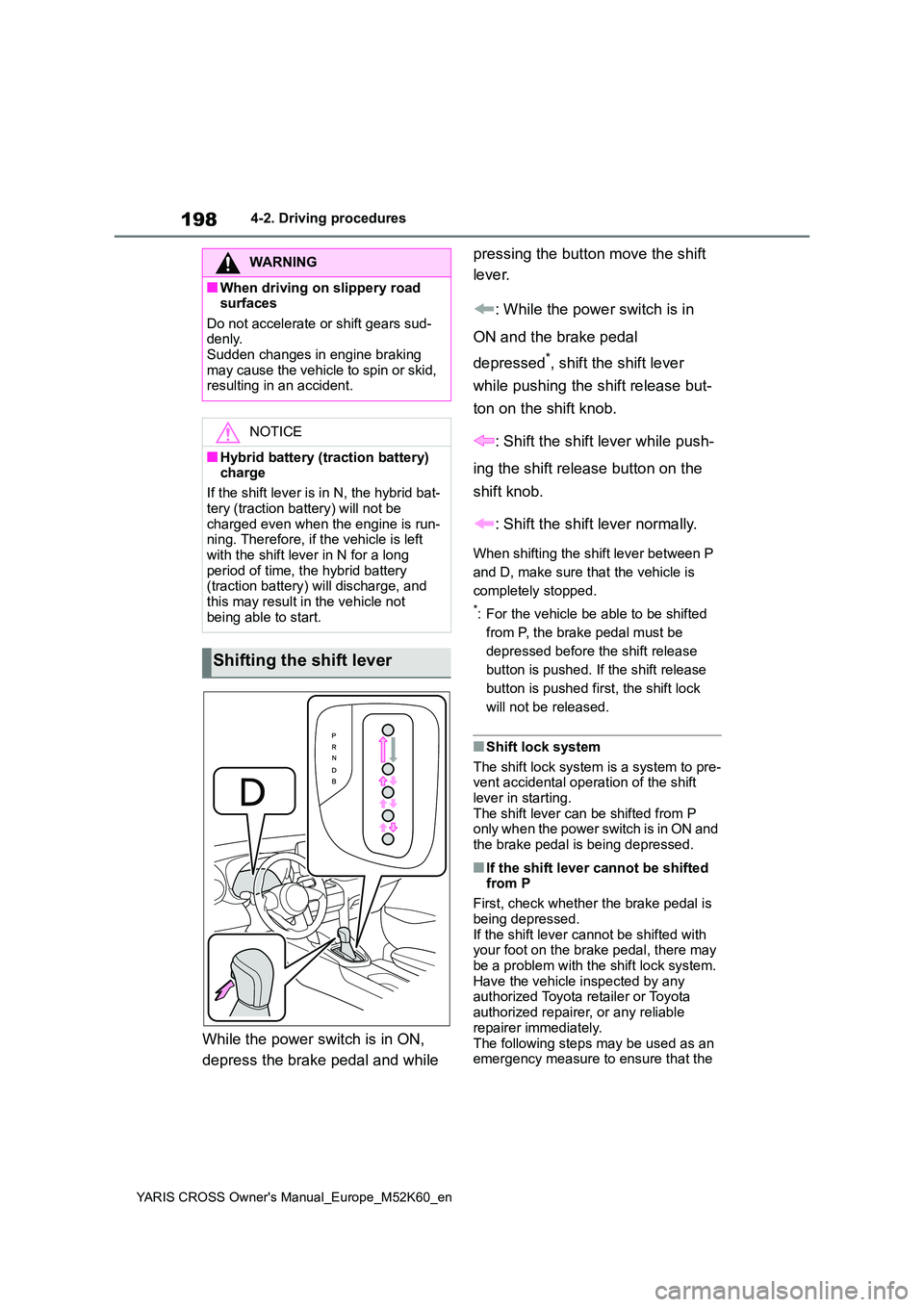
While the power switch is in ON,
depress the brake pedal and while
pressing the button move the shift
lever.
: While the power switch is in
ON and the brake pedal
depressed*, shift the shift lever
while pushing the shift release but-
ton on the shift knob.
: Shift the shift lever while push-
ing the shift release button on the
shift knob.
: Shift the shift lever normally.
When shifting the shift lever between P
and D, make sure that the vehicle is
completely stopped.
*: For the vehicle be able to be shifted
from P, the brake pedal must be
depressed before the shift release
button is pushed. If the shift release
button is pushed first, the shift lock
will not be released.
■Shift lock system
The shift lock system is a system to pre- vent accidental operation of the shift
lever in starting. The shift lever can be shifted from P only when the power switch is in ON and
the brake pedal is being depressed.
■If the shift lever cannot be shifted from P
First, check whether the brake pedal is
being depressed. If the shift lever cannot be shifted with your foot on the brake pedal, there may
be a problem with the shift lock system. Have the vehicle inspected by any authorized Toyota retailer or Toyota
authorized repairer, or any reliable repairer immediately.
The following steps may be used as an emergency measure to ensure that the
WARNING
■When driving on slippery road surfaces
Do not accelerate or shift gears sud- denly. Sudden changes in engine braking
may cause the vehicle to spin or skid, resulting in an accident.
NOTICE
■Hybrid battery (traction battery) charge
If the shift lever is in N, the hybrid bat-
tery (traction battery) will not be charged even when the engine is run-ning. Therefore, if the vehicle is left
with the shift lever in N for a long period of time, the hybrid battery (traction battery) will discharge, and
this may result in the vehicle not being able to start.
Shifting the shift lever
Page 201 of 650
199
4
YARIS CROSS Owner's Manual_Europe_M52K60_en
4-2. Driving procedures
Driving
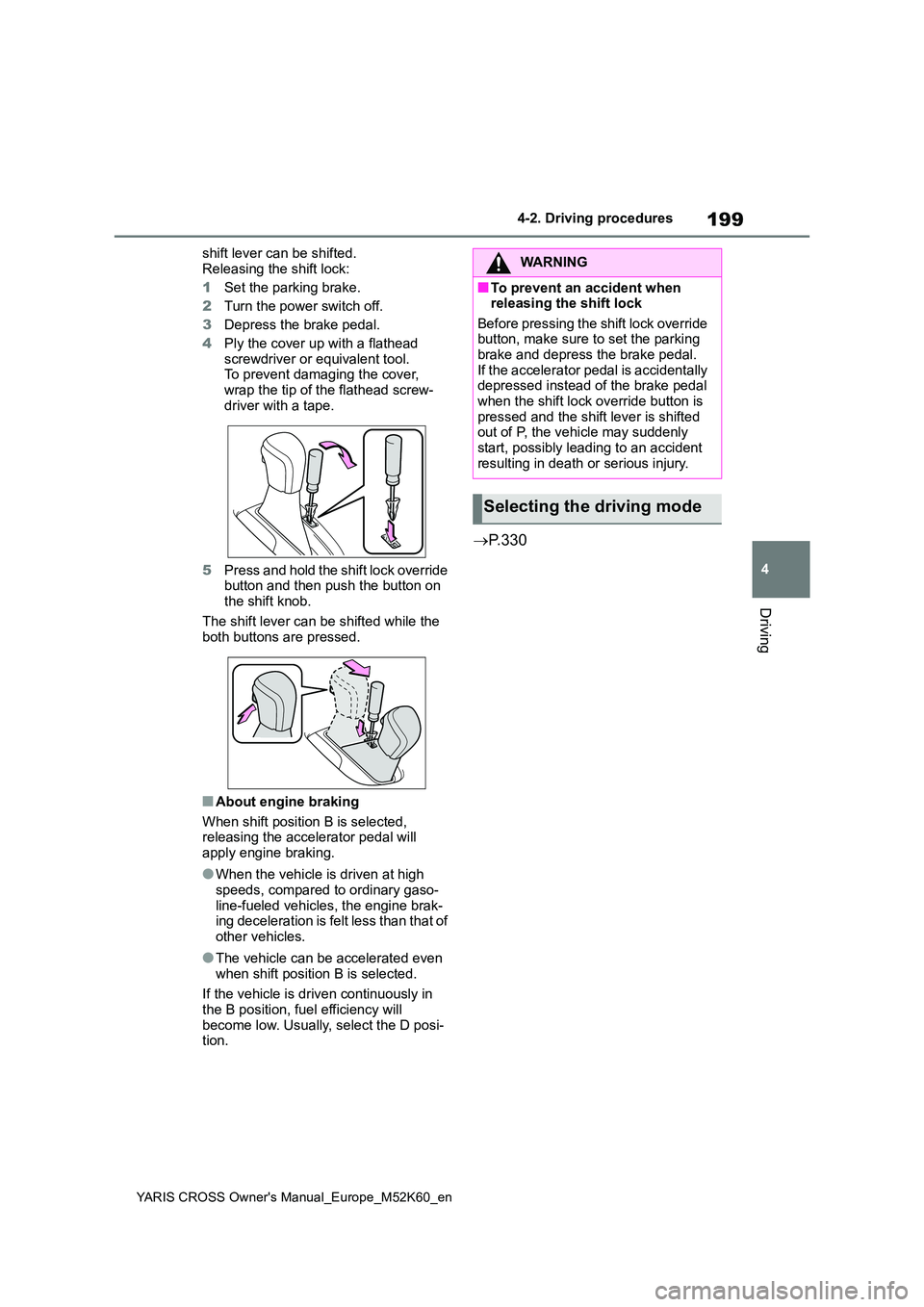
shift lever can be shifted.
Releasing the shift lock:
1 Set the parking brake.
2 Turn the power switch off.
3 Depress the brake pedal.
4 Ply the cover up with a flathead screwdriver or equivalent tool.To prevent damaging the cover,
wrap the tip of the flathead screw- driver with a tape.
5 Press and hold the shift lock override button and then push the button on the shift knob.
The shift lever can be shifted while the both buttons are pressed.
■About engine braking
When shift position B is selected, releasing the accelerator pedal will
apply engine braking.
●When the vehicle is driven at high
speeds, compared to ordinary gaso- line-fueled vehicles, the engine brak-ing deceleration is felt less than that of
other vehicles.
●The vehicle can be accelerated even
when shift position B is selected.
If the vehicle is driven continuously in the B position, fuel efficiency will
become low. Usually, select the D posi- tion.
P. 3 3 0
WARNING
■To prevent an accident when releasing the shift lock
Before pressing the shift lock override button, make sure to set the parking brake and depress the brake pedal.
If the accelerator pedal is accidentally depressed instead of the brake pedal when the shift lock override button is
pressed and the shift lever is shifted out of P, the vehicle may suddenly start, possibly leading to an accident
resulting in death or serious injury.
Selecting the driving mode
Page 338 of 650
336
YARIS CROSS Owner's Manual_Europe_M52K60_en
4-5. Using the driving support systems
■ECB (Electronically Con-
trolled Brake System)
The electronically controlled sys-
tem generates braking force corre-
sponding to the brake operation
■ABS (Anti-lock Brake System)
Helps to prevent wheel lock when
the brakes are applied suddenly, or
if the brakes are applied while driv-
ing on a slippery road surface
■Brake assist
Generates an increased level of
braking force after the brake pedal
is depressed when the system
detects a panic stop situation
■VSC (Vehicle Stability Control)
Helps the driver to control skidding
when swerving suddenly or turning
on slippery road surfaces.
■TRC (Traction Control)
Helps to maintain drive power and
prevent the drive wheels from spin-
ning when starting the vehicle or
accelerating on slippery roads
■Active Cornering Assist (ACA)
Helps to prevent the vehicle from
drifting to the outer side by perform-
ing inner wheel brake control when
attempting to accelerate while turn-
ing
■Hill-start assist control
Helps to reduce the backward
movement of the vehicle when
starting on an uphill
■EPS (Electric Power Steering)
Employs an electric motor to
reduce the amount of effort needed
to turn the steering wheel.
■E-Four (Electronic On-Demand
AWD system) (AWD models)
Automatically switches from front
wheel drive to all-wheel drive
(AWD) according to the driving con-
ditions, helping to ensure reliable
handling and stability. Examples of
conditions where the system will
switch to AWD are when cornering,
going uphill, starting off or acceler-
ating, and when the road surface is
slippery due to snow, rain, etc.
■Emergency brake signal
When the brakes are applied sud-
denly, the emergency flashers auto-
matically flash to alert the vehicle
behind.
Driving assist systems
To keep driving safety and per-
formance, the f ollowing sys-
tems operate automatically in
response to various driving sit-
uations. Be aware, however,
that these systems are supple-
mentary and should not be
relied upon too heavily when
operating the vehicle.
Summary of the driving
assist systems
Page 345 of 650
343
4
YARIS CROSS Owner's Manual_Europe_M52K60_en
4-6. Driving tips
Driving
4-6.Driving tips
When using Eco drive mode, the
torque corresponding to the accel-
erator pedal depression amount
can be generated more smoothly
than it is in normal conditions. In
addition, the operation of the air
conditioning system (heating/cool-
ing) will be minimized, improving
the fuel economy. ( P. 3 3 0 )
The Eco-friendly driving is possible
by keeping the indicate of Hybrid
System Indicator within Eco area.
( P.96, 102)
Shift the shift lever to D when
stopped at a traffic light, or driving
in heavy traffic etc. Shift the shift
lever to P when parking. When
using the N, there is no positive
effect on fuel consumption. In the
N, the gasoline engine operates but
electricity cannot be generated.
Also, when using the air condition-
ing system, etc., the hybrid battery
(traction battery) power is con-
sumed.
Drive your vehicle smoothly.
Avoid abrupt acceleration and
deceleration. Gradual accelera-
tion and deceleration will make
more effective use of the electric
motor (traction motor) without
having to use gasoline engine
power.
Avoid repeated acceleration.
Repeated acceleration con-
sumes hybrid battery (traction
battery) power, resulting in poor
fuel consumption. Battery power
can be restored by driving with
the accelerator pedal slightly
released.
Make sure to operate the brakes
gently and in a timely manner. A
greater amount of electrical energy
can be regenerated when slowing
down.
Repeated acceleration and decel-
eration, as well as long waits at traf-
fic lights, will lead to bad fuel
economy. Check traffic reports
before leaving and avoid delays as
much as possible. When driving in
Hybrid vehicle driving
tips
For economical and ecological
driving, pay attention to the fol-
lowing points:
Using Eco drive mode
Use of Hybrid System Indi-
cator
Shift lever operation
Accelerator pedal/brake
pedal operation
When braking
Delays
Page 347 of 650
345
4
YARIS CROSS Owner's Manual_Europe_M52K60_en
4-6. Driving tips
Driving
Use fluids that are appropriate to
the prevailing outside tempera-
tures.
• Engine oil
• Engine/power control unit coolant
• Washer fluid
Have a service technician
inspect the condition of the 12-
volt battery.
Have the vehicle fitted with four
snow tires or purchase a set of
tire chains for the front tires.
Ensure that all tires are the same size
and brand, and that chains match the
size of the tires.
Perform the following according to
Winter driving tips
Carry out the necessary prepa-
rations and inspections before
driving the vehicle in winter.
Always drive the vehicle in a
manner appropriate to the pre-
vailing weather conditions.
Pre-winter preparations
WARNING
■Driving with snow tires
Observe the following precautions to
reduce the risk of accidents. Failure to do so may result in a loss of vehicle control and cause death or
serious injury.
●Use tires of the size specified.
●Maintain the recommended level of air pressure.
●Do not drive at speeds in excess of the speed limit or the speed limit specified for the snow tires being
used.
●Use snow tires on all, not just some
wheels.
■Driving with tire chains
Observe the following precautions to reduce the risk of accidents.Failure to do so may result in the vehi-
cle being unable to be driven safely, and may cause death or serious injury.
●Do not drive in excess of the speed limit specified for the tire chains
being used, or 50 km/h (30 mph), whichever is lower.
●Avoid driving on bumpy road sur-faces or over potholes.
●Avoid sudden acceleration, abrupt steering, sudden braking and shift-ing operations that cause sudden
engine braking.
●Slow down sufficiently before enter-
ing a curve to ensure that vehicle control is maintained.
●Do not use LTA (Lane Tracing Assist) system. (if equipped)
NOTICE
■Repairing or replacing snow tires
Request repairs or replacement of snow tires from any authorized Toyota retailer or Toyota authorized repairer,
or any reliable repairer or legitimate tire retailers.This is because the removal and
attachment of snow tires affects the operation of the tire pressure warning valves and transmitters.
Before driving the vehicle
Page 449 of 650
447
7
YARIS CROSS Owner's Manual_Europe_M52K60_en
7-2. Steps to take in an emergency
When trouble arises
■Electric power steering system
warning light (warning buzzer)
When the 12-volt battery charge becomes insufficient or the voltage tem-
porarily drops, the electric power steer- ing system warning light may come on and the warning buzzer may sound.
■When the tire pressure warning
light comes on
Inspect the tires to check if a tire is punctured.
If a tire is punctured: P.452, 463
If none of the tires are punctured: Turn the power switch off then turn it to
ON. Check if the tire pressure warning light comes on or blinks.
If the tire pressure warning light blinks
for approximately 1 minute then stays on
There may be a malfunction in the tire
pressure warning system. Have the vehicle inspected by any authorized Toyota retailer or Toyota authorized
repairer, or any reliable repairer immedi- ately.
If the tire pressure warning light
comes on
1 After the temperature of the tires has lowered sufficiently, check the infla-tion pressure of each tire and adjust
them to the specified level.
2 If the warning light does not turn off even after several minutes have elapsed, check that the inflation
pressure of each tire is at the speci- fied level and perform initialization. ( P.401)
■The tire pressure warning light may
come on due to natural causes
The tire pressure warning light may come on due to natural causes such as
natural air leaks and tire inflation pres- sure changes caused by temperature. In this case, adjusting the tire inflation
pressure will turn off the warning light (after a few minutes).
■When a tire is replaced with a spare
tire
Vehicles with a compact spare tire: The compact spare tire is not equipped with
a tire pressure warning valve and trans- mitter. If a tire goes flat, the tire pressure warning light will not turn off even
though the flat tire has been replaced with the spare tire. Replace the spare tire with the repaired tire and adjust the
tire inflation pressure. The tire pressure warning light will go off after a few min-utes.
Vehicles with a full-size spare tire: The spare tire is also equipped with a tire pressure warning valve and transmitter.
The tire pressure warning light will turn on if the tire inflation pressure of the spare tire is low. If a tire goes flat, the
tire pressure warning light will not turn off even though the flat tire has been replaced with the spare tire. Replace the
spare tire with the repaired tire and adjust the tire inflation pressure. The tire pressure warning light will go off after a
few minutes.
■Conditions that the tire pressure warning system may not function properly
P. 3 9 9
WARNING
■If both the ABS and the brake system warning lights remain on
Stop your vehicle in a safe place immediately and contact any autho-rized Toyota retailer or Toyota autho-
rized repairer, or any reliable repairer. The vehicle will become extremely unstable during braking, and the ABS
system may fail, which could cause an accident resulting in death or seri-ous injury.
Page 450 of 650
448
YARIS CROSS Owner's Manual_Europe_M52K60_en
7-2. Steps to take in an emergency
WARNING
■When the electric power steer- ing system warning light comes
on
When the light comes on yellow, the assist to the power steering is
restricted. When the light comes on red, the assist to the power steering is lost and handling operations of the
steering wheel become extremely heavy.When steering wheel operations are
heavier than usual, grip the steering wheel firmly and operate it using more force than usual.
■If the tire pressure warning light comes on
Be sure to observe the following pre- cautions.Failure to do so could cause a loss of
vehicle control and result in death or serious injury.
●Stop your vehicle in a safe place as soon as possible. Adjust the tire inflation pressure immediately.
●Vehicles with a compact spare tire and full-size spare tire: If the tire
pressure warning light comes on even after tire inflation pressure adjustment, it is probable that you
have a flat tire. Check the tires. If a tire is flat, change it with the spare tire and have the flat tire repaired
by the nearest any authorized Toyota retailer or Toyota authorized repairer, or any reliable repairer.
●Vehicles with emergency tire punc-ture repair kit: If the tire pressure
warning light comes on even after tire inflation pressure adjustment, it is probable that you have a flat tire.
Check the tires. If a tire is flat, repair the flat tire by using emergency tire puncture repair kit.
●Avoid abrupt maneuvering and braking.If the vehicle tires deteriorate, you
could lose control of the steering wheel or the brakes.
■If a blowout or sudden air leak-age should occur
The tire pressure warning system
may not activate immediately.
NOTICE
■To ensure the tire pressure warn- ing system operates properly
Do not install tires with different speci- fications or makers, as the tire pres-sure warning system may not operate
properly.