light TOYOTA YARIS HATCHBACK 2009 Owners Manual
[x] Cancel search | Manufacturer: TOYOTA, Model Year: 2009, Model line: YARIS HATCHBACK, Model: TOYOTA YARIS HATCHBACK 2009Pages: 402, PDF Size: 7.61 MB
Page 340 of 402
330 5-2. Steps to take in an emergency
nThe starter motor does not turn over, the interior lights and
headlights do not turn on, or the horn does not sound.
One of the following may be the cause of the problem.
l One or
both of the battery terminals may be disconnected.
lThe battery
may be discharged. (→ P. 333)
Contact your Toyota dealer if the problem cannot be repaired, or if
repair procedures are unknown.
Page 344 of 402
334 5-2. Steps to take in an emergency
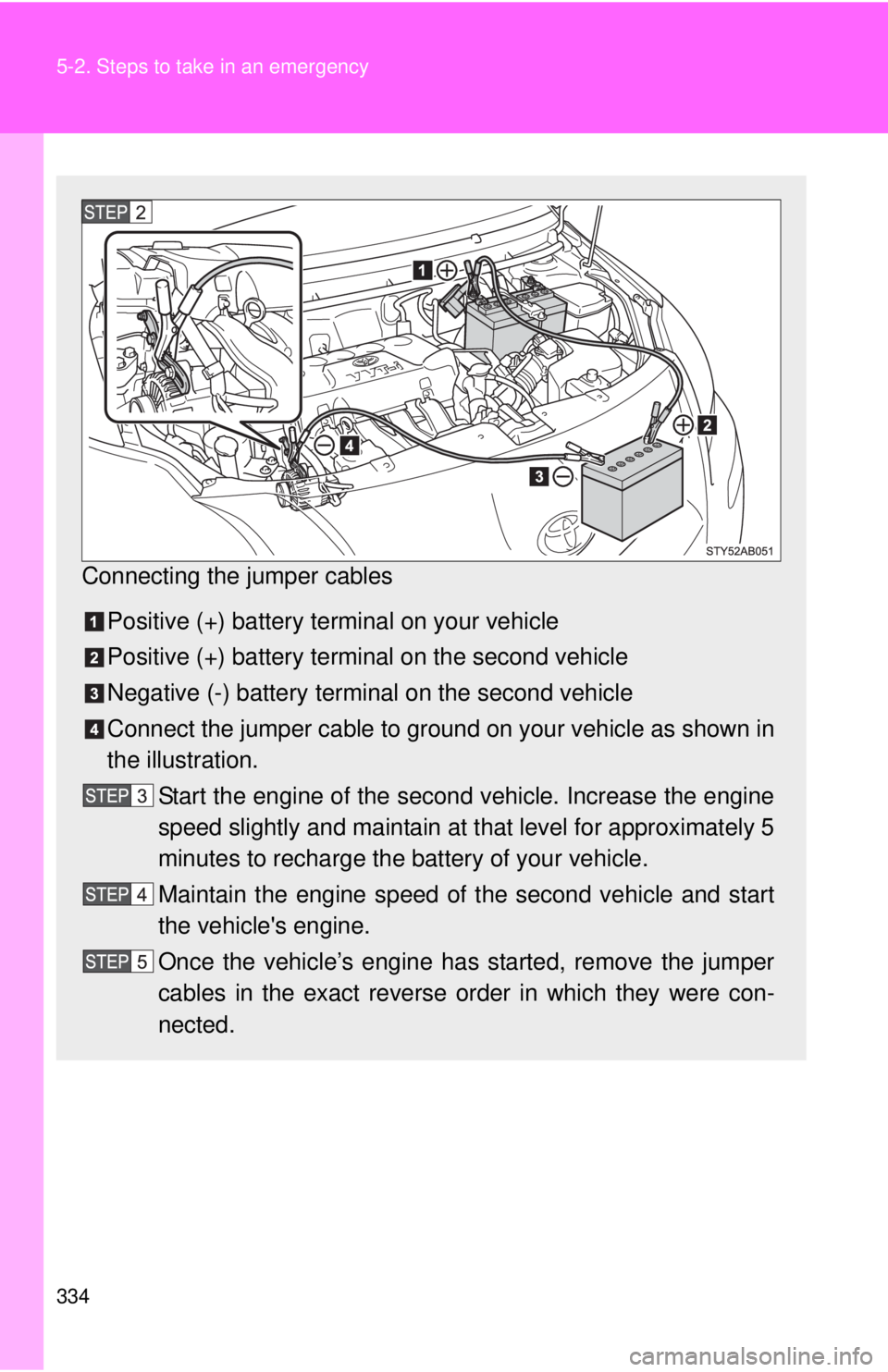
Connecting the jumper cables
Positive (+) battery terminal on your vehicle
Positive (+) battery terminal on the second vehicle
Negative (-) battery terminal on the second vehicle
Connect the jumper cable to ground on your
vehicle as shown in
the illustration.
Start the engine of the second vehicle. Increase the engine
speed slightly and maintain at that level fo
r approximately 5
minutes to recharge the battery of your vehicle.
Maintain the engine speed of the second vehicle and start
the vehicle's engine.
Once the vehicle’s engine has started, remove the jumper
cables in the exact reverse order in which they were con -
nected.
Page 345 of 402
5
When trouble arises
335
5-2. Steps to take in an emergency
n
Starting the engine when the battery is discharged (vehicles with an
automatic transmission)
The engine cannot be started by push-starting.
n A
voiding a discharged battery
lT
urn off the headlights and the audio system while the engine is turned
off.
l T
urn off any unnecessary electrical components when the vehicle is run -
ning at a low speed for an extended period, such as in heavy traffic, etc.
CAUTION
nAvoiding battery fires or explosions
Observe the following precautions to prevent accidentally igniting the flam-
mable gas that may be emitted from the battery.
lMake sure the jumper cable is connected to the correct terminal and that it
is not unintentionally in contact with any part other than the intended termi-
nal.
l Do not allow the jumper cables to come into contact with the “+” and “-” ter-
minals.
l Do not smoke, use matches, cigarette lighters or allow open flame near
the battery.
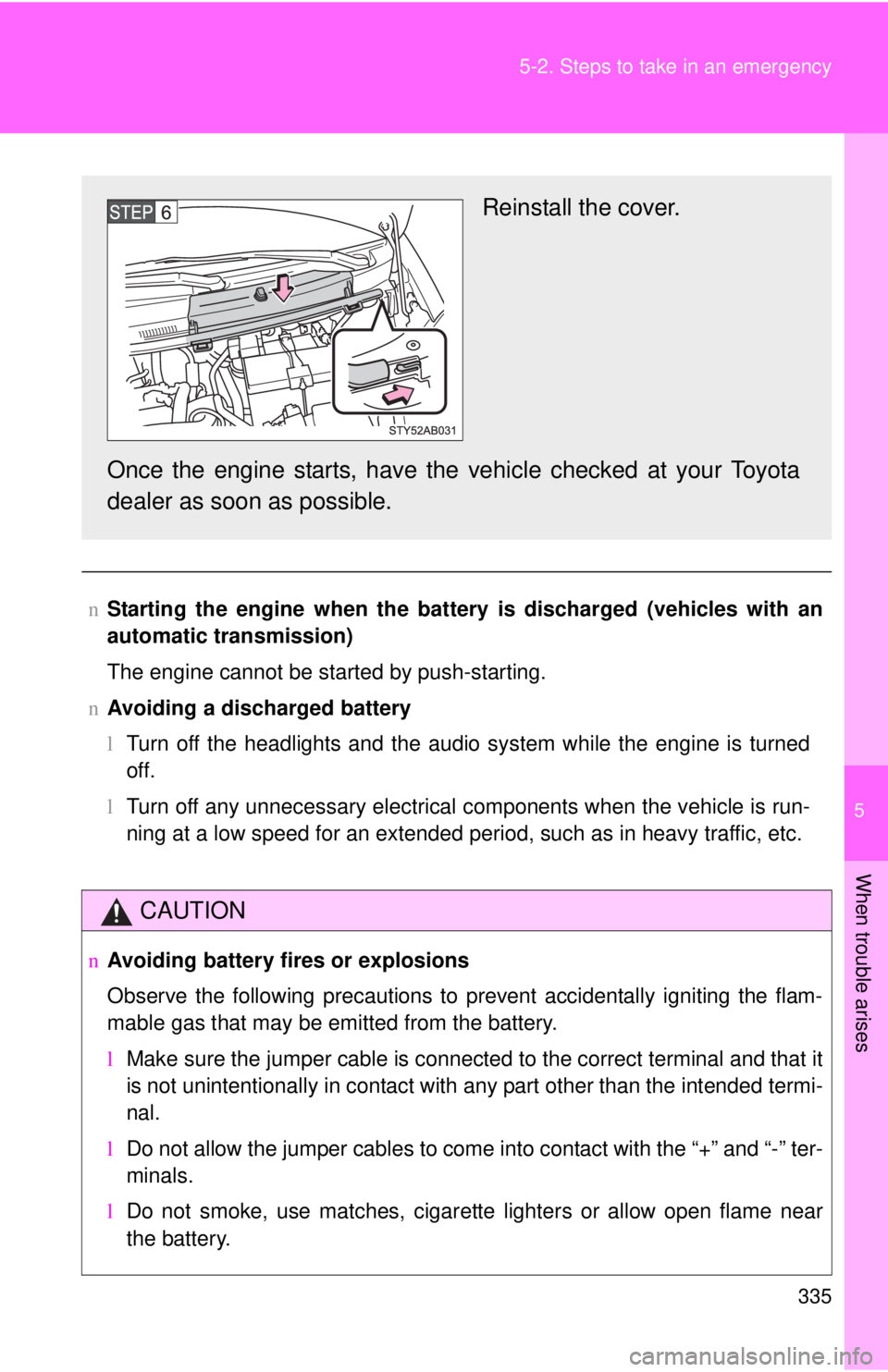
Reinstall the cover.
Once the engine starts, have the vehicle checked at your Toyota
dealer as soon as possible.
Page 349 of 402
5
When trouble arises
339
5-2. Steps to take in an emergency
n
Overheating
If you observe the following, your vehicle may be overheating.
lThe high
engine coolant temperature warning light flashes or comes on
or a loss of power is experienced.
l Steam is coming from under the hood.
CAUTION
nTo prevent an accident or injury when inspecting un der the hood of
your vehicle
l If steam is seen coming from under the hood, do not open the hood until
the steam has subsided. The engine compartment may be very hot, caus-
ing serious injury such as burns.
l Keep hands and clothing away from the fan and other belts while the
engine is running.
l Do not loosen the radiator cap while the engine and radiator are hot.
Serious injury, such as burns, may result from hot coolant and steam
released under pressure.
NOTICE
n When adding engine coolant
Wait until the engine has cooled down before adding engine coolant.
When adding coolant, do so slowly. Adding cool coolant to a hot engine too
quickly can cause damage to the engine.
Page 358 of 402
349
6-1. Specifications
6
Vehicle specifications
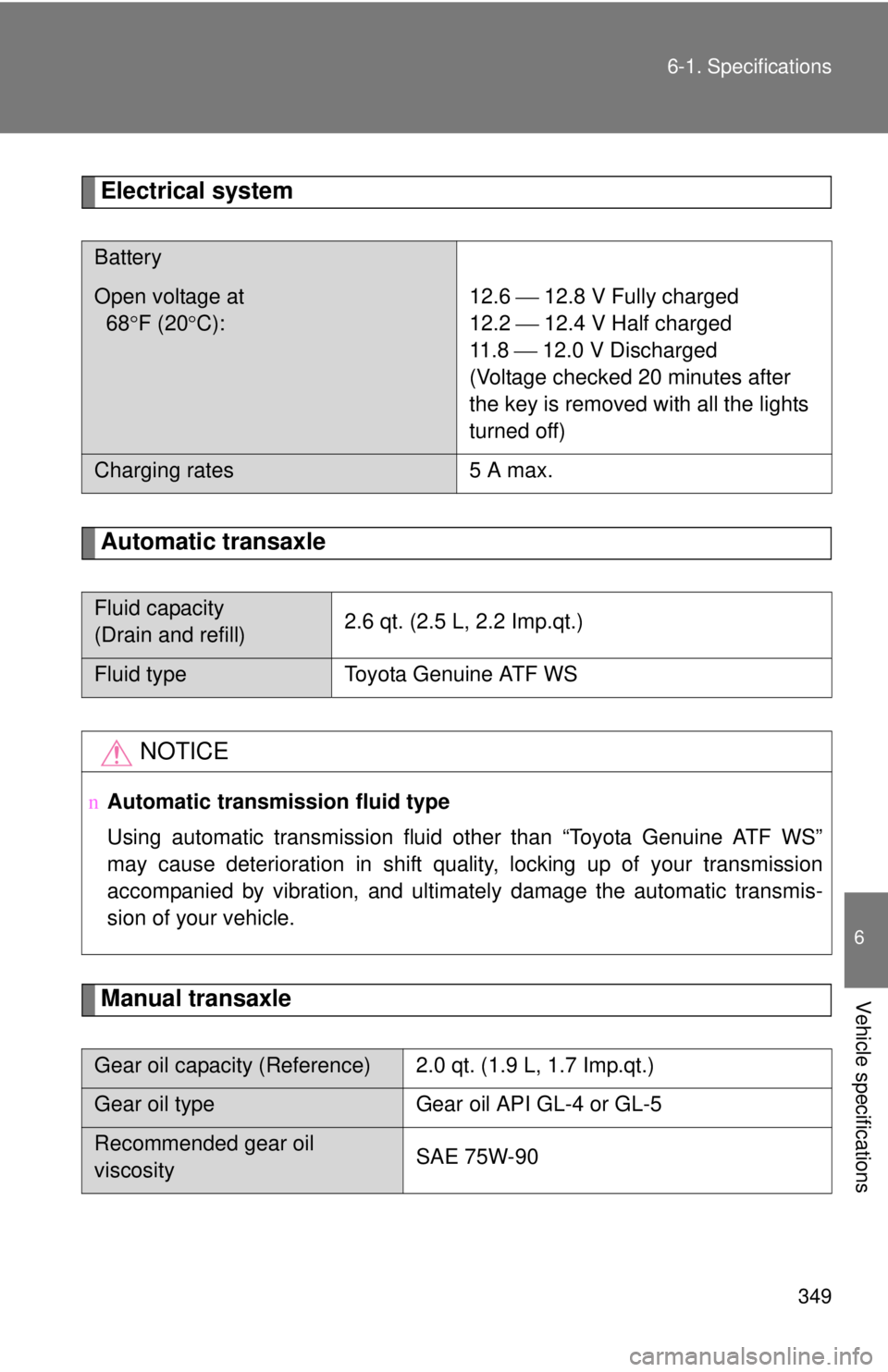
Electrical system
Automatic transaxle
Manual transaxle
Battery
Open voltage at
68°
F (20 °C): 12.6 ⎯ 12.8 V Fully charged
12.2 ⎯ 12.4 V Half charged
11 . 8 ⎯ 12.0 V Discharged
(Voltage checked 20 minutes after
the key is removed with all the lights
turned off)
Charging rates 5 A max.
Fluid capacity
(Drain and refill) 2.6 qt. (2.5 L, 2.2 Imp.qt.)
Fluid type
Toyota Genuine ATF WS
NOTICE
nAutomatic transmission fluid type
Using automatic transmission fluid other than “Toyota Genuine ATF WS”
may cause deterioration in shift quality, locking up of your transmission
accompanied by vibration, and ultimately damage the automatic transmis-
sion of your vehicle.
Gear oil capacity (Reference) 2.0 qt. (1.9 L, 1.7 Imp.qt.)
Gear oil type Gear oil API GL-4 or GL-5
Recommended gear oil
viscosity SAE 75W-90
Page 361 of 402

352 6-1. Specifications
Light bulbs
A: HB2 halogen bulbs
B: H11 halogen bulbs
C: Single end bulbs
D: Single end bulbs (amber)
E: Wedge base bulbs
F: Wedge base bulbs (amber)
G: Double end bulbs
Light BulbsBulb NoWTy p e
ExteriorHeadlights 9003 60/55 A
Parking lights 168 5 E
Front fog lights
(if equipped) —55 B
Front side marker
lights 168 5 E
Front turn signal lights — 21 D
Side turn signal lights — 5 F
Rear turn signal lights 7440 21 E
Stop/tail and rear side
marker lights 7443 21/5 E
Back-up lights 921 16 E
License plate light 168 5 E
Interior Interior light — 8 G
Personal lights — 8 E
Luggage compart-
ment light
—5 G
Page 362 of 402
353
6-1. Specifications
6
Vehicle specifications
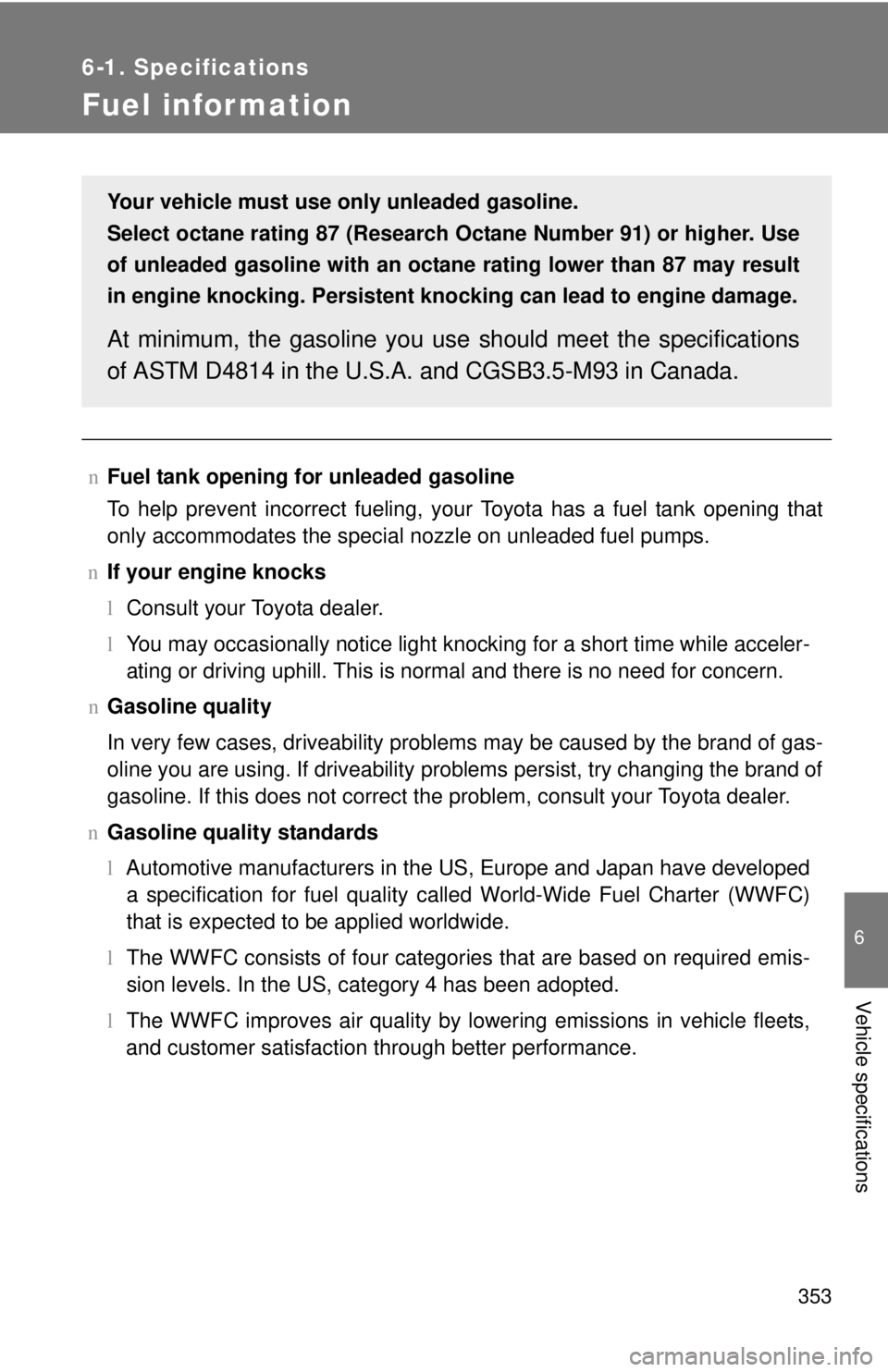
Fuel information
nFuel tank opening fo r unleaded gasoline
To help prevent incorrect fueling, your Toyota has a fuel tank opening that
only accommodate
s the special nozzle on unleaded fuel pumps.
n If your engine knocks
l Consult your T
oyota dealer.
l Y
ou may occasionally notice light knocking for a short time while acceler -
ating or driving uphill. This is normal and there is no need for concern.
n Gasoline quality
In very few cases, driveability problems may be caused by the brand of gas -
oline you are using. If driveability problems persist, try changing the brand of
gasoline. If this does not correct the problem, c
onsult your Toyota dealer.
n Gasoline quality st
andards
l Automotive manufacture
rs in the US, Europe and Japan have developed
a specification for fuel quality called World-Wide Fuel Charter (WWFC)
that is expected to be applied worldwide.
l The
WWFC consists of four categories that are based on required emis -
sion levels. In the US, category 4 has been adopted.
l The WWFC improves air quality by
lowering emissions in vehicle fleets,
and customer satisfaction through better performance.
Your vehicle must use only unleaded gasoline.
Select octane rating 87 (Research Octane Number 91) or higher. Use
of unleaded gasoline with an octane rating lower than 87 may result
in engine knocking. Persistent kno cking can lead to engine damage.
At minimum, the gasoline you use should meet the specifications
of ASTM D4814 in the U.S.A. and CGSB3.5-M93 in Canada.
Page 375 of 402
366 6-1. Specifications
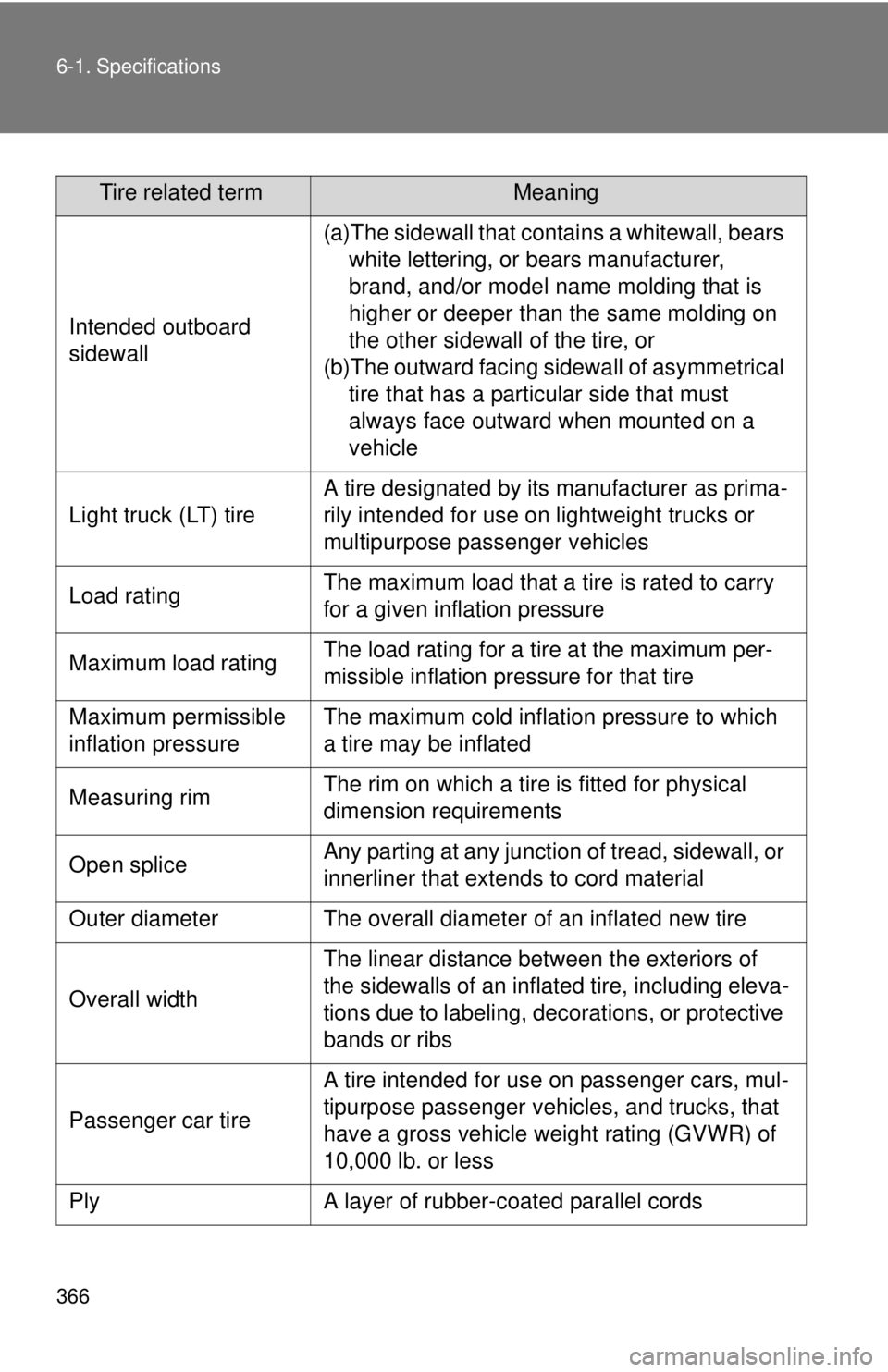
Tire related termMeaning
Intended outboard
sidewall
(a)The sidewall that contains a whitewall, bears white lettering, or bears manufacturer,
brand, and/or model name molding that is
higher or deeper than the same molding on
the other sidewall of the tire, or
(b)The outward facing sidewall of asymmetrical tire that has a particular side that must
always face outward when mounted on a
vehicle
Light truck (LT) tire
A tire designated by its manufacturer as prima-
rily intended for use on lightweight trucks or
multipurpose passenger vehicles
Load ratingThe maximum load that a tire is rated to carry
for a given inflation pressure
Maximum load ratingThe load rating for a tire at the maximum per-
missible inflation pressure for that tire
Maximum permissible
inflation pressureThe maximum cold inflation pressure to which
a tire may be inflated
Measuring rimThe rim on which a tire is fitted for physical
dimension requirements
Open spliceAny parting at any junction of tread, sidewall, or
innerliner that extends to cord material
Outer diameterThe overall diameter of an inflated new tire
Overall width
The linear distance between the exteriors of
the sidewalls of an inflated tire, including eleva-
tions due to labeling, decorations, or protective
bands or ribs
Passenger car tire
A tire intended for use on passenger cars, mul-
tipurpose passenger vehicles, and trucks, that
have a gross vehicle weight rating (GVWR) of
10,000 lb. or less
PlyA layer of rubber-coated parallel cords
Page 379 of 402
370 6-2. Customization
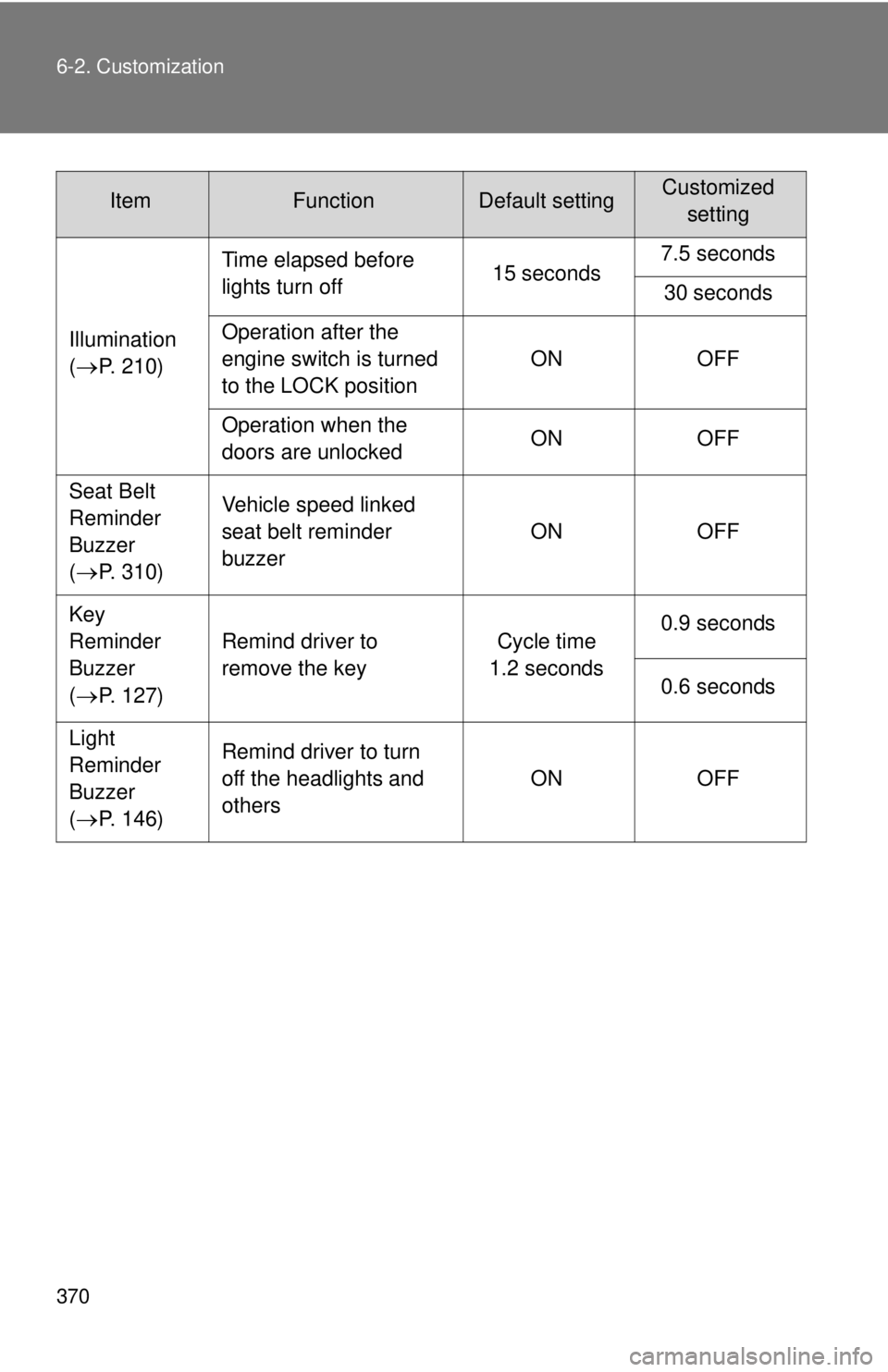
Illumination
(
→P. 210) Time elapsed before
lights turn off
15 seconds7.5 seconds
30 seconds
Operation after the
engine switch is turned
to the LOCK position ON OFF
Operation when the
doors are unlocked ON OFF
Seat Belt
Reminder
Buzzer
(
→P. 310) Vehicle speed linked
seat belt reminder
buzzer
ON OFF
Key
Reminder
Buzzer
(
→P. 127) Remind driver to
remove the key
Cycle time
1.2 seconds 0.9 seconds
0.6 seconds
Light
Reminder
Buzzer
(
→P. 146) Remind driver to turn
off the headlights and
others
ON OFF
ItemFunctionDefault settingCustomized
setting
Page 387 of 402

381
Alphabetical index
Alphabetical index
A/C ............................................178
ABS ABS ...................................... 155
Warning light ........................ 308
Air conditioning filter .............. 270
Air conditioning system Air conditioning filter ............. 270
Air conditioning
system................................ 178
Airbags
Airbag operating conditions .... 84
Airbag precautions for your
child...................................... 88
Curtain shield airbag operating
conditions ............................. 84
Curtain shield airbag
precautions .......................... 88
Front passenger occupant classification system ............ 93
General airbag precautions .... 88
Indicators ................................ 93
Locations of airbags ............... 81
Modification and disposal of
airbags ................................. 92
Proper driving posture ...... 79, 88
Side airbag operating
conditions ............................. 84
Side airbag precautions.......... 88
SRS airbags ........................... 81
Warning light ........................ 308
Alarm .......................................... 76
Antenna ............................ 191, 228
Anti-lock brake system Anti-lock brake system ......... 155
Warning light ........................ 308
Audio input .............................. 209
Audio system Antenna ................................ 191
Audio input ........................... 209
AUX adapter ......................... 209
CD player ............................. 195
MP3/WMA disc ..................... 200
Optimal use .......................... 207Portable music player............
209
Radio ..................................... 189
Type ...................................... 187
Automatic transmission
Automatic transmission ......... 128
Fluid ...................................... 349
If the shift lever cannot be
shifted from P......................331
Indicators............................... 128
Shift lock system .. .................331
AUX adapter ............................. 209
Auxiliary boxes ................ 217, 225
Back-up lights Replacing light bulbs ............. 286
Wattage ................................. 352
Back door ................................... 36
Battery
Checking ............................... 253
If the vehicle battery is
discharged ..........................333
Preparing and checking before winter .......................161
Voltage .................................. 349
Warning light ......................... 308
Bottle holders ........................... 215
Brakes
Fluid ...................................... 252
Parking brake ........................ 132
Specifications ........................ 350
Warning light .........................307
Break-in tips ............................. 118
Care Exterior .................................. 228
Interior ................................... 230
Seat belts .............................. 231
Cargo capacity ......................... 157
CD player .................................. 195
Chains ....................................... 161
A
B
C