engine coolant TOYOTA YARIS HATCHBACK 2009 User Guide
[x] Cancel search | Manufacturer: TOYOTA, Model Year: 2009, Model line: YARIS HATCHBACK, Model: TOYOTA YARIS HATCHBACK 2009Pages: 402, PDF Size: 7.61 MB
Page 261 of 402
250 4-3. Do-it-yourself maintenance
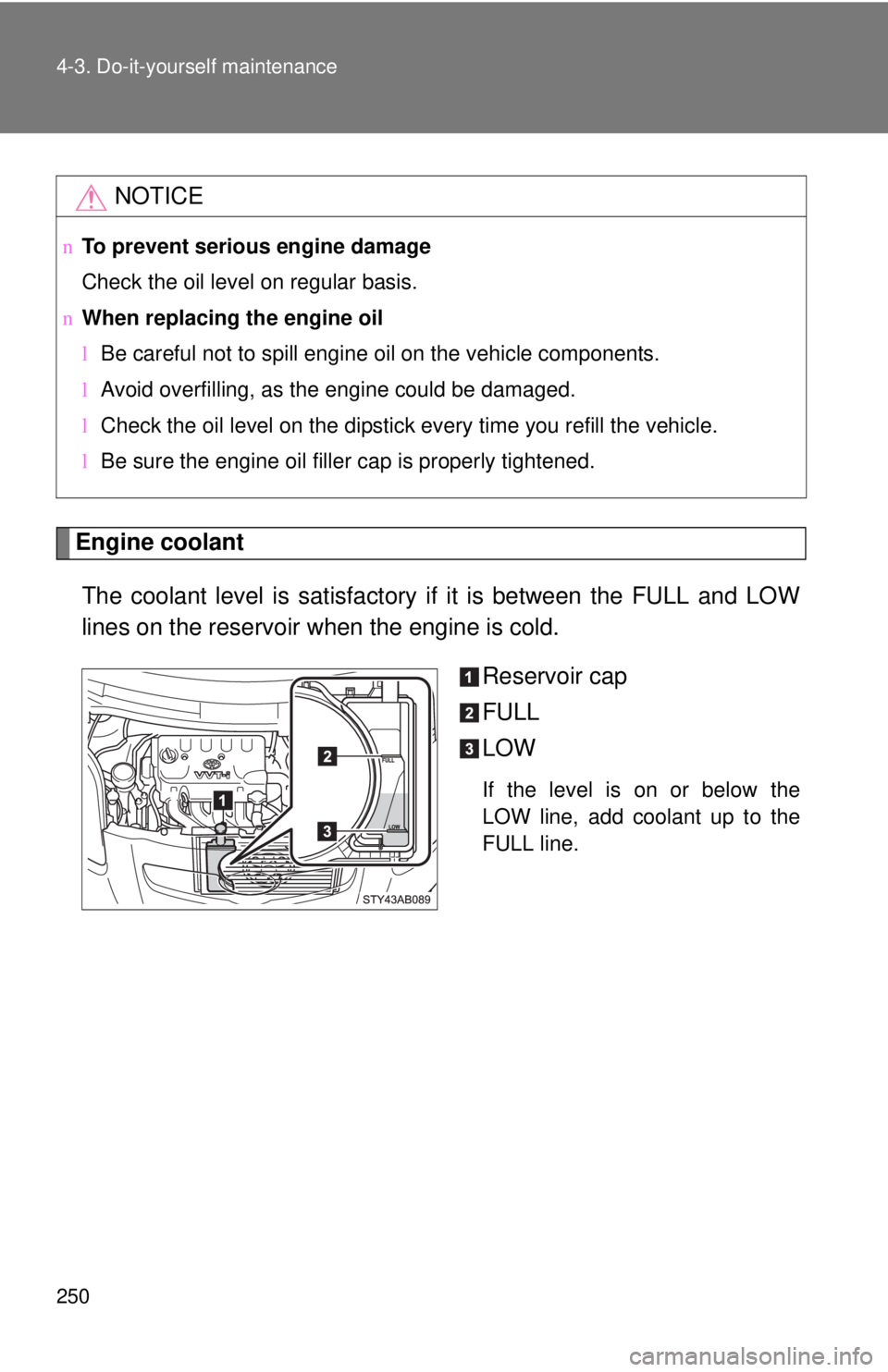
Engine coolant
The coolant level is satisfactory if it is between the FULL and LOW
lines on the reservoir when the engine is cold.Reservoir cap
FULL
LOW
If the level is on or below the
LOW line, add coolant up to the
FULL line.
NOTICE
nTo prevent serious engine damage
Check the oil level on regular basis.
n When replacing the engine oil
lBe careful not to spill engine oil on the vehicle components.
l Avoid overfilling, as the engine could be damaged.
l Check the oil level on the dipstick every time you refill the vehicle.
l Be sure the engine oil filler cap is properly tightened.
Page 262 of 402
251
4-3. Do-it-yourself maintenance
4
Maintenance and care
n
If the coolant level drops within a short time after replenishing
Visually check the radiator, hoses, reservoir cap, radiator cap, drain cock
and water pump.
If you cannot find a leak, have your Toyota dealer pressure test the cap and
check for leaks in the cooling system.
n Coolant selec
tion
Only use “Toyota Super Long Life Coolant” or similar high quality ethylene
glycol based n
on-silicate, non-amine, non-nitrite and non-borate coolant with
long-life hybrid organic acid technology.
Except Canada:“Toyota Super Long Life Coolant” is a mixture of 50% cool -
ant and 50% deionized water. (Enabled: -31 °F [-
35°C])
Canada: “Toyota Super Long Life Coolant” is a mixture of 55% coolant and 45% deionized water
. (Enabled: -44°F [-42 °C])
For more details about engine coolant, contact your Toyota dealer.
CAUTION
n When the engine is hot
Do not remove the radiator cap.
The cooling system may be under pressure and may spray hot coolant if the
cap is removed, causing burns or other injuries.
NOTICE
nWhen adding engine coolant
Coolant is neither plain water nor strai ght antifreeze. The correct mixture of
water and antifreeze must be used to provide proper lubrication, corrosion
protection and cooling. Be sure to read the antifreeze or coolant label.
n If you spill coolant
Be sure to wash it off with water to prevent damage to parts or paint.
Page 313 of 402
5
When trouble arises
303
5-1. Essential information
If you think something is wrong
If you notice any of the following symptoms, your vehicle probably
needs adjustment or repair. Contact your Toyota dealer as soon as
possible.
n Visible symptoms
lFlu
id leaks under the vehicle
(Water dripping from the air cond ition
ing after use is normal.)
l Fla
t-looking tires or uneven tire wear
lHigh
engine coolant temperatur e warning light flashes or
comes on
l Low
engine coolant temperature indicator comes on or does
not come on continuously
n Audible sy
mptoms
l Cha
nges in exhaust sound
lEx
cessive tire squeal when cornering
lS
trange noises related to the suspension system
l Pin
ging or other noises related to the engine
n Operat
ional symptoms
lEn
gine missing, stumbling or running rough
lAp
preciable loss of power
lV
ehicle pulls heavily to one side when braking
lV
ehicle pulls heavily to one side when driving on a level road
lLoss o
f brake effectiveness, s pongy feeling, pedal almost
touches the floor
Page 318 of 402
308 5-2. Steps to take in an emergency
Stop the vehicle immediately.
The following warnings indicate the possibility of damage to the vehi-
cle that may lead to an accident. Immediately stop the vehicle in a
sa
fe place and contact your Toyota dealer.
*: The light may come on when the oil level is extremely low. It is not designed to indicate low oil level, and the oil level must be checked using the engine
oil level dipstick.
Have the vehicle inspected immediately.
Failing to investigate the cause of the following warnings may lead to
the system operating abnormally and possibly cause an accident.
Have the vehicle inspected by your Toyota dealer immediately.
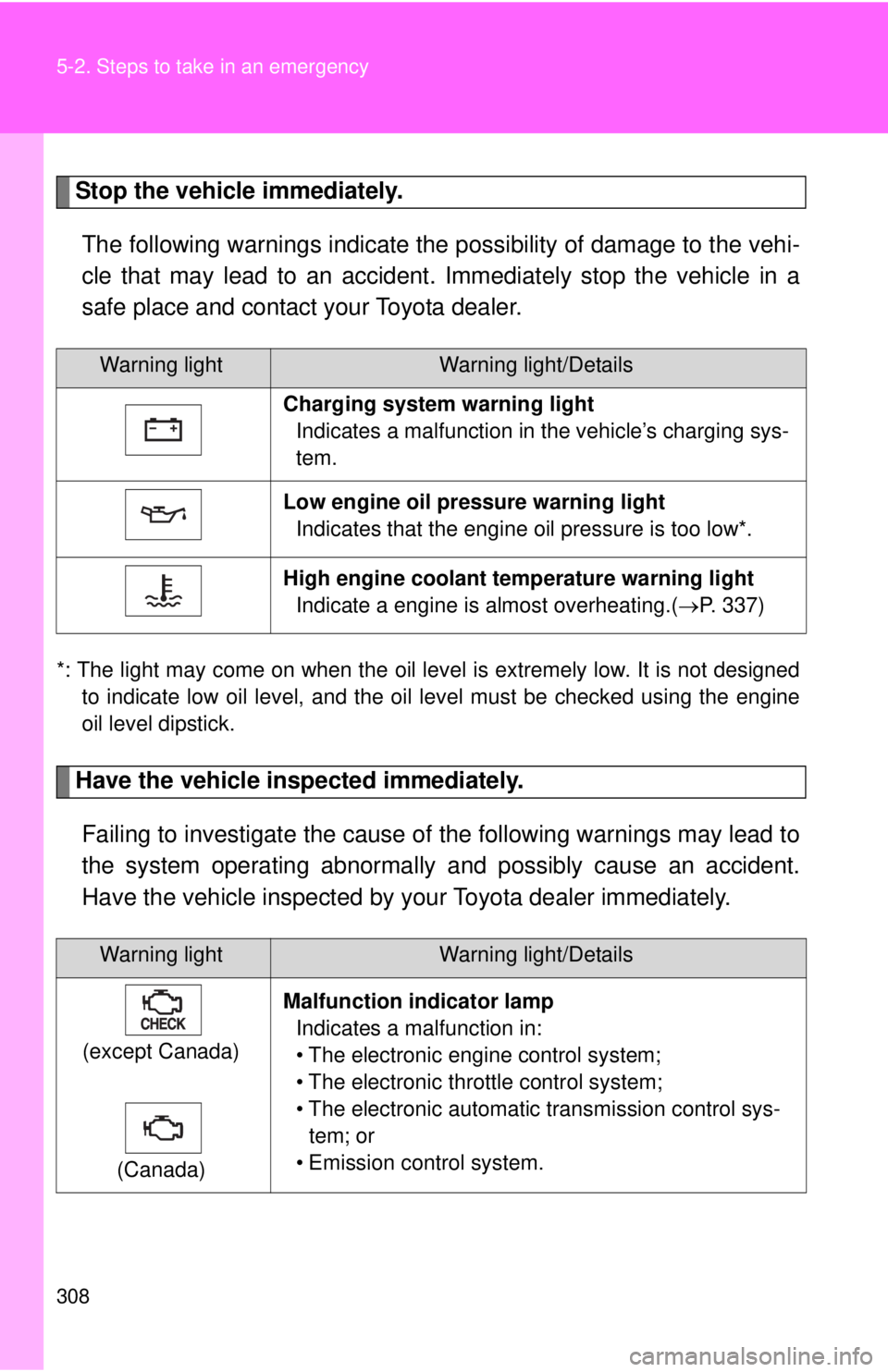
Warning lightWarning light/Details
Charging system warning light Indicates a malfunction in the vehicle’s charging sys-
tem.
Low engine oil pressure warning light Indicates that the engine oil pressure is too low*.
High engine coolant temperature warning light Indicate a engine is almost overheating.( →P. 337)
Warning lightWarning light/Details
(except Canada)
(Canada) Malfunction indicator lamp
Indicates a malfunction in:
• The electronic engine control system;
• The electronic throttle control system;
• The electronic automatic transmission control sys-tem; or
• Emission control system.
Page 347 of 402
5
When trouble arises
337
5-2. Steps to take in an emergency
If your vehicle overheats
If your engine overheats:
Stop the vehicle in a safe place and turn off the air condi-
tioning system.
Check to see if steam is coming out from under the hood.
If you see steam:
Stop the engine. Carefully lift the hood after the steam
sub
sides and then restart the engine.
If you do not see steam:
Leave the engine running and carefully lift the hood.
Check to see if the cooling fan is operating.
If the fan is operating:
Wait until the high engine coolant temperature warning
lig
ht goes off and then stop the engine.
If the fan is not operating:
Stop the engine immediately and call your local Toyota
dea
ler.
Page 348 of 402
338 5-2. Steps to take in an emergency
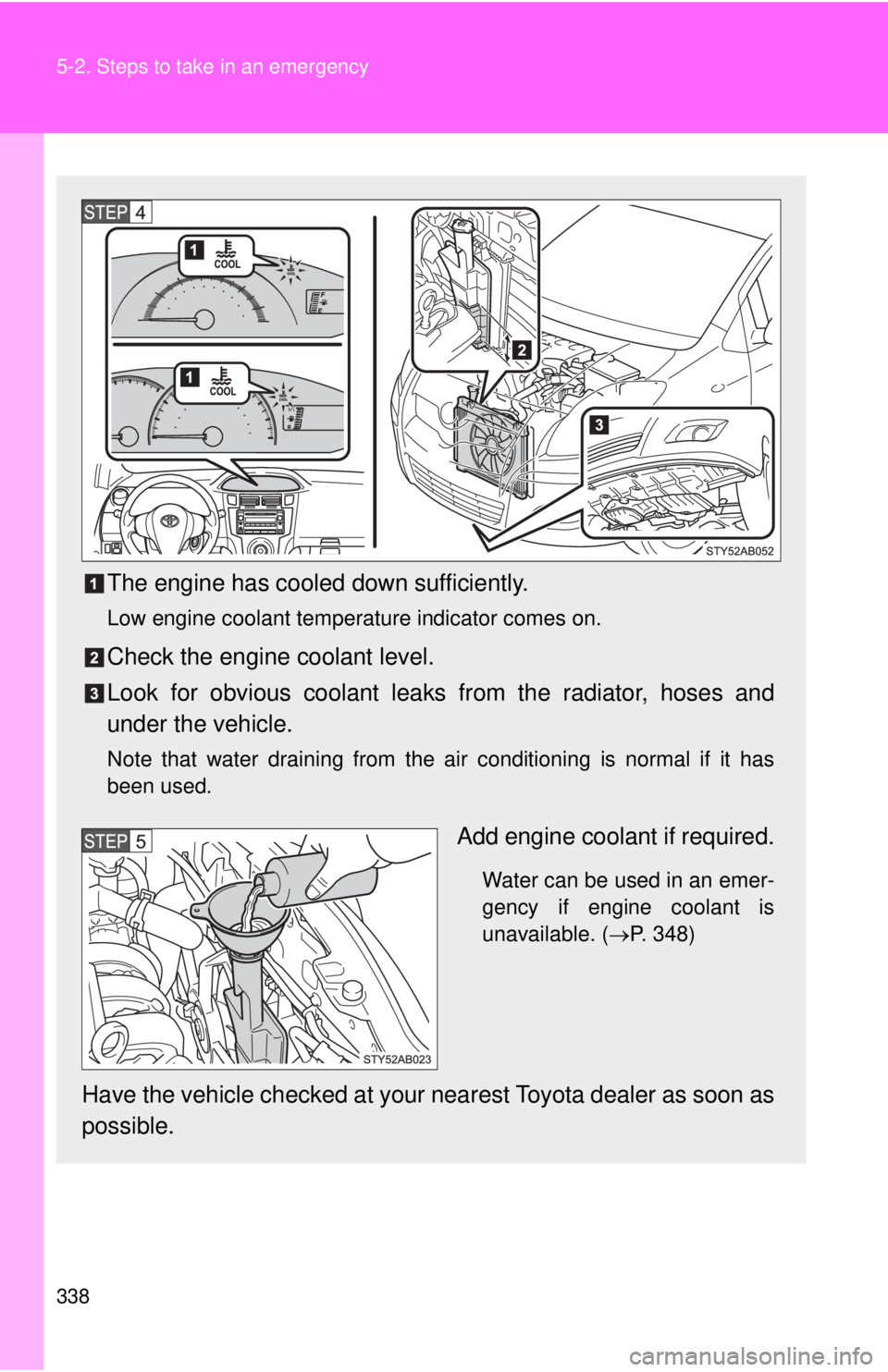
The engine has cooled down sufficiently.
Low engine coolant temperature indicator comes on.
Check the engine coolant level.
Look for obvious coolant leaks from th
e radiator, hoses and
under the vehicle.
Note that water draining from the air conditioning is normal if it has
been used.
Add engine coolant if required.
Water can be used in an emer -
gency if engine coolant is
unavailable. ( →P. 348)
Have the vehicle checked at your nea rest Toyota dealer as soon as
possible.
Page 349 of 402
5
When trouble arises
339
5-2. Steps to take in an emergency
n
Overheating
If you observe the following, your vehicle may be overheating.
lThe high
engine coolant temperature warning light flashes or comes on
or a loss of power is experienced.
l Steam is coming from under the hood.
CAUTION
nTo prevent an accident or injury when inspecting un der the hood of
your vehicle
l If steam is seen coming from under the hood, do not open the hood until
the steam has subsided. The engine compartment may be very hot, caus-
ing serious injury such as burns.
l Keep hands and clothing away from the fan and other belts while the
engine is running.
l Do not loosen the radiator cap while the engine and radiator are hot.
Serious injury, such as burns, may result from hot coolant and steam
released under pressure.
NOTICE
n When adding engine coolant
Wait until the engine has cooled down before adding engine coolant.
When adding coolant, do so slowly. Adding cool coolant to a hot engine too
quickly can cause damage to the engine.
Page 357 of 402
348 6-1. Specifications
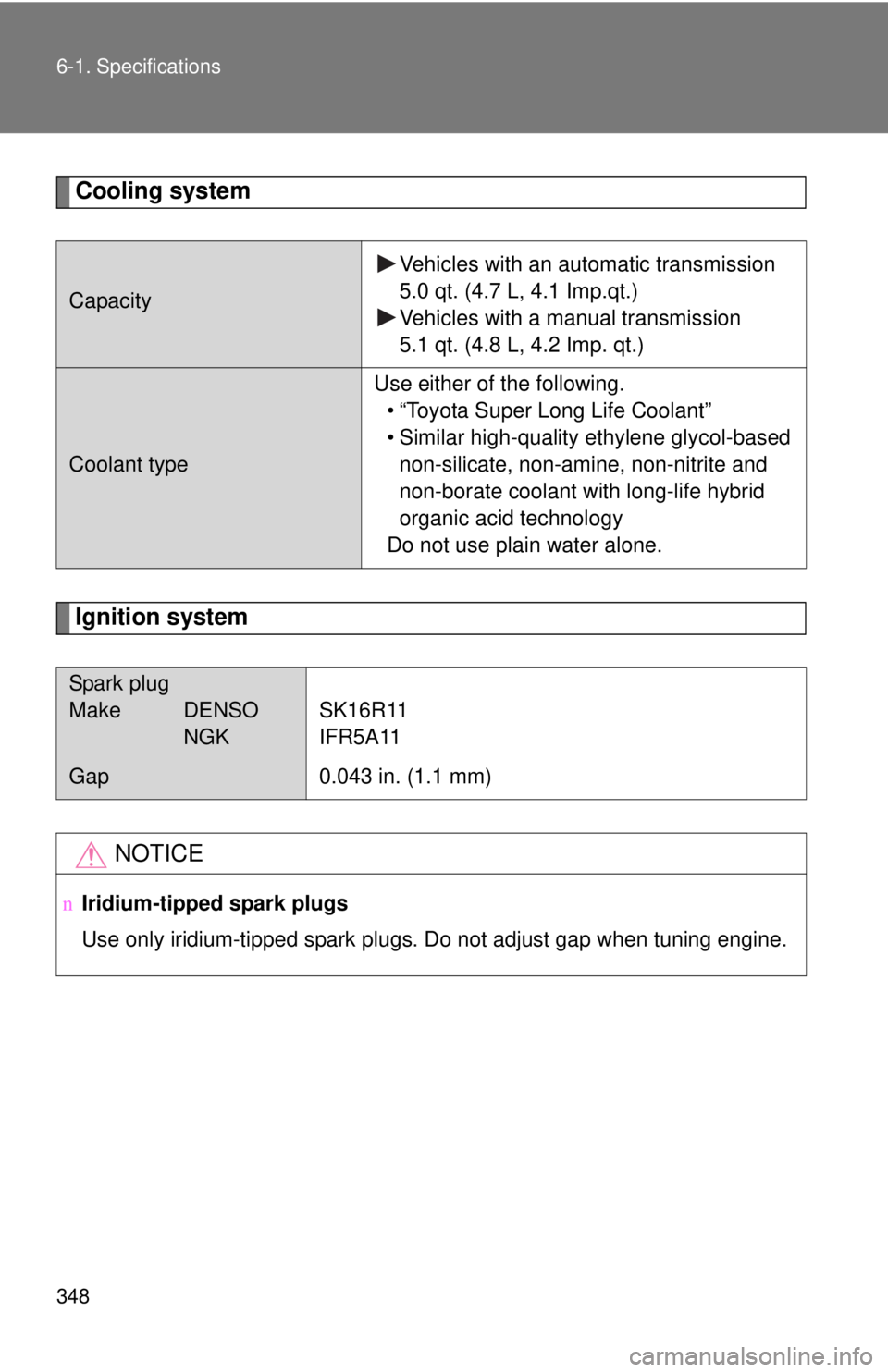
Cooling system
Ignition system
CapacityVehicles with an automatic transmission
5.0 qt. (4.7 L, 4.1 Imp.qt.)
Vehicles with a manual transmission
5.1 qt. (4.8 L, 4.2 Imp. qt.)
Coolant type Use either of the following.
• “Toyota Super Long Life Coolant”
• Similar high-quality ethylene glycol-based non-silicate, non-amine, non-nitrite and
non-borate coolant with long-life hybrid
organic acid technology
Do not use plain water alone.
Spark plug
Make DENSO NGK SK16R11
IFR5A11
Gap
0.043 in. (1.1 mm)
NOTICE
nIridium-tipped spark plugs
Use only iridium-tipped spark plugs. Do not adjust gap when tuning engine.
Page 372 of 402
363
6-1. Specifications
6
Vehicle specifications
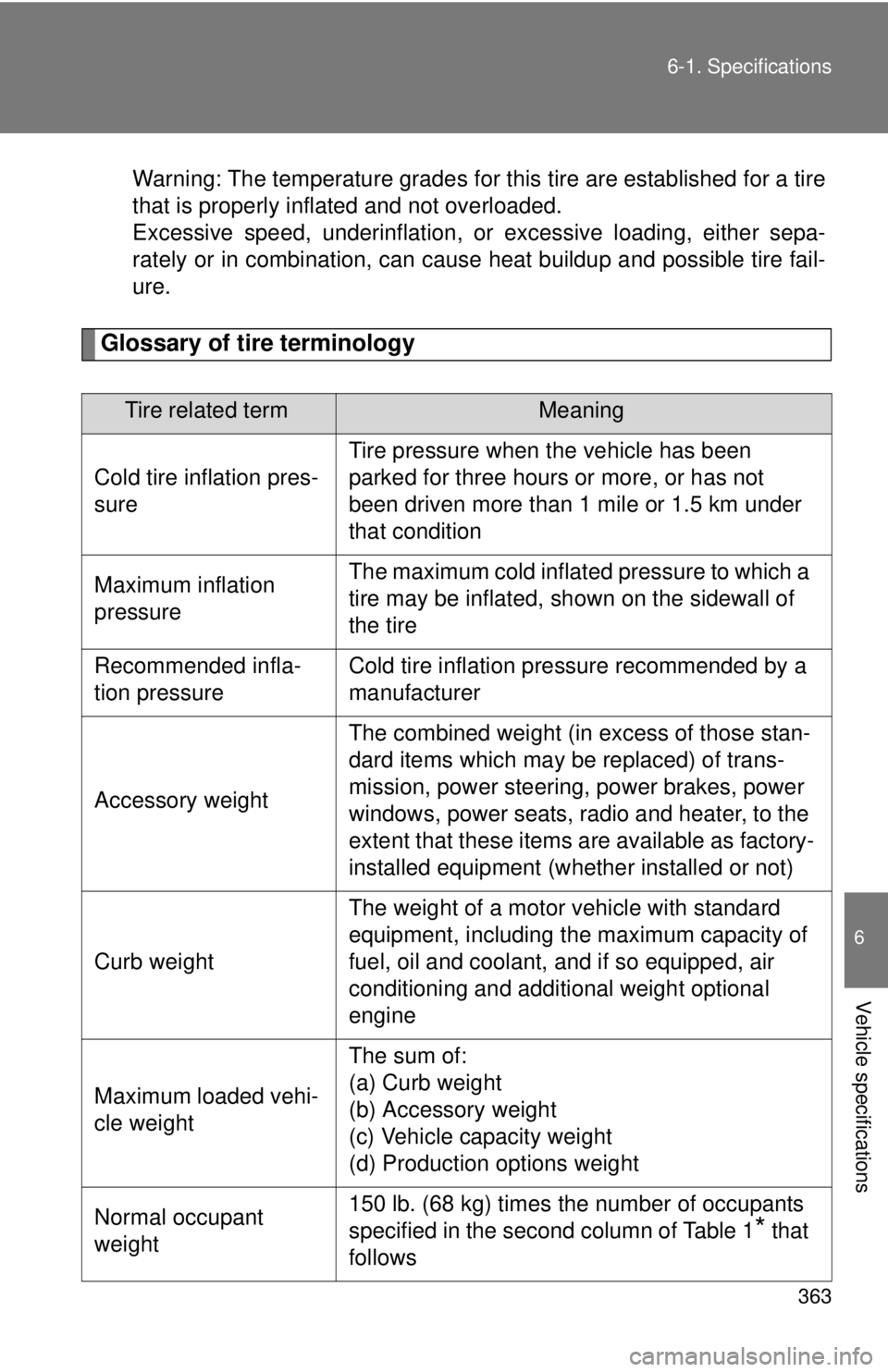
Warning: The temperature grades for this tire are established for a tire
that is properly inflated and not overloaded.
Excessive speed, underinflation, or excessive
loading, either sepa-
rately or in combination, can caus e hea
t buildup and possible tire fail-
ure.
Glossary of tire terminology
Tire related termMeaning
Cold tire inflation pres-
sure
Tire pressure when the vehicle has been
parked for three hours or more, or has not
been driven more than 1 mile or 1.5 km under
that condition
Maximum inflation
pressureThe maximum cold inflated pressure to which a
tire may be inflated, s hown on the sidewall of
the tire
Recommended infla-
tion pressureCold tire inflation pressure recommended by a
manufacturer
Accessory weight
The combined weight (in excess of those stan-
dard items which may be replaced) of trans-
mission, power steering, power brakes, power
windows, power seats, radio and heater, to the
extent that these items are available as factory-
installed equipment (whether installed or not)
Curb weight
The weight of a motor vehicle with standard
equipment, including the maximum capacity of
fuel, oil and coolant, and if so equipped, air
conditioning and additional weight optional
engine
Maximum loaded vehi-
cle weight
The sum of:
(a) Curb weight
(b) Accessory weight
(c) Vehicle capacity weight
(d) Production options weight
Normal occupant
weight150 lb. (68 kg) times the number of occupants
specified in the second column of Table 1
* that
follows
Page 389 of 402

383
Alphabetical index
If the warning light turns
on ....................................... 307
If you have a flat tire ............ 317
If you lose your keys............. 332
If you think something is
wrong ................................. 303
If the vehicle becomes
stuck................................... 340
If your vehicle needs to be
towed ................................. 297
If your vehicle overheats ...... 337
Engine Compartment........................ 245
Engine switch ....................... 125
Hood ..................................... 242
How to start the engine ........ 125
Identification number ............ 345
If the engine will not start...... 329
Ignition switch ....................... 125
Immobilizer system................. 74
Overheating .......................... 337
Specifications ....................... 346
Warning light ........................ 308
Engine coolant Capacity ............................... 348
Checking .............................. 250
Indicator................................ 141
Preparing and checking before winter ...................... 161
Type ..................................... 348
Warning light ........................ 308
Engine immobilizer system ...... 74
Engine oil Capacity ............................... 347
Checking .............................. 246
Grade ................................... 347
Initializing the maintenance
data .................................... 249
Preparing and checking before winter ...................... 161
Warning light ................ 308, 310
Engine switch .......................... 125Engine oil maintenance
data .........................................249
EPS EPS ....................................... 155
Warning light ......................... 308
Event data recorder ................. 305
Floor mat................................... 224
Fluid Automatic transmission ......... 349
Brake ..................................... 252
Clutch .................................... 350
Warning light ................. 307, 310
Washer .................................. 256
Fog lights Indicator ................................ 147
Replacing light bulbs ............. 286
Switch.................................... 147
Wattage ................................. 352
Front fog lights Indicator ................................ 147
Replacing light bulbs ............. 286
Switch.................................... 147
Wattage ................................. 352
Front passenger's seat belt
reminder light.........................310
Front seats Adjustment .............................. 38
Front side marker lights Replacing light bulbs ............. 286
Switch.................................... 145
Wattage ................................. 352
Front turn signal lights Indicator ................................
131
Lever ..................................... 131
Replacing light bulbs ............. 286
Switch.................................... 131
Wattage ................................. 352
Fuel Capacity ................................ 346
Fuel pump shut off system .... 304
Gas station information ......... 392
Gauge ................................... 135
F