light TOYOTA YARIS HATCHBACK 2009 Owner's Manual
[x] Cancel search | Manufacturer: TOYOTA, Model Year: 2009, Model line: YARIS HATCHBACK, Model: TOYOTA YARIS HATCHBACK 2009Pages: 402, PDF Size: 7.61 MB
Page 42 of 402
28
1-2. Opening, closing and locking the doors
Wireless remote control (if equipped)
nOperation signals
The emergency flashers flash to indicate that the doors have been locked/
unlocked. (Locked: Once; Unlocked: T
wice)
nPanic mode
nKey battery depletion
The standard battery life is 1 to 2 years. (The battery becomes depleted
even if
the key is not used.) If the wireless remote control function does not
operate, the battery may be depleted. Replace the battery when necessary.
( → P. 273)
n Security feature
If a door is not opened within approximately 30 seconds after the vehicle is
unlocked, the security feature automatically locks
the vehicle again.
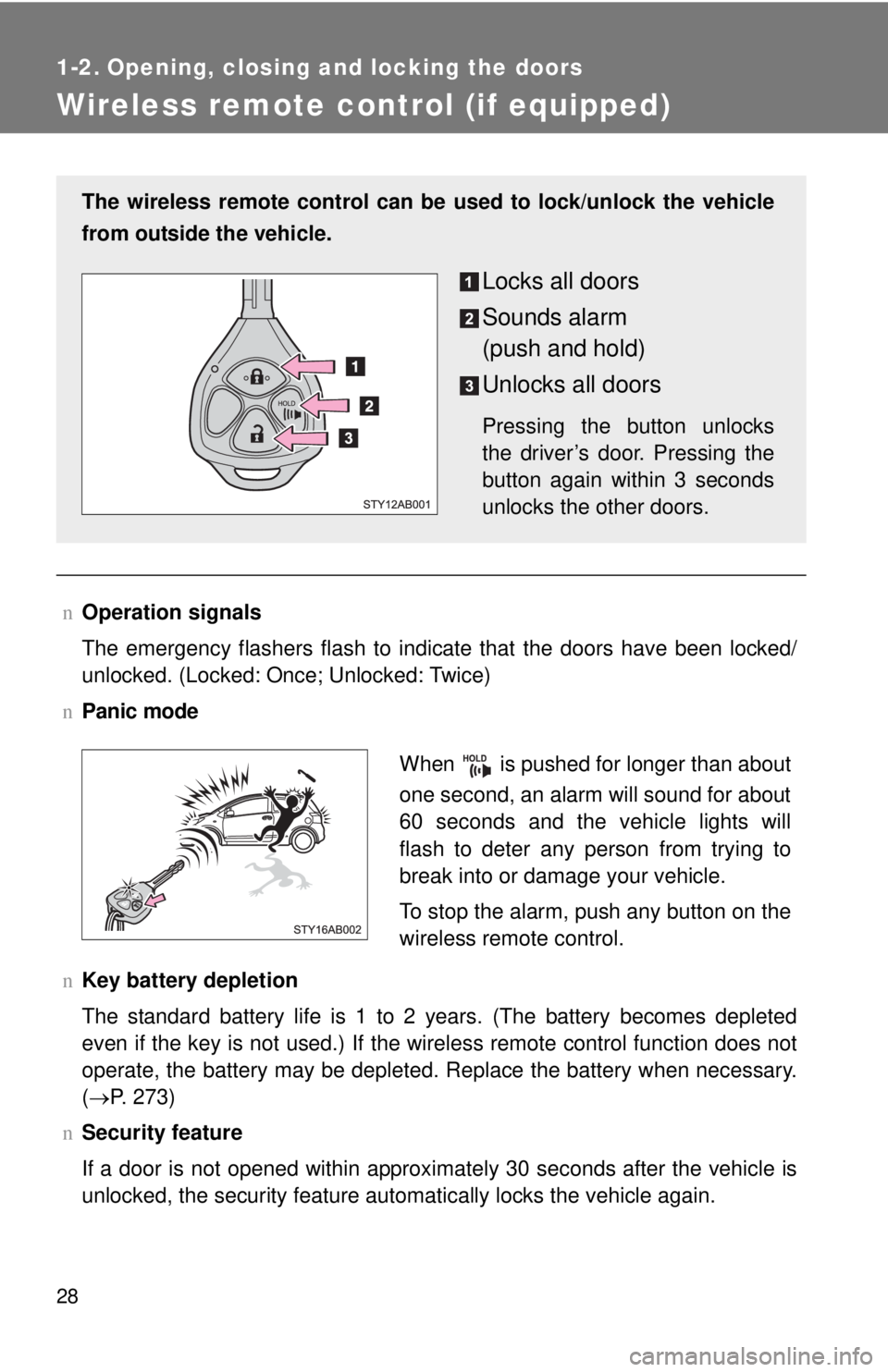
The wireless remote control can be used to lock/unlock the vehicle
from outside the vehicle.
Locks all doors
Sounds alarm
(push and hold)
Unlocks all doors
Pressing the button unlocks
the driver’s door. Pressing the
button again within 3 seconds
unlocks the other doors.
When is pushed for longer than about
one second, an alarm will sound for about
60 seconds and the vehicle lights will
flash to deter any person from trying to
break into or damage your vehicle.
To stop the alarm, push any button on the
wireless remote control.
Page 61 of 402

47
1-3. Adjustable components (s
eats, mirrors, steering wheel)
1
Before driving
CAUTION
nSeat adjustment
lDo not recline the seat more than necessary when the vehicle is in motion
to reduce the risk of sliding under the lap belt. If the seat is too reclined,
the lap belt may slide past the hips and apply restraint forces directly to the
abdomen or your neck may contact the shoulder belt, increasing the risk of
death or serious injury in the event of an accident.
l After adjusting the seat, make sure that the seat is locked in position.
n After returning the seatback to the upright position
Observe the following precautions. Failure to do so may result in death or
serious injury.
lMake sure that the seatback is securely locked in position by lightly rock-
ing it back and forth.
l Check that the seat belts and buckles are not twisted or caught under the
seat.
l Arrange the seat belts in the proper positions for ready use.
NOTICE
nStowing the seat belts
The seat belts and the buckles must be stowed before you fold down the
rear seat backs.
n When returning the seatback to the upright position
Do not pull the pocket that stores the seat belt comfort guide.
Page 71 of 402
57
1-3. Adjustable components (s
eats, mirrors, steering wheel)
1
Before driving
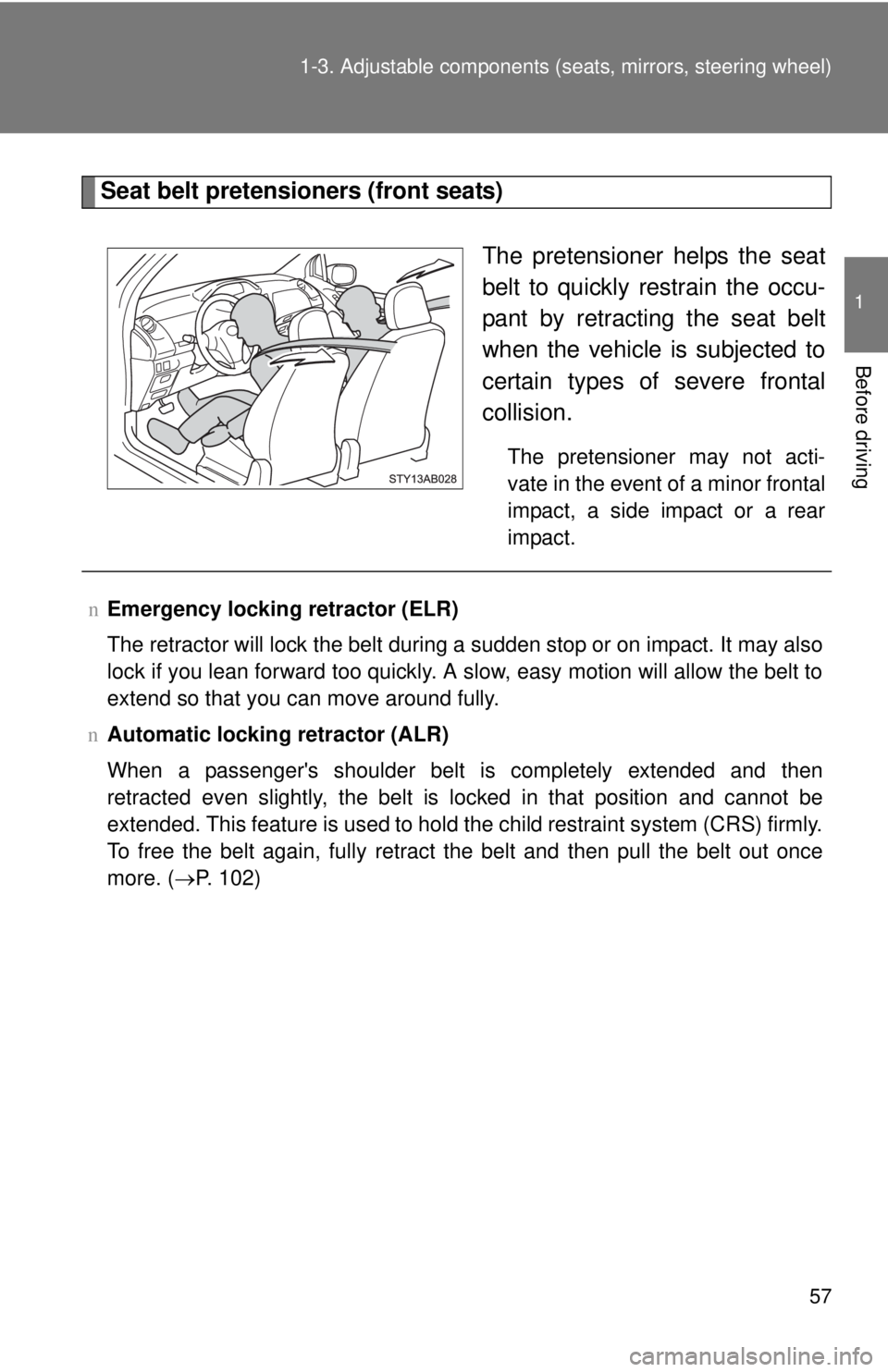
Seat belt pretensioners (front seats)
The pretensioner helps the seat
belt to quickly restrain the occu -
pant by retracting the seat belt
w
hen the vehicle is subjected to
certain types of severe frontal
collision.
The pretensioner may not acti -
vate in the event of a minor frontal
imp
act, a side impact or a rear
impact.
n Emergency locking retractor (ELR)
The retractor will lock the belt during a sudden stop or on impact. It may also
lock if you lean forward
too quickly. A slow, easy motion will allow the belt to
extend so that you can move around fully.
n Automatic locking retractor (ALR)
When a passenger's shoulder belt is completely extended and then
retracted even
slightly, the belt is locked in that position and cannot be
extended. This feature is used to hold the child restraint system (CRS) firmly.
To free the belt again, fully retract the belt and then pull the belt out once
more. ( →P. 102)
Page 77 of 402
63
1
1-3. Adjustable components (seats, mirrors, steering wheel)
Before driving
Anti-glare inside rear view mirror
CAUTION
nCaution while driving
Do not adjust the position of the mirror while driving.
Doing so may lead to mishandling of the vehicle and an accident, resulting in
death or serious injury.
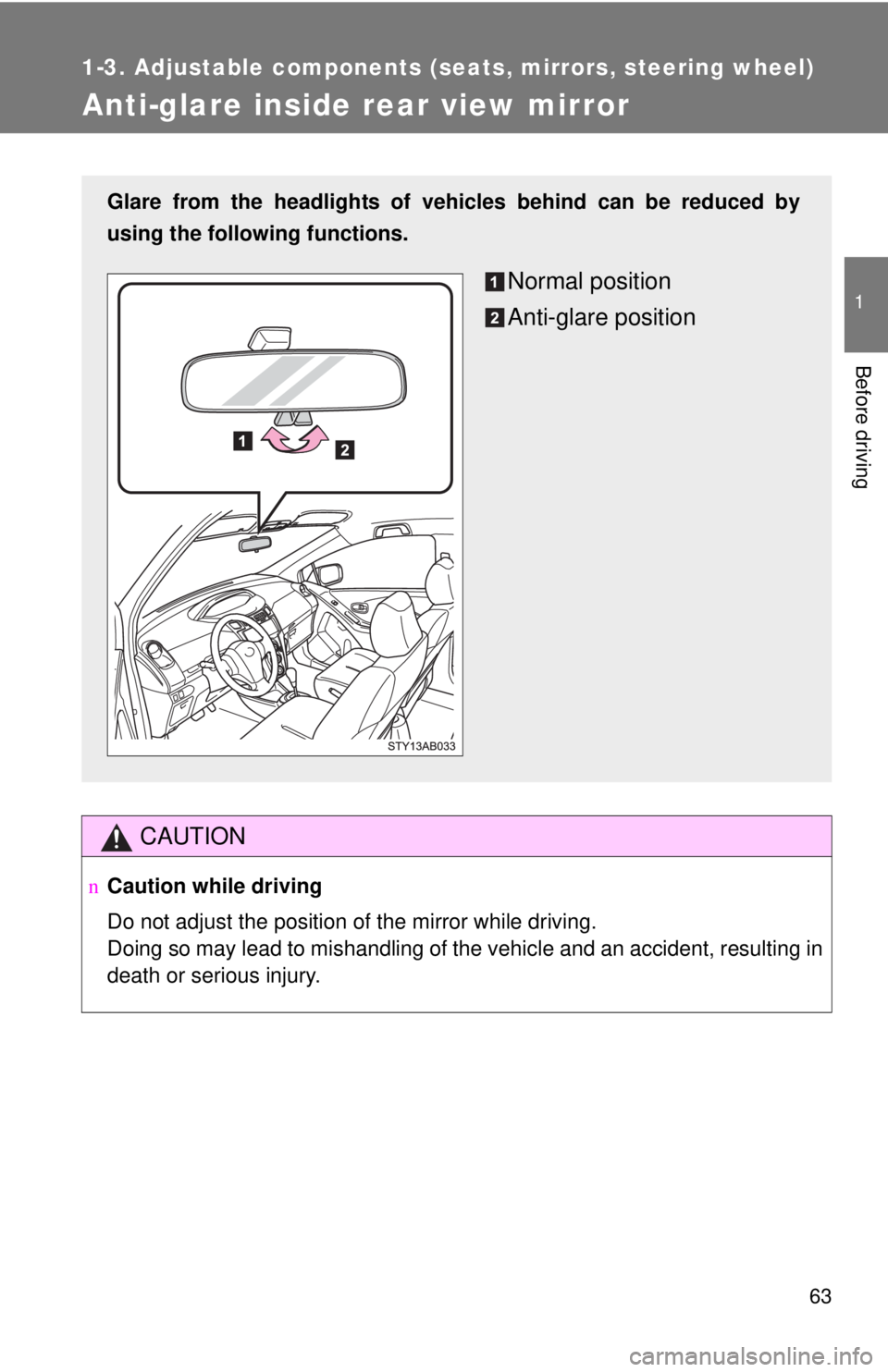
Glare from the headlights of vehic les behind can be reduced by
using the following functions.
Normal position
Anti-glare position
Page 85 of 402
71
1-5. Refueling
1
Before driving
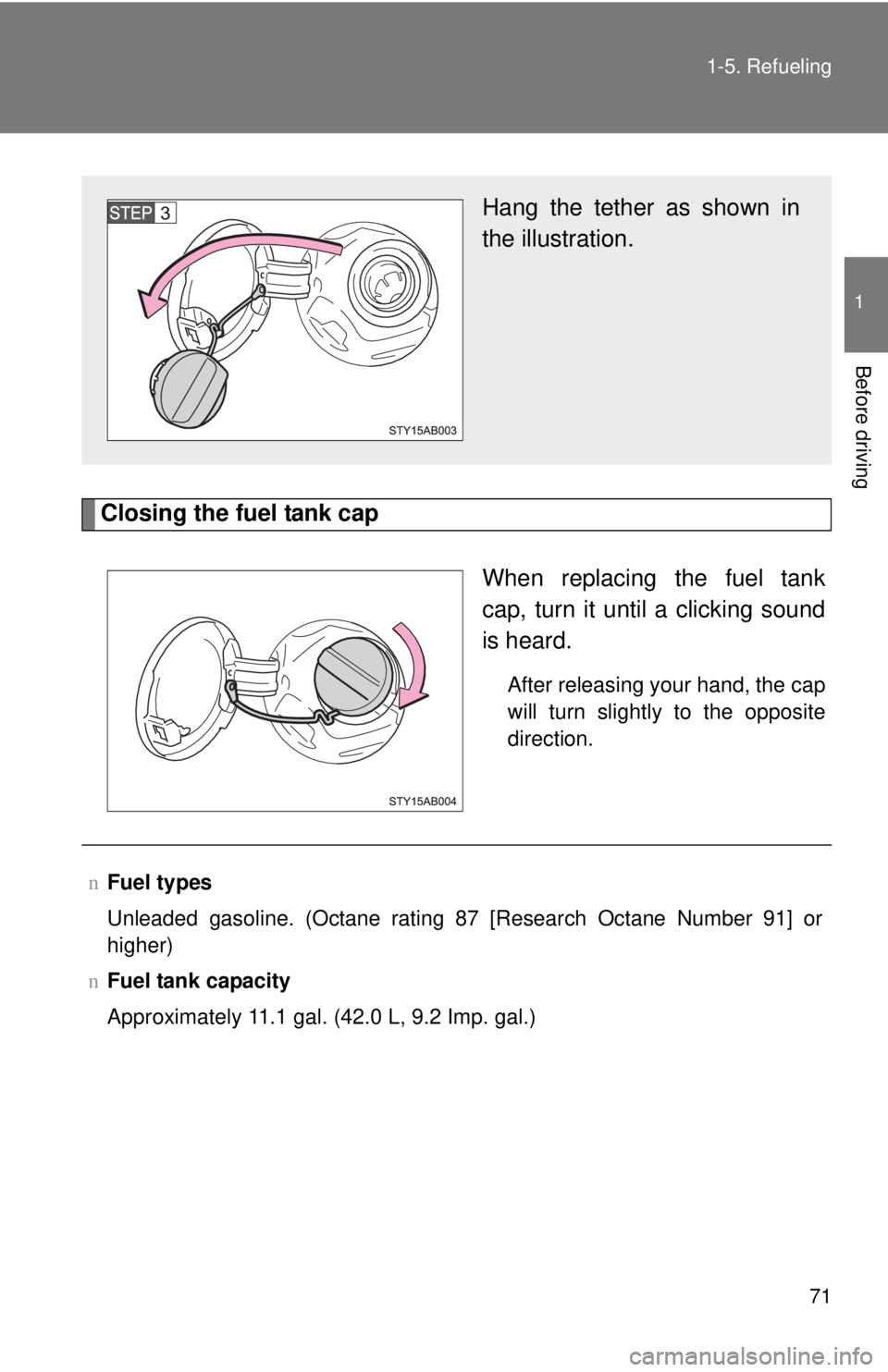
Closing the fuel tank cap
When replacing the fuel tank
cap, turn it until a clicking sound
is heard.
After releasing your hand, the cap
will turn slightly to the opposite
direction.
Hang the tether as shown in
the illustration.
n
Fuel types
Unleaded gasoline. (Octane rating 87 [Research Octane Number 91] or
higher)
n Fuel t
ank capacity
Approximately 11.1 gal. (42.0 L, 9.2 Imp. gal.)
Page 88 of 402
74
1-6. Theft deterrent system
Engine immobilizer system (if equipped)
nSystem maintenance
The vehicle has a maintenance-free type of engine immobilizer system.
n Conditions that may
cause the system to malfunction
l If the
key is in contact with a metallic object
lIf
the key is in close proximity to or touching a key to the security system
(key with a built-in transponder chip) of another vehicle
n Certifications for the engine immobilizer system
For vehicles sold in U.S.A.
FCC ID: MOZRI-20BTY
This device complies with Part 15 of the FCC Rules. Operation is subject to
the followin
g two conditions: (1) This device may not cause harmful interfer -
ence, and (2) this device must accept any interference received, including
interference that may cause undesire
d operation.
FCC WARNING:
Changes or modifications not expressly approved by the party responsible
for complia
nce could void the user’s authority to operate the equipment.
The vehicle's keys have built-in tran sponder chips that prevent the
engine from starting if the key has not been previously registered in
the vehicle's on-board computer.
Never leave the keys inside the vehicle when you leave the vehicle.
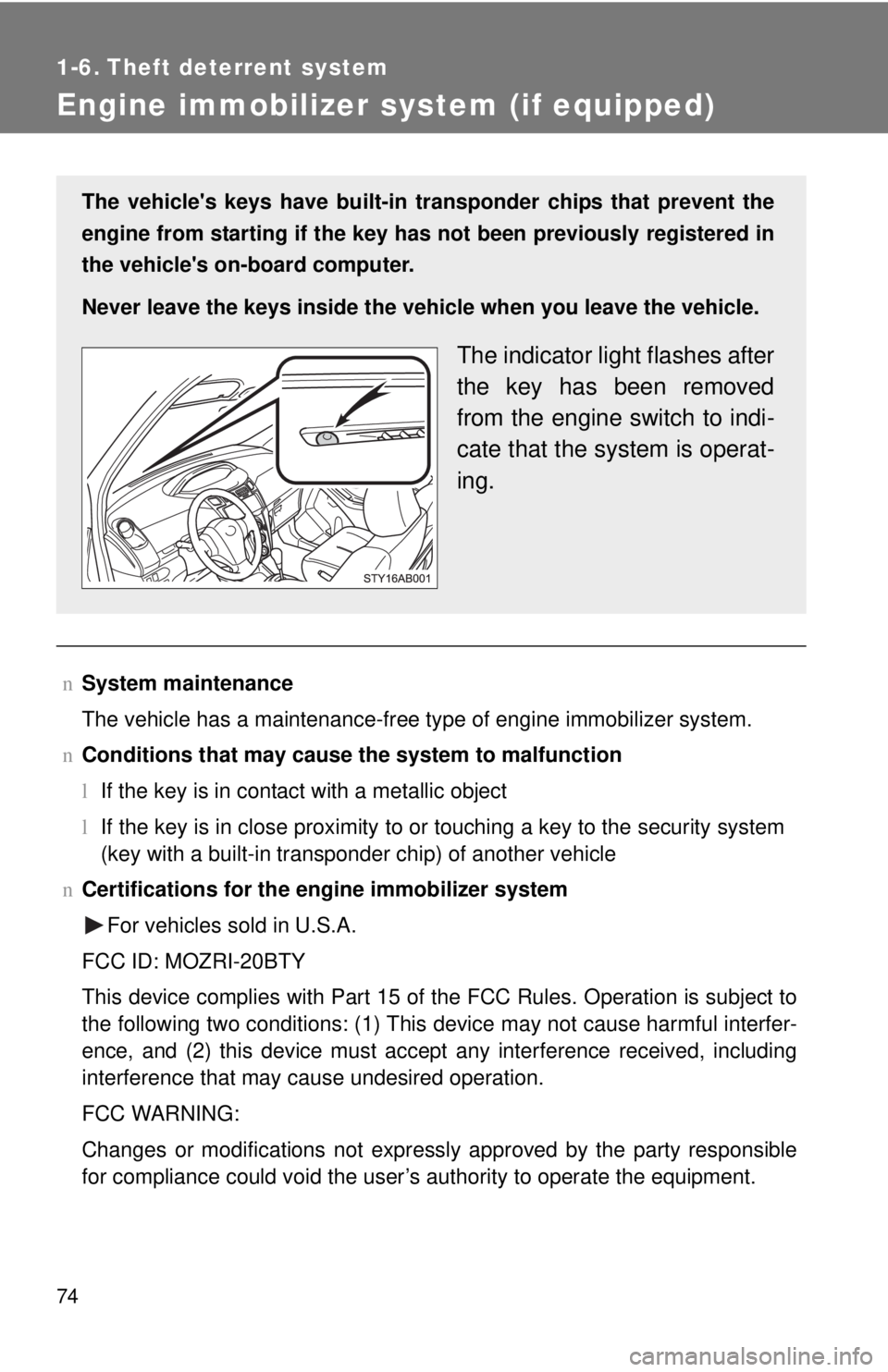
The indicator light flashes after
the key has been removed
from the engine switch to indi -
cate that the system is operat-
ing.
Page 90 of 402
76
1-6. Theft deterrent system
Alarm (Puerto Rico)
The system sounds the alarm and flashes lights when forcible entry
is detected.
n Triggering of the alarm
The alarm is triggered in the following situations.
lA locked
door is unlocked or opened in any way other than
using the key.
l The hoo
d is opened while t he vehicle is locked.
n Se
tting the alarm system
Close the doors and
hood, and lock all
do
ors using the key.
Use the key to lock the
last door. When the back
door is the last, turn the
key to the unlock posi -
tion and then turn to the
door lock position.
The system will be set
automatically after 30
seco
nds.
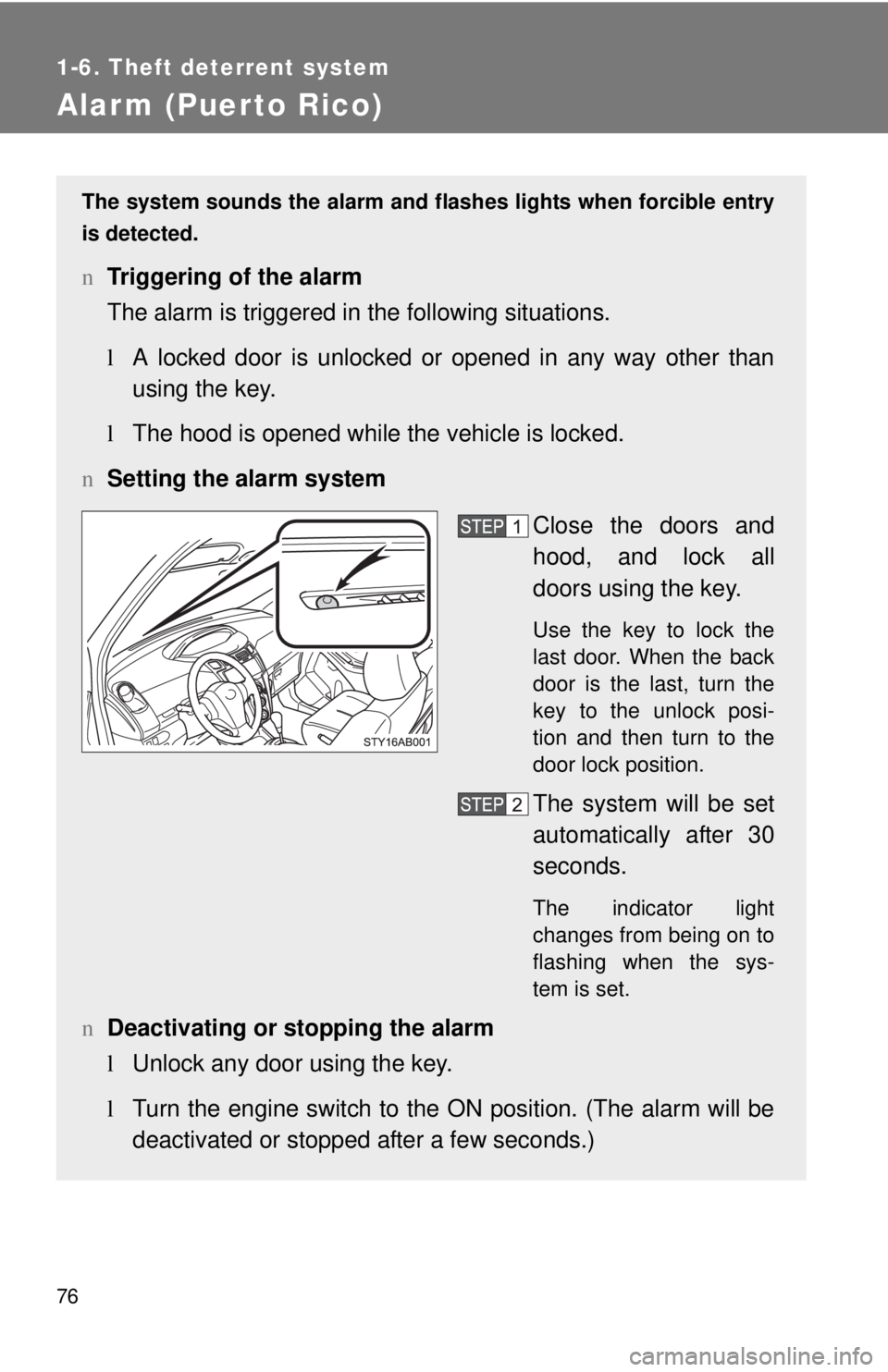
The indicator light
changes from being on to
flashing when the sys-
tem is set.
nDeactivating or stopping the alarm
lUnlock an
y door using the key.
l T
urn the engine switch to the ON position. (The alarm will be
deactivated or stopped after a few seconds.)
Page 96 of 402
82 1-7. Safety information
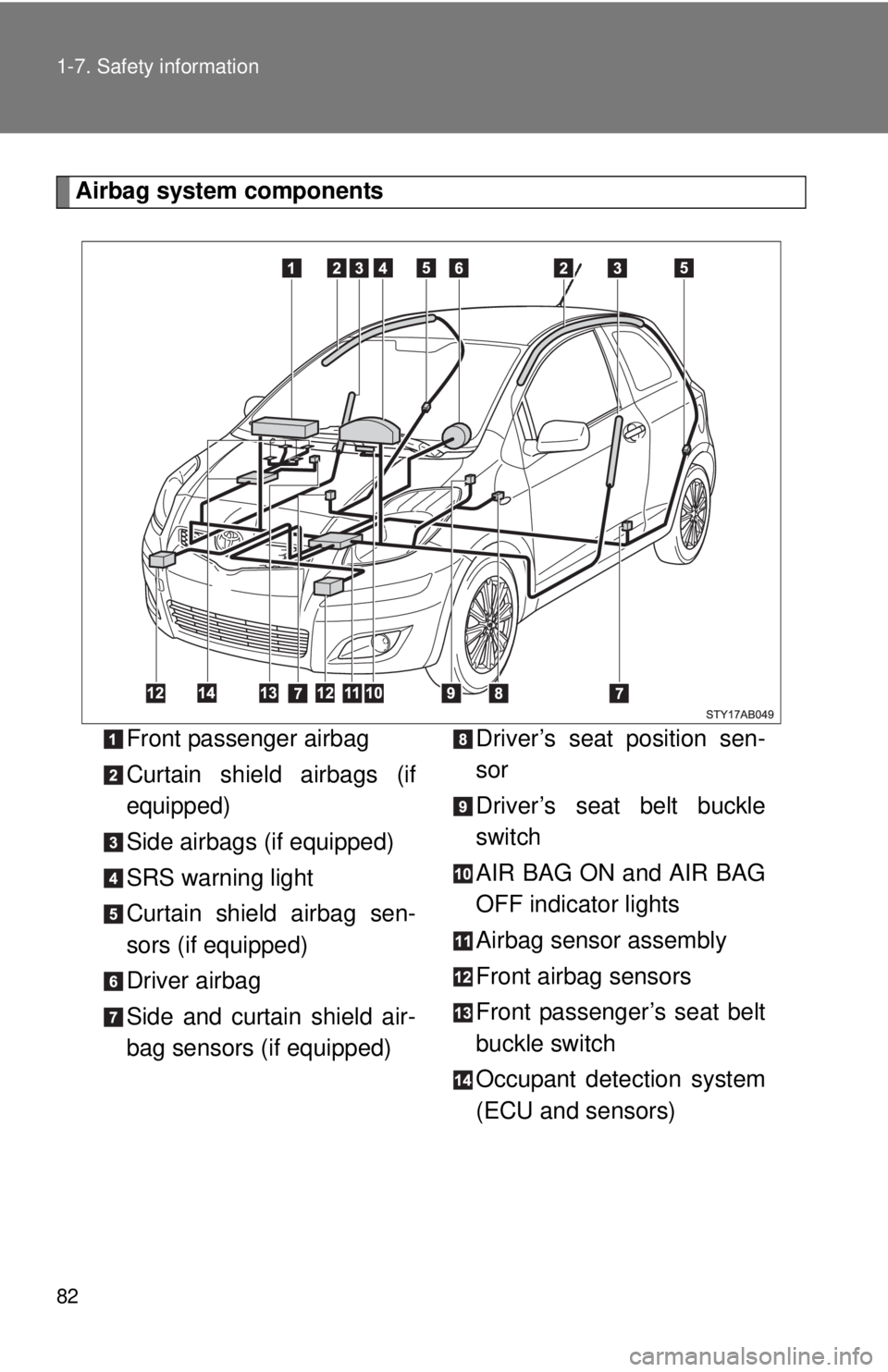
Airbag system components
Front passenger airbag
Curtain shield airbags (if
equipped)
Side airbags (if equipped)
SRS warning light
Curtain shield airbag sen-
sors (if equipped)
Driver airbag
Side and curtain shield air-
bag sensors (if equipped)Driver’s seat position sen-
sor
Driver’s seat belt buckle
switch
AIR BAG ON and AIR BAG
OFF indicator lights
Airbag sensor assembly
Front airbag sensors
Front passenger’s seat belt
buckle switch
Occupant detection system
(ECU and sensors)
Page 97 of 402

83
1-7. Safety information
1
Before driving
Your vehicle is equipped with
ADVANCED AIRBAGS designed based
on US motor vehicle safety standards (FMVSS208). The airbag sys -
tem controls airbag deployment power
for the driver and front pas-
senger. The driver airbag system consists of the driver seat’s position
se
nsor etc. The front passenger’s airbag system consists of the front
passenger occupant classification sensor etc.
The main SRS airbag system components are shown above. The
SRS airbag
system is controlled by the airbag sensor assembly. The
airbag sensor assembly consists of a safing sensor and an airbag
sensor.
In certain types of severe frontal or side imp
acts, the SRS airbag sys-
tem triggers the airbag inflators. A chemical rea
ction in the inflators
quickly fills the airbags with non-toxic gas to help restrain the motion
of the occupants.
n SRS warning light
This warning light system monitors the airbag sensor assembly, front airbag
sensors, side and curtain shield airbag sensors, curtain shield airbag sen -
sors, driver’s seat position sensor, driver’s seat belt buckle switch, front pas -
senger occupant classification system, AIR BAG ON indicator light, AIR
BAG OFF indicator
light, front passenger’s seat belt buckle switch, seat belt
pretensioner assemblies, inflators, interconnecting wiring and power
sources. ( →P. 3 0 8 )
n If the SRS airbags deploy (inflate)
l Bruising and
slight abrasions may result from contact with a deploying
(inflating) SRS airbag.
l A loud noise and white powder will be emitted.
l V
ehicles with side and curtain shield airbags: Parts of the airbag module
(steering wheel hub, airbag cover and inflator) as well as the front seats,
and parts of the front and rear pillars and roof side rail, may be hot for
several minutes. The airbag itself may also be hot.
l V
ehicles without side and curtain shield airbags: Parts of the airbag mod -
ule (steering wheel hub, airbag cover and inflator) as well as the front
seat
s may be hot for several minutes. The airbag itself may also be hot.
Page 102 of 402

88 1-7. Safety information
CAUTION
nSRS airbag precautions
Observe the following precautions regarding the airbags.
Failure to do so may cause death or serious injury.
l The driver and all passengers in the vehicle must wear their seat belts
properly.
The SRS airbags are supplemental devices to be used with the seat belts.
l The SRS driver airbag deploys with considerable force, and can cause
death or serious injury especially if the driver is very close to the airbag.
The National Highway Traffic Safety Administration (“NHTSA”) advises:
Since the risk zone for driver airbag is the first 2 - 3 in. (50 - 75 mm) of infla-
tion, placing yourself 10 in. (250 mm) fr om your driver airbag provides you
with a clear margin of safety. This distance is measured from the center of
the steering wheel to your breastbone. If you sit less than 10 in. (250 mm)
away now, you can change your driving position in several ways:
• Move your seat to the rear as far as you can while still reaching the pedals comfortably.
• Slightly recline the back of the seat. Although vehicle designs vary, many drivers can achieve the 10 in.
(250 mm) distance, even with the driver seat all the way forward, sim-
ply by reclining the back of the seat somewhat. If reclining the back of
your seat makes it hard to see the road, raise yourself by using a firm,
non-slippery cushion, or raise the seat if your vehicle has that feature\
.
• If your steering wheel is adjustable, tilt it downward. This points the air- bag toward your chest instead of your head and neck.
The seat should be adjusted as recommended by NHTSA above, while still
maintaining control of the foot pedals, steering wheel, and your view of the
instrument panel controls.