ECU TOYOTA YARIS HATCHBACK 2009 Service Manual
[x] Cancel search | Manufacturer: TOYOTA, Model Year: 2009, Model line: YARIS HATCHBACK, Model: TOYOTA YARIS HATCHBACK 2009Pages: 402, PDF Size: 7.61 MB
Page 322 of 402

312 5-2. Steps to take in an emergency
nKey reminder buzzer
The buzzer indicates that the key has not been removed (with the engine
switch in the ACC or LOCK position and the driver’s door opened).
n L
ight reminder buzzer
The buzzer indicates that the headlight switch is left on (with the key
removed and the driver
’s door opened).
n If the malfunction indic
ator lamp comes on while driving
First check the following:
l Is your vehicle low on gas?
If it is, refuel the vehicle immediately.
l Is the fue
l tank cap loose?
If it is, tighten it securely.
The light will go off after taking several driving trips.
If the light does not go off even after several trips, contact your Toyota dealer
as soon as possible.
n Front p
assenger detect ion sensor and passenger seat belt reminder
If luggage or other load is placed on the front passenger seat, depending on
it
s weight, the reminder light to flash and buzzer to sound.
n
When the tire pressure warning light comes on
Check the tire inflation pressure and adjust to the appropriate level.
nThe tire pressure warning light ma y turn on due to natural causes
The tire pressure warning light may turn on due to natural causes such
a
s natural air leaks or tire inflation pressure changes caused by temper -
ature. In this case, adjusting the ti re inflation pressure will turn of
f the
warning light (after a few minutes).
nWhen a tire is replaced with a spare tire
The compact spare tire is not equipped with the tire pressure warning
valve and trans
mitter. If a tire goes flat, the tire pressure warning light will
not turn off even though the flat tire is replaced with the spare tire.
Replace the spare tire with the repair ed tire and adjust the proper tire
inflation pressure. The ti re pressure warning light will turn off after a few
minutes.
Page 329 of 402
5
When trouble arises
319
5-2. Steps to take in an emergency
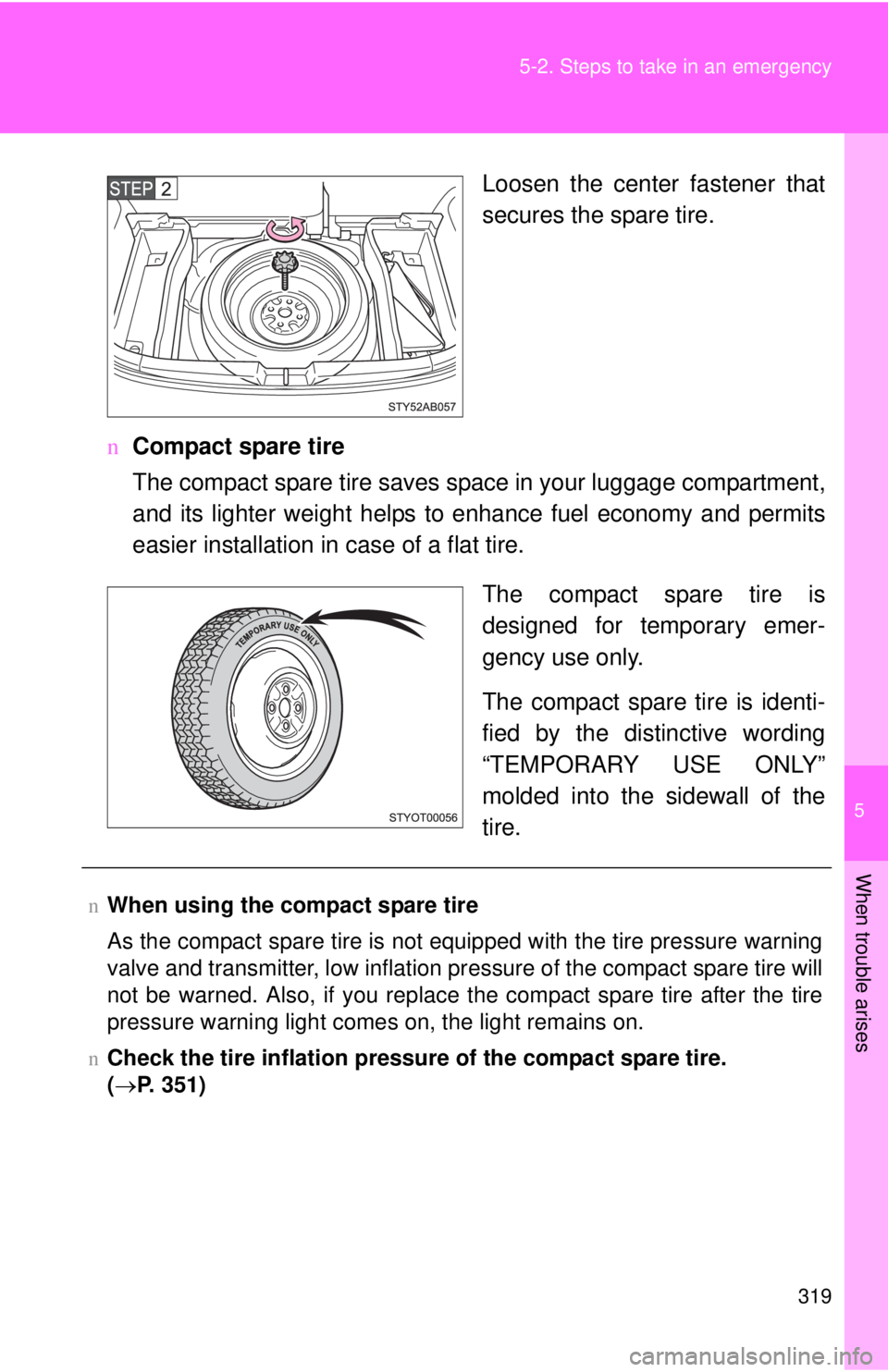
Loosen the center fastener that
secures the spare tire.
n Comp
act spare tire
The compact spare tire saves space in your luggage compartment,
and
its lighter weight helps to enhance fuel economy and permits
easier installation in case of a flat tire.
The compact spare tire is
d
esigned for temporary emer -
gency use only.
The compact spare tire is identi -
fied by the distinctive wording
“TE
MPORARY USE ONLY”
molded into the sidewall of the
tire.
nWhen using the compact spare tire
As the compact spare tire is not equipped with the tire pressure warning
valve and trans
mitter, low inflation pr essure of the compact spare tire will
not be warned. Also, if you replace the compact spare tire after the tire
pressure warning light comes on, the light remains on.
nCheck the tire inflation pressure of the compact spare tire.
( → P. 3 5 1 )
Page 335 of 402
5
When trouble arises
325
5-2. Steps to take in an emergency
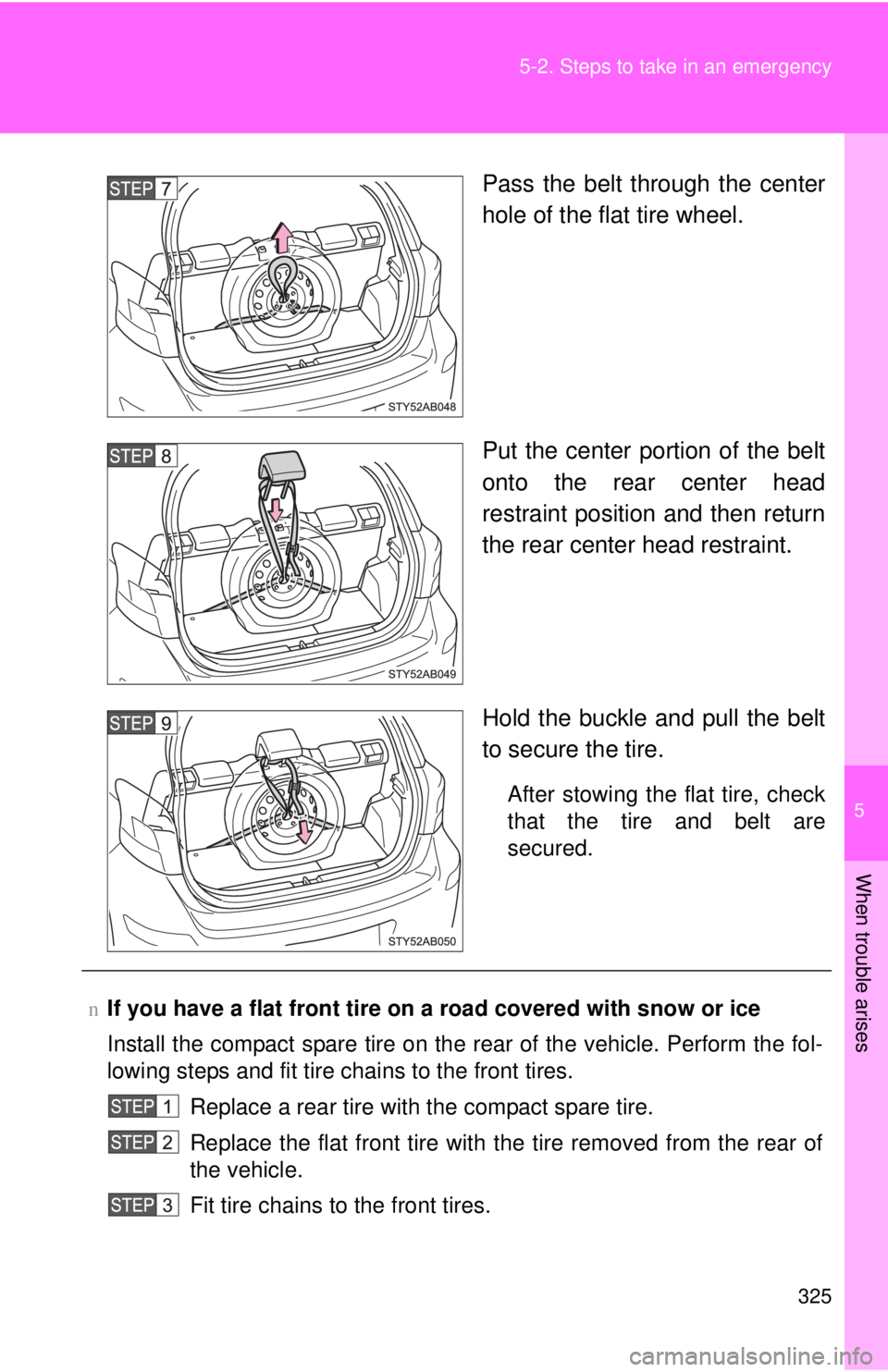
Pass the belt through the center
hole of the flat tire wheel.
Put the center portion of the belt
o
nto the rear center head
restraint position and then return
the rear center head restraint.
Hold the buckle and pull the belt
t
o secure the tire.
After stowing the flat tire, check
that the tire and belt are
secured.
nIf you have a flat front tire on a road covered with snow or ice
Install the compact spare tire on the rear of the vehicle. Perform the fol -
lowing steps and fit tire chains to the front tires.
Replace a rear tire with the compact spare tire.
Replace the flat front tire with t he tir
e removed from the rear of
the vehicle.
Fit tire chains to the front tires.
Page 336 of 402

326 5-2. Steps to take in an emergency
CAUTION
nUsing the jack
Improper use of the jack may lead to death or injuries due to the vehicle
suddenly falling off the jack.
lDo not use the jack for any purpose other than replacing tires or install-
ing and removing tire chains.
lOnly use the jack that comes with this vehicle for replacing a flat tire.
Do not use it on other vehicles, an d do not use other jacks for replac-
ing tires on this vehicle.
lAlways check that the jack is securely set to the jack point.
lDo not put any part of your body under the vehicle supported by a jack.
lDo not start or run the engine while your vehicle is supported by the
jack.
lDo not raise the vehicle while someone is in it.
lWhen raising the vehicle, do not put an object on or under the jack.
lDo not raise the vehicle to a heigh t greater than that required to
replace the tire.
lUse a jack stand if it is necessary to get under the vehicle.
Take particular care when lowering the vehicle to ensure that no one
working on or near the vehicle will be injured.
nReplacing a flat tire
Observe the following precautions to reduce the risk of death or serious
injury.
lNever use oil or grease on the wheel bolts or wheel nuts.
The oil or grease can cause the wheel nuts to loosen, causing a seri-
ous accident.
Remove any oil or grease on the wheel bolts or wheel nuts.
lHave the wheel nuts tightened with a torque wrench to 76 ft·lbf (103
N·m, 10.5 kgf·m) as soon as possible after changing wheels.
Failure to follow these precautions could cause the nuts to loosen and
the wheel may fall off, which could lead to an accident causing death
or serious injury.
Page 377 of 402
368 6-1. Specifications
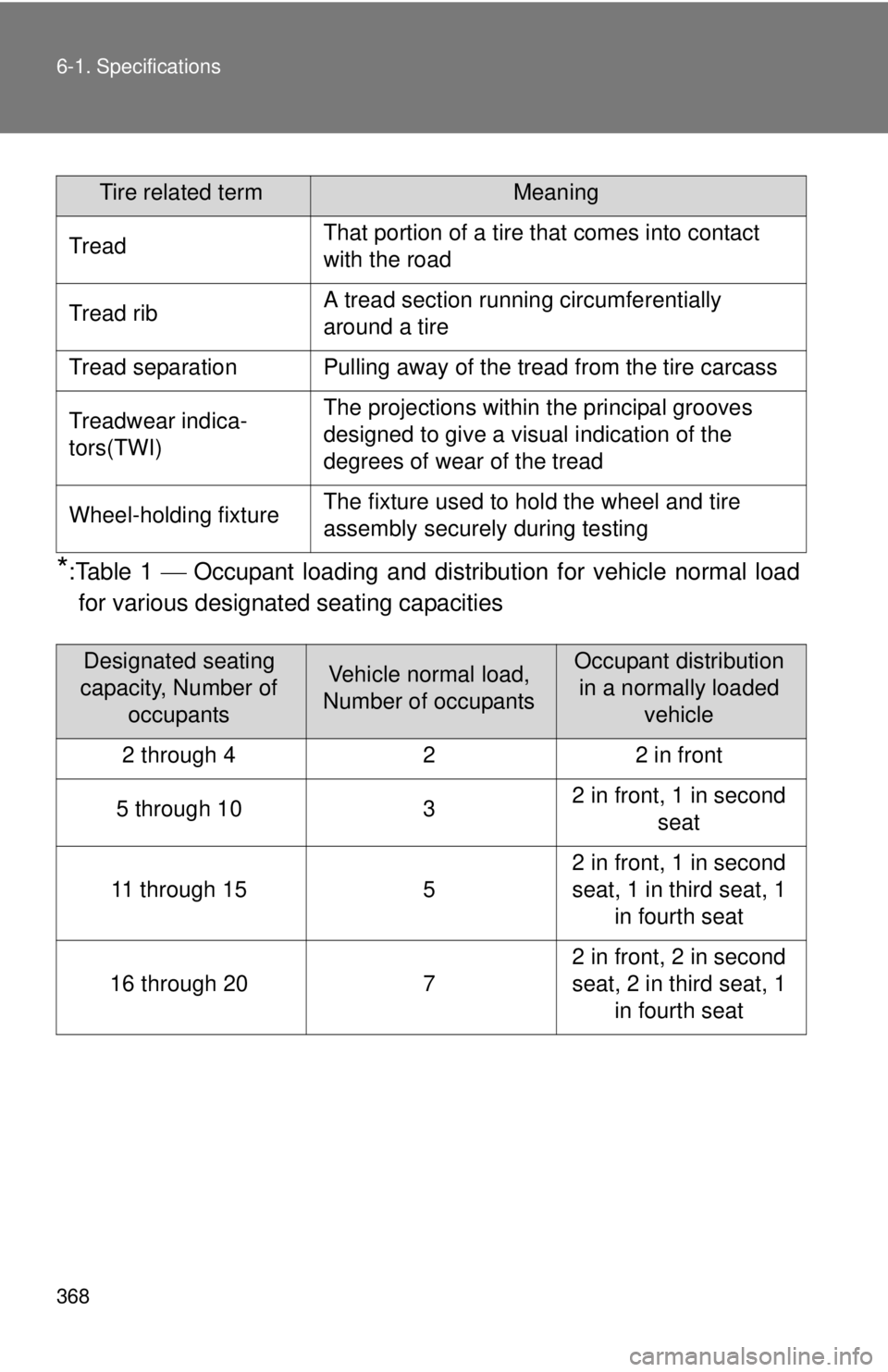
*:Table 1 ⎯ Occupant loading and distribut ion for vehicle normal load
for various designated seating capacities
Tire related termMeaning
TreadThat portion of a tire that comes into contact
with the road
Tread ribA tread section running circumferentially
around a tire
Tread separationPulling away of the tread from the tire carcass
Treadwear indica-
tors(TWI)The projections within the principal grooves
designed to give a visual indication of the
degrees of wear of the tread
Wheel-holding fixtureThe fixture used to hold the wheel and tire
assembly securely during testing
Designated seating
capacity, Number of occupants Vehicle normal load,
Number of occupantsOccupant distribution in a normally loaded vehicle
2 through 422 in front
5 through 1032 in front, 1 in second seat
11 through 155
2 in front, 1 in second
seat, 1 in third seat, 1 in fourth seat
16 through 207
2 in front, 2 in second
seat, 2 in third seat, 1 in fourth seat
Page 384 of 402
376
AT T E N T I O N
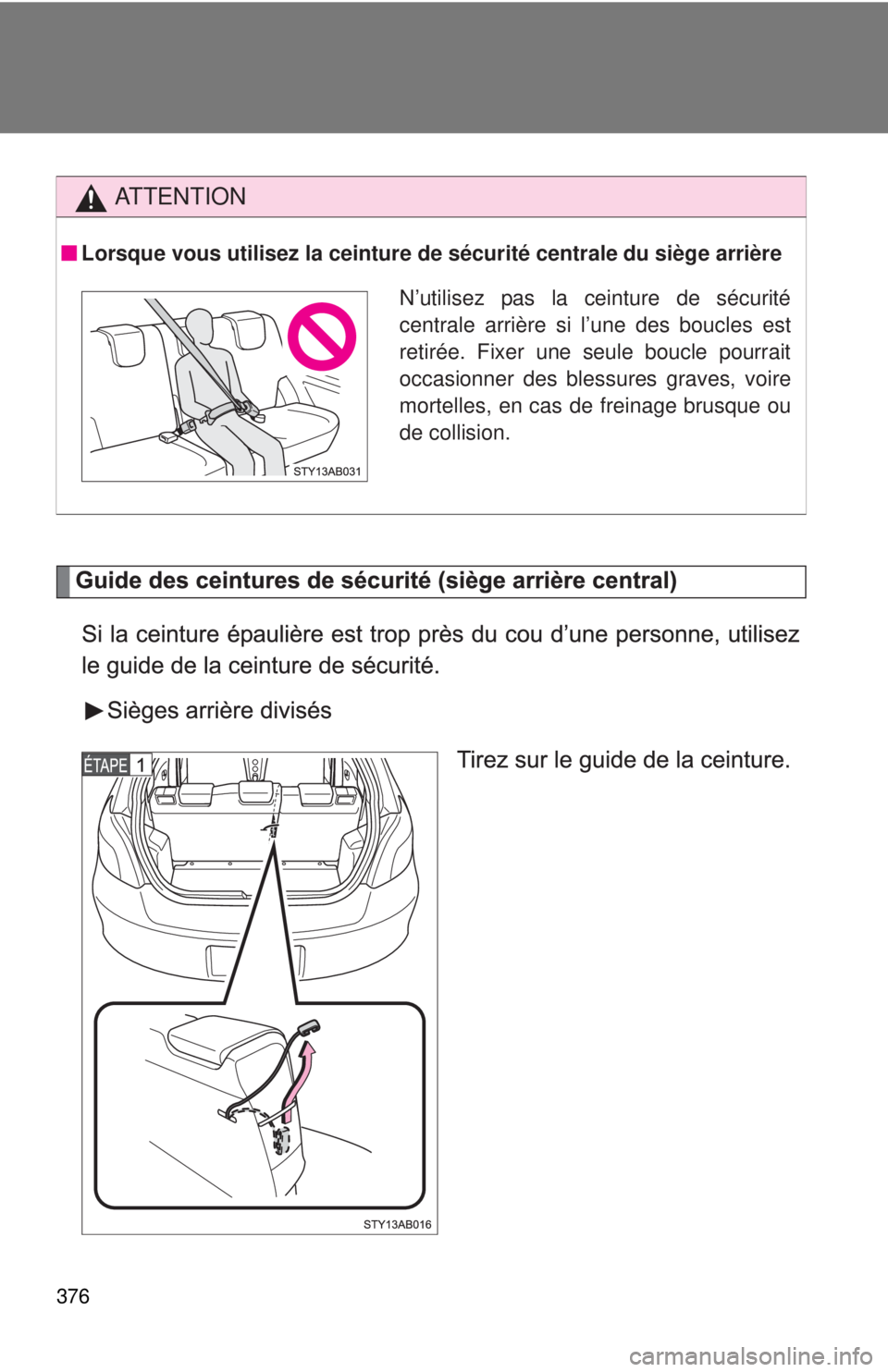
Lorsque vous utilisez la ceinture de sécurité centrale du siège arrière
N’utilisez pas la ceinture de sécurité
centrale arrière si l’une des boucles est
retirée. Fixer une seule boucle pourrait
occasionner des blessures graves, voire
mortelles, en cas de freinage brusque ou
de collision.