ECU TOYOTA YARIS HATCHBACK 2009 User Guide
[x] Cancel search | Manufacturer: TOYOTA, Model Year: 2009, Model line: YARIS HATCHBACK, Model: TOYOTA YARIS HATCHBACK 2009Pages: 402, PDF Size: 7.61 MB
Page 76 of 402
62
1-3. Adjustable components (seats, mirrors, steering wheel)
Steering wheel
CAUTION
nCaution while driving
Do not adjust the steering wheel while driving.
Doing so may cause the driver to mishandle the vehicle and an accident
may occur resulting in death or serious injury.
n After adjusting the steering wheel
Make sure that the steering wheel is securely locked.
Otherwise, the steering wheel may move suddenly, possibly causing an
accident and resulting in death or serious injury.
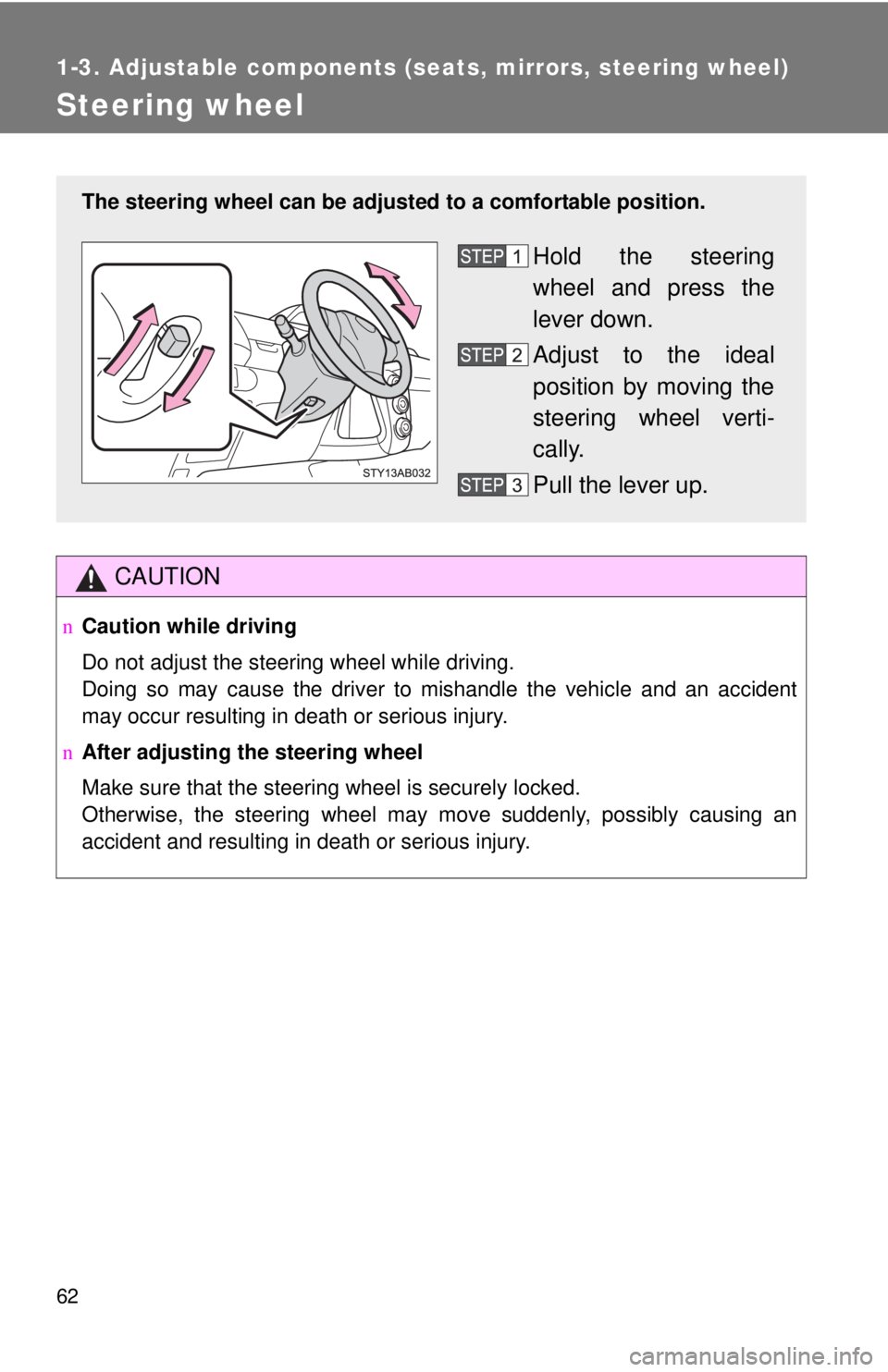
The steering wheel can be adjust ed to a comfortable position.
Hold the steering
wheel and press the
lever down.
Adjust to the ideal
position by moving the
ste
ering wheel verti -
cally.
Pull the lever up.
Page 88 of 402
74
1-6. Theft deterrent system
Engine immobilizer system (if equipped)
nSystem maintenance
The vehicle has a maintenance-free type of engine immobilizer system.
n Conditions that may
cause the system to malfunction
l If the
key is in contact with a metallic object
lIf
the key is in close proximity to or touching a key to the security system
(key with a built-in transponder chip) of another vehicle
n Certifications for the engine immobilizer system
For vehicles sold in U.S.A.
FCC ID: MOZRI-20BTY
This device complies with Part 15 of the FCC Rules. Operation is subject to
the followin
g two conditions: (1) This device may not cause harmful interfer -
ence, and (2) this device must accept any interference received, including
interference that may cause undesire
d operation.
FCC WARNING:
Changes or modifications not expressly approved by the party responsible
for complia
nce could void the user’s authority to operate the equipment.
The vehicle's keys have built-in tran sponder chips that prevent the
engine from starting if the key has not been previously registered in
the vehicle's on-board computer.
Never leave the keys inside the vehicle when you leave the vehicle.
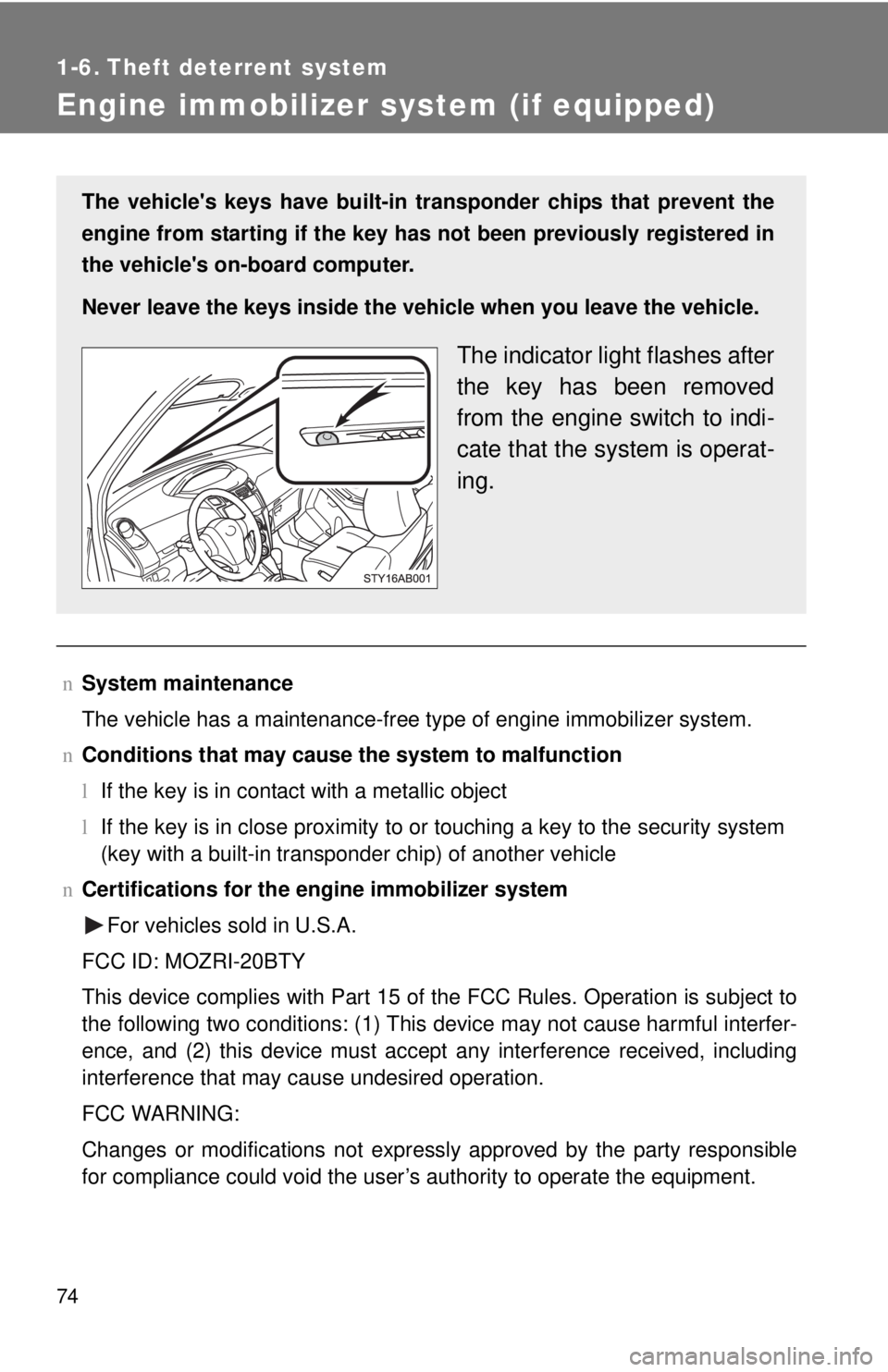
The indicator light flashes after
the key has been removed
from the engine switch to indi -
cate that the system is operat-
ing.
Page 96 of 402
82 1-7. Safety information
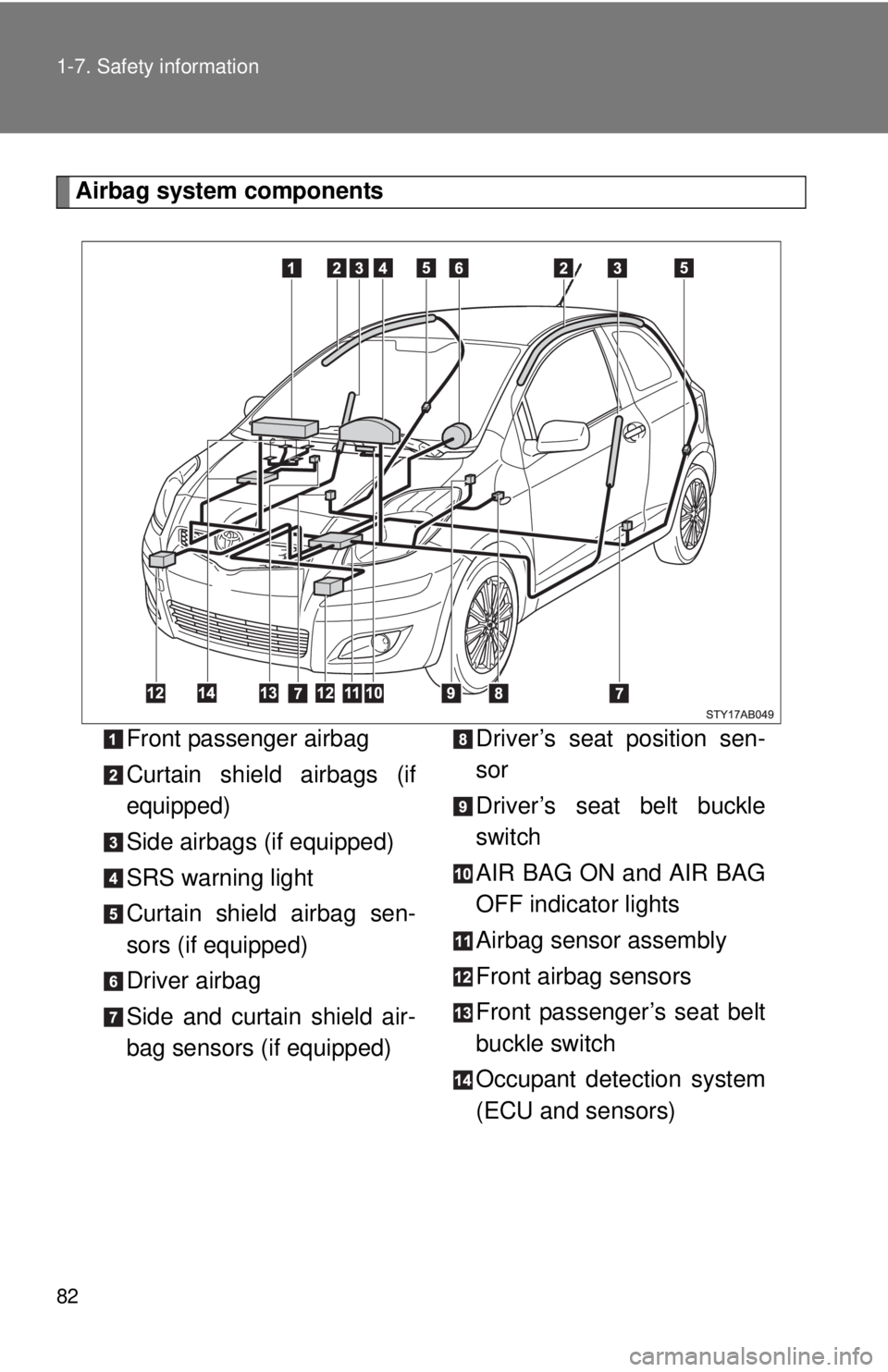
Airbag system components
Front passenger airbag
Curtain shield airbags (if
equipped)
Side airbags (if equipped)
SRS warning light
Curtain shield airbag sen-
sors (if equipped)
Driver airbag
Side and curtain shield air-
bag sensors (if equipped)Driver’s seat position sen-
sor
Driver’s seat belt buckle
switch
AIR BAG ON and AIR BAG
OFF indicator lights
Airbag sensor assembly
Front airbag sensors
Front passenger’s seat belt
buckle switch
Occupant detection system
(ECU and sensors)
Page 103 of 402
89
1-7. Safety information
1
Before driving
CAUTION
n
SRS airbag precautions
lThe SRS front passenger airbag also deploys with considerable force, and
can cause death or serious injury especially if the front passenger is very
close to the airbag. The front passenger seat should be as far from the air-
bag as possible with the seatback adjusted, so the front passenger sits
upright.
l Improperly seated and/or restrained in fants and children can be killed or
seriously injured by a deploying airbag. An infant or child who is too small
to use a seat belt should be properly secured using a child restraint sys-
tem. Toyota strongly recommends that all infants and children be placed in
the rear seats of the vehicle and properly restrained. The rear seats are
the safest for infants and children. ( →P. 98)
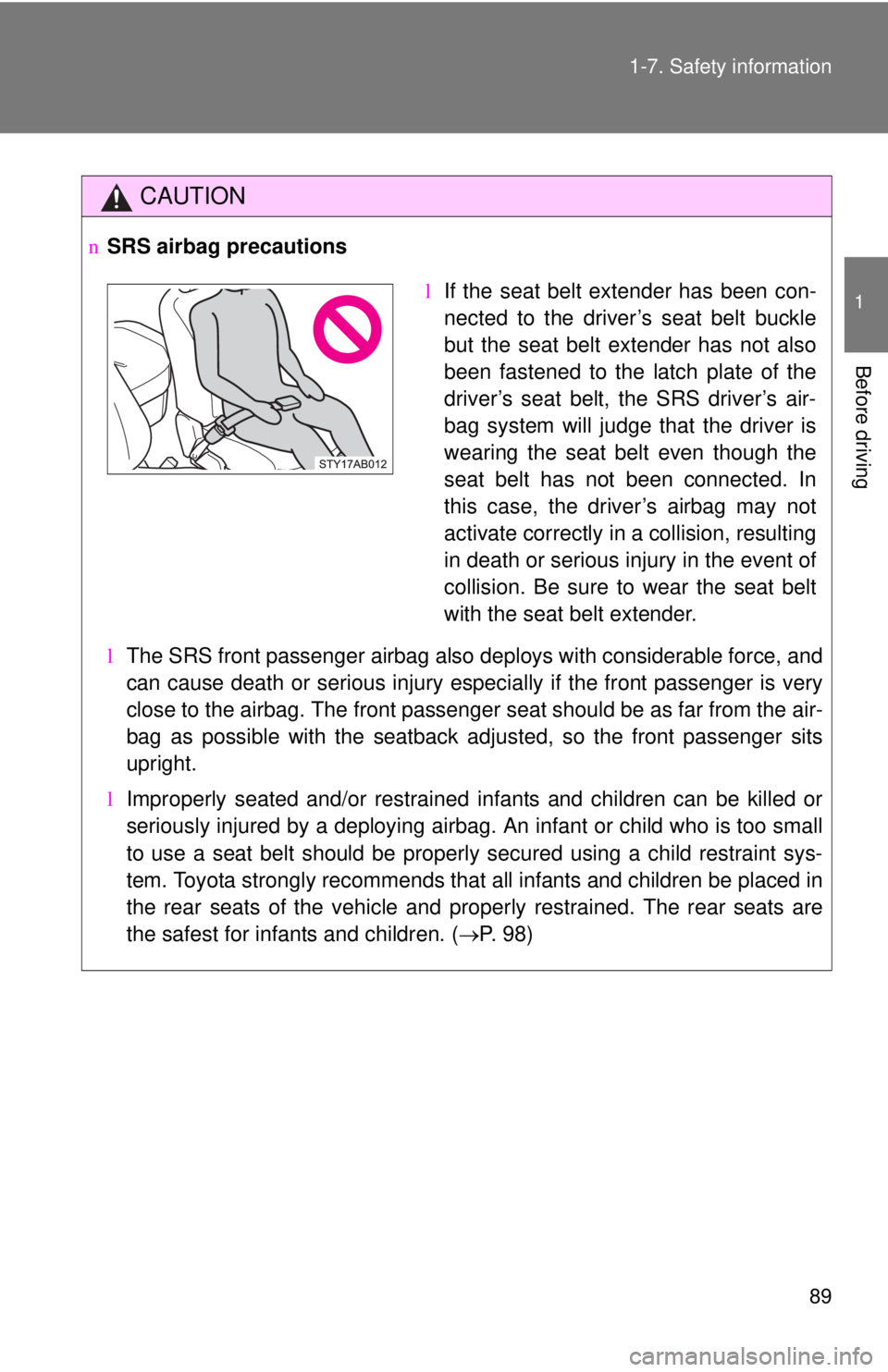
lIf the seat belt extender has been con-
nected to the driver’s seat belt buckle
but the seat belt extender has not also
been fastened to the latch plate of the
driver’s seat belt, the SRS driver’s air-
bag system will judge that the driver is
wearing the seat belt even though the
seat belt has not been connected. In
this case, the driver’s airbag may not
activate correctly in a collision, resulting
in death or serious injury in the event of
collision. Be sure to wear the seat belt
with the seat belt extender.
Page 114 of 402
100 1-7. Safety information
CAUTION
nChild restraint precautions
lFor effective protection in automobile accidents and sudden stops, a child
must be properly restrained, using a seat belt or child restraint system
depending on the age and size of the child. Holding a child in your arms is
not a substitute for a child restraint system. In an accident, the child can be
crushed against the windshield, or between you and the vehicle's interior.
l Toyota strongly urges the use of a proper child restraint system that con-
forms to the size of the child, installed on the rear seat. According to acci-
dent statistics, the child is safer when properly restrained in the rear seat
than in the front seat.
l Never install a rear-facing child restraint system on the front passenger
seat even if AIR BAG OFF indicator light is illuminated. In the event of an
accident, the force of the rapid inflation of the front passenger airbag can
cause death or serious injury to the child if the rear-facing child restraint
system is installed on the front passenger seat.
l A forward-facing child restraint system may be installed on the front pas-
senger seat only when it is unavoidable. A child restraint system that
requires a top tether strap should not be used in the front passenger seat
since there is no top tether strap anchor for the front passenger seat.
Adjust the seatback as upright as possible and always move the seat as
far back as possible even if the AIR BAG OFF indicator light is illuminated,
because the front passenger airbag could inflate with considerable speed
and force. Otherwise, the child may be killed or seriously injured.
l Do not use the seat belt extender when installing a child restraint system
on the front or rear passenger seat. If installing a child restraint system
with the seat belt extender connected to the seat belt, the seat belt will not
securely hold the child restraint system, which could cause death or seri-
ous injury to the child or other passengers in the event of collision.
l Vehicles with side airbags and curtain shield airbags: Do not allow the
child to lean his/her head or any part of his/her body against the door or
the area of the seat, front and rear pill ars or roof side rail from which the
side airbags or curtain shield airbags deploy even if the child is seated in
the child restraint system. It is dangerous if the side airbags and curtain
shield airbags inflate, and the impact could cause death or serious injury to
the child.
Page 115 of 402
101
1-7. Safety information
1
Before driving
CAUTION
n
Child restraint precautions
lMake sure you have complied with all installation instructions provided by
the child restraint manufacturer and that the system is properly secured. If
it is not secured properly, it may cause death or serious injury to the child
in the event of a sudden stop or accident.
n Child restraint lock function belt precaution
Do not allow children to play with the child restraint lock function belt. If the
belt becomes twisted around a child’s neck, it will not be possible to pull the
belt out leading to choking or other serious injuries that could result in death.
If this occurs and the buckle cannot be unfastened, scissors should be used
to cut the belt.
n When the child restrain t system is not in use
l Keep the child restraint system properly secured on the seat even if it is
not in use. Do not store the restraint unsecured in the passenger compart-
ment.
l If it is necessary to detach the child restraint system, remove it from the
vehicle or store it securely in the luggage compartment. This will prevent it
from injuring passengers in the event of a sudden stop or accident.
Page 116 of 402
102
1-7. Safety information
Installing child restraints
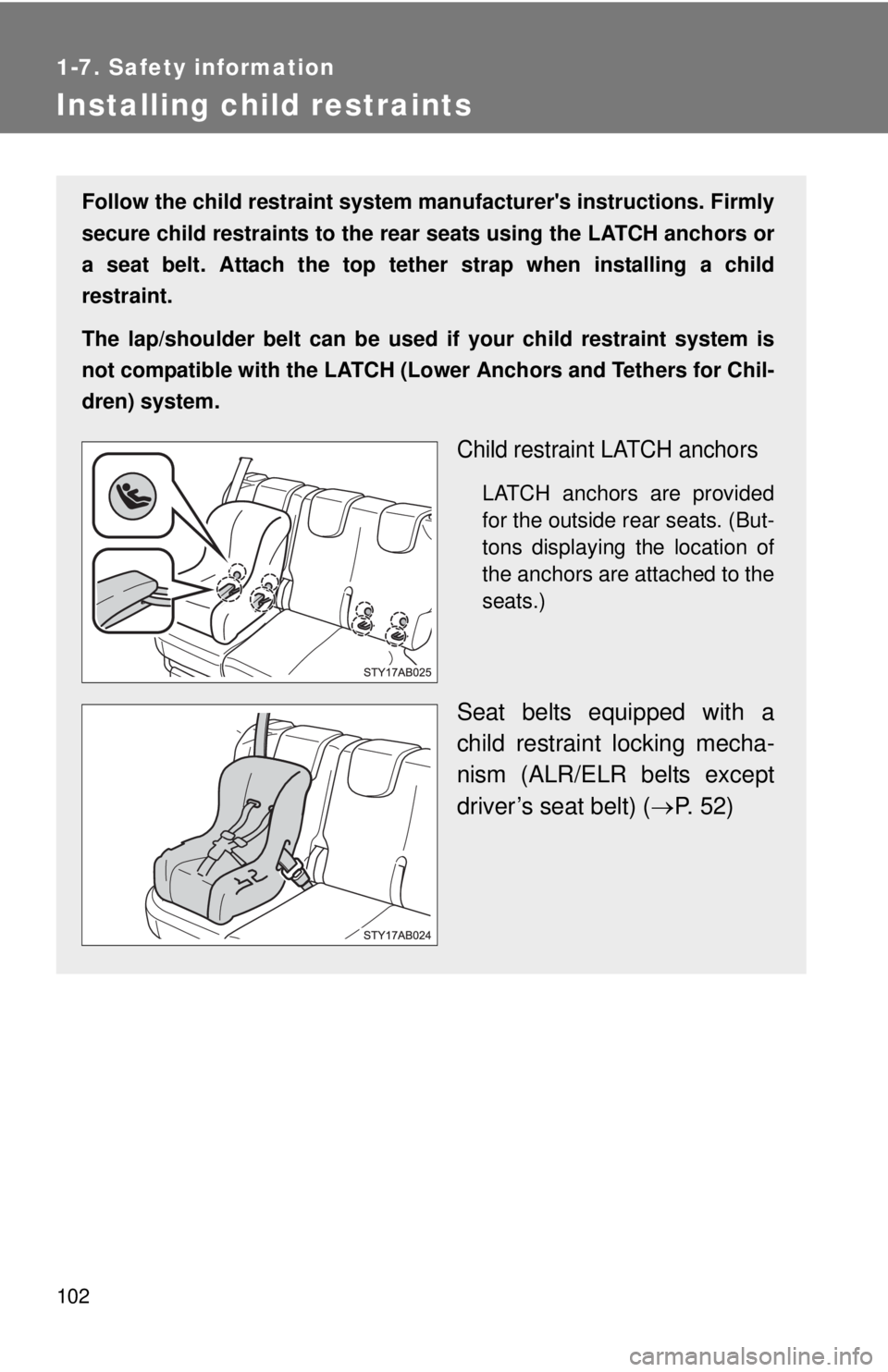
Follow the child restraint system manufacturer's instructions. Firmly
secure child restraints to the rear seats using the LATCH anchors or
a seat belt. Attach the top tether strap when installing a child
restraint.
The lap/shoulder belt can be used if your child restraint system is
not compatible with the LATCH (Low er Anchors and Tethers for Chil-
dren) system.
Child restraint LATCH anchors
LATCH anchors are provided
for the outside rear seats. (But -
tons displaying the location of
the anchors are att
ached to the
seats.)
Seat belts equipped with a
child restraint locking mecha -
nism (ALR/ELR belts except
d
river’s seat belt) ( →P. 5 2 )
Page 120 of 402
106 1-7. Safety information
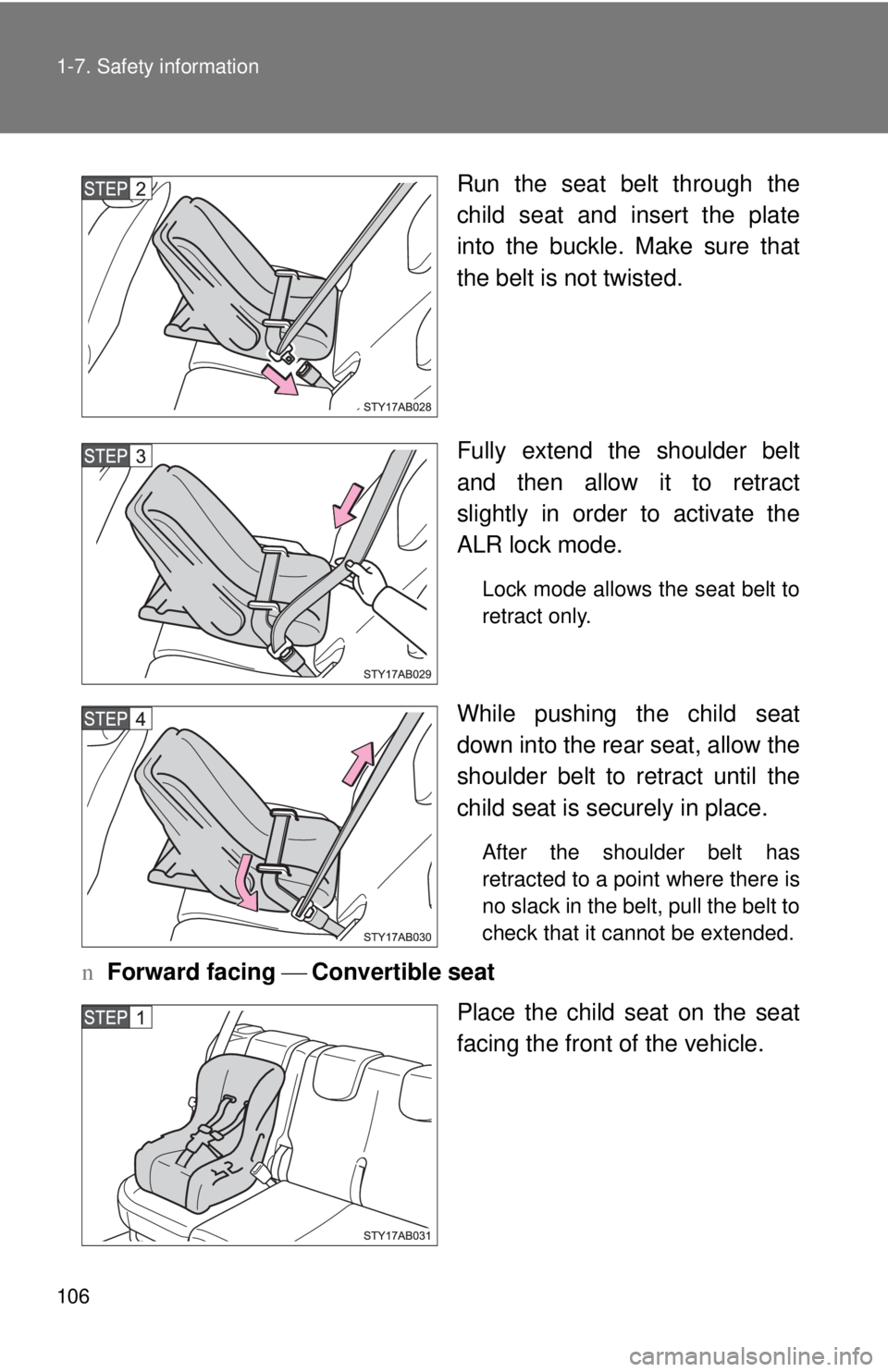
Run the seat belt through the
child seat and insert the plate
into the buckle. Make sure that
the belt is not twisted.
Fully extend the shoulder belt
an
d then allow it to retract
slightly in order to activate the
ALR lock mode.
Lock mode allows the seat belt to
retract only.
While pushing the child seat
down into the rear seat, allow the
shoulder belt to retract until the
child seat is securely in place.
After the shoulder belt has
retracted to a point where there is
no slack in the belt, pull the belt to
check that it cannot be extended.
n Forward facing ⎯ Convertible seat
Place the child seat on the seat
facing the fr
ont of the vehicle.
Page 121 of 402
107
1-7. Safety information
1
Before driving
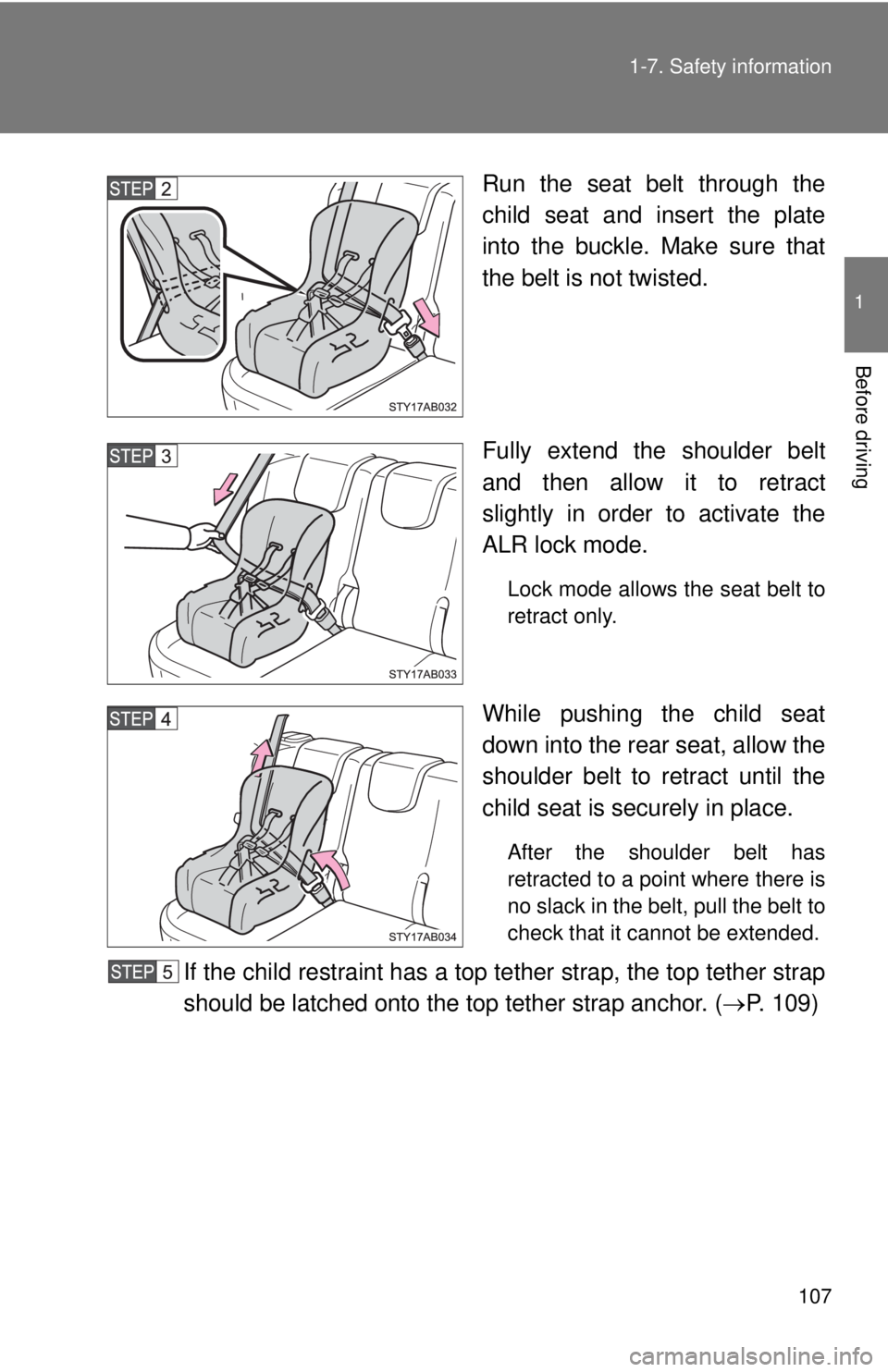
Run the seat belt through the
child seat and insert the plate
into the buckle. Make sure that
the belt is not twisted.
Fully extend the shoulder belt
and
then allow it to retract
slightly in order to activate the
ALR lock mode.
Lock mode allows the seat belt to
retract only.
While pushing the child seat
down into the rear seat, allow the
shoulder belt to retract until the
child seat is securely in place.
After the shoulder belt has
retracted to a point where there is
no slack in the belt, pull the belt to
check that it cannot be extended.
If the child restraint has a top te ther strap, the top tether strap
should be latched onto the top tether strap anchor. ( →P. 1 0 9 )
Page 123 of 402
109
1-7. Safety information
1
Before driving
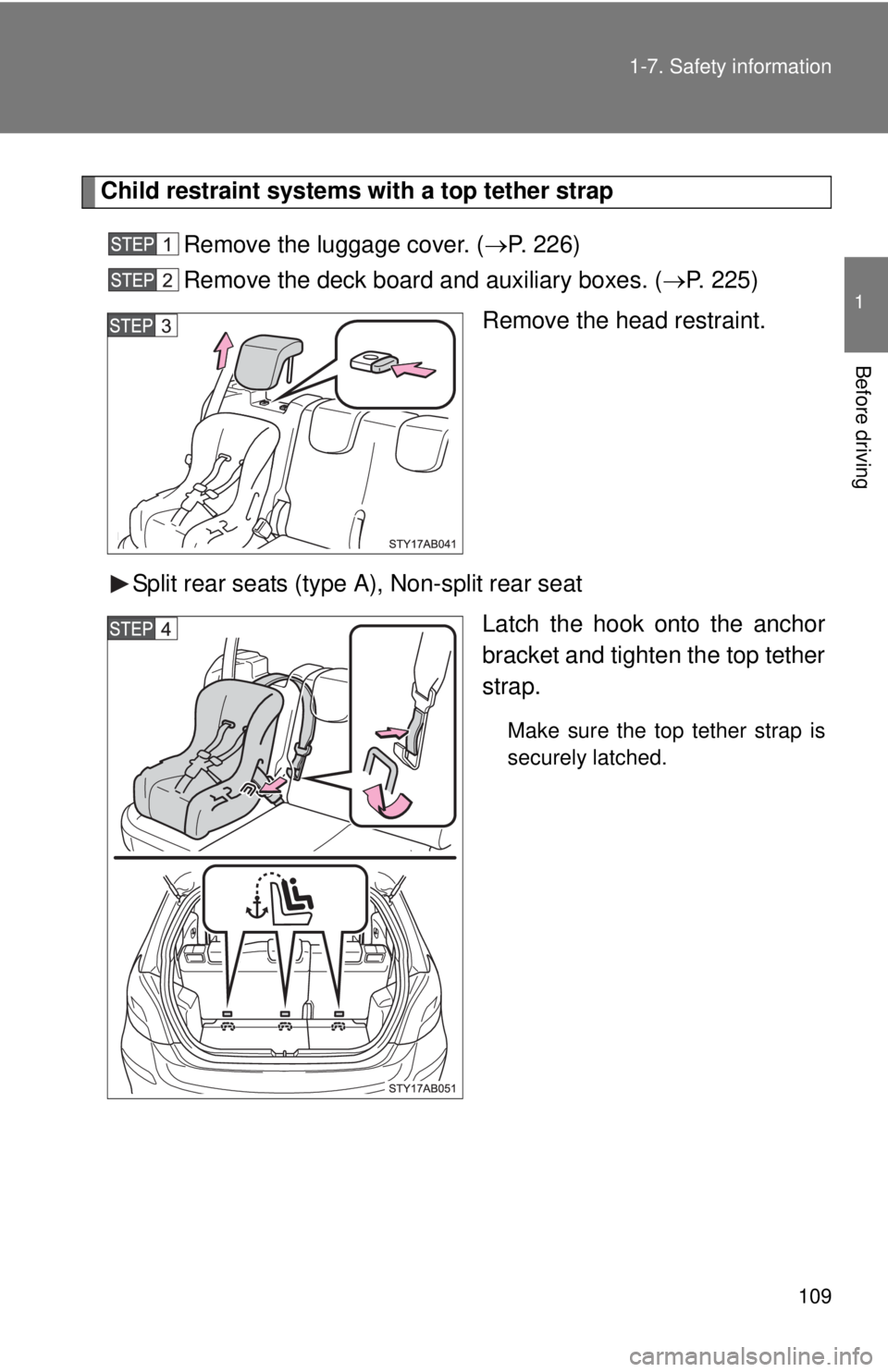
Child restraint systems with a top tether strap
Remove the luggage cover. (
→P. 226 )
Remove the deck board and auxiliary boxes. ( →P. 2 2 5 )
Remove the head restraint.
Split rear seats (type A), Non-split rear seat Latch the hook onto the anchor
b
racket and tighten the top tether
strap.
Make sure the top tether strap is
securely latched.