power steering TOYOTA YARIS HATCHBACK 2009 Owners Manual
[x] Cancel search | Manufacturer: TOYOTA, Model Year: 2009, Model line: YARIS HATCHBACK, Model: TOYOTA YARIS HATCHBACK 2009Pages: 402, PDF Size: 7.61 MB
Page 3 of 402
1
OVERVIEW
FEATURES/OPERATIONS
SAFETY AND EMERGENCY FEATURES
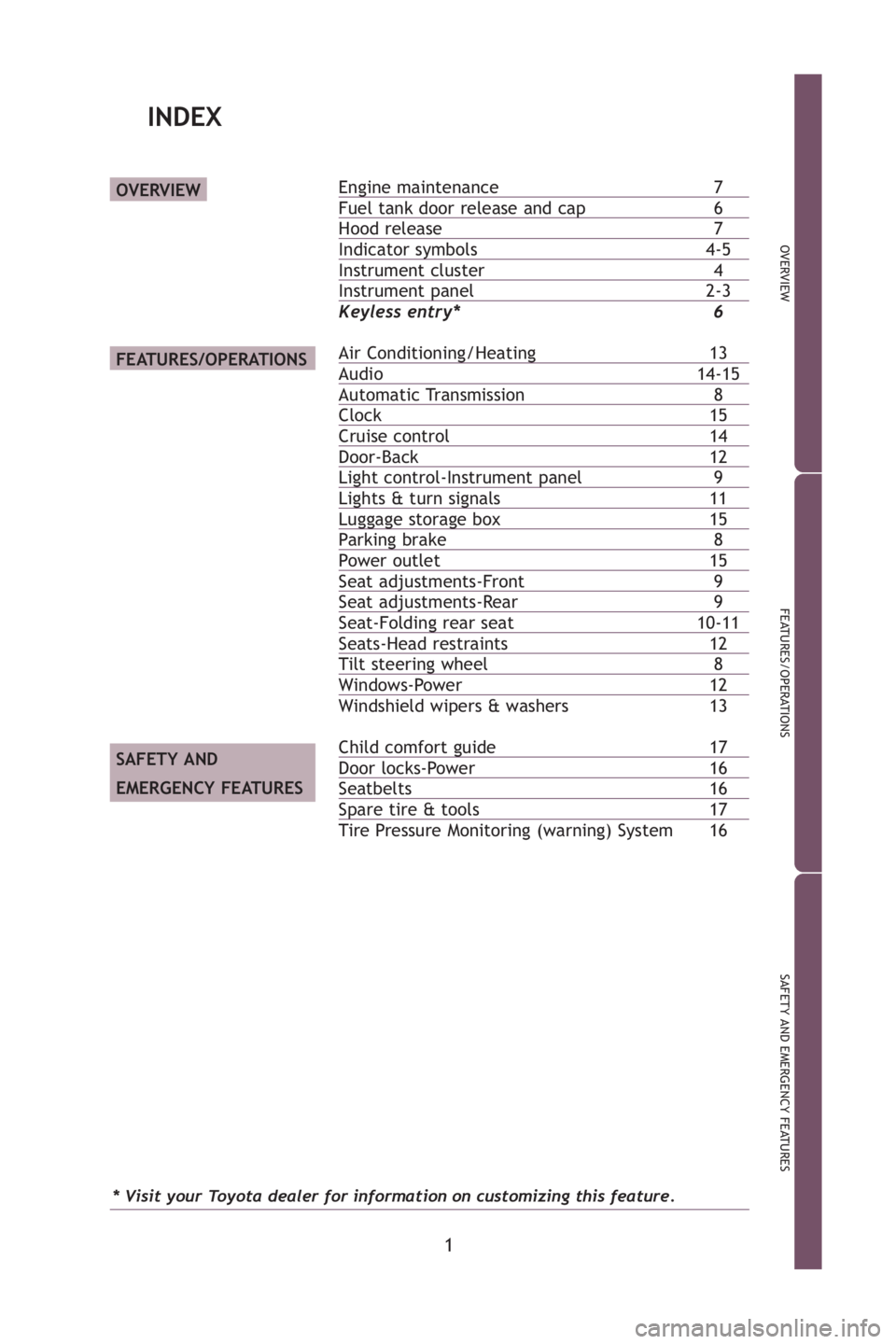
Enginemaintenance7Fuel tank door release and cap6Hood release 7Indicator symbols4-5Instrument cluster 4Instrument panel2-3
Keyless entry* 6
Air Conditioning/Heating13Audio 14-15Automatic Transmission 8Clock15Cruise control14Door-Back 12Lightcontrol-Instrument panel9Lights& turn signals11Luggagestoragebox15Parkingbrake 8Power outlet 15Seat adjustments-Front9Seat adjustments-Rear9Seat-Foldingrear seat10-11Seats-Head restraints 12Tilt steeringwheel8Windows-Power 12
Windshield wipers & washers 13
Child comfort guide17Door locks-Power 16Seatbelts16Sparetire & tools17
Tire Pressure Monitoring (warning) System 16
OVERVIEW
FEATURES/OPERATIONS
SAFETY AND
EMERGENCY FEATURES
INDEX
* Visit your Toyota dealer for information on customizing this feature.
412782M2.qxd:_412782M2 8/18/08 2:02 PM Page 1
Page 5 of 402
3
OVERVIEW
FEATURES/OPERATIONS
SAFETY AND EMERGENCY FEATURES
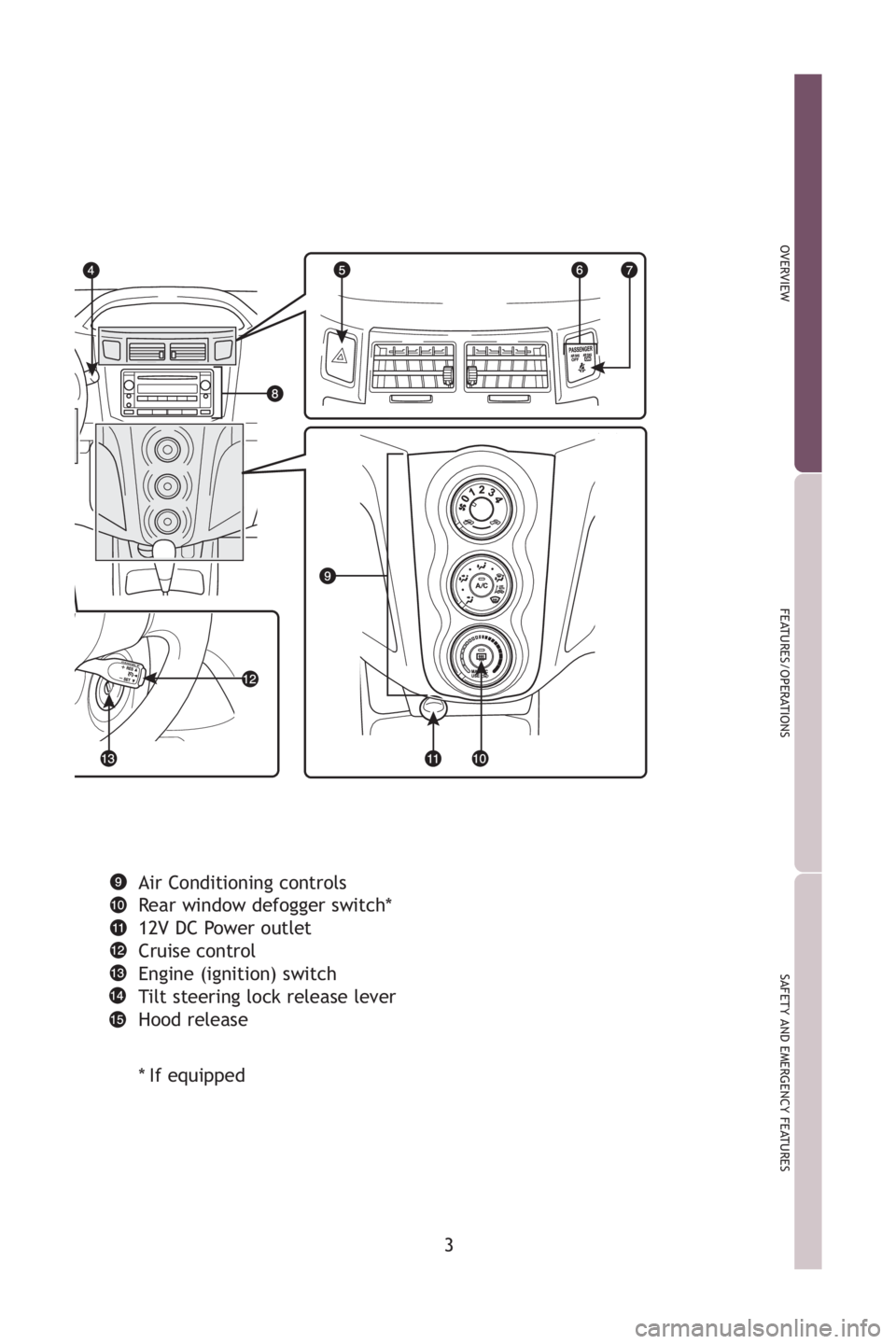
Air Conditioning controls
Rear window defogger switch*
12V DC Power outlet
Cruise control
Engine (ignition) switch
Tilt steering lock release lever
Hood release
*If equipped
412782M2.qxd:_412782M2 8/18/08 2:04 PM Page 3
Page 7 of 402
5
OVERVIEW
FEATURES/OPERATIONS
SAFETY AND EMERGENCY FEATURES
2For details, refer to “If a warning light turns on or a warning buzzer sounds,” Section
5-2, 2009 Owner’s Manual.
3For details, refer to “If your vehicle overheats,” Section 5-2, 2009 Owner’s Manual.
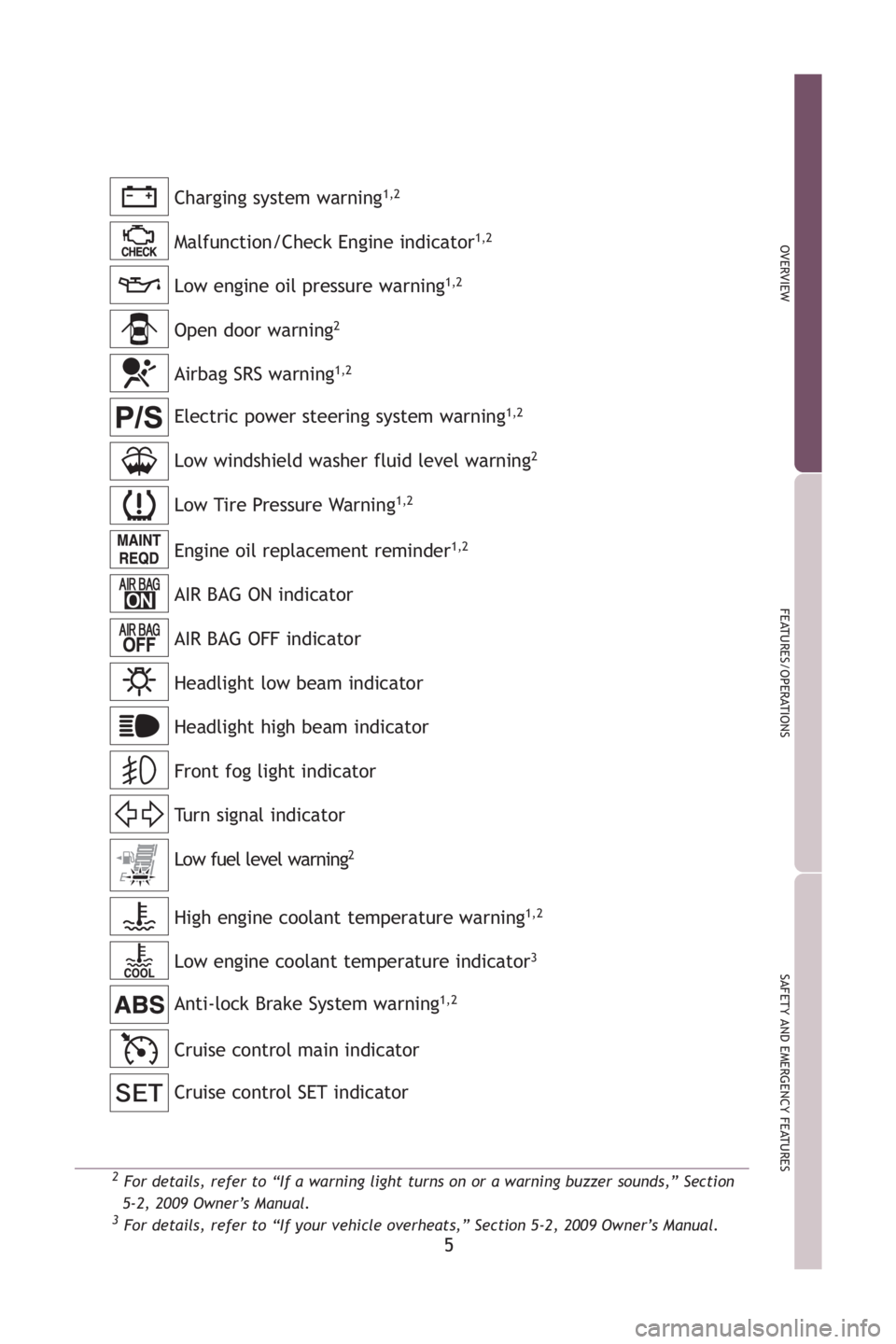
Charging system warning1,2
Low engine oil pressure warning1,2
Anti-lock Brake System warning1,2
Malfunction/Check Engine indicator1,2
Open door warning2
Low windshield washer fluid level warning2
Engine oil replacement reminder1,2
AIR BAG ON indicator
AIR BAG OFF indicator
Headlight low beam indicator
Turn signal indicator
Low fuel level warning2
Headlight high beam indicator
High engine coolant temperature warning
1,2
Airbag SRS warning1,2
Electric power steering system warning1,2
Low engine coolant temperature indicator3
Front fog light indicator
Low Tire Pressure Warning1,2
Cruise control SET indicator
Cruise control main indicator
412782M2.qxd:_412782M2 8/18/08 2:06 PM Page 5
Page 10 of 402
8
FEATURES/OPERATIONS
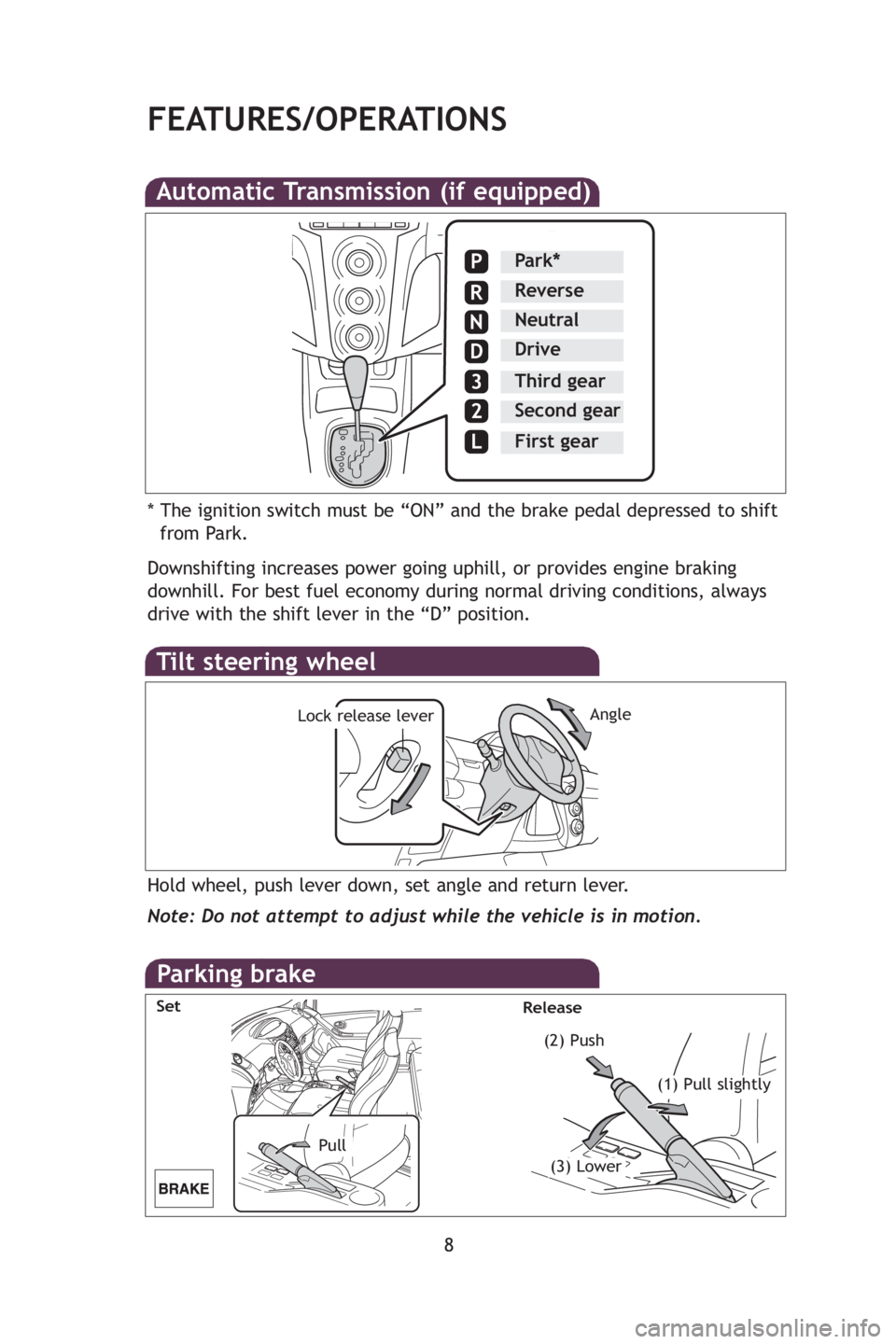
Automatic Transmission (if equipped)
* The ignition switch must be “ON” and the brake pedal depressed to shiftfrom Park.
Downshifting increases power going uphill, or provides engine braking
downhill. For best fuel economy during normal driving conditions, always
drive with the shift lever in the “D” position.
Park*
Reverse
Neutral
Drive
Third gear
Second gear
First gear
P
R
N
D
3
2
L
Tilt steering wheel
Angle
Hold wheel, push lever down, set angle and return lever.
Note: Do not attempt to adjust while the vehicle is in motion.
Lock release lever
Parking brake
Sea
Sea
Non
Pull (2) Push
Set
Release
(1) Pull slightly
(3) Lower
Spli
Seat
Lig
412782M2.qxd:_412782M2 8/18/08 2:06 PM Page 8
Page 19 of 402
380
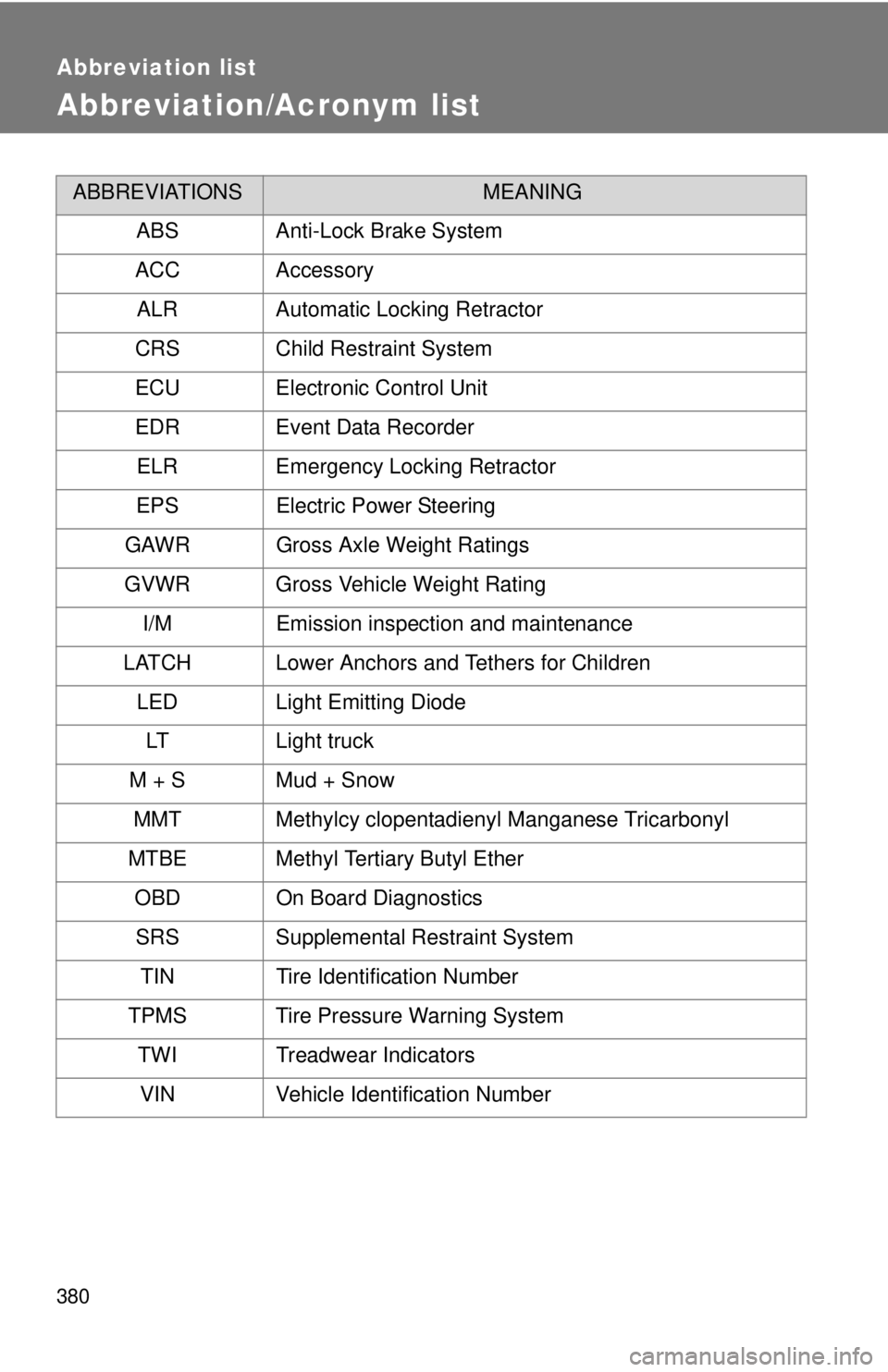
Abbreviation list
Abbreviation/Acronym list
ABBREVIATIONSMEANING
ABS Anti-Lock Brake System
ACC Accessory ALR Automatic Locking Retractor
CRS Child Restraint System
ECU Electronic Control Unit
EDR Event Data Recorder ELR Emergency Locking Retractor
EPS Electric Power Steering
GAWR Gross Axle Weight Ratings
GVWR Gross Vehicle Weight Rating I/M Emission inspection and maintenance
LATCH Lower Anchors and Tethers for Children LED Light Emitting Diode
LT Light truck
M + S Mud + Snow MMT Methylcy clopentadienyl Manganese Tricarbonyl
MTBE Methyl Tertiary Butyl Ether OBD On Board DiagnosticsSRS Supplemental Restraint System
TIN Tire Identification Number
TPMS Tire Pressure Warning System TWI Treadwear Indicators
VIN Vehicle Identification Number
Page 78 of 402
64
1-3. Adjustable components (seats, mirrors, steering wheel)
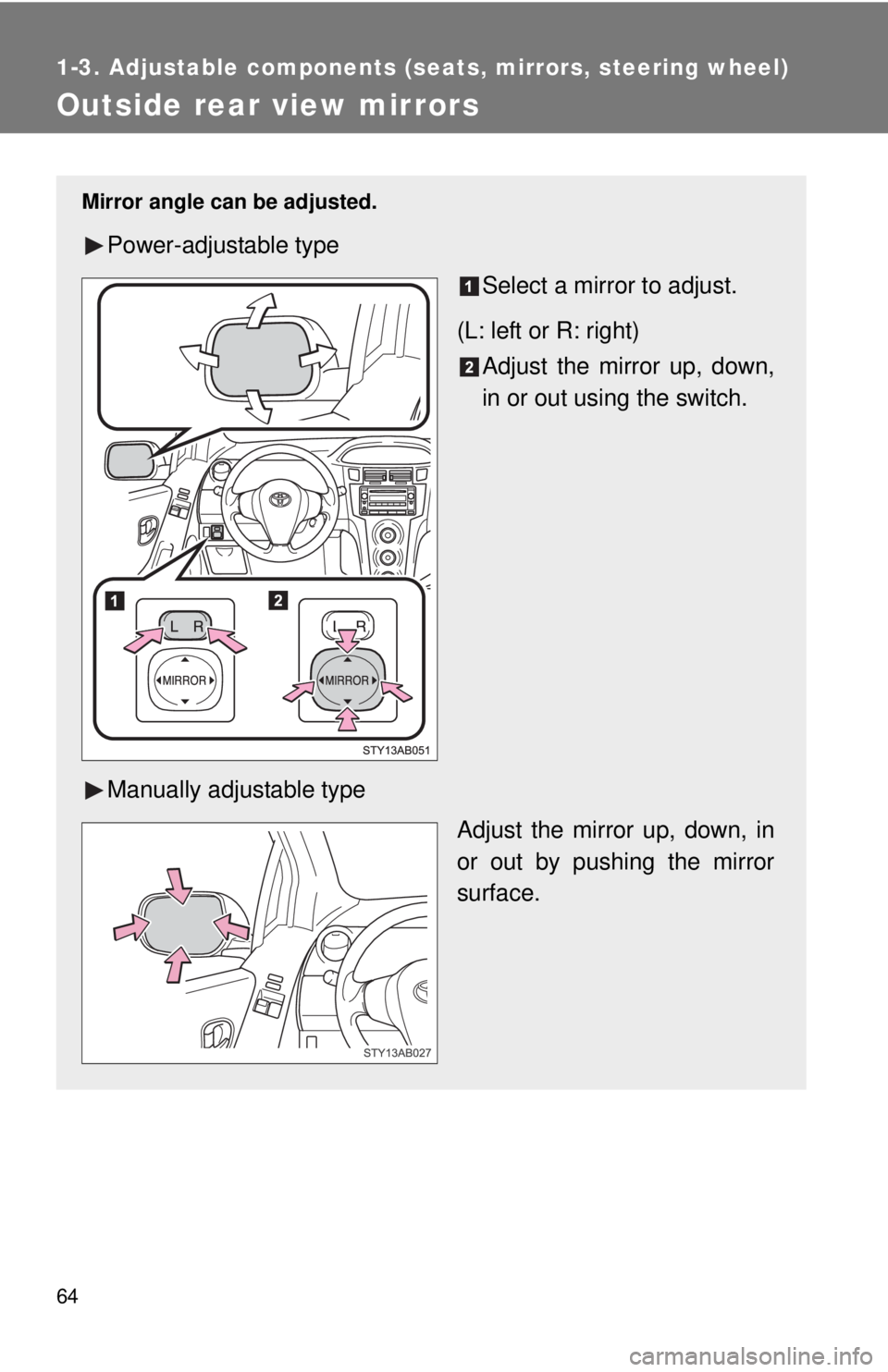
Outside rear view mirrors
Mirror angle can be adjusted.
Power-adjustable type
Select a mirror to adjust.
(L: left or R: right) Adjust the mirror up, down,
in or out using the switch.
Manually adjustable type Adjust the mirror up, down, in
or
out by pushing the mirror
surface.
Page 79 of 402
65
1-3. Adjustable components (s
eats, mirrors, steering wheel)
1
Before driving
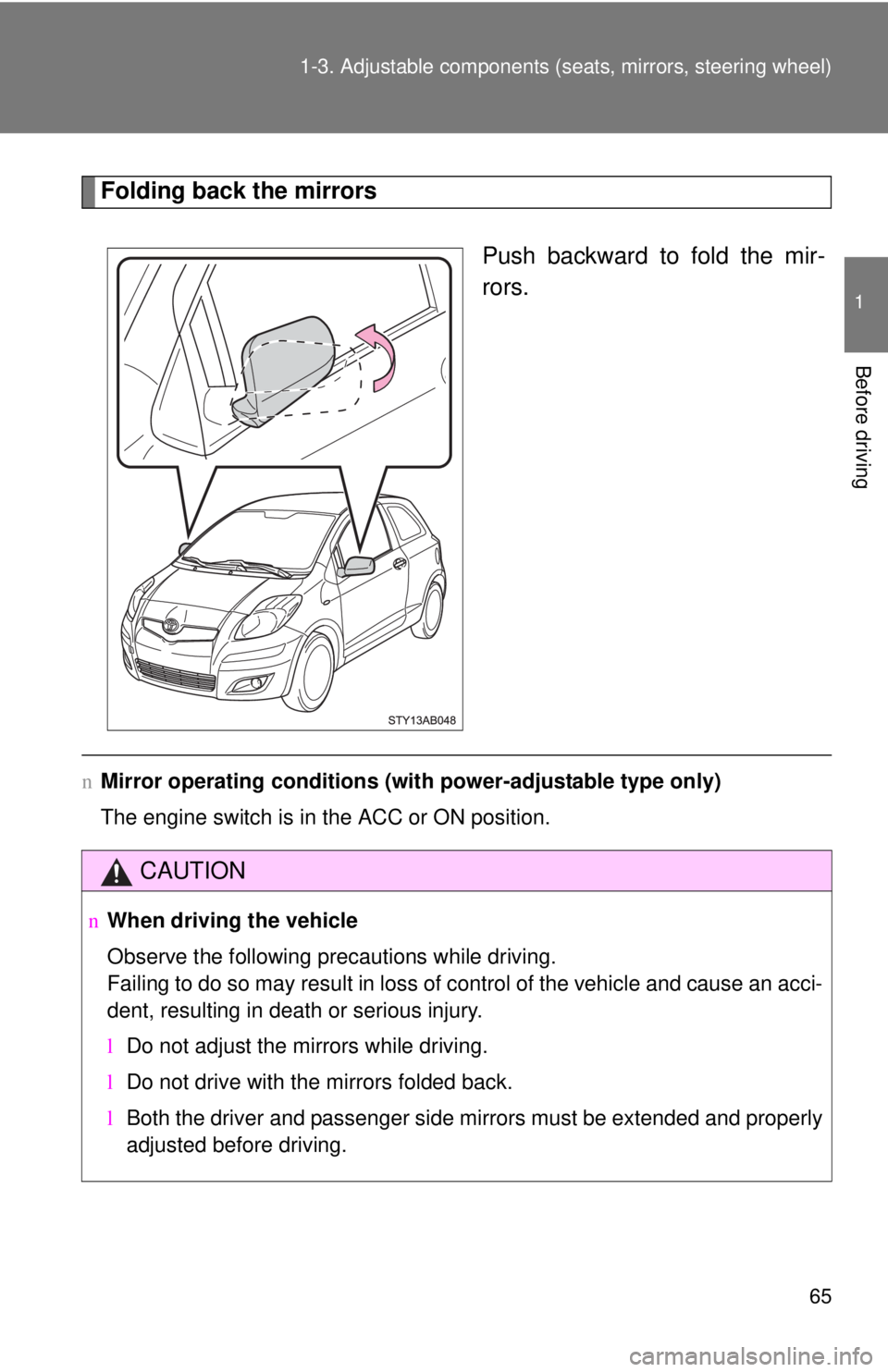
Folding back the mirrors
Push backward to fold the mir -
rors.
n Mirror operating conditions (wit h power-adjustable type only)
The engine switch is in the ACC or ON position.
CAUTION
nWhen driving the vehicle
Observe the following precautions while driving.
Failing to do so may result in loss of control of the vehicle and cause an acci-
dent, resulting in death or serious injury.
l Do not adjust the mirrors while driving.
l Do not drive with the mirrors folded back.
l Both the driver and passenger side mirrors must be extended and properly
adjusted before driving.
Page 97 of 402

83
1-7. Safety information
1
Before driving
Your vehicle is equipped with
ADVANCED AIRBAGS designed based
on US motor vehicle safety standards (FMVSS208). The airbag sys -
tem controls airbag deployment power
for the driver and front pas-
senger. The driver airbag system consists of the driver seat’s position
se
nsor etc. The front passenger’s airbag system consists of the front
passenger occupant classification sensor etc.
The main SRS airbag system components are shown above. The
SRS airbag
system is controlled by the airbag sensor assembly. The
airbag sensor assembly consists of a safing sensor and an airbag
sensor.
In certain types of severe frontal or side imp
acts, the SRS airbag sys-
tem triggers the airbag inflators. A chemical rea
ction in the inflators
quickly fills the airbags with non-toxic gas to help restrain the motion
of the occupants.
n SRS warning light
This warning light system monitors the airbag sensor assembly, front airbag
sensors, side and curtain shield airbag sensors, curtain shield airbag sen -
sors, driver’s seat position sensor, driver’s seat belt buckle switch, front pas -
senger occupant classification system, AIR BAG ON indicator light, AIR
BAG OFF indicator
light, front passenger’s seat belt buckle switch, seat belt
pretensioner assemblies, inflators, interconnecting wiring and power
sources. ( →P. 3 0 8 )
n If the SRS airbags deploy (inflate)
l Bruising and
slight abrasions may result from contact with a deploying
(inflating) SRS airbag.
l A loud noise and white powder will be emitted.
l V
ehicles with side and curtain shield airbags: Parts of the airbag module
(steering wheel hub, airbag cover and inflator) as well as the front seats,
and parts of the front and rear pillars and roof side rail, may be hot for
several minutes. The airbag itself may also be hot.
l V
ehicles without side and curtain shield airbags: Parts of the airbag mod -
ule (steering wheel hub, airbag cover and inflator) as well as the front
seat
s may be hot for several minutes. The airbag itself may also be hot.
Page 133 of 402

120 2-1. Driving procedures
CAUTION
nWhen driving the vehicle
lDo not shift the shift lever to N while the vehicle is moving.
Doing so may cause the engine brake to not operate properly and lead to
an accident.
l Do not turn the engine off while driving.
The power steering and brake booster systems will not operate properly if
the engine is not running.
l Use engine braking (downshift) to maintain a safe speed when driving
down a steep hill.
Using the brakes continuously may cause the brakes to overheat and lose
effectiveness. ( →P. 128,130)
l When stopped on an inclined surface, use the brake pedal and parking
brake to prevent the vehicle from rolling backward or forward and causing
an accident.
l Do not adjust the position of the steering wheel, the seat, or the inside or
outside rear view mirrors while driving.
Doing so may result in a loss of vehicle control that can cause accidents
that may result in death or serious injury.
l Always check that all passengers' arms, heads or other parts of their bod-
ies are not outside the vehicle, as this may result in death or serious injury.
l Do not drive in excess of the speed limit. Even if the legal speed limit per-
mits it, do not drive over 85 mph (140 km/h) unless your vehicle has high-
speed capability tires. Driving over 85 mph (140 km/h) may result in tire
failure, loss of control and possible injury. Be sure to consult a tire dealer
to determine whether the tires on your vehicle are high-speed capability
tires or not before driving at such speeds.
n When driving on slippery road surfaces
lSudden braking, acceleration and steering may cause tire slippage and
reduce your ability to control the vehicle, resulting in an accident.
l Sudden changes in engine speed, such as engine braking caused by up-
shifting or down-shifting, may cause the vehicle to skid, resulting in an
accident.
Page 137 of 402

124 2-1. Driving procedures
NOTICE
nAvoiding damage to vehicle parts
lDo not turn the steering wheel fully in either direction and hold it there for a
long time.
Doing so may damage the power steering motor.
l When driving over bumps in the road, drive as slowly as possible to avoid
damaging the wheels, underside of the vehicle, etc.
n If you hear a squealing or scrapin g noise while driving (brake pad wear
limit indicators)
Have the brake pads checked and replaced by your Toyota dealer as soon
as possible.
The rotor damage can result if the pads are not replaced when needed.
It is dangerous to drive the vehicle when the wear limits of the brake pads
and/or that of the brake discs are exceeded.
n If you get a flat tire while driving
A flat or damaged tire may cause the following situations. Hold the steering
wheel firmly and gradually press the brake pedal to slow down the vehicle.
lIt may be difficult to control your vehicle.
l The vehicle will make abnormal sounds.
l The vehicle will behave abnormally.
Replace a flat tire with a new one. ( →P. 320)
n When encountering flooded roads
Do not drive on a road that has flooded after heavy rain etc. Doing so may
cause the following serious damage to the vehicle.
lEngine stalling
l Short in electrical components
l Engine damage caused by water immersion
In the event that you drive on a flooded road and the vehicle is flooded, be
sure to have your Toyota dealer check the following.
l Brake function
l Changes in quantity and quality of eng ine oil, transaxle fluid, etc.
l Lubricant condition for the bearings and suspension joints (where possi-
ble) and the function of all joints, bearings, etc.