steering TOYOTA YARIS HATCHBACK 2010 Repair Manual
[x] Cancel search | Manufacturer: TOYOTA, Model Year: 2010, Model line: YARIS HATCHBACK, Model: TOYOTA YARIS HATCHBACK 2010Pages: 406, PDF Size: 8.14 MB
Page 315 of 406
5
When trouble arises
305
5-1. Essential information
If your vehicle needs to be towed
Before towingThe following may indicate a problem with your transmission. Contact
your Toyota dealer before towing.
● The engine is running, but the vehicle will not move.
● The vehicle makes an abnormal sound.
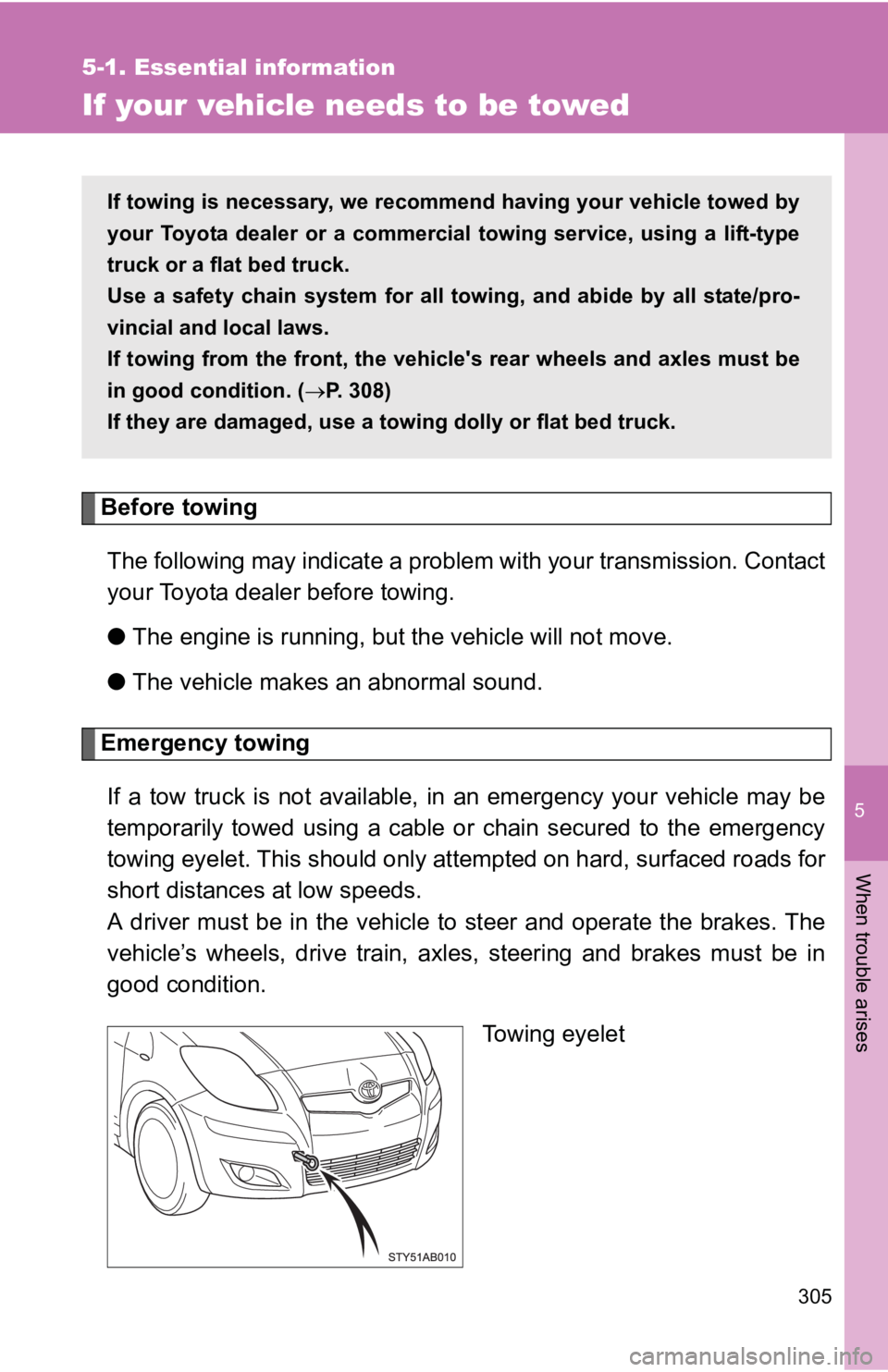
Emergency towing
If a tow truck is not available, in an emergency your vehicle may be
temporarily towed using a cable or chain secured to the emergency
towing eyelet. This should only attempted on hard, surfaced roads for
short distances at low speeds.
A driver must be in the vehicle to steer and operate the brakes. The
vehicle’s wheels, drive train, axles, steering and brakes must be in
good condition.
Towing eyelet
If towing is necessary, we recommend having your vehicle towed by
your Toyota dealer or a commerci al towing service, using a lift-type
truck or a flat bed truck.
Use a safety chain system for all to wing, and abide by all state/pro-
vincial and local laws.
If towing from the front, the vehic le's rear wheels and axles must be
in good condition. (→P. 308)
If they are damaged, use a towing dolly or flat bed truck.
Page 316 of 406
306 5-1. Essential information
■Emergency towin g procedure
Release the parking brake.
Put the transmission in N.
Turn the engine switch to the ACC (engine off) or ON (engine run-
ning) position.
CAUTION
■ Caution while towing
●Use extreme caution when towing the vehicle.
Avoid sudden starts or erratic driving maneuvers which place excessive
stress on the emergency towing eyelet and the cables or chains. Always
use caution for the surroundings and other vehicles while towing.
● If the engine is not running, the power assist for the brakes and steering
will not function, making steering and braking more difficult.
NOTICE
■To prevent causing serious dama ge to the transmission
(vehicles with an automatic transmission)
Never tow this vehicle from the rear with the front wheels on the ground.
This may cause serious damage to the transmission.
■ When towing a vehicle without using a towing dolly
(vehicles with a manual transmission)
Do not tow with the key removed or in the LOCK position.
Page 319 of 406
5
When trouble arises
309
5-1. Essential information
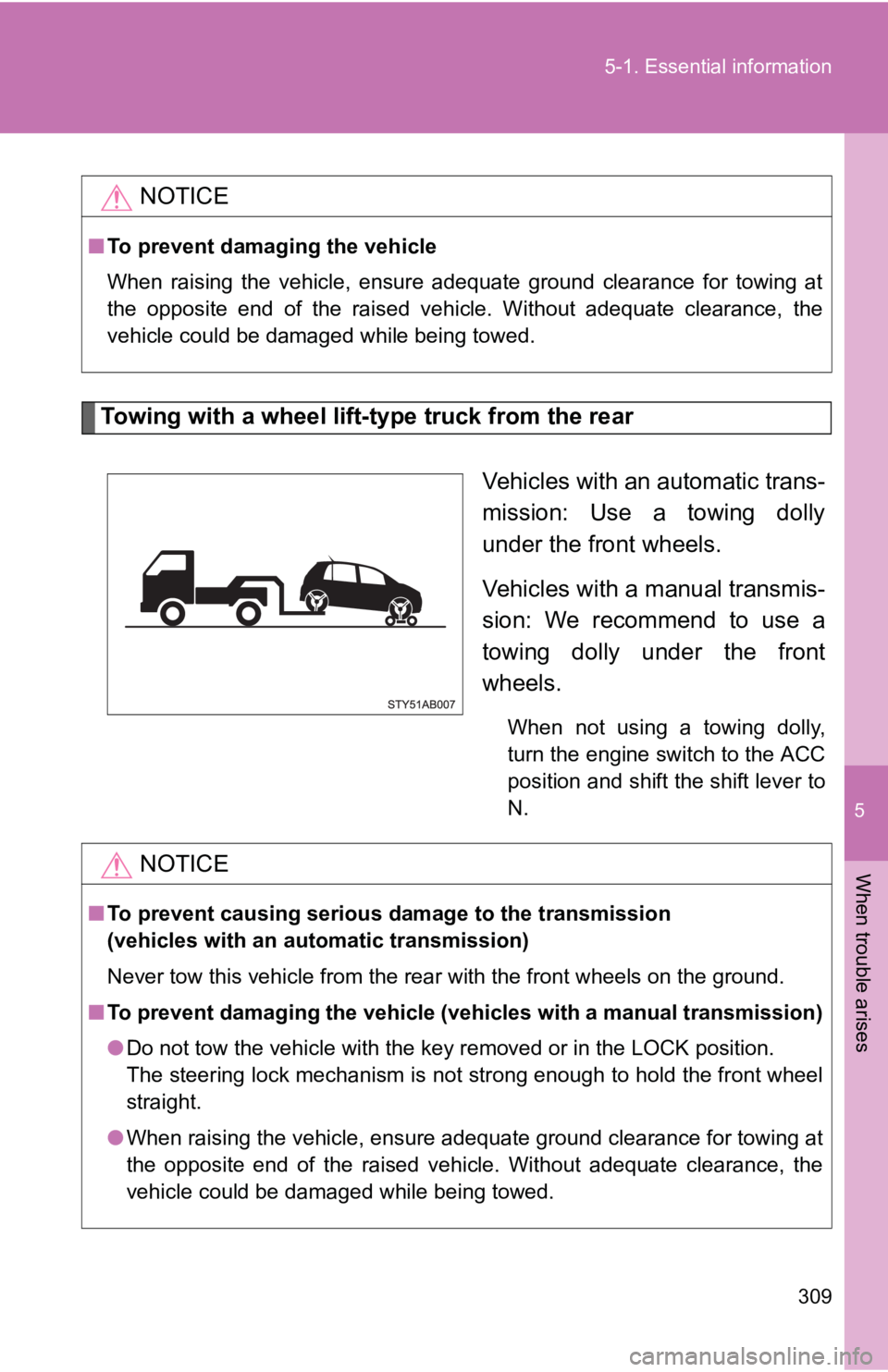
Towing with a wheel lift-type truck from the rear
Vehicles with an automatic trans-
mission: Use a towing dolly
under the front wheels.
Vehicles with a manual transmis-
sion: We recommend to use a
towing dolly under the front
wheels.
When not using a towing dolly,
turn the engine switch to the ACC
position and shift the shift lever to
N.
NOTICE
■To prevent damaging the vehicle
When raising the vehicle, ensure adequate ground clearance for towing at
the opposite end of the raised vehicle. Without adequate clearance, the
vehicle could be damaged while being towed.
NOTICE
■To prevent causing serious da mage to the transmission
(vehicles with an automatic transmission)
Never tow this vehicle from the rear with the front wheels on the ground.
■ To prevent damaging the vehicle (vehicles with a manual transmission)
●Do not tow the vehicle with the key removed or in the LOCK position.
The steering lock mechanism is not strong enough to hold the front wheel
straight.
● When raising the vehicle, ensure adequate ground clearance for towing at
the opposite end of the raised vehicle. Without adequate clearance, the
vehicle could be damaged while being towed.
Page 327 of 406
5
When trouble arises
317
5-2. Steps to take in an emergency
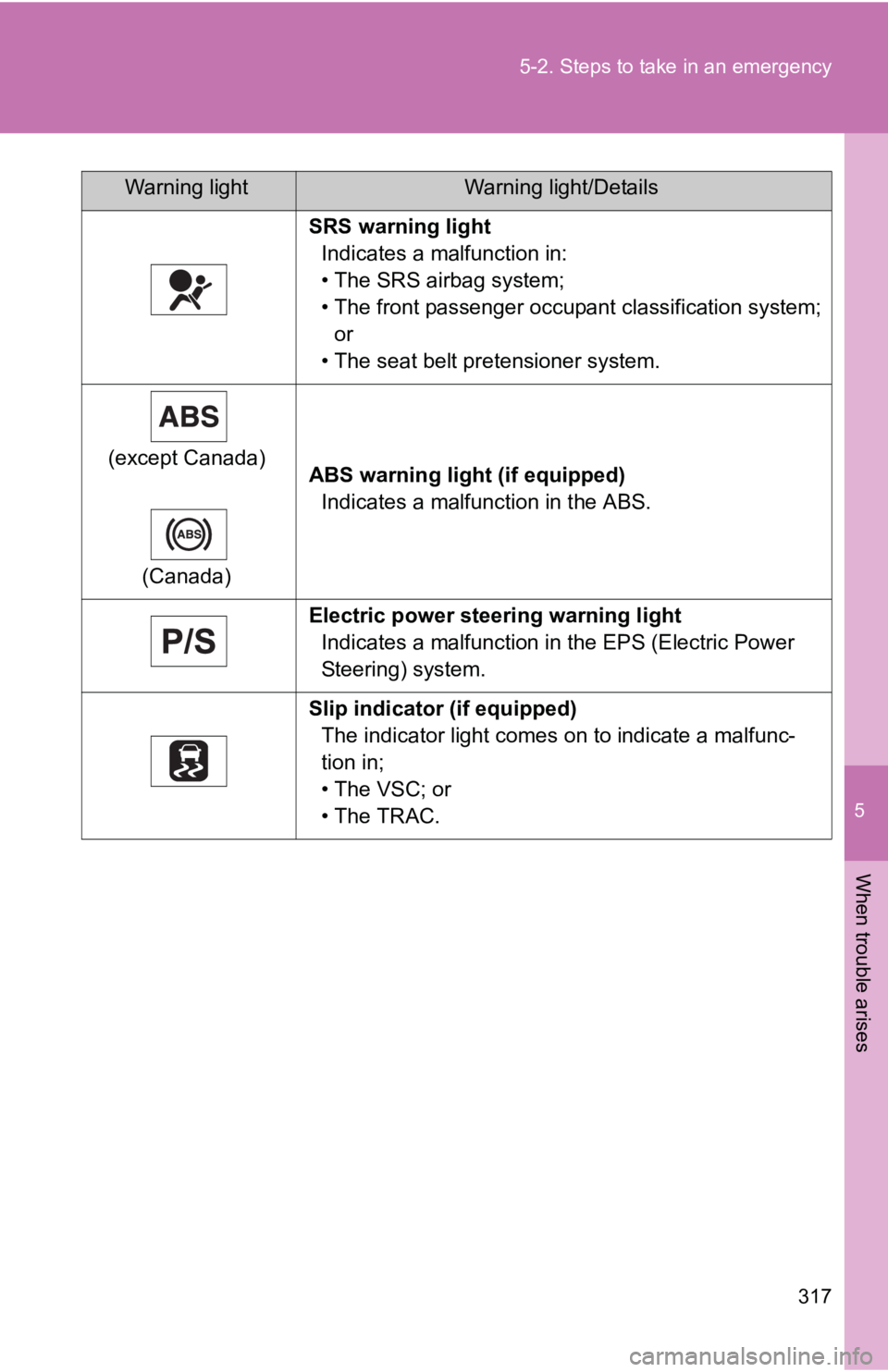
SRS warning light
Indicates a malfunction in:
• The SRS airbag system;
• The front passenger occupant classification system; or
• The seat belt pretensioner system.
(except Canada)
(Canada) ABS warning light (if equipped)
Indicates a malfunction in the ABS.
Electric power steering warning light Indicates a malfunction in the EPS (Electric Power
Steering) system.
Slip indicator (if equipped) The indicator light comes on to indicate a malfunc-
tion in;
• The VSC; or
• The TRAC.
Warning lightWarning light/Details
Page 332 of 406
322 5-2. Steps to take in an emergency
■Customization that can be co nfigured at Toyota dealer
● The vehicle speed linked seat belt reminder buzzer can be disabled.
(Customizable features →P. 377)
● The key reminder buzzer can be disabled.
(Customizable features →P. 377)
● The light reminder buzzer can be disabled.
(Customizable features →P. 377)
CAUTION
■If the tire pressure warning light comes on
Be sure to observe the following precautions. Failure to do so could
cause loss of vehicle control and re sult in death or serious injury.
●Stop your vehicle in a safe place as soon as possible. Adjust the tire
inflation pressure immediately.
●If the tire pressure warning light comes on even after tire inflation pres-
sure adjustment, it is pr obable that you have a flat tire. Check the tires.
If the tire is flat, change to the spare tire and have the flat tire repaired
by the nearest Toyota dealer.
●Avoid abrupt maneuvering and braking. If the vehicle tires deteriorate,
you could lose control of the steering wheel or the brakes.
■If a blowout or sudden air leakage should occur
The tire pressure warning syste m may not activate immediately.
■Maintenance of the tire
Each tire, including the spare (if provided), should be checked monthly
when cold and inflated to the inflation pressure recommended by the
vehicle manufacturer on the vehicle placard or tire inflation pressure
label (tire and load information label). (If your vehicle has tires of a differ-
ent size than the size indicated on the vehicle placard or tire inflation
pressure label [tire and load information label], you should determine the
proper tire inflation pr essure for those tires.)
Page 347 of 406
5
When trouble arises
337
5-2. Steps to take in an emergency
If the engine will not start
If the engine still does not start after following the correct starting
procedure ( →P. 129) or releasing the steering lock (→P. 130), confirm
the following points.
■ The engine will not start even when the starter motor oper-
ates normally.
One of the following may be the cause of the problem.
●There may not be sufficient fuel in the vehicle’s tank.
Refuel the vehicle.
● The engine may be flooded.
Try to restart the engine once more following correct starting
procedures. ( →P. 129)
● Vehicles with engine immobilizer system: There may be a
malfunction in the engine immobilizer system.
( → P. 7 8 )
■ The starter motor turns over slowly, the interior lights and
headlights are dim, or the horn does not sound or sounds at
a low volume.
One of the following may be the cause of the problem.
●The battery may be discharged. ( →P. 341)
● The battery terminal connec tions may be loose or corroded.
Page 360 of 406
350
5-2. Steps to take in an emergency
If your vehicle has to be stopped in an emergency
CAUTION
■If the engine has to be turned off while driving
●Power assist for the brakes and steering wheel will be lost, making the
brake pedal harder to depress and the steering wheel heavier to turn.
Decelerate as much as possible before turning off the engine.
● Never attempt to remove the key, as doing so will lock the steering wheel.
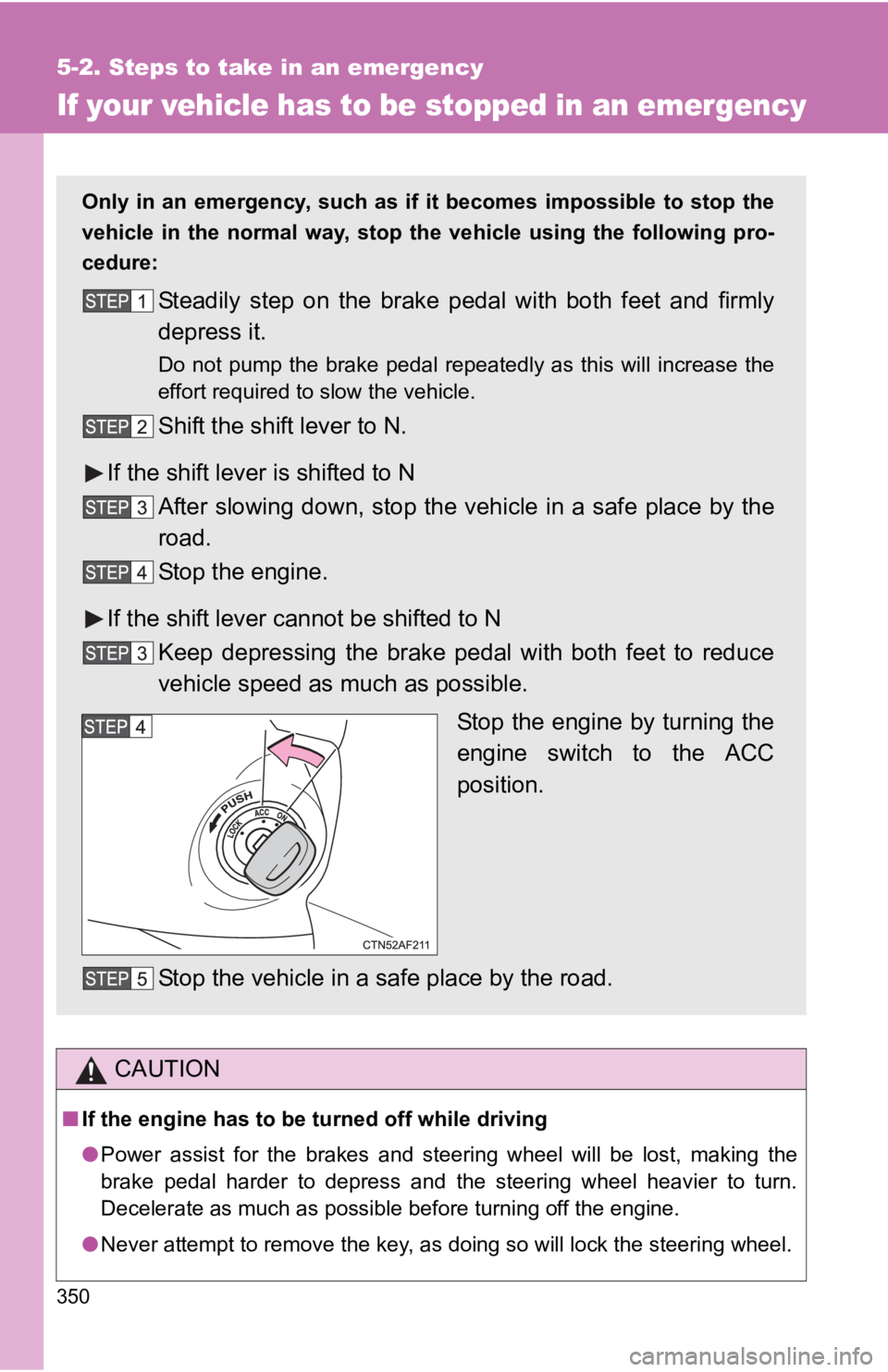
Only in an emergency, such as if it becomes impossible to stop the
vehicle in the normal way, stop the vehicle using the following pro-
cedure:
Steadily step on the brake pedal with both feet and firmly
depress it.
Do not pump the brake pedal repeatedly as this will increase the
effort required to slow the vehicle.
Shift the shift lever to N.
If the shift lever is shifted to N After slowing down, stop the vehi cle in a safe place by the
road.
Stop the engine.
If the shift lever cannot be shifted to N Keep depressing the brake pedal with both feet to reduce
vehicle speed as much as possible.
Stop the engine by turning the
engine switch to the ACC
position.
Stop the vehicle in a safe place by the road.
Page 368 of 406
359
6-1. Specifications
6
Vehicle specifications
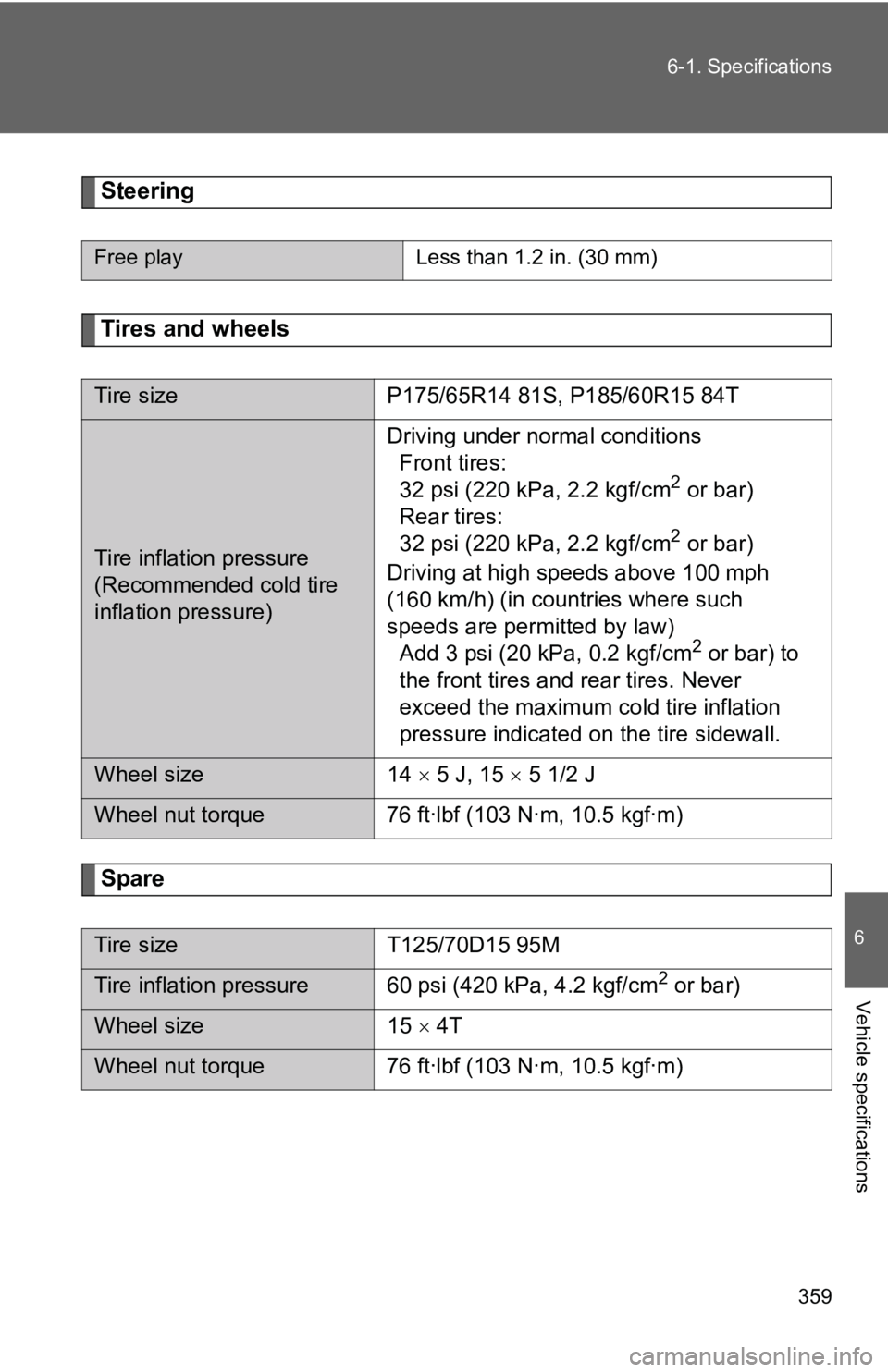
Steering
Tires and wheels
Spare
Free play
Less than 1.2 in. (30 mm)
Tire sizeP175/65R14 81S, P185/60R15 84T
Tire inflation pressure
(Recommended cold tire
inflation pressure)Driving under normal conditions
Front tires:
32 psi (220 kPa, 2.2 kgf/cm
2 or bar)
Rear tires:
32 psi (220 kPa, 2.2 kgf/cm
2 or bar)
Driving at high speeds above 100 mph
(160 km/h) (in countries where such
speeds are permitted by law) Add 3 psi (20 kPa, 0.2 kgf/cm
2 or bar) to
the front tires and rear tires. Never
exceed the maximum co ld tire inflation
pressure indicated on the tire sidewall.
Wheel size 14 × 5 J, 15 × 5 1/2 J
Wheel nut torque 76 ft·lbf (103 N·m, 10.5 kgf·m)
Tire size T125/70D15 95M
Tire inflation pressure 60 psi (420 kPa, 4.2 kgf/cm2 or bar)
Wheel size15 × 4T
Wheel nut torque 76 ft·lbf (103 N·m, 10.5 kgf·m)
Page 380 of 406
371
6-1. Specifications
6
Vehicle specifications
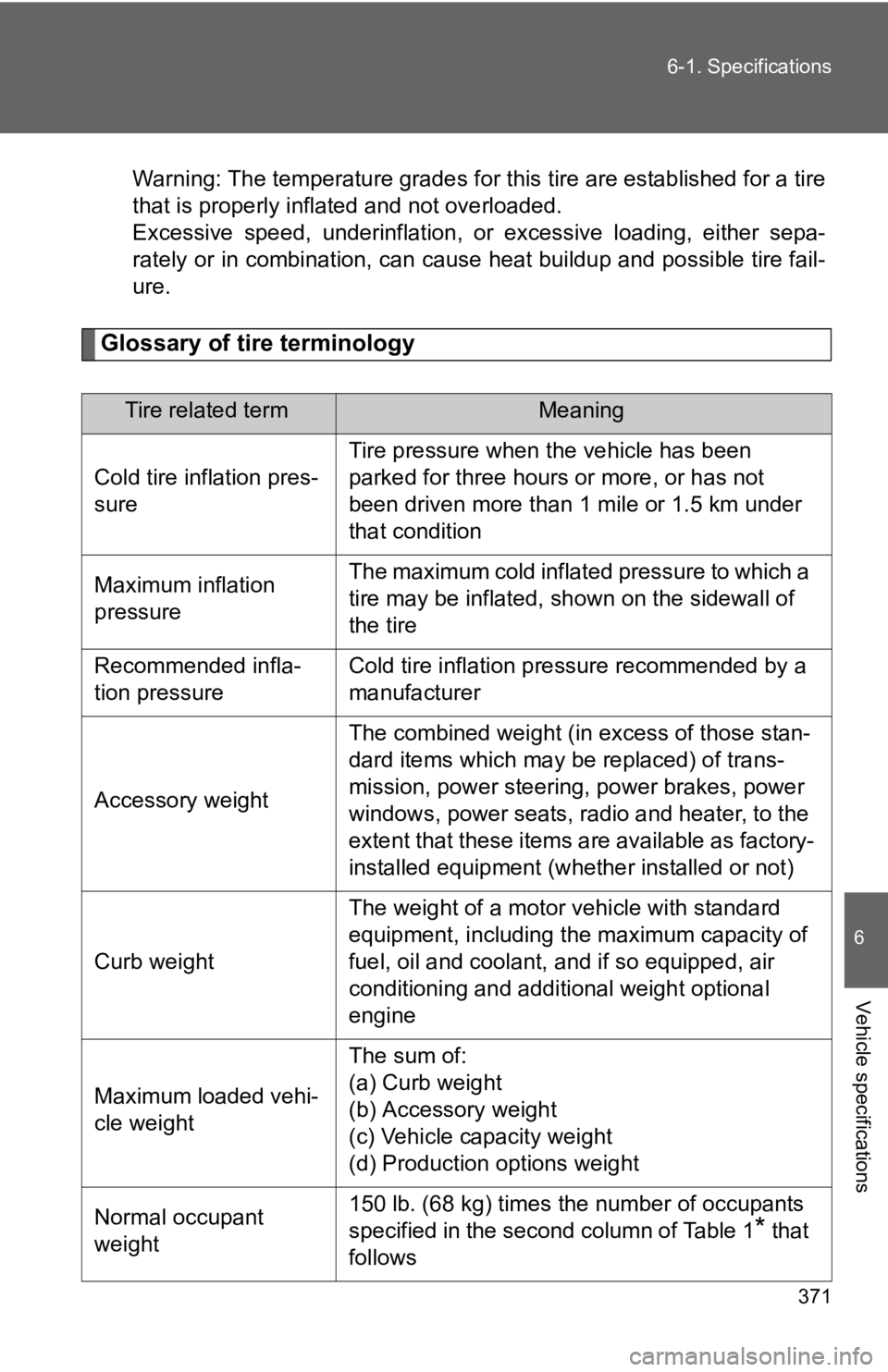
Warning: The temperature grades for this tire are established for a tire
that is properly inflated and not overloaded.
Excessive speed, underinflation, or
excessive loading, either sepa-
rately or in combination, can caus e heat buildup and possible tire fail-
ure.
Glossary of tire terminology
Tire related termMeaning
Cold tire inflation pres-
sure
Tire pressure when the vehicle has been
parked for three hours or more, or has not
been driven more than 1 mile or 1.5 km under
that condition
Maximum inflation
pressureThe maximum cold inflated pressure to which a
tire may be inflated, s hown on the sidewall of
the tire
Recommended infla-
tion pressureCold tire inflation pressure recommended by a
manufacturer
Accessory weight
The combined weight (in excess of those stan-
dard items which may be replaced) of trans-
mission, power steering, power brakes, power
windows, power seats, radio and heater, to the
extent that these items are available as factory-
installed equipment (whether installed or not)
Curb weight
The weight of a motor vehicle with standard
equipment, including the maximum capacity of
fuel, oil and coolant, and if so equipped, air
conditioning and additional weight optional
engine
Maximum loaded vehi-
cle weight
The sum of:
(a) Curb weight
(b) Accessory weight
(c) Vehicle capacity weight
(d) Production options weight
Normal occupant
weight150 lb. (68 kg) times the number of occupants
specified in the second column of Table 1
* that
follows
Page 396 of 406

390 Alphabetical index
Child restraint systemBooster seats, definition ........ 102
Booster seats, installation ..... 106
Convertible seats, definition .. 102
Convertible seats,
installation ........................... 106
Front passenger occupant classification system .............97
Infant seat, definition ............. 102
Infant seats, installation......... 106
Installing CRS with LATCH system ................................ 108
Installing CRS with seat belts .................................... 109
Installing CRS with top tether straps ........................ 113
Child safety
Airbag precautions ..................92
Battery precautions ....... 262, 344
Child restraint system............ 102
Child-protectors .......................34
How your child should wear the seat belt ..........................62
Installing child restraints ........ 106
Power window lock switch.......72
Power window precautions .....73
Removed key battery precautions ......................... 282
Seat belt extender
precautions ...........................65
Seat belt precautions ..............63
Child-protectors .........................34
Cleaning
Exterior .................................. 236
Interior ................................... 238
Seat belts .............................. 239
Clock ......................... 139, 141, 229
Clutch Fluid ...................................... 358
Pedal ..............................120,134
Comfort guide ............................59
Condenser ................................ 259
CRS ........................................... 102 Cruise control
Cruise control ........................ 156
Indicator ................................ 156
Cup holders .............................. 222
Curtain shield airbags ............... 85
Customizable features ............ 377
Daytime running light system .................................... 150
Defogger
Rear window ......................... 193
Side mirrors........................... 193
Dimension ................................ 352
Do-it-yourself maintenance .... 247
Doors Back door ................................ 36
Door glasses ........................... 71
Door lock ................................. 31
Side doors ............................... 31
Side mirrors............................. 68
Warning light ......................... 318
Driver's seat belt reminder
light ......................................... 318
Driving Break-in tips .......................... 122
Correct posture ....................... 83
Procedures............................ 120
Winter driving tips ................. 169
Electric power steering Electric power steering.......... 160
Warning light ......................... 316
Emergency flashers
Switch ................................... 304
Emergency, in case of If the engine will not start ...... 337
If the shift lever cannot be
shifted from P ..................... 339
If the vehicle battery is
discharged .......................... 341
If the warning buzzer sounds ................................ 315
D
E