airbag TOYOTA YARIS HATCHBACK 2010 Owners Manual
[x] Cancel search | Manufacturer: TOYOTA, Model Year: 2010, Model line: YARIS HATCHBACK, Model: TOYOTA YARIS HATCHBACK 2010Pages: 406, PDF Size: 8.14 MB
Page 7 of 406
5
OVERVIEW
FEATURES/OPERATIONS
SAFETY AND EMERGENCY FEATURES
2For details, refer to “If a warning light turns on or a warning buzzer sounds,” Section
5-2, 2010 Owner’s Manual.
3For details, refer to “If your vehicle overheats,” Section 5-2, 2010 Owner’s Manual.
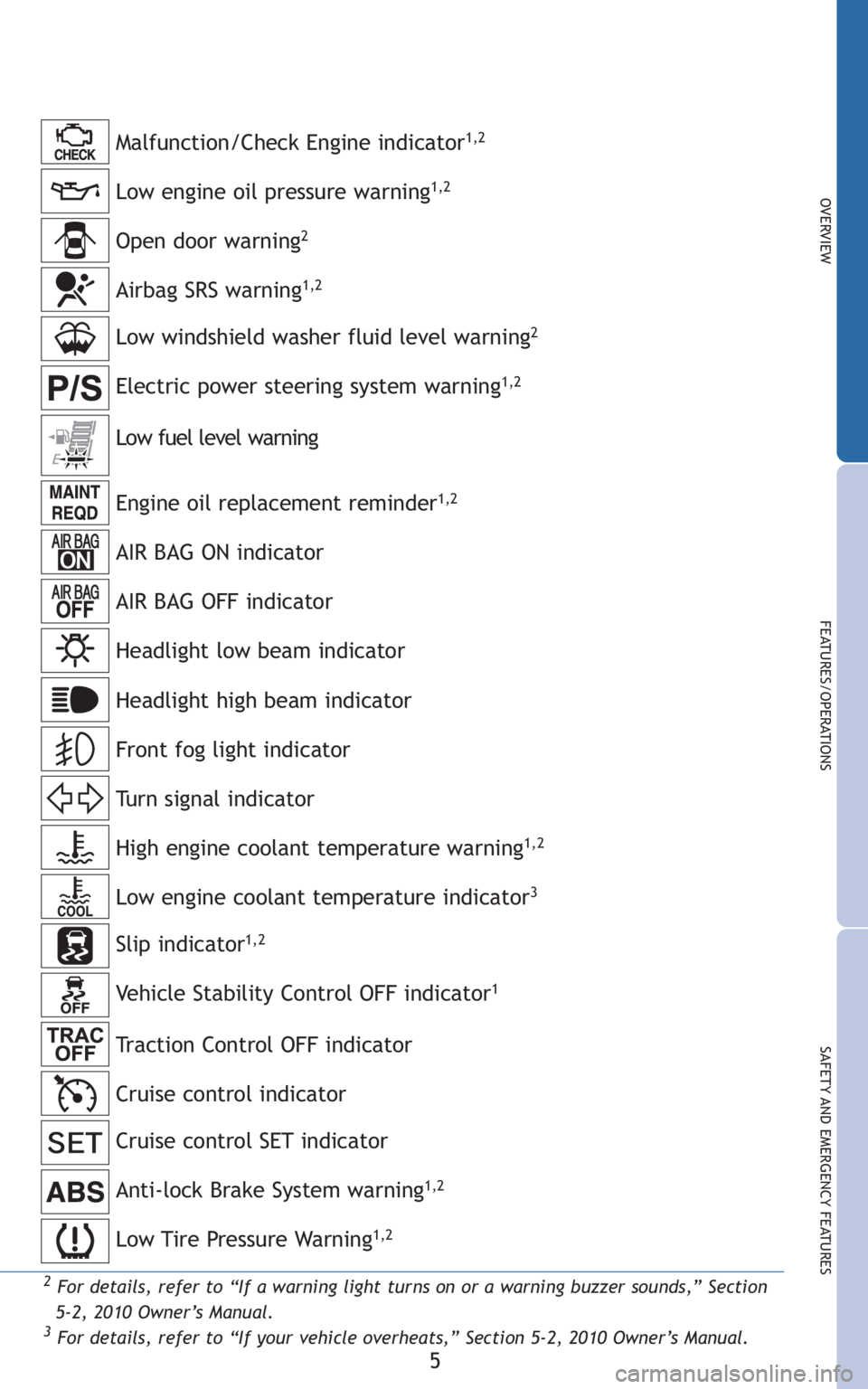
Low engine oil pressure warning1,2
Anti-lock Brake System warning1,2
Malfunction/Check Engine indicator1,2
Open door warning2
Low windshield washer fluid level warning2
Engine oil replacement reminder1,2
AIR BAG ON indicator
AIR BAG OFF indicator
Headlight low beam indicator
Turn signal indicator
Low fuel level warning
Headlight high beam indicator
High engine coolant temperature warning
1,2
Airbag SRS warning1,2
Electric power steering system warning1,2
Low engine coolant temperature indicator3
Front fog light indicator
Low Tire Pressure Warning1,2
Cruise control SET indicator
Cruise control indicator Slip indicator
1,2
Vehicle Stability Control OFF indicator1
Traction Control OFF indicator
Page 21 of 406

21
Installation of a mobile two-way radio system
As the installation of a mobile two-way radio system in your vehicle could
affect electronic systems such as the multiport fuel injection system/sequen-
tial multiport fuel injection system, anti-lock brake system, SRS airbag sys-
tem and seat belt pretensioner system, be sure to check with your Toyota
dealer for precautionary measures or special instructions regarding installa-
tion.
Scrapping your Toyota
The SRS airbag and seat belt pretensioner devices in your Toyota contain
explosive chemicals. If the vehicle is scrapped with the airbags and seat belt
pretensioners left as they are, this may cause an accident such as fire. Be
sure to have the systems of the SRS airbag and seat belt pretensioner
removed and disposed of by a qualified service shop or by your Toyota
dealer before you scrap your vehicle.
Perchlorate Material
Special handling may apply,
See www.dtsc.ca.gov/hazardouswaste/perchlorate.
Your vehicle has components that may contain perchlorate. These compo-
nents may include airbag, seat belt pretensioners, and wireless remote con-
trol batteries.
Page 30 of 406
10
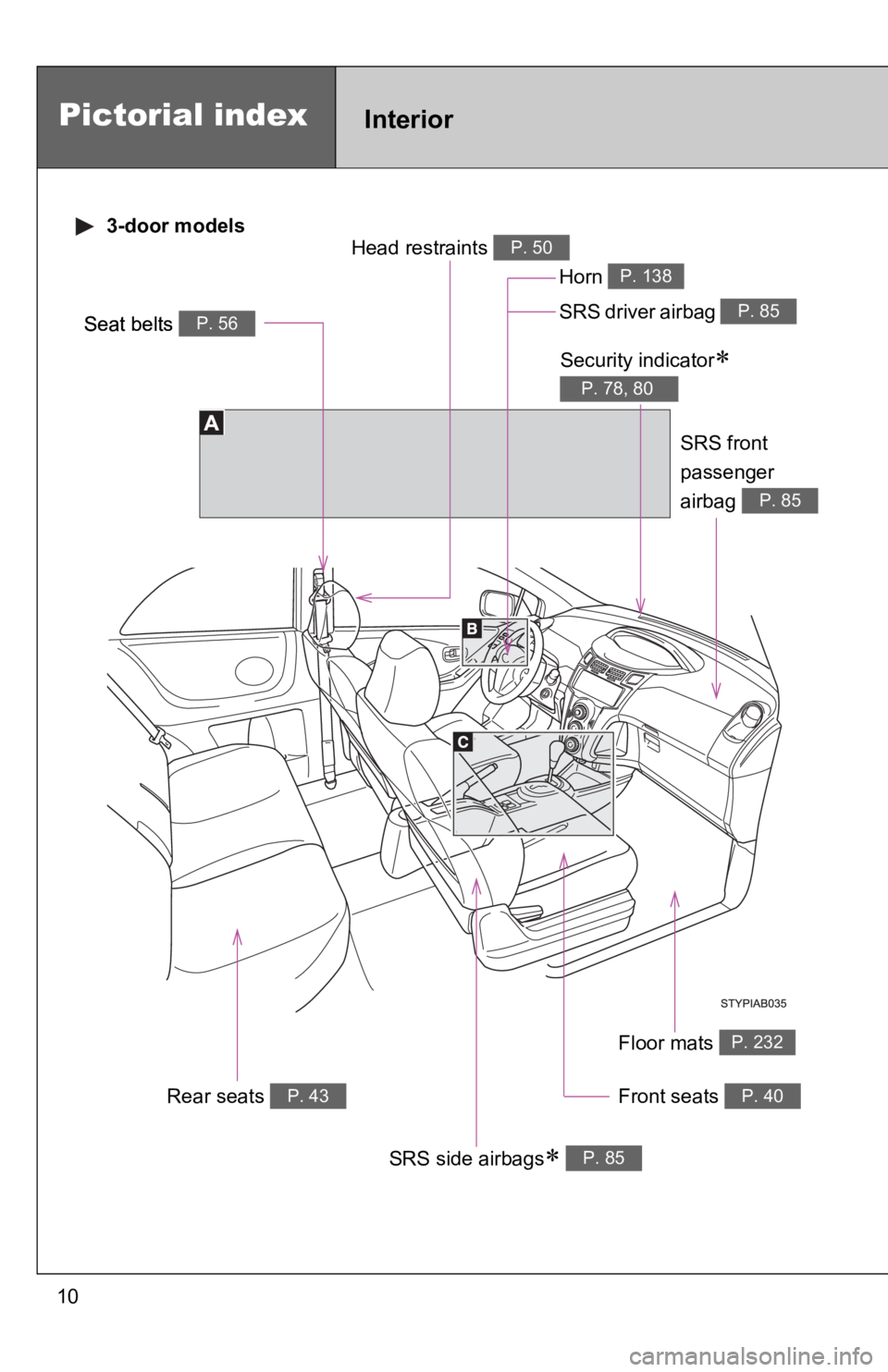
Pictorial indexInterior
Seat belts P. 56SRS driver airbag P. 85
Head restraints P. 50
Front seats P. 40
SRS side airbags∗ P. 85
Floor mats P. 232
SRS front
passenger
airbag
P. 85
Security indicator∗
P. 78, 80
3-door models
Rear seats P. 43
Seat belts P. 56
Horn P. 138
Page 31 of 406
11
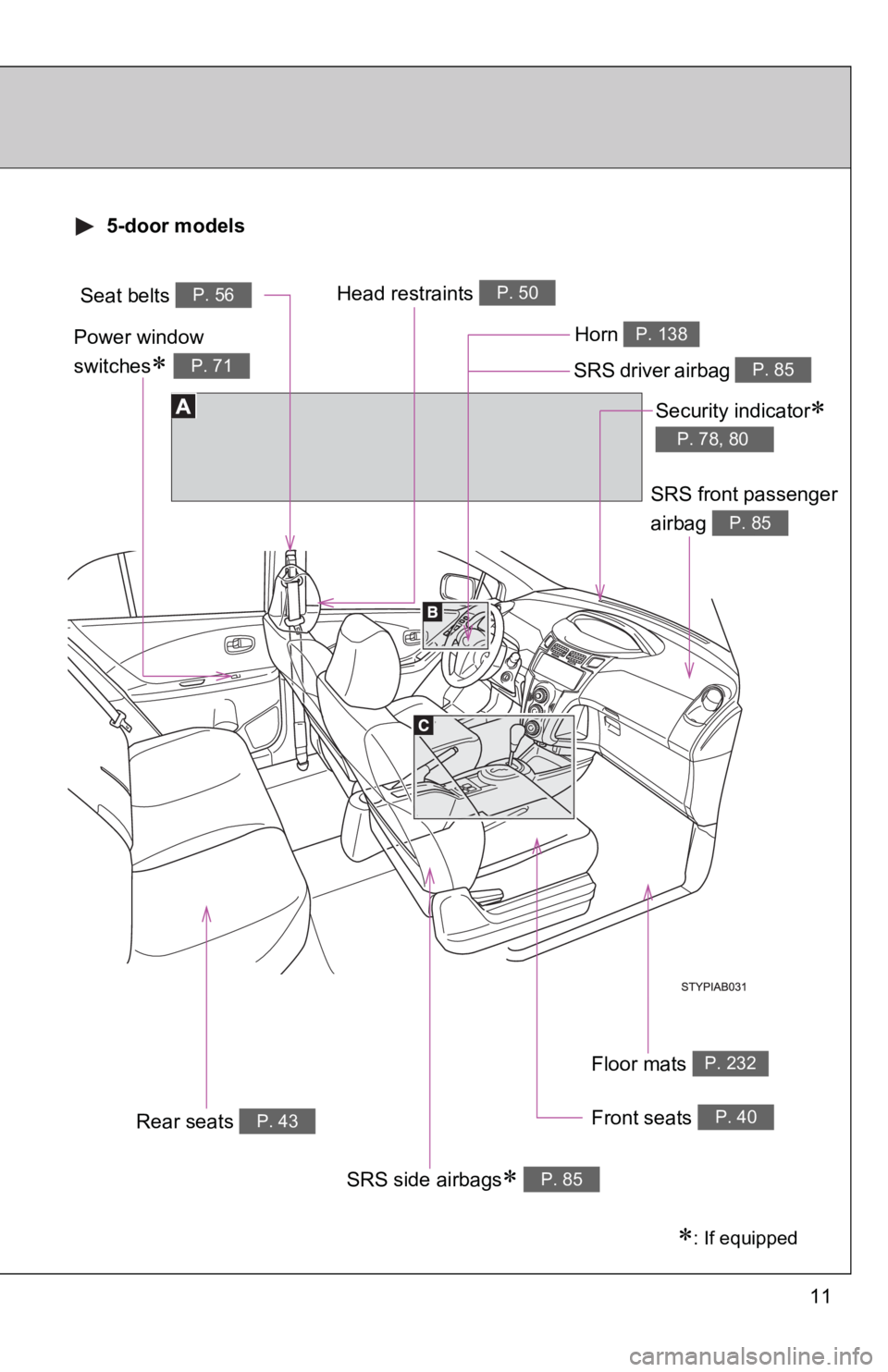
Seat belts P. 56
SRS driver airbag P. 85
Head restraints P. 50
Front seats P. 40
SRS side airbags∗ P. 85
Floor mats P. 232
SRS front passenger
airbag
P. 85
Security indicator∗
P. 78, 80
Power window
switches
∗ P. 71
5-door models
Rear seats P. 43
∗: If equipped
Horn P. 138
Page 32 of 406
12
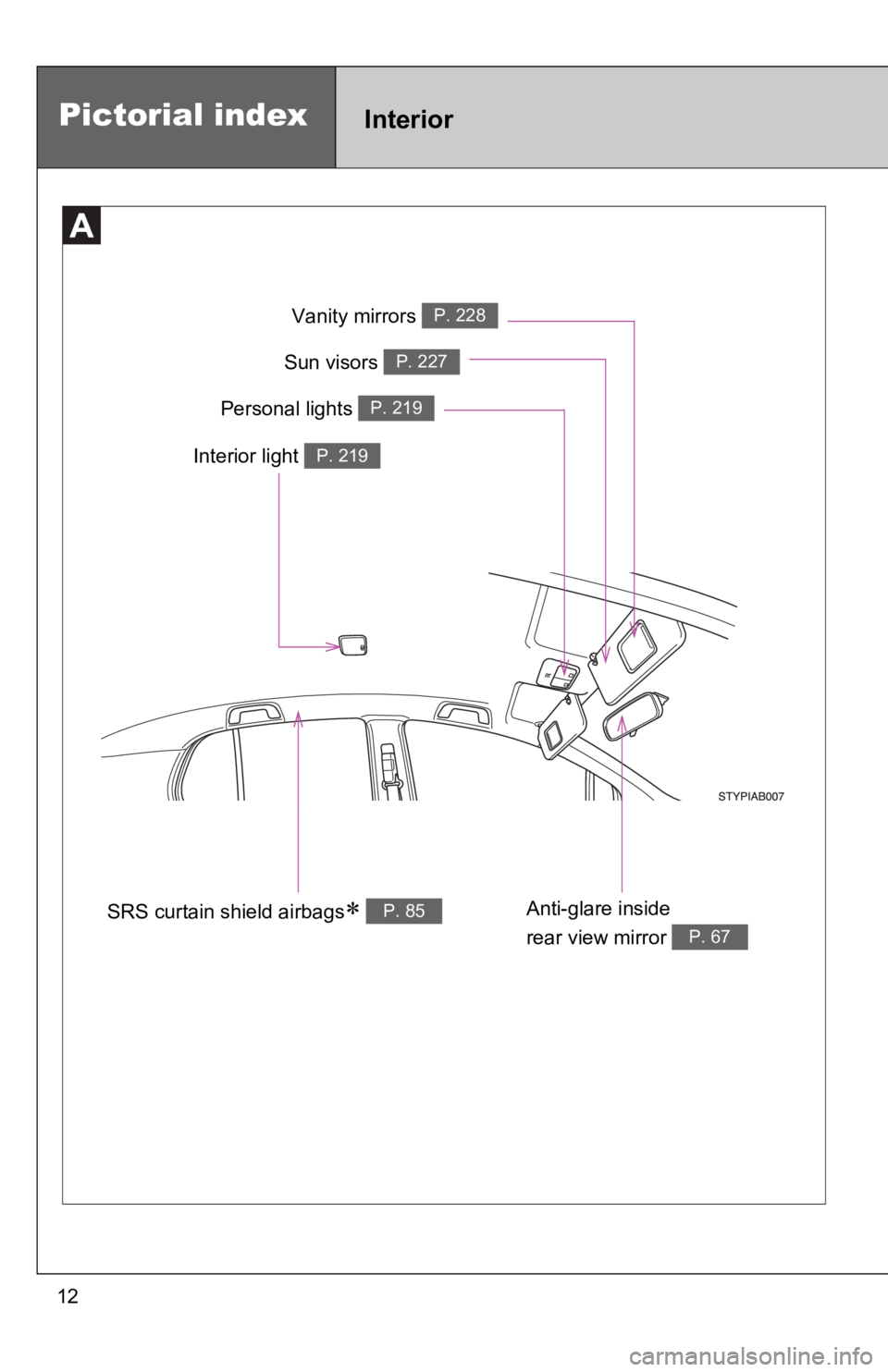
Pictorial indexInterior
Anti-glare inside
rear view mirror
P. 67
Interior light P. 219
Vanity mirrors P. 228
Personal lights P. 219
Sun visors P. 227
SRS curtain shield airbags∗ P. 85
Page 97 of 406
83
1
Before driving
1-7. Safety information
Correct driving posture
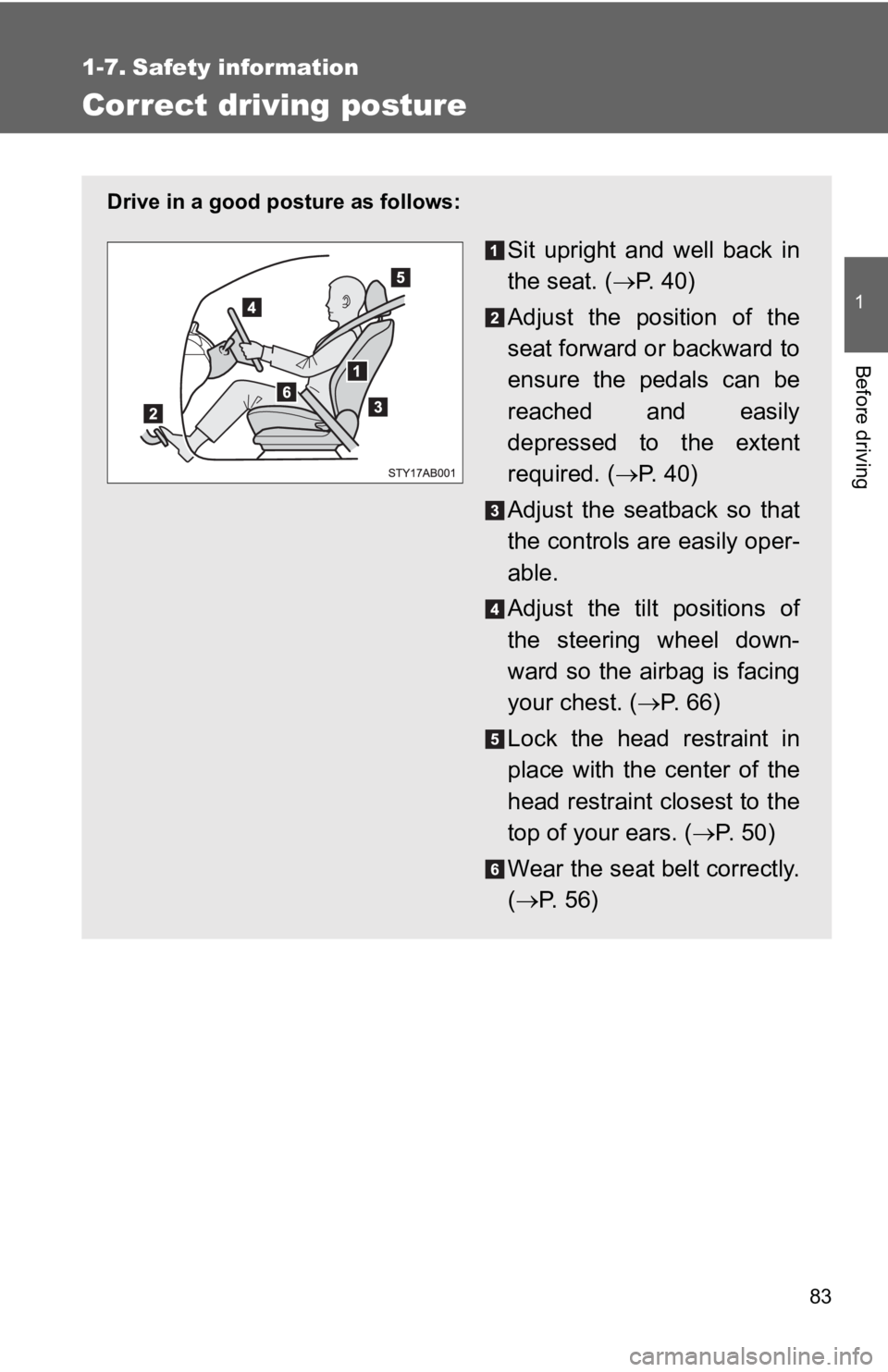
Drive in a good posture as follows:
Sit upright and well back in
the seat. (→P. 4 0 )
Adjust the position of the
seat forward or backward to
ensure the pedals can be
reached and easily
depressed to the extent
required. ( →P. 40)
Adjust the seatback so that
the controls are easily oper-
able.
Adjust the tilt positions of
the steering wheel down-
ward so the airbag is facing
your chest. ( →P. 6 6 )
Lock the head restraint in
place with the center of the
head restraint closest to the
top of your ears. ( →P. 50)
Wear the seat belt correctly.
( → P. 56)
Page 99 of 406
85
1
1-7. Safety information
Before driving
SRS airbags
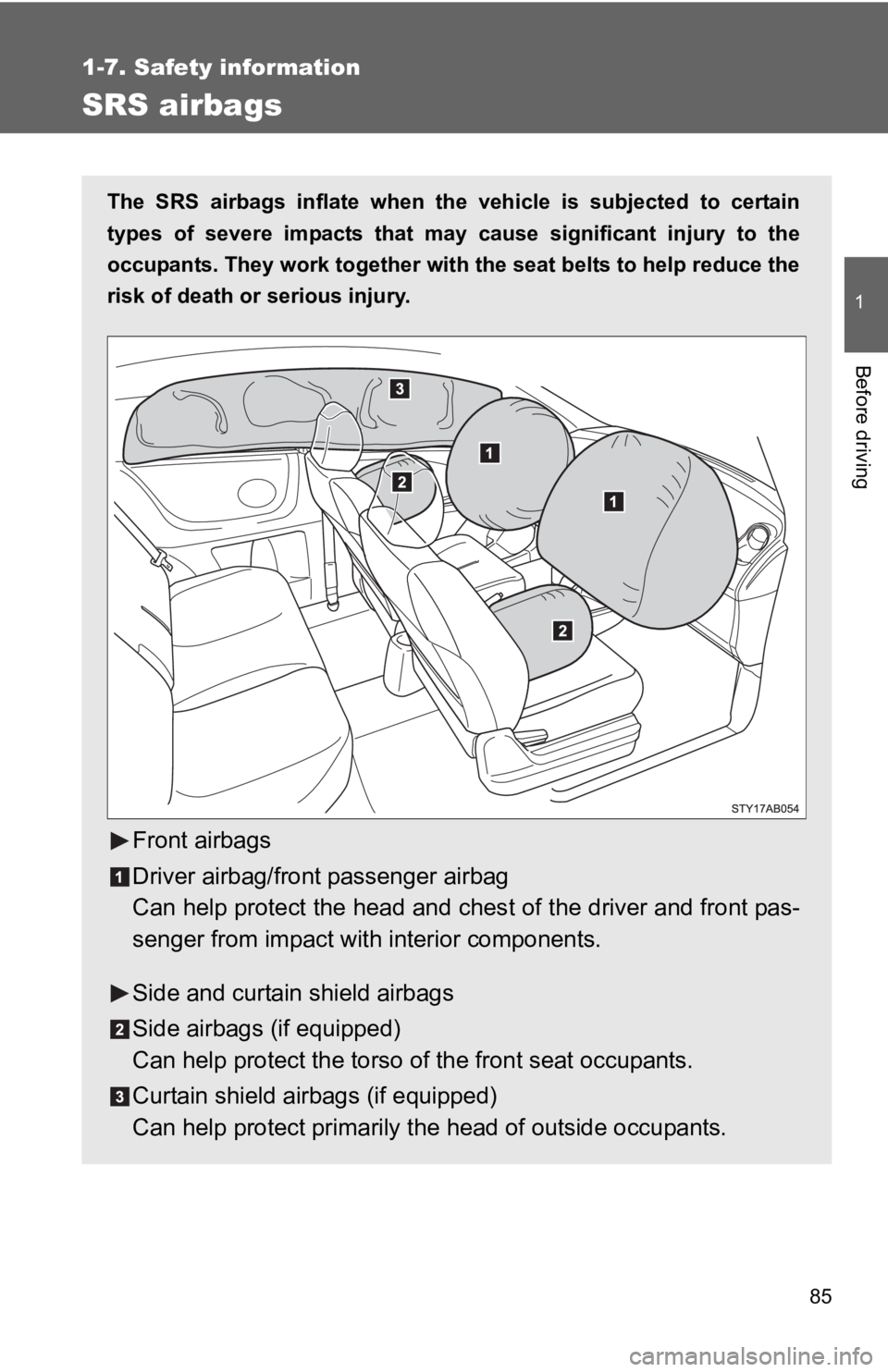
The SRS airbags inflate when the vehicle is subjected to certain
types of severe impacts that may cause significant injury to the
occupants. They work together with the seat belts to help reduce the
risk of death or serious injury.
Front airbags
Driver airbag/front passenger airbag
Can help protect the head and ches t of the driver and front pas-
senger from impact with interior components.
Side and curtain shield airbags
Side airbags (if equipped)
Can help protect the torso of the front seat occupants.
Curtain shield airbags (if equipped)
Can help protect primarily the head of outside occupants.
Page 100 of 406
86 1-7. Safety information
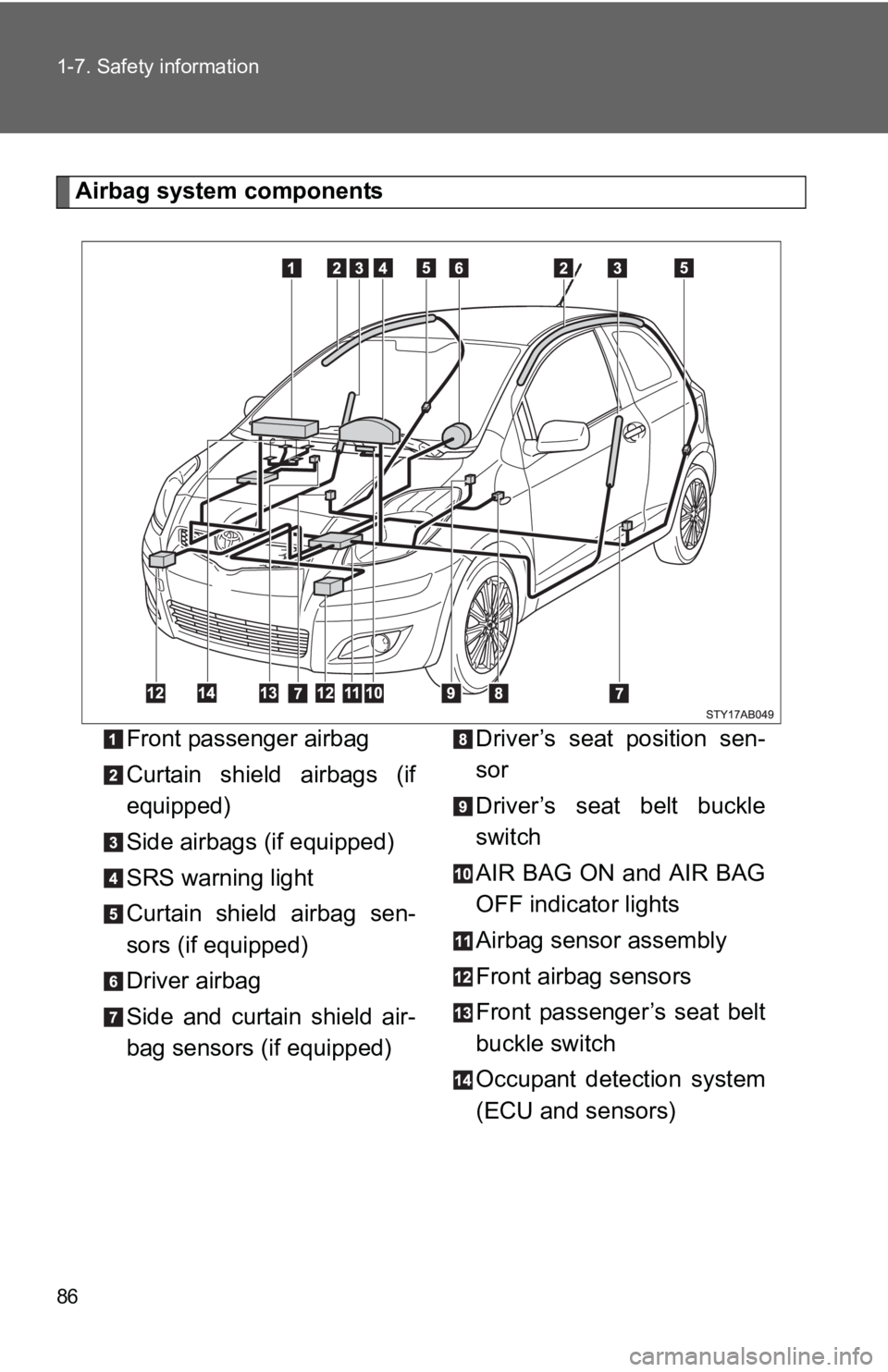
Airbag system componentsFront passenger airbag
Curtain shield airbags (if
equipped)
Side airbags (if equipped)
SRS warning light
Curtain shield airbag sen-
sors (if equipped)
Driver airbag
Side and curtain shield air-
bag sensors (if equipped) Driver’s seat position sen-
sor
Driver’s seat belt buckle
switch
AIR BAG ON and AIR BAG
OFF indicator lights
Airbag sensor assembly
Front airbag sensors
Front passenger’s seat belt
buckle switch
Occupant detection system
(ECU and sensors)
Page 101 of 406

87
1-7. Safety information
1
Before driving
Your vehicle is equipped with
ADVANCED AIRBAGS designed based
on US motor vehicle safety standards (FMVSS208). The airbag sys-
tem controls airbag deployment po wer for the driver and front pas-
senger. The driver airbag system consists of the driver seat’s position
sensor etc. The front passenger’s airbag system consists of the front
passenger occupant classification sensor etc.
The main SRS airbag system components are shown above. The
SRS airbag system is controlled by the airbag sensor assembly. The
airbag sensor assembly consists of a safing sensor and an airbag
sensor.
In certain types of severe frontal or side impacts, the SRS airbag sys-
tem triggers the airbag inflators. A chemical reaction in the inflators
quickly fills the airbags with non-toxic gas to help rest rain the motion
of the occupants.
■ SRS warning light
This warning light system monitors the airbag sensor assembly, front airbag
sensors, side and curtain shield airbag sensors, curtain shield airbag sen-
sors, driver’s seat position sensor, driver’s seat belt buckle switch, front pas-
senger occupant classification system, AIR BAG ON indicator light, AIR
BAG OFF indicator light, front passenger’s seat belt buckle switch, seat belt
pretensioner assemblies, inflators, interconnecting wiring and power
sources. ( →P. 316)
■ If the SRS airbags deploy (inflate)
●Bruising and slight abrasions may result from contact with a deploying
(inflating) SRS airbag.
● A loud noise and white powder will be emitted.
● Vehicles with side and curtain shield airbags: Parts of the airbag module
(steering wheel hub, airbag cover and inflator) as well as the front seats,
and parts of the front and rear pillars and roof side rail, may be hot for
several minutes. The airbag itself may also be hot.
● Vehicles without side and curtain shield airbags: Parts of the airbag mod-
ule (steering wheel hub, airbag cover and inflator) as well as the front
seats may be hot for several minutes. The airbag itself may also be hot.
● The front windshield may crack.
Page 102 of 406

88 1-7. Safety information
■Operating conditions (front airbags)
● The SRS front airbag will deploy in the event of an impact that exceeds
the set threshold level (the level of force corresponding to an approxi-
mately 12-18 mph [20-30 km/h] frontal collision with a fixed wall that does
not move or deform).
However, this threshold velocity will be considerably higher if the vehicle
strikes an object, such as a parked vehicle or sign pole, which can move or
deform on impact, or if the vehicle is involved in an underride collision (e.g.
a collision in which the front of the vehicle “underrides”, or goes under, the
bed of a truck, etc.).
● It is possible that in some collisions where the forward deceleration of the
vehicle is very close to the designed threshold level, the SRS front air-
bags and the seat belt pretensioners may not activate together.
● The SRS front passenger airbag will not activate if there is no passenger
sitting in the front passenger seat. However, the front passenger airbag
may deploy if luggage is put in the seat, even if the seat is unoccupied.
(→ P. 9 7 )
■ Operating conditions (side airbag s and curtain shield airbags [if
equipped])
● SRS airbag deployment conditions (S RS side airbags & SRS curtain
shield airbag)
The SRS side airbag & SRS curtain shield airbag will deploy in the event
of an impact that exceeds the set threshold level (the level of force corre-
sponding to the impact force produced by an approximately 3307 lb. [1500
kg] vehicle colliding with the vehicle cabin from a direction perpendicular to
the vehicle orientation at an approximately speed of 12-18 mph [20-30 km/
h]).
● The SRS side airbag on the passenger seat will not activate if there is no
passenger sitting in the front passenger seat. However, the side airbag
on the passenger seat may deploy if luggage is put in the seat, even if
the seat is unoccupied. ( →P. 97)