battery TOYOTA YARIS HATCHBACK 2012 Owner's Manual
[x] Cancel search | Manufacturer: TOYOTA, Model Year: 2012, Model line: YARIS HATCHBACK, Model: TOYOTA YARIS HATCHBACK 2012Pages: 365, PDF Size: 8.17 MB
Page 229 of 365
250 4-3. Do-it-yourself maintenance
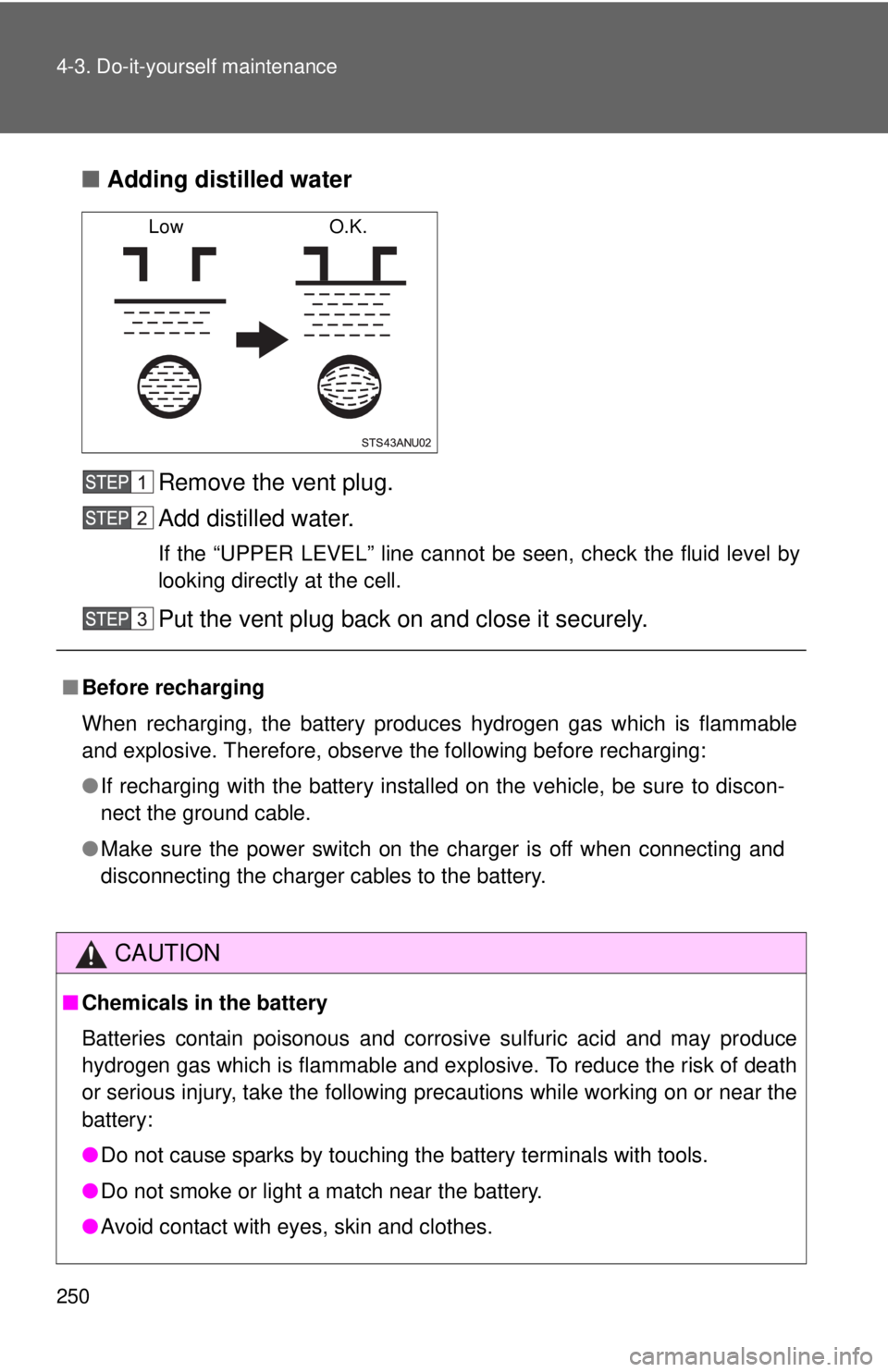
■Adding distilled water
Remove the vent plug.
Add distilled water.
If the “UPPER LEVEL” line cannot be seen, check the fluid level by
looking directly at the cell.
Put the vent plug back on and close it securely.
Low O.K.
■Before recharging
When recharging, the battery produces hydrogen gas which is flammable
and explosive. Therefore, observe the following before recharging:
● If recharging with the battery installed on the vehicle, be sure to discon-
nect the ground cable.
● Make sure the power switch on the charger is off when connecting and
disconnecting the charger cables to the battery.
CAUTION
■Chemicals in the battery
Batteries contain poisonous and corrosive sulfuric acid and may produce
hydrogen gas which is flammable and explosive. To reduce the risk of death
or serious injury, take the following precautions while working on or near the
battery:
●Do not cause sparks by touching the battery terminals with tools.
● Do not smoke or light a match near the battery.
● Avoid contact with eyes, skin and clothes.
Page 230 of 365
251
4-3. Do-it-yourself maintenance
4
Maintenance and care
CAUTION
●
Never inhale or swallow electrolyte.
● Wear protective safety glasses when working near the battery.
● Keep children away from the battery.
■ Where to safety charge the battery
Always charge the battery in an open area. Do not charge the battery in a
garage or closed room where there is insufficient ventilation.
■ Emergency measures regarding electrolyte
●If electrolyte gets in your eyes
Flush your eyes with clean water for at least 15 minutes and get immedi-
ate medical attention. If possible, continue to apply water with a sponge or
cloth while traveling to the nearest medical facility.
● If electrolyte gets on your skin
Wash the affected area thoroughly. If you feel pain or burning, get medical
attention immediately.
● If electrolyte gets on your clothes
It can soak through clothing on to your skin. Immediately take off the cloth-
ing and follow the procedure above if necessary.
● If you accidentally swallow electrolyte
Drink a large quantity of water or milk. Get emergency medical attention
immediately.
NOTICE
■When recharging the battery
Never recharge the battery while the engine is running. Also, be sure all
accessories are turned off.
■ When adding distilled water
Avoid overfilling. Water spilled during battery recharging may cause corro-
sion.
Page 249 of 365
270
4-3. Do-it-yourself maintenance
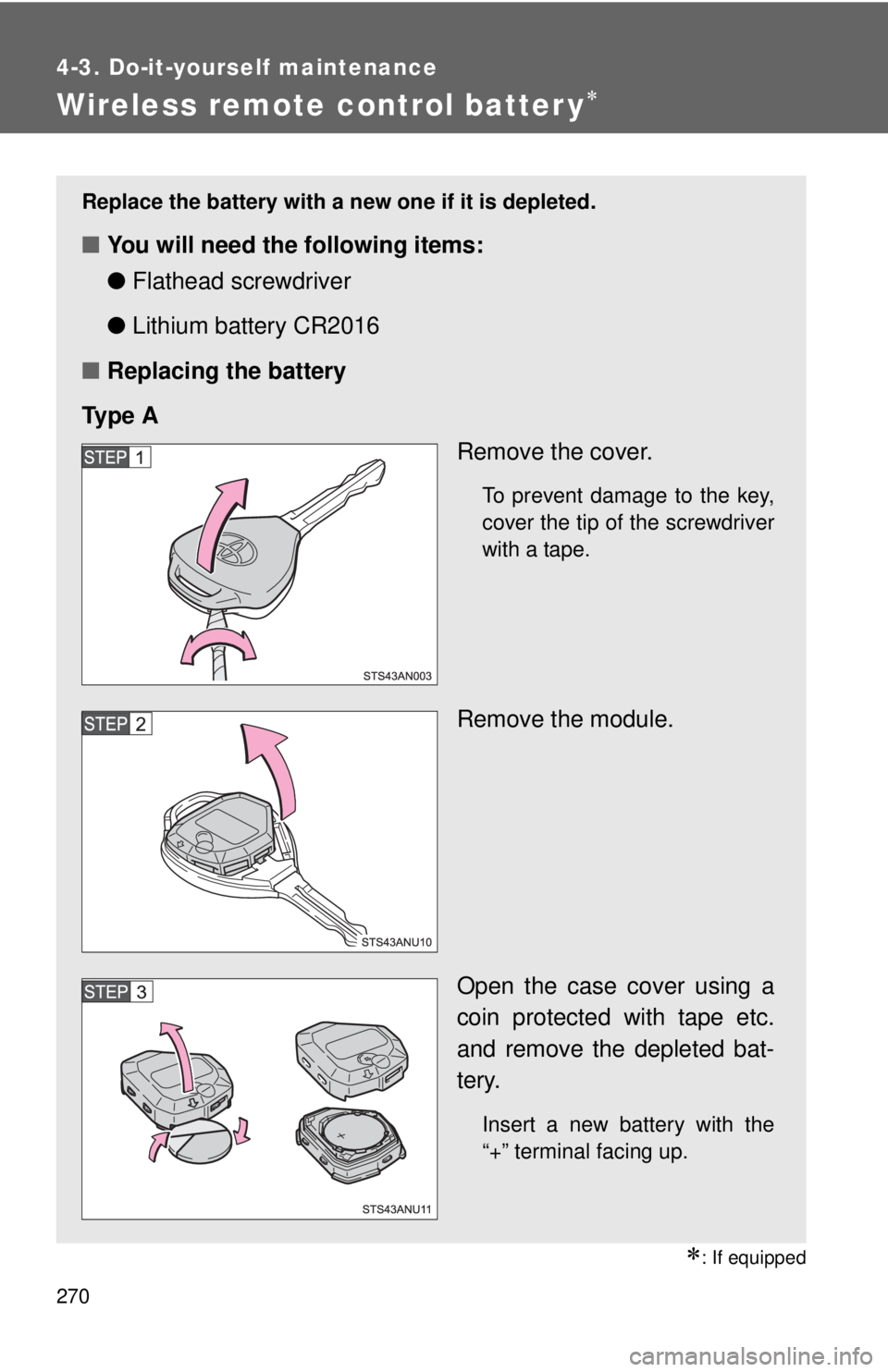
Wireless remote control batter y∗
∗: If equipped
Replace the battery with a new one if it is depleted.
■You will need the following items:
●Flathead screwdriver
● Lithium battery CR2016
■ Replacing the battery
Ty p e A Remove the cover.
To prevent damage to the key,
cover the tip of the screwdriver
with a tape.
Remove the module.
Open the case cover using a
coin protected with tape etc.
and remove the depleted bat-
tery.
Insert a new battery with the
“+” terminal facing up.
Page 250 of 365
271
4-3. Do-it-yourself maintenance
4
Maintenance and care
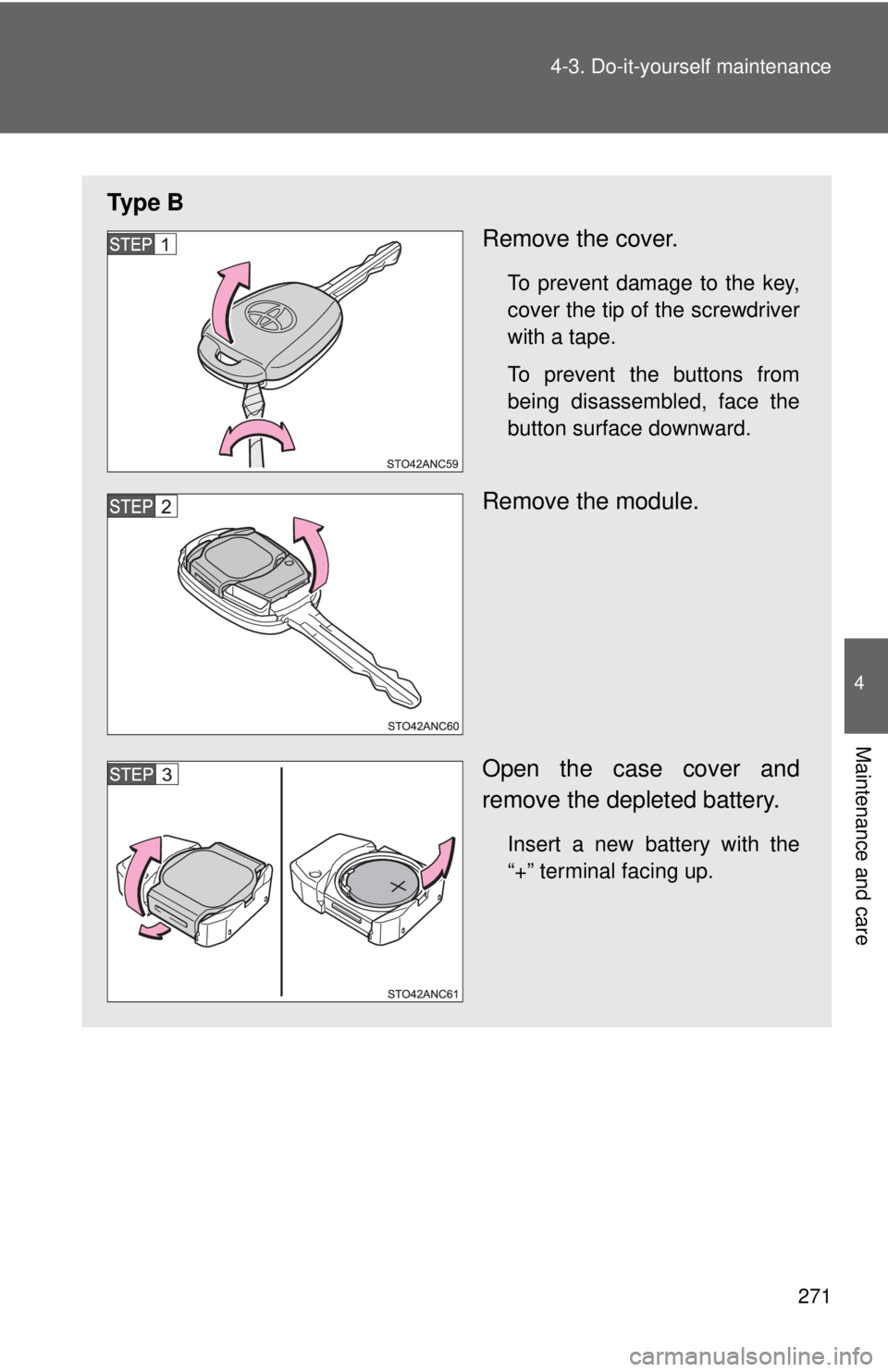
Ty p e B
Remove the cover.
To prevent damage to the key,
cover the tip of the screwdriver
with a tape.
To prevent the buttons from
being disassembled, face the
button surface downward.
Remove the module.
Open the case cover and
remove the depleted battery.
Insert a new battery with the
“+” terminal facing up.
Page 251 of 365
272 4-3. Do-it-yourself maintenance
■Use a CR2016 lithium battery
●Batteries can be purchased at your Toyota dealer, local electrical appli-
ance shops or camera stores.
● Replace only with the same or equivalent type recommended by the
manufacturer.
● Dispose of used batteries according to local laws.
■ If the key battery is depleted
The following symptoms may occur:
●The wireless remote control will not function properly.
● The operational range will be reduced.
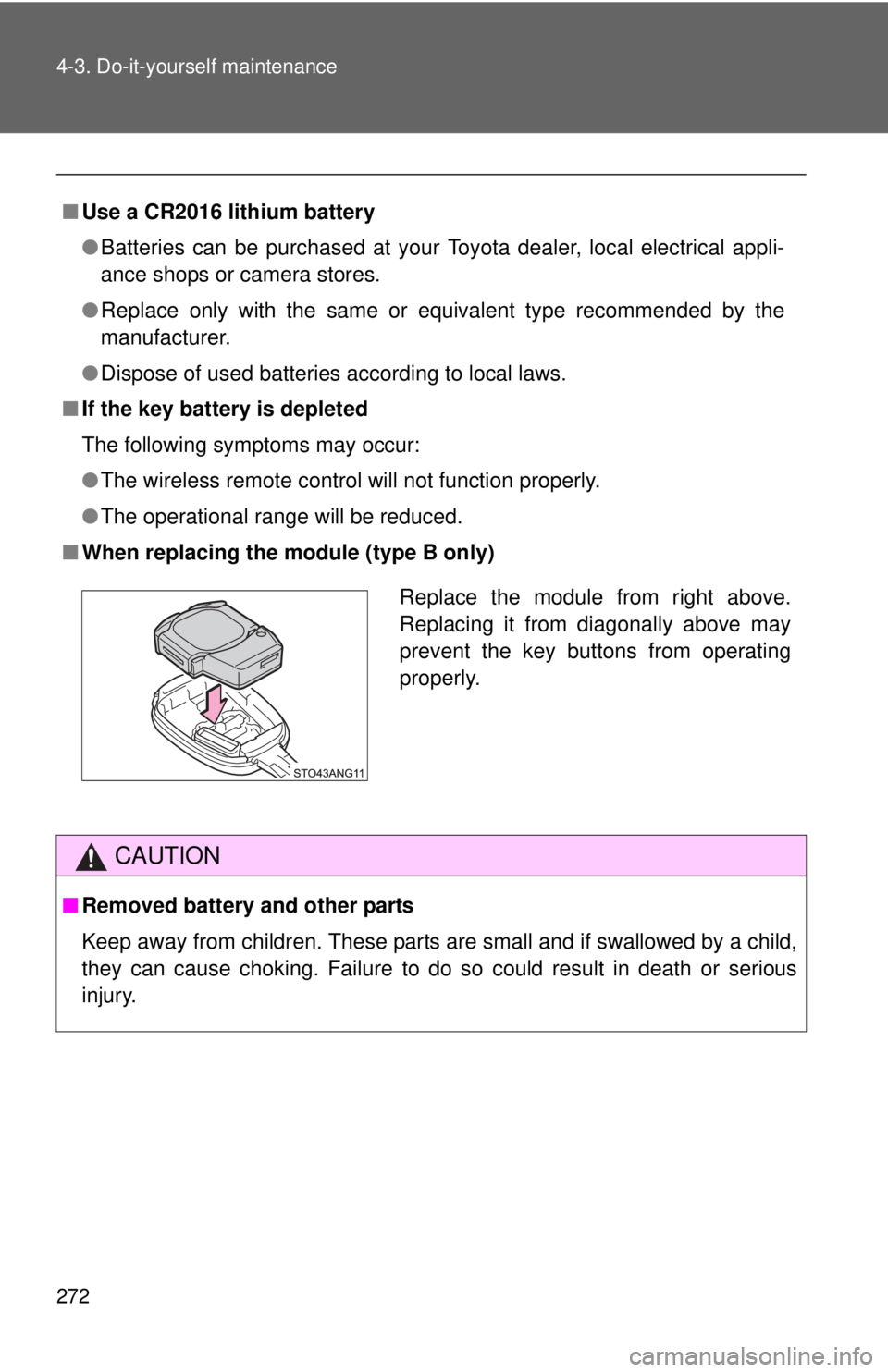
■ When replacing the module (type B only)
CAUTION
■Removed battery and other parts
Keep away from children. These parts are small and if swallowed by a child,
they can cause choking. Failure to do so could result in death or serious
injury.
Replace the module from right above.
Replacing it from diagonally above may
prevent the key buttons from operating
properly.
Page 252 of 365
273
4-3. Do-it-yourself maintenance
4
Maintenance and care
NOTICE
■
For normal operation after replacing the battery
Observe the following precautions to prevent accidents:
●Always work with dry hands.
Moisture may cause the battery to rust.
● Do not touch or move any other components inside the remote control.
● Do not bend either of the battery terminals.
Page 254 of 365
275
4-3. Do-it-yourself maintenance
4
Maintenance and care
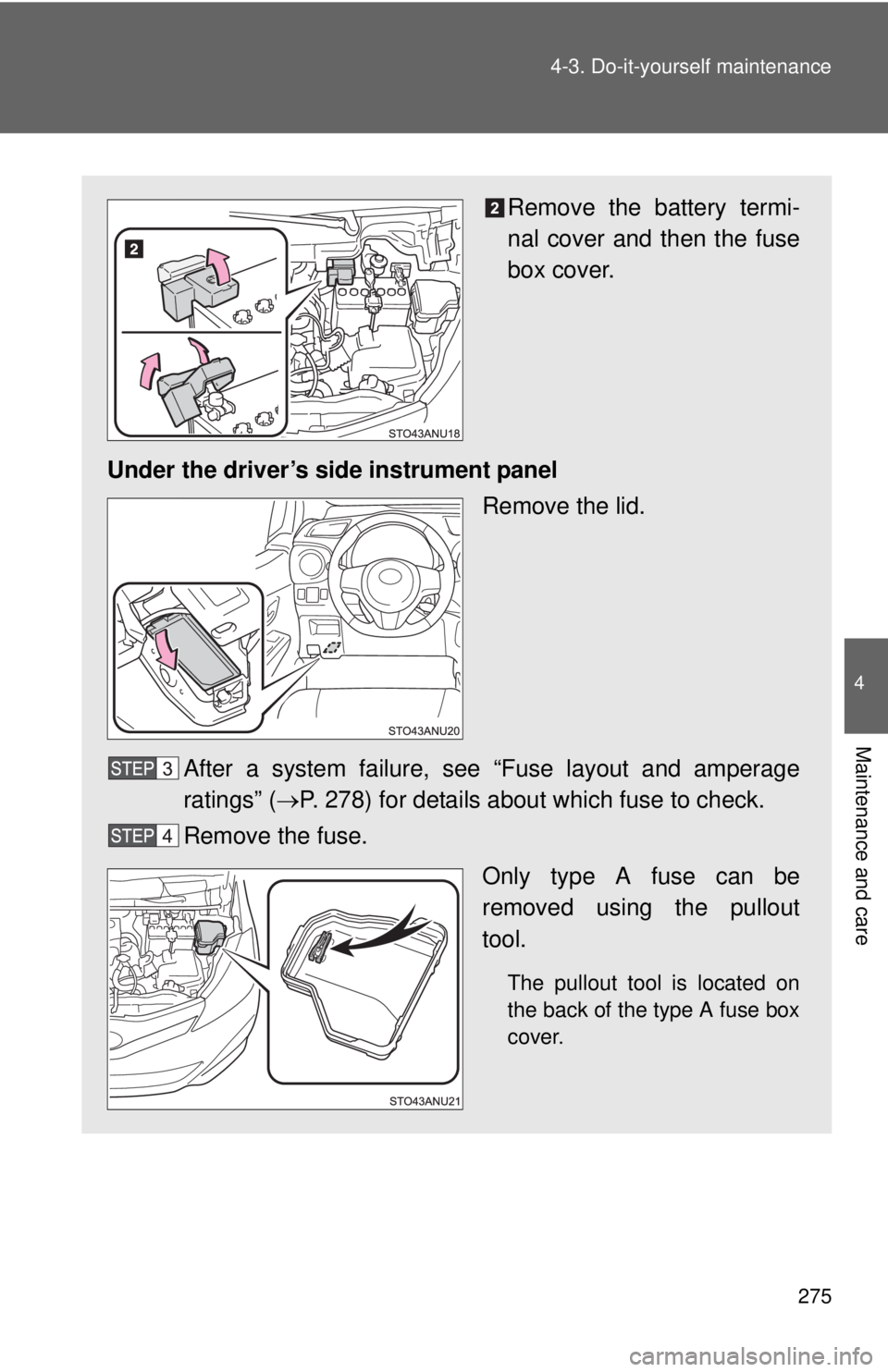
Remove the battery termi-
nal cover and then the fuse
box cover.
Under the driver’s side instrument panel Remove the lid.
After a system failure, s ee “Fuse layout and amperage
ratings” (→ P. 278) for details about which fuse to check.
Remove the fuse.
Only type A fuse can be
removed using the pullout
tool.
The pullout tool is located on
the back of the type A fuse box
cover.
Page 274 of 365
296
5-1. Essential information
Emergency flashers
NOTICE
■To prevent battery discharge
Do not leave the emergency flashers on longer than necessary when the
engine is not running.
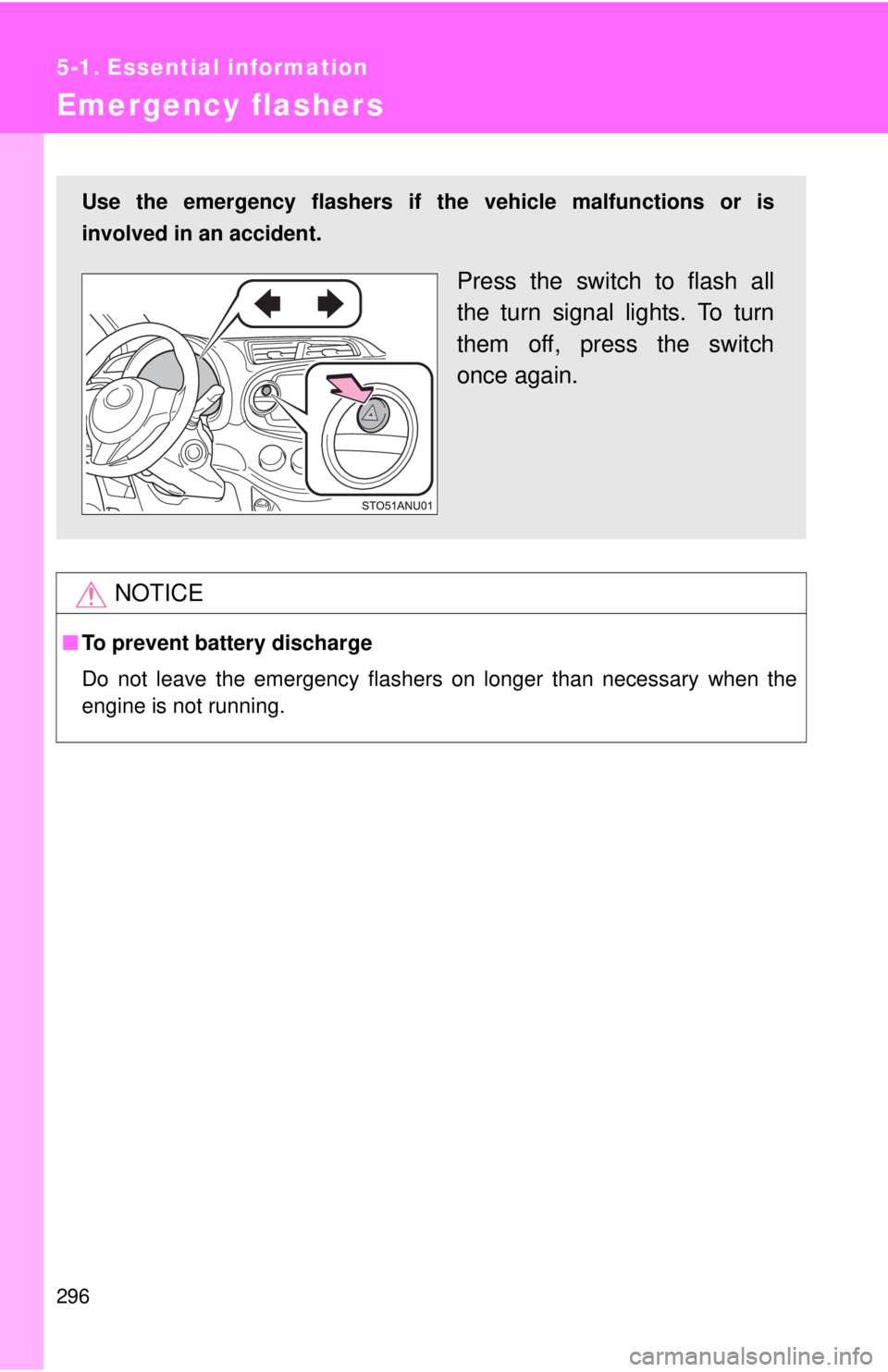
Use the emergency flashers if th e vehicle malfunctions or is
involved in an accident.
Press the switch to flash all
the turn signal lights. To turn
them off, press the switch
once again.
Page 305 of 365
5
When trouble arises
327
5-2. Steps to take in an emergency
If the engine will not start
If the engine will not start even though correct starting procedures
are being followed ( →P. 124), consider each of the following points:
■ The engine will not start even though the starter motor
operates normally.
One of the following may be the cause of the problem:
●There may not be sufficient fuel in the vehicle’s tank.
Refuel the vehicle.
● The engine may be flooded.
Try to restart the engine again following correct starting proce-
dures. ( →P. 124)
● Vehicles with engine immobilizer system: There may be a
malfunction in the engine immobilizer system. (→P. 7 2 )
■ The starter motor turns over slowly, the interior lights and
headlights are dim, or the horn does not sound or sounds at
a low volume.
One of the following may be the cause of the problem:
●The battery may be discharged. ( →P. 330)
● The battery terminal connec tions may be loose or corroded.
■ The starter motor does not turn over, the interior lights and
headlights do not turn on, or the horn does not sound.
One of the following may be the cause of the problem:
● One or both of the battery terminals may be disconnected.
● The battery may be discharged. ( →P. 330)
Contact your Toyota dealer if the problem cannot be repaired, or if
repair procedures are unknown.
Page 308 of 365
330
5-2. Steps to take in an emergency
If the vehicle batter y is discharged
The following procedures may be used to start the engine if the
vehicle’s battery is discharged.
You can also call your Toyota de aler or qualified repair shop.
If you have a set of jumper (or boo ster) cables and a second vehi-
cle with a 12-volt battery, you can jump start your vehicle by follow-
ing the steps below.
Open the hood ( →P. 236)
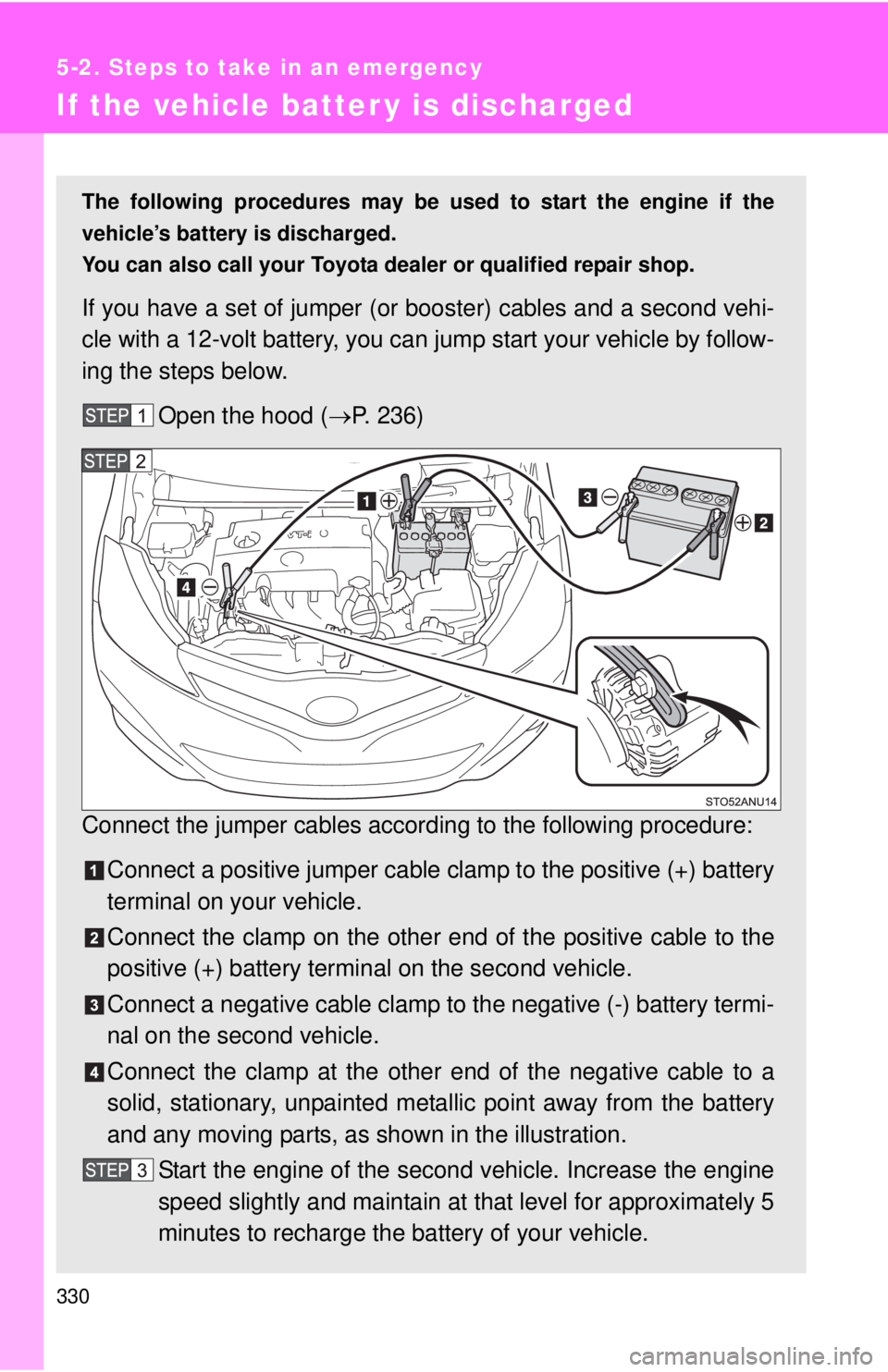
Connect the jumper cables accord ing to the following procedure:
Connect a positive jumper cable clamp to the positive (+) battery
terminal on your vehicle.
Connect the clamp on the other e nd of the positive cable to the
positive (+) battery termin al on the second vehicle.
Connect a negative cable clamp to the negative (-) battery termi-
nal on the second vehicle.
Connect the clamp at the other end of the negative cable to a
solid, stationary, unpainted metallic point away from the battery
and any moving parts, as shown in the illustration.
Start the engine of the second vehicle. Increase the engine
speed slightly and maintain at that level for approximately 5
minutes to recharge the battery of your vehicle.