battery TOYOTA YARIS HATCHBACK 2012 Owner's Guide
[x] Cancel search | Manufacturer: TOYOTA, Model Year: 2012, Model line: YARIS HATCHBACK, Model: TOYOTA YARIS HATCHBACK 2012Pages: 365, PDF Size: 8.17 MB
Page 309 of 365
5
When trouble arises
331
5-2. Steps to take in an emergency
■
Starting the engine when the battery is discharged (vehicles with an
automatic transmission)
The engine cannot be started by push-starting.
■ To prevent battery discharge
●Turn off the headlights and the air conditioning system while the engine is
off.
● Turn off any unnecessary electrical components when the vehicle is run-
ning at a low speed for an extended period, such as in heavy traffic.
■ Charging the battery
The electricity stored in the battery will discharge gradually even when the
vehicle is not in use, due to natural discharge and the draining effects of cer-
tain electrical appliances. If the vehicle is left for a long time, the battery may
discharge, and the engine may be unable to start. (The battery recharges
automatically during driving.)
Maintain the engine speed of the second vehicle and start
the engine of your vehicle by turning the engine switch to
the “ON” position.
Once the vehicle’s engine has started, remove the jumper
cables in the exact reverse or der from which they were con-
nected.
Once the engine starts, have the vehicle inspected at your Toyota
dealer as soon as possible.
Page 310 of 365
332 5-2. Steps to take in an emergency
CAUTION
■Avoiding battery fires or explosions
Observe the following precautions to prevent accidentally igniting the flam-
mable gas that may be emitted from the battery:
●Make sure each jumper cable is connected to the correct terminal and that
it is not unintentionally in contact with any other than the intended terminal.
● Do not allow the + and - clamps of the jumper cables to come into contact
with each other.
● Do not smoke, use matches, cigarette lighters or allow open flame near
the battery.
■ Battery precautions
The battery contains poisonous and corrosive acidic electrolyte, while
related parts contain lead and lead compounds. Observe the following pre-
cautions when handling the battery:
●When working with the battery, always wear safety glasses and take care
not to allow any battery fluids (acid) to come into contact with skin, clothing
or the vehicle body.
● Do not lean over the battery.
● In the event that battery fluid comes into contact with the skin or eyes,
immediately wash the affected area with water and seek medical attention.
Place a wet sponge or cloth over the affected area until medical attention
can be received.
● Always wash your hands after handling the battery support, terminals, and
other battery-related parts.
● Do not allow children near the battery.
■ To prevent damaging to the vehicle
Do not pull- or push-start the vehicle as the three-way catalytic converter
may overheat and become a fire hazard.
Page 325 of 365
348 6-1. Specifications
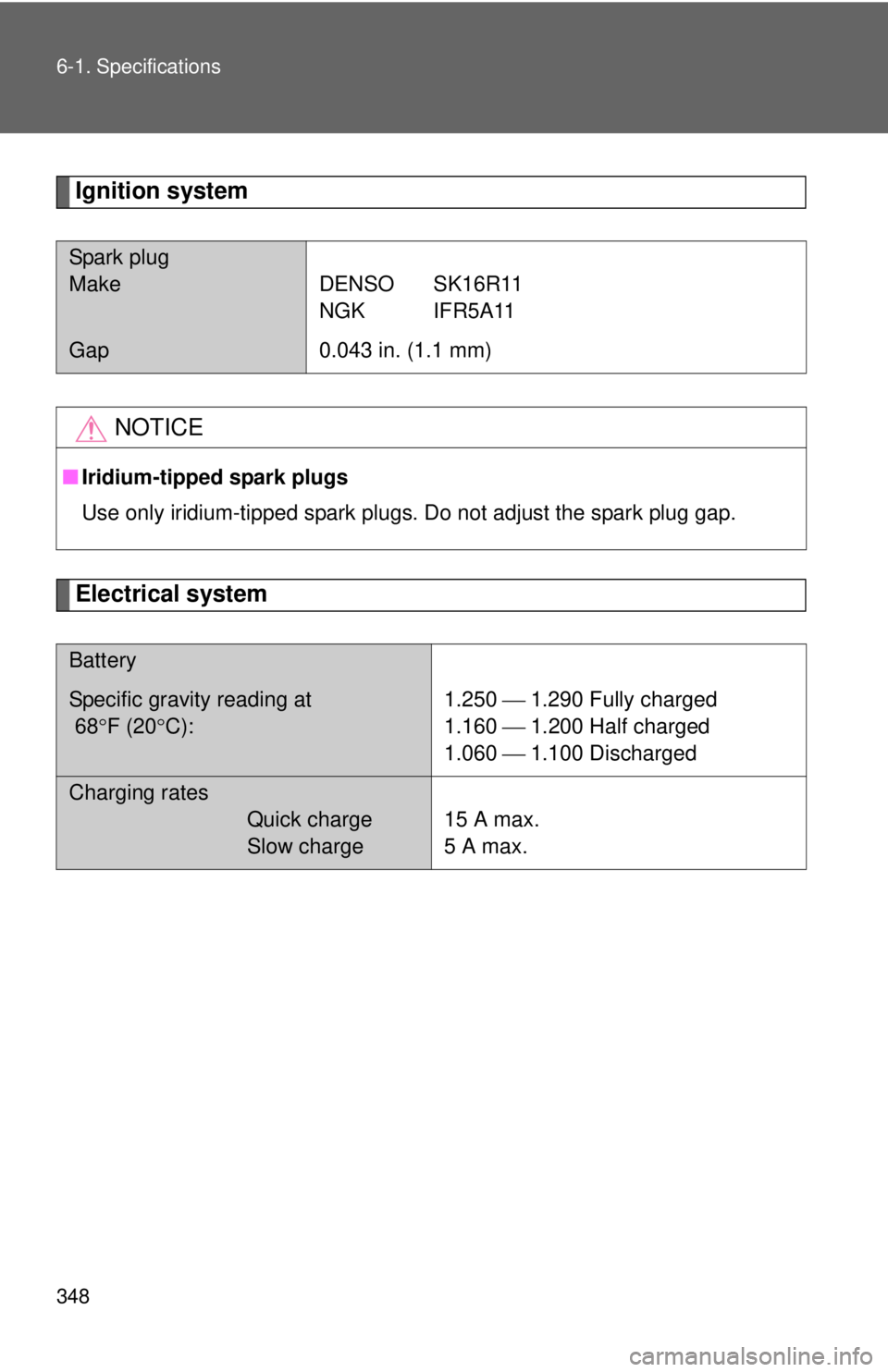
Ignition system
Electrical system
Spark plug
Make DENSO SK16R11NGK IFR5A11
Gap0.043 in. (1.1 mm)
NOTICE
■Iridium-tipped spark plugs
Use only iridium-tipped spark plugs. Do not adjust the spark plug gap.
Battery
Specific gravity reading at
68° F (20 °C): 1.250 ⎯ 1.290 Fully charged
1.160 ⎯ 1.200 Half charged
1.060 ⎯ 1.100 Discharged
Charging rates
Quick charge
Slow charge 15 A max.
5 A max.
Page 340 of 365
363
6-1. Specifications
6
Vehicle specifications
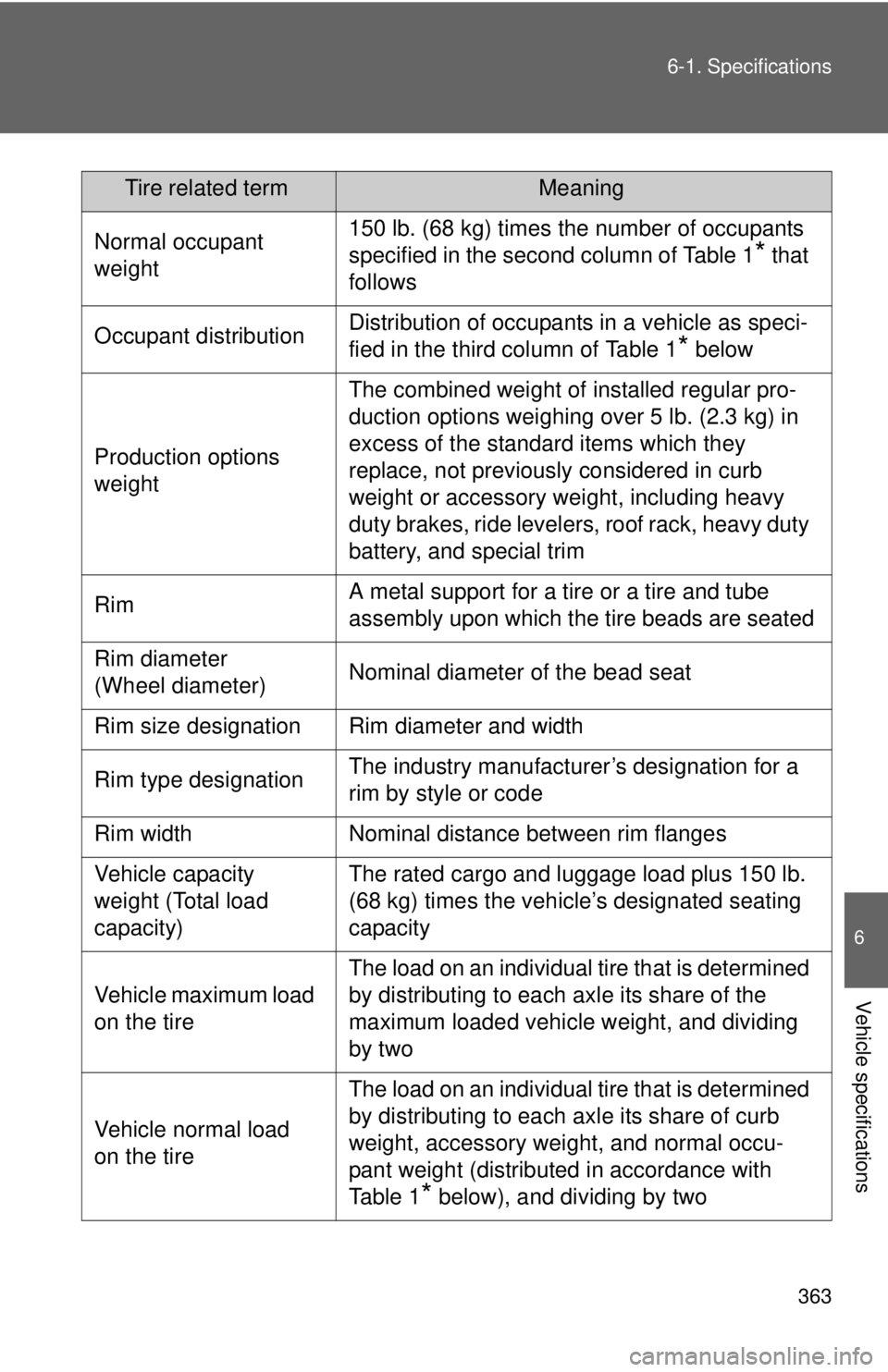
Normal occupant
weight150 lb. (68 kg) times the number of occupants
specified in the second column of Table 1
* that
follows
Occupant distributionDistribution of occupants in a vehicle as speci-
fied in the third column of Table 1
* below
Production options
weight
The combined weight of installed regular pro-
duction options weighing over 5 lb. (2.3 kg) in
excess of the standard items which they
replace, not previously considered in curb
weight or accessory weight, including heavy
duty brakes, ride levelers, roof rack, heavy duty
battery, and special trim
RimA metal support for a tire or a tire and tube
assembly upon which the tire beads are seated
Rim diameter
(Wheel diameter)Nominal diameter of the bead seat
Rim size designationRim diameter and width
Rim type designationThe industry manufacturer’s designation for a
rim by style or code
Rim widthNominal distance between rim flanges
Vehicle capacity
weight (Total load
capacity)The rated cargo and luggage load plus 150 lb.
(68 kg) times the vehicle’s designated seating
capacity
Vehicle maximum load
on the tire
The load on an individual tire that is determined
by distributing to each axle its share of the
maximum loaded vehicle weight, and dividing
by two
Vehicle normal load
on the tire
The load on an individual tire that is determined
by distributing to each axle its share of curb
weight, accessory weight, and normal occu-
pant weight (distributed in accordance with
Ta b l e 1
* below), and dividing by two
Tire related termMeaning
Page 347 of 365
370
6-2. Customization
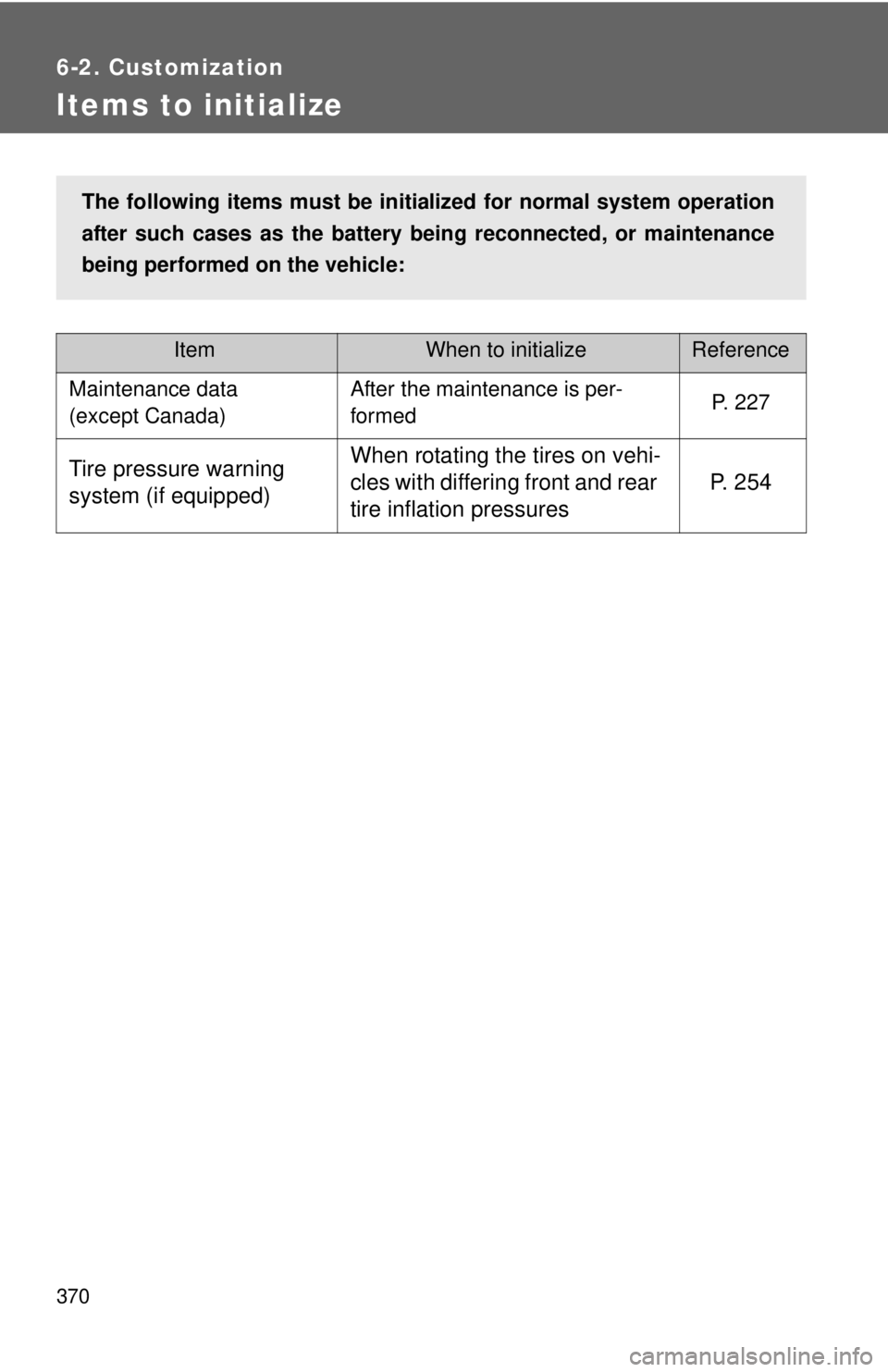
Items to initialize
ItemWhen to initializeReference
Maintenance data
(except Canada)After the maintenance is per-
formedP. 227
Tire pressure warning
system (if equipped)When rotating the tires on vehi-
cles with differing front and rear
tire inflation pressures
P. 2 5 4
The following items must be initialized for normal system operation
after such cases as the battery being reconnected, or maintenance
being performed on the vehicle:
Page 361 of 365
396
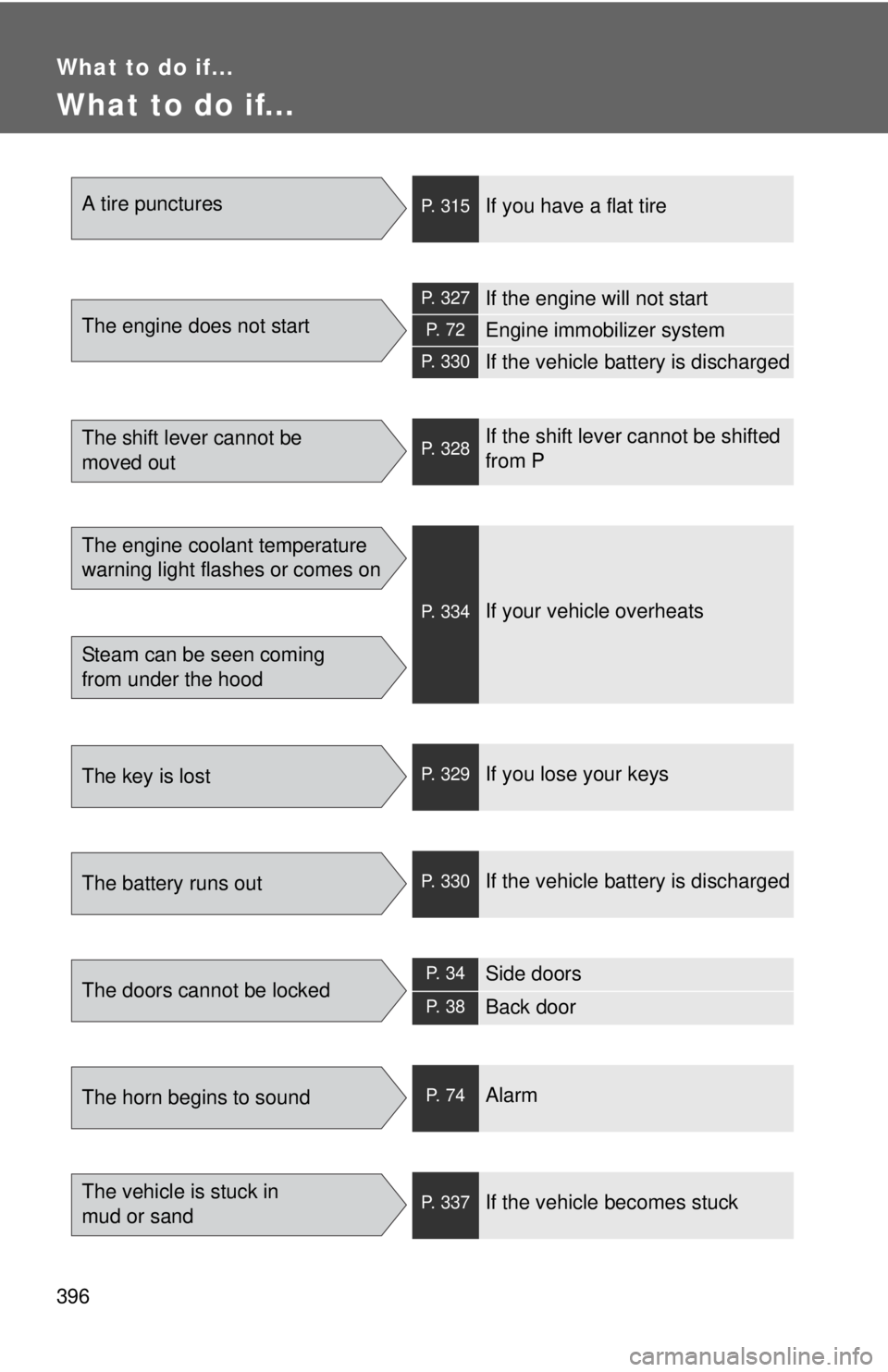
What to do if...
What to do if...
A tire puncturesP. 315If you have a flat tire
The engine does not start
P. 327If the engine will not start
P. 7 2Engine immobilizer system
P. 330If the vehicle battery is discharged
The shift lever cannot be
moved outP. 328If the shift lever cannot be shifted
from P
The engine coolant temperature
warning light flashes or comes on
Steam can be seen coming
from under the hood
P. 334If your vehicle overheats
The key is lostP. 329If you lose your keys
The battery runs outP. 330If the vehicle battery is discharged
The doors cannot be lockedP. 3 4Side doors
P. 3 8Back door
The horn begins to soundP. 7 4Alarm
The vehicle is stuck in
mud or sandP. 337If the vehicle becomes stuck