engine TOYOTA YARIS HATCHBACK 2012 Owner's Manual
[x] Cancel search | Manufacturer: TOYOTA, Model Year: 2012, Model line: YARIS HATCHBACK, Model: TOYOTA YARIS HATCHBACK 2012Pages: 365, PDF Size: 8.17 MB
Page 105 of 365
124
2-1. Driving procedures
Engine (ignition) switch
■Starting the engine
Vehicles with an au tomatic transmission
Check that the parking brake is set.
Check that the shift lever is set in P.
Firmly depress the brake pedal.
Turn the engine switch to the “START” position to start the
engine.
Vehicles with a manual transmission Check that the parking brake is set.
Check that the shift lever is set in N.
Firmly depress the clutch pedal.
Turn the engine switch to the “START” position to start the
engine.
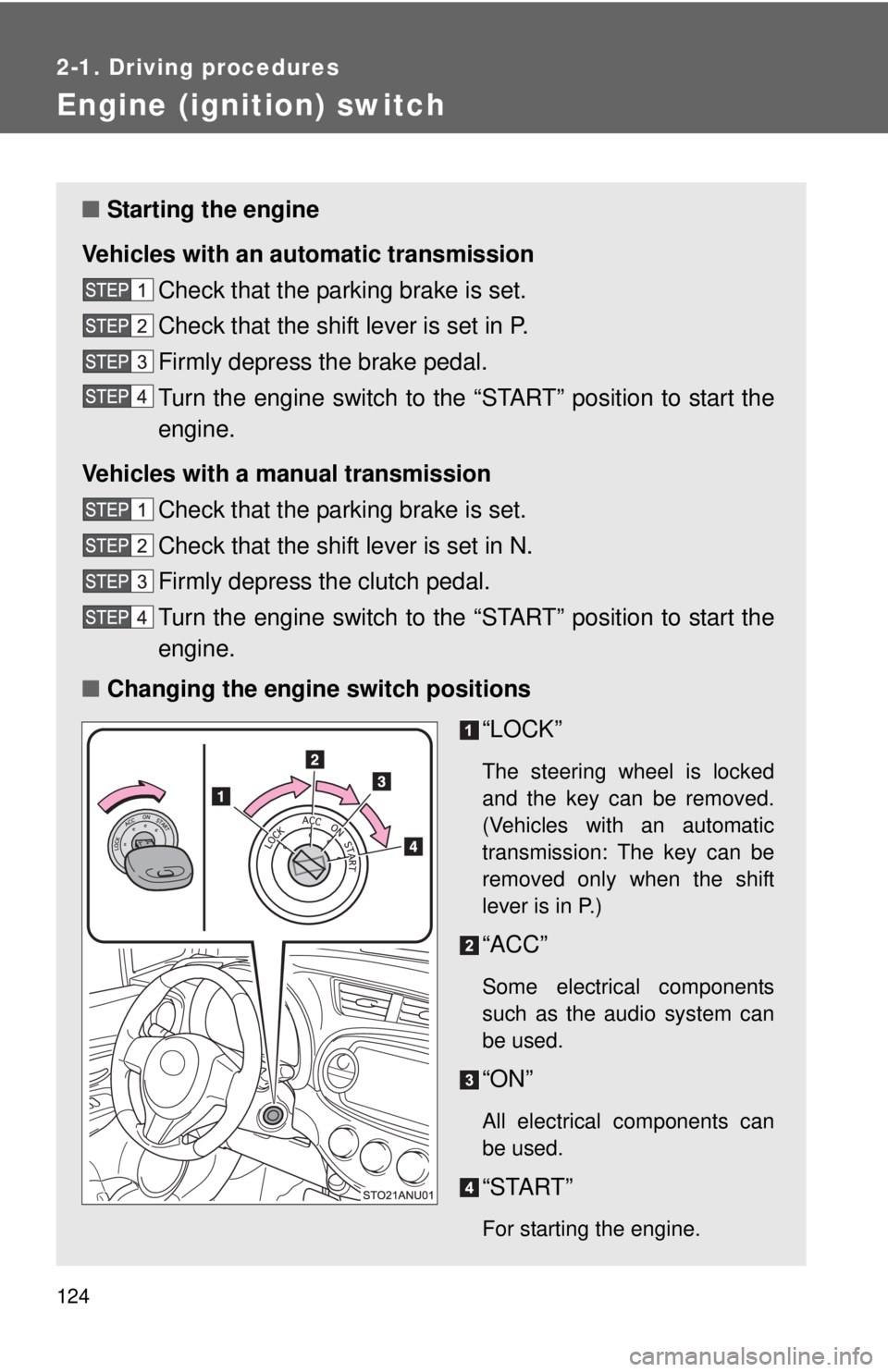
■ Changing the engine switch positions
“LOCK”
The steering wheel is locked
and the key can be removed.
(Vehicles with an automatic
transmission: The key can be
removed only when the shift
lever is in P.)
“ACC”
Some electrical components
such as the audio system can
be used.
“ON”
All electrical components can
be used.
“START”
For starting the engine.
Page 106 of 365
125
2-1. Driving procedures
2
When driving
■
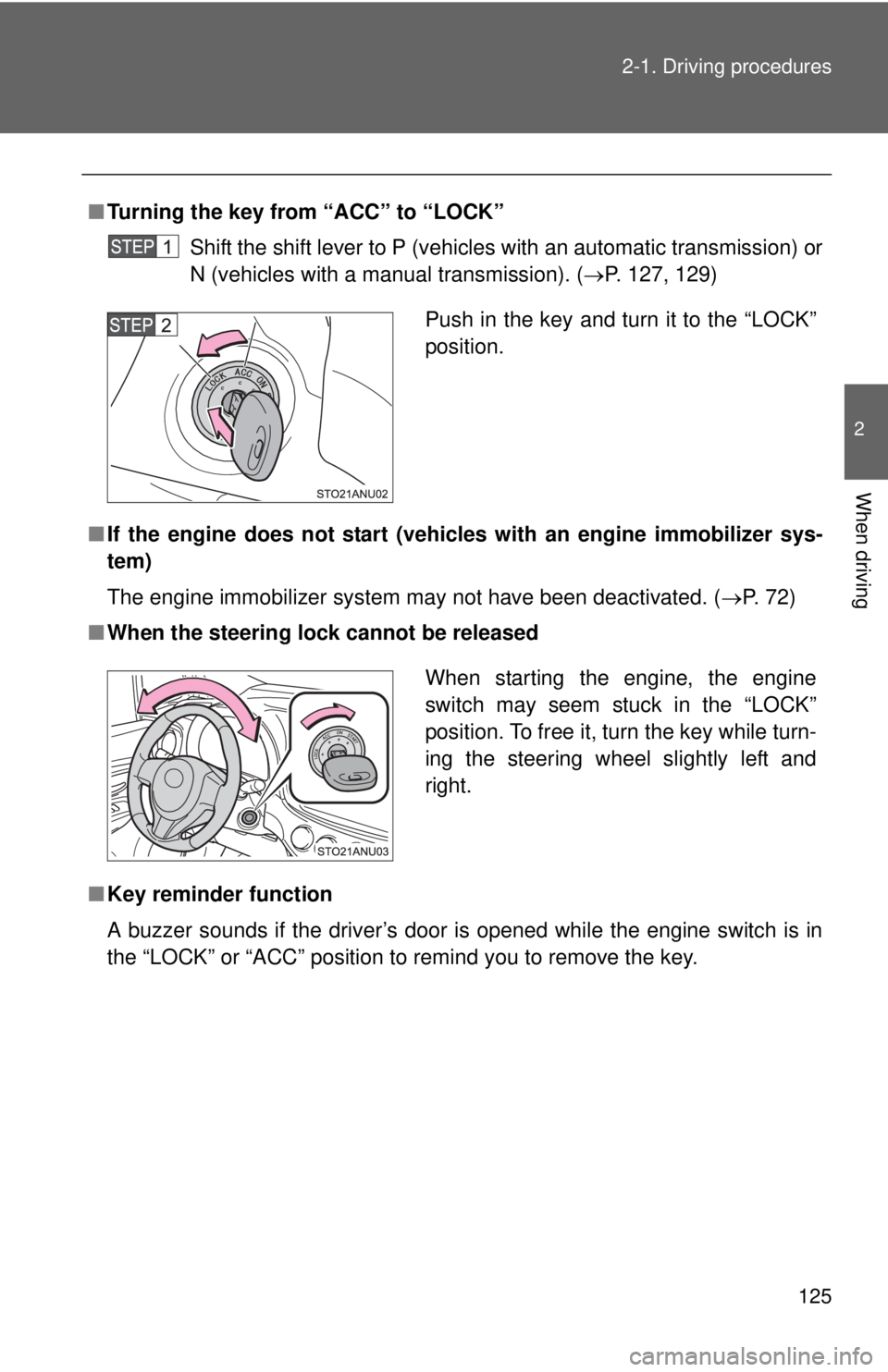
Turning the key from “ACC” to “LOCK”
Shift the shift lever to P (vehicles with an automatic transmission) or
N (vehicles with a manual transmission). ( →P. 127, 129)
■ If the engine does not start (vehic les with an engine immobilizer sys-
tem)
The engine immobilizer system may not have been deactivated. ( →P. 72)
■ When the steering lock cannot be released
■ Key reminder function
A buzzer sounds if the driver’s door is opened while the engine switch is in
the “LOCK” or “ACC” position to remind you to remove the key\
.
Push in the key and turn it to the “LOCK”
position.
When starting the engine, the engine
switch may seem stuck in the “LOCK”
position. To free it, turn the key while turn-
ing the steering wheel slightly left and
right.
Page 107 of 365
126 2-1. Driving procedures
CAUTION
■When starting the engine
Always start the engine while sitting in the driver’s seat. Do not depress the
accelerator pedal while starting the engine under any circumstances.
Doing so may cause an accident resulting in death or serious injury.
■ Caution while driving
Do not turn the engine switch to the “LOCK” position while driving. If, in an
emergency, you must turn the engine off while the vehicle is moving, turn the
engine switch only to the “ACC” position to stop the engine. An accident may
result if the engine is stopped while driving.
NOTICE
■To prevent battery discharge
Do not leave the engine switch in the “ACC” or “ON” position for long periods
of time without the engine running.
■ When starting the engine
●Do not crank the engine for more than 30 seconds at a time. This may
overheat the starter and wiring systems.
● Do not race a cold engine.
● If the engine becomes difficult to start or stalls frequently, have the engine
checked immediately.
Page 108 of 365
127
2-1. Driving procedures
2
When driving
Automatic transmission∗
∗: If equipped
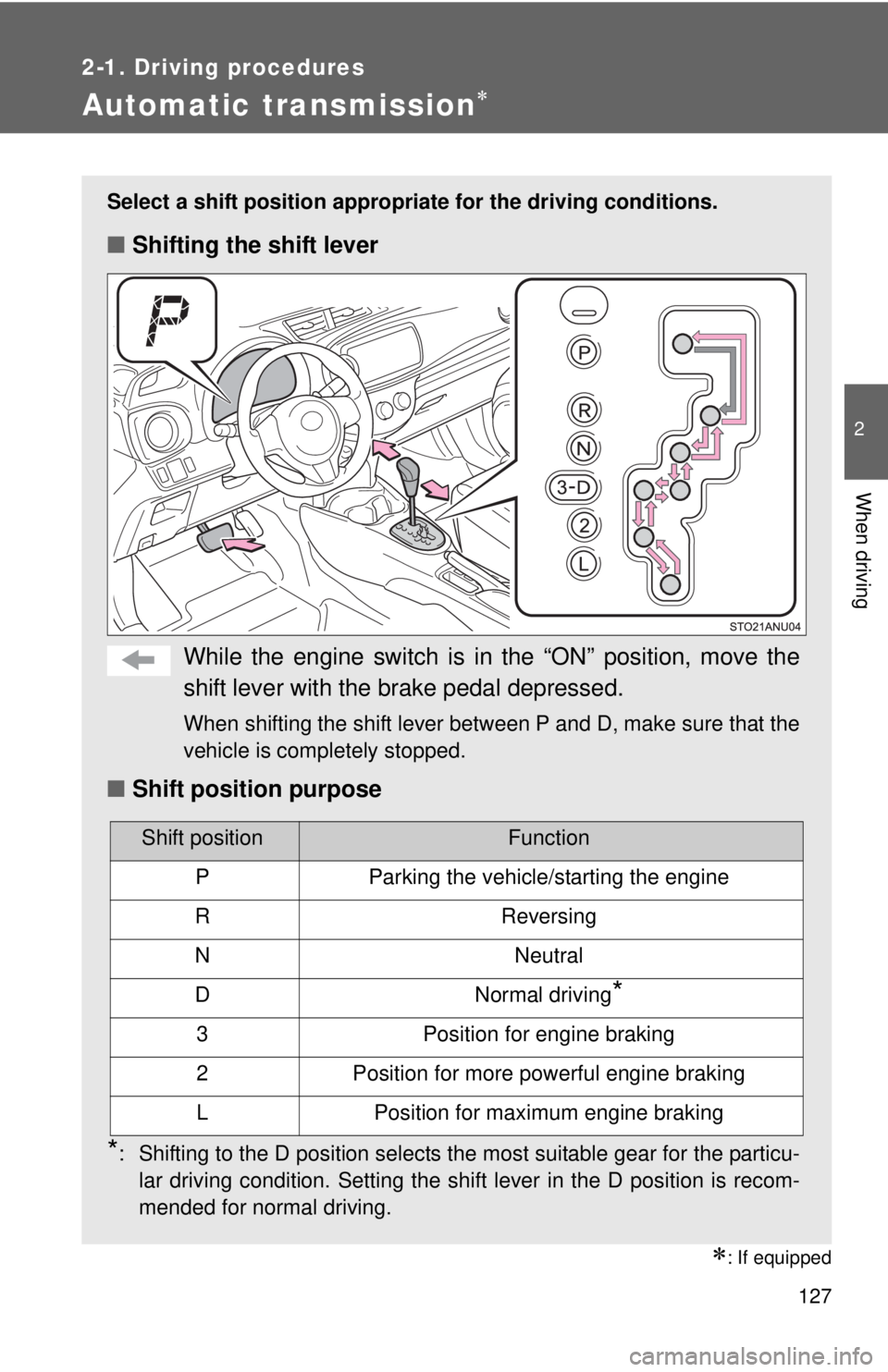
Select a shift position appropriate for the driving conditions.
■Shifting the shift lever
While the engine switch is in the “ON” position, move the
shift lever with the brake pedal depressed.
When shifting the shift lever between P and D, make sure that the
vehicle is completely stopped.
■Shift position purpose
*: Shifting to the D position selects the most suitable gear for the particu-
lar driving condition. Setting the shift lever in the D position is recom-
mended for normal driving.
Shift positionFunction
PParking the vehicle/starting the engine
RReversing
NNeutral
DNormal driving*
3Position for engine braking
2Position for more powerful engine braking
LPosition for maximum engine braking
Page 109 of 365
128 2-1. Driving procedures
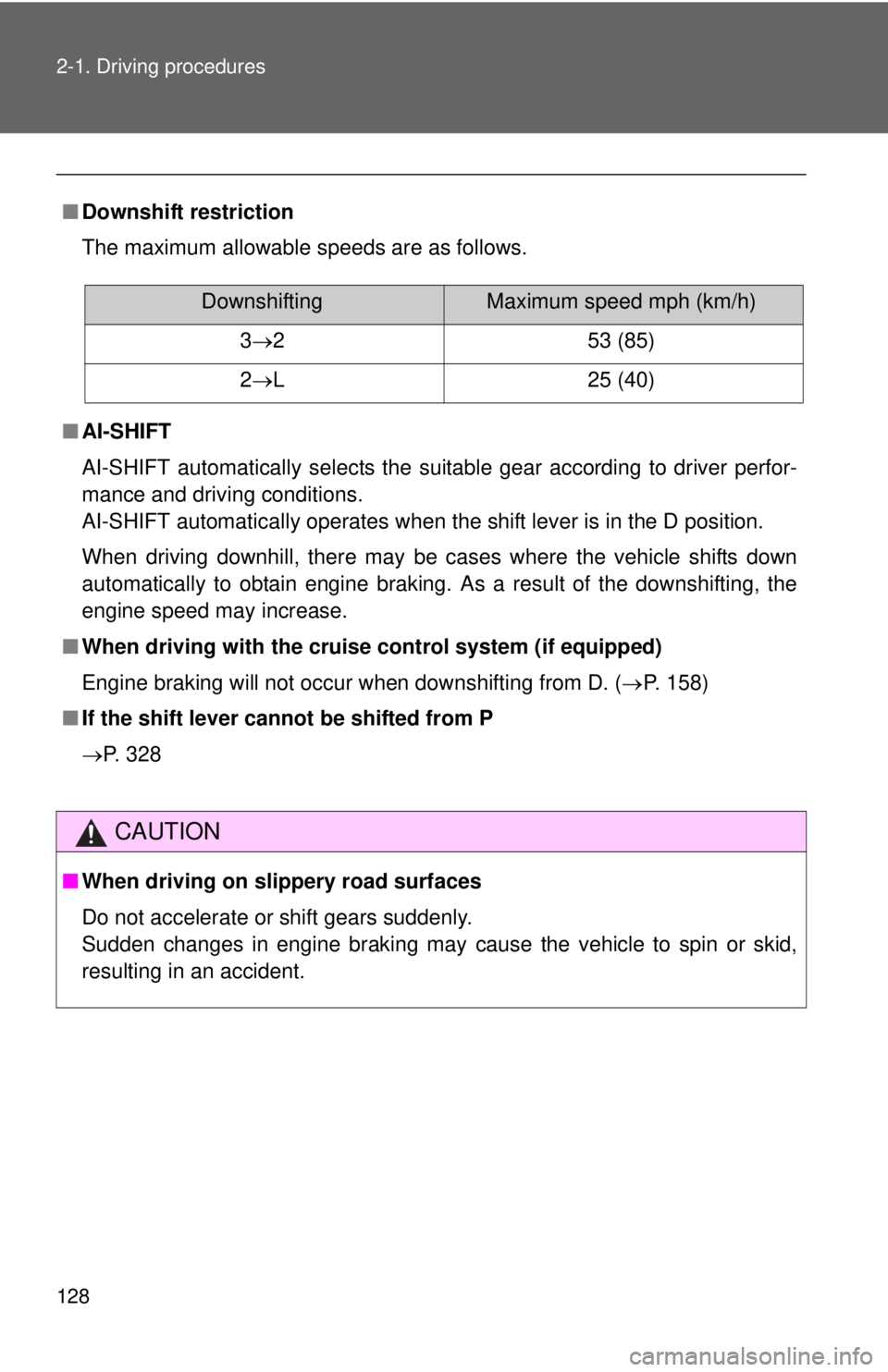
■Downshift restriction
The maximum allowable speeds are as follows.
■ AI-SHIFT
AI-SHIFT automatically selects the suitable gear according to driver perfor-
mance and driving conditions.
AI-SHIFT automatically operates when the shift lever is in the D position.
When driving downhill, there may be cases where the vehicle shifts down
automatically to obtain engine braking. As a result of the downshifting, the
engine speed may increase.
■ When driving with the cruise control system (if equipped)
Engine braking will not occur when downshifting from D. ( →P. 158)
■ If the shift lever cannot be shifted from P
→ P. 328
CAUTION
■When driving on slippery road surfaces
Do not accelerate or shift gears suddenly.
Sudden changes in engine braking may cause the vehicle to spin or skid,
resulting in an accident.
DownshiftingMaximum speed mph (km/h)
3 → 2 53 (85)
2 → L 25 (40)
Page 110 of 365
129
2-1. Driving procedures
2
When driving
Manual transmission∗
∗: If equipped
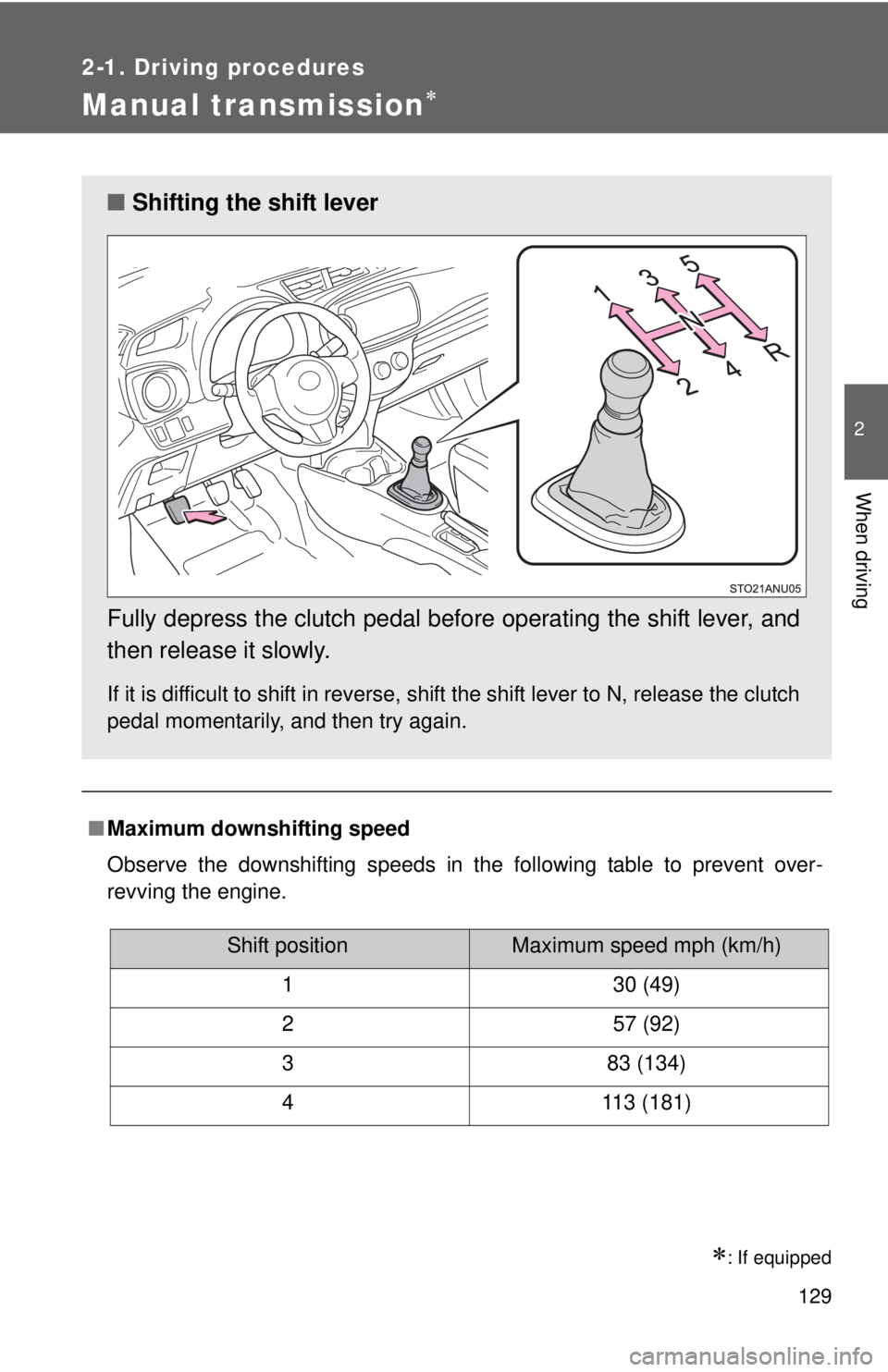
■Maximum downshifting speed
Observe the downshifting speeds in the following table to prevent over-
revving the engine.
■ Shifting the shift lever
Fully depress the clutch pedal before operating the shift lever, and
then release it slowly.
If it is difficult to shift in reverse, shift the shift lever to N, release the clutch
pedal momentarily, and then try again.
Shift positionMaximum speed mph (km/h)
1 30 (49)
2 57 (92)
3 83 (134)
4 113 (181)
Page 111 of 365
130
2-1. Driving procedures
Turn signal lever
■Turn signals can be operated when
The engine switch is in the “ON” position.
■ If the indicator flashes faster than usual
Check that a light bulb in the front or rear turn signal lights has not burned
out.
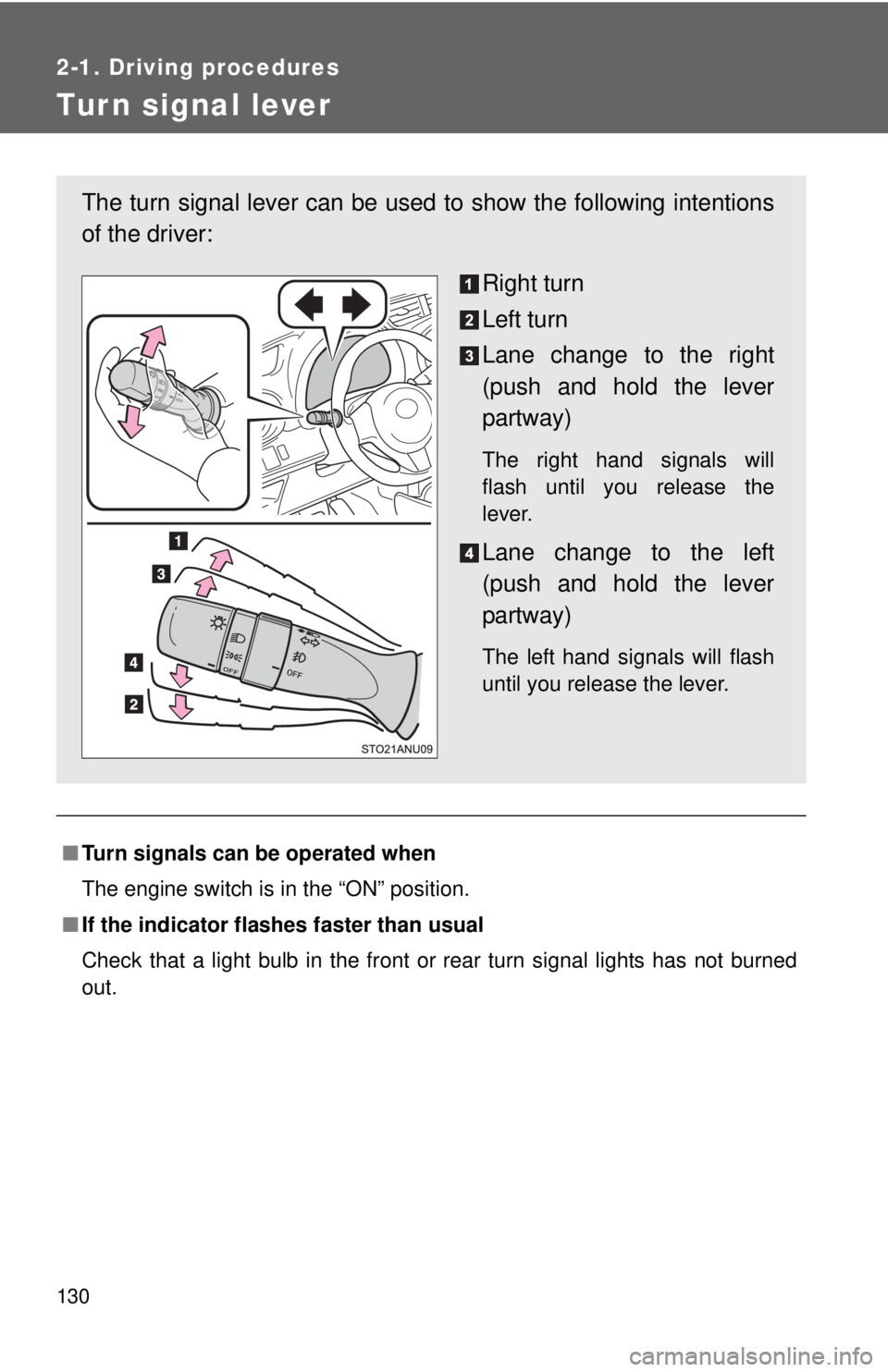
The turn signal lever can be used to show the following intentions
of the driver:
Right turn
Left turn
Lane change to the right
(push and hold the lever
partway)
The right hand signals will
flash until you release the
lever.
Lane change to the left
(push and hold the lever
partway)
The left hand signals will flash
until you release the lever.
Page 115 of 365
134 2-2. Instrument cluster
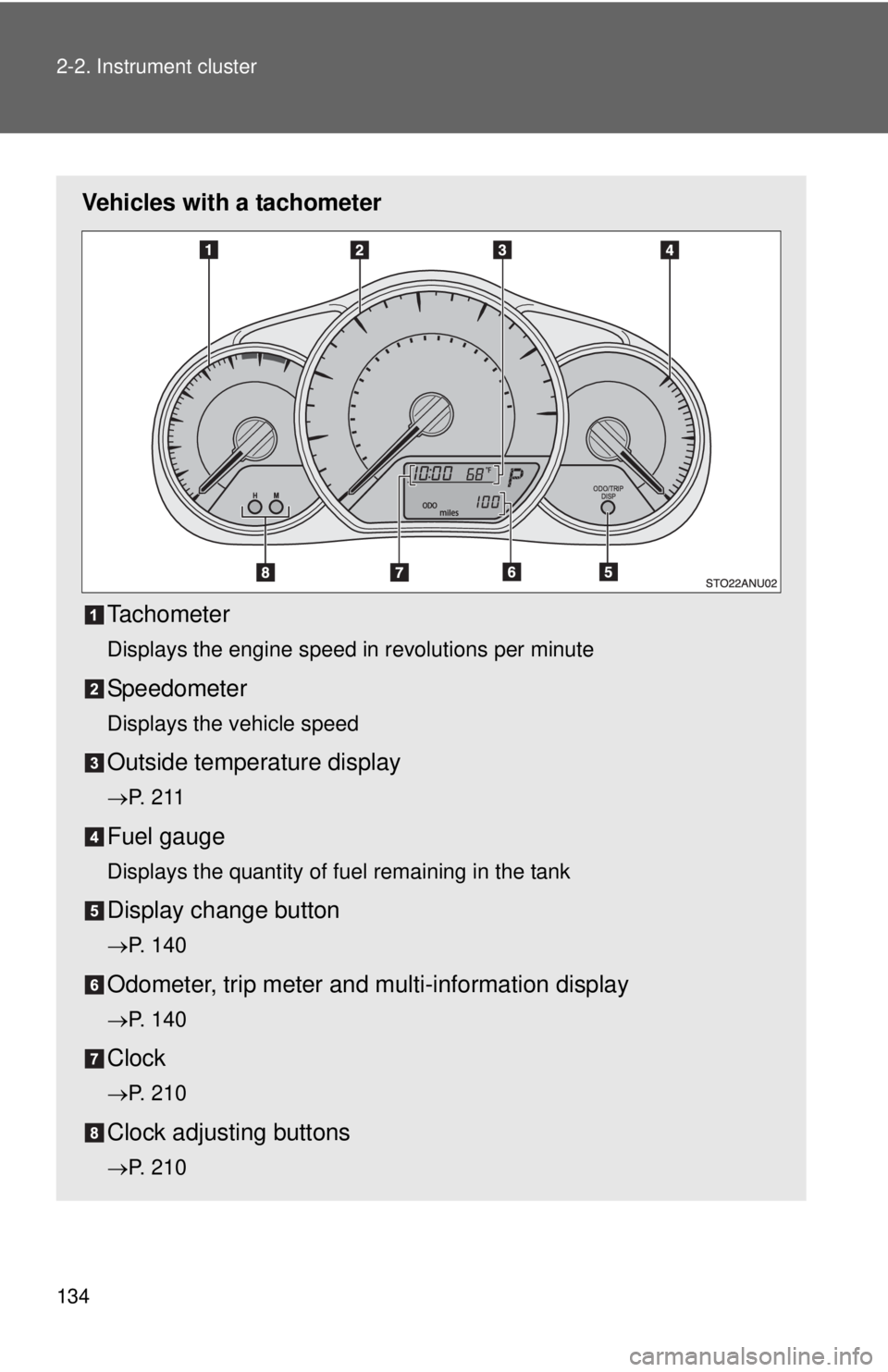
Vehicles with a tachometerTachometer
Displays the engine speed in revolutions per minute
Speedometer
Displays the vehicle speed
Outside temperature display
→P. 2 1 1
Fuel gauge
Displays the quantity of fuel remaining in the tank
Display change button
→P. 140
Odometer, trip meter and multi-information display
→P. 140
Clock
→P. 210
Clock adjusting buttons
→P. 210
Page 116 of 365
135
2-2. Instrument cluster
2
When driving
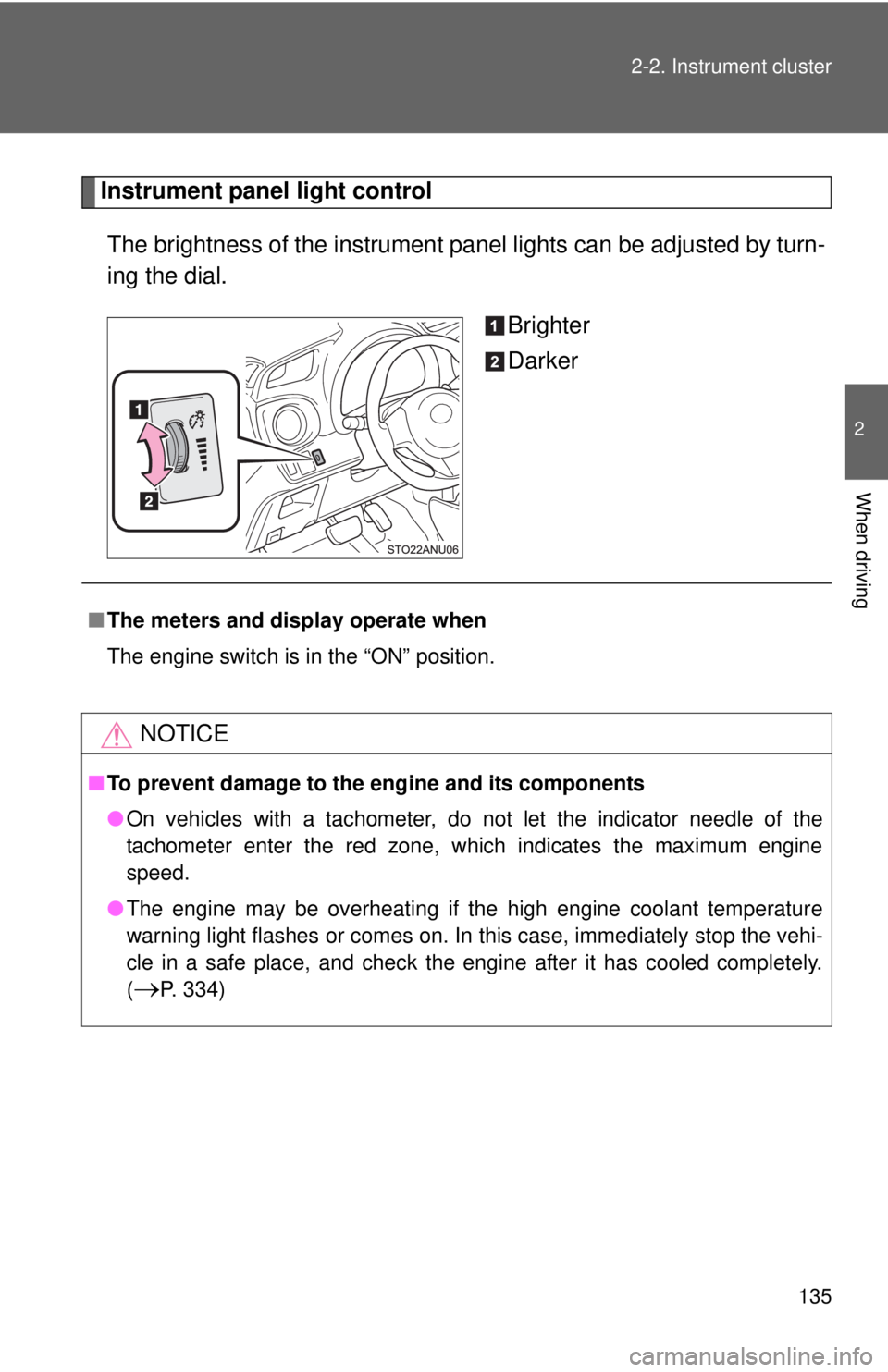
Instrument panel light control
The brightness of the instrument pa nel lights can be adjusted by turn-
ing the dial.
Brighter
Darker
■The meters and display operate when
The engine switch is in the “ON” position.
NOTICE
■To prevent damage to the engine and its components
●On vehicles with a tachometer, do not let the indicator needle of the
tachometer enter the red zone, which indicates the maximum engine
speed.
● The engine may be overheating if the high engine coolant temperature
warning light flashes or comes on. In this case, immediately stop the vehi-
cle in a safe place, and check the engine after it has cooled completely.
(
→P. 334)
Page 119 of 365
138 2-2. Instrument cluster
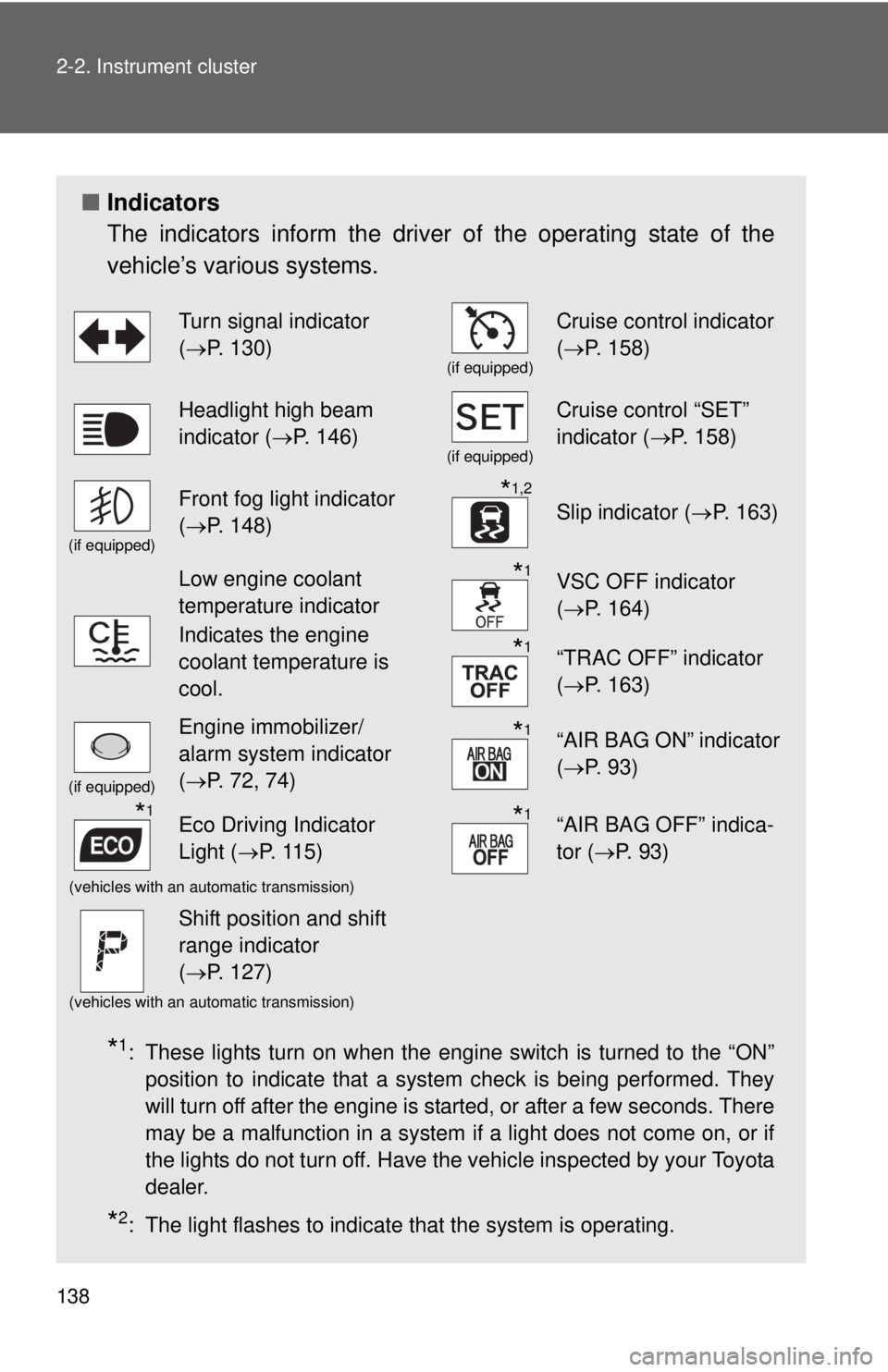
■Indicators
The indicators inform the driver of the operating state of the
vehicle’s various systems.
*1: These lights turn on when the engine switch is turned to the “ON”
position to indicate that a system check is being performed. They
will turn off after the engine is started, or after a few seconds. There
may be a malfunction in a system if a light does not come on, or if
the lights do not turn off. Have the vehicle inspected by your Toyota
dealer.
*2: The light flashes to indicate that the system is operating.
Turn signal indicator
(→ P. 130)
(if equipped)
Cruise control indicator
(→ P. 158)
Headlight high beam
indicator ( →P. 146)
(if equipped)
Cruise control “SET”
indicator ( →P. 158)
(if equipped)
Front fog light indicator
(→ P. 148)*1,2
Slip indicator ( →P. 163)
Low engine coolant
temperature indicator
Indicates the engine
coolant temperature is
cool.*1VSC OFF indicator
(→ P. 164)
*1“TRAC OFF” indicator
(→ P. 163)
(if equipped)
Engine immobilizer/
alarm system indicator
(→ P. 72, 74)*1“AIR BAG ON” indicator
(→ P. 93)
*1Eco Driving Indicator
Light ( →P. 115)*1“AIR BAG OFF” indica-
tor (→ P. 93)
(vehicles with an automatic transmission)
Shift position and shift
range indicator
(→ P. 127)
(vehicles with an automatic transmission)