engine TOYOTA YARIS HATCHBACK 2012 Workshop Manual
[x] Cancel search | Manufacturer: TOYOTA, Model Year: 2012, Model line: YARIS HATCHBACK, Model: TOYOTA YARIS HATCHBACK 2012Pages: 365, PDF Size: 8.17 MB
Page 192 of 365

212 3-5. Other interior features
■The outside temperatur e is displayed when
The engine switch is in the “ON” position.
■ Display
In the following situations, the correct outside temperature may not be dis-
played, or the display may take longer than normal to change:
●When the vehicle is stopped, or moving at low speeds (less than 16 mph
[25 km/h])
● When the outside temperature has changed suddenly (at the entrance/
exit of a garage, tunnel, etc.)
■ When “ − −” or “E” is displayed
The system may be malfunctioning. Take your vehicle to your Toyota dealer.
Page 193 of 365
213
3-5. Other interior features
3
Interior features
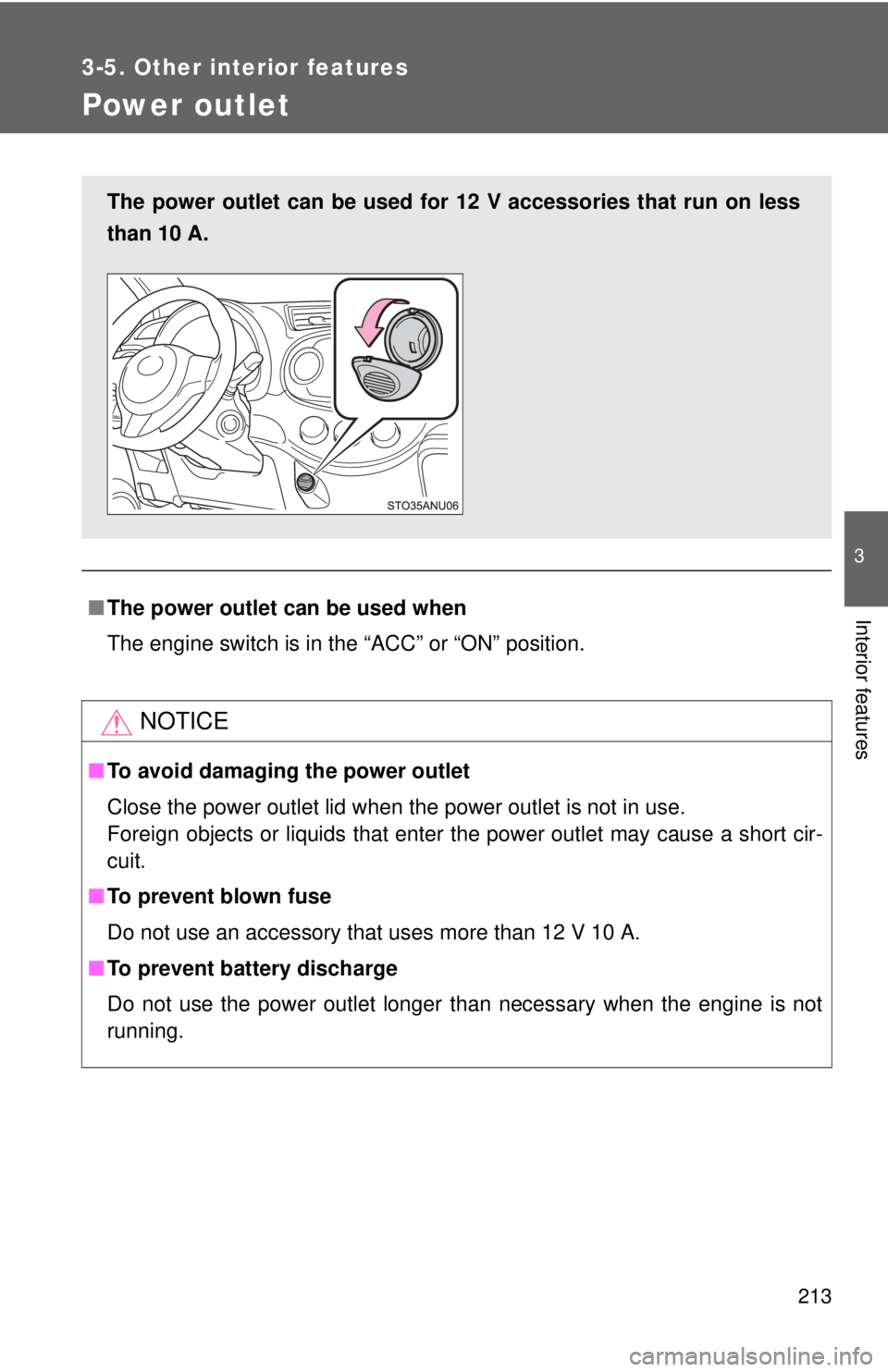
Power outlet
■The power outlet can be used when
The engine switch is in the “ACC” or “ON” position.
NOTICE
■To avoid damaging the power outlet
Close the power outlet lid when the power outlet is not in use.
Foreign objects or liquids that enter the power outlet may cause a short cir-
cuit.
■ To prevent blown fuse
Do not use an accessory that uses more than 12 V 10 A.
■ To prevent battery discharge
Do not use the power outlet longer than necessary when the engine is not\
running.
The power outlet can be used for 12 V accessories that run on less
than 10 A.
Page 195 of 365
215
3-5. Other interior features
3
Interior features
CAUTION
Observe the following precautions.
Failure to do so may cause the driver’s floor mat to slip, possibly interfering
with the pedals while driving. An unexpectedly high speed may result or it may
become difficult to stop the vehicle, leading to a serious accident.
■
When installing the driver’s floor mat
●Do not use floor mats designed for other models or different model year
vehicles, even if they are Toyota Genuine floor mats.
● Only use floor mats designed for the driver’s seat.
● Always install the floor mat securely using the retaining hooks (clips) pro-
vided.
● Do not use two or more floor mats on top of each other.
● Do not place the floor mat bottom-side up or upside-down.
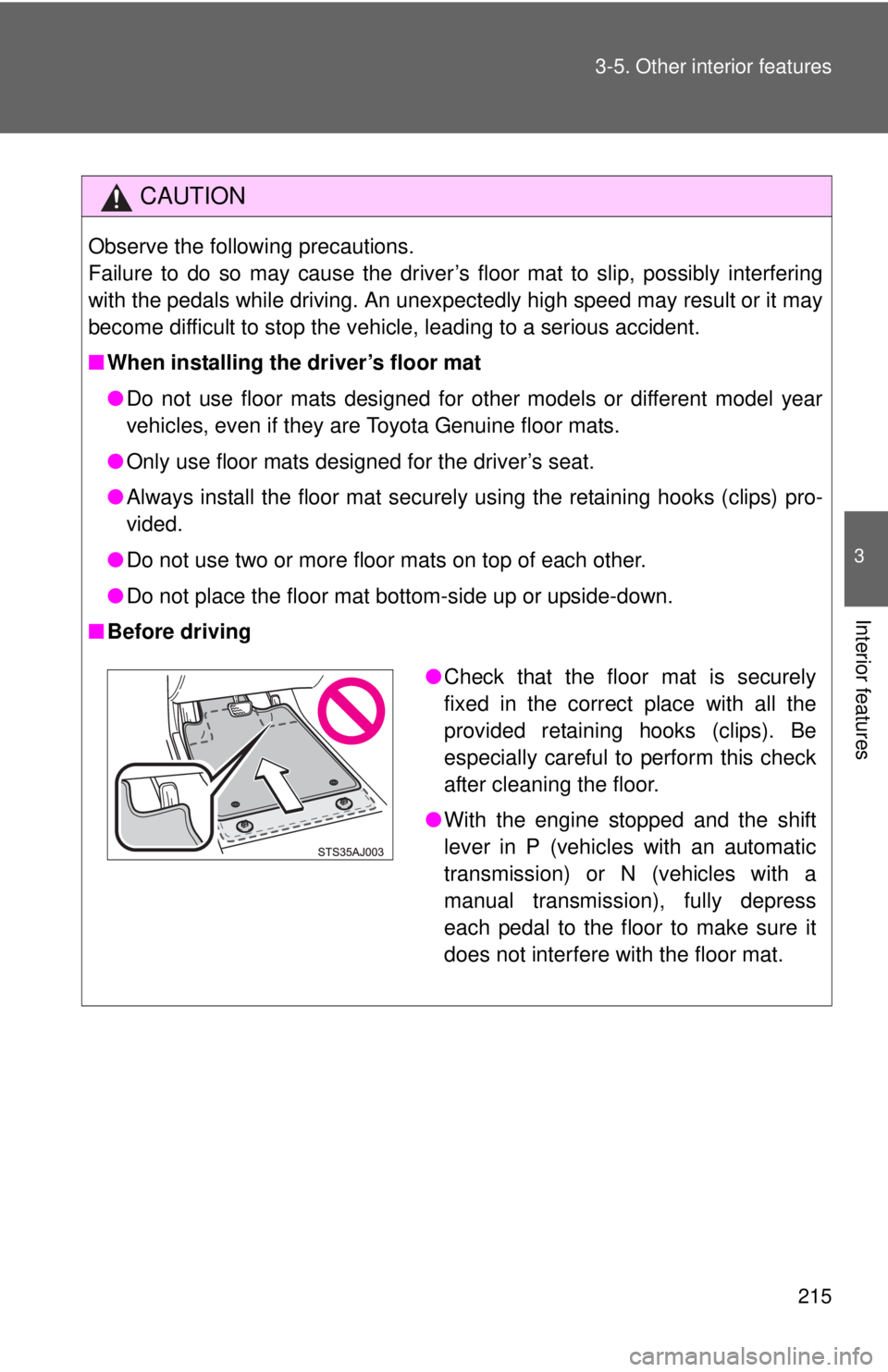
■ Before driving
●Check that the floor mat is securely
fixed in the correct place with all the
provided retaining hooks (clips). Be
especially careful to perform this check
after cleaning the floor.
● With the engine stopped and the shift
lever in P (vehicles with an automatic
transmission) or N (vehicles with a
manual transmission), fully depress
each pedal to the floor to make sure it
does not interfere with the floor mat.
Page 200 of 365
221
4-1. Maintenance and care
4
Maintenance and care
■
Aluminum wheels (if equipped)
●Remove any dirt immediately by using a neutral detergent. Do not use
hard brushes or abrasive cleaners. Do not use strong or harsh chemical
cleaners.
Use the same mild detergent and wax as used on the paint.
● Do not use detergent on the wheels when they are hot, for example after
driving for long distance in the hot weather.
● Wash detergent from the wheels immediately after use.
● To preserve the wheels’ luster, do not allow hot water, such as from
steam cleaning, to contact them directly.
■ Bumpers
Do not scrub with abrasive cleaners.
CAUTION
■When washing the vehicle
Do not apply water to the inside of the engine compartment. Doing so may
cause the electrical components etc. to catch fire.
■ Precautions regardin g the exhaust pipe
Exhaust gasses cause the exhaust pipe to become quite hot.
When washing the vehicle, be careful not to touch the pipe until it has cooled
sufficiently, as touching a hot exhaust pipe can cause burns.
Page 206 of 365
227
4-2. Maintenance
4
Maintenance and care
■
Reset the maintenance data (except Canada)
After the required maintenance is performed according to the maintenance
schedule, please reset the maintenance data.
To reset the data, follow the procedures described below:
Switch the display to the trip meter “A” when the engine is running.
(→ Page 133)
Turn the engine switch to the “LOCK” position.
While pressing the display change button ( →Page 133), turn the
engine switch to the “ON” position (do not start the engine because
reset mode will be canceled). Continue to press and hold the button
until the trip meter displays “000000”.
■ Allow inspection and repairs to be performed by a Toyota dealer
● Toyota technicians are well-trained specialists and are kept up to date
with the latest service information. They are well informed about the
operations of all systems on your vehicle.
● Keep a copy of the repair order. It proves that the maintenance that has
been performed is under warranty coverage. If any problem should arise
while your vehicle is under warranty, your Toyota dealer will promptly
take care of it.
CAUTION
■If your vehicle is not properly maintained
Improper maintenance could result in serious damage to the vehicle and
possible serious injury or death.
■ Handling of the battery
●Engine exhaust, some of its constituents, and a wide variety of automobile
components contain or emit chemicals known to the State of California to
cause cancer and birth defects and other reproductive harm. Work in a
well ventilated area.
● Oils, fuels and fluids contained in vehicles as well as waste produced by
component wear contain or emit chemicals known to the State of Califor-
nia to cause cancer and birth defects or other reproductive harm. Avoid
exposure and wash any affected area immediately.
● Battery posts, terminals and related accessories contain lead and lead
compounds which are known to cause brain damage. Wash your hands
after handling. ( →P. 249)
Page 207 of 365
228
4-2. Maintenance
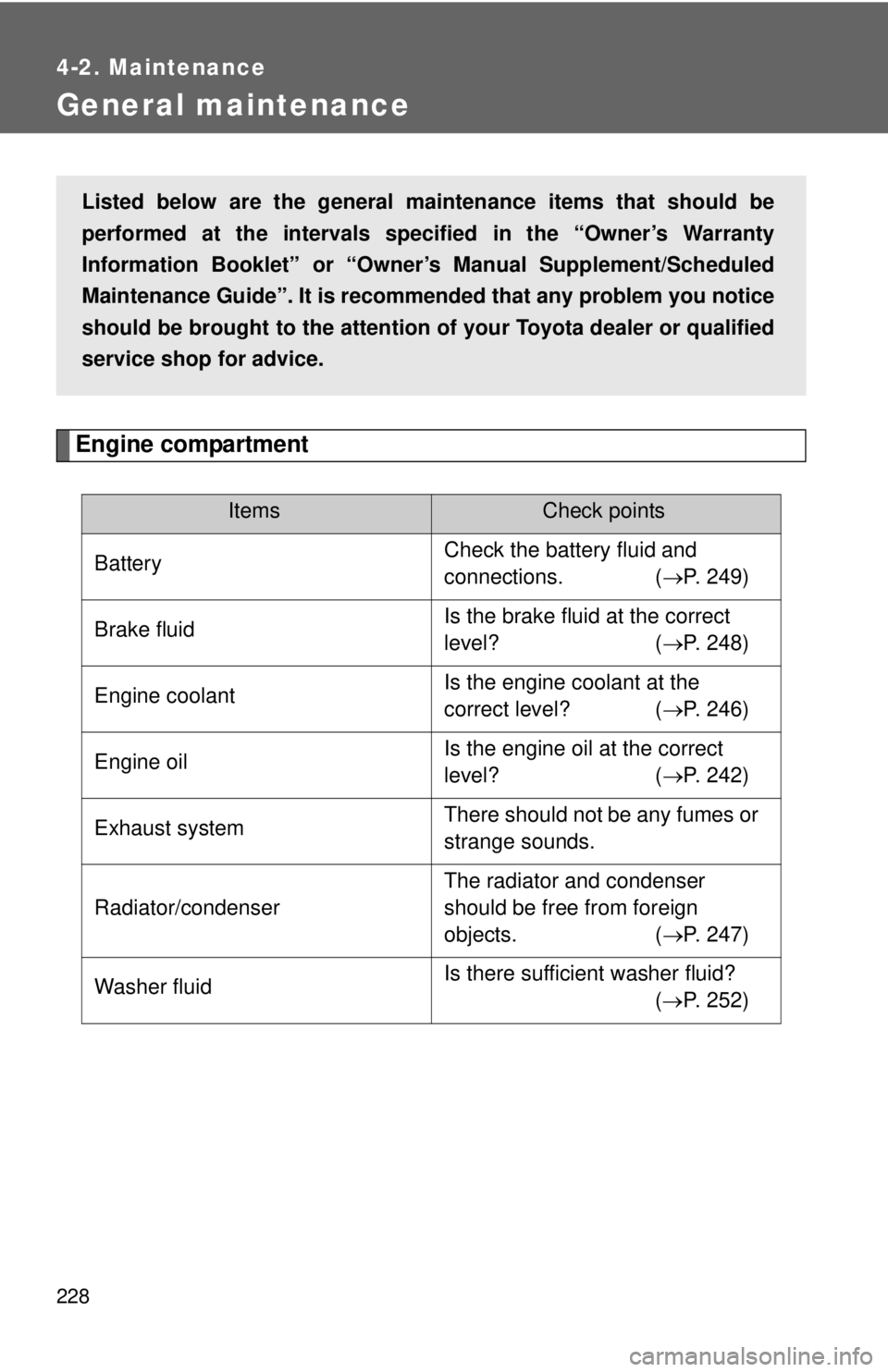
General maintenance
Engine compartment
ItemsCheck points
Battery Check the battery fluid and
connections. (
→P. 249)
Brake fluid Is the brake fluid at the correct
level? (
→P. 248)
Engine coolant Is the engine coolant at the
correct level? (
→P. 246)
Engine oil Is the engine oil at the correct
level? (
→P. 242)
Exhaust system There should not be any fumes or
strange sounds.
Radiator/condenser The radiator and condenser
should be free from foreign
objects. (
→P. 247)
Washer fluid Is there sufficient washer fluid?
(→ P. 252)
Listed below are the general maintenance items that should be
performed at the intervals specified in the “Owner’s Warranty
Information Booklet” or “Owner’s Manual Supplement/Scheduled
Maintenance Guide”. It is recommended that any problem you notice
should be brought to the attention of your Toyota dealer or qualified
service shop for advice.
Page 210 of 365
231
4-2. Maintenance
4
Maintenance and care
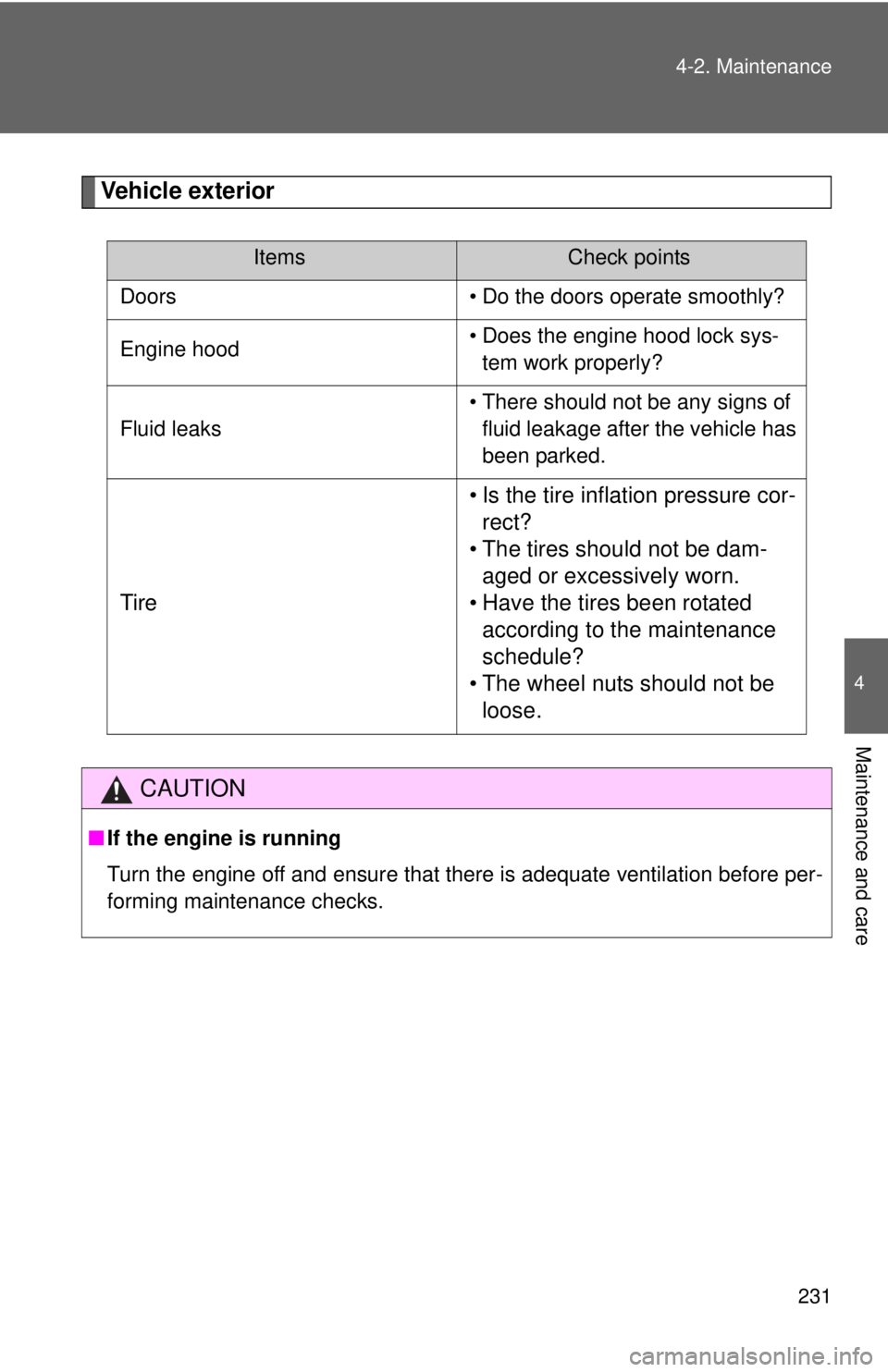
Vehicle exterior
ItemsCheck points
Doors • Do the doors operate smoothly?
Engine hood • Does the engine hood lock sys-
tem work properly?
Fluid leaks • There should not be any signs of
fluid leakage after the vehicle has
been parked.
Tire • Is the tire inflation pressure cor-
rect?
• The tires should not be dam- aged or excessively worn.
• Have the tires been rotated according to the maintenance
schedule?
• The wheel nuts should not be loose.
CAUTION
■ If the engine is running
Turn the engine off and ensure that there is adequate ventilation before per-
forming maintenance checks.
Page 212 of 365
233
4
Maintenance and care
4-3. Do-it-yourself maintenance
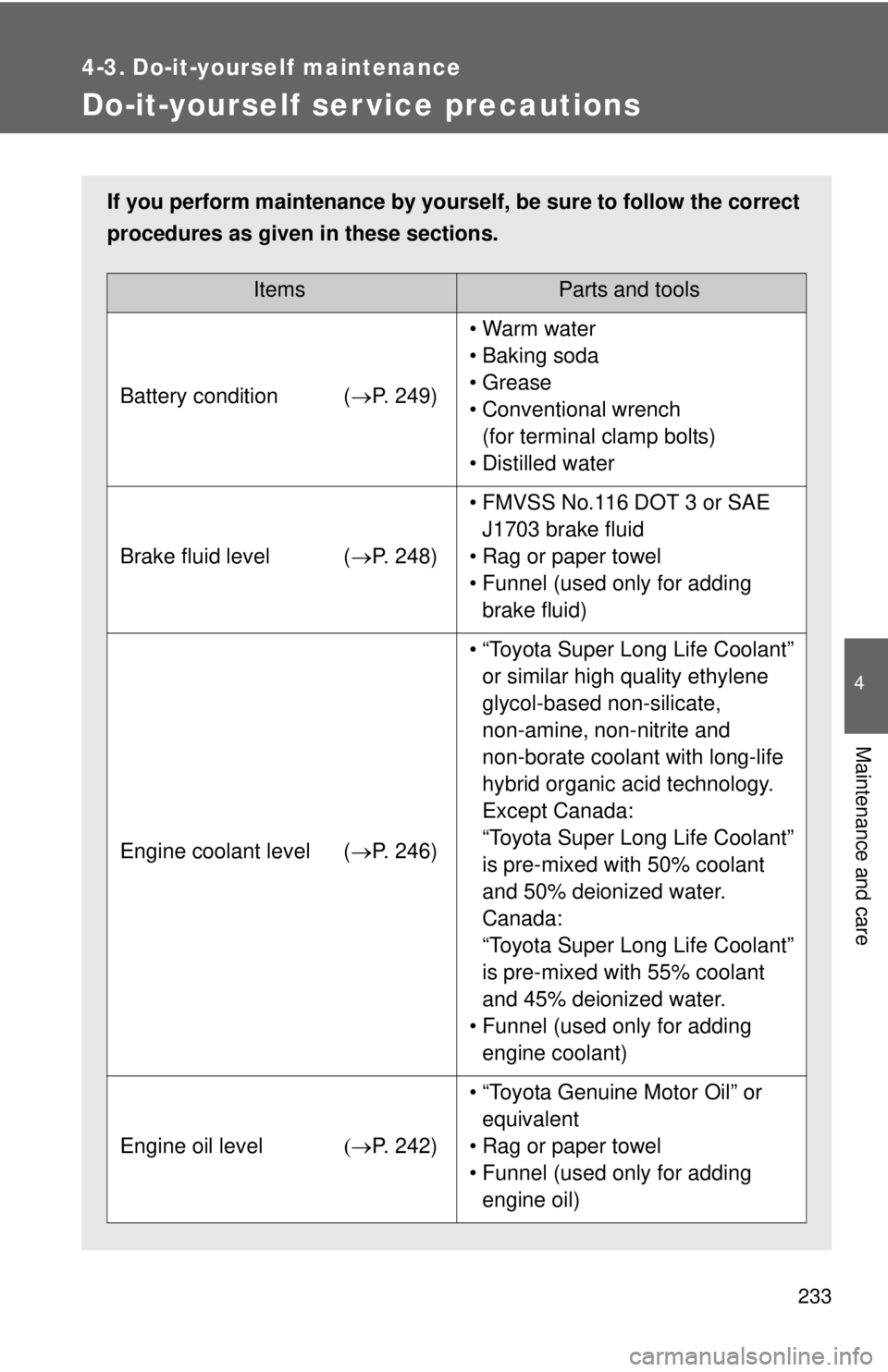
Do-it-yourself ser vice precautions
If you perform maintenance by yourself, be sure to follow the correct
procedures as given in these sections.
ItemsParts and tools
Battery condition ( →P. 249)
•Warm water
• Baking soda
• Grease
• Conventional wrench
(for terminal clamp bolts)
• Distilled water
Brake fluid level ( →P. 248)
• FMVSS No.116 DOT 3 or SAE
J1703 brake fluid
• Rag or paper towel
• Funnel (used only for adding brake fluid)
Engine coolant level ( →P. 246)
• “Toyota Super Long Life Coolant”
or similar high quality ethylene
glycol-based non-silicate,
non-amine, non-nitrite and
non-borate coolant with long-life
hybrid organic acid technology.
Except Canada:
“Toyota Super Long Life Coolant”
is pre-mixed with 50% coolant
and 50% deionized water.
Canada:
“Toyota Super Long Life Coolant”
is pre-mixed with 55% coolant
and 45% deionized water.
• Funnel (used only for adding engine coolant)
Engine oil level (→P. 242)
• “Toyota Genuine Motor Oil” or
equivalent
• Rag or paper towel
• Funnel (used only for adding engine oil)
Page 213 of 365
234 4-3. Do-it-yourself maintenance
CAUTION
The engine compartment contains many mechanisms and fluids that may
move suddenly, become hot, or become electrically energized. To avoid death
or serious injury, observe the following precautions:
■When working on the engine compartment:
● Keep hands, clothing and tools away from the moving fan and engine
drive belt.
● Be careful not to touch the engine, radiator, exhaust manifold, etc. right
after driving as they may be hot. Oil and other fluids may also be hot.
● Do not leave anything that may burn easily, such as paper and rags, in the
engine compartment.
● Do not smoke, cause sparks or expose an open flame to fuel or the bat-
tery. Fuel and battery fumes are flammable.
● Be extremely cautious when working on the battery. It contains poisonous
and corrosive sulfuric acid.
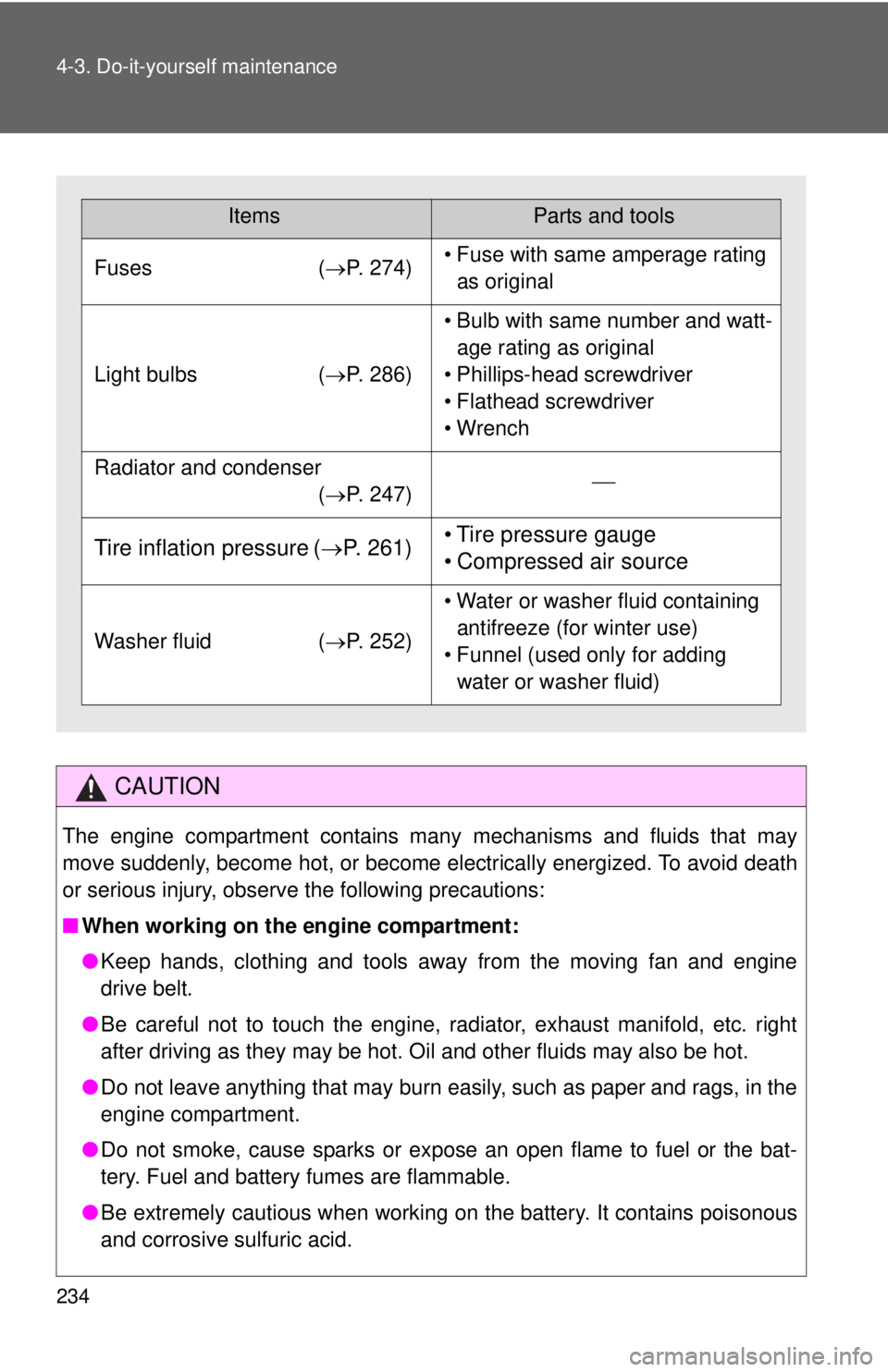
ItemsParts and tools
Fuses (→ P. 274)• Fuse with same amperage rating
as original
Light bulbs (→ P. 286)
• Bulb with same number and watt-
age rating as original
• Phillips-head screwdriver
• Flathead screwdriver
• Wrench
Radiator and condenser (→ P. 247)⎯
Tire inflation pressure ( →P. 261)• Tire pressure gauge
• Compressed air source
Washer fluid (→ P. 252)
• Water or washer fluid containing
antifreeze (for winter use)
• Funnel (used only for adding water or washer fluid)
Page 214 of 365
235
4-3. Do-it-yourself maintenance
4
Maintenance and care
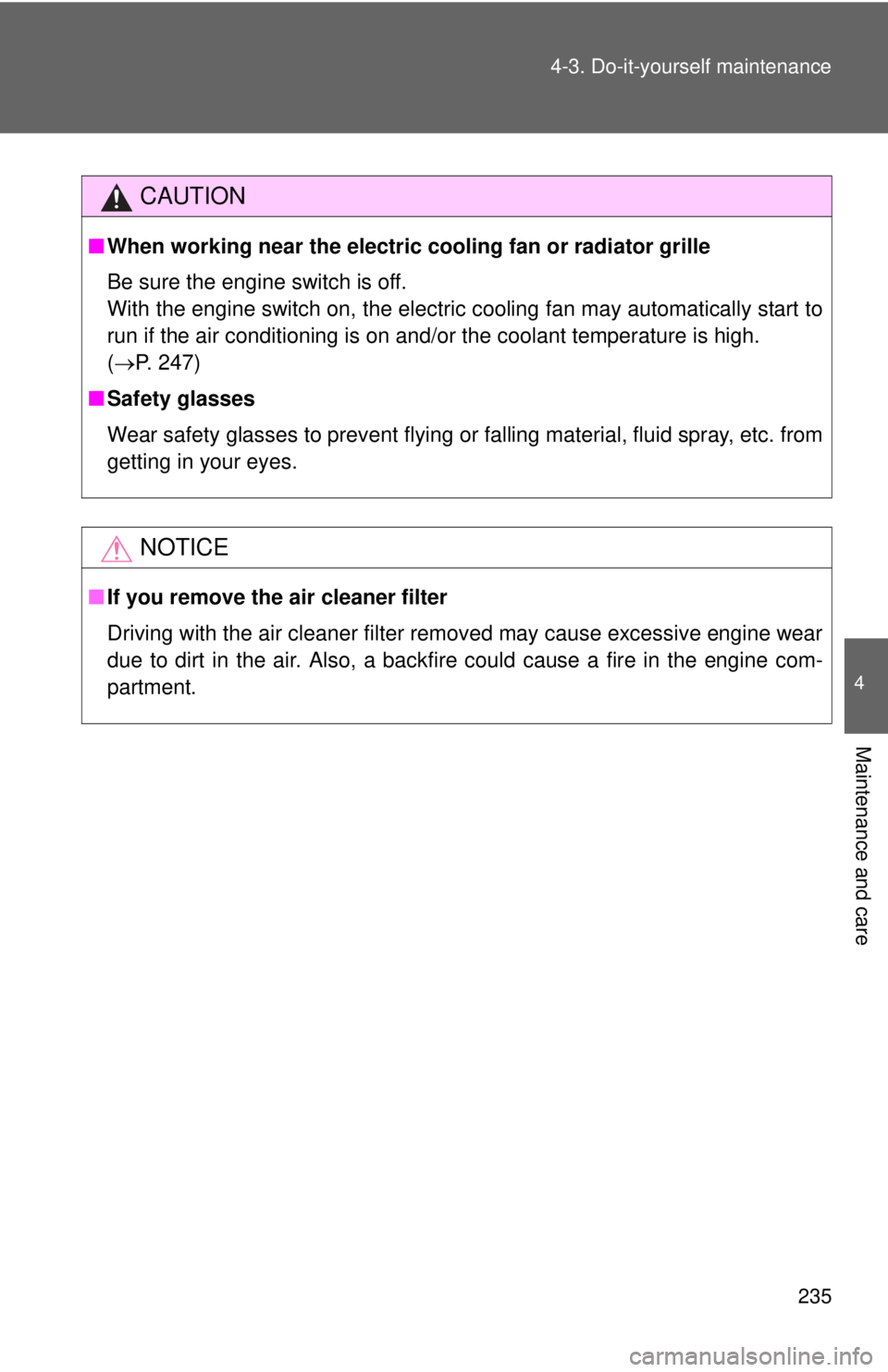
CAUTION
■
When working near the electric cooling fan or radiator grille
Be sure the engine switch is off.
With the engine switch on, the electric cooling fan may automatically start to
run if the air conditioning is on and/or the coolant temperature is high.
( → P. 247)
■ Safety glasses
Wear safety glasses to prevent flying or falling material, fluid spray, etc. from
getting in your eyes.
NOTICE
■If you remove the air cleaner filter
Driving with the air cleaner filter removed may cause excessive engine wear
due to dirt in the air. Also, a backfire could cause a fire in the engine com-
partment.