automatic transmission TOYOTA YARIS HATCHBACK 2013 Owner's Manual
[x] Cancel search | Manufacturer: TOYOTA, Model Year: 2013, Model line: YARIS HATCHBACK, Model: TOYOTA YARIS HATCHBACK 2013Pages: 403, PDF Size: 8.93 MB
Page 145 of 403
143
2-2. Instrument cluster
2
When driving
YARIS_HB_U_52D44U
■
Driving range
■ Average vehicle speed
Eco Driving Indicator Light customization (vehicles with an
automatic transmission)Except Canada
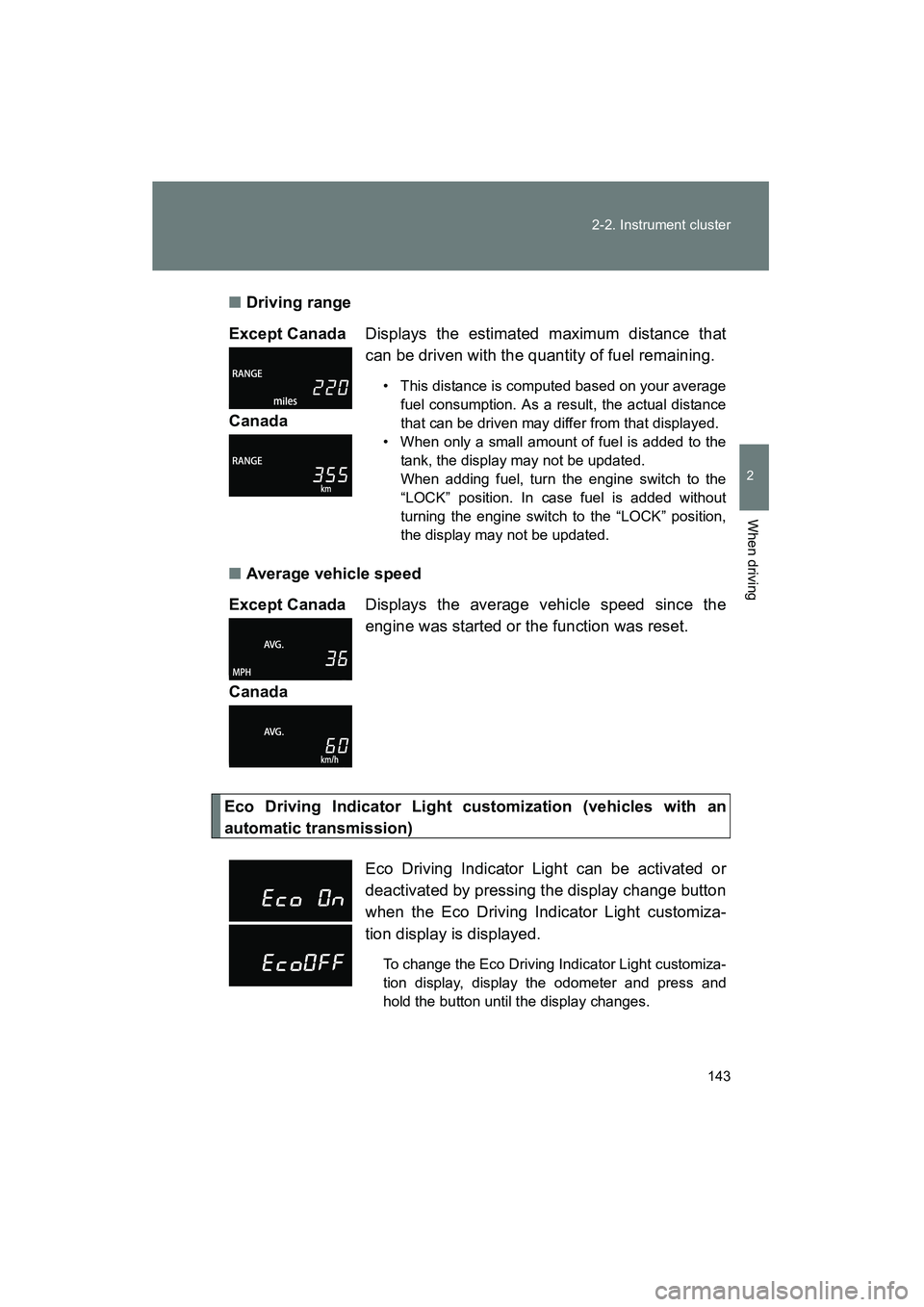
Displays the estimated maximum distance that
can be driven with the quantity of fuel remaining.
• This distance is computed based on your average
fuel consumption. As a result, the actual distance
that can be driven may differ from that displayed.
• When only a small amount of fuel is added to the tank, the display may not be updated.
When adding fuel, turn the engine switch to the
“LOCK” position. In case fuel is added without
turning the engine switch to the “LOCK” position,
the display may not be updated.
Canada
Except Canada Displays the average vehicle speed since the
engine was started or the function was reset.
Canada
Eco Driving Indicator Light can be activated or
deactivated by pressing the display change button
when the Eco Driving Indicator Light customiza-
tion display is displayed.
To change the Eco Driving Indicator Light customiza-
tion display, display the odometer and press and
hold the button until the display changes.
Page 175 of 403
173
2-5. Driving information
2
When driving
YARIS_HB_U_52D44U
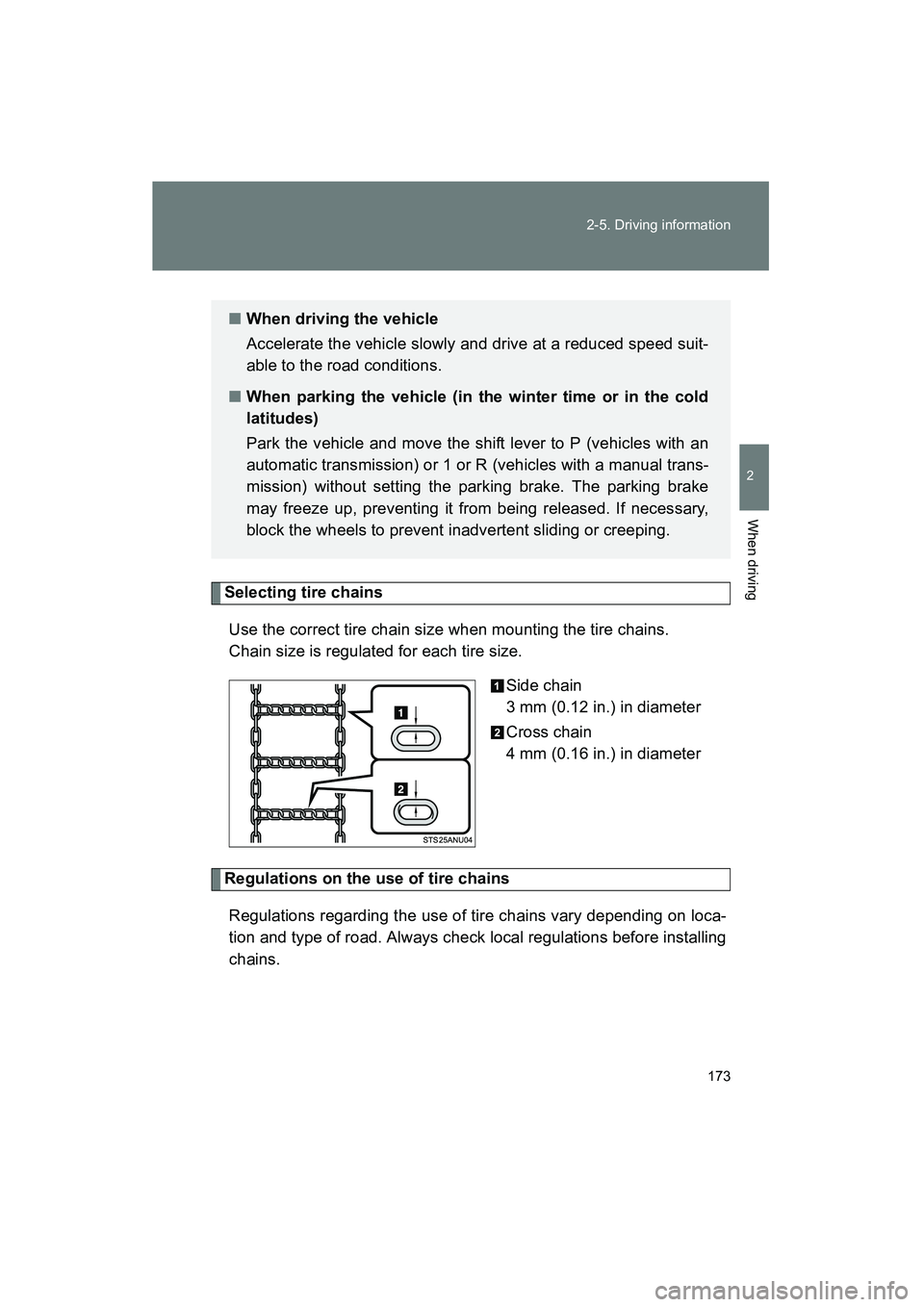
Selecting tire chains
Use the correct tire chain size when mounting the tire chains.
Chain size is regulated for each tire size. Side chain
3 mm (0.12 in.) in diameter
Cross chain
4 mm (0.16 in.) in diameter
Regulations on the use of tire chains
Regulations regarding the use of tire chains vary depending on loca-
tion and type of road. Always check local regulations before installing
chains.
■ When driving the vehicle
Accelerate the vehicle slowly and drive at a reduced speed suit-
able to the road conditions.
■ When parking the vehicle (in the winter time or in the cold
latitudes)
Park the vehicle and move the shift lever to P (vehicles with an
automatic transmission) or 1 or R (vehicles with a manual trans-
mission) without setting the parking brake. The parking brake
may freeze up, preventing it from being released. If necessary,
block the wheels to prevent inadvertent sliding or creeping.
Page 183 of 403
181
2-5. Driving information
2
When driving
YARIS_HB_U_52D44U
●
Crosswinds and rough roads will adversely affect handling of your
vehicle and trailer, causing sway. Periodically check the rear to
prepare for being passed by large trucks or buses, which may
cause your vehicle and trailer to sway. If swaying occurs, firmly grip
the steering wheel, reduce speed immediately but gradually, and
steer straight ahead. Never increase speed. If you make no
extreme correction with the steering or brakes, your vehicle and
trailer will stabilize.
● Take care when passing other vehicles. Passing requires consider-
able distance. After passing a vehicle, do not forget the length of
your trailer, and be sure you have plenty of room before changing
lanes.
● To maintain engine braking efficiency and charging system perfor-
mance when using engine braking, do not use the transmission in
D (vehicles with an automatic transmission) or 5 (vehicles with a
manual transmission).
● Due to the added load of the trailer, your vehicle’s engine may
overheat on hot days (at temperatures over 85°F [30°C]) when
driving up a long or steep grade. If the high engine coolant temper-
ature warning light flashes or comes on overheating, immediately
turn off the air conditioning (if in use), pull your vehicle off the road
and stop in a safe place. ( →P. 334)
Page 184 of 403
182 2-5. Driving information
YARIS_HB_U_52D44U●
Always place wheel blocks under both the vehicle and the trailer
wheels when parking. Apply the parking brake firmly, and put the
transmission in P (vehicles with an automatic transmission) or in 1
or R (vehicles with a manual transmission). Avoid parking on a
slope, but if unavoidable, do so only after performing the following:
Apply the brakes and keep them applied.
Have someone place wheel blocks under both the vehicle and
trailer wheels.
When the wheel blocks are in place, release the brakes slowly
until the blocks absorb the load.
Apply the parking brake firmly.
Shift into P (vehicles with an automatic transmission) or 1 or R
(vehicles with a manual transmission) and turn off the engine.
● When restarting after parking on a slope:
With the transmission in P (vehicles with an automatic trans-
mission) or the clutch pedal (vehicles with a manual transmis-
sion) depressed, start the engine. On vehicles with an
automatic transmission, be sure to keep the brake pedal
pressed.
Shift into a forward gear. If reversing, shift into R.
Release the parking brake (also brake pedal on vehicles with
an automatic transmission), and slowly pull or back away from
the wheel blocks. Stop and apply the brakes.
Have someone retrieve the blocks.
Page 189 of 403
187
2-5. Driving information
2
When driving
YARIS_HB_U_52D44U
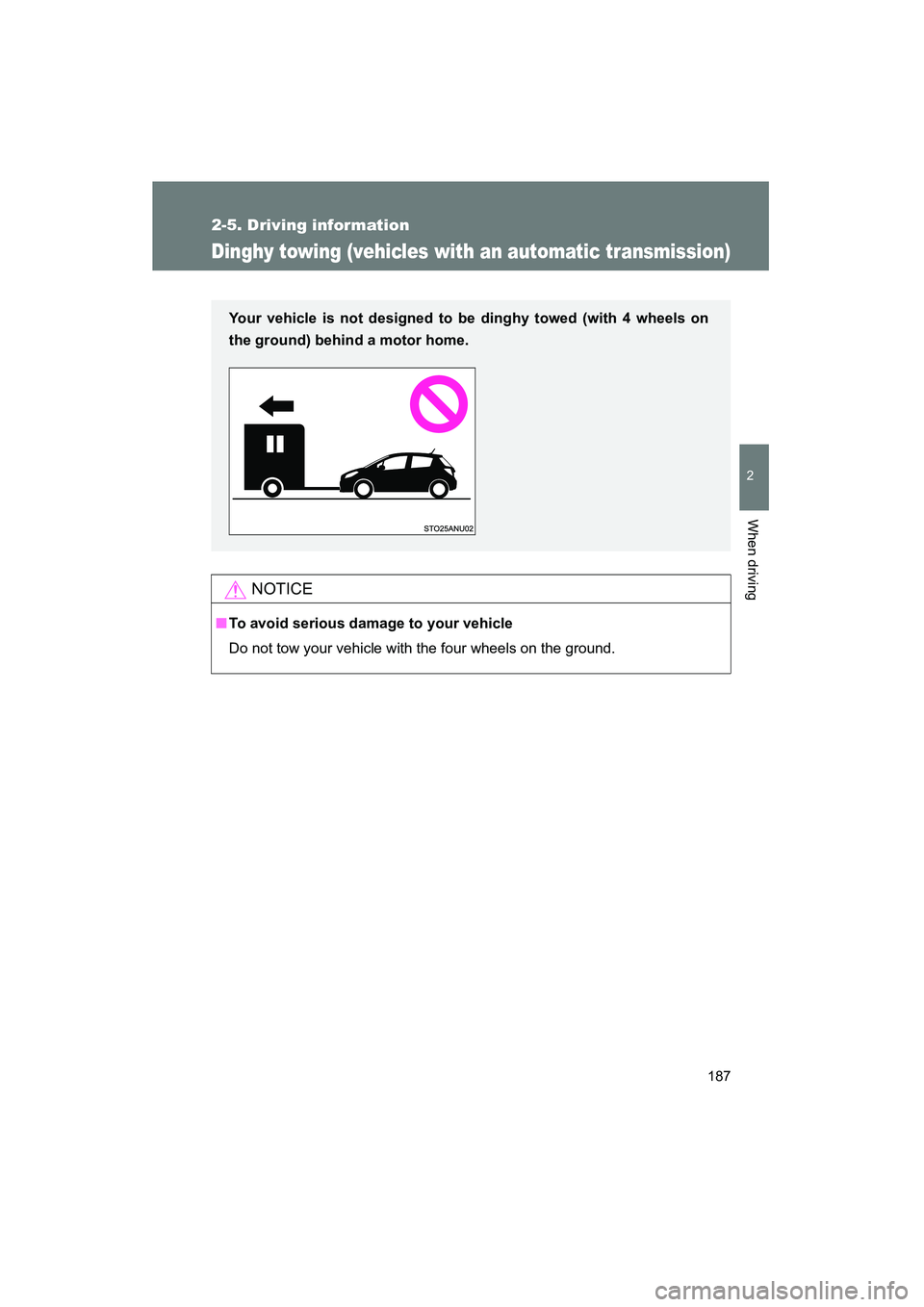
Dinghy towing (vehicles with an automatic transmission)
NOTICE
■To avoid serious damage to your vehicle
Do not tow your vehicle with the four wheels on the ground.
Your vehicle is not designed to be dinghy towed (with 4 wheels on
the ground) behind a motor home.
Page 218 of 403
216 3-5. Other interior features
YARIS_HB_U_52D44U
CAUTION
Observe the following precautions.
Failure to do so may cause the driver’s floor mat to slip, possibly interfering
with the pedals while driving. An unexpectedly high speed may result or it may
become difficult to stop the vehicle, leading to a serious accident.
■When installing the driver’s floor mat
● Do not use floor mats designed for other models or different model year
vehicles, even if they are Toyota Genuine floor mats.
● Only use floor mats designed for the driver’s seat.
● Always install the floor mat securely using the retaining hooks (clips) pro-
vided.
● Do not use two or more floor mats on top of each other.
● Do not place the floor mat bottom-side up or upside-down.
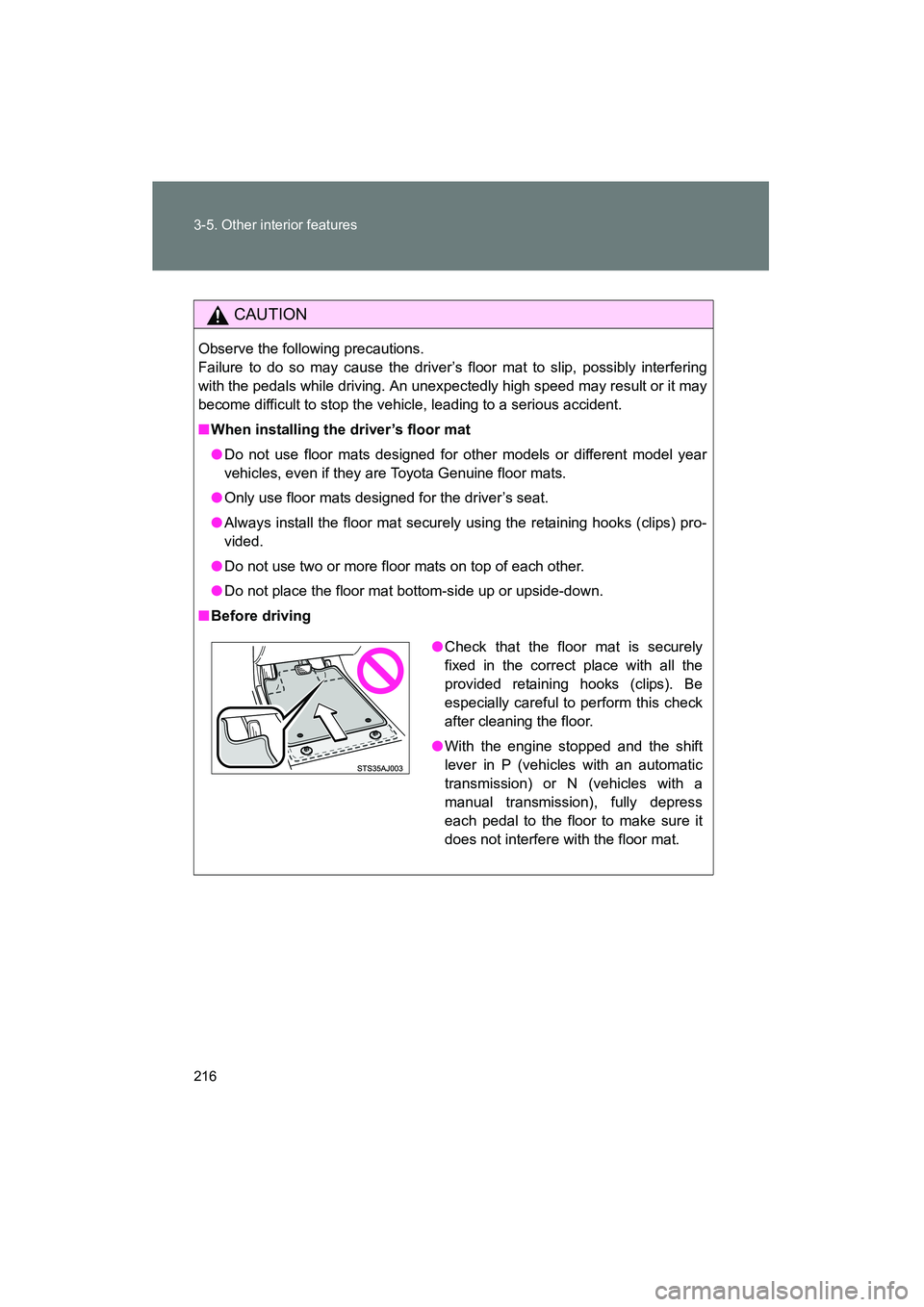
■ Before driving
● Check that the floor mat is securely
fixed in the correct place with all the
provided retaining hooks (clips). Be
especially careful to perform this check
after cleaning the floor.
● With the engine stopped and the shift
lever in P (vehicles with an automatic
transmission) or N (vehicles with a
manual transmission), fully depress
each pedal to the floor to make sure it
does not interfere with the floor mat.
Page 233 of 403
231
4-2. Maintenance
4
Maintenance and care
YARIS_HB_U_52D44U
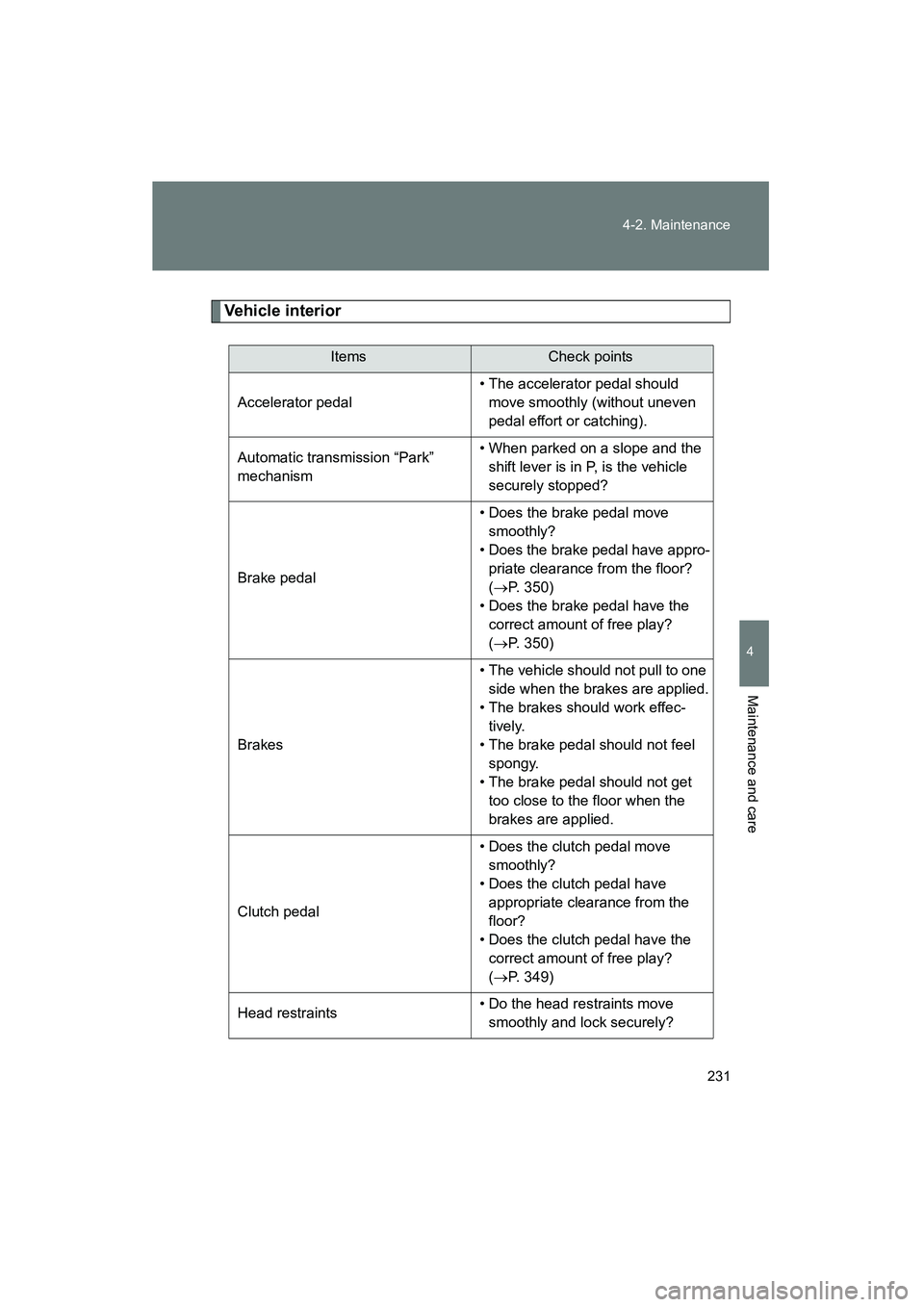
Vehicle interior
ItemsCheck points
Accelerator pedal • The accelerator pedal should
move smoothly (without uneven
pedal effort or catching).
Automatic transmission “Park”
mechanism • When parked on a slope and the
shift lever is in P, is the vehicle
securely stopped?
Brake pedal • Does the brake pedal move
smoothly?
• Does the brake pedal have appro- priate clearance from the floor?
(→ P. 350)
• Does the brake pedal have the correct amount of free play?
(→ P. 350)
Brakes • The vehicle should not pull to one
side when the brakes are applied.
• The brakes should work effec- tively.
• The brake pedal should not feel spongy.
• The brake pedal should not get too close to the floor when the
brakes are applied.
Clutch pedal • Does the clutch pedal move
smoothly?
• Does the clutch pedal have appropriate clearance from the
floor?
• Does the clutch pedal have the correct amount of free play?
(→ P. 349)
Head restraints • Do the head restraints move
smoothly and lock securely?
Page 243 of 403
241
4-3. Do-it-yourself maintenance
4
Maintenance and care
YARIS_HB_U_52D44U
CAUTION
■
When raising your vehicle
Make sure to observe the following precautions to reduce the possibility of
death or serious injury:
●When using a floor jack, follow the in structions of the manual provided with
the jack.
● Do not use the jack that was supplied with your vehicle.
● Do not put any part of your body underneath the vehicle when it is sup-
ported only by the floor jack.
● Always use floor jack and/or automotive jack stands on a solid, flat, level
surface.
● Do not start the engine while the vehicle is supported by the floor jack.
● Stop the vehicle on level, firm ground, firmly set the parking brake and shift
the shift lever to P (vehicles with an automatic transmission) or R (vehicles
with a manual transmission).
● Make sure to set the floor jack properly at the jack point.
Raising the vehicle with an improperly positioned floor jack will damage
the vehicle and may cause the vehicle to fall off the floor jack.
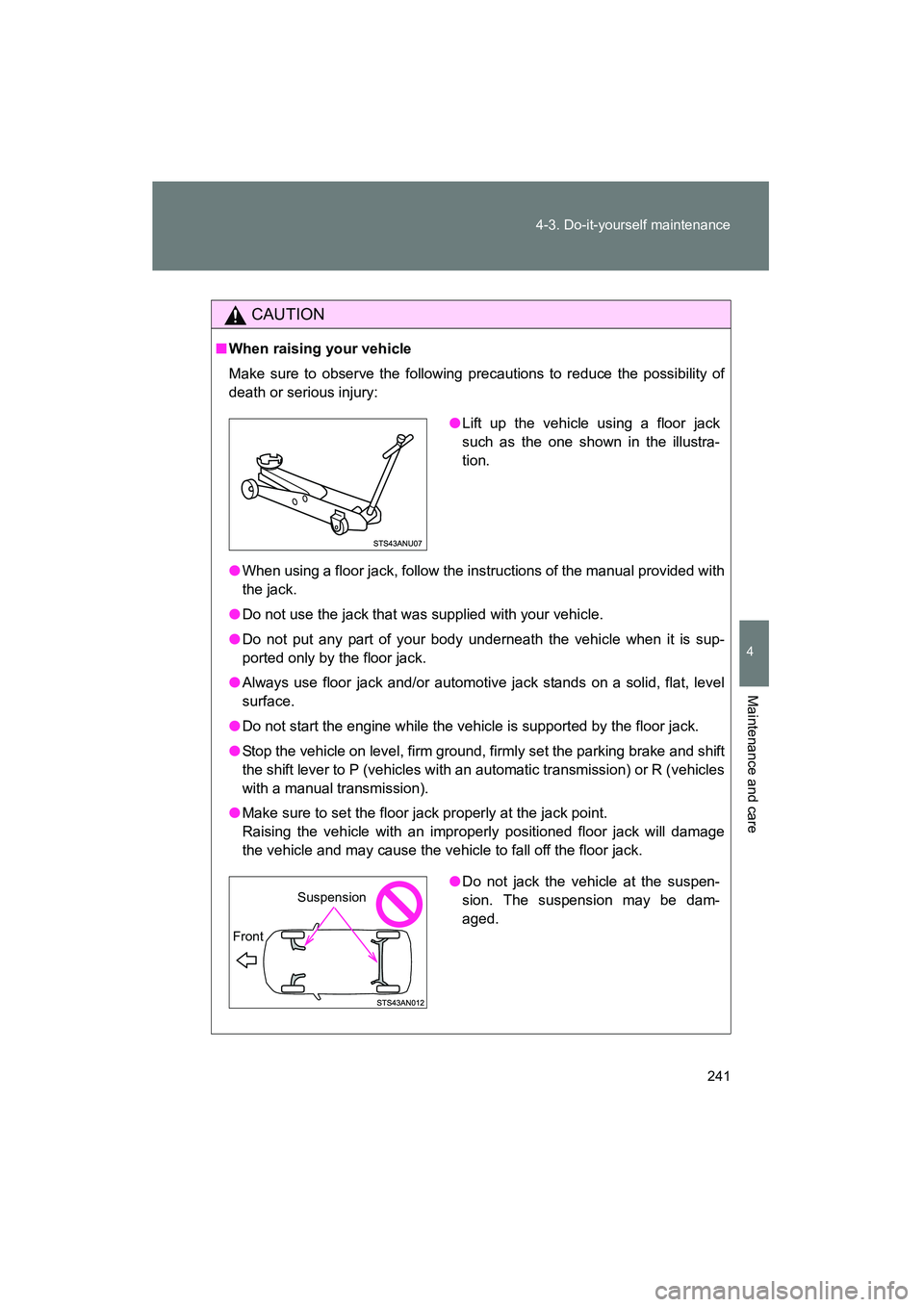
●Lift up the vehicle using a floor jack
such as the one shown in the illustra-
tion.
●Do not jack the vehicle at the suspen-
sion. The suspension may be dam-
aged.Suspension
Front
Page 297 of 403
When trouble arises5
295
YARIS_HB_U_52D44U
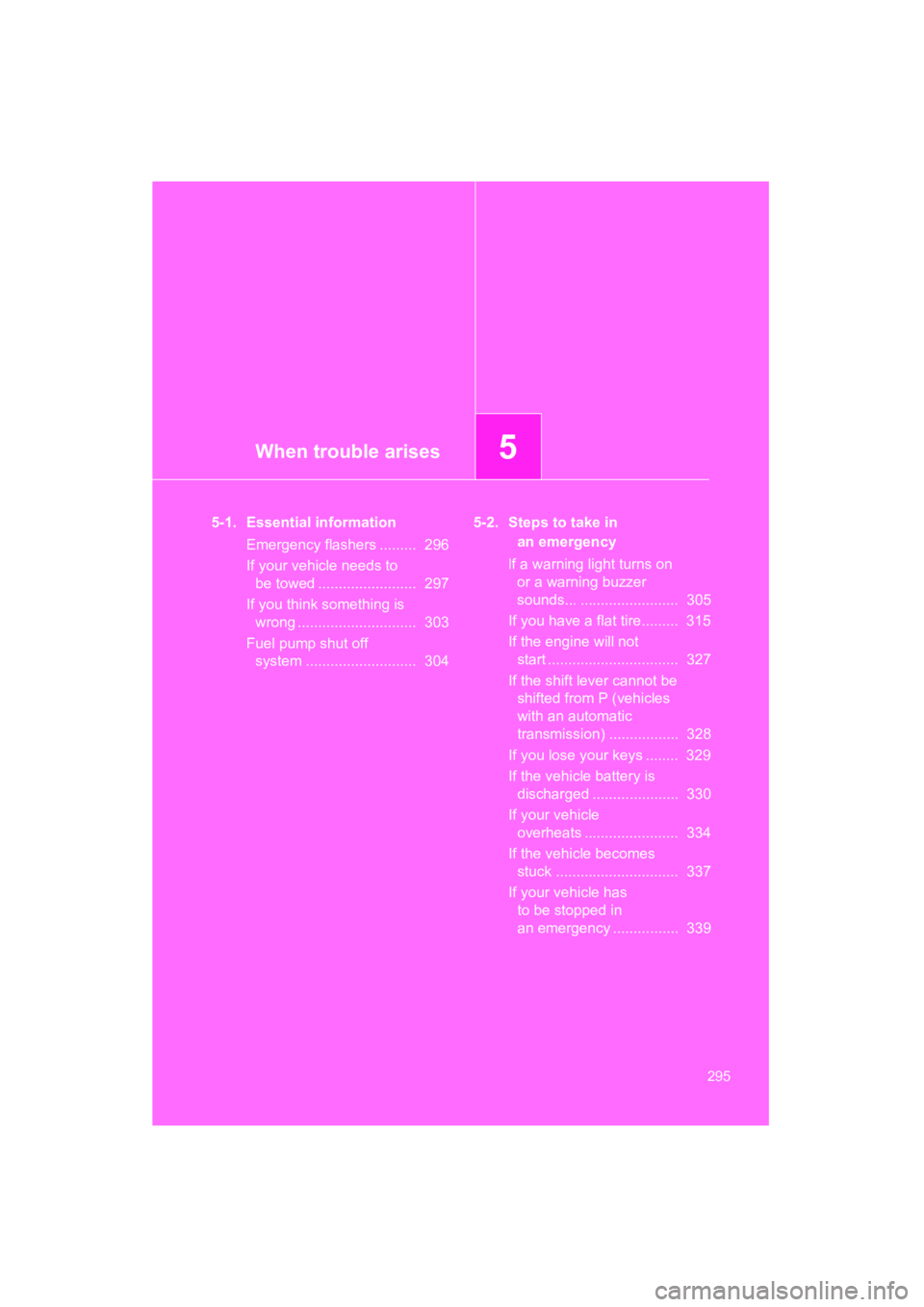
5-1. Essential informationEmergency flashers ......... 296
If your vehicle needs to be towed ........................ 297
If you think something is wrong ............................. 303
Fuel pump shut off system ........................... 304 5-2. Steps to take in
an emergency
If a warning light turns on or a warning buzzer
sounds..
......................... 305
If you have a flat tire......... 315
If the engine will not start ................................ 327
If the shift lever cannot be shifted from P (vehicles
with an automatic
transmission) ................. 328
If you lose your keys ........ 329
If the vehicle battery is discharged ..................... 330
If your vehicle overheats ....................... 334
If the vehicle becomes stuck .............................. 337
If your vehicle has to be stopped in
an emergency ................ 339
Page 304 of 403
302 5-1. Essential information
YARIS_HB_U_52D44U
CAUTION
■Caution while towing
● Use extreme caution when towing the vehicle.
Avoid sudden starts or erratic driving maneuvers which place excessive
stress on the emergency towing eyelet and the cables or chains. Always
be cautious of the surroundings and other vehicles while towing.
● If the engine is not running, the power assist for the brakes and steering
will not function, making steering and braking more difficult.
■ Installing towing eyelet to the vehicle
Make sure that towing eyelet is installed securely.
If not securely installed, towing eyelet may come loose during towing. This
may lead to accidents that cause serious injury or even death.
NOTICE
■To prevent causing serious damage to the transmission when towing
using a wheel-lift type truck (vehicl es with an automatic transmission)
Never tow this vehicle from the rear with the front wheels on the ground.
■ To prevent damage to the vehicle when towing using a wheel-lift type
truck (vehicles with an automatic transmission)
When raising the vehicle, ensure adequate ground clearance for towing at
the opposite end of the raised vehicle. Without adequate clearance, the
vehicle could be damaged while being towed.
■ To prevent damage to the vehicle when towing using a wheel-lift type
truck (vehicles with a manual transmission)
● Do not tow the vehicle from the rear when the engine switch is in the
“LOCK” position or the key is removed.
The steering lock mechanism is not strong enough to hold the front wheel
straight.
● When raising the vehicle, ensure adequate ground clearance for towing at
the opposite end of the raised vehicle. Without adequate clearance, the
vehicle could be damaged while being towed.
■ To prevent body damage when towing with a sliding-type truck
Do not tow with a sling-type truck, either from the front or rear.