brake TOYOTA YARIS HATCHBACK 2013 Owner's Manual
[x] Cancel search | Manufacturer: TOYOTA, Model Year: 2013, Model line: YARIS HATCHBACK, Model: TOYOTA YARIS HATCHBACK 2013Pages: 403, PDF Size: 8.93 MB
Page 149 of 403
147
2-3. Operating the lights and wipers
2
When driving
YARIS_HB_U_52D44U
■
Daytime running light system (if equipped)
●To make your vehicle more visible to other drivers, the headlights turn on
automatically (at a reduced intensity) whenever the engine is started and
the parking brake is released. Daytime running lights are not designed for
use at night.
● Compared to turning on the headlights, the daytime running light system
offers greater durability and consumes less electricity, so it can help
improve fuel economy.
■ Light reminder buzzer
A buzzer sounds when the engine switch is turned to the “LOCK” or “ACC”
position and the driver’s door is opened while the lights are turned on.
■ Battery-saving function (vehicles with an alarm system or daytime run-
ning light system)
In all following conditions, the headli ghts and the other remaining lights will
go off automatically after 20 minutes in order to prevent the vehicle battery
from being discharged:
● The engine switch is in the “LOCK” position.
● The headlights and/or tail lights are on.
This function will be canceled in any of the following situations:
● When the engine switch is turned to the “ON” position.
● When the light switch is operated.
● When the door is opened or closed.
NOTICE
■To prevent battery discharge
Do not leave the lights on longer than necessary when the engine is not run-
ning.
Page 161 of 403
159
2-4. Using other driving systems
2
When driving
YARIS_HB_U_52D44U
■
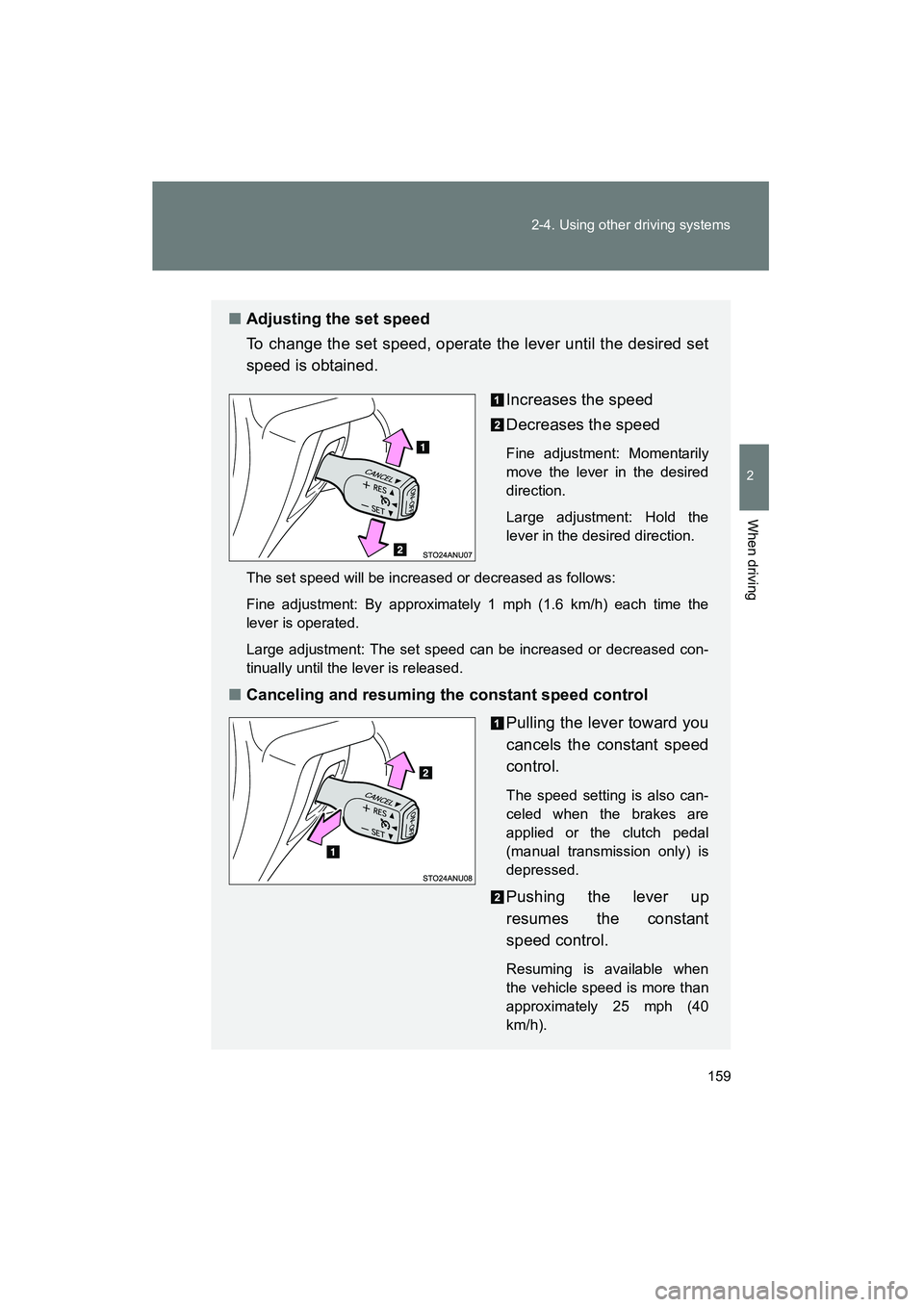
Adjusting the set speed
To change the set speed, operate the lever until the desired set
speed is obtained.
Increases the speed
Decreases the speed
Fine adjustment: Momentarily
move the lever in the desired
direction.
Large adjustment: Hold the
lever in the desired direction.
The set speed will be increased or decreased as follows:
Fine adjustment: By approximately 1 mph (1.6 km/h) each time the
lever is operated.
Large adjustment: The set speed can be increased or decreased con-
tinually until the lever is released.
■ Canceling and resuming the constant speed control
Pulling the lever toward you
cancels the constant speed
control.
The speed setting is also can-
celed when the brakes are
applied or the clutch pedal
(manual transmission only) is
depressed.
Pushing the lever up
resumes the constant
speed control.
Resuming is available when
the vehicle speed is more than
approximately 25 mph (40
km/h).
Page 164 of 403
162
2-4. Using other driving systems
YARIS_HB_U_52D44U
Driving assist systems
To help enhance driving safety and performance, the following sys-
tems operate automatically in response to various driving situations.
Be aware, however, that these systems are supplementary and
should not be relied upon too heavily when operating the vehicle.
■ ABS (Anti-lock Brake System)
Helps to prevent wheel lock when the brakes are applied suddenly, or if
the brakes are applied while driving on a slippery road surface.
■Brake assist
Generates an increased level of braking force after the brake pedal is
depressed when the system detects a panic stop situation.
■VSC (Vehicle Stability Control)
Helps the driver to control skidding when swerving suddenly or turning
on slippery road surfaces.
■TRAC (Traction Control)
Helps to maintain drive power and pr event the drive wheels from spin-
ning when starting the vehicle or accelerating on slippery roads.
■ EPS (Electric Power Steering)
Employs an electric motor to reduce the amount of effort needed to turn
the steering wheel.
Page 166 of 403
164 2-4. Using other driving systems
YARIS_HB_U_52D44U■
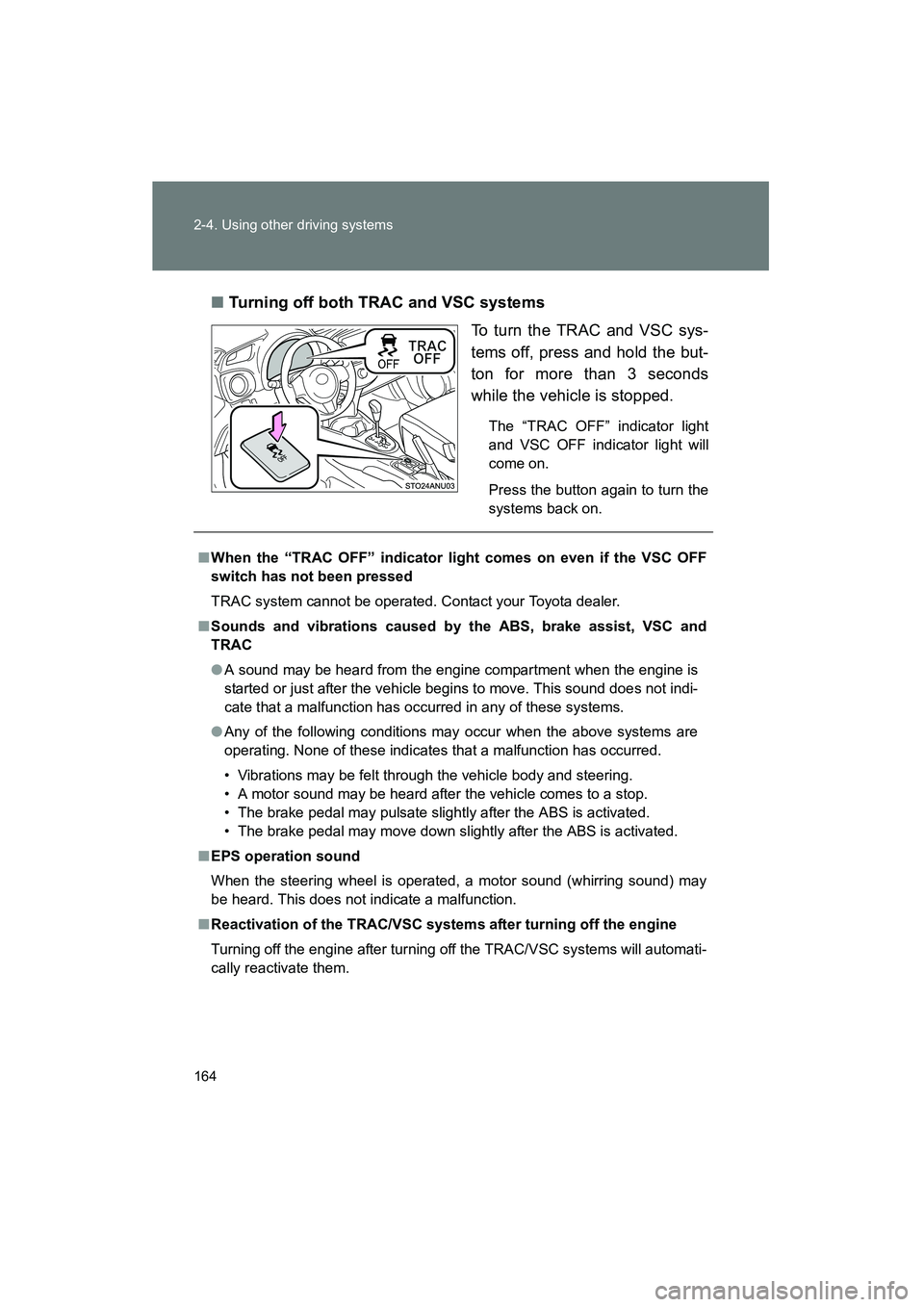
Turning off both TRAC and VSC systems
To turn the TRAC and VSC sys-
tems off, press and hold the but-
ton for more than 3 seconds
while the vehicle is stopped.
The “TRAC OFF” indicator light
and VSC OFF indicator light will
come on.
Press the button again to turn the
systems back on.
■When the “TRAC OFF” indicator light comes on even if the VSC OFF
switch has not been pressed
TRAC system cannot be operated. Contact your Toyota dealer.
■ Sounds and vibrations caused by the ABS, brake assist, VSC and
TRAC
● A sound may be heard from the engine compartment when the engine is
started or just after the vehicle begins to move. This sound does not indi-
cate that a malfunction has occurred in any of these systems.
● Any of the following conditions may occur when the above systems are
operating. None of these indicates that a malfunction has occurred.
• Vibrations may be felt through the vehicle body and steering.
• A motor sound may be heard after the vehicle comes to a stop.
• The brake pedal may pulsate slightly after the ABS is activated.
• The brake pedal may move down slightly after the ABS is activated.
■ EPS operation sound
When the steering wheel is operated, a motor sound (whirring sound) may
be heard. This does not indicate a malfunction.
■ Reactivation of the TRAC/VSC system s after turning off the engine
Turning off the engine after turning off the TRAC/VSC systems will automati-
cally reactivate them.
Page 171 of 403
169
2-5. Driving information
2
When driving
YARIS_HB_U_52D44U
As shown in the example above, if the number of occupants
increases, the cargo and luggage load will be reduced by an amount
that equals the increased weight due to the additional occupants. In
other words, if an increase in the number of occupants causes an
excess of the total load capacity (combined weight of occupants plus
cargo and luggage load), you must reduce the cargo and luggage on
your vehicle.
CAUTION
■Things that must not be carried in the luggage compartment
The following things may cause a fire if loaded in the luggage compart-
ment:
●Receptacles containing gasoline
●Aerosol cans
■Storage precautions
Observe the following precautions.
Failure to do so may result in death or serious injury.
●Stow cargo and luggage in the luggage compartment whenever possi-
ble.
●Do not stack cargo and luggage in the luggage compartment higher
than the seatbacks.
Such items may be thrown about and possibly injure people in the
vehicle in the event of sudden braking or in an accident.
●Do not place cargo or luggage in or on the following locations as the
item may get under the clutch, brake or accelerator pedal and prevent
the pedals from being depressed properly, block the driver’s vision, or
hit the driver or passengers, causing an accident:
• At the feet of the driver
• On the front passenger or rear seats (when stacking items)
• On the luggage cover
• On the instrument panel
• On the dashboard
●Secure all items in the occupant compartment, as they may shift and
injure someone in the event of an accident or sudden braking.
Page 174 of 403
172
2-5. Driving information
YARIS_HB_U_52D44U
Winter driving tips
Carry out the necessary preparations and inspections before driving
the vehicle in winter. Always drive the vehicle in a manner appropri-
ate to the prevailing weather conditions.
■Pre-winter preparations
●Use fluids that are appropriate to the prevailing outside tem-
peratures.
• Engine oil
• Engine coolant
• Washer fluid
● Have a service technician inspect the level and specific grav-
ity of battery electrolyte.
● Have the vehicle fitted with four snow tires or purchase a set
of tire chains for the front tires.
Ensure that all tires are the same size and brand and that their wear
level is not noticeably different with each other. Also make sure that
chains match the size of the tires.
■ Before driving the vehicle
Perform the following according to the driving conditions:
●Do not try to forcibly open a window or move a wiper that is
frozen. Pour warm water over the frozen area to melt the ice.
Wipe away the water immediately to prevent it from freezing.
● To ensure proper operation of the climate control system fan,
remove any snow that has accumulated on the air inlet vents
in front of the windshield.
● Remove any ice that has accumulated on the vehicle chassis.
● Periodically check for and remove any excess ice or snow
that may have accumulated in the wheel well or on the
brakes.
Page 175 of 403
173
2-5. Driving information
2
When driving
YARIS_HB_U_52D44U
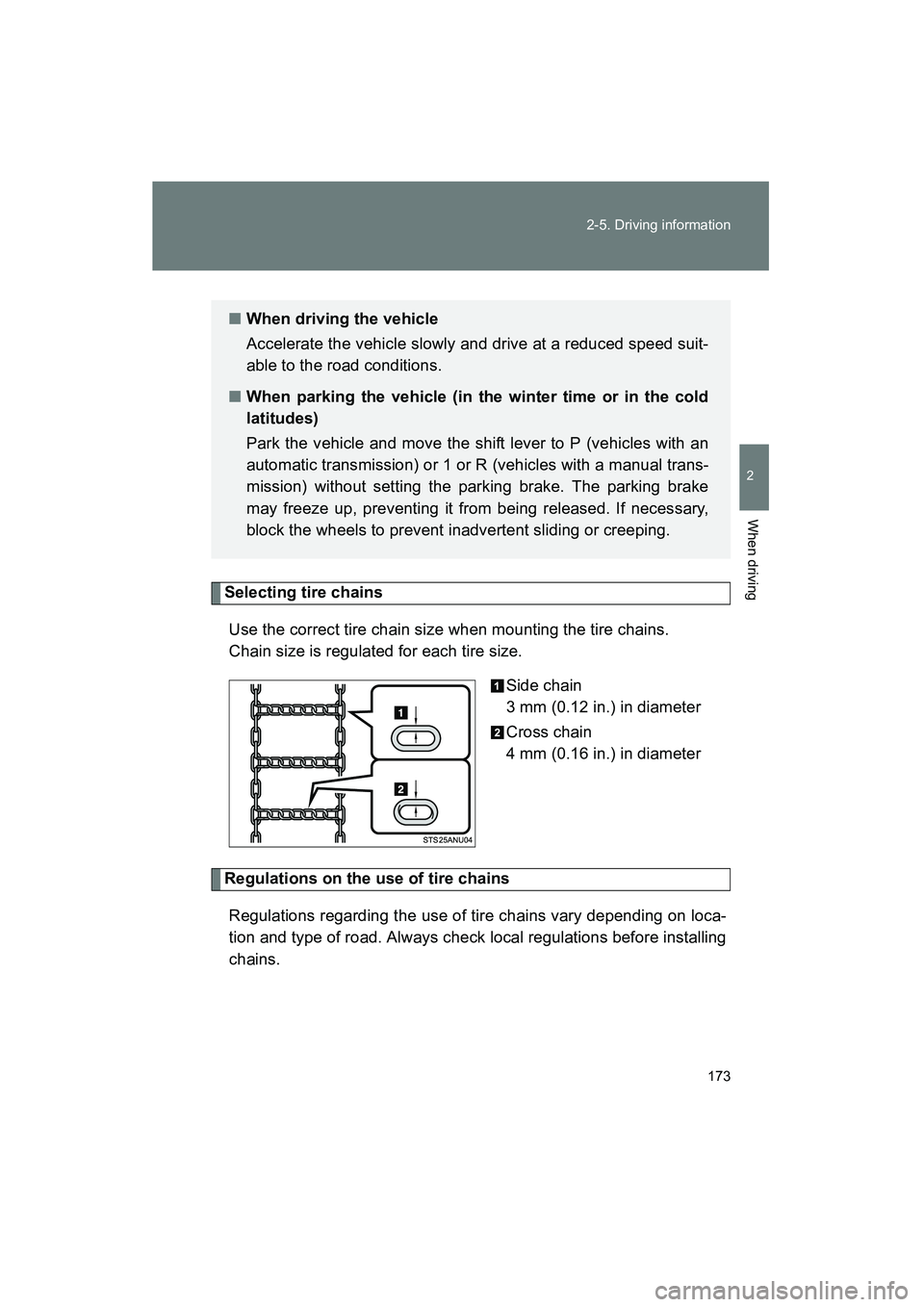
Selecting tire chains
Use the correct tire chain size when mounting the tire chains.
Chain size is regulated for each tire size. Side chain
3 mm (0.12 in.) in diameter
Cross chain
4 mm (0.16 in.) in diameter
Regulations on the use of tire chains
Regulations regarding the use of tire chains vary depending on loca-
tion and type of road. Always check local regulations before installing
chains.
■ When driving the vehicle
Accelerate the vehicle slowly and drive at a reduced speed suit-
able to the road conditions.
■ When parking the vehicle (in the winter time or in the cold
latitudes)
Park the vehicle and move the shift lever to P (vehicles with an
automatic transmission) or 1 or R (vehicles with a manual trans-
mission) without setting the parking brake. The parking brake
may freeze up, preventing it from being released. If necessary,
block the wheels to prevent inadvertent sliding or creeping.
Page 179 of 403
177
2-5. Driving information
2
When driving
YARIS_HB_U_52D44U
Trailer towing (3-door models for Canada)
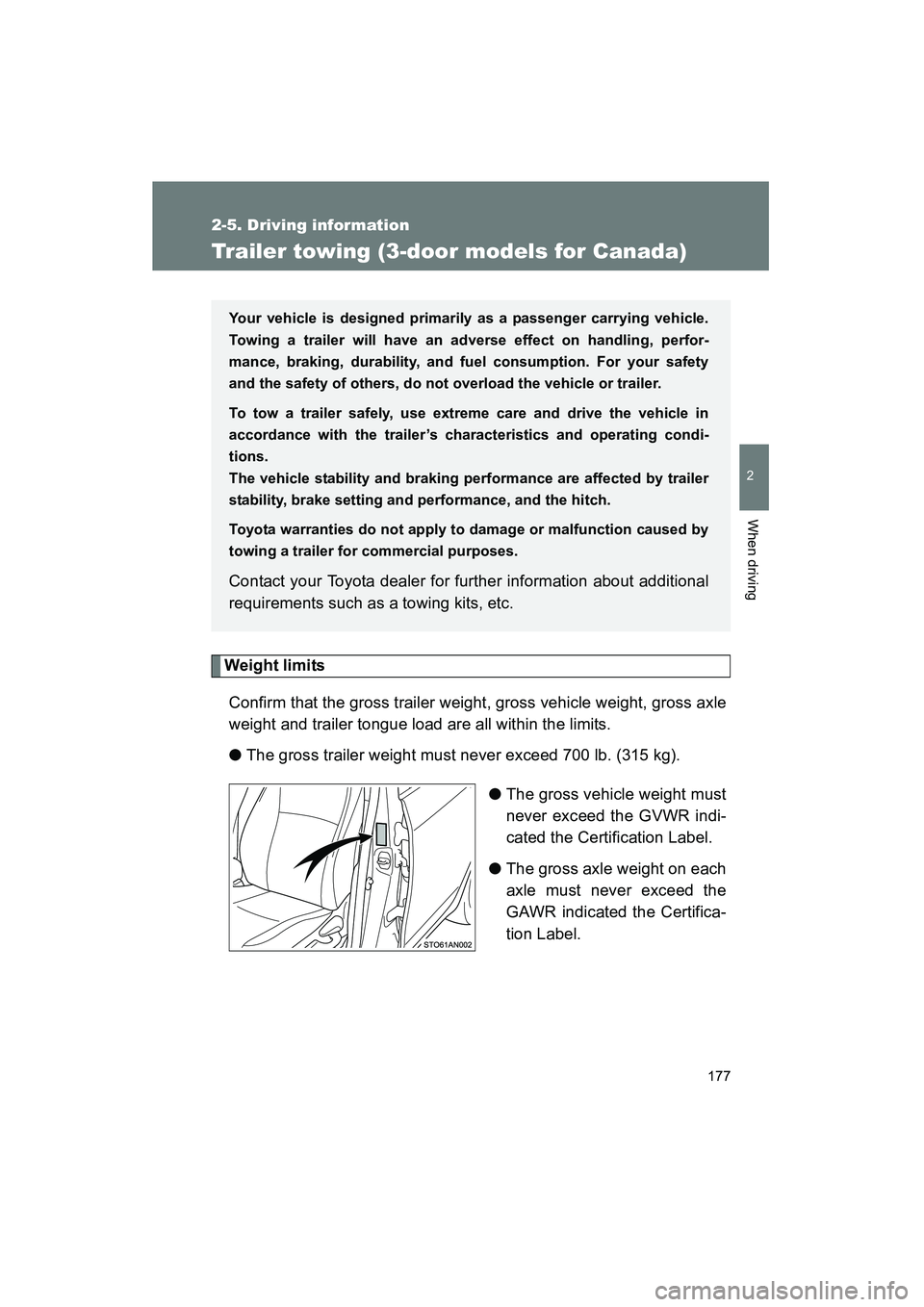
Weight limitsConfirm that the gross trailer weight, gross vehicle weight, gross axle
weight and trailer tongue load are all within the limits.
● The gross trailer weight must never exceed 700 lb. (315 kg).
●The gross vehicle weight must
never exceed the GVWR indi-
cated the Certification Label.
● The gross axle weight on each
axle must never exceed the
GAWR indicated the Certifica-
tion Label.
Your vehicle is designed primarily as a passenger carrying vehicle.
Towing a trailer will have an adverse effect on handling, perfor-
mance, braking, durability, and fuel consumption. For your safety
and the safety of others, do not overload the vehicle or trailer.
To tow a trailer safely, use extreme care and drive the vehicle in
accordance with the trailer’s characteristics and operating condi-
tions.
The vehicle stability and braking performance are affected by trailer
stability, brake setting and performance, and the hitch.
Toyota warranties do not apply to damage or malfunction caused by
towing a trailer for commercial purposes.
Contact your Toyota dealer for further information about additional
requirements such as a towing kits, etc.
Page 183 of 403
181
2-5. Driving information
2
When driving
YARIS_HB_U_52D44U
●
Crosswinds and rough roads will adversely affect handling of your
vehicle and trailer, causing sway. Periodically check the rear to
prepare for being passed by large trucks or buses, which may
cause your vehicle and trailer to sway. If swaying occurs, firmly grip
the steering wheel, reduce speed immediately but gradually, and
steer straight ahead. Never increase speed. If you make no
extreme correction with the steering or brakes, your vehicle and
trailer will stabilize.
● Take care when passing other vehicles. Passing requires consider-
able distance. After passing a vehicle, do not forget the length of
your trailer, and be sure you have plenty of room before changing
lanes.
● To maintain engine braking efficiency and charging system perfor-
mance when using engine braking, do not use the transmission in
D (vehicles with an automatic transmission) or 5 (vehicles with a
manual transmission).
● Due to the added load of the trailer, your vehicle’s engine may
overheat on hot days (at temperatures over 85°F [30°C]) when
driving up a long or steep grade. If the high engine coolant temper-
ature warning light flashes or comes on overheating, immediately
turn off the air conditioning (if in use), pull your vehicle off the road
and stop in a safe place. ( →P. 334)
Page 184 of 403
182 2-5. Driving information
YARIS_HB_U_52D44U●
Always place wheel blocks under both the vehicle and the trailer
wheels when parking. Apply the parking brake firmly, and put the
transmission in P (vehicles with an automatic transmission) or in 1
or R (vehicles with a manual transmission). Avoid parking on a
slope, but if unavoidable, do so only after performing the following:
Apply the brakes and keep them applied.
Have someone place wheel blocks under both the vehicle and
trailer wheels.
When the wheel blocks are in place, release the brakes slowly
until the blocks absorb the load.
Apply the parking brake firmly.
Shift into P (vehicles with an automatic transmission) or 1 or R
(vehicles with a manual transmission) and turn off the engine.
● When restarting after parking on a slope:
With the transmission in P (vehicles with an automatic trans-
mission) or the clutch pedal (vehicles with a manual transmis-
sion) depressed, start the engine. On vehicles with an
automatic transmission, be sure to keep the brake pedal
pressed.
Shift into a forward gear. If reversing, shift into R.
Release the parking brake (also brake pedal on vehicles with
an automatic transmission), and slowly pull or back away from
the wheel blocks. Stop and apply the brakes.
Have someone retrieve the blocks.