lock TOYOTA YARIS HATCHBACK 2013 Owner's Manual
[x] Cancel search | Manufacturer: TOYOTA, Model Year: 2013, Model line: YARIS HATCHBACK, Model: TOYOTA YARIS HATCHBACK 2013Pages: 403, PDF Size: 8.93 MB
Page 43 of 403
41
1-2. Opening, closing and locking the doors
1
Before driving
YARIS_HB_U_52D44U
CAUTION
●
Do not pull on the back door damper stay to close the back door, and do
not hang on the back door damper stay.
Doing so may cause hands to be caught or the back door damper stay to
break, causing an accident.
● If a bicycle carrier or similar heavy object is attached to the back door, it
may suddenly shut again after being opened, causing someone’s hands,
head or neck to be caught and injured. When installing an accessory part
to the back door, using a genuine Toyota part is recommended.
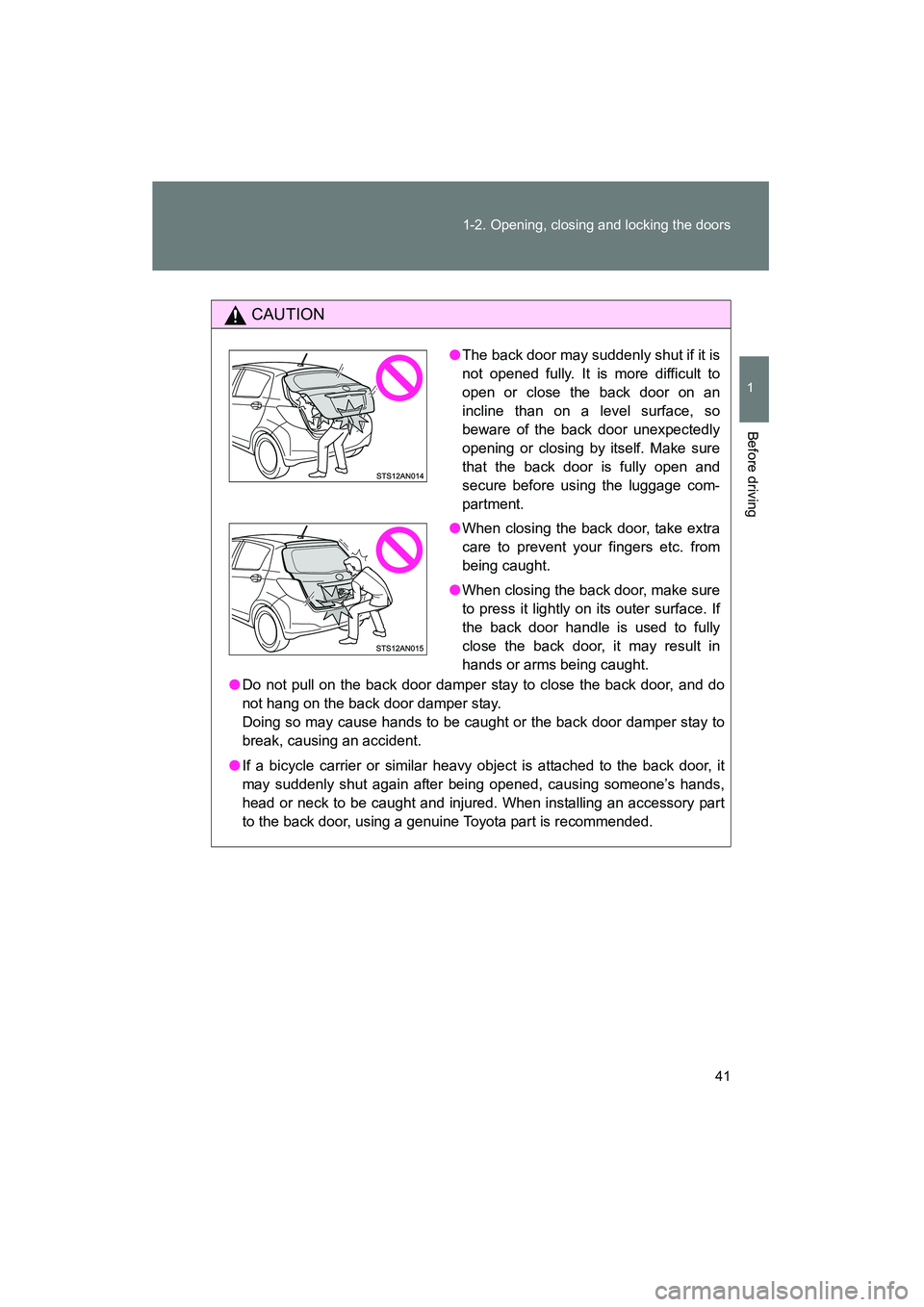
●The back door may suddenly shut if it is
not opened fully. It is more difficult to
open or close the back door on an
incline than on a level surface, so
beware of the back door unexpectedly
opening or closing by itself. Make sure
that the back door is fully open and
secure before using the luggage com-
partment.
● When closing the back door, take extra
care to prevent your fingers etc. from
being caught.
● When closing the back door, make sure
to press it lightly on its outer surface. If
the back door handle is used to fully
close the back door, it may result in
hands or arms being caught.
Page 44 of 403
42 1-2. Opening, closing and locking the doors
YARIS_HB_U_52D44U
NOTICE
■Back door damper stays
The back door is equipped with damper stays that hold the back door in
place.
Observe the following precautions.
Failure to do so may cause damage to the back door damper stay, resulting
in malfunction.
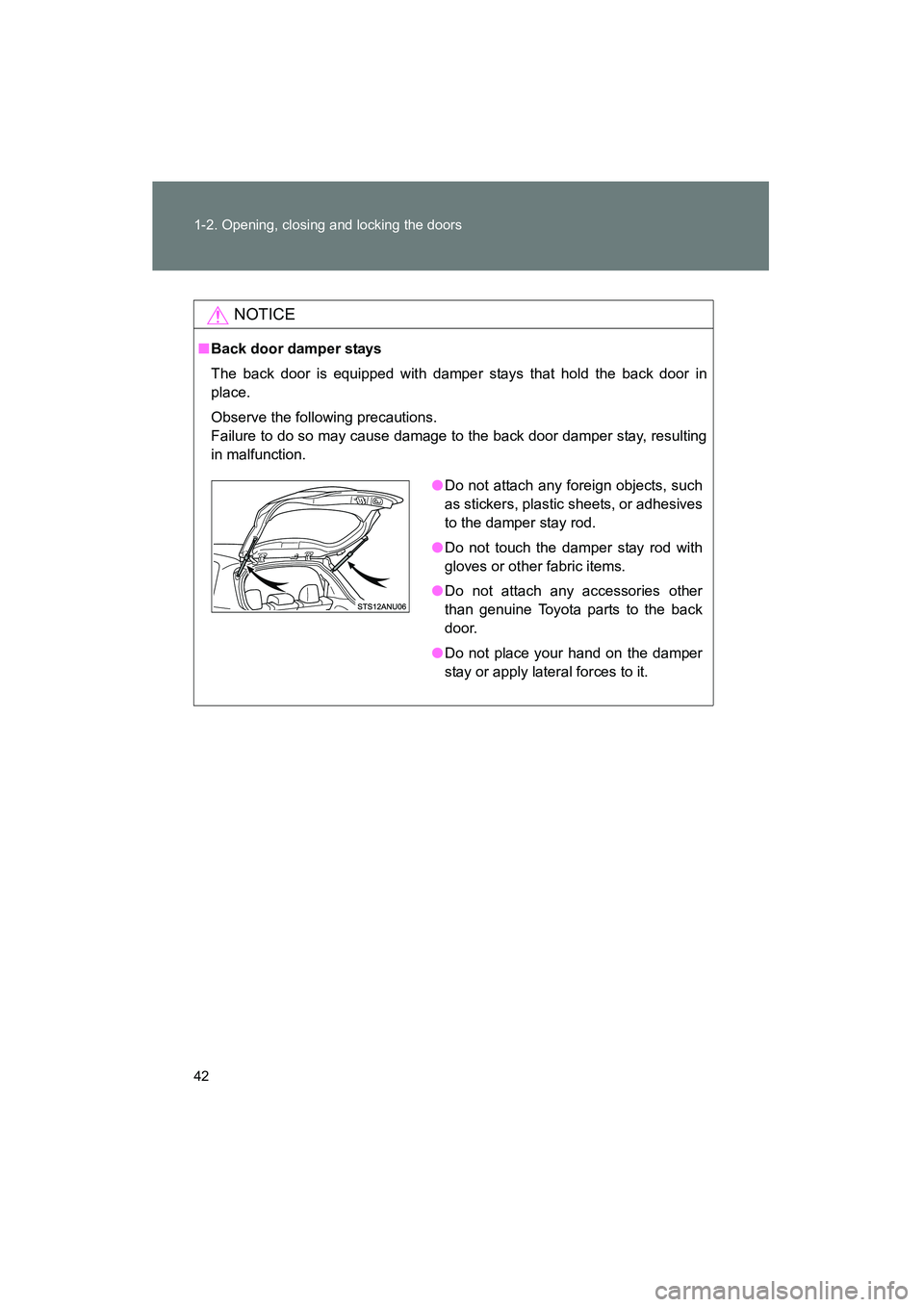
● Do not attach any foreign objects, such
as stickers, plastic sheets, or adhesives
to the damper stay rod.
● Do not touch the damper stay rod with
gloves or other fabric items.
● Do not attach any accessories other
than genuine Toyota parts to the back
door.
● Do not place your hand on the damper
stay or apply lateral forces to it.
Page 46 of 403
44 1-3. Adjustable components (seats, mirrors, steering wheel)
YARIS_HB_U_52D44U
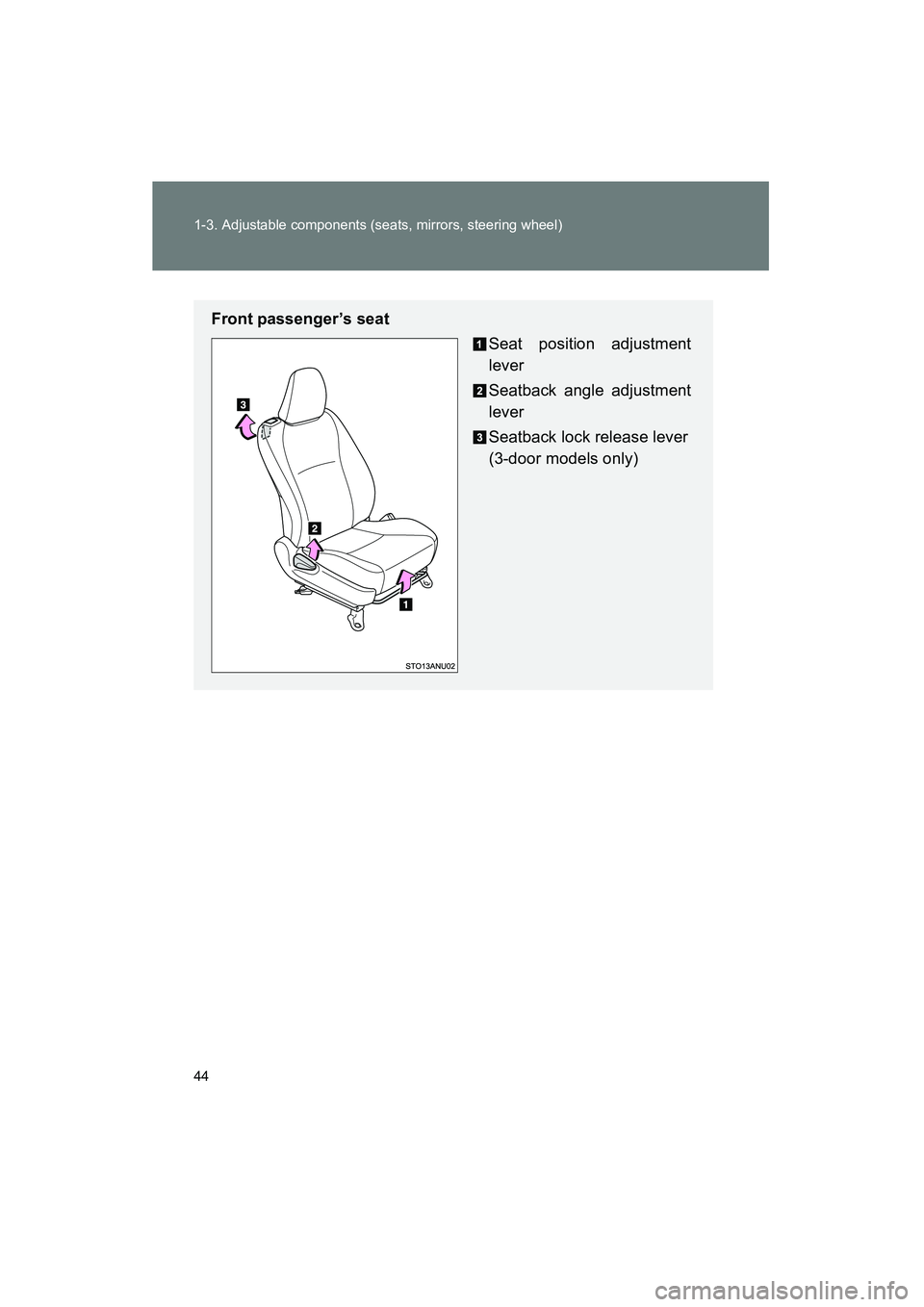
Front passenger’s seatSeat position adjustment
lever
Seatback angle adjustment
lever
Seatback lock release lever
(3-door models only)
Page 47 of 403
45
1-3. Adjustable components (seats, mirrors, steering wheel)
1
Before driving
YARIS_HB_U_52D44U
Moving front passenger seat for rear seat entry (3-door models only)
■
Getting in or out the vehicle
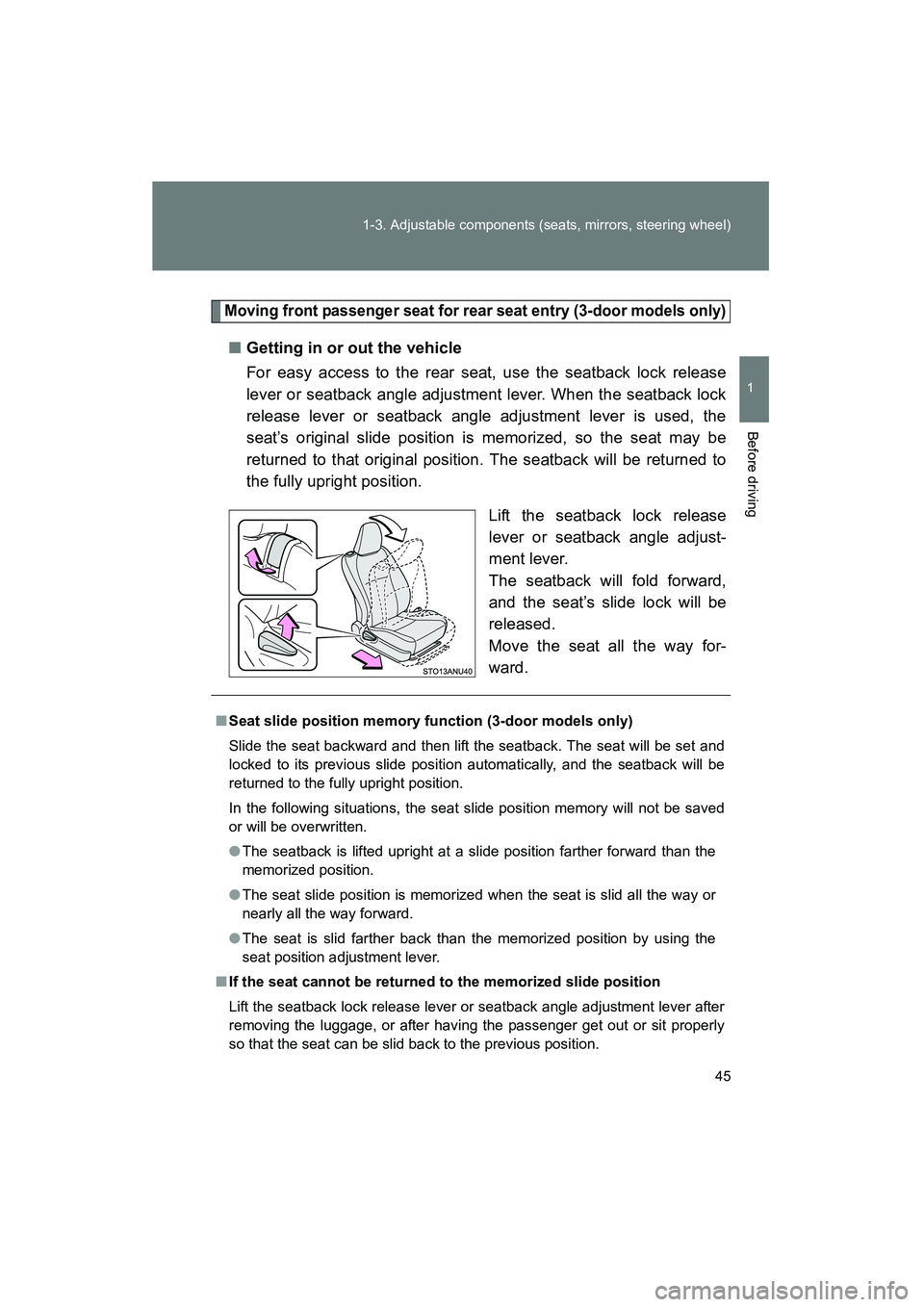
For easy access to the rear seat, use the seatback lock release
lever or seatback angle adjustment lever. When the seatback lock
release lever or seatback angle adjustment lever is used, the
seat’s original slide position is memorized, so the seat may be
returned to that original position. The seatback will be returned to
the fully upright position.
Lift the seatback lock release
lever or seatback angle adjust-
ment lever.
The seatback will fold forward,
and the seat’s slide lock will be
released.
Move the seat all the way for-
ward.
■Seat slide position memory function (3-door models only)
Slide the seat backward and then lift the seatback. The seat will be set and
locked to its previous slide position automatically, and the seatback will be
returned to the fully upright position.
In the following situations, the seat slide position memory will not be saved
or will be overwritten.
●The seatback is lifted upright at a slide position farther forward than the
memorized position.
● The seat slide position is memorized when the seat is slid all the way or
nearly all the way forward.
● The seat is slid farther back than the memorized position by using the
seat position adjustment lever.
■ If the seat cannot be returned to the memorized slide position
Lift the seatback lock release lever or seatback angle adjustment lever after
removing the luggage, or after having the passenger get out or sit properly
so that the seat can be slid back to the previous position.
Page 48 of 403
46 1-3. Adjustable components (seats, mirrors, steering wheel)
YARIS_HB_U_52D44U
CAUTION
■Seat adjustment
● Be careful that the seat does not hit passengers or luggage.
● To reduce the risk of sliding under the lap belt during a collision, do not
recline the seat more than necessary.
If the seat is too reclined, the lap belt may slide past the hips and apply
restraint forces directly to the abdomen, or your neck may contact the
shoulder belt, increasing the risk of death or serious injury in the event of
an accident.
Adjustments should not be made while driving as the seat may unexpect-
edly move and cause the driver to lose control of the vehicle.
● After adjusting the seat, make sure that the seat is locked in position.
● Never allow anyone to touch seatback lock release levers while the vehi-
cle is moving.
● If anyone is in the vicinity, make sure they are clear of the seat back path
and let them know that the seat is about to move.
■ After returning the seatback to the upright position
Make sure the seatback is securely locked by pushing it forward and rear-
ward. Failure to do so may result in death or serious injury.
NOTICE
■To prevent the seat lock mechanism malfunction
Do not use the seatback angle adjustment lever and seatback lock release
lever at the same time. If they are used together, the seat lock mechanism
may be damaged.
Page 50 of 403
48 1-3. Adjustable components (seats, mirrors, steering wheel)
YARIS_HB_U_52D44U
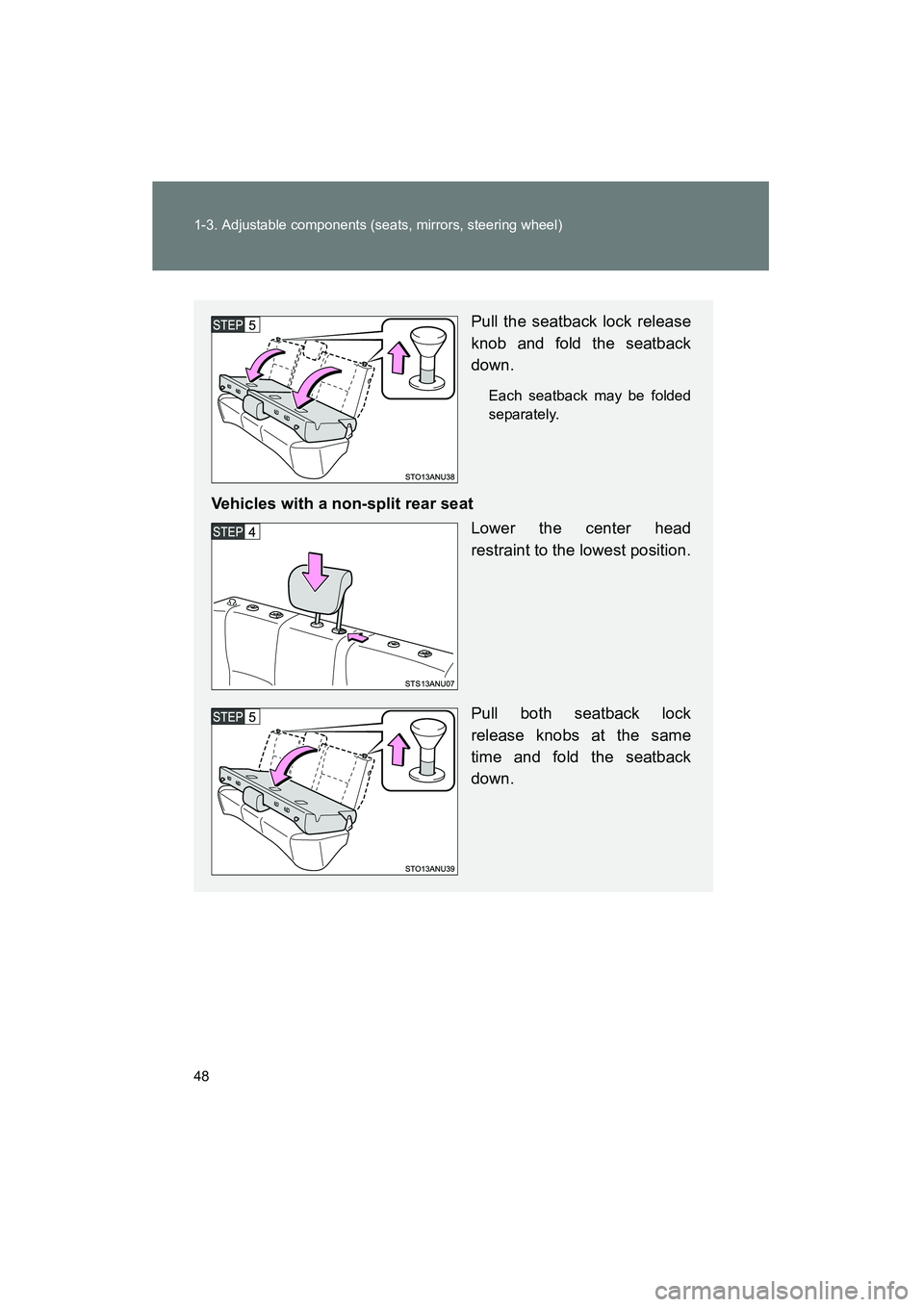
Pull the seatback lock release
knob and fold the seatback
down.
Each seatback may be folded
separately.
Vehicles with a non-split rear seatLower the center head
restraint to the lowest position.
Pull both seatback lock
release knobs at the same
time and fold the seatback
down.
Page 52 of 403
50 1-3. Adjustable components (seats, mirrors, steering wheel)
YARIS_HB_U_52D44U
CAUTION
■After returning the rear seatback to the upright position
Observe the following precautions. Failure to do so may result in death or
serious injury.
● Check that the seat belts are not twisted or caught in the seatback.
NOTICE
■Stowing the seat belts
The seat belts and the buckles must be stowed before you fold down the
rear seatbacks.
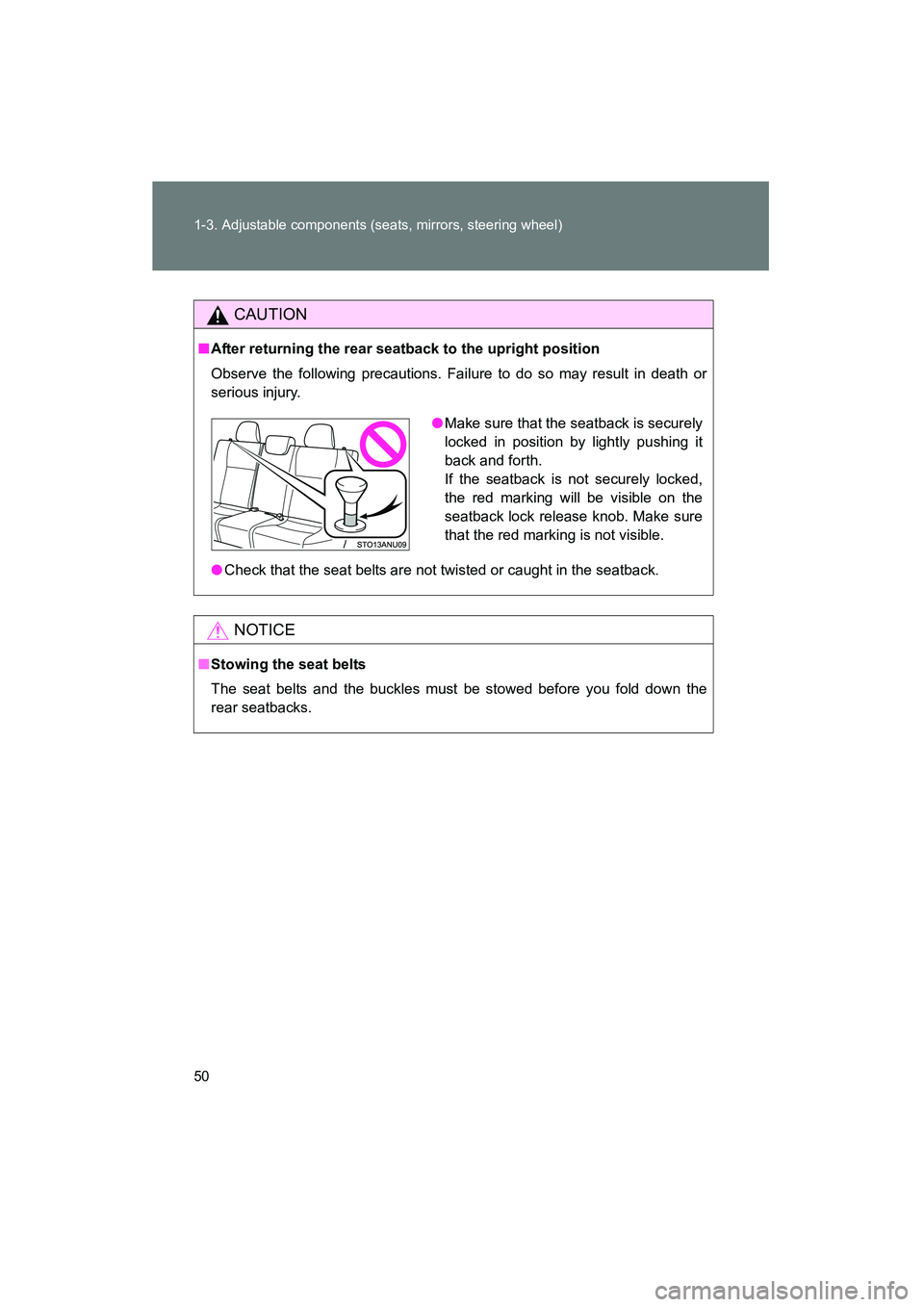
● Make sure that the seatback is securely
locked in position by lightly pushing it
back and forth.
If the seatback is not securely locked,
the red marking will be visible on the
seatback lock release knob. Make sure
that the red marking is not visible.
Page 53 of 403
51
1
1-3. Adjustable components (seats, mirrors, steering wheel)
Before driving
YARIS_HB_U_52D44U
Head restraints
■Removing the head restraints
Front and rear center head restraints
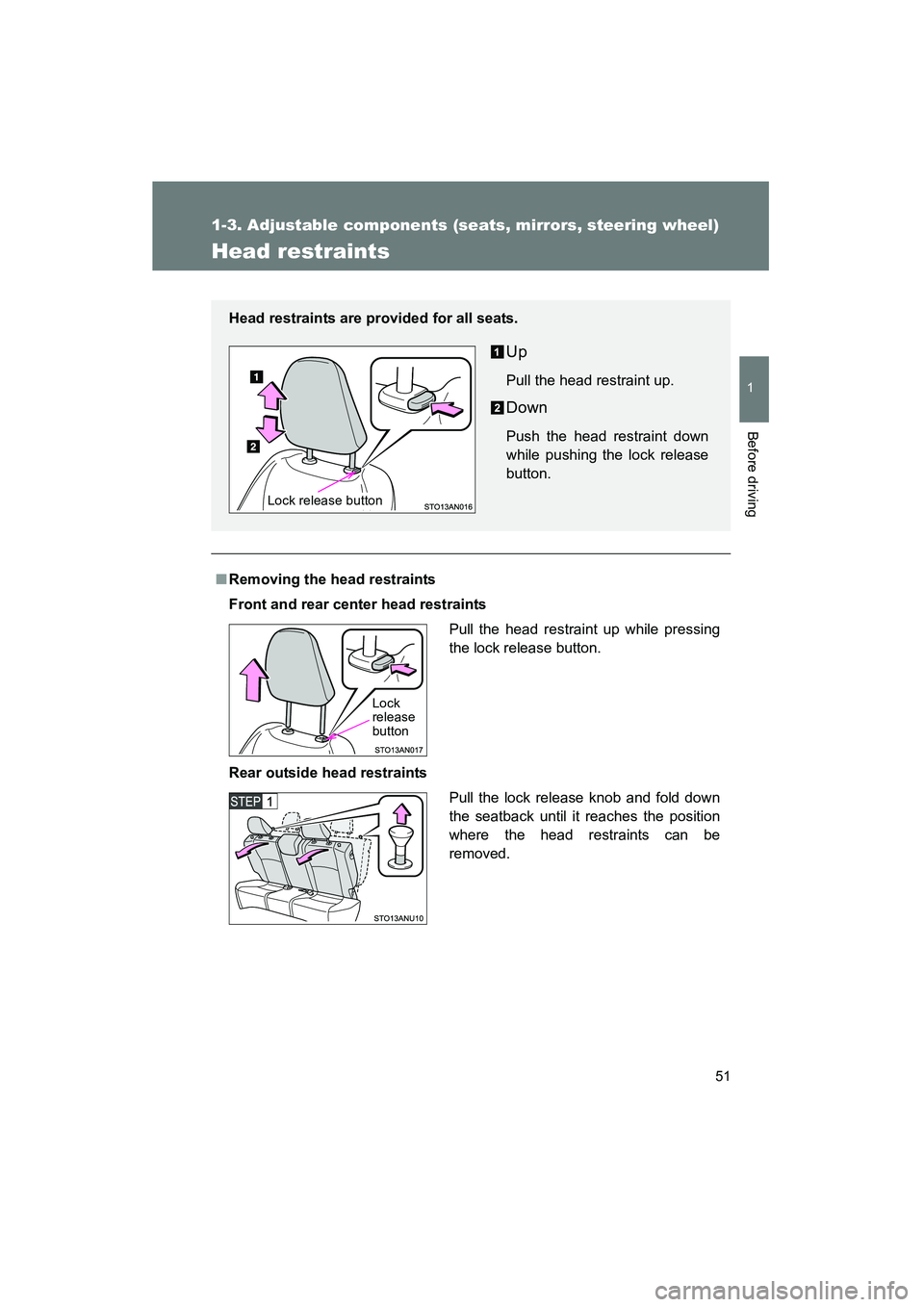
Rear outside head restraints Head restraints are provided for all seats.
Up
Pull the head restraint up.
Down
Push the head restraint down
while pushing the lock release
button.
Lock release button
Pull the head restraint up while pressing
the lock release button.
Lock
release
button
Pull the lock release knob and fold down
the seatback until it reaches the position
where the head restraints can be
removed.
Page 54 of 403
52 1-3. Adjustable components (seats, mirrors, steering wheel)
YARIS_HB_U_52D44U
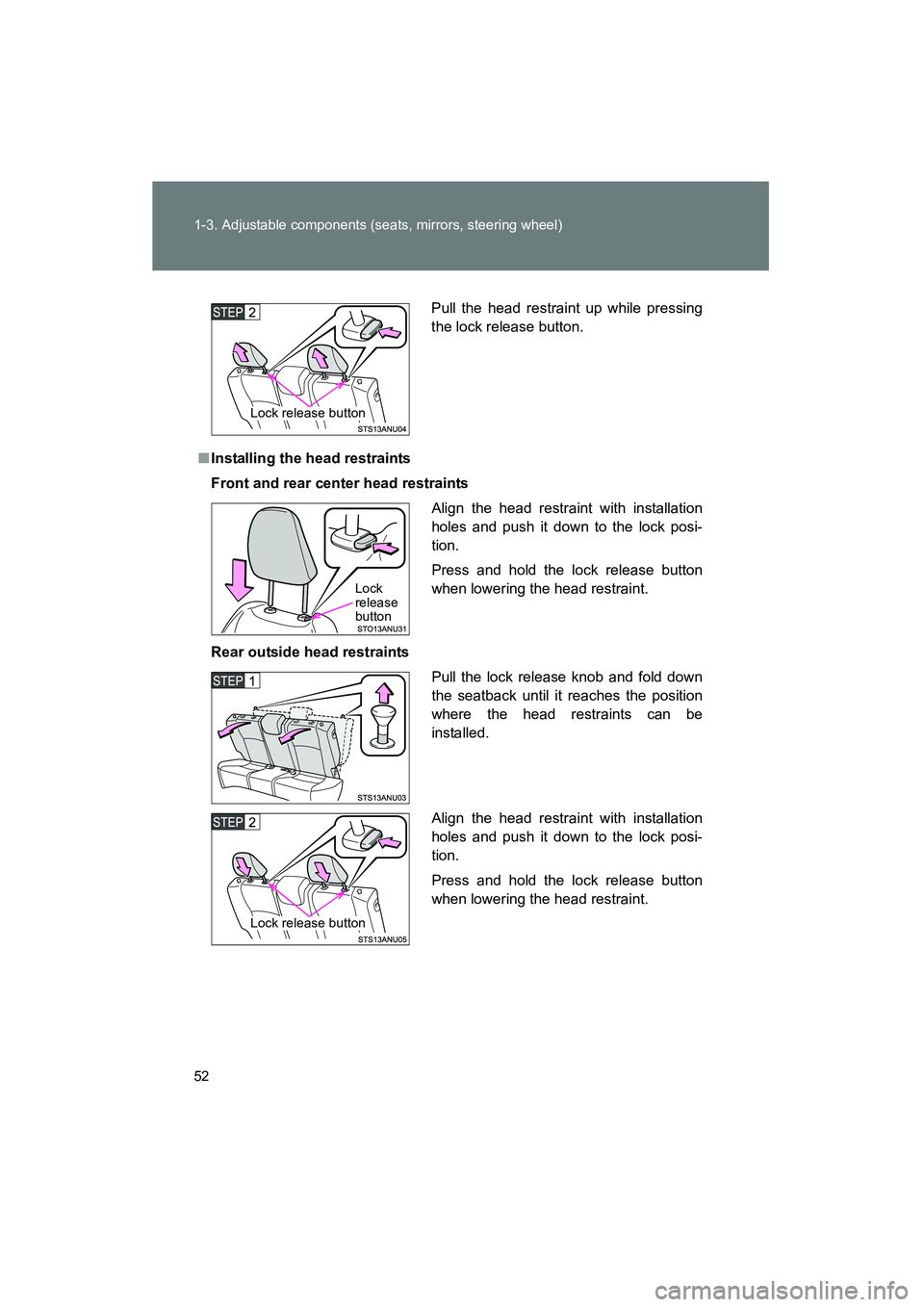
■Installing the head restraints
Front and rear center head restraints
Rear outside head restraints Pull the head restraint up while pressing
the lock release button.
Lock release button
Align the head restraint with installation
holes and push it down to the lock posi-
tion.
Press and hold the lock release button
when lowering the head restraint.
Lock
release
button
Pull the lock release knob and fold down
the seatback until it reaches the position
where the head restraints can be
installed.
Align the head restraint with installation
holes and push it down to the lock posi-
tion.
Press and hold the lock release button
when lowering the head restraint.
Lock release button
Page 55 of 403
53
1-3. Adjustable components (seats, mirrors, steering wheel)
1
Before driving
YARIS_HB_U_52D44U
■
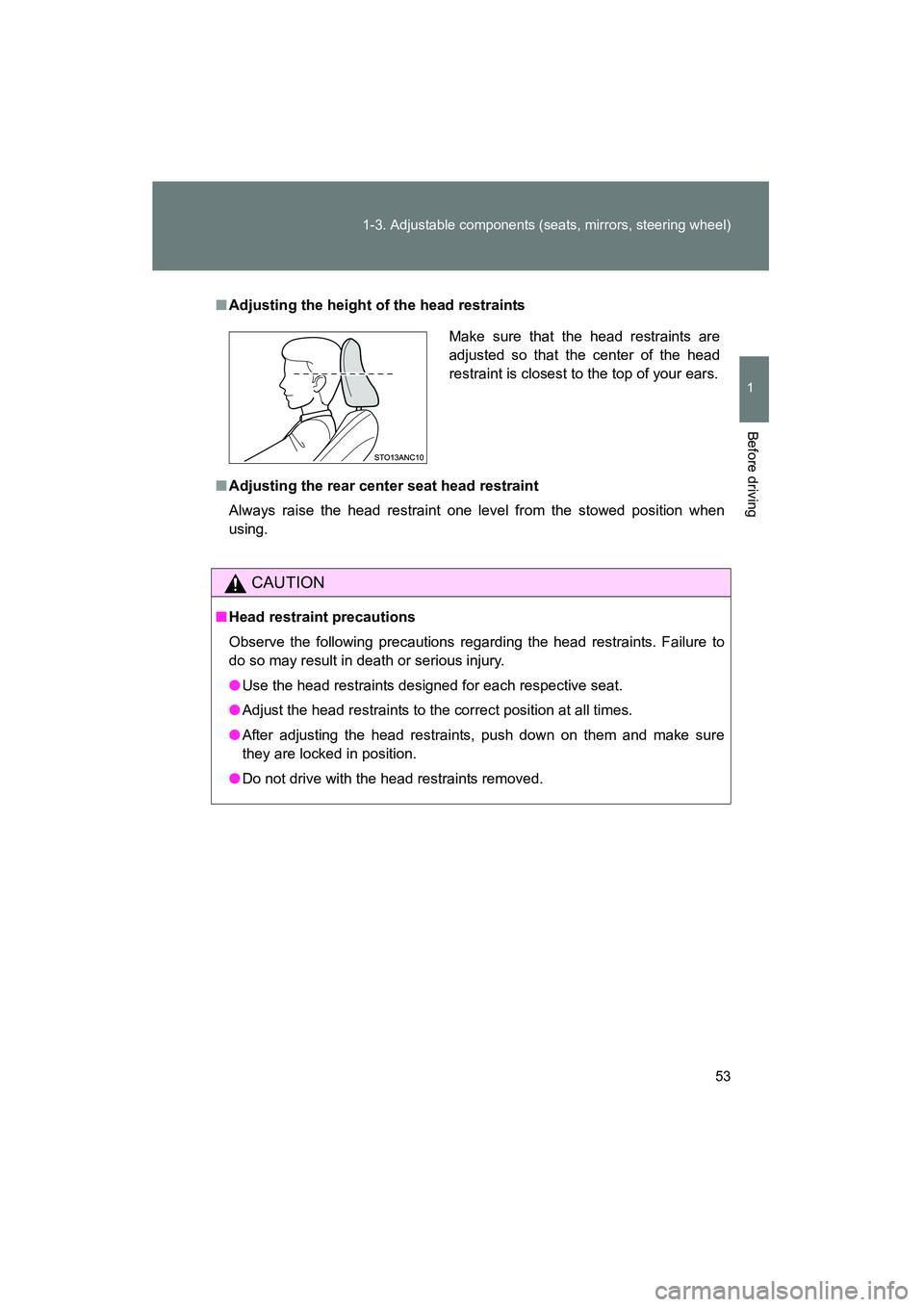
Adjusting the height of the head restraints
■ Adjusting the rear cente r seat head restraint
Always raise the head restraint one level from the stowed position when
using.
CAUTION
■ Head restraint precautions
Observe the following precautions r egarding the head restraints. Failure to
do so may result in death or serious injury.
● Use the head restraints designed for each respective seat.
● Adjust the head restraints to the correct position at all times.
● After adjusting the head restraints, push down on them and make sure
they are locked in position.
● Do not drive with the head restraints removed.
Make sure that the head restraints are
adjusted so that the center of the head
restraint is closest to the top of your ears.