wheel TOYOTA YARIS HATCHBACK 2013 Workshop Manual
[x] Cancel search | Manufacturer: TOYOTA, Model Year: 2013, Model line: YARIS HATCHBACK, Model: TOYOTA YARIS HATCHBACK 2013Pages: 403, PDF Size: 8.93 MB
Page 183 of 403
181
2-5. Driving information
2
When driving
YARIS_HB_U_52D44U
●
Crosswinds and rough roads will adversely affect handling of your
vehicle and trailer, causing sway. Periodically check the rear to
prepare for being passed by large trucks or buses, which may
cause your vehicle and trailer to sway. If swaying occurs, firmly grip
the steering wheel, reduce speed immediately but gradually, and
steer straight ahead. Never increase speed. If you make no
extreme correction with the steering or brakes, your vehicle and
trailer will stabilize.
● Take care when passing other vehicles. Passing requires consider-
able distance. After passing a vehicle, do not forget the length of
your trailer, and be sure you have plenty of room before changing
lanes.
● To maintain engine braking efficiency and charging system perfor-
mance when using engine braking, do not use the transmission in
D (vehicles with an automatic transmission) or 5 (vehicles with a
manual transmission).
● Due to the added load of the trailer, your vehicle’s engine may
overheat on hot days (at temperatures over 85°F [30°C]) when
driving up a long or steep grade. If the high engine coolant temper-
ature warning light flashes or comes on overheating, immediately
turn off the air conditioning (if in use), pull your vehicle off the road
and stop in a safe place. ( →P. 334)
Page 184 of 403
182 2-5. Driving information
YARIS_HB_U_52D44U●
Always place wheel blocks under both the vehicle and the trailer
wheels when parking. Apply the parking brake firmly, and put the
transmission in P (vehicles with an automatic transmission) or in 1
or R (vehicles with a manual transmission). Avoid parking on a
slope, but if unavoidable, do so only after performing the following:
Apply the brakes and keep them applied.
Have someone place wheel blocks under both the vehicle and
trailer wheels.
When the wheel blocks are in place, release the brakes slowly
until the blocks absorb the load.
Apply the parking brake firmly.
Shift into P (vehicles with an automatic transmission) or 1 or R
(vehicles with a manual transmission) and turn off the engine.
● When restarting after parking on a slope:
With the transmission in P (vehicles with an automatic trans-
mission) or the clutch pedal (vehicles with a manual transmis-
sion) depressed, start the engine. On vehicles with an
automatic transmission, be sure to keep the brake pedal
pressed.
Shift into a forward gear. If reversing, shift into R.
Release the parking brake (also brake pedal on vehicles with
an automatic transmission), and slowly pull or back away from
the wheel blocks. Stop and apply the brakes.
Have someone retrieve the blocks.
Page 185 of 403
183
2-5. Driving information
2
When driving
YARIS_HB_U_52D44U
■
Before towing
Check that the following conditions are met:
●Ensure that your vehicle’s tires are properly inflated. ( →P. 351)
● Trailer tires should be inflated accordin g to the trailer manufacturer’s rec-
ommendation.
● All trailer lights work as required by law.
● All lights work each time you connect them.
● The trailer ball is set at the proper height for the coupler on the trailer.
● The trailer is level when it is hitched.
Do not drive if the trailer is not level, and check for improper tongue
weight, overloading, worn suspension, or other possible causes.
● The trailer cargo is securely loaded.
● The rear view mirrors conform to any federal, state/provincial or local
regulations. If they do not, install r ear view mirrors appropriate for towing
purposes.
■ Break-in schedule
If your vehicle is new or equipped with any new power train components
(such as an engine, transmission, differential and wheel bearing), Toyota
recommends that you do not tow a trailer until it has been driven for over 500
miles (800 km).
However, avoid full throttle acceleration.
■ Maintenance
●If you tow a trailer, your vehicle will require more frequent maintenance
due to the additional load. (See “Scheduled Maintenance Guide” or
“Owner’s Manual Supplement”.)
● Retighten the fixing bolts of the towing ball and bracket after approxi-
mately 600 miles (1000 km) of trailer towing.
Page 188 of 403
186 2-5. Driving information
YARIS_HB_U_52D44U
NOTICE
■When installing a trailer hitch
● Use only the position recommended by your Toyota dealer. Do not install
the trailer hitch on the bumper; this may cause body damage.
● Do not use axle-mounted hitches, as they can cause damage to the axle
housing, wheel bearings, wheels or tires.
■ Safety chain
A safety chain must always be used between the towing vehicle and the
trailer. Leave sufficient slack in the chain for turns. The chain should cross
under the trailer tongue to prevent the tongue from dropping to the ground in
the case that it becomes damaged or separated. For the correct safety chain
installation procedure, ask your Toyota dealer.
■ Do not directly splice trailer lights
Directly splicing trailer lights may damage your vehicle’s electrical system
and cause a malfunction.
Page 189 of 403
187
2-5. Driving information
2
When driving
YARIS_HB_U_52D44U
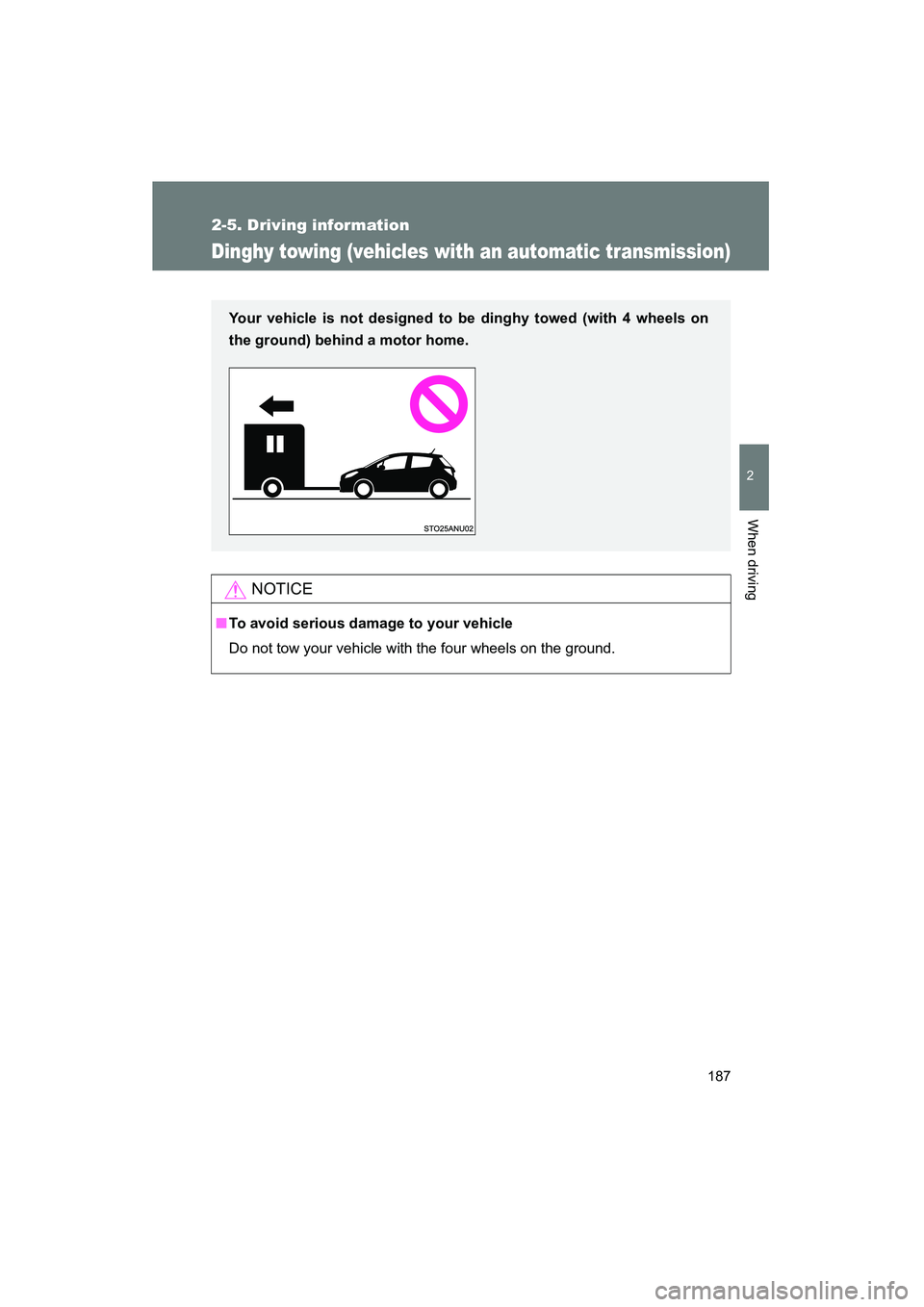
Dinghy towing (vehicles with an automatic transmission)
NOTICE
■To avoid serious damage to your vehicle
Do not tow your vehicle with the four wheels on the ground.
Your vehicle is not designed to be dinghy towed (with 4 wheels on
the ground) behind a motor home.
Page 190 of 403
188
2-5. Driving information
YARIS_HB_U_52D44U
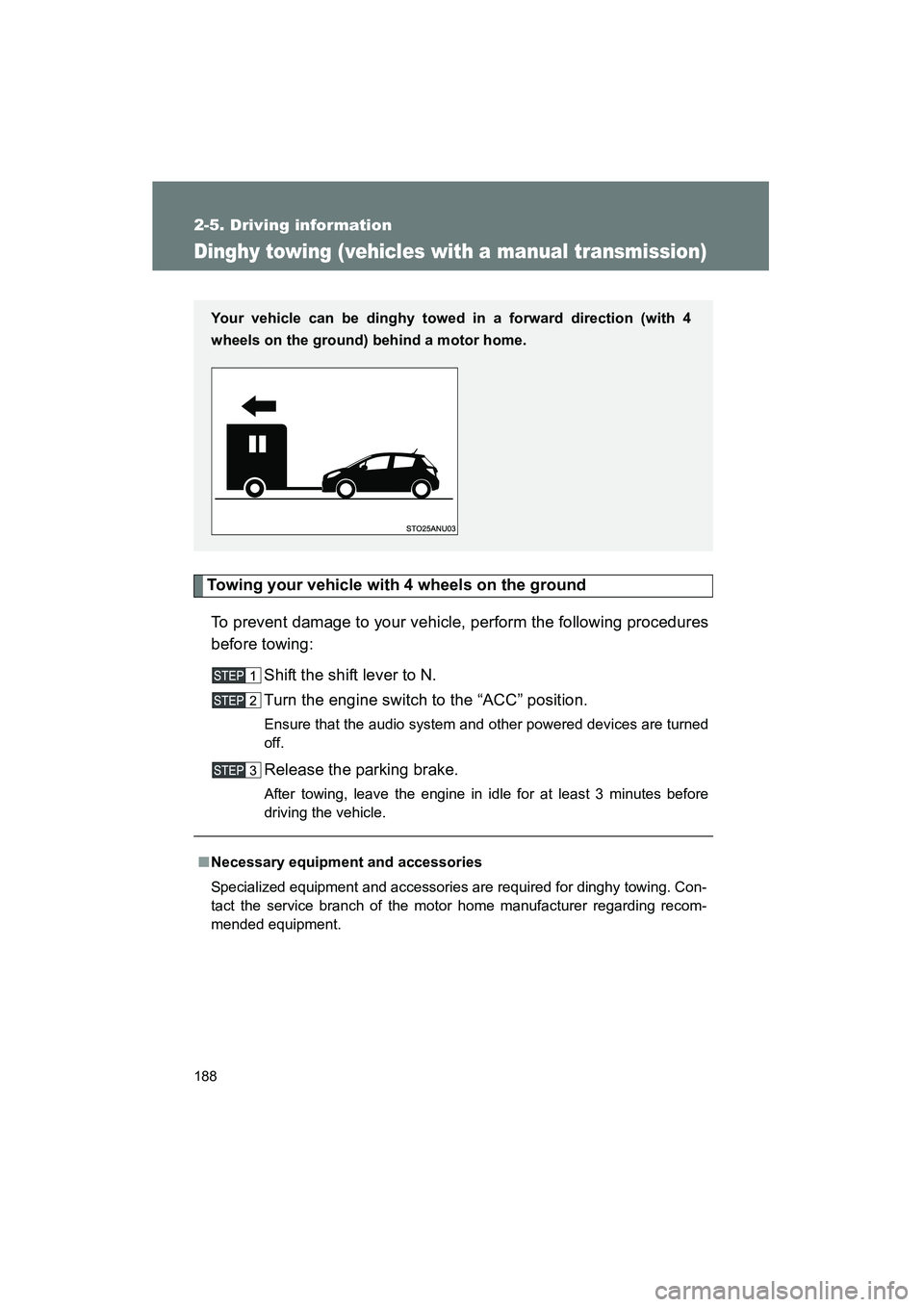
Dinghy towing (vehicles with a manual transmission)
Towing your vehicle with 4 wheels on the groundTo prevent damage to your vehicle, perform the following procedures
before towing: Shift the shift lever to N.
Turn the engine switch to the “ACC” position.
Ensure that the audio system and other powered devices are turned
off.
Release the parking brake.
After towing, leave the engine in idle for at least 3 minutes before
driving the vehicle.
■Necessary equipment and accessories
Specialized equipment and accessories are required for dinghy towing. Con-
tact the service branch of the motor home manufacturer regarding recom-
mended equipment. Your vehicle can be dinghy towed in a forward direction (with 4
wheels on the ground) behind a motor home.
Page 193 of 403
Interior features3
191
YARIS_HB_U_52D44U
3-1. Using the air conditioning system and defogger
Air conditioning system .... 192
Rear window and outside rear view mirror
defoggers ....................... 199
3-2. Using the audio system Using the AUX port/USB port ........................ 200
Using the steering wheel audio switches ............... 201
3-3. Using the interior lights Interior lights list ............... 202
• Personal lights ............... 203
• Interior light .................... 203
3-4. Using the st orage features
List of storage features .... 204
• Glove box....................... 205
• Cup holders ................... 205
• Bottle holders ................. 207 3-5. Other interior features
Sun visors ........................ 208
Vanity mirrors ................... 209
Clock ................................ 210
Outside temperature display ............................ 211
Power outlet ..................... 213
Assist grips....................... 214
Floor mat .......................... 215
Luggage compartment features .......................... 217
Page 203 of 403
201
3-2. Using the audio system
3
Interior features
YARIS_HB_U_52D44U
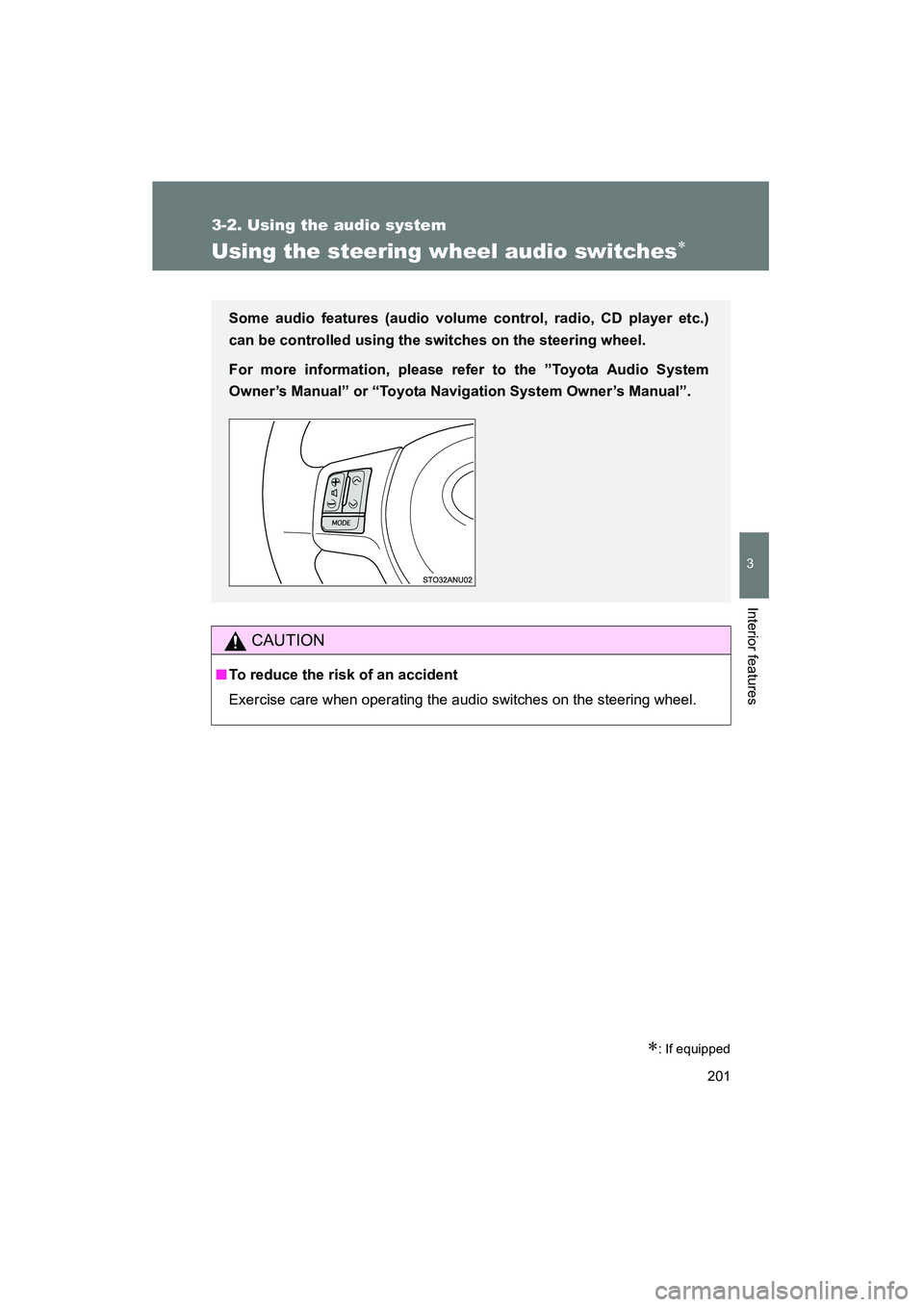
Using the steering wheel audio switches∗
∗: If equipped
CAUTION
■To reduce the risk of an accident
Exercise care when operating the audio switches on the steering wheel.
Some audio features (audio volume control, radio, CD player etc.)
can be controlled using the switches on the steering wheel.
For more information, please refer to the ”Toyota Audio System
Owner’s Manual” or “Toyota Navigation System Owner’s Manual”.
Page 223 of 403
Maintenance and care4
221
YARIS_HB_U_52D44U
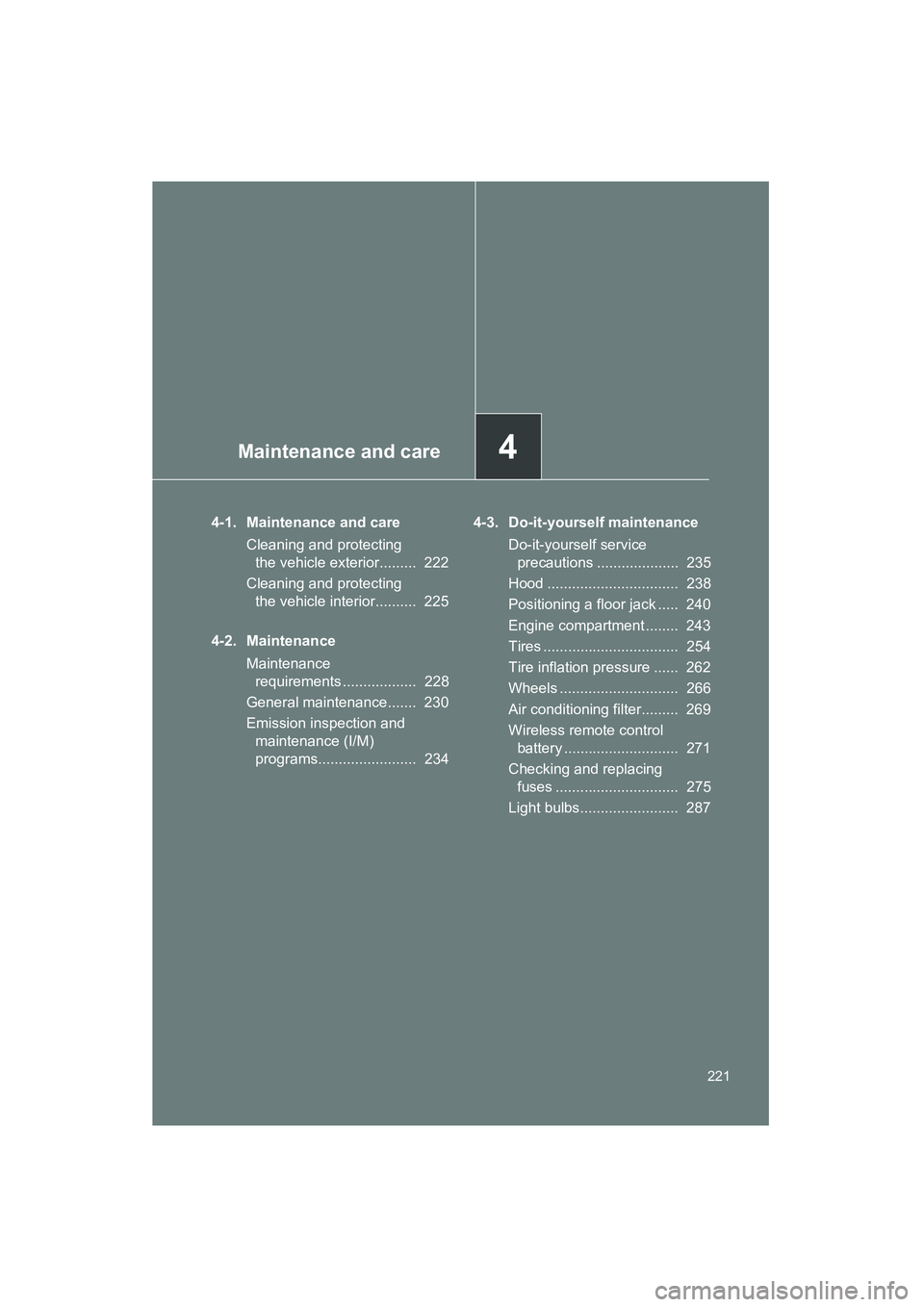
4-1. Maintenance and careCleaning and protecting the vehicle exterior......... 222
Cleaning and protecting the vehicle interior.......... 225
4-2. Maintenance Maintenance requirements .................. 228
General maintenance....... 230
Emission inspection and maintenance (I/M)
programs........................ 234 4-3. Do-it-yourself maintenance
Do-it-yourself service precautions .................... 235
Hood ................................ 238
Positioning a floor jack ..... 240
Engine compartment ........ 243
Tires ................................. 254
Tire inflation pressure ...... 262
Wheels ............................. 266
Air conditioning filter......... 269
Wireless remote control battery ............................ 271
Checking and replacing fuses .............................. 275
Light bulbs........................ 287
Page 224 of 403
222
YARIS_HB_U_52D44U
4-1. Maintenance and care
Cleaning and protecting the vehicle exterior
■Automatic car washes
● Fold the mirrors and remove the antenna before washing the vehicle.
Start washing from the front of the vehicle. Make sure to re-install the
antenna and extend the mirrors before driving.
● Brushes used in automatic car washes may scratch the vehicle surface
and harm your vehicle’s paint.
● For vehicles with the rear spoiler, in certain automatic car washes, the
rear spoiler may interfere with mach ine operation. This may prevent the
vehicle from being cleaned properly or result in damage to the rear
spoiler.
■ High pressure car washes
● Do not allow the nozzles of the car wash to come within close proximity
of the window and door borders, and high mounted stoplight.
● Before using the car wash, check that the fuel filler door on your vehicle
is closed properly.
Perform the following to protect the
vehicle and maintain it in prime
condition:
● Working from top to bottom, liberally apply water to the vehicle
body, wheel wells and underside of the vehicle to remove any
dirt and dust.
● Wash the vehicle body using a sponge or soft cloth, such as a
chamois.
● For hard-to-remove marks, use car wash soap and rinse thor-
oughly with water.
● Wipe away any water.
● Wax the vehicle when the waterproof coating deteriorates.
If water does not bead on a clean surface, apply wax when the vehi-
cle body is cool.