eco TOYOTA YARIS HATCHBACK 2015 Owners Manual
[x] Cancel search | Manufacturer: TOYOTA, Model Year: 2015, Model line: YARIS HATCHBACK, Model: TOYOTA YARIS HATCHBACK 2015Pages: 540, PDF Size: 34.12 MB
Page 352 of 540

3527-3. Do-it-yourself maintenance
YARIS_F_WE_52G04E
WARNING
The engine compartment contains many mechanisms and fluids that may
move suddenly, become hot, or become electrically energized. To avoid death
or serious injury, observe the following precautions.
■ When working on the engine compartment
● Keep hands, clothing and tools away from the moving fan and engine
drive belt.
● Be careful not to touch the engine, radiator, exhaust manifold, etc. right
after driving as they may be hot. Oil and other fluids may also be hot.
● Do not leave anything that may burn easily, such as paper and rags, in the
engine compartment.
● Do not smoke, cause sparks or expose an open flame to fuel on the bat-
tery. Fuel and battery fumes are flammable.
● Be extremely cautious when working on the battery. It contains poisonous
and corrosive sulfuric acid.
● Take care because brake fluid can harm your hands or eyes and damage
painted surfaces. If fluid gets on your hands or in your eyes, flush the
affected area with clean water immediately.
If you still experience discomfort, consult a doctor.
■ When working near the electric cooling fan or radiator grille
Vehicles without a smart entry & start system
Be sure the engine switch is in the “LOCK” position.
With the engine switch in the “ON” position, the electric cooling fan may
automatically start to run if the air conditioning is on and/or the coolant tem-
perature is high. ( P. 367)
Vehicles with a smart entry & start system
Be sure the engine switch is off.
With the engine switch in IGNITION ON mode, the electric cooling fan may
automatically start to run if the air conditioning is on and/or the coolant tem-
perature is high. ( P. 367)
■ Safety glasses
Wear safety glasses to prevent flying or falling material, fluid spray, etc.
from getting in your eyes.
Page 369 of 540

3697-3. Do-it-yourself maintenance
7
Maintenance and care
YARIS_F_WE_52G04E
■Before recharging
When recharging, the battery produces hydrogen gas which is flammable and
explosive. Therefore, observe the following before recharging:
● If recharging with the battery installed on the vehicle, be sure to disconnect
the ground cable.
● Make sure the power switch on the charger is off when connecting and dis-
connecting the charger cables to the battery.
■ After recharging/reconnecting the battery (vehicles with a smart entry &
start system)
● Unlocking the doors using the smart entry & start system may not be possi-
ble immediately after reconnecting the battery. If this happens, use the wire-
less remote control or the mechanical key to lock/unlock the doors.
● Start the engine with the engine switch in ACCESSORY mode. The engine
may not start with the engine switch turned off. However, the engine will
operate normally from the second attempt.
● The engine switch mode is recorded by the vehicle. If the battery is recon-
nected, the vehicle will return the engine switch mode to the status it was in
before the battery was disconnected. Make sure to turn off the engine
before disconnect the battery. Take extra care when connecting the battery
if the engine switch mode prior to discharge is unknown.
If the engine will not start even after multiple attempts, contact any authorized
Toyota dealer or repairer, or another duly qualified and equipped professional.
WARNING
■Chemicals in the battery
Batteries contain poisonous and corrosive sulfuric acid and may produce
hydrogen gas which is flammable and explosive. To reduce the risk of death
or serious injury, take the following precautions while working on or near the
battery:
● Do not cause sparks by touching the battery terminals with tools.
● Do not smoke or light a match near the battery.
● Avoid contact with eyes, skin and clothes.
● Never inhale or swallow electrolyte.
● Wear protective safety glasses when working near the battery.
● Keep children away from the battery.
Page 372 of 540

3727-3. Do-it-yourself maintenance
YARIS_F_WE_52G04E
You may drain the fuel filter yourself. However, as the operation is dif-
ficult, we recommend having it drained by any authorized Toyota
dealer or repairer, or another duly qualified and equipped profes-
sional. Even if you decide to drain it yourself, contact any authorized
Toyota dealer or repairer, or another duly qualified and equipped pro-
fessional.
The water in the fuel filter needs to be drained if the fuel filter warning
light comes on. (P. 434)
Turn the engine switch to the “LOCK” position (vehicles without a
smart entry & start system) or off (vehicles with a smart entry & start
system).
Place a small tray under the drain plug to catch the water and any
fuel that comes out.
Turn the drain plug counter-
clockwise about 2 to 2 1/2
turns.
Operate the priming pump until
fuel begins to run out.
After draining, tighten the drain plug by hand.
Fuel filter (diesel engine)
1
2
3
4
5
Page 374 of 540

3747-3. Do-it-yourself maintenance
YARIS_F_WE_52G04E
Rotate the tires in the order shown.
To equalize tire wear and help extend tire life, Toyota recommends
that tire rotation is carried out approximately every 10000 km (6000
miles).
Your vehicle is equipped with a tire pressure warning system that uses
tire pressure warning valves and transmitters to detect low tire infla-
tion pressure before serious problems arise.
If the tire pressure drops below a predetermined level, the driver is
warned by a warning light. ( P. 435)
Tire rotation
Vehicles with a spare tire of dif-
ferent wheel type from the
installed tires or an emergency
tire puncture repair kit
Vehicles with a spare tire of
the same wheel type as the
installed tires
FrontFront
Tire pressure warning system (if equipped)
Page 378 of 540

3787-3. Do-it-yourself maintenance
YARIS_F_WE_52G04E
■ Routine tire inflation pressure checks (vehicles with a tire pressure
warning system)
The tire pressure warning system does not replace routine tire inflation pres-
sure checks. Make sure to check tire inflation pressure as part of your routine
of daily vehicle checks.
■ Initializing the tire pressure warning system (vehicles with a tire pres-
sure warning system)
Initialize the system with the tire inflation pressure adjusted to the specified
level.
■ If the tread on snow tires wears down below 4 mm (0.16 in.)
The effectiveness of the tires as snow tires is lost.
■ When initialization of the tire pressure warning system has failed (vehi-
cles with a tire pressure warning system)
Initialization can be completed in a few minutes. However, in the following
cases, the settings have not been recorded and the system will not operate
properly. If repeated attempts to record tire inflation pressure settings are
unsuccessful, have the vehicle inspected by any authorized Toyota dealer or
repairer, or another duly qualified and equipped professional.
● When operating the tire pressure warning reset switch, the tire pressure
warning light does not blink 3 times.
● After driving for a certain period of time since the initialization has been
completed, the warning light comes on after blinking for 1 minute.
Page 385 of 540

3857-3. Do-it-yourself maintenance
7
Maintenance and care
YARIS_F_WE_52G04E
WARNING
■When inspecting or replacing tires
Observe the following precautions to prevent accidents.
Failure to do so may cause damage to parts of the drive train as well as
dangerous handling characteristics, which may lead to an accident resulting
in death or serious injury.
● Do not mix tires of different makes, models or tread patterns.
Also, do not mix tires of remarkably different treadwear.
● Do not use tire sizes other than those recommended by Toyota.
● Do not mix differently constructed tires (radial, bias-belted or bias-ply
tires).
● Do not mix summer, all season and snow tires.
● Do not use tires that have been used on another vehicle.
Do not use tires if you do not know how they were used previously.
● Vehicles with a compact spare tire: Do not tow if your vehicle has a com-
pact spare tire installed.
■ When initializing the tire pressure warning system (vehicles with a tire
pressure warning system)
Do not operate the tire pressure warning reset switch without first adjusting
the tire inflation pressure to the specified level. Otherwise, the tire pressure
warning light may not come on even if the tire inflation pressure is low, or it
may come on when the tire inflation pressure is actually normal.
NOTICE
■ Repairing or replacing tires, wheels, tire pressure warning valves,
transmitters and tire valve caps (vehicles with a tire pressure warning
system)
● When removing or fitting the wheels, tires or the tire pressure warning
valves and transmitters, contact any authorized Toyota dealer or repairer,
or another duly qualified and equipped professional as the tire pressure
warning valves and transmitters may be damaged if not handled correctly.
● Make sure to install the tire valve caps. If the tire valve caps are not
installed, water could enter the tire pressure warning valves and the tire
pressure warning valves could be bound.
● When replacing tire valve caps, do not use tire valve caps other than those
specified. The cap may become stuck.
Page 386 of 540

3867-3. Do-it-yourself maintenance
YARIS_F_WE_52G04E
NOTICE
■To avoid damage to the tire pressure warning valves and transmitters
(vehicles with a tire pressure warning system)
When a tire is repaired with liquid sealants, the tire pressure warning valve
and transmitter may not operate properly. If a liquid sealant is used, contact
any authorized Toyota dealer or repairer, or another duly qualified and
equipped professional or other qualified service shop as soon as possible.
After use of liquid sealant, make sure to replace the tire pressure warning
valve and transmitter when repairing or replacing the tire. ( P. 375)
■ Driving on rough roads
Take particular care when driving on roads with loose surfaces or potholes.
These conditions may cause losses in tire inflation pressure, reducing the
cushioning ability of the tires. In addition, driving on rough roads may cause
damage to the tires themselves, as well as the vehicle’s wheels and body.
■ Low profile tires (vehicles with 195/50R16 tires)
Low profile tires may cause greater damage than usual to the tire wheel
when sustaining impact from the road surface. Therefore, pay attention to
the following:
● Be sure to use proper tire inflation pressure. If tires are under-inflated, they
may be damaged more severely.
● Avoid potholes, uneven pavement, curbs and other road hazards. Failure
to do so may lead to severe tire and wheel damage.
■ If tire inflation pressure of each tire becomes low while driving
Do not continue driving, or your tires and/or wheels may be ruined.
Page 387 of 540

3877-3. Do-it-yourself maintenance
7
Maintenance and care
YARIS_F_WE_52G04E
Tire inflation pressure
■Effects of incorrect tire inflation pressure
Driving with incorrect tire inflation pressure may result in the following:
● Reduced fuel economy
● Reduced driving comfort and poor handling
● Reduced tire life due to wear
● Reduced safety
● Damage to the drive train
If a tire needs frequent inflating, have it checked by any authorized Toyota
dealer or repairer, or another duly qualified and equipped professional.
■ Instructions for checking tire inflation pressure
When checking tire inflation pressure, observe the following:
● Check only when the tires are cold.
If your vehicle has been parked for at least 3 hours or has not been driven
for more than 1.5 km or 1 mile, you will get an accurate cold tire inflation
pressure reading.
● Always use a tire pressure gauge.
It is difficult to judge if a tire is properly inflated based only on its appear-
ance.
● It is normal for the tire inflation pressure to be higher after driving as heat is
generated in the tire. Do not reduce tire inflation pressure after driving.
Make sure to maintain proper tire inflation pressure. Tire infla-
tion pressure should be checked at least once per month. How-
ever, Toyota recommends that tire inflation pressure be checked
once every two weeks. ( P. 509)
Page 389 of 540
3897-3. Do-it-yourself maintenance
7
Maintenance and care
YARIS_F_WE_52G04E
Wheels
When replacing wheels, care should be taken to ensure that they are
equivalent to those removed in load capacity, diameter, rim width and
inset*.
Replacement wheels are available at any authorized Toyota dealer or
repairer, or another duly qualified and equipped professional.
*: Conventionally referred to as “offset”.
Toyota does not recommend using the following:
● Wheels of different sizes or types
● Used wheels
● Bent wheels that have been straightened
● Use only Toyota wheel nuts and wrenches designed for use with
your aluminum wheels.
● When rotating, repairing or changing your tires, check that the
wheel nuts are still tight after driving 1600 km (1000 miles).
● Be careful not to damage the aluminum wheels when using tire
chains.
● Use only Toyota genuine balance weights or equivalent and use a
plastic or rubber hammer when balancing your wheels.
If a wheel is bent, cracked or heavily corroded, it should be
replaced. Otherwise, the tire may separate from the wheel or
cause a loss of handling control.
Wheel selection
Aluminum wheel precautions (if equipped)
Page 390 of 540
3907-3. Do-it-yourself maintenance
YARIS_F_WE_52G04E
■When removing the wheel ornament (vehicles with steel wheels and
emergency tire puncture repair kit)
■ When replacing wheels (vehicles with a tire pressure warning system)
The wheels of your vehicle are equipped with tire pressure warning valves
and transmitters (except for spare tire [inc lude compact spare tire]) that allow
the tire pressure warning system to provide advance warning in the event of a
loss in tire inflation pressure. Whenever wheels are replaced, tire pressure
warning valves and transmitters must be installed. ( P. 375)
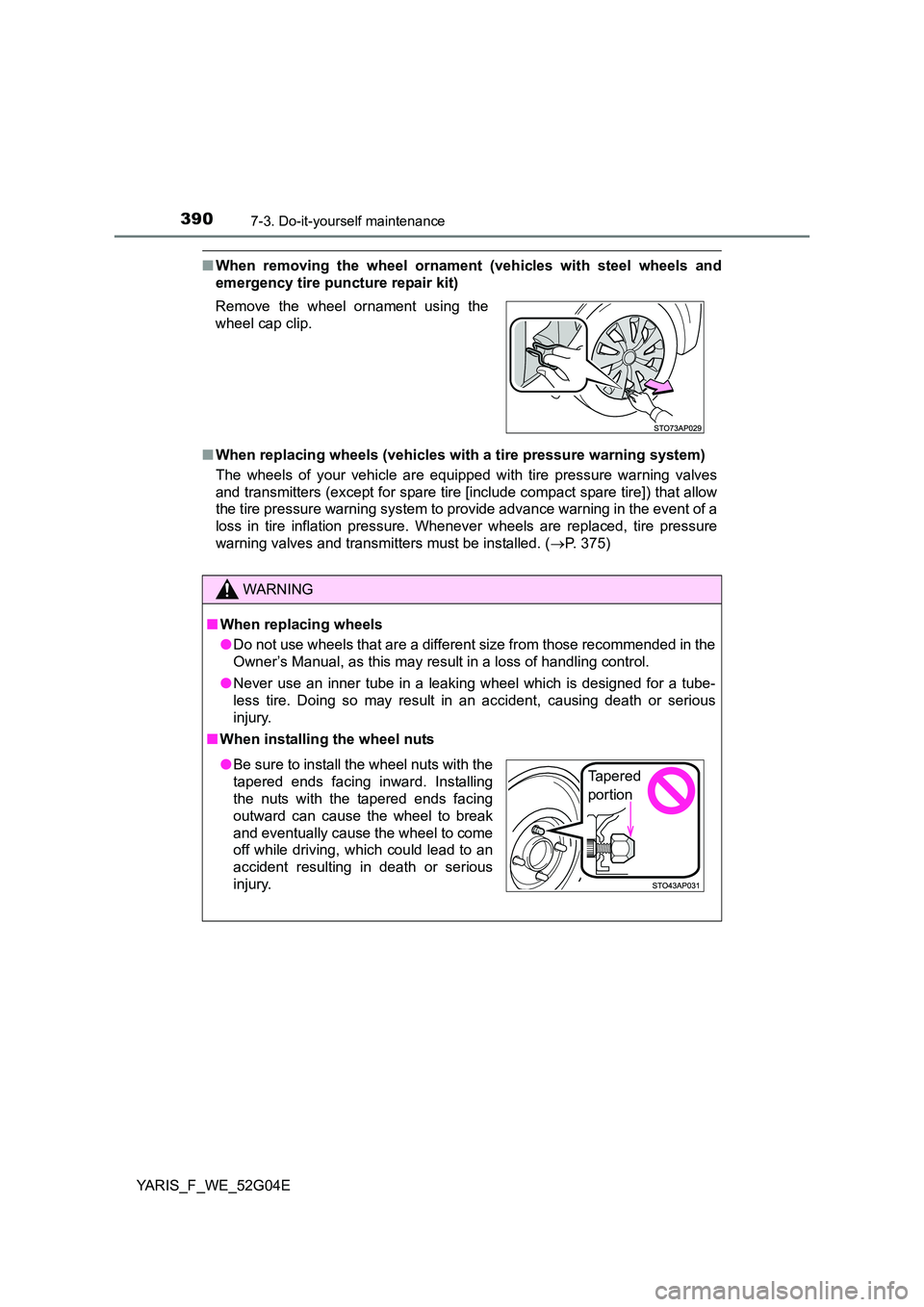
Remove the wheel ornament using the
wheel cap clip.
WARNING
■ When replacing wheels
● Do not use wheels that are a different size from those recommended in the
Owner’s Manual, as this may result in a loss of handling control.
● Never use an inner tube in a leaking wheel which is designed for a tube-
less tire. Doing so may result in an accident, causing death or serious
injury.
■ When installing the wheel nuts
●Be sure to install the wheel nuts with the
tapered ends facing inward. Installing
the nuts with the tapered ends facing
outward can cause the wheel to break
and eventually cause the wheel to come
off while driving, which could lead to an
accident resulting in death or serious
injury.
Tapered
portion