eco TOYOTA YARIS HATCHBACK 2015 Repair Manual
[x] Cancel search | Manufacturer: TOYOTA, Model Year: 2015, Model line: YARIS HATCHBACK, Model: TOYOTA YARIS HATCHBACK 2015Pages: 540, PDF Size: 34.12 MB
Page 230 of 540
2304-5. Toyota Safety Sense
YARIS_F_WE_52G04E
■Operational conditions
The pre-crash safety system is enabled and determines that the possibility of
a frontal collision with a vehicle (e xcept motorcycles and bicycles) is high.
● Pre-crash warning:
• Vehicle speed is approximately 15 to 140 km/h (10 to 86 mph).
• The relative speed between your vehicle and the vehicle ahead is greater
than approximately 15 km/h (10 mph).
● Pre-crash brake assist:
• Vehicle speed is approximately 30 to 80 km/h (19 to 49 mph).
• The relative speed between your vehicle and the vehicle ahead is greater
than approximately 30 km/h (19 mph).
● Pre-crash braking:
• Vehicle speed is approximately 10 to 80 km/h (7 to 49 mph).
• The relative speed between your vehicle and the vehicle ahead is greater
than approximately 10 km/h (7 mph).
When the brake pedal is stepped on, the system judges if evasion actions are
being done by the driver and the start timing for pre-crash braking may be
delayed.
During the following, the driver operations takes precedence and the system
may not operate:
● The accelerator pedal is depressed strongly
● The steering wheel is turned sharply or abruptly
In case of the following, the system will not operate:
● If a battery terminal has been disconnected and reconnected and then the
vehicle has not been driven for a certain amount of time
● If VSC is disabled (only the pre-crash warning function will be operational)
● If the PCS warning light is flashing or illuminated
● When the shift position is in R
■ Cancelation of the pre-crash braking
● If either of the following situations occur while the pre-crash braking function
is operating, it will be canceled:
• The accelerator pedal is depressed strongly.
• The steering wheel is turned sharply or abruptly.
● If the vehicle is stopped by the operation of the pre-crash braking function,
the operation of the pre-crash braking function will be canceled after the
vehicle has been stopped for approximately 2 seconds.
Page 233 of 540
2334-5. Toyota Safety Sense
4
Driving
YARIS_F_WE_52G04E
■ If the PCS warning light flashes
The pre-crash safety system may be temporarily unavailable or there may be
a malfunction in the system.
● In the following situations, the warning light will be cleared and the system
will become operational when normal operating conditions return:
• When the area around the front sensor is hot, such as after the vehicle
has been parked in the sun
• When the windshield is fogged up or covered with condensation or ice
( P. 308, 317)
• If the area in front of the front sens or is obstructed, such as when the
hood is open
● If the PCS warning light continues to flash, the system may be malfunction-
ing. Have the vehicle inspected by any authorized Toyota dealer or repairer,
or another duly qualified and equi pped professional immediately.
■ If the TRC and VSC are disabled
● If the TRC and VSC are disabled (P. 262), pre-crash brake assist and pre-
crash braking are also disabled. However, the pre-crash warning function
will still operate.
● The PCS warning light illuminates.
Page 234 of 540
2344-5. Toyota Safety Sense
YARIS_F_WE_52G04E
WARNING
■Limitations of the pre-crash safety system
● The driver is solely responsible for safe driving. Always drive safely, taking care to observe your surroundings.
Do not use the pre-crash safety sy stem instead of normal braking opera- tions under any circumstances. This system will not prevent collisions or lessen damage or injuries in every situation. Do not overly rely on this system. Failure to do so may lead to an accident, resulting in death orserious injury.
Although this system is designed to help avoid and reduce the impact of a collision, its effectiveness may change according to various conditions ( P. 230). As a result, the system may not always provide the same level of performance.
● The pre-crash braking function may not operate if certain operations are performed by the driver. If the accelerator pedal is being depressed strongly or the steering wheel is bei ng turned, the system may determine that the driver is taking evasive action and possibly prevent the pre-crashbraking function from operating.
● In some situations, while the pre-crash braking function is operating, oper- ation of the function may be canceled if the accelerator pedal is depressedstrongly or the steering wheel is turned and the system determines that the driver is taking evasive action.
● While driving, the system may recognize front obstacles, such as the crossing gate of a railway crossing, as a collision objects and operate thepre-crash brake.In the event that the vehicle gets caught within the railroad crossing, move the vehicle with the following actions and depending on the situation main- tain safety.
• Depress the accelerator pedal after the vehicle has stopped
• Strongly depress the accelerator pedal when decelerating ( P. 230)
• Turn the Pre-crash safety system OFF ( P. 229)
● A large amount of braking force is applied while the pre-crash braking function is operating. Additionally, as the vehicle may creep after the pre- crash braking function has operated, the driver should depress the brake pedal as necessary.
Page 236 of 540
2364-5. Toyota Safety Sense
YARIS_F_WE_52G04E
LDA (Lane Depar ture Aler t)
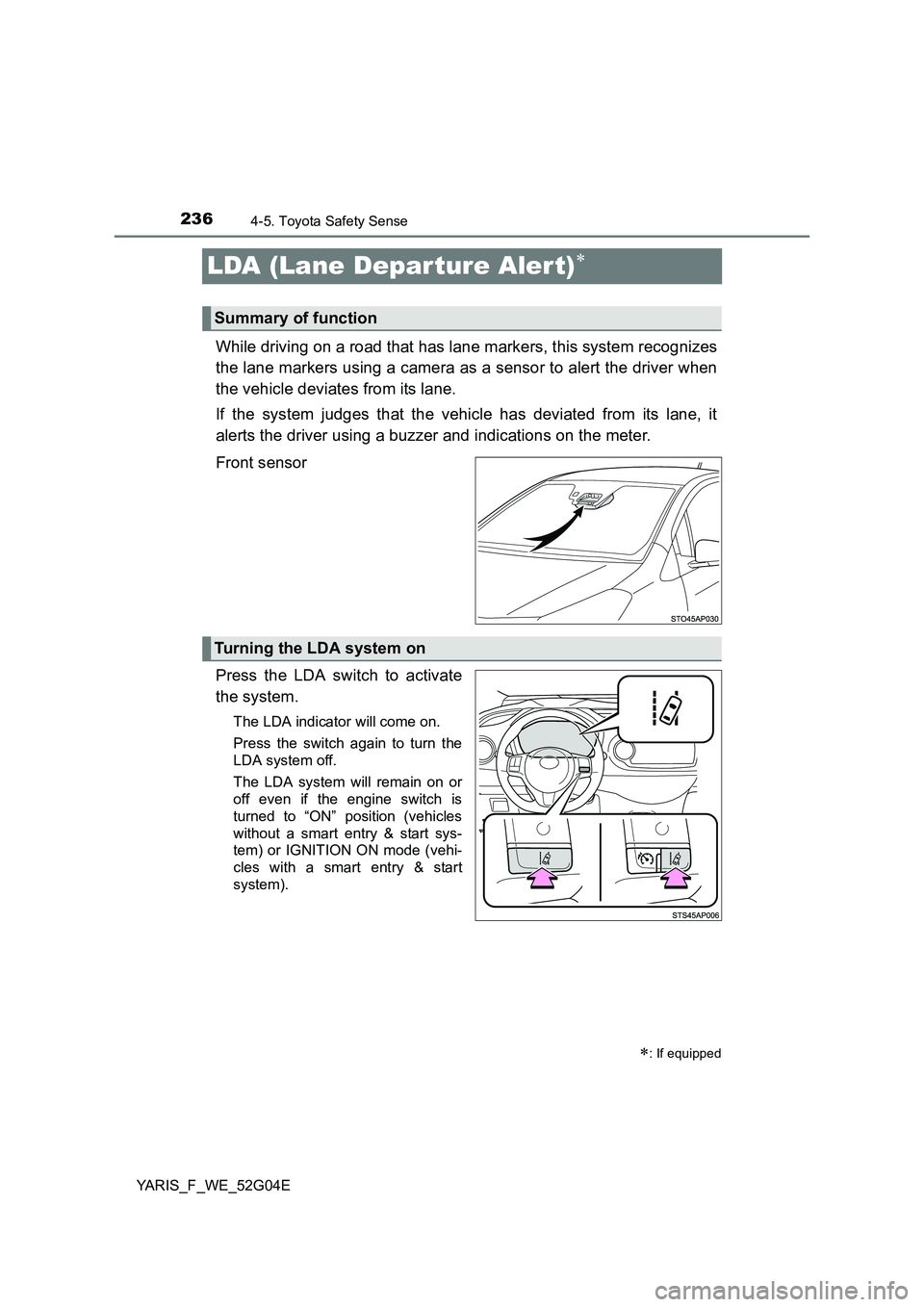
While driving on a road that has lane markers, this system recognizes
the lane markers using a camera as a sensor to alert the driver when
the vehicle deviates from its lane.
If the system judges that the vehicle has deviated from its lane, it
alerts the driver using a buzzer and indications on the meter.
Front sensor
Press the LDA switch to activate
the system.
The LDA indicator will come on.
Press the switch again to turn the
LDA system off.
The LDA system will remain on or
off even if the engine switch is
turned to “ON” position (vehicles
without a smart entry & start sys-
tem) or IGNITION ON mode (vehi-
cles with a smart entry & start
system).
: If equipped
Summary of function
Turning the LDA system on
Page 237 of 540
2374-5. Toyota Safety Sense
4
Driving
YARIS_F_WE_52G04E
●When the vehicle speed is approximately 50 km/h (32 mph) or
more
● When the lane width is more than approximately 3 m (9.8 ft.)
● When driving on a straight road or through a curve with a radius of
more than approximately 150 m (492 ft.)
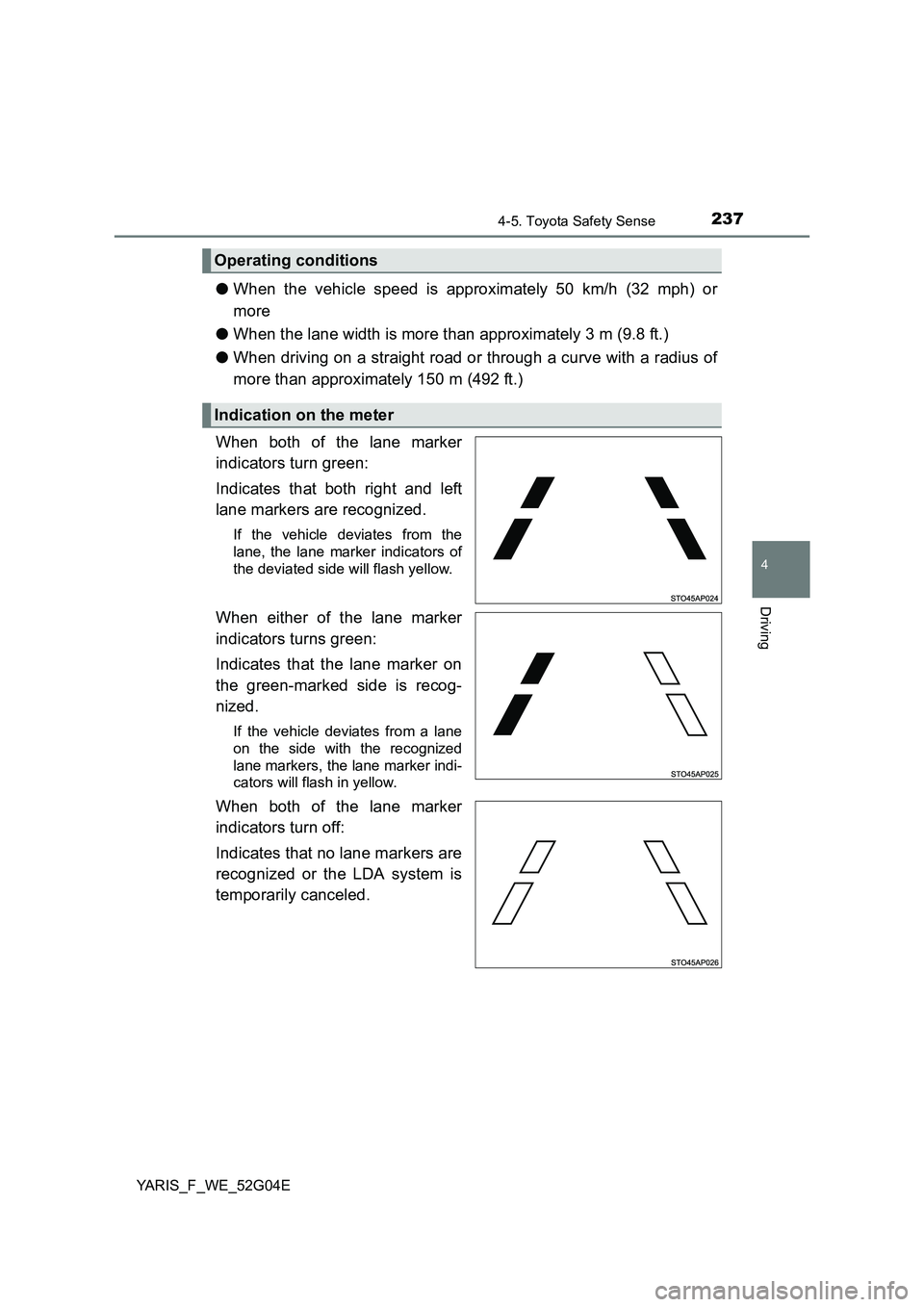
When both of the lane marker
indicators turn green:
Indicates that both right and left
lane markers are recognized.
If the vehicle deviates from the
lane, the lane marker indicators of
the deviated side will flash yellow.
When either of the lane marker
indicators turns green:
Indicates that the lane marker on
the green-marked side is recog-
nized.
If the vehicle deviates from a lane
on the side with the recognized
lane markers, the lane marker indi-
cators will flash in yellow.
When both of the lane marker
indicators turn off:
Indicates that no lane markers are
recognized or the LDA system is
temporarily canceled.
Operating conditions
Indication on the meter
Page 238 of 540
2384-5. Toyota Safety Sense
YARIS_F_WE_52G04E
■Temporary cancelation of the LDA system functions
If any of the following occurs, the LDA system functions will be temporarily
canceled. The functions will resume after the necessary operating conditions
have returned.
● The turn signal lever is operated.
● The vehicle speed deviates from the operating range of the LDA system
functions.
● When the lane lines cannot be recognized while driving.
● When the lane departure warning sounds.
The lane departure warning function will not operate again for a several sec-
onds after it has been activated, even if the vehicle leaves the lane again.
■ The lane departure warning
Depending on the audio system sound level or air conditioning fan noise
while the audio system or air conditioning sy stem is in use, it may be difficult
to hear the warning sound.
■ After the vehicle has been parked in the sun
The LDA system may not be immediatel y available. When the temperature in
the cabin decreases and the temperature around the front sensor ( P. 236)
becomes suitable for its operation, the functions will begin to operate.
■ If there are lane markers on only one side of the vehicle
The lane departure warning will not operate for the side on which lane mark-
ers could not be recognized.
■ Conditions in which the function may not operate correctly
In the following situations, the front sensor may be unable to recognize lane
markers causing the lane departure warning function to operate incorrectly.
However, this does not indicate a malfunction.
● When driving through an area, such as a tollbooth, a crossing or before a
ticket checkpoint
● When driving on a sharp curve
● When lane markers are extremely narrow or extremely wide
● When the vehicle leans to one side an unusual amount due to a heavy load
or improper tire inflation pressure
● When the following distance between your vehicle and the vehicle ahead is
extremely short
● When the lane markers are yellow (These may be more difficult for the sys-
tem to recognize compared to white markers.)
● When the lane markers are broken, Botts’ dots (raised pavement markers)
or stones
Page 245 of 540
245
4
4-6. Using the driving support systems
Driving
YARIS_F_WE_52G04E
Cruise control
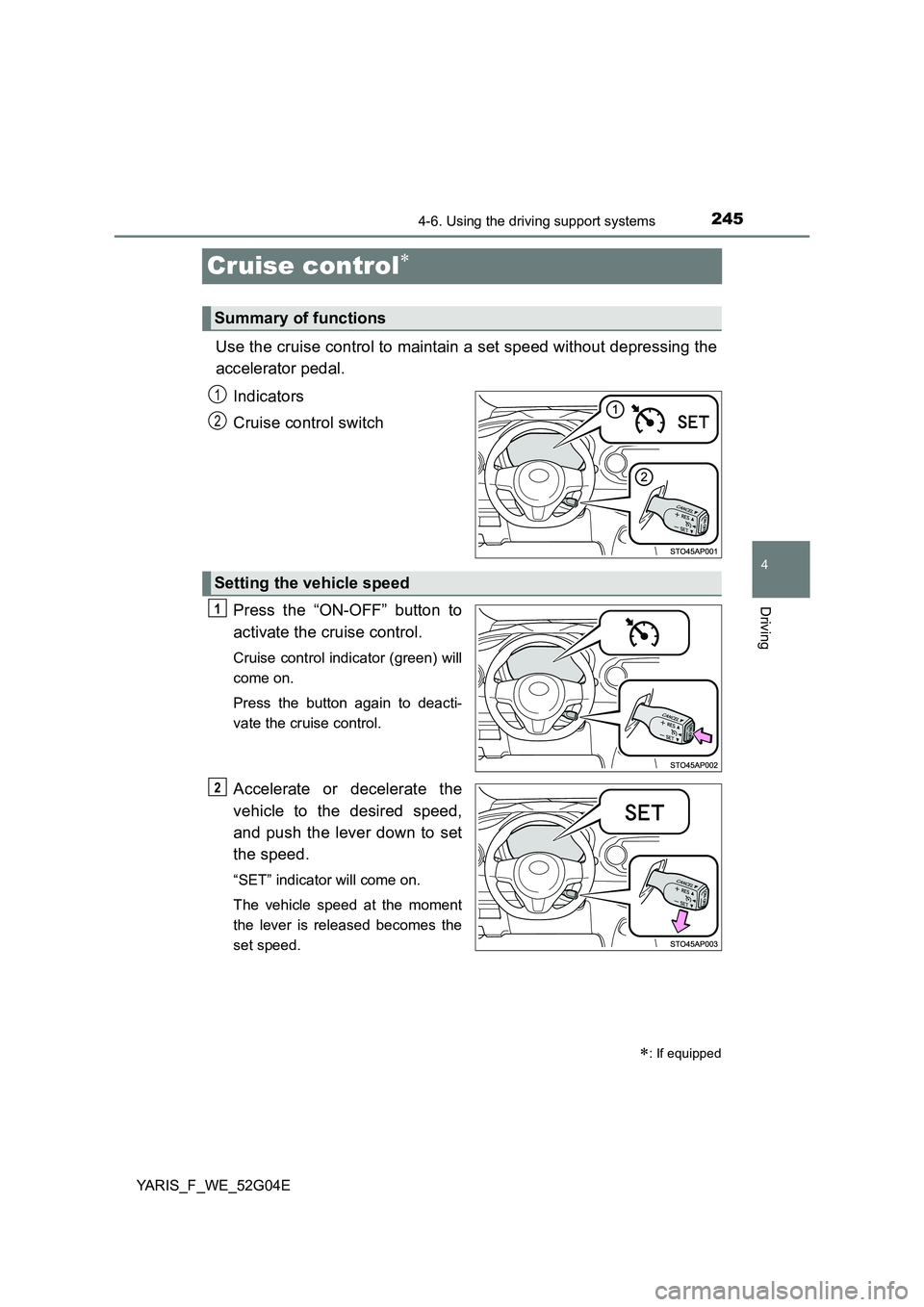
Use the cruise control to maintain a set speed without depressing the
accelerator pedal.
Indicators
Cruise control switch
Press the “ON-OFF” button to
activate the cruise control.
Cruise control indicator (green) will
come on.
Press the button again to deacti-
vate the cruise control.
Accelerate or decelerate the
vehicle to the desired speed,
and push the lever down to set
the speed.
“SET” indicator will come on.
The vehicle speed at the moment
the lever is released becomes the
set speed.
: If equipped
Summary of functions
1
2
Setting the vehicle speed
1
2
Page 250 of 540
2504-6. Using the driving support systems
YARIS_F_WE_52G04E
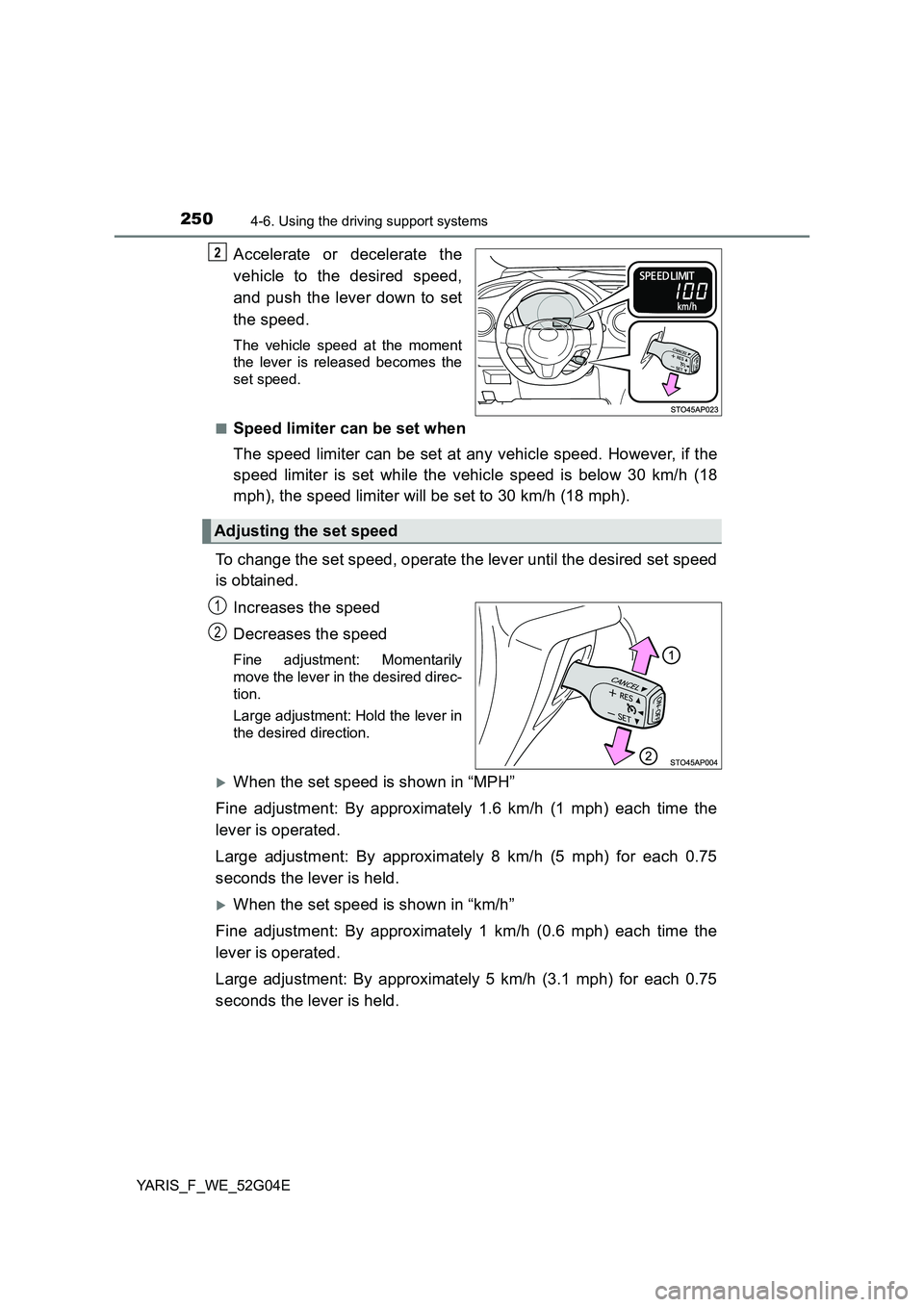
Accelerate or decelerate the
vehicle to the desired speed,
and push the lever down to set
the speed.
The vehicle speed at the moment
the lever is released becomes the
set speed.
■Speed limiter can be set when
The speed limiter can be set at any vehicle speed. However, if the
speed limiter is set while the vehicle speed is below 30 km/h (18
mph), the speed limiter will be set to 30 km/h (18 mph).
To change the set speed, operate the lever until the desired set speed
is obtained.
Increases the speed
Decreases the speed
Fine adjustment: Momentarily
move the lever in the desired direc-
tion.
Large adjustment: Hold the lever in
the desired direction.
When the set speed is shown in “MPH”
Fine adjustment: By approximately 1.6 km/h (1 mph) each time the
lever is operated.
Large adjustment: By approximately 8 km/h (5 mph) for each 0.75
seconds the lever is held.
When the set speed is shown in “km/h”
Fine adjustment: By approximately 1 km/h (0.6 mph) each time the
lever is operated.
Large adjustment: By approximately 5 km/h (3.1 mph) for each 0.75
seconds the lever is held.
2
Adjusting the set speed
1
2
Page 255 of 540
2554-6. Using the driving support systems
4
Driving
YARIS_F_WE_52G04E
■If the Stop & Start cancel switch is pressed while the vehicle is
stopped
● When the engine is stopped by the Stop & Start system, pressing
the Stop & Start cancel switch will restart the engine.
From the next time the vehicle is stopped (after Stop & Start sys-
tem has been turned off), the engine will not be stopped.
● With the Stop & Start system disabled, pressing the Stop & Start
cancel switch will re-enable the system but not stop the engine.
From the next time the vehicle is stopped (after Stop & Start sys-
tem has been turned on), the engine will be stopped.
■ Operating conditions
● The Stop & Start system is operational when all of the following conditions
are met:
• The engine is adequately warmed up.
• The battery is sufficiently charged.
• The driver’s door is closed.
• The driver’s seat belt is fastened.
• The hood is closed.
• The accelerator pedal is not being depressed.
• Vehicles with a Multidrive: The brake pedal is firmly depressed.
• Vehicles with a Multidrive: The shift lever is not in R.
• Vehicles with a manual transmission: The clutch pedal is not being
depressed.
• Vehicles with a manual transmission: The shift lever is in N.
● In the following circumstances the engine may not be stopped by the Stop &
Start system. This is not a malfunction of the Stop & Start system.
• Engine coolant temperature or transmi ssion fluid temperature is too low
or too high.
• The outside temperature is extremely low.
• The air conditioning system is being used when the outside temperature
is high or low.
• The air conditioning system is being used when the vehicle interior tem-
perature is extremely high such as after the vehicle was parked under the
hot sun.
• Vehicles with an automatic air c onditioning system: The windshield
defogger is being used.
• The battery is not sufficiently charged, or is undergoing a periodic
recharge.
• Due to traffic or other circumstances the vehicle is stopped repeatedly,
resulting in the amount of time the engine is stopped by the Stop & Start
system to become excessively high.
Page 256 of 540
2564-6. Using the driving support systems
YARIS_F_WE_52G04E
• The driver’s seat belt is unfastened.
• The driver’s door is opened.
• The hood is opened.
• The vehicle is stopped on a steep hill.
• The brake booster vacuum is low.
• A large amount of electricity is being used.
• At high altitude.
When the above conditions improve, the Stop & Start system will stop and
restart the engine from the next time the vehicle is stopped.
● In the following situations, the engine may start even without the brake
pedal being released (Multidrive) or clutch pedal being depressed (manual
transmission).
• The brake pedal is pumped or strongly depressed.
• The air conditioning system is being used or turned on.
• Vehicles with an automatic air c onditioning system: The windshield
defogger is turned on.
• The battery is not sufficiently charged.
• The vehicle starts to roll on an incline.
• Vehicles with a Multidrive: The hood is opened when the shift lever is in N
or P.
• Vehicles with a Multidrive: The shift lever is shifted into a position other
than N or P.
• The accelerator pedal is depressed.
• A large amount of electricity is being used.
• The driver’s door is opened.
• The driver’s seat belt is unfastened.
● In the following situations, it may take longer than normal for the Stop & Start
system to activate.
• The battery is discharged.
• After the battery terminals have been disconnected and reconnected
after a battery replacement, etc.
• The engine coolant temperature is low.
■ Automatic reactivation of the Stop & Start system
Vehicles without a smart entry & start system
Even if the Stop & Start system is disabled by the Stop & Start cancel switch,
it will be automatically re-enabled once the engine switch is turned to the
“LOCK” position then to the “START” position.
Vehicles with a smart entry & start system
Even if the Stop & Start system is disabled by the Stop & Start cancel switch,
it will be automatically re-enabled once the engine switch is turned off then
the engine is started.