Wheels NM TOYOTA YARIS HATCHBACK 2015 Owners Manual
[x] Cancel search | Manufacturer: TOYOTA, Model Year: 2015, Model line: YARIS HATCHBACK, Model: TOYOTA YARIS HATCHBACK 2015Pages: 540, PDF Size: 34.12 MB
Page 4 of 540

TABLE OF CONTENTS4
YARIS_F_WE_52G04E
6-1. Using the air conditioning
system and defogger
Manual air conditioning
system .............................306
Automatic air conditioning
system .............................313
Power heater .....................321
Seat heaters ......................323
6-2. Using the interior lights
Interior lights list .................325
• Interior light ....................325
• Personal lights ...............326
6-3. Using the storage features
List of storage features ......327
• Glove box ......................328
• Cup holders ...................329
• Bottle holders ................330
• Auxiliary box ..................331
Luggage compartment
features............................332
6-4. Using the other interior
features
Other interior features ........335
• Sun visors ......................335
• Vanity mirrors ................335
• Portable ashtray ............336
• Cigarette lighter .............337
• Power outlet ..................338
• Armrest ..........................339
• Panoramic roof shade ...339
• Assist grips ....................340
7-1. Maintenance and care
Cleaning and protecting
the vehicle exterior .......... 342
Cleaning and protecting
the vehicle interior ........... 345
7-2. Maintenance
Maintenance
requirements ................... 348
7-3. Do-it-yourself maintenance
Do-it-yourself service
precautions ..................... 351
Hood.................................. 354
Positioning a floor jack ...... 356
Engine compartment ......... 358
Tires .................................. 373
Tire inflation pressure........ 387
Wheels .............................. 389
Air conditioning filter .......... 392
Wireless remote control/
electronic key battery ...... 394
Checking and replacing
fuses ............................... 397
Light bulbs ......................... 403
6Interior features7Maintenance and care
Page 163 of 540

1634-1. Before driving
4
Driving
YARIS_F_WE_52G04E
Vehicles with a Multidrive
With the shift lever in D, depress the brake pedal.
Vehicles with a Stop & Start system: If the Stop & Start system is enabled,
depressing the brake pedal will stop the engine. ( P. 253)
If necessary, set the parking brake.
If the vehicle is to be stopped for an extended period of time, shift the shift
lever to P. ( P. 193)
Vehicles with a manual transmission
While depressing the clutch pedal, depress the brake pedal.
If necessary, set the parking brake.
If the vehicle is to be stopped for an extended period of time, shift the shift
lever to N. ( P. 198)
Vehicles with a Stop & Start system: If the Stop & Start system is enabled,
shifting the shift lever to N and releasing the clutch pedal will stop the
engine. ( P. 253)
Vehicles with a Multidrive
With the shift lever in D, depress the brake pedal.
Set the parking brake. ( P. 203)
Shift the shift lever to P. ( P. 193)
If parking on a hill, block the wheels as needed.
Vehicles without a smart entry & start system: Turn the engine
switch to the “LOCK” position to stop the engine.
Vehicles with a smart entry & start system: Press the engine switch
to stop the engine.
Lock the door, making sure that you have the electronic key on your
person.
Stopping
Parking the vehicle
1
2
1
2
1
2
3
4
5
Page 164 of 540

1644-1. Before driving
YARIS_F_WE_52G04E
Vehicles with a manual transmission
While depressing the clutch pedal, depress the brake pedal.
Set the parking brake. ( P. 203)
Shift the shift lever to N. ( P. 198)
If parking on a hill, shift the shift lever to 1 or R and block the wheels as
needed.
Vehicles without a smart entry & start system: Turn the engine
switch to the “LOCK” position to stop the engine.
Vehicles with a smart entry & start system: Press the engine switch
to stop the engine.
Lock the door, making sure that you have the key on your person.
Vehicles with a Multidrive
Firmly set the parking brake with the brake pedal depressed, and
then shift the shift lever to D.
Release the brake pedal and gently depress the accelerator pedal.
Release the parking brake.
Vehicles with a manual transmission
With the parking brake firmly set and the clutch pedal fully
depressed, shift the shift lever to 1.
Lightly depress the accelerator pedal at the same time as gradually
releasing the clutch pedal.
Release the parking brake.
Starting off on a steep uphill
1
2
3
4
5
1
2
3
1
2
3
Page 172 of 540

1724-1. Before driving
YARIS_F_WE_52G04E
NOTICE
■Avoiding damage to vehicle parts
● Do not turn the steering wheel fully in either direction and hold it there for
an extended period of time.
Doing so may damage the power steering motor.
● When driving over bumps in the road, drive as slowly as possible to avoid
damaging the wheels, underside of the vehicle, etc.
● Diesel engine only: Make sure to idle the engine immediately after high-
speed driving or hill climbing. Stop the engine only after the turbocharger
has cooled down.
Failure to do so may cause damage to the turbocharger.
■ If you get a flat tire while driving
A flat or damaged tire may cause the following situations. Hold the steering
wheel firmly and gradually depress the brake pedal to slow down the vehi-
cle.
● It may be difficult to control your vehicle.
● The vehicle will make abnormal sounds or vibrations.
● The vehicle will lean abnormally.
Information on what to do in case of a flat tire ( P. 445)
■ When encountering flooded roads
Do not drive on a road that has flooded after heavy rain, etc. Doing so may
cause the following serious damage to the vehicle:
● Engine stalling
● Short in electrical components
● Engine damage caused by water immersion
In the event that you drive on a flooded road and the vehicle is flooded, be
sure to have any authorized Toyota dealer or repairer or another duly quali-
fied and equipped professional check the following:
● Brake function
● Changes in quantity and quality of engine oil and transaxle fluid, etc.
● Lubricant condition for the bearings and suspension joints (where possi-
ble), and the function of all joints, bearings, etc.
Page 182 of 540
1824-1. Before driving
YARIS_F_WE_52G04E
■Sudden acceleration/steering input/cornering
Executing sharp turns when towing may result in the trailer colliding
with your vehicle. Decelerate well in advance when approaching
turns and take them slowly and carefully to avoid sudden braking.
■Important points regarding turning
The wheels of the trailer will travel closer to the inside of the curve
than the wheels of the vehicle. To make allowance for this, take the
turns wider than you would normally do.
■Important points regarding stability
Vehicle movement resulting from uneven road surfaces and strong
crosswinds will affect handling. The vehicle may also be rocked by
passing buses or large trucks. Frequently check behind when mov-
ing alongside such vehicles. As soon as such vehicle movement
occurs, immediately start to decelerate smoothly by slowly applying
the brakes. Always steer the vehicle straight ahead while braking.
■Passing other vehicles
Consider the total combined length of your vehicle and trailer and
ensure that the vehicle-to-vehicle distance is sufficient before exe-
cuting lane changes.
■Transmission information
Vehicles with a Multidrive
To maintain engine braking efficiency, when using engine braking,
do not use the transmission in D. Transmission shift gear position
must be in 4 in the M mode. ( P. 193)
Vehicles with a manual transmission
To maintain engine braking efficiency, when using engine braking,
do not use the transmission in 5 and 6 (vehicles with a 6-speed
manual transmission) gear. ( P. 198)
Page 183 of 540
1834-1. Before driving
4
Driving
YARIS_F_WE_52G04E
■If the engine overheats
Towing a loaded trailer up a long, steep incline in temperatures
exceeding 30 C (85F) may result in the engine overheating. If the
high engine coolant temperature warning light flashes or comes on,
turn the air conditioning off immediately, leave the road and stop the
vehicle in a safe place. ( P. 485)
■When parking the vehicle
Always place wheel chocks under the wheels of both the vehicle
and trailer. Firmly set the parking brake and shift the shift lever to P
for Multidrives or 1 or R for manual transmissions.
WARNING
Follow all the instructions described in this section. Failure to do so could
cause an accident resulting in death or serious injury.
■ Trailer towing precautions
When towing, make sure that none of the weight limits are exceeded.
( P. 176)
■ Vehicle speed in towing
Observe the legal maximum speeds for trailer towing.
■ Before descending hills or long declines
Reduce speed and downshift. However, never downshift suddenly while
descending steep or long downhill grades.
■ Operation of the brake pedal
Do not hold the brake pedal depressed often or for long periods of time.
Doing so may result in the brake overheating or reduce braking effects.
■ To avoid accident or injury
● Vehicles with a cruise control: Do not use cruise control when you are tow-
ing.
● Vehicles with a compact spare tire: Do not tow a trailer when the compact
spare tire is installed on your vehicle.
● Vehicles with an emergency tire puncture repair kit: Do not tow a trailer
when the tire installed is repaired with the emergency tire puncture repair
kit.
Page 260 of 540
2604-6. Using the driving support systems
YARIS_F_WE_52G04E
Driving assist systems
◆ABS (Anti-lock Brake System)
Helps to prevent wheel lock when the brakes are applied suddenly,
or if the brakes are applied while driving on a slippery road surface
◆Brake assist
Generates an increased level of braking force after the brake pedal
is depressed when the system detects a panic stop situation
◆VSC (Vehicle Stability Control) (if equipped)
Helps the driver to control skidding when swerving suddenly or
turning on slippery road surfaces
◆TRC (Traction Control) (if equipped)
Helps to maintain drive power and prevent the drive wheels from
spinning when starting the vehicle or accelerating on slippery roads
◆EPS (Electric Power Steering)
Employs an electric motor to reduce the amount of effort needed to
turn the steering wheel
◆PCS (Pre-Crash Safety system) (if equipped)
P. 2 2 7
◆Emergency brake signal
When the brakes are applied suddenly, the emergency flashers
automatically flash to alert the vehicle behind.
To help enhance driving safety and performance, the following
systems operate automatically in response to various driving
situations. Be aware, however, that these systems are supple-
mentary and should not be relied upon too heavily when operat-
ing the vehicle.
Page 261 of 540
2614-6. Using the driving support systems
4
Driving
YARIS_F_WE_52G04E
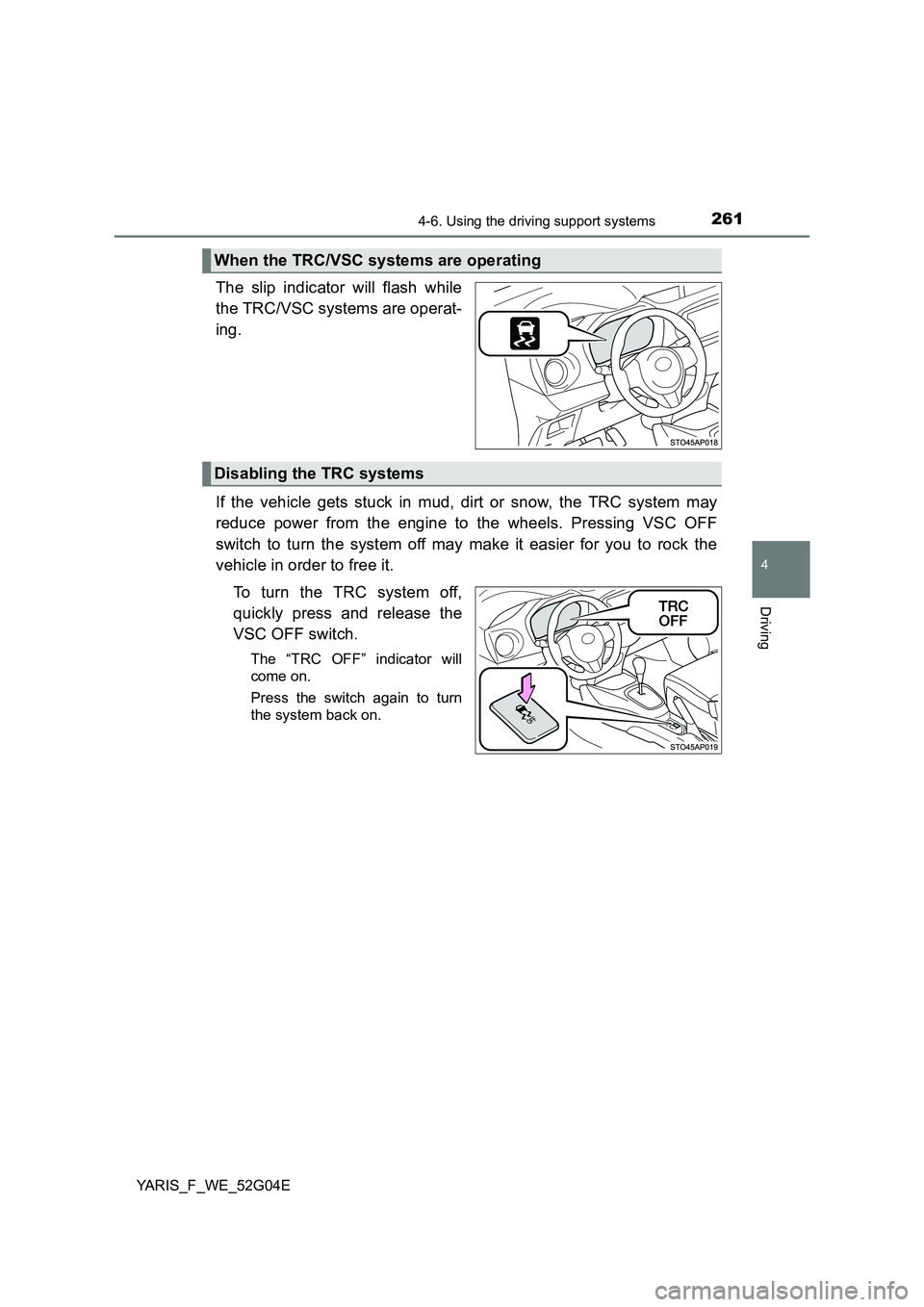
The slip indicator will flash while
the TRC/VSC systems are operat-
ing.
If the vehicle gets stuck in mud, dirt or snow, the TRC system may
reduce power from the engine to the wheels. Pressing VSC OFF
switch to turn the system off may make it easier for you to rock the
vehicle in order to free it.
To turn the TRC system off,
quickly press and release the
VSC OFF switch.
The “TRC OFF” indicator will
come on.
Press the switch again to turn
the system back on.
When the TRC/VSC systems are operating
Disabling the TRC systems
Page 264 of 540
2644-6. Using the driving support systems
YARIS_F_WE_52G04E
WARNING
■When the VSC is activated
The slip indicator flashes. Always drive carefully. Reckless driving may
cause an accident. Exercise particular care when the indicator light flashes.
■ When the TRC/VSC systems are turned off
Be especially careful and drive at a speed appropriate to the road condi-
tions. As these are the systems to help ensure vehicle stability and driving
force, do not turn the TRC/VSC systems off unless unnecessary.
■ Replacing tires
Make sure that all tires are of the specified size, brand, tread pattern and
total load capacity. In addition, make sure that the tires are inflated to the
recommended tire inflation pressure level.
The ABS, TRC and VSC systems will not function correctly if different tires
are installed on the vehicle.
Contact any authorized Toyota dealer or repairer, or another duly qualified
and equipped professional for further in formation when replacing tires or
wheels.
■ Handling of tires and the suspension
Using tires with any kind of problem or modifying the suspension will affect
the driving assist systems, and may cause a system to malfunction.
Page 268 of 540
2684-7. Driving tips
YARIS_F_WE_52G04E
Accelerate the vehicle slowly, keep a safe distance between you and
the vehicle ahead, and drive at a reduced speed suitable to road con-
ditions.
Park the vehicle and move the shift lever to P (Multidrive) 1 or R (man-
ual transmission) without setting the parking brake. The parking brake
may freeze up, preventing it from being released. If necessary, block
the wheels to prevent inadvertent sliding or creeping.
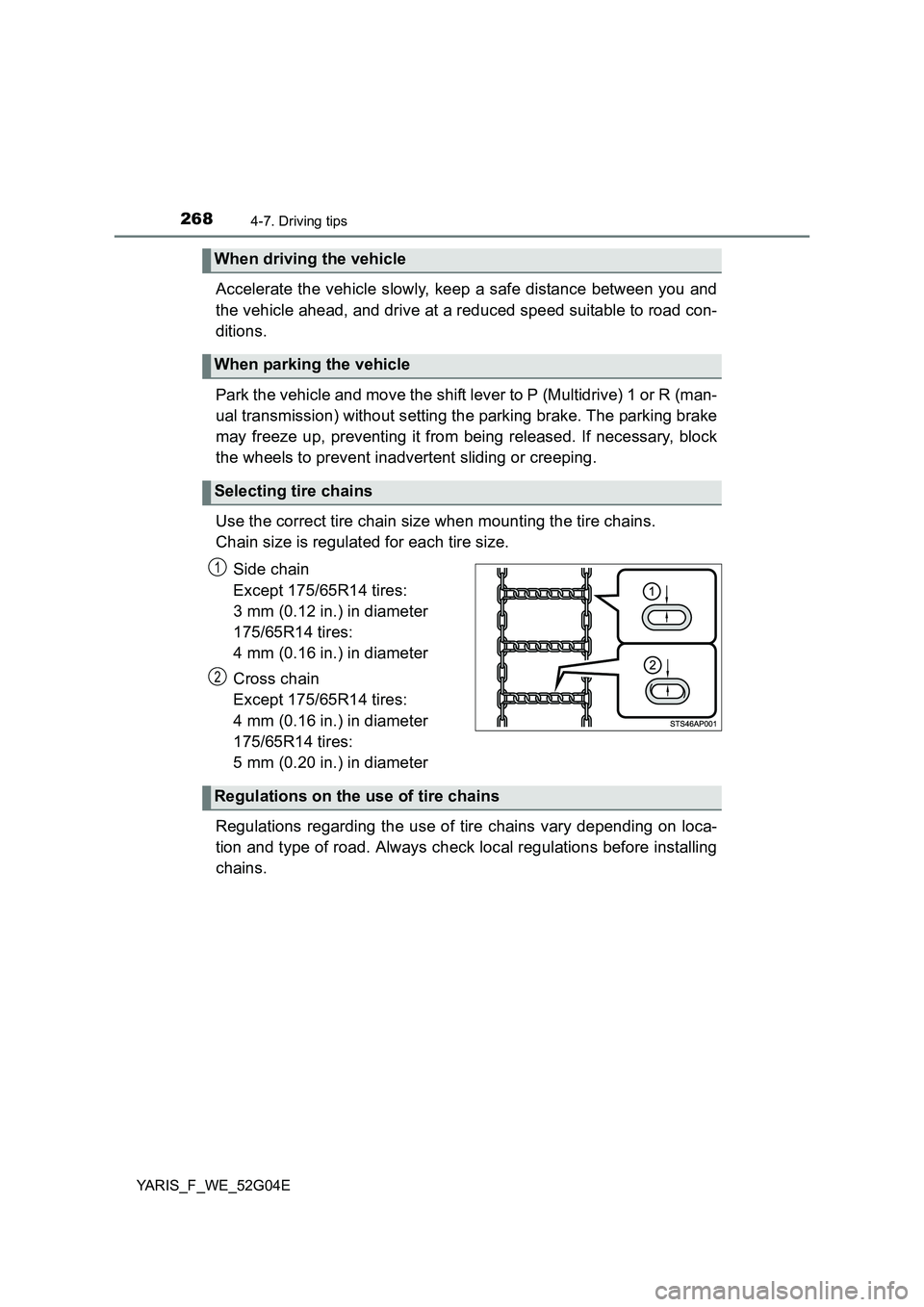
Use the correct tire chain size when mounting the tire chains.
Chain size is regulated for each tire size.
Side chain
Except 175/65R14 tires:
3 mm (0.12 in.) in diameter
175/65R14 tires:
4 mm (0.16 in.) in diameter
Cross chain
Except 175/65R14 tires:
4 mm (0.16 in.) in diameter
175/65R14 tires:
5 mm (0.20 in.) in diameter
Regulations regarding the use of tire chains vary depending on loca-
tion and type of road. Always check local regulations before installing
chains.
When driving the vehicle
When parking the vehicle
Selecting tire chains
1
2
Regulations on the use of tire chains