tires TOYOTA YARIS HATCHBACK 2016 Owner's Guide
[x] Cancel search | Manufacturer: TOYOTA, Model Year: 2016, Model line: YARIS HATCHBACK, Model: TOYOTA YARIS HATCHBACK 2016Pages: 368, PDF Size: 7.86 MB
Page 285 of 368
2857-2. Steps to take in an emergency
7
When trouble arises
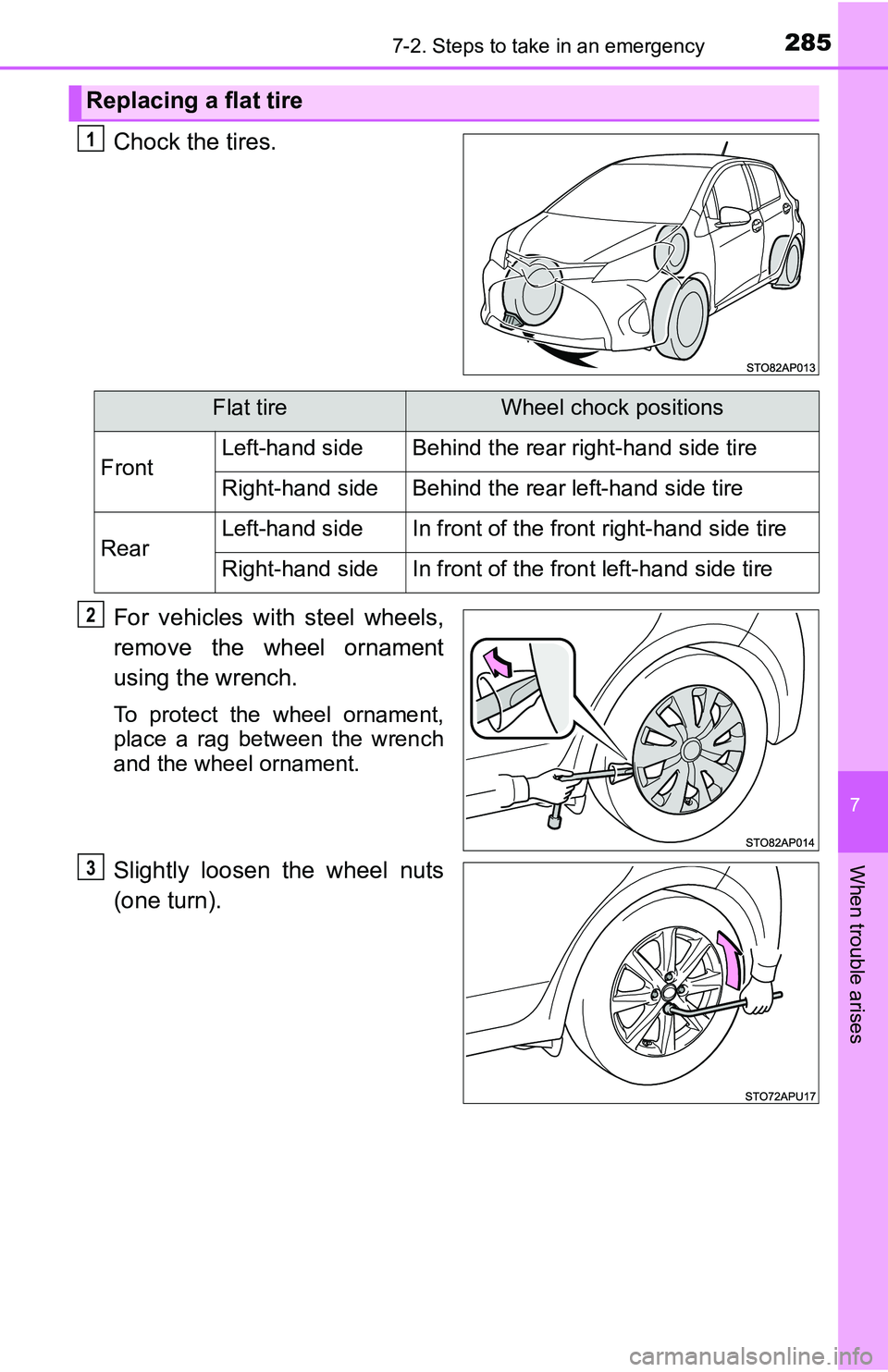
Chock the tires.
For vehicles with steel wheels,
remove the wheel ornament
using the wrench.
To protect the wheel ornament,
place a rag between the wrench
and the wheel ornament.
Slightly loosen the wheel nuts
(one turn).
Replacing a flat tire
1
Flat tireWheel chock positions
FrontLeft-hand sideBehind the rear right-hand side tire
Right-hand sideBehind the rear left-hand side tire
RearLeft-hand sideIn front of the front right-hand side tire
Right-hand sideIn front of the front left-hand side tire
2
3
Page 291 of 368
2917-2. Steps to take in an emergency
7
When trouble arises
■The compact spare tire
●The compact spare tire is identified by the label “TEMPORARY USE
ONLY” on the tire sidewall.
Use the compact spare tire temporarily, and only in an emergency.
●Make sure to check the tire inflatio n pressure of the compact spare tire.
( P. 315)
■After completing the tire change (vehicles with a tire pressure warn-
ing system)
The tire pressure warning system must be reset. ( P. 224)
■When using the compact spare tire (vehicles with a tire pressure
warning system)
As the compact spare tire is not equipped with a tire pressure warning
valve and transmitter, lo w inflation pressure of the spare tire will not be
indicated by the tire pressure warning system. Also, if you replace the
compact spare tire after the tire pressure warning light comes on, the light
remains on.
■If you have a flat front tire on a road covered with snow or ice
Install the compact spare tire on one of the rear wheels of the vehicle.
Perform the following steps and fit tire chains to the front tires:
Replace a rear tire with the compact spare tire.
Replace the flat front tire with the tire removed from the rear of the
vehicle.
Fit tire chains to the front tires.
1
2
3
Page 293 of 368
2937-2. Steps to take in an emergency
7
When trouble arises
NOTICE
■Do not drive the vehicle with a flat tire
Do not continue driving with a flat tire.
Driving even a short distance with a flat tire can damage the tire and the
wheel beyond repair.
■Be careful when driving over bumps with the compact spare tire
installed on the vehicle
The vehicle becomes lower when driving with the compact spare tire
compared to when driving with standard tires. Be careful when driving
over uneven road surfaces.
■Driving with tire chains and the compact spare tire
Do not fit tire chains to the compact spare tire.
Tire chains may damage the vehicle body and adversely affect driving
performance.
■When replacing the tires (vehicles with a tire pressure warning sys-
tem)
When removing or fitting the wheels, tires or the tire pressure warning
valve and transmitter, contact your Toyota dealer as the tire pressure
warning valve and transmitter may be damaged if not handled correctly.
■To avoid damage to the tire pressure warning valves and transmit-
ters (vehicles with a tire pressure warning system)
When a tire is repaired with liquid sealants, the tire pressure warning
valve and transmitter may not operate properly. If a liquid sealant is
used, contact your Toyota dealer or other qualified service shop as soon
as possible. Make sure to replace the tire pressure warning valve and
transmitter when replacing the tire. ( P. 224)
Page 303 of 368
303
7
When trouble arises
7-2. Steps to take in an emergency
If the vehicle becomes stuck
Stop the engine. Set the parking brake and shift the shift lever to P
(automatic transmission) or N (manual transmission).
Remove the mud, snow or sand from around the front wheels.
Place wood, stones or some othe r material under the front wheels
to help provide traction.
Restart the engine.
Shift the shift lever to D or R (automatic transmission) or 1 or R
(manual transmission) and release the parking brake. Then, while
exercising caution, depre ss the accelerator pedal.
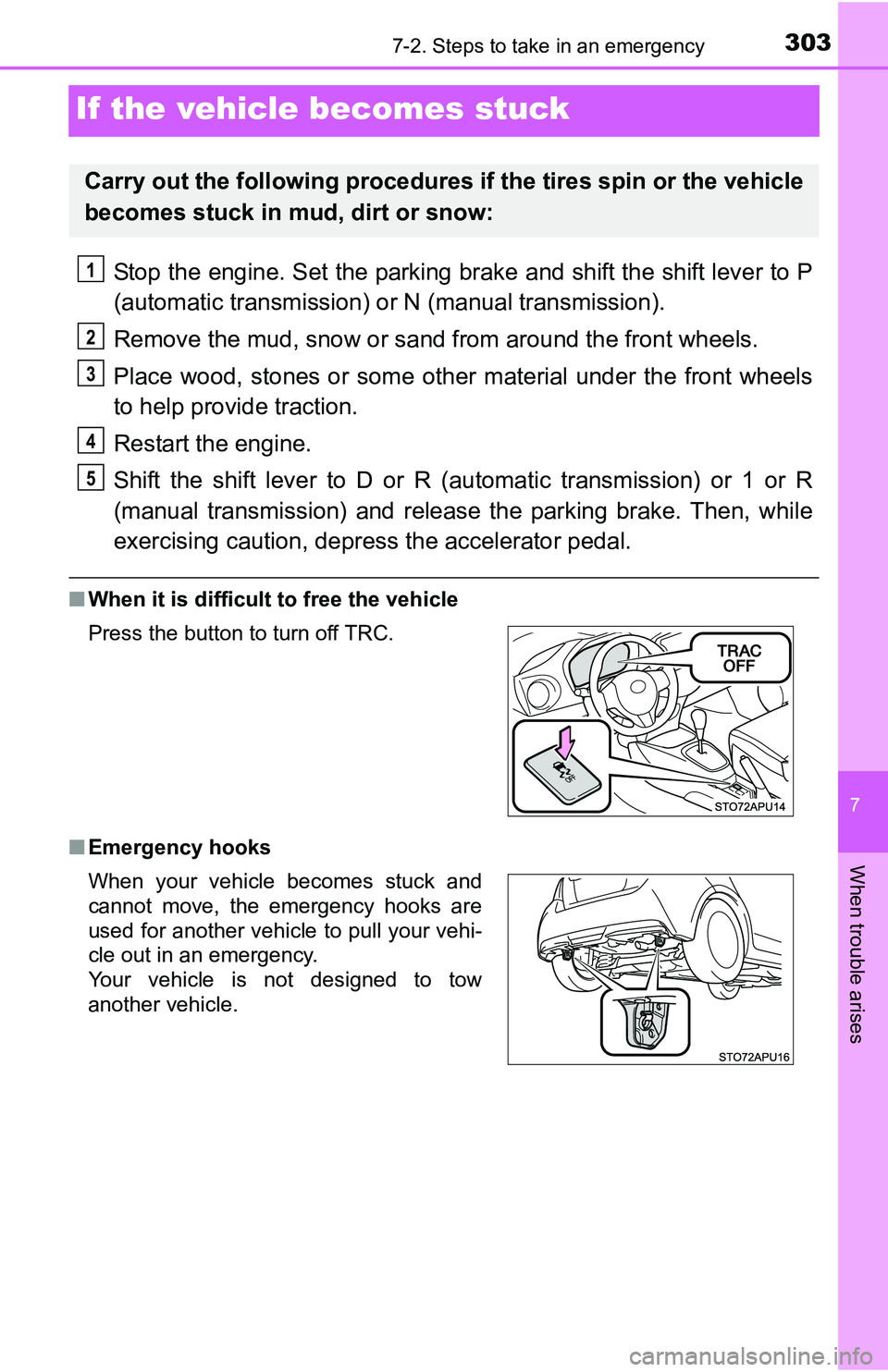
■When it is difficult to free the vehicle
■ Emergency hooks
Carry out the following procedures if the tires spin or the vehicle
becomes stuck in mud, dirt or snow:
Press the button to turn off TRC.
When your vehicle becomes stuck and
cannot move, the emergency hooks are
used for another vehicle to pull your vehi-
cle out in an emergency.
Your vehicle is not designed to tow
another vehicle.
1
2
3
4
5
Page 306 of 368
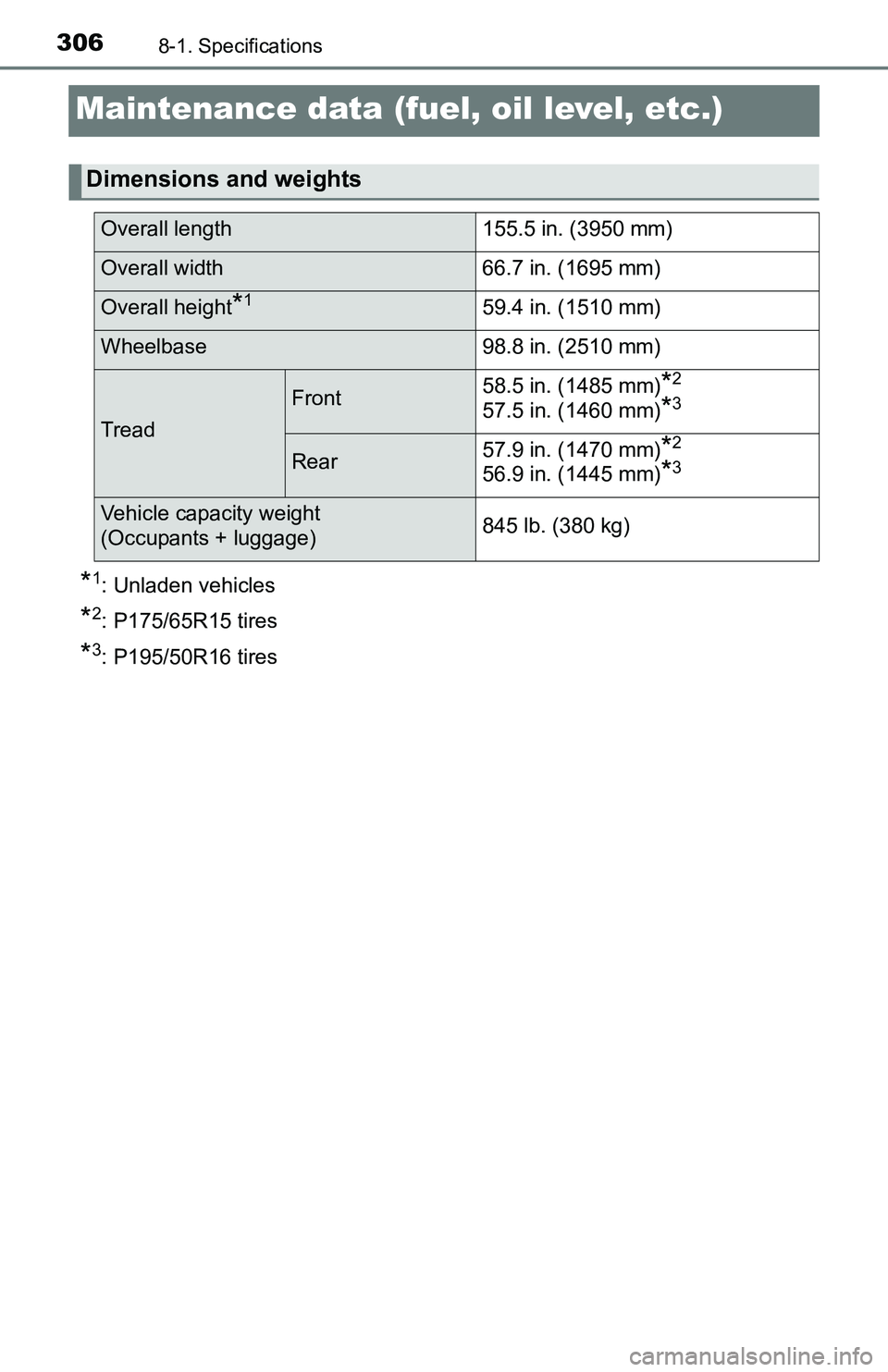
3068-1. Specifications
Maintenance data (fuel, oil level, etc.)
*1: Unladen vehicles
*2: P175/65R15 tires
*3: P195/50R16 tires
Dimensions and weights
Overall length155.5 in. (3950 mm)
Overall width 66.7 in. (1695 mm)
Overall height*159.4 in. (1510 mm)
Wheelbase98.8 in. (2510 mm)
Tread
Front58.5 in. (1485 mm)*2
57.5 in. (1460 mm)*3
Rear57.9 in. (1470 mm)*2
56.9 in. (1445 mm)*3
Vehicle capacity weight
(Occupants + luggage) 845 lb. (380 kg)
Page 315 of 368

3158-1. Specifications
8
Vehicle specifications
15-inch tires
16-inch tires
Compact spare tires
Tires and wheels
Tire sizeP175/65R15 84H
Tire inflation pressure
(Recommended cold
tire inflation pressure)
Driving under normal conditions
Front:
33 psi (230 kPa, 2.3 kgf/cm
2 or bar)
Rear:
33 psi (230 kPa, 2.3 kgf/cm
2 or bar)
Never exceed the maximum cold tire inflation
pressure indicated on the tire sidewall.
Wheel size15 5 1/2J
Wheel nut torque76 ft·lbf (103 N·m, 10.5 kgf·m)
Tire sizeP195/50R16 83V
Tire inflation pressure
(Recommended cold
tire inflation pressure)
Driving under normal conditions
Front:
32 psi (220 kPa, 2.2 kgf/cm
2 or bar)
Rear:
29 psi (200 kPa, 2.0 kgf/cm
2 or bar)
Never exceed the maximum cold tire inflation
pressure indicated on the tire sidewall.
Wheel size16 6J
Wheel nut torque76 ft·lbf (103 N·m, 10.5 kgf·m)
Tire sizeT125/70D16 96M
Tire inflation pressure
(Recommended cold
tire inflation pressure)60 psi (420 kPa, 4.2 kgf/cm2 or bar)
Never exceed the maximum cold tire inflation
pressure indicated on the tire sidewall.
Wheel size16 4T
Wheel nut torque76 ft·lbf (103 N·m, 10.5 kgf·m)
Page 321 of 368
3218-1. Specifications
8
Vehicle specifications
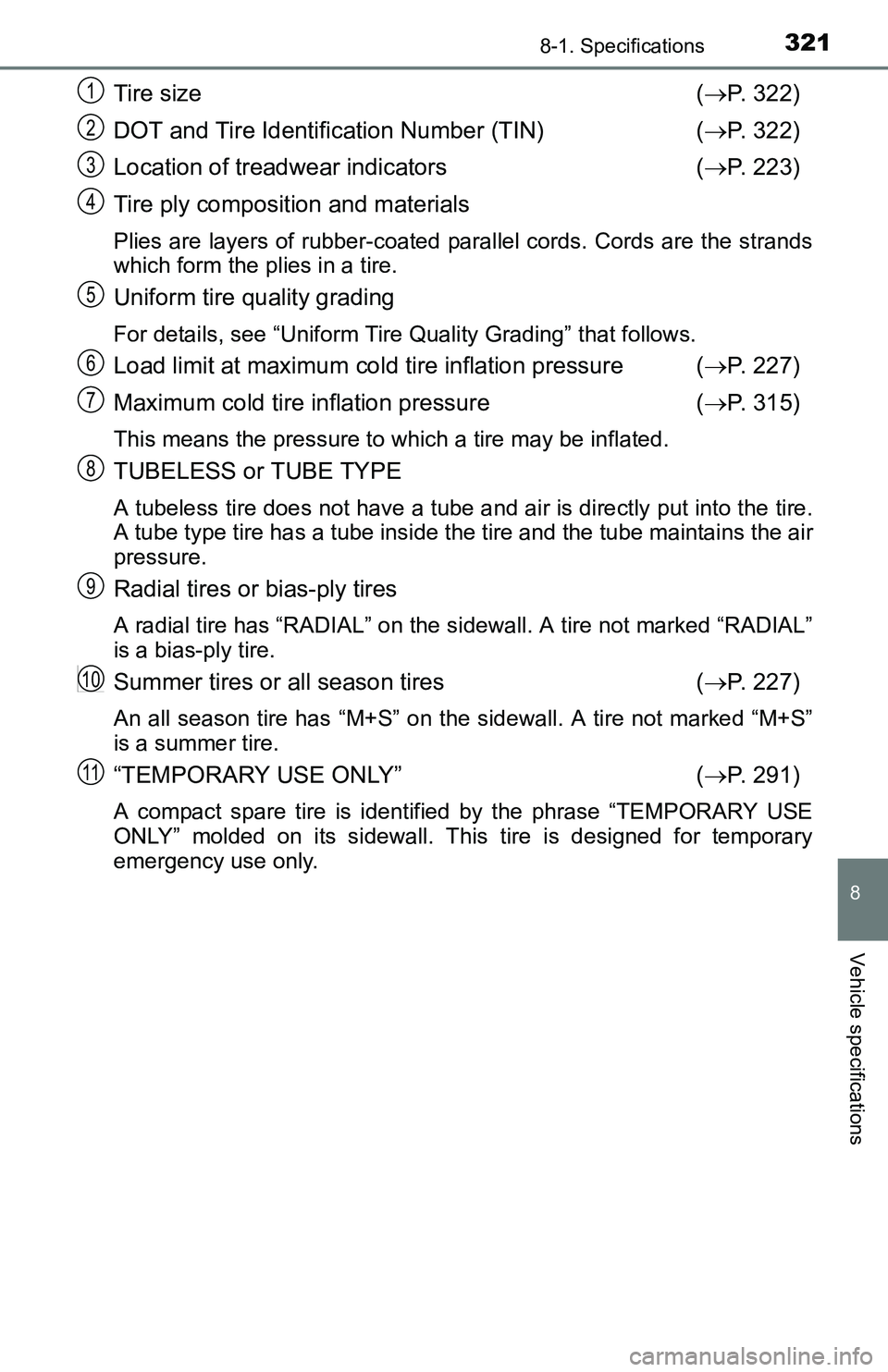
Tire size ( P. 322)
DOT and Tire Identification Number (TIN) ( P. 322)
Location of treadwear indicators ( P. 223)
Tire ply composition and materials
Plies are layers of rubber-coated parallel cords. Cords are the strands
which form the plies in a tire.
Uniform tire quality grading
For details, see “Uniform Tire Quality Grading” that follows.
Load limit at maximum cold tire inflation pressure ( P. 227)
Maximum cold tire inflation pressure ( P. 315)
This means the pressure to which a tire may be inflated.
TUBELESS or TUBE TYPE
A tubeless tire does not have a tube and air is directly put into the tire.
A tube type tire has a tube inside the tire and the tube maintains the air
pressure.
Radial tires or bias-ply tires
A radial tire has “RADIAL” on the sidewall. A tire not marked “RADIAL”
is a bias-ply tire.
Summer tires or all season tires ( P. 227)
An all season tire has “M+S” on the sidewall. A tire not marked “M+S”
is a summer tire.
“TEMPORARY USE ONLY” ( P. 291)
A compact spare tire is identified by the phrase “TEMPORARY USE
ONLY” molded on its sidewall. This tire is designed for temporary
emergency use only.
1
2
3
4
5
6
7
8
9
1010
11
Page 324 of 368
3248-1. Specifications
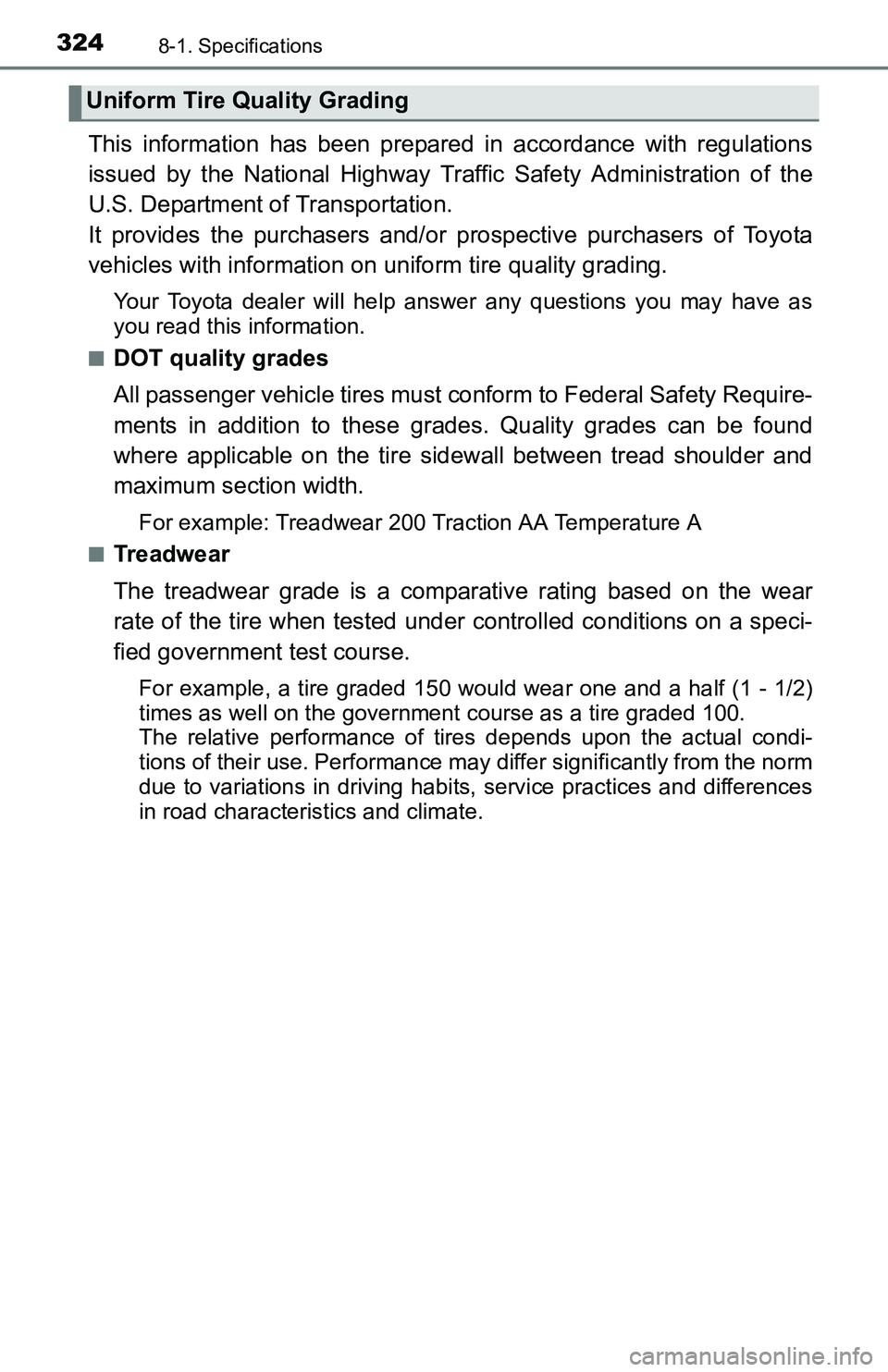
This information has been prepared in accordance with regulations
issued by the National Highway Traffic Safety Administration of the
U.S. Department of Transportation.
It provides the purchasers and/or prospective purchasers of Toyota
vehicles with information on uniform tire quality grading.
Your Toyota dealer will help answer any questions you may have as
you read this information.
■DOT quality grades
All passenger vehicle tires must c onform to Federal Safety Require-
ments in addition to these grades. Quality grades can be found
where applicable on the tire sidewall between tread shoulder and
maximum section width.
For example: Treadwear 200 Traction AA Temperature A
■Treadwear
The treadwear grade is a comparative rating based on the wear
rate of the tire when tested under controlled conditions on a speci-
fied government test course.
For example, a tire graded 150 wo uld wear one and a half (1 - 1/2)
times as well on the government course as a tire graded 100.
The relative performance of tire s depends upon the actual condi-
tions of their use. Performance may differ significantly from the norm
due to variations in driving habits , service practices and differences
in road characteristics and climate.
Uniform Tire Quality Grading
Page 325 of 368
3258-1. Specifications
8
Vehicle specifications
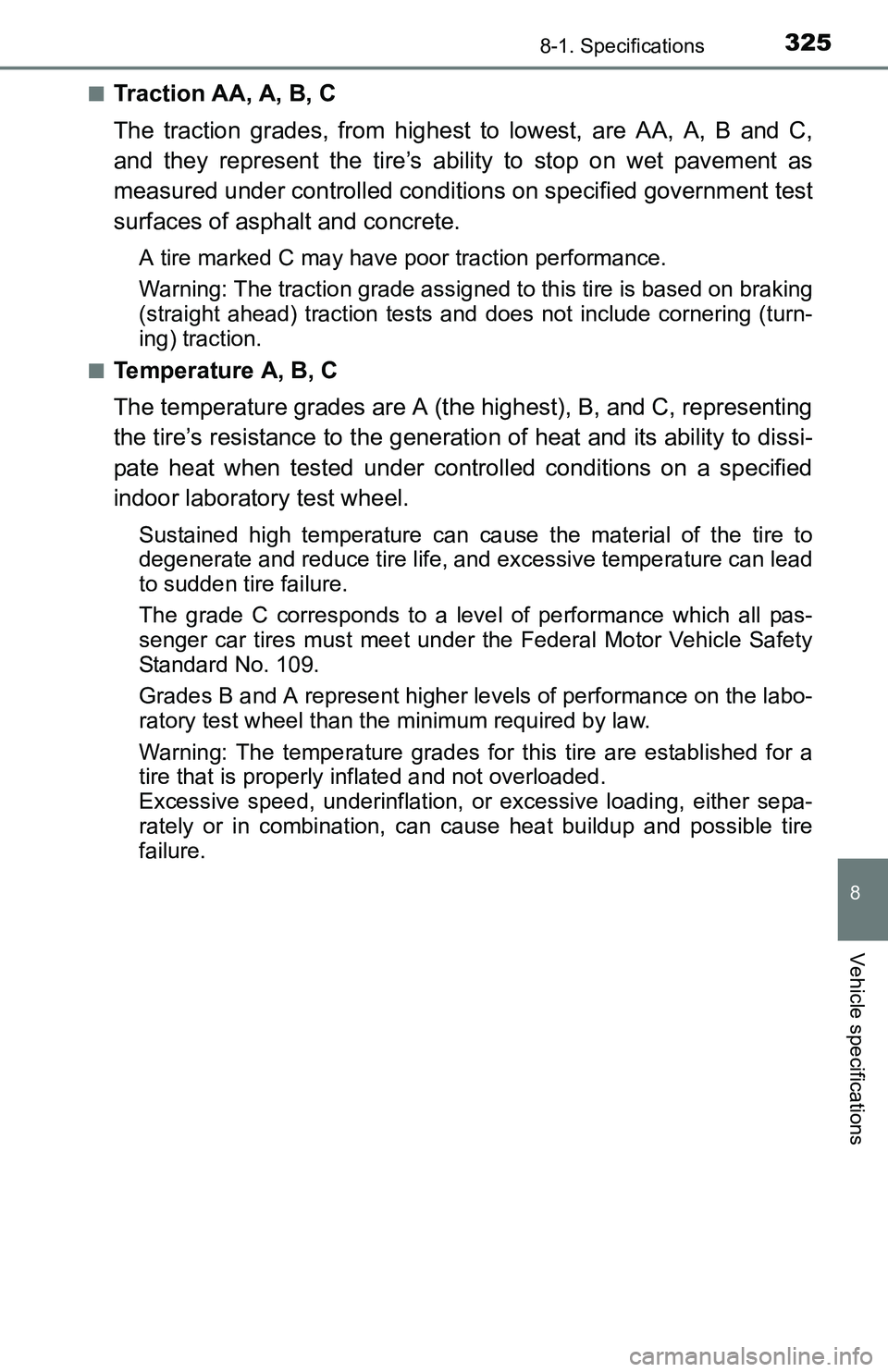
■Traction AA, A, B, C
The traction grades, from highest to lowest, are AA, A, B and C,
and they represent the tire’s ability to stop on wet pavement as
measured under controlled conditions on specified government test
surfaces of asphalt and concrete.
A tire marked C may have poor traction performance.
Warning: The traction grade assigned to this tire is based on braking
(straight ahead) traction tests and does not include cornering (turn-
ing) traction.
■Temperature A, B, C
The temperature grades are A (the hi ghest), B, and C, representing
the tire’s resistance to the generation of heat and its ability to dissi-
pate heat when tested under cont rolled conditions on a specified
indoor laboratory test wheel.
Sustained high temperature can cause the material of the tire to
degenerate and reduce tire life, and excessive temperature can lead
to sudden tire failure.
The grade C corresponds to a level of performance which all pas-
senger car tires must meet under the Federal Motor Vehicle Safety
Standard No. 109.
Grades B and A represent higher le vels of performance on the labo-
ratory test wheel than the minimum required by law.
Warning: The temperature grades for this tire are established for a
tire that is properly inflated and not overloaded.
Excessive speed, underinflation, or excessive loading, either sepa-
rately or in combination, can cause heat buildup and possible tire
failure.
Page 335 of 368
3358-2. Customization
8
Vehicle specifications
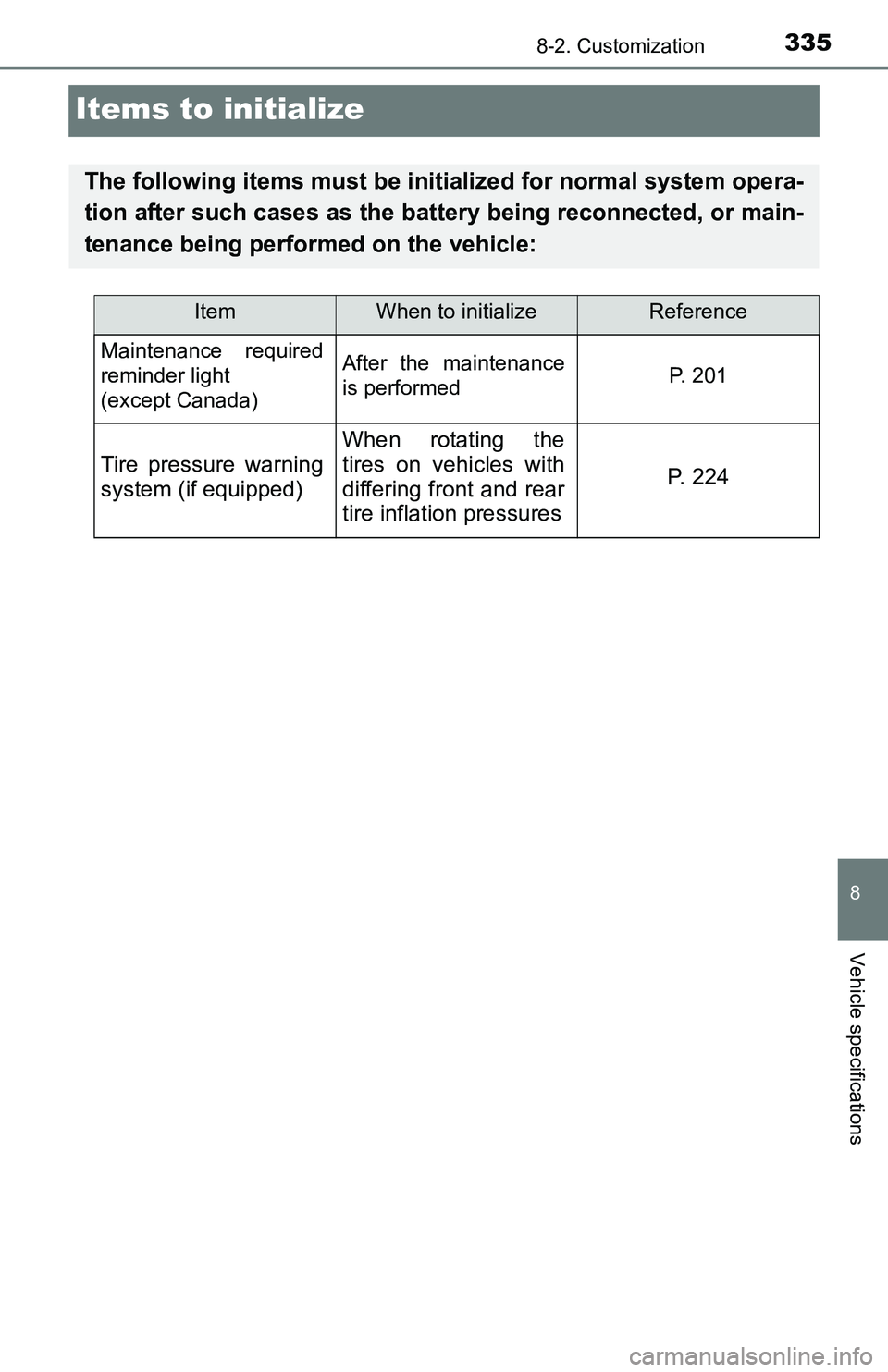
Items to initialize
The following items must be initialized for normal system opera-
tion after such cases as the battery being reconnected, or main-
tenance being performed on the vehicle:
ItemWhen to initializeReference
Maintenance required
reminder light
(except Canada)After the maintenance
is performedP. 201
Tire pressure warning
system (if equipped)
When rotating the
tires on vehicles with
differing front and rear
tire inflation pressures
P. 2 2 4