tow TOYOTA YARIS HATCHBACK 2018 Owner's Guide
[x] Cancel search | Manufacturer: TOYOTA, Model Year: 2018, Model line: YARIS HATCHBACK, Model: TOYOTA YARIS HATCHBACK 2018Pages: 520, PDF Size: 8.69 MB
Page 376 of 520

3767-3. Do-it-yourself maintenance
WARNING
■When inspecting or replacing tires
Observe the following precautions to prevent accidents.
Failure to do so may cause damage to parts of the drive train as well as
dangerous handling characteristics, which may lead to an accident
resulting in death or serious injury.
●Do not mix tires of different makes, models or tread patterns.
Also, do not mix tires of remarkably different treadwear.
●Do not use tire sizes other than those recommended by Toyota.
●Do not mix differently constructed tires (radial, bias-belted or bias-ply
tires).
●Do not mix summer, all season and snow tires.
●Do not use tires that have been used on another vehicle.
Do not use tires if you do not know how they were used previously.
●Do not tow if your vehicle has a compact spare tire installed.
■When initializing the tire pressure warning system (vehicles with a
tire pressure warning system)
Do not operate the tire pressure warning reset switch without first
adjusting the tire inflation pressure to the specified level. Otherwise, the
tire pressure warning light may not come on even if the tire inflation
pressure is low, or it may come on when the tire inflation pressure is
actually normal.
Page 411 of 520

411
8When trouble arises
8-1. Essential informationEmergency flashers .......... 412
If your vehicle has to be stopped in
an emergency ................. 413
8-2. Steps to take in an emergency
If your vehicle needs to be towed ......................... 415
If you think something is wrong .............................. 420
Fuel pump shut off system ............................ 421
If a warning light turns on or a warning buzzer
sounds ............................ 422
If you have a flat tire.......... 433
If the engine will not start ................................. 448
If the vehicle battery is discharged ...................... 450
If your vehicle overheats ... 453
If the vehicle becomes stuck ............................... 456
Page 415 of 520
4158-2. Steps to take in an emergency
8
When trouble arises
If your vehicle needs to be towed
The following may indicate a problem with your transmission. Contact
your Toyota dealer or commercial towing service before towing.
● The engine is running but the vehicle does not move.
● The vehicle makes an abnormal sound.
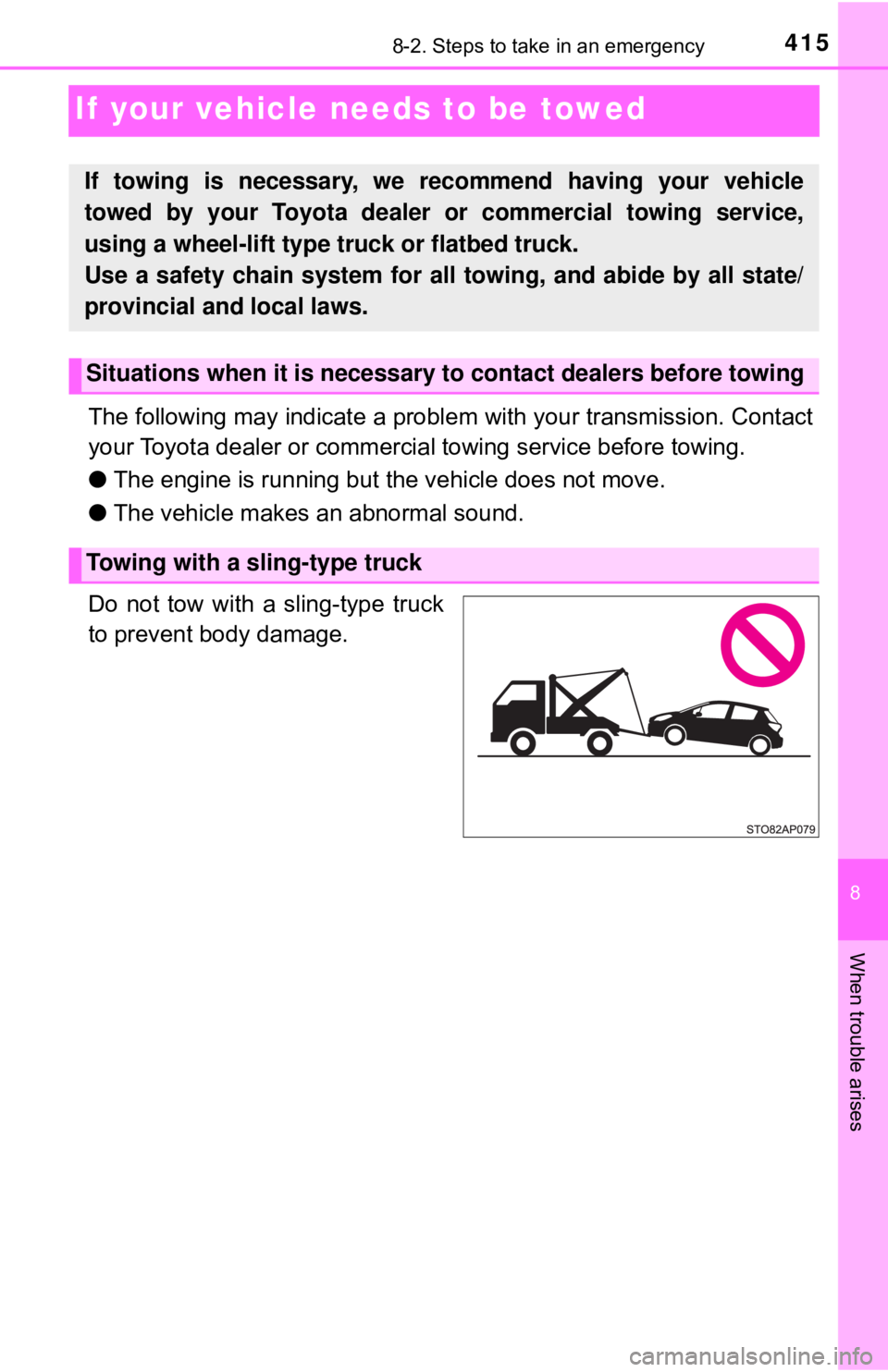
Do not tow with a sling-type truck
to prevent body damage.
If towing is necessary, we re commend having your vehicle
towed by your Toyota dealer or commercial towing service,
using a wheel-lift type truck or flatbed truck.
Use a safety chain system for all towing, and abide by all state/
provincial and local laws.
Situations when it is necessary to contact dealers before towing
Towing with a sling-type truck
Page 416 of 520
4168-2. Steps to take in an emergency
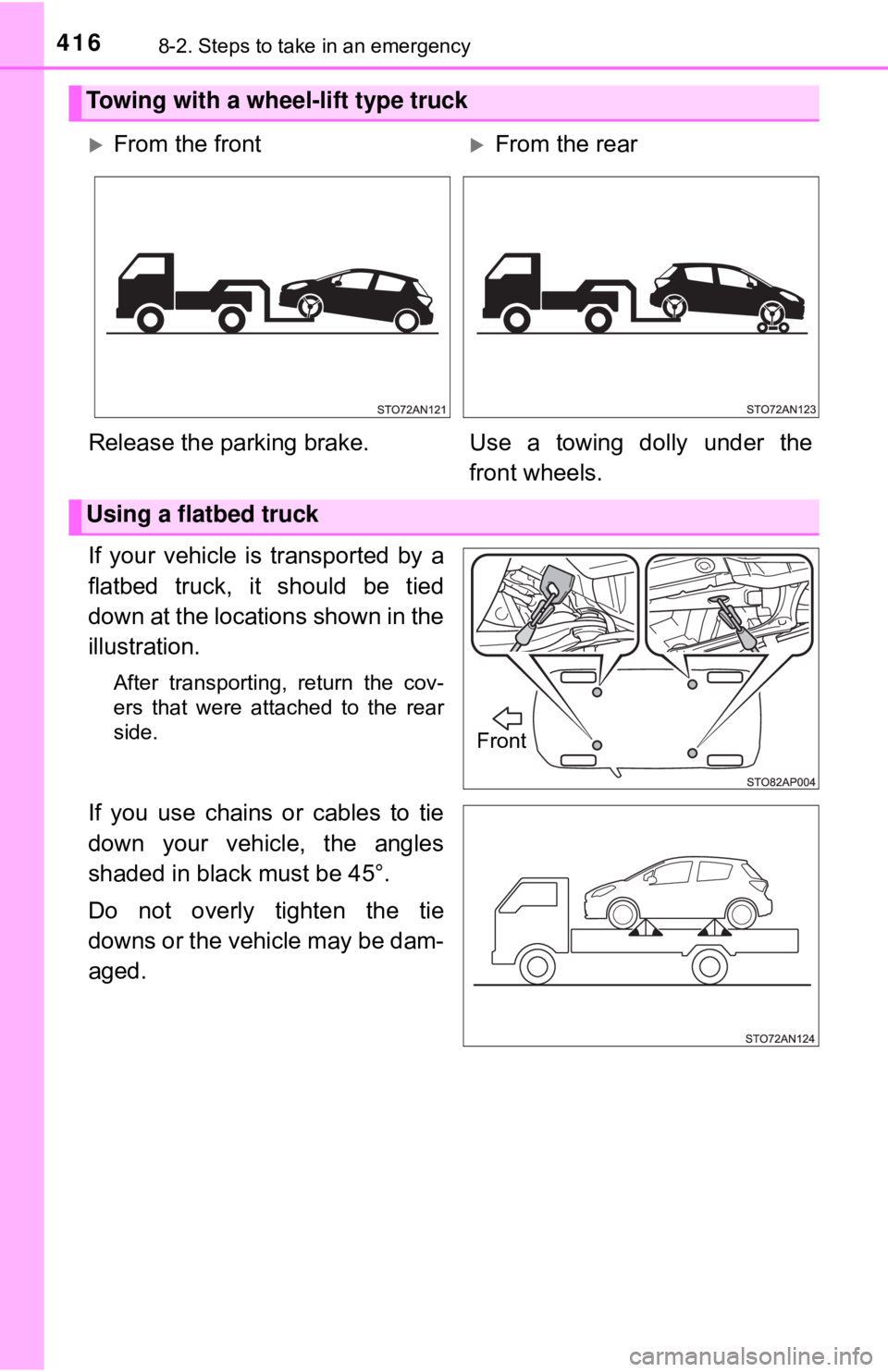
If your vehicle is transported by a
flatbed truck, it should be tied
down at the locations shown in the
illustration.
After transporting, return the cov-
ers that were attached to the rear
side.
If you use chains or cables to tie
down your vehicle, the angles
shaded in black must be 45°.
Do not overly tighten the tie
downs or the vehicle may be dam-
aged.
Towing with a wheel-lift type truck
From the frontFrom the rear
Release the parking brake. Use a towing dolly under the front wheels.
Using a flatbed truck
Front
Page 417 of 520
4178-2. Steps to take in an emergency
8
When trouble arises
If a tow truck is not available in an emergency, your vehicle may be
temporarily towed using cables or chains secured to the emergency
towing eyelets. This should only be attempted on hard surfaced roads
for at most 50 miles (80 km) at under 18 mph (30 km/h).
A driver must be in the vehicle to steer and operate the brakes. The
vehicle’s wheels, drive train, axles, steering and brakes must be in
good condition.
For vehicles with an automatic transmission, only the front towing
eyelets may be used.
Take out the towing eyelet. ( →P. 434)
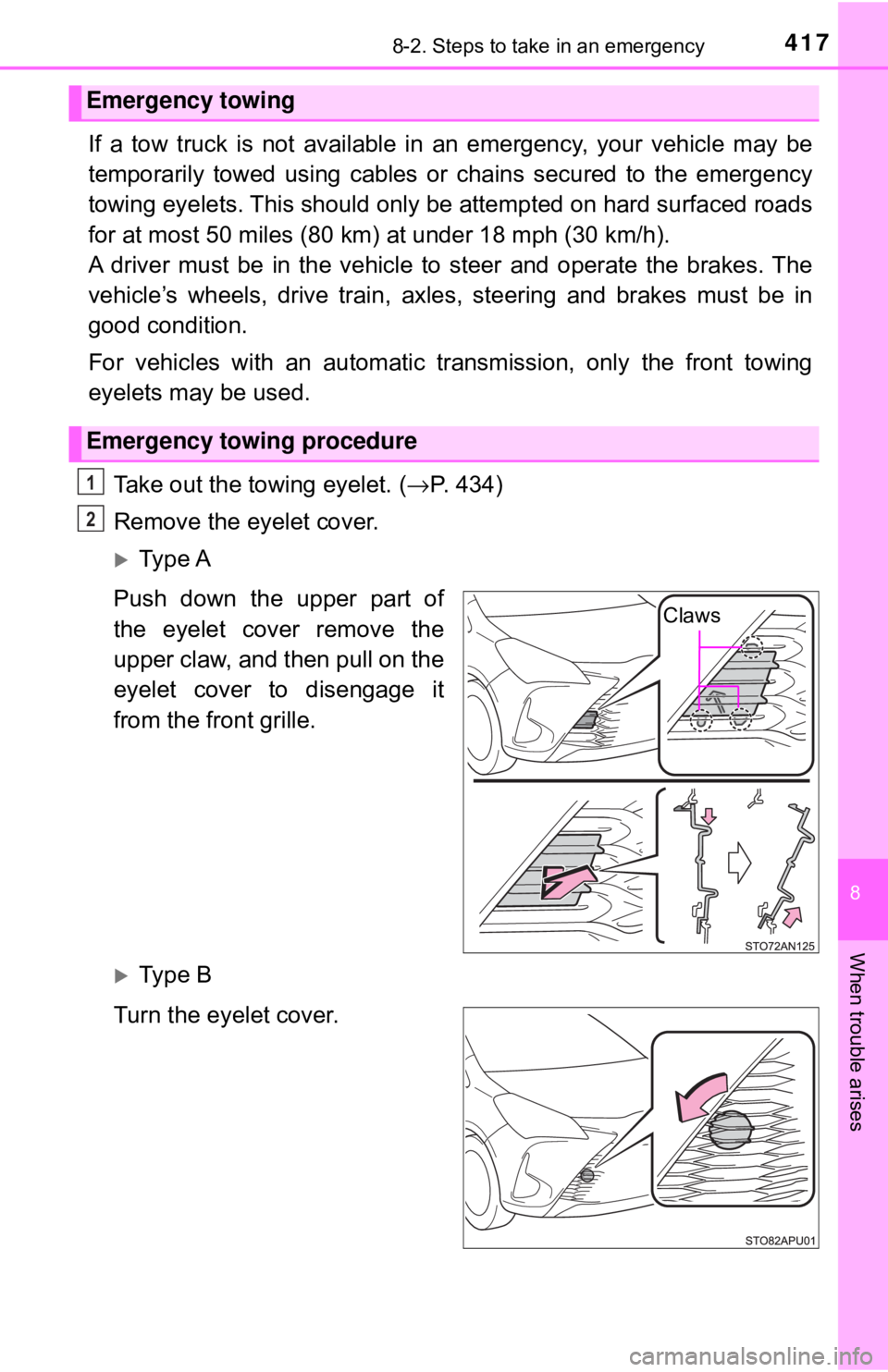
Remove the eyelet cover.
Ty p e A
Push down the upper part of
the eyelet cover remove the
upper claw, and then pull on the
eyelet cover to disengage it
from the front grille.
Ty p e B
Turn the eyelet cover.
Emergency towing
Emergency towing procedure
1
2
Claws
Page 418 of 520
4188-2. Steps to take in an emergency
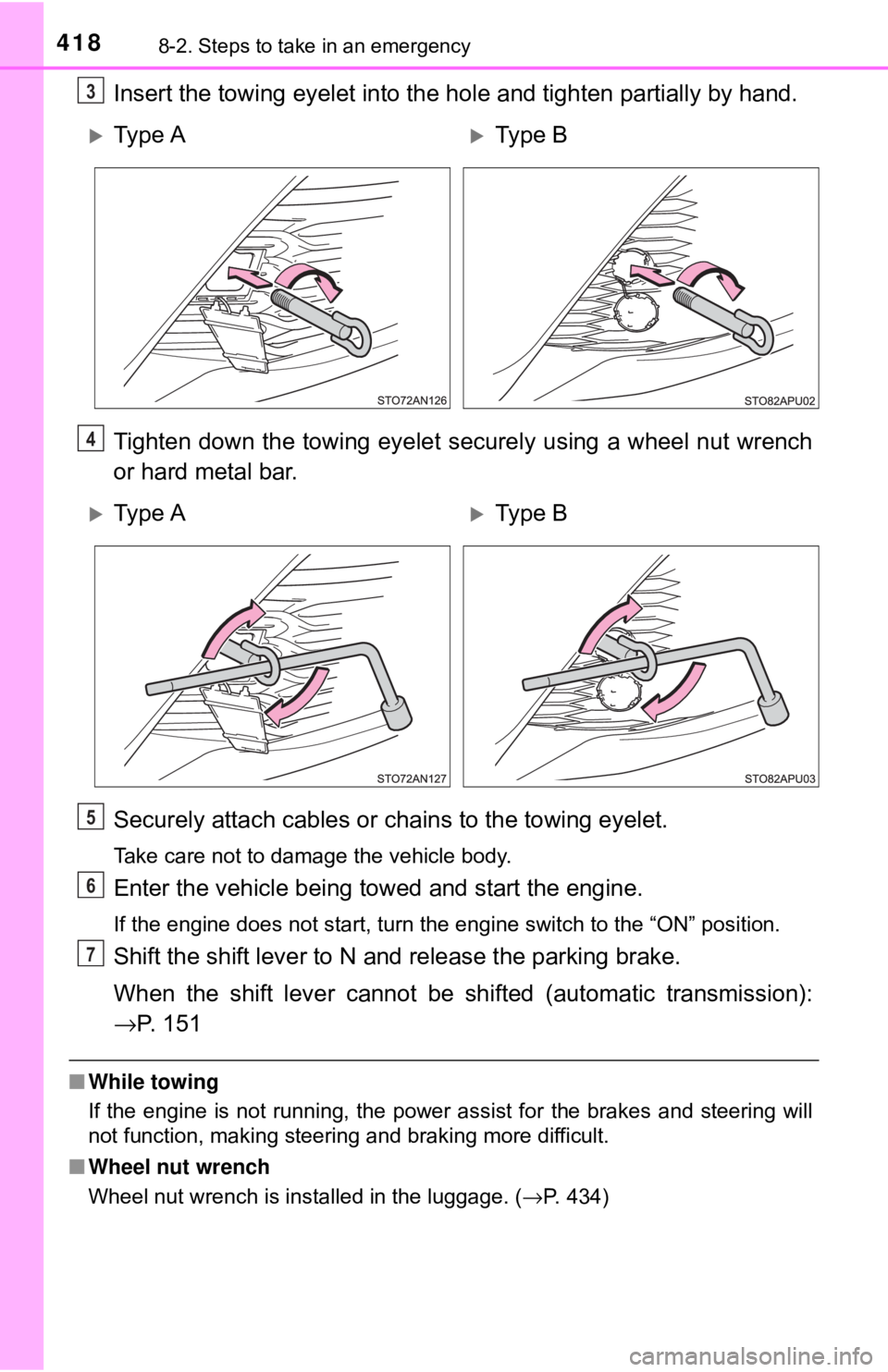
Insert the towing eyelet into the hole and tighten partially by hand.
Tighten down the towing eyelet securely using a wheel nut wrench
or hard metal bar.
Securely attach cables or chains to the towing eyelet.
Take care not to damage the vehicle body.
Enter the vehicle being towed and start the engine.
If the engine does not start, turn the engine switch to the “ON” p\
osition.
Shift the shift lever to N and release the parking brake.
When the shift lever cannot be sh ifted (automatic transmission):
→ P. 1 5 1
■While towing
If the engine is not running, the power assist for the brakes and steering will
not function, making steering and braking more difficult.
■ Wheel nut wrench
Wheel nut wrench is installed in the luggage. ( →P. 434)
3
Ty p e AType B
4
Ty p e AType B
5
6
7
Page 419 of 520
4198-2. Steps to take in an emergency
8
When trouble arises
WARNING
Observe the following precautions.
Failure to do so may result in death or serious injury.
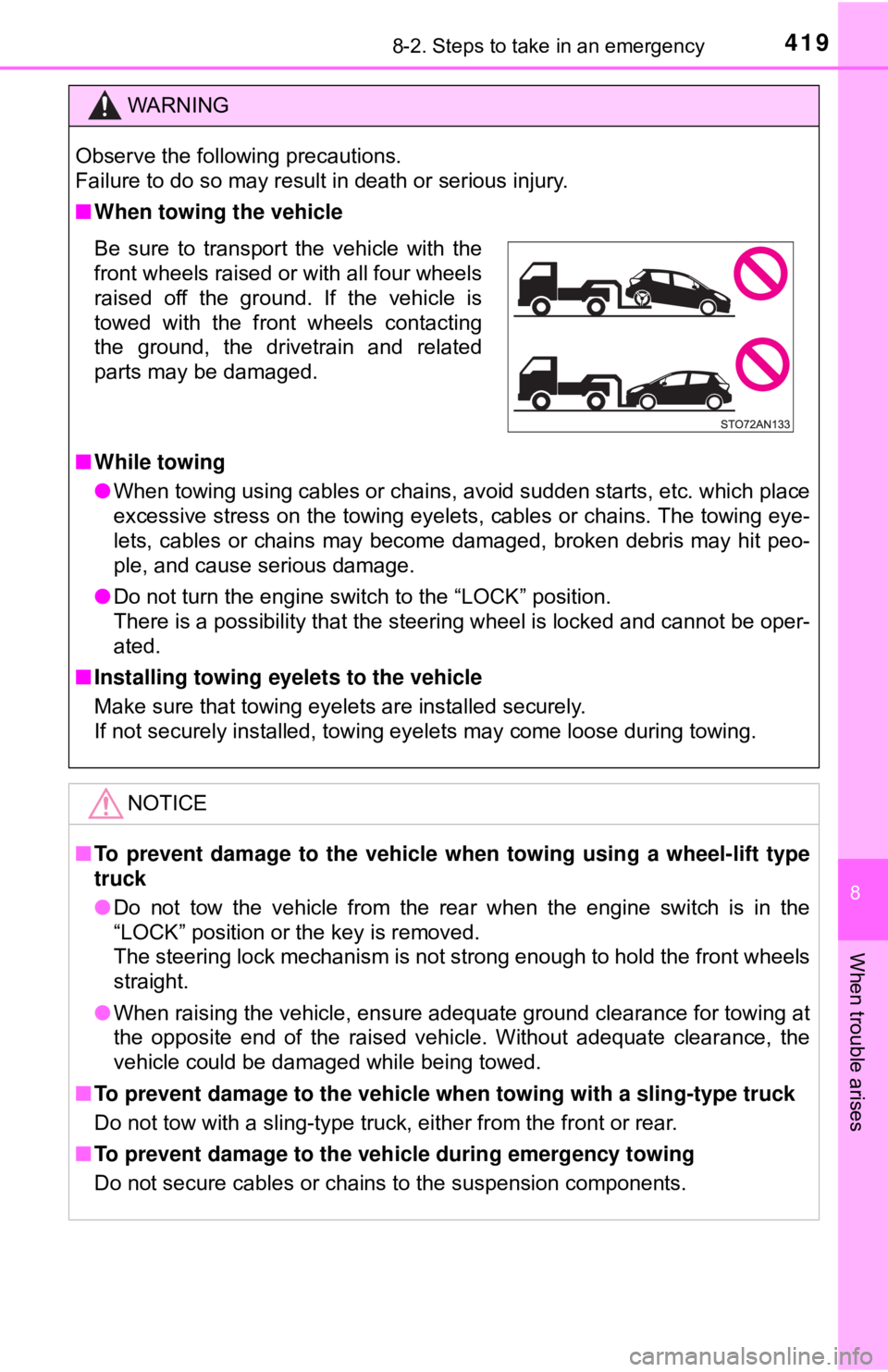
■When towing the vehicle
■ While towing
● When towing using cables or chains, avoid sudden starts, etc. which place
excessive stress on the towing eyelets, cables or chains. The towing eye-
lets, cables or chains may become damaged, broken debris may hit peo-
ple, and cause serious damage.
● Do not turn the engine switch to the “LOCK” position.
There is a possibility that the steering wheel is locked and cannot be oper-
ated.
■ Installing towing eyelets to the vehicle
Make sure that towing eyelets are installed securely.
If not securely installed, towing eyelets may come loose during towing.
NOTICE
■To prevent damage to the vehicle when towing using a wheel-lift type
truck
● Do not tow the vehicle from the rear when the engine switch is in the
“LOCK” position or the key is removed.
The steering lock mechanism is not strong enough to hold the front wheels
straight.
● When raising the vehicle, ensure adequate ground clearance for towing at
the opposite end of the raised vehicle. Without adequate clearance, the
vehicle could be damaged while being towed.
■ To prevent damage to the vehicle when towing with a sling-type truck
Do not tow with a sling-type truck, either from the front or rear.
■ To prevent damage to the vehic le during emergency towing
Do not secure cables or chains to the suspension components.
Be sure to transport the vehicle with the
front wheels raised or with all four wheels
raised off the ground. If the vehicle is
towed with the front wheels contacting
the ground, the drivetrain and related
parts may be damaged.
Page 434 of 520
4348-2. Steps to take in an emergency
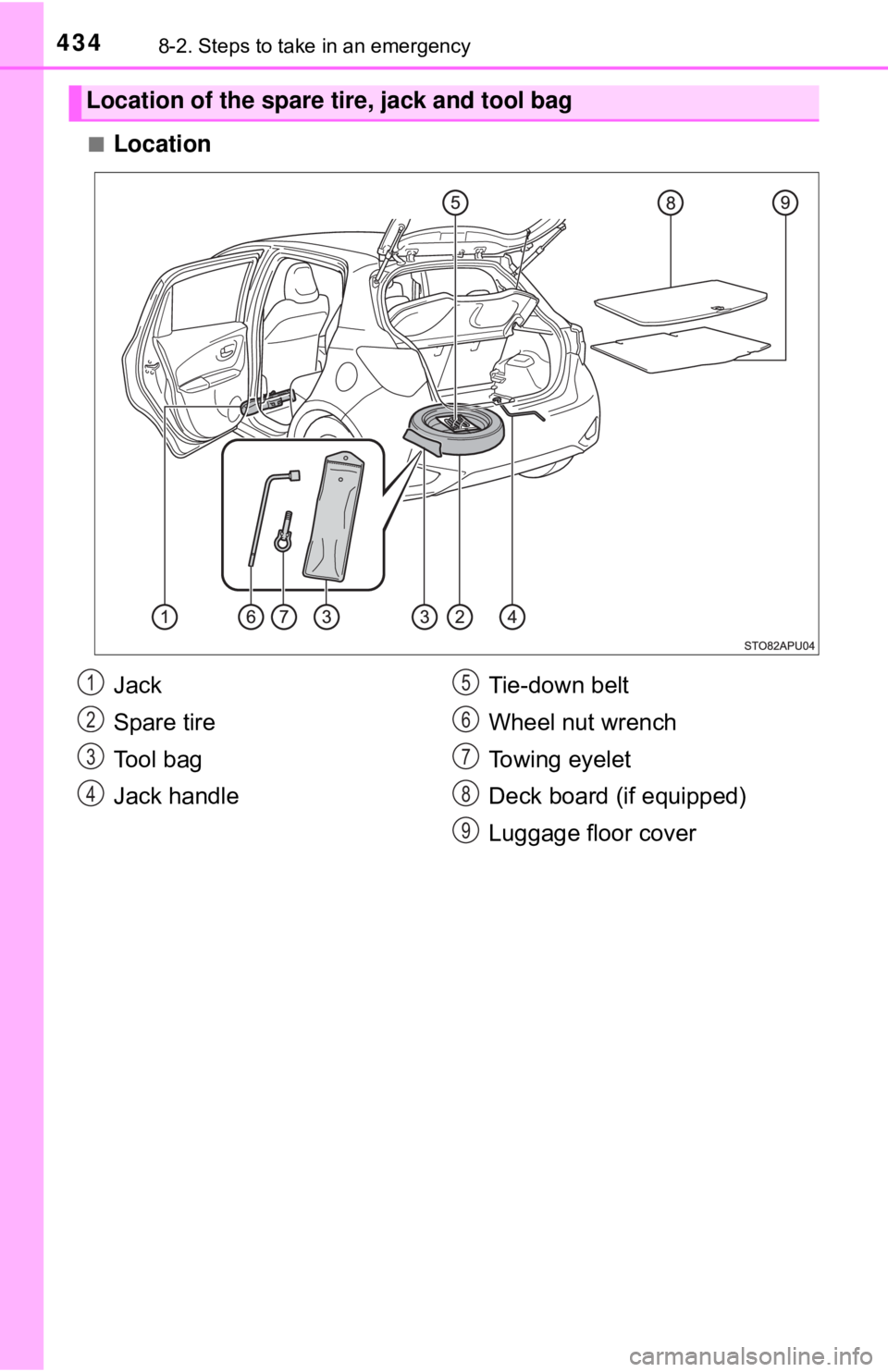
■Location
Location of the spare tire, jack and tool bag
Jack
Spare tire
Tool bag
Jack handleTie-down belt
Wheel nut wrench
Towing eyelet
Deck board (if equipped)
Luggage floor cover1
2
3
4
5
6
7
8
9
Page 437 of 520
4378-2. Steps to take in an emergency
8
When trouble arises
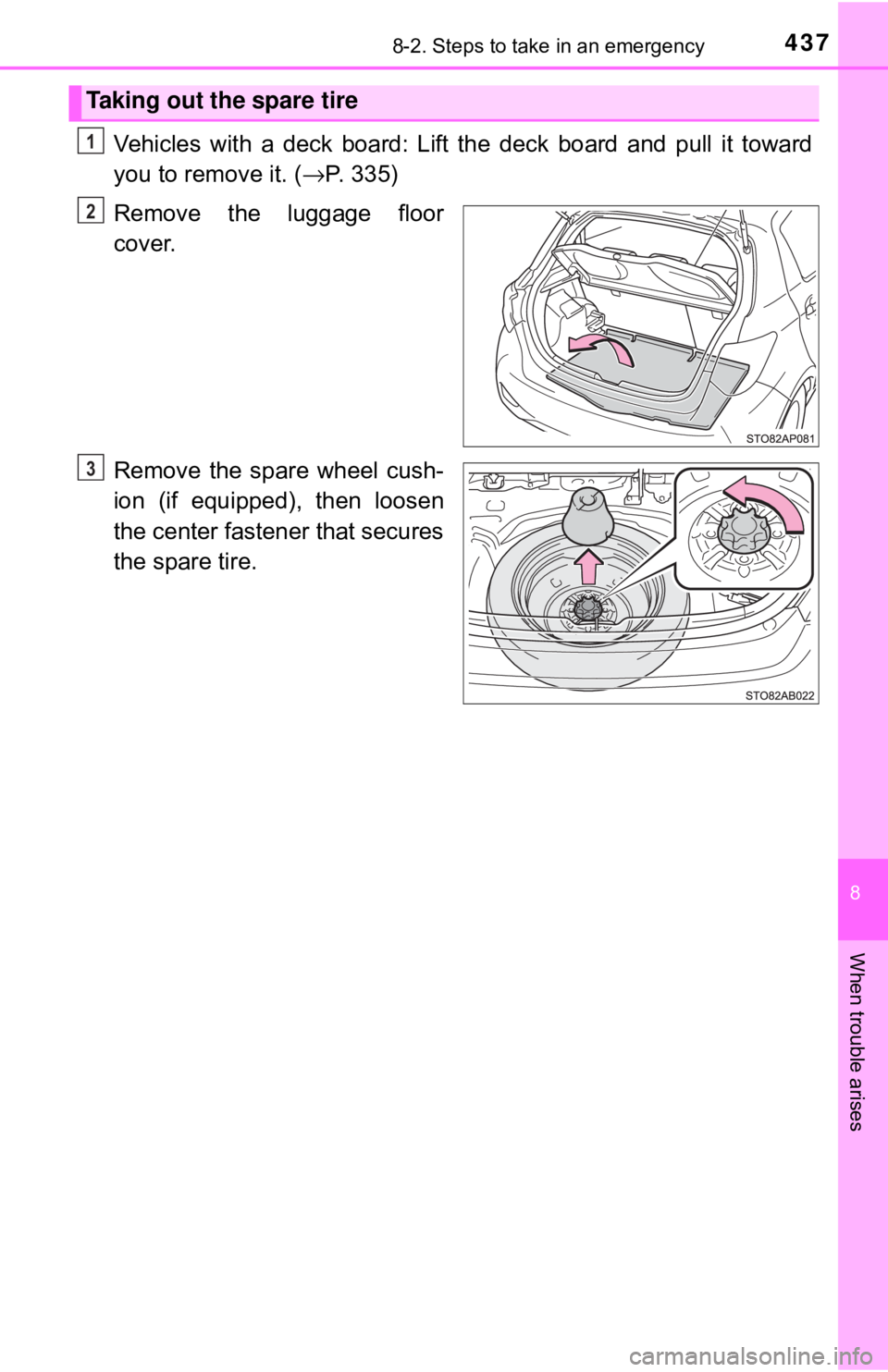
Vehicles with a deck board: Lift the deck board and pull it toward
you to remove it. (→P. 335)
Remove the luggage floor
cover.
Remove the spare wheel cush-
ion (if equipped), then loosen
the center fastener that secures
the spare tire.
Taking out the spare tire
1
2
3
Page 442 of 520
4428-2. Steps to take in an emergency
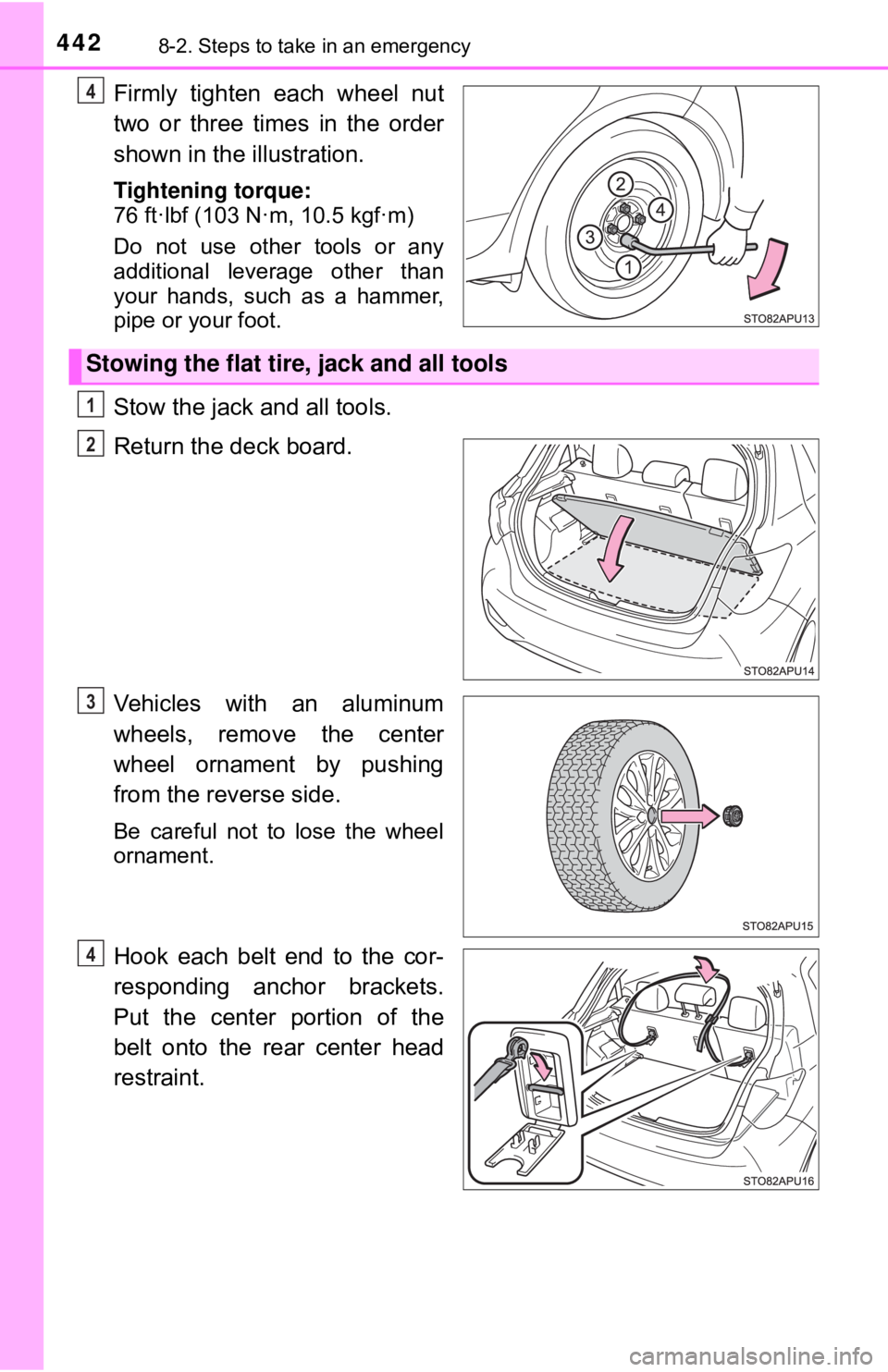
Firmly tighten each wheel nut
two or three times in the order
shown in the illustration.
Tightening torque:
76 ft·lbf (103 N·m, 10.5 kgf·m)
Do not use other tools or any
additional leverage other than
your hands, such as a hammer,
pipe or your foot.
Stow the jack and all tools.
Return the deck board.
Vehicles with an aluminum
wheels, remove the center
wheel ornament by pushing
from the reverse side.
Be careful not to lose the wheel
ornament.
Hook each belt end to the cor-
responding anchor brackets.
Put the center portion of the
belt onto the rear center head
restraint.
4
Stowing the flat tire, jack and all tools
1
2
3
4