lights TOYOTA YARIS HATCHBACK 2018 Repair Manual
[x] Cancel search | Manufacturer: TOYOTA, Model Year: 2018, Model line: YARIS HATCHBACK, Model: TOYOTA YARIS HATCHBACK 2018Pages: 520, PDF Size: 8.69 MB
Page 405 of 520
4057-3. Do-it-yourself maintenance
7
Maintenance and care
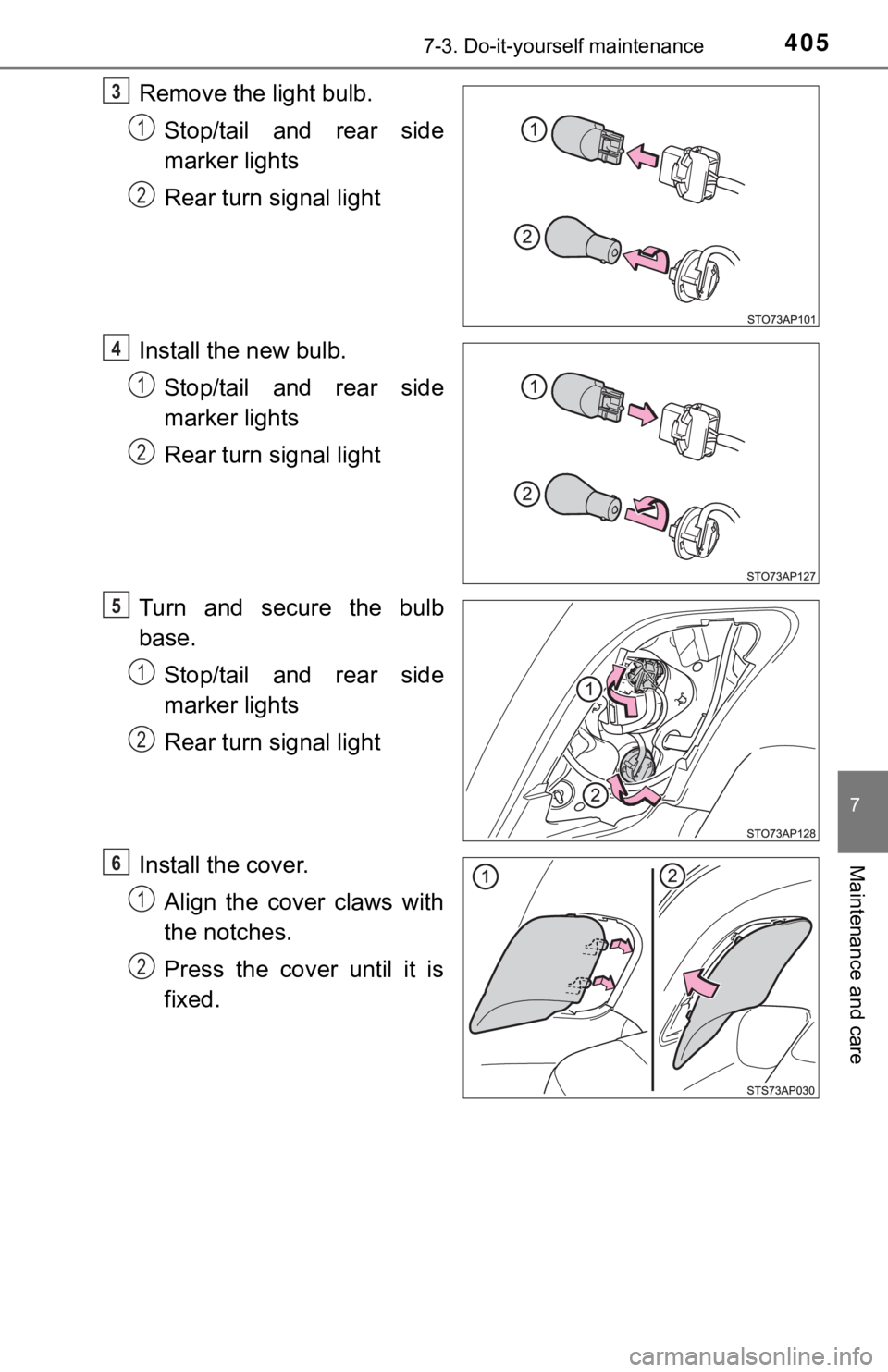
Remove the light bulb.Stop/tail and rear side
marker lights
Rear turn signal light
Install the new bulb. Stop/tail and rear side
marker lights
Rear turn signal light
Turn and secure the bulb
base. Stop/tail and rear side
marker lights
Rear turn signal light
Install the cover. Align the cover claws with
the notches.
Press the cover until it is
fixed.3
1
2
4
1
2
5
1
2
6
1
2
Page 409 of 520
4097-3. Do-it-yourself maintenance
7
Maintenance and care
■Replacing the following bulbs
If any of the lights listed below has burnt out, have it replaced by
your Toyota dealer.
● Parking lights (vehicles with projector type headlights)
● Daytime running lights (if equipped on projector type headlights)
● High mounted stoplight
■LED Lights
The parking lights (LED type), daytime running lights (LED type) and high
mounted stoplight consists of a number of LEDs. If any of the LEDs burn out,
take your vehicle to your Toyota dealer to have the light replaced.
■ Condensation build-up on the inside of the lens
Temporary condensation build-up on the inside of the headlight lens does not
indicate a malfunction. Contact your Toyota dealer for more information in the
following situations:
●Large drops of water have built up on the inside of the lens.
● Water has built up inside the headlight.
■ When replacing light bulbs
→P. 394
Page 410 of 520

4107-3. Do-it-yourself maintenance
WARNING
■Replacing light bulbs
● Turn off the lights. Do not attempt to replace the bulb immediately after
turning off the lights.
The bulbs become very hot and may cause burns.
● Do not touch the glass portion of the light bulb with bare hands. When it is
unavoidable to hold the glass portion, use and hold with a clean dry cloth
to avoid getting moisture and oils on the bulb.
Also, if the bulb is scratched or dropped, it may blow out or crack.
● Fully install light bulbs and any parts used to secure them. Failure to do so
may result in heat damage, fire, or water entering the headlight unit. This
may damage the headlights or cause condensation to build up on the lens.
■ To prevent damage or fire
● Make sure bulbs are fully seated and locked.
● Check the wattage of the bulb before installing to prevent heat damage.
Page 412 of 520
4128-1. Essential information
Emergency flashers
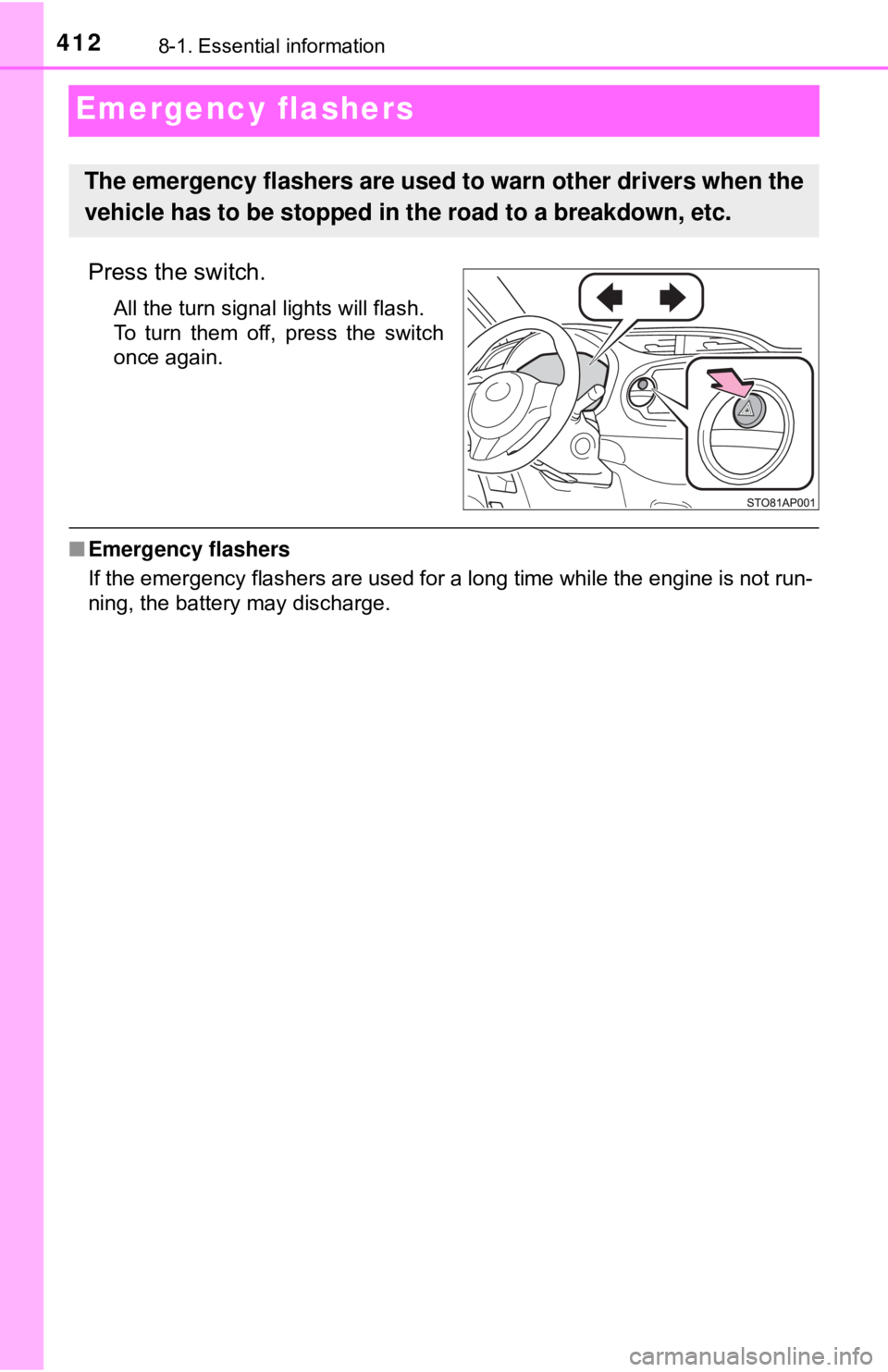
Press the switch.
All the turn signal lights will flash.
To turn them off, press the switch
once again.
■Emergency flashers
If the emergency flashers are used for a long time while the engine is n\
ot run-
ning, the battery may discharge.
The emergency flashers are used to warn other drivers when the
vehicle has to be stopped in the road to a breakdown, etc.
Page 422 of 520
4228-2. Steps to take in an emergency
If a warning light turns on or a warning
buzzer sounds
Calmly perform the following actions if any of the warning lights
comes on or flashes. If a light comes on or flashes, but then
goes off, this does not necessarily indicate a malfunction in the
system. However, if this continues to occur, have the vehicle
inspected by your Toyota dealer.
Warning light and warning buzzer list
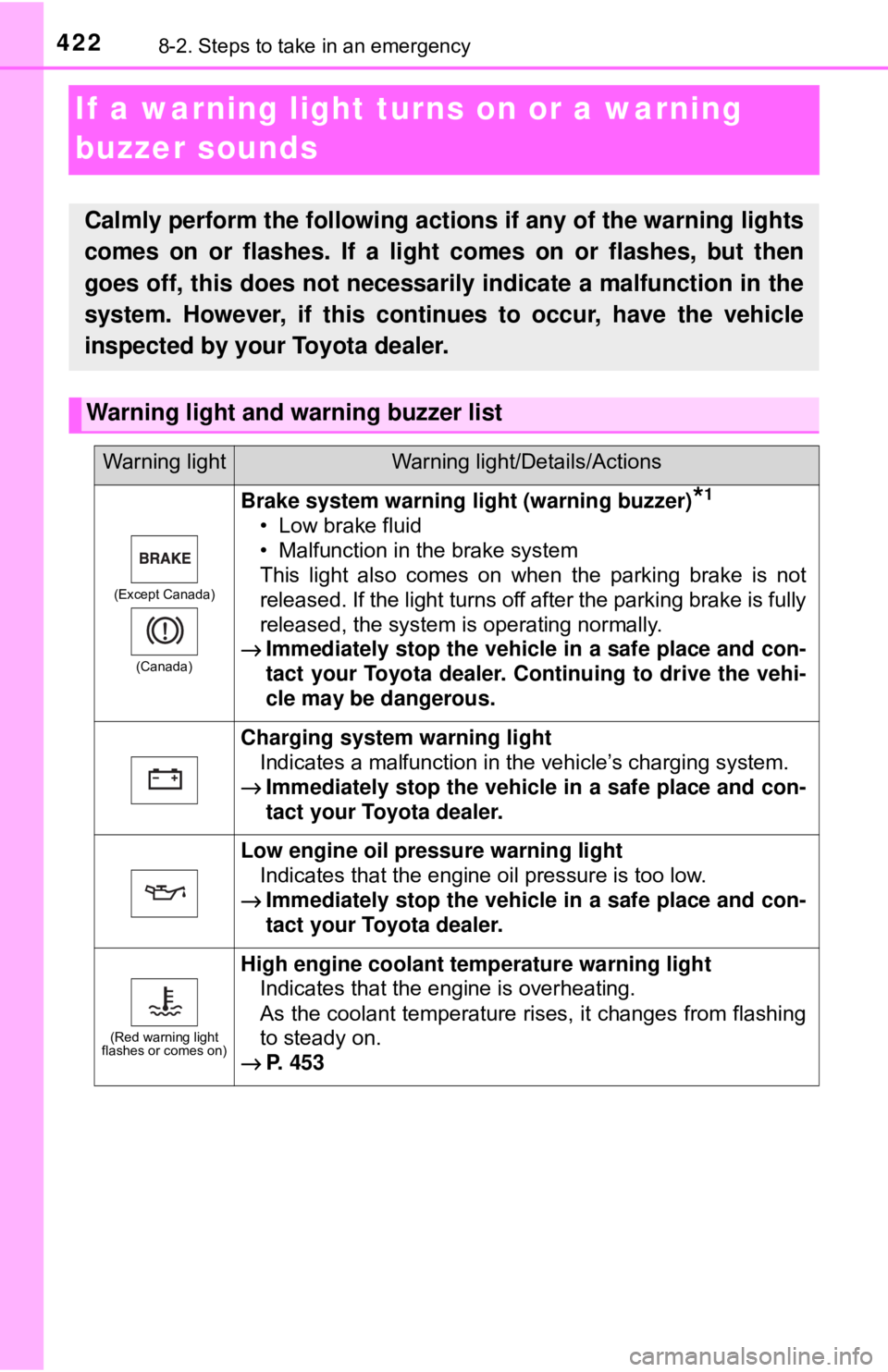
Warning lightWarning light/Details/Actions
(Except Canada)
(Canada)
Brake system warning light (warning buzzer)*1
• Low brake fluid
• Malfunction in the brake system
This light also comes on when the parking brake is not
released. If the light turns off after the parking brake is fully
released, the system is operating normally.
→ Immediately stop the vehicle in a safe place and con-
tact your Toyota dealer. Continuing to drive the vehi-
cle may be dangerous.
Charging system warning light
Indicates a malfunction in the vehicle’s charging system.
→ Immediately stop the vehicle in a safe place and con-
tact your Toyota dealer.
Low engine oil pressure warning light
Indicates that the engine oil pressure is too low.
→ Immediately stop the vehicle in a safe place and con-
tact your Toyota dealer.
(Red warning light
flashes or comes on)
High engine coolant temperature warning light
Indicates that the engine is overheating.
As the coolant temperature rises, it changes from flashing
to steady on.
→ P. 453
Page 430 of 520
4308-2. Steps to take in an emergency
■If the tire pressure warning light frequently comes on after blinking
for 1 minute (vehicles with a tire pressure warning system)
If the tire pressure warning light frequently comes on after blinking for
1 minute when the engine switch is turned to the “ON” position, have it
checked by your Toyota dealer.
■ Customization that can be co nfigured at Toyota dealer
The vehicle speed linked seat belt reminder buzzer can be disabled.
(Customizable features →P. 488) However, Toyota recommends that the seat
belt reminder buzzer be operational to alert the driver and front passenger
when seat belts are not fastened.
WARNING
■ If both the ABS and the brake system warning lights remain on
Stop your vehicle in a safe place immediately and contact your Toyota
dealer. The vehicle will become extremely unstable during braking, and the
ABS system may fail, which could cause an accident resulting in death or
serious injury.
■ When the electric power steerin g system warning light comes on
The steering wheel may become extremely heavy.
When steering wheel operations are heavier than usual, grip the steering
wheel firmly and operate it using more force than usual.
■
If the tire pressure warning light comes on (vehicles with a tire
pressure warning system)
Be sure to observe the following precautions. Failure to do so could
cause a loss of vehicle control and result in death or serious injury.
●Stop your vehicle in a safe place as soon as possible. Adjust the tire
inflation pressure immediately.
●If the tire pressure warning light co mes on even after tire inflation pres-
sure adjustment, it is probable that you have a flat tire. Check the tires.
If a tire is flat, change it with the spare tire and have the flat tire
repaired by the nearest Toyota dealer.
●Avoid abrupt maneuvering and braking. If the vehicle tires deteriorate,
you could lose control of the steering wheel or the brakes.
■If a blowout or sudden air leakage should occur (vehicles with a tire
pressure warning system)
The tire pressure warning system may not activate immediately.
Page 448 of 520
4488-2. Steps to take in an emergency
If the engine will not start
One of the following may be the cause of the problem:
●There may not be sufficient fuel in the vehicle’s tank.
Refuel the vehicle.
● The engine may be flooded.
Try to restart the engine again following correct starting procedures.
(→ P. 146)
● Vehicles with engine immobilizer system: There may be a malfunc-
tion in the engine i mmobilizer system. (→ P. 7 4 )
One of the following may be the cause of the problem:
● The battery may be discharged. ( →P. 450)
● The battery terminal connections may be loose or corroded.
If the engine will not start eve n though correct starting proce-
dures are being followed ( →P. 146), consider each of the follow-
ing points:
The engine will not start even though the starter motor operates
normally.
The starter motor turns over slowly, the interior lights and head-
lights are dim, or the horn does not sound or sounds at a low
volume.
Page 449 of 520
4498-2. Steps to take in an emergency
8
When trouble arises
One of the following may be the cause of the problem:
●One or both of the battery terminals may be disconnected.
● The battery may be discharged. ( →P. 450)
Contact your Toyota dealer if the problem cannot be repaired, or if repair
procedures are unknown.
The starter motor does not turn over, the interior lights and head-
lights do not turn on, or the horn does not sound.
Page 451 of 520
4518-2. Steps to take in an emergency
8
When trouble arises
Start the engine of the second vehicle. Increase the engine speed
slightly and maintain at that level for approximately 5 minutes to
recharge the batter y of your vehicle.
Maintain the engine speed of t he second vehicle and start the
engine of your vehicle.
Once the vehicle’s engine has star ted, remove the jumper cables in
the exact reverse order from which they were connected.
Once the engine starts, have the v ehicle inspected at your Toyota
dealer as soon as possible.
■ Starting the engine when the batt ery is discharged (vehicles with an
automatic transmission)
The engine cannot be started by push-starting.
■ To prevent battery discharge
●Turn off the headlights and the audio system while the engine is not running.
● Turn off any unnecessary electrical components when the vehicle is running
at a low speed for an extended period, such as in heavy traffic.
■ Charging the battery
The electricity stored in the battery will discharge gradually even when the
vehicle is not in use, due to natural discharge and the draining effects of cer-
tain electrical appliances. If the vehicle is left for a long time, the battery may
discharge, and the engine may be unable to start. (The battery recharges
automatically during driving.)
3
4
5
Page 466 of 520
4669-1. Specifications
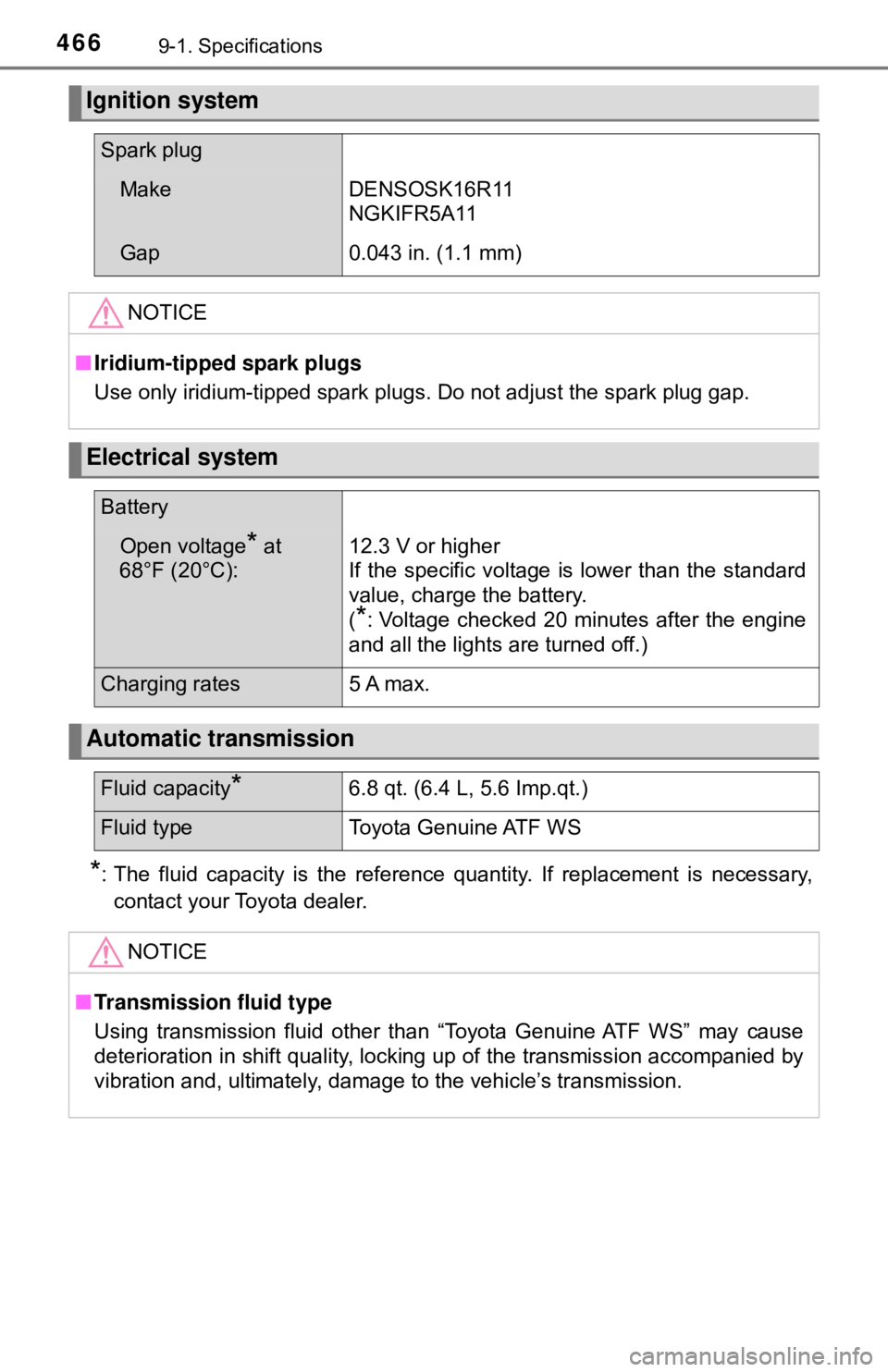
*: The fluid capacity is the reference quantity. If replacement is necessary,contact your Toyota dealer.
Ignition system
Spark plug
MakeDENSOSK16R11
NGKIFR5A11
Gap0.043 in. (1.1 mm)
NOTICE
■ Iridium-tipped spark plugs
Use only iridium-tipped spark plugs. Do not adjust the spark plug gap.
Electrical system
Battery
Open voltage* at
68°F (20°C): 12.3 V or higher
If the specific voltage is lower than the standard
value, charge the battery.
(
*: Voltage checked 20 minutes after the engine
and all the lights are turned off.)
Charging rates 5 A max.
Automatic transmission
Fluid capacity*6.8 qt. (6.4 L, 5.6 Imp.qt.)
Fluid typeToyota Genuine ATF WS
NOTICE
■Transmission fluid type
Using transmission fluid other than “Toyota Genuine ATF WS” may cause
deterioration in shift quality, locking up of the transmission accompanied by
vibration and, ultimately, damage to the vehicle’s transmission.