fuel TOYOTA YARIS HATCHBACK 2019 Owner's Manual
[x] Cancel search | Manufacturer: TOYOTA, Model Year: 2019, Model line: YARIS HATCHBACK, Model: TOYOTA YARIS HATCHBACK 2019Pages: 692, PDF Size: 68.71 MB
Page 223 of 692
2234-1. Before driving
4
Driving
YARIS_F_OM_Europe_OM52A54E
■When starting off on an uphill
The hill-start assist control will activate. (P. 358)
■Driving in the rain
●Drive carefully when it is raining, because visibility will be reduced, the win-
dows may become fogged-up, and the road will be slippery.
●Drive carefully when it starts to rain, because the road surface will be espe-
cially slippery.
●Refrain from high speeds when driving on an expressway in the rain,
because there may be a layer of water between the tires and the road sur-
face, preventing the steering and brakes from operating properly.
■Engine speed while driving (vehicles with a Multidrive)
In the following conditions, the engine speed may become high while driving.
This is due to automatic up-shifting control or down-shifting implementation to
meet driving conditions. It does not indicate sudden acceleration.
●The vehicle is judged to be driving uphill or downhill
●When the accelerator pedal is released
●When the brake pedal is depressed while sport mode is selected
■Breaking in your new Toyota
To extend the life of the vehicle, observing the following precautions is recom-
mended:
●For the first 300 km (200 miles):
Avoid sudden stops.
●For the first 800 km (500 miles):
Do not tow a trailer.
●For the first 1000 km (600 miles):
• Do not drive at extremely high speeds.
• Avoid sudden acceleration.
• Do not drive continuously in low gears.
• Do not drive at a constant speed for extended periods.
■Operating your vehicle in a foreign country
Comply with the relevant vehicle registration laws and confirm the availability
of the correct fuel. (P. 664)
Page 231 of 692
231
4
4-1. Before driving
Driving
YARIS_F_OM_Europe_OM52A54E
Trailer towing
◆Weight limits
Check the allowable towing capacity, GVM (Gross Vehicle Mass),
MPAC (Maximum Permissible Axle Capacity), and permissible
drawbar load before towing. (P. 646)
◆Towing hitch/bracket
Toyota recommends the use of the Toyota hitch/bracket for your
vehicle. Other products of a suitable nature and comparable quality
may also be used.
Your vehicle is designed primarily as a passenger carrying vehi-
cle. Towing a trailer will have an adverse effect on handling, per-
formance, braking, durability, and fuel consumption. Your safety
and satisfaction depend on the proper use of correct equipment
and cautions driving habits. For your safety and the safety of
others, do not overload the vehicle or trailer.
To tow a trailer safely, use extreme care and drive the vehicle in
accordance with the trailer’s characteristics and operating con-
ditions.
Toyota warranties do not apply to damage or malfunction
caused by towing a trailer for commercial purposes.
Ask your local authorized Toyota retailer or Toyota authorized
repairer, or any reliable repairer for further details before towing,
as there are additional legal requirements in some countries.
Page 253 of 692
2534-2. Driving procedures
4
Driving
YARIS_F_OM_Europe_OM52A54E
*1: To improve fuel consumption and reduce noises, set the shift lever in the D
position for normal driving.
*2: By selecting gear step using paddle shift switches, you can control engine
braking forces.
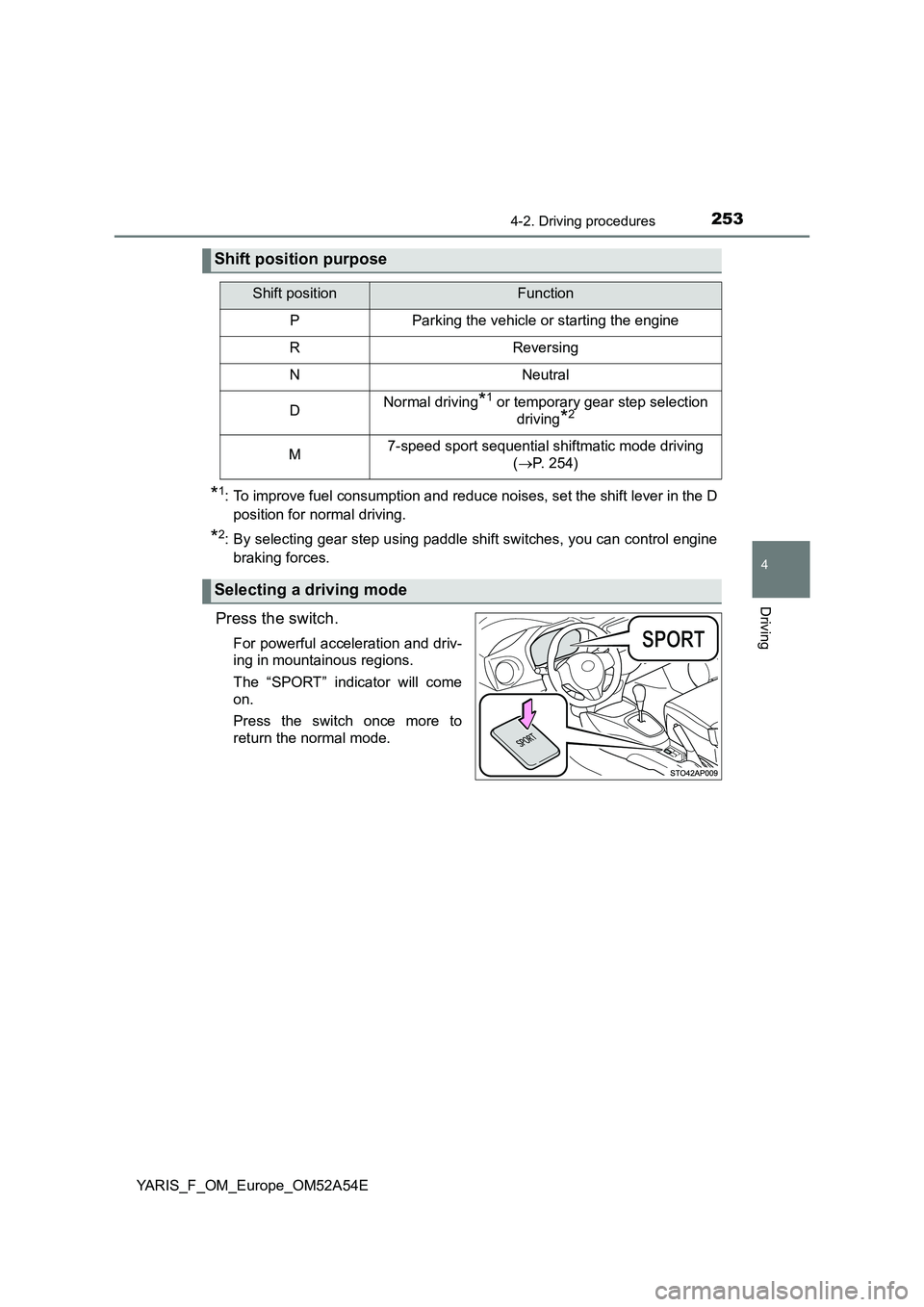
Press the switch.
For powerful acceleration and driv-
ing in mountainous regions.
The “SPORT” indicator will come
on.
Press the switch once more to
return the normal mode.
Shift position purpose
Shift positionFunction
PParking the vehicle or starting the engine
RReversing
NNeutral
DNormal driving*1 or temporary gear step selection
driving
*2
M7-speed sport sequential shiftmatic mode driving
(P. 254)
Selecting a driving mode
Page 262 of 692
2624-2. Driving procedures
YARIS_F_OM_Europe_OM52A54E
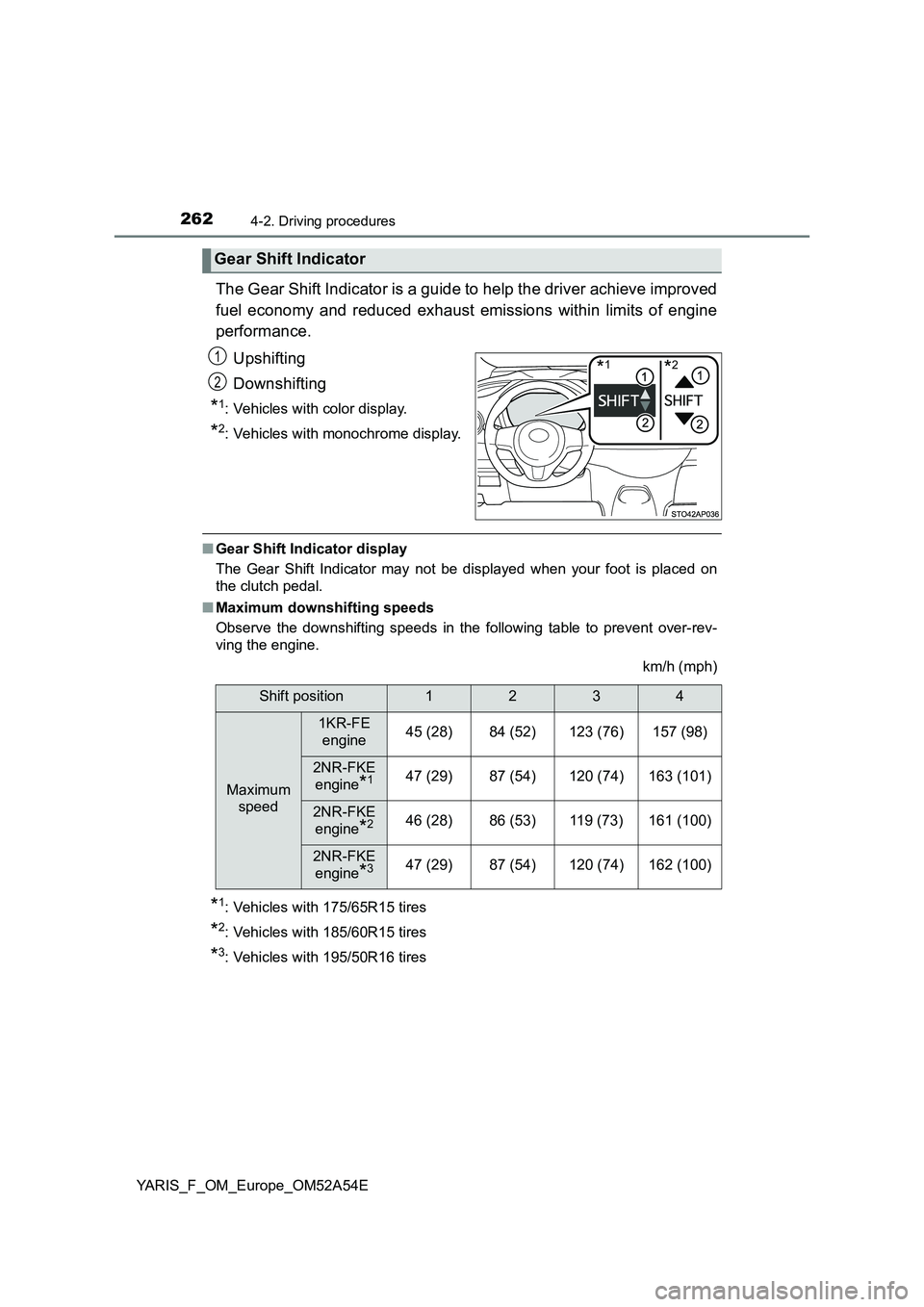
The Gear Shift Indicator is a guide to help the driver achieve improved
fuel economy and reduced exhaust emissions within limits of engine
performance.
Upshifting
Downshifting
*1: Vehicles with color display.
*2: Vehicles with monochrome display.
■Gear Shift Indicator display
The Gear Shift Indicator may not be displayed when your foot is placed on
the clutch pedal.
■Maximum downshifting speeds
Observe the downshifting speeds in the following table to prevent over-rev-
ving the engine.
km/h (mph)
*1: Vehicles with 175/65R15 tires
*2: Vehicles with 185/60R15 tires
*3: Vehicles with 195/50R16 tires
Gear Shift Indicator
*1*21
2
Shift position1234
Maximum
speed
1KR-FE
engine45 (28)84 (52)123 (76)157 (98)
2NR-FKE
engine
*147 (29)87 (54)120 (74)163 (101)
2NR-FKE
engine
*246 (28)86 (53)119 (73)161 (100)
2NR-FKE
engine
*347 (29)87 (54)120 (74)162 (100)
Page 279 of 692
279
4
4-4. Refueling
Driving
YARIS_F_OM_Europe_OM52A54E
Opening the fuel tank cap
●Vehicles without a smart entry & start system
Turn the engine switch to the “LOCK” position and ensure that all
the doors and windows are closed.
●Vehicles with a smart entry & start system
Turn the engine switch off and ensure that all the doors and win-
dows are closed.
●Confirm the type of fuel.
■Fuel types
P. 664
■Fuel tank opening for unleaded gasoline
To help prevent incorrect fueling, your vehicle has a fuel tank opening that
only accommodates the special nozzle on unleaded fuel pumps.
Perform the following steps to open the fuel tank cap:
Before refueling the vehicle
Page 280 of 692
2804-4. Refueling
YARIS_F_OM_Europe_OM52A54E
WARNING
■When refueling the vehicle
Observe the following precautions while refueling the vehicle. Failure to do
so may result in death or serious injury.
● After exiting the vehicle and before opening the fuel door, touch an
unpainted metal surface to discharge any stat ic electricity. It is important to
discharge static electricity before re fueling because sparks resulting from
static electricity can cause fuel vapors to ignite while refueling.
● Always hold the grips on the fuel tank cap and turn it slowly to remove it.
A whooshing sound may be heard when the fuel tank cap is loosened.
Wait until the sound cannot be heard before fully removing the cap. In hot
weather, pressurized fuel may spray out the filler neck and cause injury.
● Do not allow anyone that has not discharged static electricity from their
body to come close to an open fuel tank.
● Do not inhale vaporized fuel.
Fuel contains substances that are harmful if inhaled.
● Do not smoke while refueling the vehicle.
Doing so may cause the fuel to ignite and cause a fire.
● Do not return to the vehicle or touch any person or object that is statically
charged.
This may cause static electricity to build up, resulting in a possible ignition
hazard.
■ When refueling
Observe the following precautions to pr event fuel overflowing from the fuel
tank:
● Securely insert the fuel nozzle into the fuel filler neck.
● Stop filling the tank after the fuel nozzle automatically clicks off.
● Do not top off the fuel tank.
NOTICE
■Refueling
Do not spill fuel during refueling.
Doing so may damage the vehicle, such as causing the emission control
system to operate abnormally or damaging fuel system components or the
vehicle’s painted surface.
Page 281 of 692
2814-4. Refueling
4
Driving
YARIS_F_OM_Europe_OM52A54E
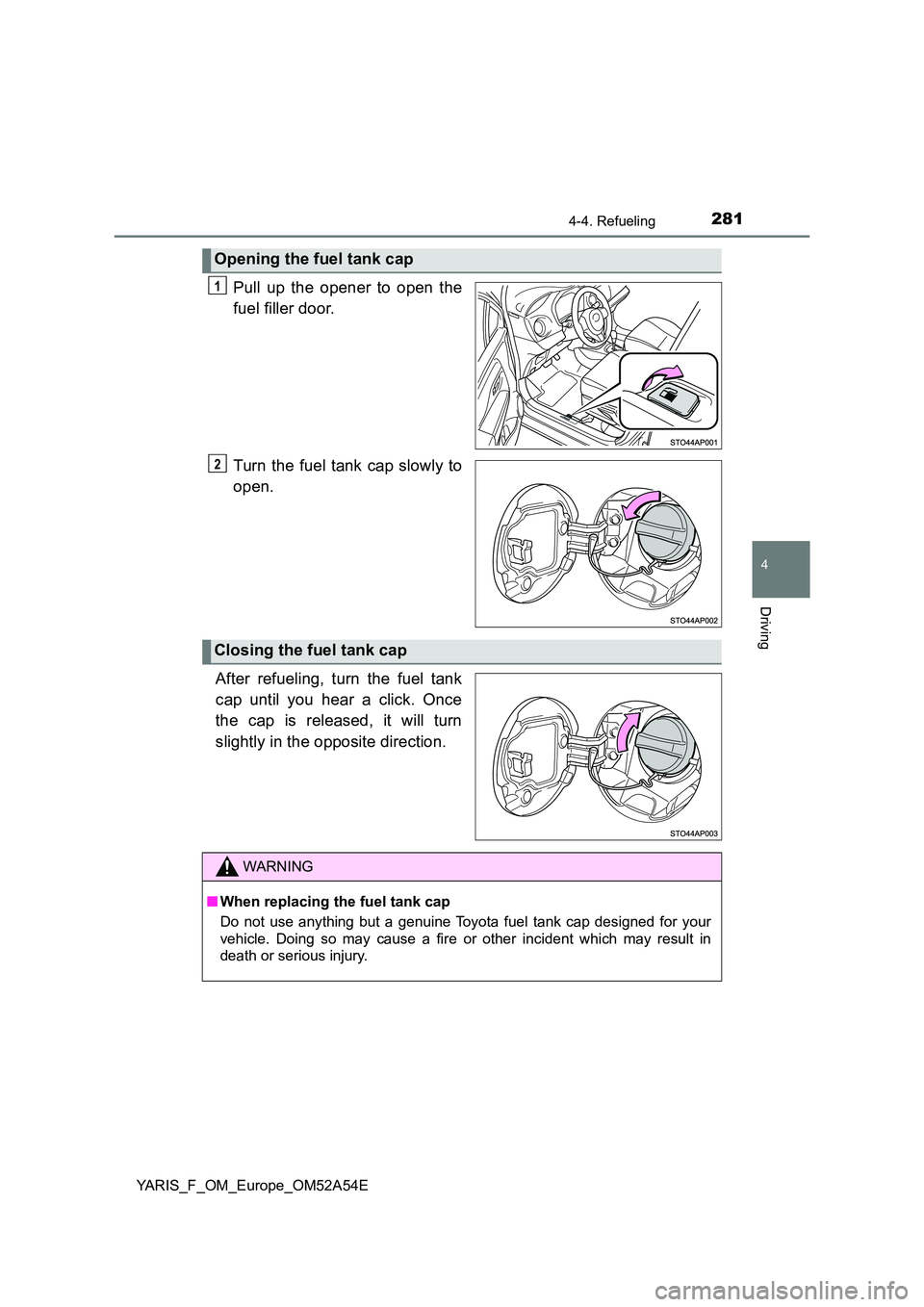
Pull up the opener to open the
fuel filler door.
Turn the fuel tank cap slowly to
open.
After refueling, turn the fuel tank
cap until you hear a click. Once
the cap is released, it will turn
slightly in the opposite direction.
Opening the fuel tank cap
1
2
Closing the fuel tank cap
WARNING
■ When replacing the fuel tank cap
Do not use anything but a genuine Toyota fuel tank cap designed for your
vehicle. Doing so may cause a fire or other incident which may result in
death or serious injury.
Page 489 of 692
4897-3. Do-it-yourself maintenance
7
Maintenance and care
YARIS_F_OM_Europe_OM52A54E
.
WARNING
The engine compartment contains many mechanisms and fluids that may
move suddenly, become hot, or become el ectrically energized. To avoid death
or serious injury, observe the following precautions.
■ When working on the engine compartment
● Keep hands, clothing and tools away from the moving fan and engine
drive belt.
● Be careful not to touch the engine, radiator, exhaust manifold, etc., right
after driving as they may be hot. Oil and other fluids may also be hot.
● Do not leave anything that may burn easily, such as paper and rags, in the
engine compartment.
● Do not smoke, cause sparks or expose an open flame to fuel on the bat-
tery. Fuel and battery fumes are flammable.
● Be extremely cautious when working on the battery. It contains poisonous
and corrosive sulfuric acid.
● Take care because brake fluid can harm your hands or eyes and damage
painted surfaces. If fluid gets on your hands or in your eyes, flush the
affected area with clean water immediately.
If you still experience discomfort, consult a doctor.
■ When working near the electric cooling fan or radiator grille
Vehicles without a smart entry & start system
Be sure the engine switch is in the “LOCK” position.
With the engine switch in the “ON” position, the electric cooling fan may
automatically start to run if the air conditioning is on and/or the coolant tem-
perature is high. ( P. 503)
Vehicles with a smart entry & start system
Be sure the engine switch is off.
With the engine switch in IGNITION ON mode, the electric cooling fan may
automatically start to run if the air conditioning is on and/or the coolant tem-
perature is high. ( P. 503)
■ Safety glasses
Wear safety glasses to prevent flying or falling material, fluid spray, etc.,
from getting in your eyes.
Page 528 of 692
5287-3. Do-it-yourself maintenance
YARIS_F_OM_Europe_OM52A54E
Tire inflation pressure
■Effects of incorrect tire inflation pressure
Driving with incorrect tire inflation pressure may result in the following:
●Reduced fuel economy
●Reduced driving comfort and poor handling
●Reduced tire life due to wear
●Reduced safety
●Damage to the drive train
If a tire needs frequent inflating, have it checked by any authorized Toyota
retailer or Toyota authorized repairer, or any reliable repairer.
■Instructions for checking tire inflation pressure
When checking tire inflation pressure, observe the following:
●Check only when the tires are cold.
If your vehicle has been parked for at least 3 hours or has not been driven
for more than 1.5 km or 1 mile, you will get an accurate cold tire inflation
pressure reading.
●Always use a tire pressure gauge.
It is difficult to judge if a tire is properly inflated based only on its appear-
ance.
●It is normal for the tire inflation pressure to be higher after driving as heat is
generated in the tire. Do not reduce tire inflation pressure after driving.
Make sure to maintain proper tire inflation pressure. Tire infla-
tion pressure should be checked at least once per month. How-
ever, Toyota recommends that tire inflation pressure be checked
once every two weeks. (P. 659)
Page 567 of 692
567
8When trouble arises
YARIS_F_OM_Europe_OM52A54E
8-1. Essential information
Emergency flashers ........... 568
If your vehicle has to
be stopped in
an emergency .................. 569
If the vehicle is
trapped in rising water ..... 571
8-2. Steps to take in
an emergency
If your vehicle needs to
be towed .......................... 572
If you think something is
wrong ............................... 579
Fuel pump
shut off system ............... 580
If a warning light turns on
or a warning buzzer
sounds ............................. 581
If a warning message is
displayed (vehicles with
color display) ................... 592
If you have a flat tire
(vehicles with
an emergency tire
puncture repair kit)........... 596
If you have a flat tire
(vehicles with
a spare tire) ..................... 614
If the engine will not start ... 629
If the electronic key does
not operate properly
(vehicles with a smart
entry & start system)........ 631
If the vehicle battery is
discharged ....................... 634
If your vehicle overheats .... 639
If the vehicle becomes
stuck ................................ 643