brakes TOYOTA YARIS HATCHBACK 2020 (in English) User Guide
[x] Cancel search | Manufacturer: TOYOTA, Model Year: 2020, Model line: YARIS HATCHBACK, Model: TOYOTA YARIS HATCHBACK 2020Pages: 572, PDF Size: 7.94 MB
Page 216 of 572
216
YARIS_YARIS HATCHBACK_OM_OM99V59z_(U)
3-6. ABS/TCS/DSC
Traction Control System (TCS)
The warning light turns on when the system has a malfunction.
Refer to Contact Your Toyota Dealer and Have Vehicle Inspected on
P. 493.
To turn off the TCS, press the DSC OFF switch ( P. 219).
The Traction Control System (TCS) enhances traction and safety
by controlling engine torque and braking. W hen the TCS detects
driving wheel slippage, it lower s engine torque and operates th e
brakes to prevent loss of traction.
This means that on a slick surface , the engine adjusts automati-
cally to provide optimum power to the drive wheels, limiting
wheel spin and loss of traction.
WARNING
■ Do not rely on the Traction Cont rol System (TCS) as a substitute for
safe driving
The Traction Control System (TCS) cannot compensate for unsafe and
reckless driving, excessive speed, tailgating (following anothe r vehicle too
closely), and hydroplaning (reduced tire friction and road contact because
of water on the road surface). You can still have an accident.
■ Use snow tires or tire chains and drive at reduced speeds when roads
are covered with ice and/or snow
Driving without proper traction devices on snow and/or ice-cove red roads is
dangerous. The Traction Control System (TCS) alone cannot provide ade-
quate traction and you could still have an accident.
Page 228 of 572
228
YARIS_YARIS HATCHBACK_OM_OM99V59z_(U)
3-10. Active Safety System
Low Speed Pre-Collision System
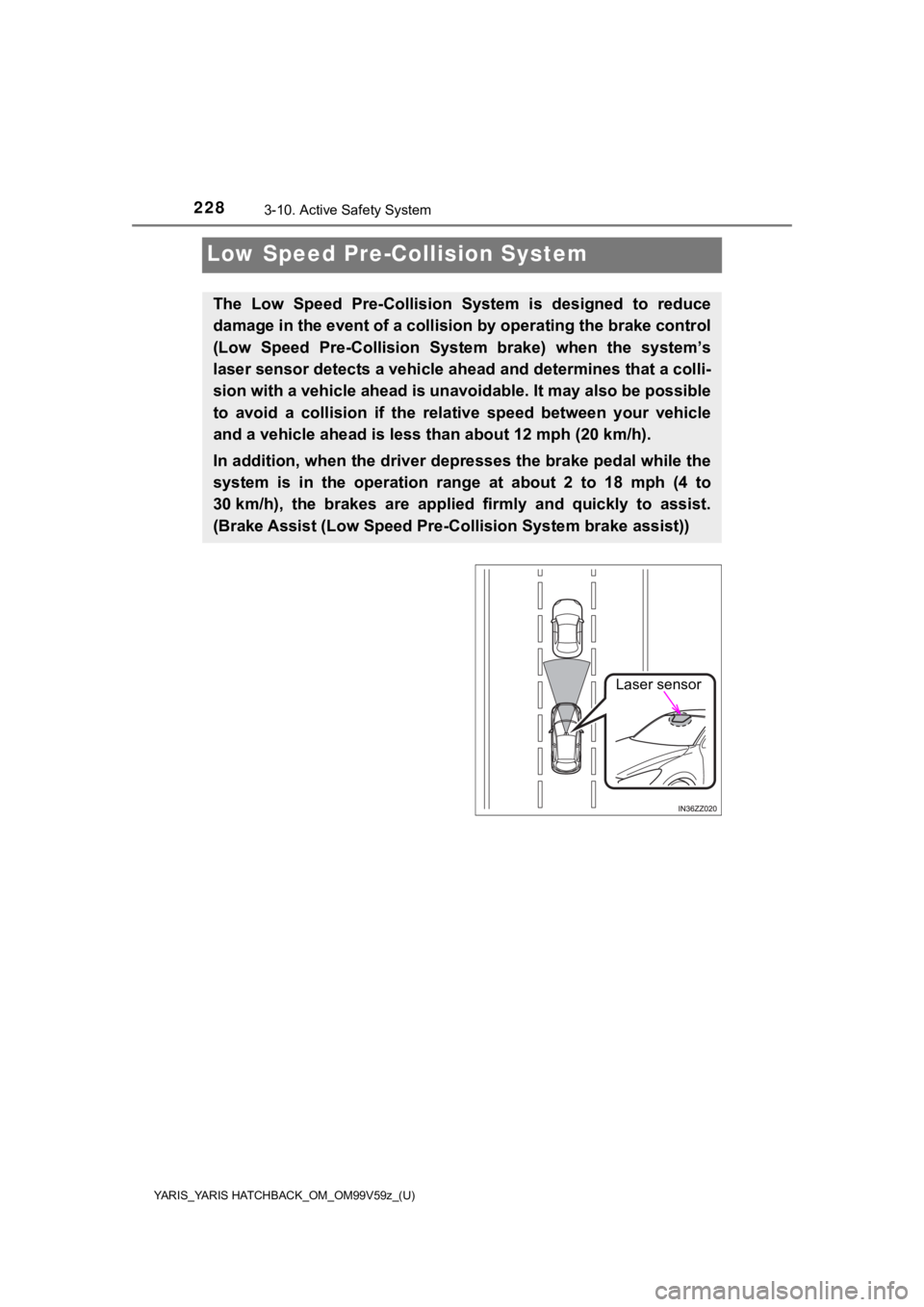
The Low Speed Pre-Collision System is designed to reduce
damage in the event of a colli sion by operating the brake control
(Low Speed Pre-Collision System brake) when the system’s
laser sensor detects a vehicle a head and determines that a colli-
sion with a vehicle ahead is unavo idable. It may also be possible
to avoid a collision if the relat ive speed between your vehicle
and a vehicle ahead is less than about 12 mph (20 km/h).
In addition, when the driver depresses the brake pedal while th e
system is in the operation range at about 2 to 18 mph (4 to
30 km/h), the brakes are applied firmly and quickly to assist.
(Brake Assist (Low Speed Pre-Collision System brake assist))
Laser sensor
Page 401 of 572
401
YARIS_YARIS HATCHBACK_OM_OM99V59z_(U)
5-3. Owner Maintenance
5
Maintenance and Care
Brake/Clutch Fluid
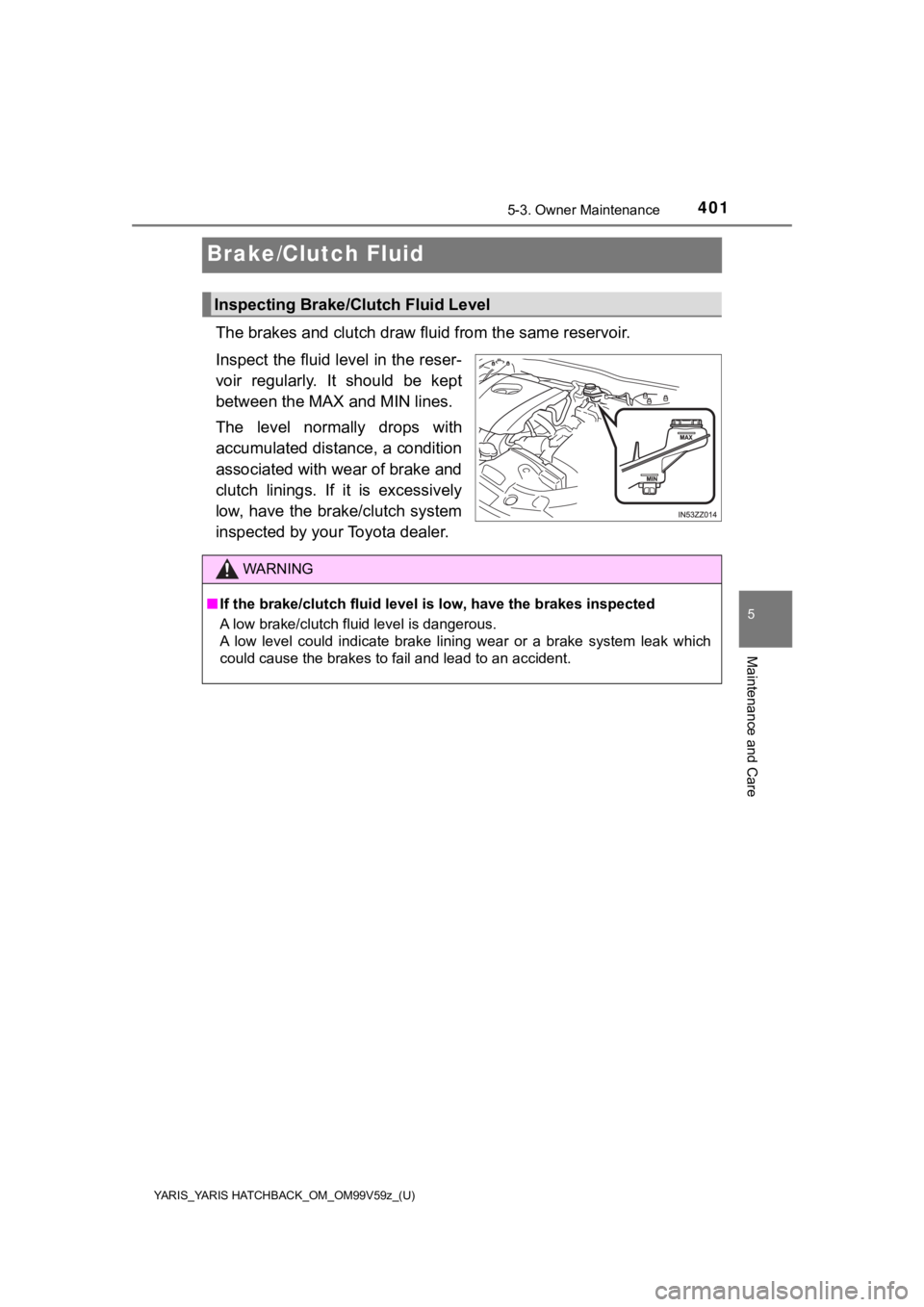
The brakes and clutch draw fluid from the same reservoir.
Inspect the fluid level in the reser-
voir regularly. It should be kept
between the MAX and MIN lines.
The level normally drops with
accumulated distance, a condition
associated with wear of brake and
clutch linings. If it is excessively
low, have the brake/clutch system
inspected by your Toyota dealer.
Inspecting Brake/Clutch Fluid Level
WARNING
■ If the brake/clutch fluid level is low, have the brakes inspect ed
A low brake/clutch fluid level is dangerous.
A low level could indicate brake lining wear or a brake system leak which
could cause the brakes to fail and lead to an accident.
Page 446 of 572
4465-4. Appearance Care
YARIS_YARIS HATCHBACK_OM_OM99V59z_(U)
■Washing
●Toyota is not responsible for scratches caused by automatic car washes or
improper washing.
● Scratches are more noticeable on vehicles with darker paint fin ishes.
■ Waxing
A spot remover to remove oil, tar, and similar materials will usually also take
off the wax. Rewax these areas even if the rest of the vehicle does not need
it.
WARNING
■Dry off brakes that have become wet by driving slowly, releasin g the
accelerator pedal and lightly applying the brakes several times until
the brake performance returns to normal
Driving with wet brakes is dangerous. Increased stopping distan ce or the
vehicle pulling to one side when braking could result in a seri ous accident.
Light braking will indicate whether the brakes have been affect ed.
NOTICE
●When the wiper lever is in the AUTO position and the ignition is switched
ON, the wipers may move automatically in the following cases:
• If the windshield above the rain sensor is touched or wiped with a cloth.
• If the windshield is struck with a hand or other object from e ither outside
or inside the vehicle.
Keep hands and scrapers clear of the windshield when the wiper lever is
in the AUTO position and the ignition is switched ON as fingers could be
pinched or the wipers and wiper blades damaged when the wipers acti-
vate automatically.
If you are going to clean the windshield, be sure the wipers ar e turned off
completely (when it is most likely that the engine is left runn ing) this is par-
ticularly important when clearing ice and snow.
● Do not spray water in the engine compartment. Otherwise, it cou ld result in
engine-starting problems or damage to electrical parts.
● When washing and waxing the vehicle, be careful not to apply ex cessive
force to any single area of the vehicle roof or the antenna. Otherwise, you
could dent the vehicle or damage the antenna.
● Do not use steel wool, abrasive cleaners, or strong detergents containing
highly alkaline or caustic agents on chrome-plated or anodized aluminum
parts. This may damage the protective coating; also, cleaners a nd deter-
gents may discolor or deteriorate the paint.
Page 448 of 572
4485-4. Appearance Care
YARIS_YARIS HATCHBACK_OM_OM99V59z_(U)
Road chemicals and salt used for ice and snow removal and solvents
used for dust control may collect on the underbody. If not remo ved,
they will speed up rust ing and deterioration of such underbody parts
as fuel lines, frame, floor pan, and exhaust system, even though these
parts may be coated with anti-corrosive material.
Thoroughly flush the underbody and wheel housings with lukewarm or
cold water at the end of each wi nter. Try also to do this every month.
Pay special attention to these areas because they easily hide m ud
and dirt. It will do more harm than good to wet down the road grime
without removing it.
The lower edges of doors, rocker panels, and frame members have
drain holes that should not be clogged. Water trapped there wil l cause
rusting.
A protective coating is provided over the aluminum wheels. Spec ial
care is needed to protect this coating.
Underbody Maintenance
WARNING
■ Dry off brakes that have become wet by driving slowly, releasin g the
accelerator pedal and lightly applying the brakes several times until
the brake performance returns to normal
Driving with wet brakes is dangerous. Increased stopping distan ce or the
vehicle pulling to one side when braking could result in a seri ous accident.
Light braking will indicate whether the brakes have been affect ed.
Aluminum Wheel Maintenance (if equipped)
Page 492 of 572
4926-7. Warning/Indicator Lights and Warning Sounds
YARIS_YARIS HATCHBACK_OM_OM99V59z_(U)
■Power Steering Malfunction Indicator Light
●If the indicator light illuminates/flashes, the power steering will not operate
normally. If this happens, the steering wheel can still be operated, however,
the operation may feel heavy compared to normal, or the steering wheel
could vibrate when turning.
● Repeatedly jerking the steering wheel left and right while the vehicle is
stopped or moving extremely slowly will cause the power steerin g system to
go into protective mode which will make the steering feel heavy , but this
does not indicate a problem. If this occurs, park the vehicle safely and wait
several minutes for the system to return to normal.
WARNING
■ Do not drive with the brake system warning light illuminated. C ontact
your Toyota dealer to have the brakes inspected as soon as poss ible
Driving with the brake system warning light illuminated is dang erous. It indi-
cates that your brakes may not work at all or that they could c ompletely fail
at any time. If this light remains illuminated, after checking that the parking
brake is fully released, have the brakes inspected immediately.
In addition, the effectiveness of the braking may diminish so y ou may need
to depress the brake pedal more strongly than normal to stop th e vehicle.
■ Do not drive with both the ABS warning light and brake warning light
illuminated. Have the vehicle towed to your Toyota dealer to have the
brakes inspected as soon as possible
Driving when the brake system warning light and ABS warning lig ht are illu-
minated simultaneously is dangerous.
When both lights are illuminated, the rear wheels could lock mo re quickly in
an emergency stop than under normal circumstances.
NOTICE
■ Charging System Warning Light
Do not continue driving when the charging system warning light is illumi-
nated because the engine could stop unexpectedly.
■ Engine Oil Warning Light
● Do not run the engine if the oil pressure is low. Otherwise, it could result in
extensive engine damage.
● Do not run the engine if the oil level is low. Otherwise, it co uld result in
extensive engine damage.
■ High Engine Coolant Temperature Warning Light
Do not drive the vehicle with the high engine coolant temperatu re warning
light illuminated. Otherwise, it could result in damage to the engine.
Page 493 of 572
YARIS_YARIS HATCHBACK_OM_OM99V59z_(U)
4936-7. Warning/Indicator Lights and Warning Sounds
6
If Trouble Arises
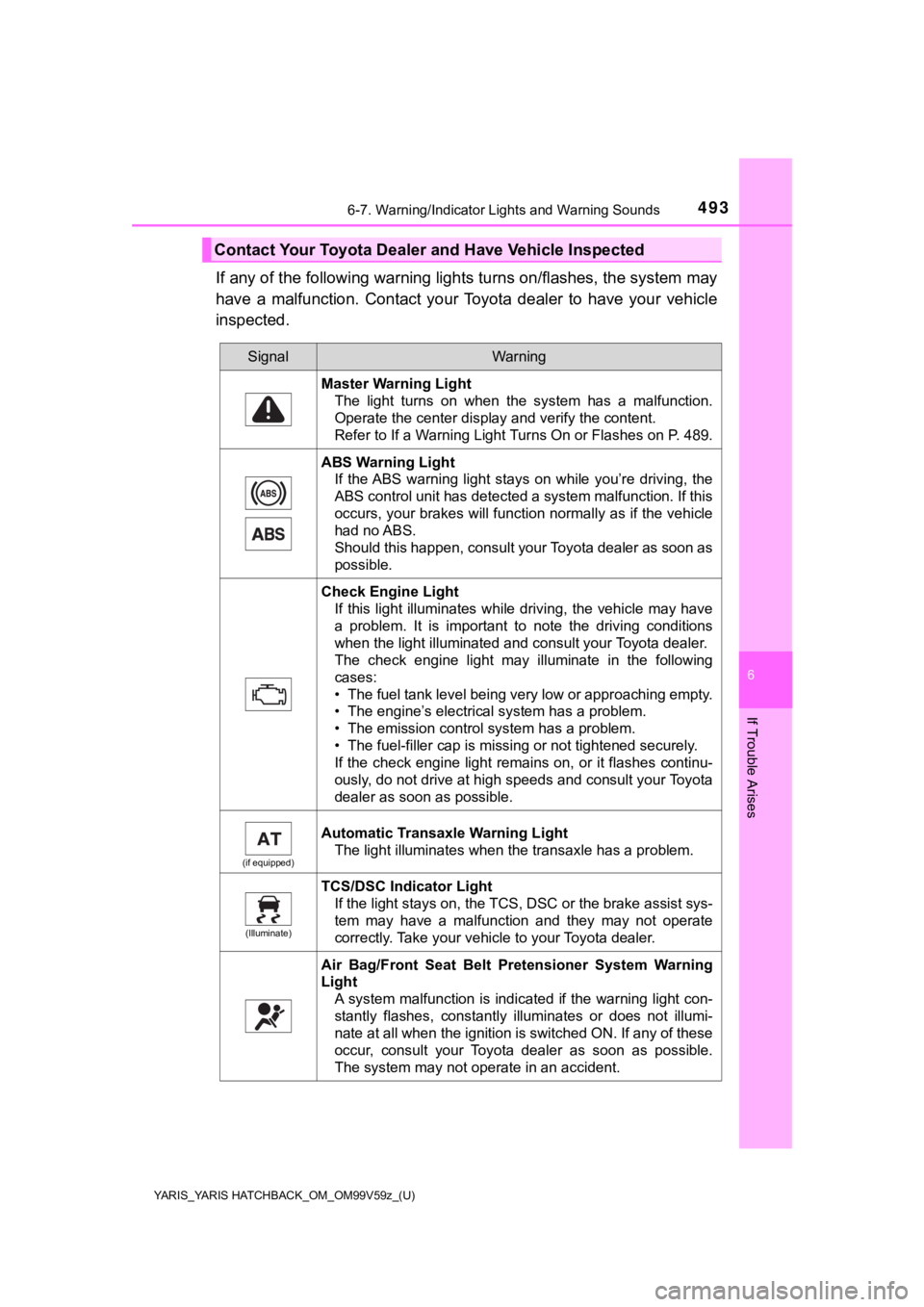
If any of the following warning lights turns on/flashes, the system may
have a malfunction. Contact your Toyota dealer to have your veh icle
inspected.
Contact Your Toyota Dealer and Have Vehicle Inspected
SignalWarning
Master Warning Light The light turns on when the system has a malfunction.
Operate the center display and verify the content.
Refer to If a Warning Light Turns On or Flashes on P. 489.
ABS Warning LightIf the ABS warning light stays on while you’re driving, the
ABS control unit has detected a system malfunction. If this
occurs, your brakes will function normally as if the vehicle
had no ABS.
Should this happen, consult your Toyota dealer as soon as
possible.
Check Engine Light
If this light illuminates while driving, the vehicle may have
a problem. It is important to note the driving conditions
when the light illuminated and consult your Toyota dealer.
The check engine light may illuminate in the following
cases:
• The fuel tank level being very low or approaching empty.
• The engine’s electrical system has a problem.
• The emission control system has a problem.
• The fuel-filler cap is missing or not tightened securely.
If the check engine light remains on, or it flashes continu-
ously, do not drive at high speeds and consult your Toyota
dealer as soon as possible.
(if equipped)
Automatic Transaxle Warning LightThe light illuminates when the transaxle has a problem.
(Illuminate)
TCS/DSC Indicator LightIf the light stays on, the TCS, DSC or the brake assist sys-
tem may have a malfunction and they may not operate
correctly. Take your vehicle to your Toyota dealer.
Air Bag/Front Seat Belt Pretensioner System Warning
LightA system malfunction is indicated if the warning light con-
stantly flashes, constantly illuminates or does not illumi-
nate at all when the ignition is switched ON. If any of these
occur, consult your Toyota dealer as soon as possible.
The system may not operate in an accident.
Page 530 of 572

530
YARIS_YARIS HATCHBACK_OM_OM99V59z_(U)
7-7. Tire Information (U.S.A.)
●Tire Placard: A label indicating the OE tire sizes, recommended
inflation pressure, and the maxi mum weight the vehicle can carry.
● Tire Identification Number (TIN): A number on the sidewall of e ach
tire providing information about the tire brand and manufacturi ng
plant, tire size, and date of manufacture.
● Inflation Pressure: A measure of the amount of air in a tire.
● kPa: Kilopascal, the metri c unit for air pressure.
● psi: Pounds per square inch, the English unit for air pressure.
● B-pillar: The structural member at the si de of the vehicle behind the
front door.
● Original Equipment (OE): Des cribes components originally
equipped on the vehicle.
● Vehicle Load Limit: The maximum value of the combination weight
of occupants and cargo.
● Bead Area of the Tire: Area of the tire ne xt to the rim.
● Sidewall Area of the Tire: Area between the bead area and the
tread.
● Tread Area of the Tire: Area on the perimeter of the tire that con-
tacts the road when it’s mounted on the vehicle.
● Seating capacity means the total allowable number of vehicle oc cu-
pants. Seating capacity is described on the tire label.
● Production options weight is the combination weight of installe d
regular production options weighin g over 2.3 kilograms in excess of
the standard items whic h they replace, and not previously consid-
ered in the curb weight or accessory weight, including heavy du ty
brakes, ride levelers, roof rac k, heavy duty battery, and speci al trim.
● Rim is the metal support (wheel) for a tire or a tire and tube assem-
bly upon which the tire beads are seated.
Glossary of Terms
Page 538 of 572

538
YARIS_YARIS HATCHBACK_OM_OM99V59z_(U)
7-7. Tire Information (U.S.A.)
GCWR (Gross Combination Weight Rating) is the maximum allowable
weight of the vehicle - including all cargo and passengers - that the
vehicle can handle without risk ing damage. The GCW must never
exceed the GCWR.
WARNING
■Do not tow a trailer with this vehicle
Towing a trailer with this vehicle is dangerous because it has not been
designed to tow a trailer and do ing so will affect the drive system which
could result in vehicle damage.
■Overloaded Vehicle
Overloading a vehicle is dangerous. The results of overloading can
have serious consequences in terms of passenger safety. Too muc h
weight on a vehicle’s suspensi on system can cause spring or sho ck
absorber failure, brake failure, handling or steering problems, irregular
tire wear, tire failu re or other damage.
Overloading makes a vehicle harder to drive and control. It als o
increases the distance required for stopping. In cases of serio us over-
loading, brakes can fail completely, particularly on steep grad es. The
load a tire will carry safely is a combination of the size of t he tire, its load
range, and corresponding inflation pressure.
Never overload the vehicle and always observe the vehicle’s wei ght rat-
ings from the vehicle’s Safety C ertification and Tire and Load Informa-
tion labels.
■Never Exceed Axle Weight Rating Limits
Exceeding the Safety Certification Label axle weight rating lim its is dan-
gerous and could result in death or serious injury as a result of substan-
dard vehicle handling, performance, engine, transmission and/or
structural damage, serious damage to the vehicle, or loss of control.
Always keep the vehicle within the axle weight rating limits.
■Never Exceed GVWR or GAWR Specifications
Exceeding the GVWR or the GAWR specified on the certification l abel is
dangerous. Exceeding any vehicle rating limitation could result in a seri-
ous accident, injury, or damage to the vehicle.
Do not use replacement tires with lower load carrying capacities than
the originals because they may lower the vehicle’s GVWR and GAW R
limitations. Replacement tires with a higher limit than the ori ginals do
not increase the GVWR and GAWR limitations. Never exceed the
GVWR or the GAWR specified on the certification label.
Page 564 of 572

564Alphabetical index
YARIS_YARIS HATCHBACK_OM_OM99V59z_(U)
Alphabetical index
Accessory Socket.................... 378
Active Safety System .............. 227Laser Sensor ........................ 234
Low Speed Pre-Collision System ............................... 228
Pre-Crash Safety Technology ......................... 227
Add-On Non-Genuine Parts
and Accessories.................... 514
Advanced Key Advanced keyless entry
system ......... ......................... 99
Operational range ................. 100
Advanced Keyless Entry
System ..................................... 99
Air Bag/Front Seat Belt Pretensioner System
Warning Beep ........................ 502
Air Bag Systems ........................ 66
Ambient Temperature Display ................................... 170
Antilock Brake System (ABS) ...................................... 215
Audio Control Switch Adjusting the Volume ............ 304
Seek Switch .......................... 305
Audio System........................... 271
Antenna ................................ 271
Audio Control Switch ............ 304
Audio Set .............................. 283
AUX/USB mode .................... 307
Operating Tips for Audio System ............................... 273 Automatic Transaxle ............... 181
Active Adaptive Shift
(AAS).................................. 184
Driving tips ............................ 191
Manual shift mode ................ 185
Shift-lock override ................. 185
Shift-lock system .................. 184
Shift position indication ......... 182
Transaxle ranges .................. 182
Warning light......................... 182
Battery ...................................... 408 Maintenance ......................... 409
Replacement ........................ 409
Specifications ....................... 548
Battery runs out....................... 478
Jump-Starting ....................... 478
Beep Sounds Key left-in-trunk
compartment warning......... 504
Key left-in-vehicle warning............................... 505
Request switch inoperable warning............................... 504
Bluetooth
®............................... 327
Bluetooth® Audio .................. 353
Bluetooth® Hands-Free ........ 339
Troubleshooting .................... 366
Body Lubrication ..................... 403
Bottle Holder ............................ 380
Brakes Brake assist .......................... 212
Foot brake ............................ 209
Pad wear indicator ................ 211
Parking brake ....................... 210
Warning light......................... 211
Break-In Period ........................ 141
A
B