seats TOYOTA YARIS HYBRID 2014 Owners Manual
[x] Cancel search | Manufacturer: TOYOTA, Model Year: 2014, Model line: YARIS HYBRID, Model: TOYOTA YARIS HYBRID 2014Pages: 464, PDF Size: 23.4 MB
Page 2 of 464

TABLE OF CONTENTS2
For your information .......................6
Reading this manual.....................10
How to search ..............................11
Pictorial index ...............................12
1-1. For safe use
Before driving.......................28
For safety drive ....................30
Seat belts .............................32
SRS airbags.........................39
Airbag manual on-off sys-
tem.................................... 50
Safety information for chil-
dren....................................52
Child restraint systems ........53
Installing child restraints ......63
Exhaust gas precautions .....72
1-2. Hybrid system
Hybrid system features ........73
Hybrid system precautions ..77
1-3. Theft deterrent system
Immobilizer system ..............82
Double locking system .........87
2. Instrument cluster
Warning lights and indica-
tor.......................................90
Gauges and meters .............95
Multi-information display ......98
Energy monitor/consumption
screen ..............................1023-1. Key information
Keys .................................. 108
3-2. Opening, closing and locking
the doors
Side doors ......................... 120
Back door .......................... 126
Smart entry & start system 132
3-3. Adjusting the seats
Front seats ........................ 147
Rear seats ......................... 149
Head restraints .................. 152
3-4. Adjusting the steering wheel
and mirrors
Steering wheel .................. 154
Inside rear view mirror....... 156
Outside rear view mirrors .. 158
3-5. Opening and closing the win-
dows
Power windows ................. 161
1For safety and security
2Instrument cluster
3Operation of each compo-
nent
Page 18 of 464
18Pictorial index
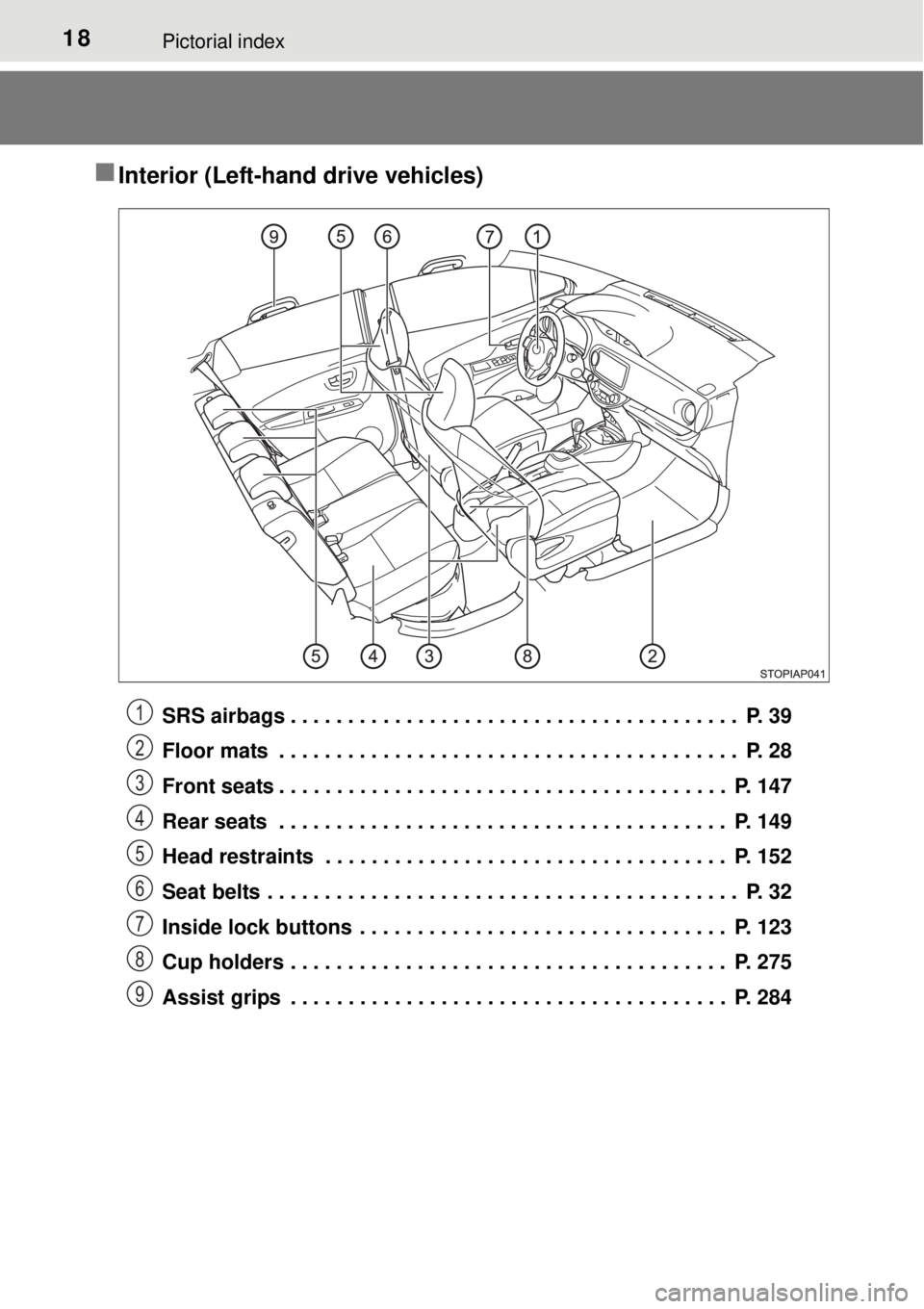
Interior (Left-hand drive vehicles)
SRS airbags . . . . . . . . . . . . . . . . . . . . . . . . . . . . . . . . . . . . . . . P. 39
Floor mats . . . . . . . . . . . . . . . . . . . . . . . . . . . . . . . . . . . . . . . . P. 28
Front seats . . . . . . . . . . . . . . . . . . . . . . . . . . . . . . . . . . . . . . . P. 147
Rear seats . . . . . . . . . . . . . . . . . . . . . . . . . . . . . . . . . . . . . . . P. 149
Head restraints . . . . . . . . . . . . . . . . . . . . . . . . . . . . . . . . . . . P. 152
Seat belts . . . . . . . . . . . . . . . . . . . . . . . . . . . . . . . . . . . . . . . . . P. 32
Inside lock buttons . . . . . . . . . . . . . . . . . . . . . . . . . . . . . . . . P. 123
Cup holders . . . . . . . . . . . . . . . . . . . . . . . . . . . . . . . . . . . . . . P. 275
Assist grips . . . . . . . . . . . . . . . . . . . . . . . . . . . . . . . . . . . . . . P. 2841
2
3
4
5
6
7
8
9
Page 24 of 464
24Pictorial index
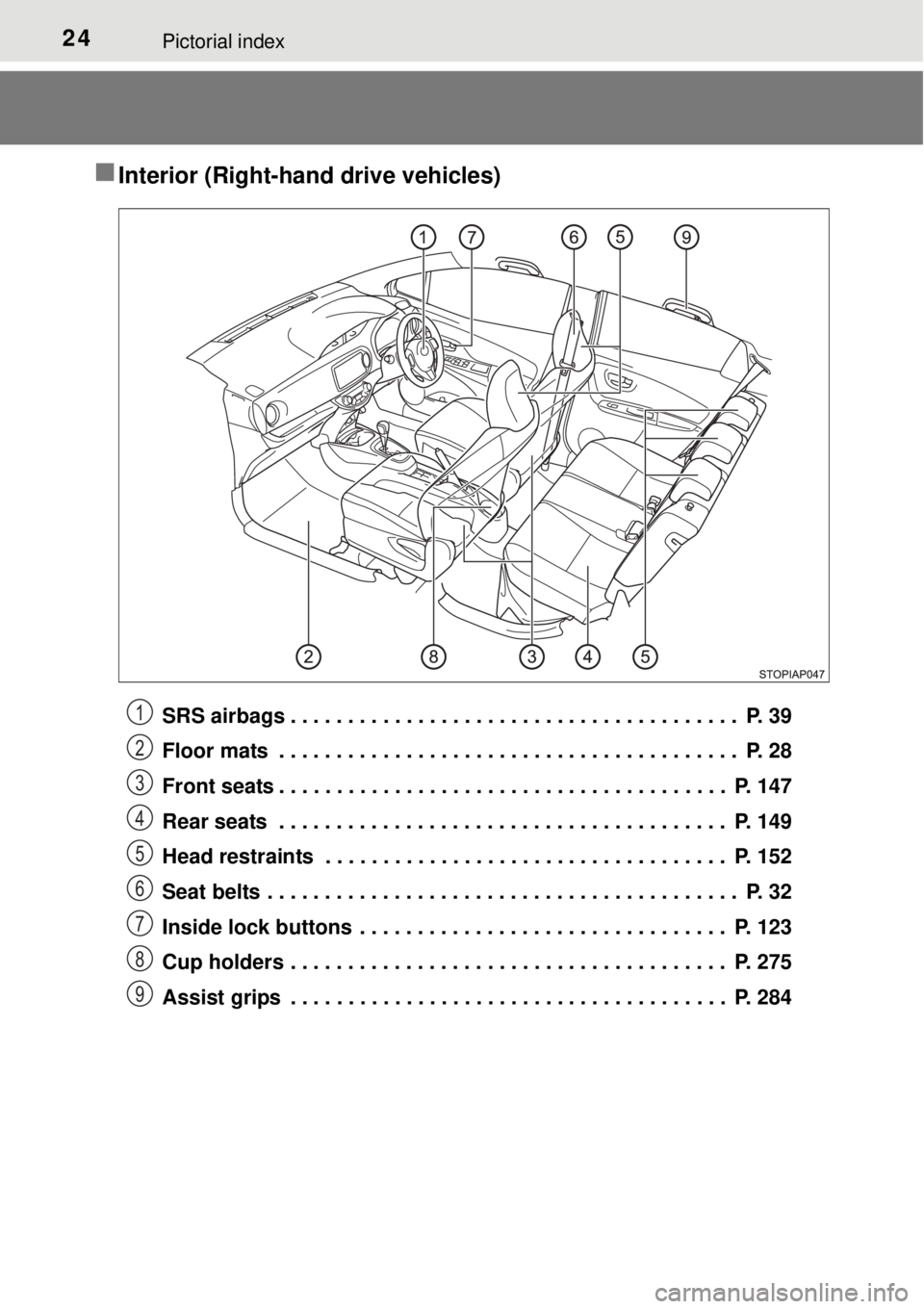
Interior (Right-hand drive vehicles)
SRS airbags . . . . . . . . . . . . . . . . . . . . . . . . . . . . . . . . . . . . . . . P. 39
Floor mats . . . . . . . . . . . . . . . . . . . . . . . . . . . . . . . . . . . . . . . . P. 28
Front seats . . . . . . . . . . . . . . . . . . . . . . . . . . . . . . . . . . . . . . . P. 147
Rear seats . . . . . . . . . . . . . . . . . . . . . . . . . . . . . . . . . . . . . . . P. 149
Head restraints . . . . . . . . . . . . . . . . . . . . . . . . . . . . . . . . . . . P. 152
Seat belts . . . . . . . . . . . . . . . . . . . . . . . . . . . . . . . . . . . . . . . . . P. 32
Inside lock buttons . . . . . . . . . . . . . . . . . . . . . . . . . . . . . . . . P. 123
Cup holders . . . . . . . . . . . . . . . . . . . . . . . . . . . . . . . . . . . . . . P. 275
Assist grips . . . . . . . . . . . . . . . . . . . . . . . . . . . . . . . . . . . . . . P. 2841
2
3
4
5
6
7
8
9
Page 31 of 464

311-1. For safe use
1
For safety and security
WARNING
Observe the following precautions.
Failure to do so may result in death or serious injury.
Do not adjust the position of the driver’s seat while driving.
Doing so could cause the driver to lose control of the vehicle.
Do not place a cushion between the driver or passenger and the seatback.
A cushion may prevent correct posture from being achieved, and reduce
the effectiveness of the seat belt and head restraint.
Do not place anything under the front seats.
Objects placed under the front seats may become jammed in the seat
tracks and stop the seat from locking in place. This may lead to an acci-
dent and the adjustment mechanism may also be damaged.
When driving over long distances, take regular breaks before you start to
feel tired.
Also, if you feel tired or sleepy while driving, do not force yourself to con-
tinue driving and take a break immediately.
Page 36 of 464
361-1. For safe use
WARNING
Observe the following precautions to reduce the risk of injury in the event of
sudden braking, sudden swerving or an accident.
Failure to do so may cause death or serious injury.
Wearing a seat belt
Ensure that all passengers wear a seat belt.
Always wear a seat belt properly.
Each seat belt should be used by one person only. Do not use a seat belt
for more than one person at once, including children.
Toyota recommends that children be seated in the rear seat and always
use a seat belt and/or an appropriate child restraint system.
To achieve a proper seating position, do not recline the seat more than
necessary. The seat belt is most effective when the occupants are sitting
up straight and well back in the seats.
Do not wear the shoulder belt under your arm.
Always wear your seat belt low and snug across your hips.
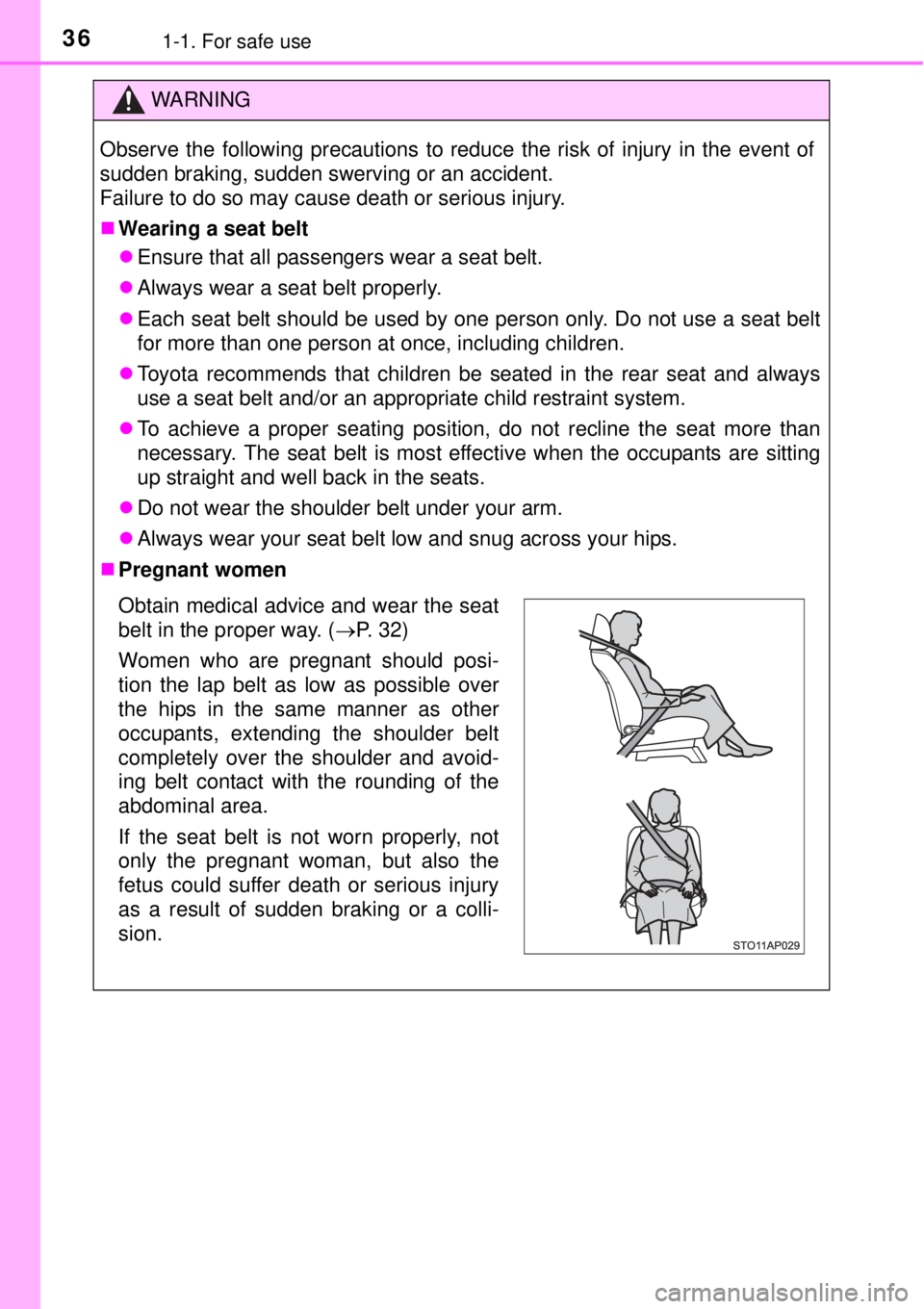
Pregnant women
Obtain medical advice and wear the seat
belt in the proper way. (P. 32)
Women who are pregnant should posi-
tion the lap belt as low as possible over
the hips in the same manner as other
occupants, extending the shoulder belt
completely over the shoulder and avoid-
ing belt contact with the rounding of the
abdominal area.
If the seat belt is not worn properly, not
only the pregnant woman, but also the
fetus could suffer death or serious injury
as a result of sudden braking or a colli-
sion.
Page 39 of 464
391-1. For safe use
1
For safety and security
SRS airbags
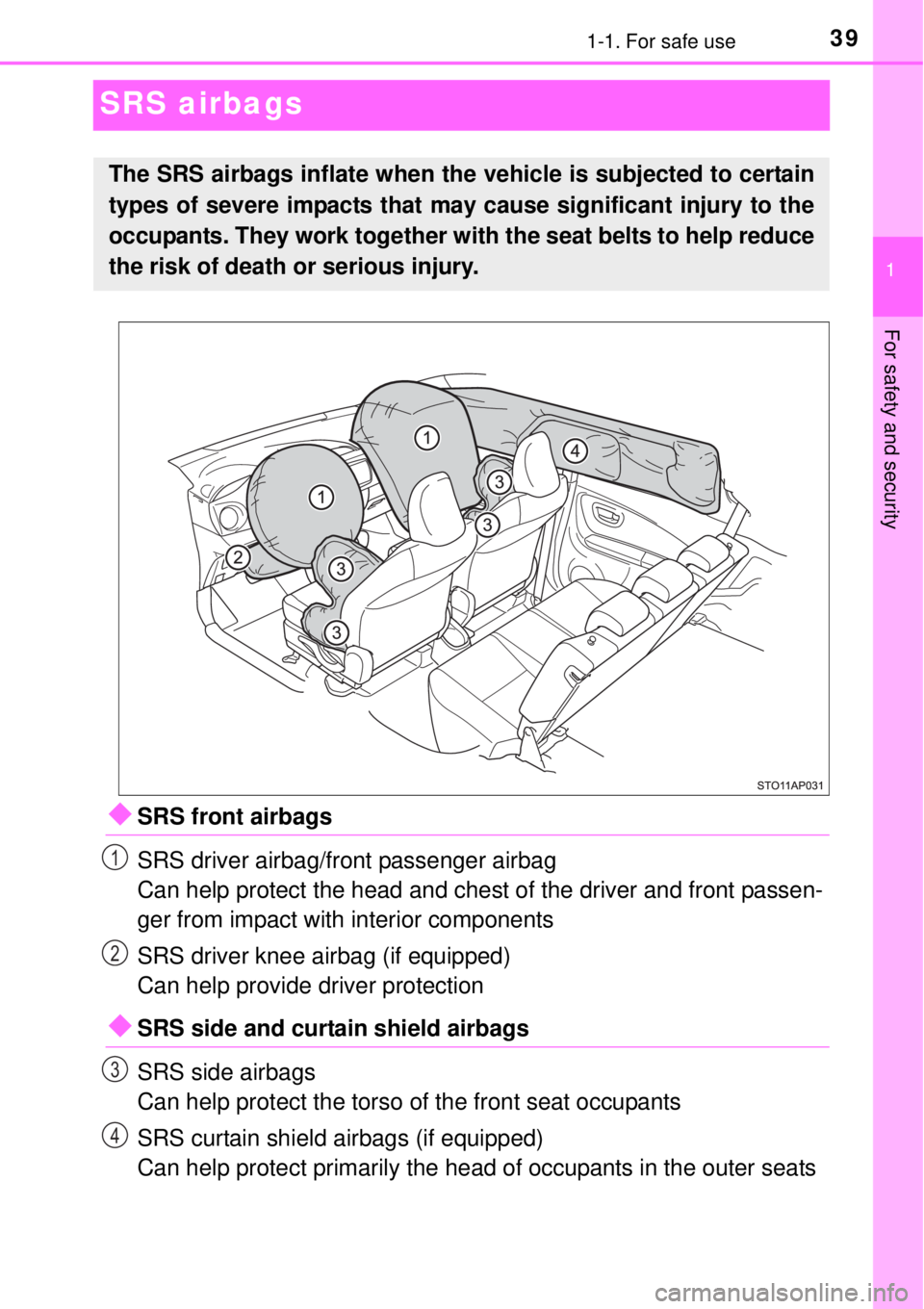
SRS front airbags
SRS driver airbag/front passenger airbag
Can help protect the head and chest of the driver and front passen-
ger from impact with interior components
SRS driver knee airbag (if equipped)
Can help provide driver protection
SRS side and curtain shield airbags
SRS side airbags
Can help protect the torso of the front seat occupants
SRS curtain shield airbags (if equipped)
Can help protect primarily the head of occupants in the outer seats
The SRS airbags inflate when the vehicle is subjected to certain
types of severe impacts that may cause significant injury to the
occupants. They work together with the seat belts to help reduce
the risk of death or serious injury.
1
2
3
4
Page 41 of 464

411-1. For safe use
1
For safety and security
WARNING
SRS airbag precautions
Observe the following precautions regarding the SRS airbags.
Failure to do so may cause death or serious injury.
The driver and all passengers in the vehicle must wear their seat belts
properly.
The SRS airbags are supplemental devices to be used with the seat belts.
The SRS driver airbag deploys with considerable force, and can cause
death or serious injury especially if the driver is very close to the airbag.
Since the risk zone for the driver’s airbag is the first 50 - 75 mm (2 - 3 in.)
of inflation, placing yourself 250 mm (10 in.) from your driver airbag pro-
vides you with a clear margin of safety. This distance is measured from
the center of the steering wheel to your breastbone. If you sit less than
250 mm (10 in.) away now, you can change your driving position in sev-
eral ways:
• Move your seat to the rear as far as you can while still reaching the ped-
als comfortably.
• Slightly recline the back of the seat. Although vehicle designs vary,
many drivers can achieve the 250 mm (10 in.) distance, even with the
driver seat all the way forward, simply by reclining the back of the seat
somewhat. If reclining the back of your seat makes it hard to see the
road, raise yourself by using a firm, non-slippery cushion, or raise the
seat if your vehicle has that feature.
• If your steering wheel is adjustable, tilt it downward. This points the air-
bag toward your chest instead of your head and neck.
The seat should be adjusted as recommended above, while still maintain-
ing control of the foot pedals, steering wheel, and your view of the instru-
ment panel controls.
The SRS front passenger airbag also deploys with considerable force, and
can cause death or serious injury especially if the front passenger is very
close to the airbag. The front passenger seat should be as far from the air-
bag as possible with the seatback adjusted, so the front passenger sits
upright.
Improperly seated and/or restrained infants and children can be killed or
seriously injured by a deploying airbag. An infant or child who is too small
to use a seat belt should be properly secured using a child restraint sys-
tem. Toyota strongly recommends that all infants and children be placed in
the rear seats of the vehicle and properly restrained. The rear seats are
safer for infants and children than the front passenger seat. (P. 53)
Page 45 of 464

451-1. For safe use
1
For safety and security
WARNING
Modification and disposal of SRS airbag system components
Do not dispose of your vehicle or perform any of the following modifications
without consulting any authorized Toyota dealer or repairer, or another duly
qualified and equipped professional. The SRS airbags may malfunction or
deploy (inflate) accidentally, causing death or serious injury.
Installation, removal, disassembly and repair of the SRS airbags
Repairs, modifications, removal or replacement of the steering wheel,
instrument panel, dashboard, seats or seat upholstery, front, side and rear
pillars or roof side rails
Repairs or modifications of the front fender, front bumper, or side of the
occupant compartment
Installation of a grille guard (bull bars, kangaroo bar, etc.), snow plows,
winches
Modifications to the vehicle’s suspension system
Installation of electronic devices such as mobile two-way radios (RF-trans-
mitter) and CD players
Page 46 of 464

461-1. For safe use
If the SRS airbags deploy (inflate)
Bruising and slight abrasions may result from contact with a deploying
(inflating) SRS airbag.
A loud noise and white powder will be emitted.
Vehicles without SRS curtain shield airbags: Parts of the airbag module
(steering wheel hub, airbag cover and inflator) as well as the front seats may
be hot for several minutes. The airbag itself may also be hot.
Vehicles with SRS curtain shield airbags: Parts of the airbag module (steer-
ing wheel hub, airbag cover and inflator) as well as the front seats, parts of
the front and rear pillars, and roof side rails, may be hot for several minutes.
The airbag itself may also be hot.
The windshield may crack.
SRS airbag deployment conditions (SRS front airbags)
The SRS front airbags will deploy in the event of an impact that exceeds the
set threshold level (the level of force corresponding to an approximately 20 -
30 km/h [12 - 18 mph] frontal collision with a fixed wall that does not move or
deform).
However, this threshold velocity will be considerably higher in the following
situations:
• If the vehicle strikes an object, such as a parked vehicle or sign pole,
which can move or deform on impact
• If the vehicle is involved in an underride collision, such as a collision in
which the front of the vehicle “underrides”, or goes under, the bed of a
truck
Depending on the type of collision, it is possible that only the seat belt pre-
tensioners will activate.
SRS airbag deployment conditions (SRS side airbags and SRS curtain
shield airbags [if equipped])
The SRS side and curtain shield airbags will deploy in the event of an impact
that exceeds the set threshold level (the level of force corresponding to the
impact force produced by an approximately 1500 kg [3300 lb.] vehicle collid-
ing with the vehicle cabin from a direction perpendicular to the vehicle orien-
tation at an approximate speed of 20 - 30 km/h [12 - 18 mph]).
Page 49 of 464
491-1. For safe use
1
For safety and security
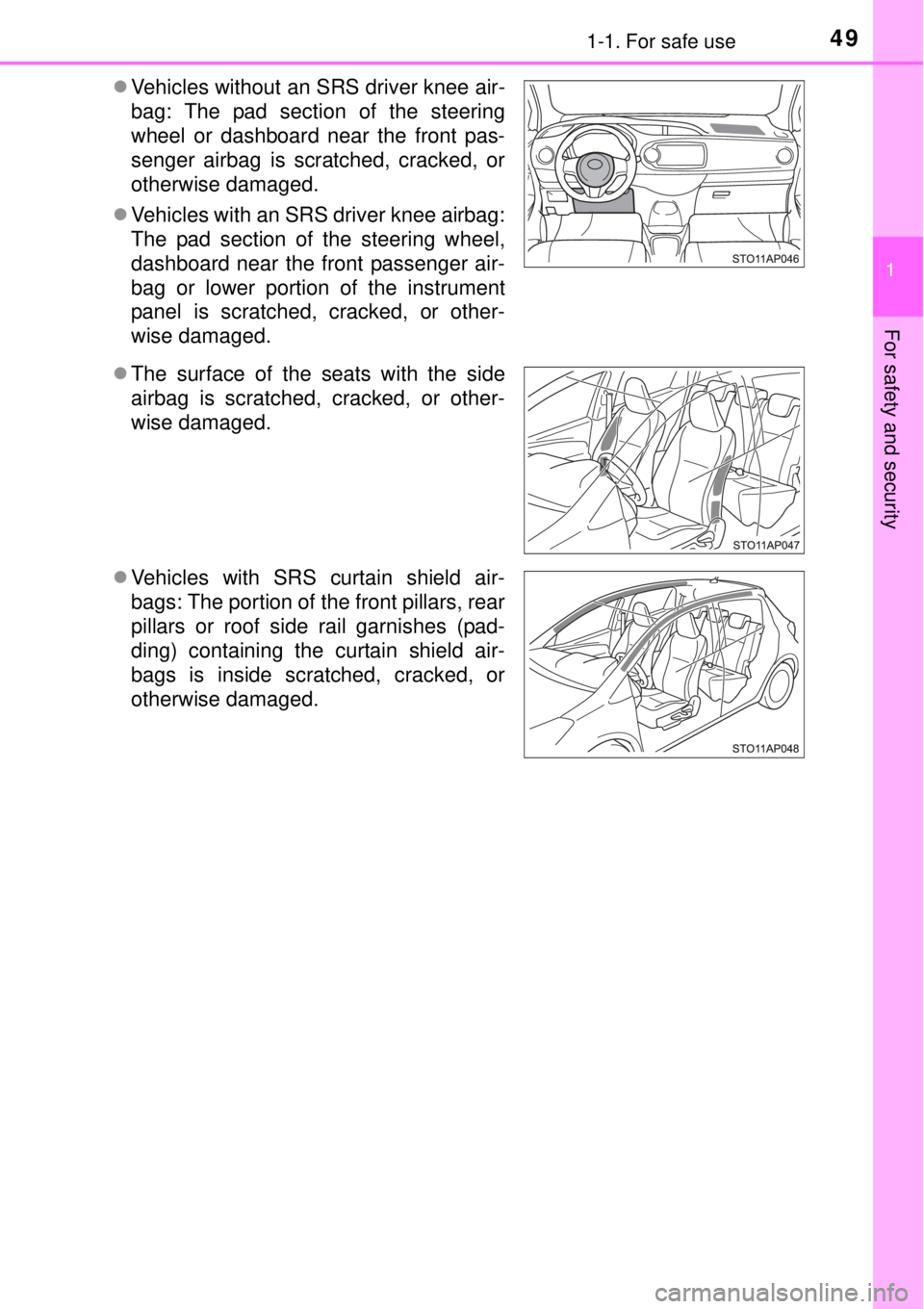
Vehicles without an SRS driver knee air-
bag: The pad section of the steering
wheel or dashboard near the front pas-
senger airbag is scratched, cracked, or
otherwise damaged.
Vehicles with an SRS driver knee airbag:
The pad section of the steering wheel,
dashboard near the front passenger air-
bag or lower portion of the instrument
panel is scratched, cracked, or other-
wise damaged.
The surface of the seats with the side
airbag is scratched, cracked, or other-
wise damaged.
Vehicles with SRS curtain shield air-
bags: The portion of the front pillars, rear
pillars or roof side rail garnishes (pad-
ding) containing the curtain shield air-
bags is inside scratched, cracked, or
otherwise damaged.