engine TOYOTA YARIS SEDAN 2011 Owners Manual
[x] Cancel search | Manufacturer: TOYOTA, Model Year: 2011, Model line: YARIS SEDAN, Model: TOYOTA YARIS SEDAN 2011Pages: 406, PDF Size: 9.23 MB
Page 329 of 406
5
When trouble arises
319
5-2. Steps to take in an emergency
CAUTION
nUsing the jack
Improper use of the jack may lead to death or serious injuries due to the
vehicle suddenly falling off the jack.
lDo not use the jack for any purpose other than replacing tires or install-
ing and removing tire chains.
lOnly use the jack that comes with this vehicle for replacing a flat tire.
Do not use it on other vehicles, an
d do not use other jacks for replac-
ing tires on this vehicle.
lAlways check that the jack is securely set to the jack point.
lDo not put any part of your body under the vehicle supported by a jack.
lDo not start or run the engine while your vehicle is supported by the
jack.
lDo not raise the vehicle while someone is in it.
lWhen raising the vehicle, do not put an object on or under the jack.
lDo not raise the vehicle to a hei ght greater than that required to
replace the tire.
lUse a jack stand if it is necessary to get under the vehicle.
Take particular care when lowering the vehicle to ensure that no one
working on or near the vehicle will be injured.
nReplacing a flat tire
Observe the following precautions to reduce the risk of death or serious
injury.
lNever use oil or grease on the wheel bolts or wheel nuts.
Oil and grease may cause the wheel nuts to be excessively tightened,
leading to bolt or disc wheel damage. In addition, the oil or grease can
cause the wheel nuts to loosen and the wheel may fall off, causing a
serious accident. Remove any oil or grease from the wheel bolts or
wheel nuts.
lHave the wheel nuts tightened with a torque wrench to 76 ft·lbf (103
N·m, 10.5 kgf·m) as soon as possible after changing wheels.
Failure to follow these precautions could cause the nuts to loosen and
the wheel may fall off, which could lead to an accident causing death
or serious injury.
Page 332 of 406
322
5-2. Steps to take in an emergency
If the engine will not start
If the engine still does not start after following the correct starting
procedure ( →P. 112) or releasing the steering lock (→ P. 112), confirm
the following points.
n The engine will not start even when the starter motor oper-
ates normally.
One of the following may be the cause of the problem.
lThere may not be sufficient fuel in the vehicle’s tank.
Refuel the vehicle.
l The engine may be flooded.
Try to restart the engine once more following correct starting
procedures.
l Vehicles with engine immobilizer system: There may be a
malfunction in the engine immobilizer system.
( → P. 6 3 )
n The starter motor turns over slowly, the interior lights and
headlights are dim, or the horn does not sound or sounds at
a low volume.
One of the following may be the cause of the problem.
lThe battery may be discharged. ( →P. 326)
l The battery terminal connec tions may be loose or corroded.
Page 334 of 406
324
5-2. Steps to take in an emergency
If the shift lever cannot be shifted from P (vehicles with an automatic transmission)
If the shift lever cannot be shifted with your foot on the brake, there
may be a problem with the shift lock system (a system to prevent
accidental operation of the shift lever). Have the vehicle inspected by
your Toyota dealer immediately.
The following steps may be used as an emergency measure to
ensure that the shift lever can be shifted.
Set the parking brake.
Turn the engine switch to the ACC or ON position.
Depress the brake pedal.
Pry the cover up with a flathead screwdriver or equivalent. Press the shift lock override
button.
The shift lever can be shifted
while the button is pressed.
Page 335 of 406
5
When trouble arises
325
5-2. Steps to take in an emergency
If you lose your keys
nIf you lose all your master keys. ( vehicles with engine immobilizer sys-
tem)
You cannot make new keys, the whole engine immobilizer system must be
replaced. New genuine Toyota keys can be made by your Toyota dealer using
the key number stamped on your key number plate. Vehicles with
engine immobilizer system, the dealer will also need the master key.
( → P. 25)
Page 336 of 406
326
5-2. Steps to take in an emergency
If the vehicle batter y is discharged
The following procedures may be used to start the engine if the
vehicle’s battery is discharged.
You can call your Toyota dealer or qualified repair shop.
If you have a set of jumper (or boo ster) cables and a second vehi-
cle with a 12-volt battery, you can jump start your Toyota following
the steps below.
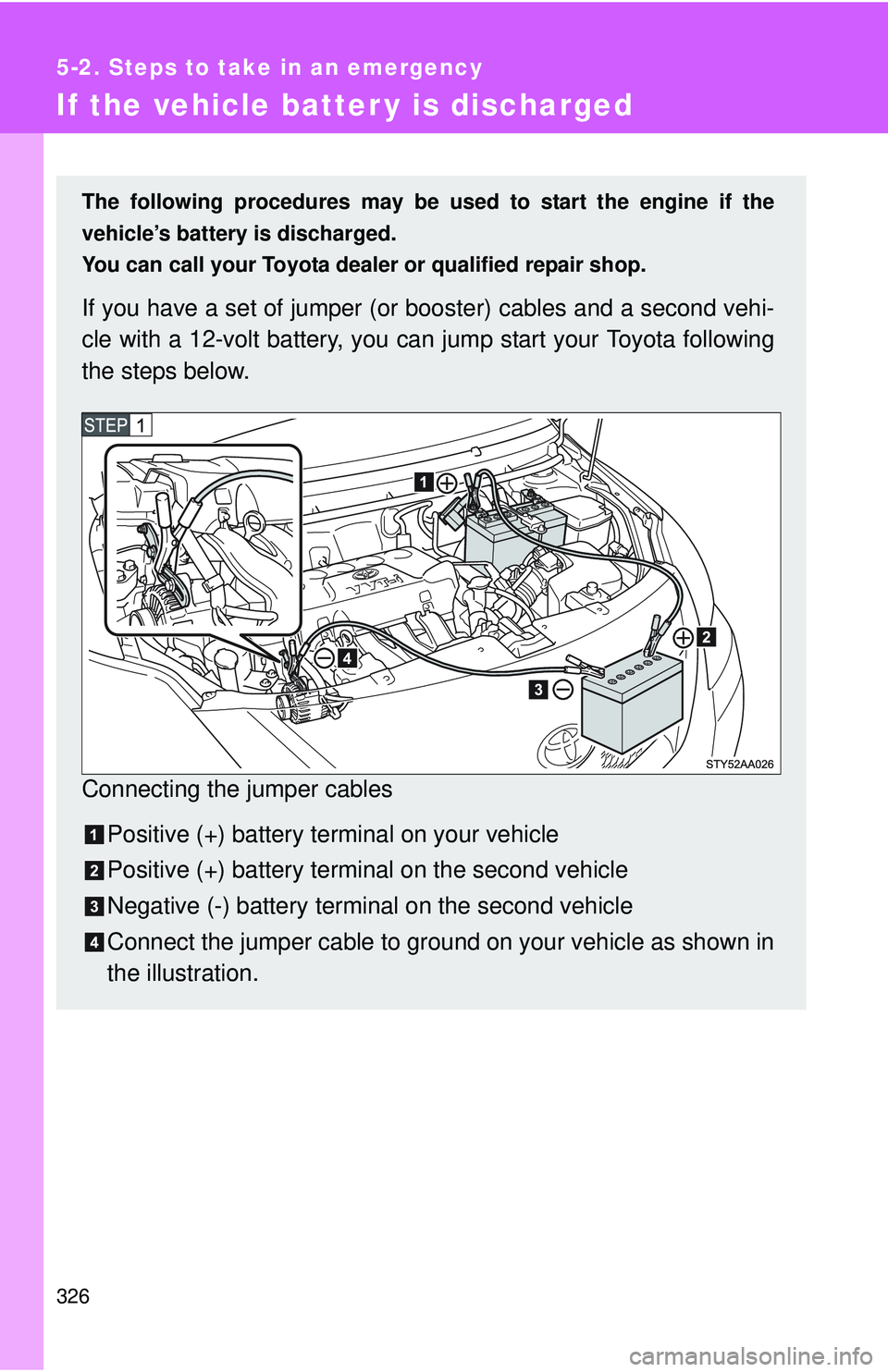
Connecting the jumper cables
Positive (+) battery terminal on your vehicle
Positive (+) battery terminal on the second vehicle
Negative (-) battery terminal on the second vehicle
Connect the jumper cable to ground on your vehicle as shown in
the illustration.
Page 337 of 406
5
When trouble arises
327
5-2. Steps to take in an emergency
n
Starting the engine when the battery is discharged (vehicles with an
automatic transmission)
The engine cannot be started by push-starting.
n Avoiding a discharged battery
lTurn off the headlights and the audio system while the engine is turned
off.
l Turn off any unnecessary electrical components when the vehicle is run-
ning at a low speed for an extended period, such as in heavy traffic, etc.
CAUTION
nAvoiding battery fires or explosions
Observe the following precautions to prevent accidentally igniting the flam-
mable gas that may be emitted from the battery.
lMake sure the jumper cable is connected to the correct terminal and that it
is not unintentionally in contact with any part other than the intended termi-
nal.
l Do not allow the jumper cables to come into contact with the “+” and “-” ter-
minals.
Start the engine of the second vehicle. Increase the engine
speed slightly and maintain at that level for approximately 5
minutes to recharge the battery of your vehicle.
Maintain the engine speed of the second vehicle and start
the vehicle’s engine.
Once the vehicle’s engine has started, remove the jumper
cables in the exact reverse order in which they were con-
nected.
Once the engine starts, have the vehicle checked at your Toyota
dealer as soon as possible.
Page 339 of 406
5
When trouble arises
329
5-2. Steps to take in an emergency
If your vehicle overheats
If your engine overheats:
Stop the vehicle in a safe place and turn off the air condi-
tioning system.
Check to see if steam is coming out from under the hood.
If you see steam: Stop the engine. Carefully lift the hood after the steam
subsides and then restart the engine.
If you do not see steam: Leave the engine running and carefully lift the hood.
Check to see if the cooling fan is operating.
If the fan is operating: Wait until the high engine coolant temperature warning
light goes off and then stop the engine.
If the fan is not operating: Stop the engine immediately and call your local Toyota
dealer.
Page 340 of 406
330 5-2. Steps to take in an emergency
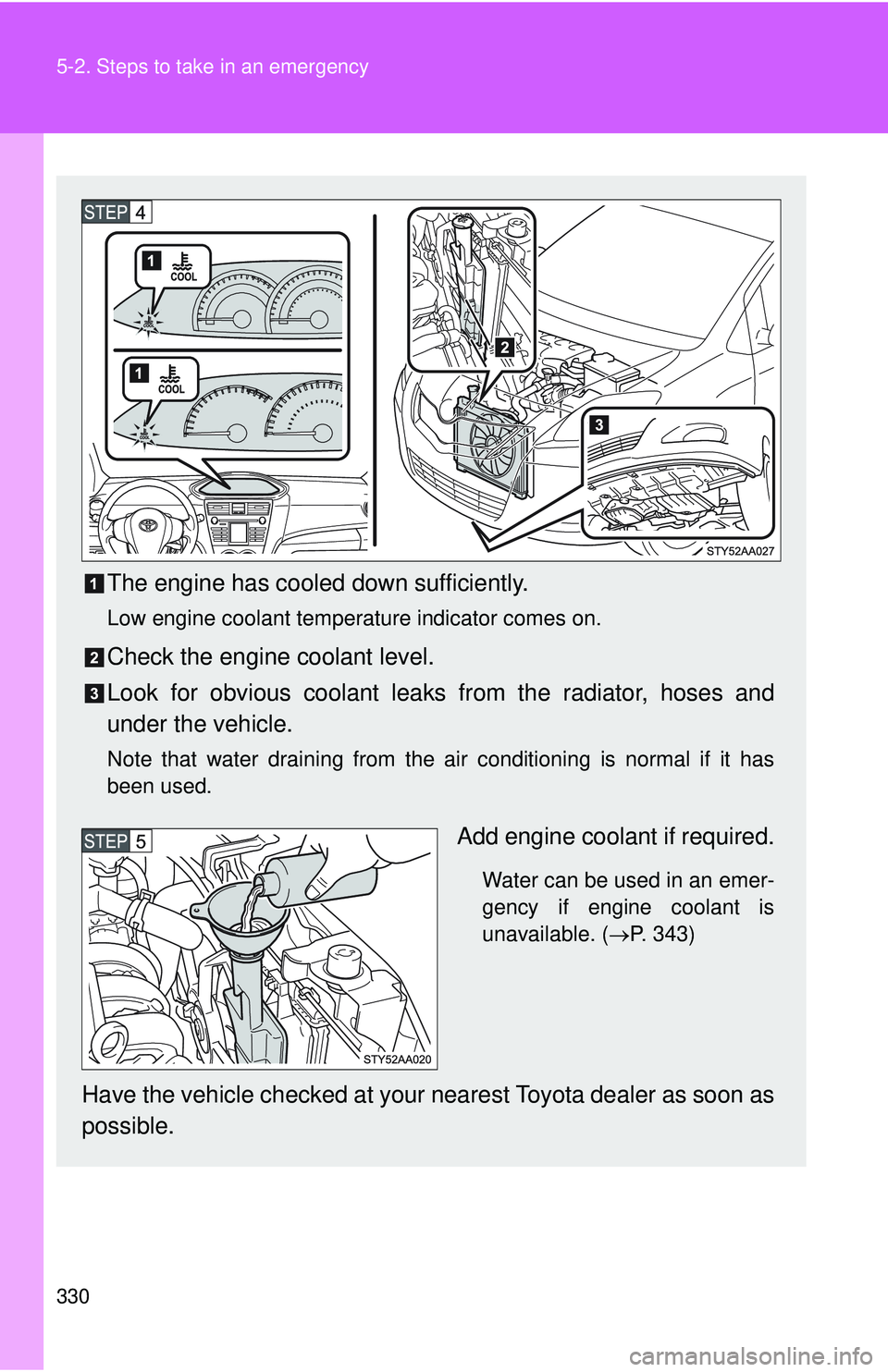
The engine has cooled down sufficiently.
Low engine coolant temperature indicator comes on.
Check the engine coolant level.
Look for obvious coolant leaks from the radiator, hoses and
under the vehicle.
Note that water draining from the air conditioning is normal if it has
been used.
Add engine coolant if required.
Water can be used in an emer-
gency if engine coolant is
unavailable. ( →P. 343)
Have the vehicle checked at your nearest Toyota dealer as soon as
possible.
Page 341 of 406
5
When trouble arises
331
5-2. Steps to take in an emergency
n
Overheating
If you observe the following, your vehicle may be overheating.
lThe high engine coolant temperature warning light flashes or comes on
or a loss of power is experienced.
l Steam is coming from under the hood.
CAUTION
nTo prevent an accident or injury when inspecting under the hood of
your vehicle
lIf steam is seen coming from under the hood, do not open the hood until
the steam has subsided. The engine compartment may be very hot, caus-
ing serious injury such as burns.
l Keep hands and clothing away from the fan and other belts while the
engine is running.
l Do not loosen the radiator cap while the engine and radiator are hot.
Serious injury, such as burns, may result from hot coolant and steam
released under pressure.
NOTICE
nWhen adding engine coolant
Wait until the engine has cooled down before adding engine coolant.
When adding coolant, do so slowly. Adding cool coolant to a hot engine too
quickly can cause damage to the engine.
Page 342 of 406
332
5-2. Steps to take in an emergency
If the vehicle becomes stuck
nEmergency hook Carry out the following procedures if the tires spin or the vehicle
becomes stuck in mud, dirt, or snow.
Stop the engine. Set the parking brake and put the shift
lever in P (vehicles with an automatic transmission) or N
(vehicles with a manual transmission).
Remove the mud, snow, or sand from around the stuck tire.
Place wood, stones or some other material to help provide
traction under the tires.
Restart the engine.
If equipped, turn off the VSC ( →P. 142)
Shift the shift lever to D or R (automatic transmission) or 1
or R (manual transmission) and carefully apply the acceler-
ator to free the vehicle.
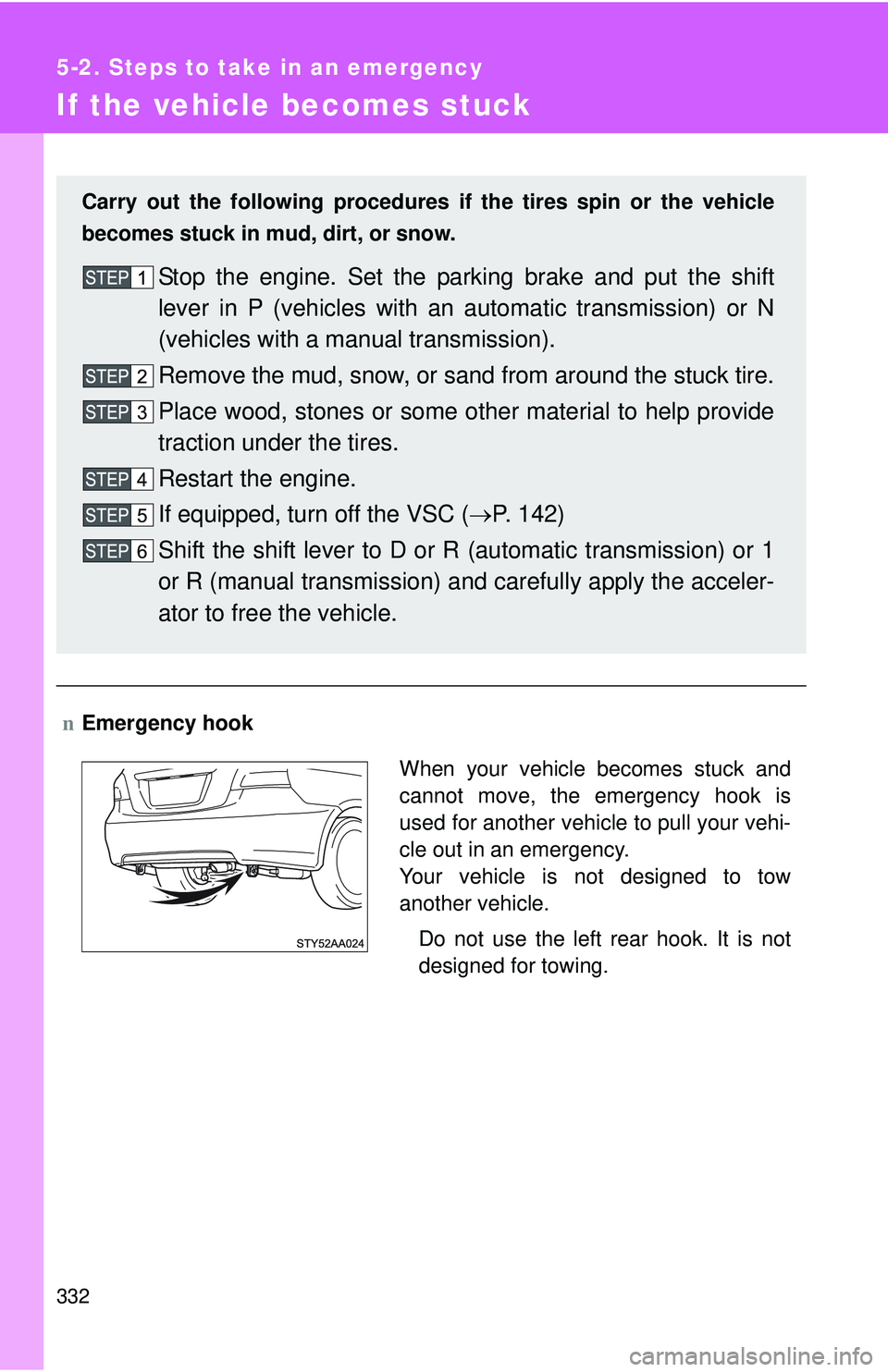
When your vehicle becomes stuck and
cannot move, the emergency hook is
used for another vehicle to pull your vehi-
cle out in an emergency.
Your vehicle is not designed to tow
another vehicle.
Do not use the left rear hook. It is not
designed for towing.