engine TOYOTA YARIS SEDAN 2011 Manual PDF
[x] Cancel search | Manufacturer: TOYOTA, Model Year: 2011, Model line: YARIS SEDAN, Model: TOYOTA YARIS SEDAN 2011Pages: 406, PDF Size: 9.23 MB
Page 254 of 406
243
4-3. Do-it-yourself maintenance
4
Maintenance and care
Engine coolant
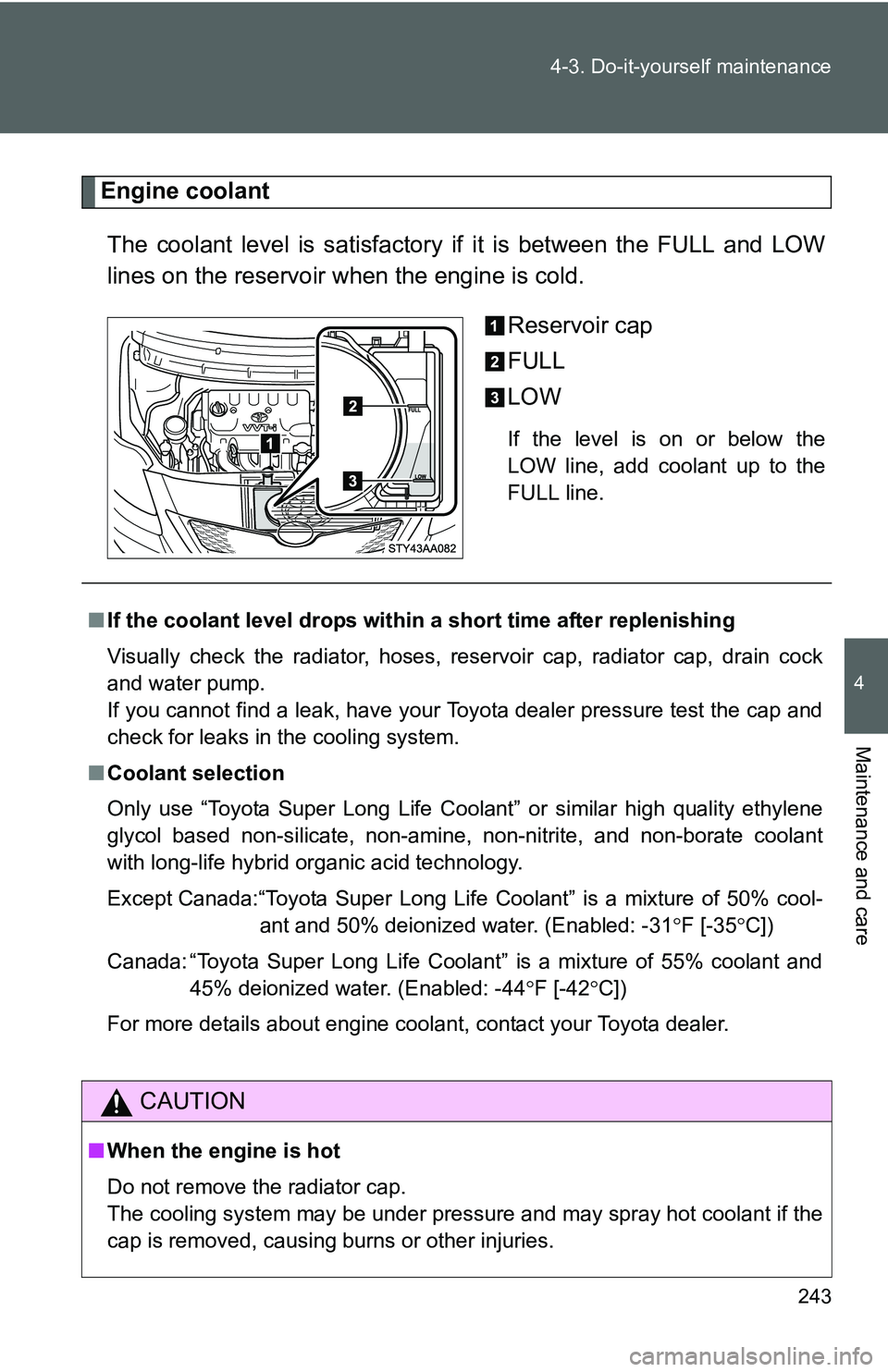
The coolant level is satisfactory if it is between the FULL and LOW
lines on the reservoir when the engine is cold.
Reservoir cap
FULL
LOW
If the level is on or below the
LOW line, add coolant up to the
FULL line.
■If the coolant level drops within a short time after replenishing
Visually check the radiator, hoses, reservoir cap, radiator cap, drain cock
and water pump.
If you cannot find a leak, have your Toyota dealer pressure test the cap and
check for leaks in the cooling system.
■ Coolant selection
Only use “Toyota Super Long Life Coolant” or similar high quality ethylene
glycol based non-silicate, non-amine, non-nitrite, and non-borate coolant
with long-life hybrid organic acid technology.
Except Canada:“Toyota Super Long Life Coolant” is a mixture of 50% cool- ant and 50% deionized water. (Enabled: -31 °F [-35 °C])
Canada: “Toyota Super Long Life Coolant” is a mixture of 55% coolant and 45% deionized water. (Enabled: -44 °F [-42 °C])
For more details about engine coolant, contact your Toyota dealer.
CAUTION
■ When the engine is hot
Do not remove the radiator cap.
The cooling system may be under pressure and may spray hot coolant if the
cap is removed, causing burns or other injuries.
Page 255 of 406
244 4-3. Do-it-yourself maintenance
Radiator and condenserCheck the radiator and condenser and clear any foreign objects.
If either of the above parts are ex tremely dirty or you are not sure of
their condition, have your vehicl e checked by your Toyota dealer.
Brake fluid
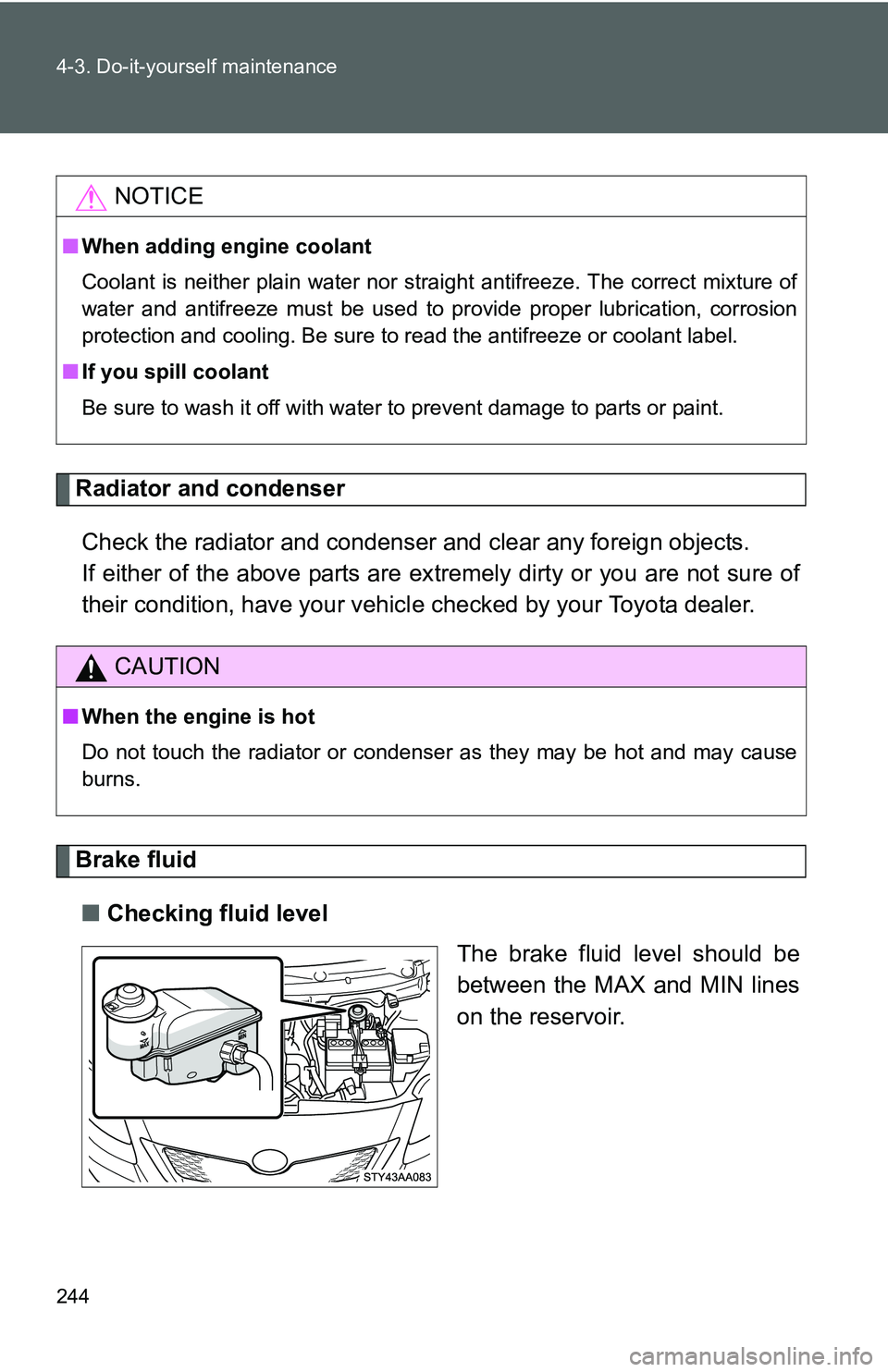
■ Checking fluid level
The brake fluid level should be
between the MAX and MIN lines
on the reservoir.
NOTICE
■When adding engine coolant
Coolant is neither plain water nor stra ight antifreeze. The correct mixture of
water and antifreeze must be used to provide proper lubrication, corrosion
protection and cooling. Be sure to read the antifreeze or coolant label.
■ If you spill coolant
Be sure to wash it off with water to prevent damage to parts or paint.
CAUTION
■When the engine is hot
Do not touch the radiator or condenser as they may be hot and may cause
burns.
Page 259 of 406
248 4-3. Do-it-yourself maintenance
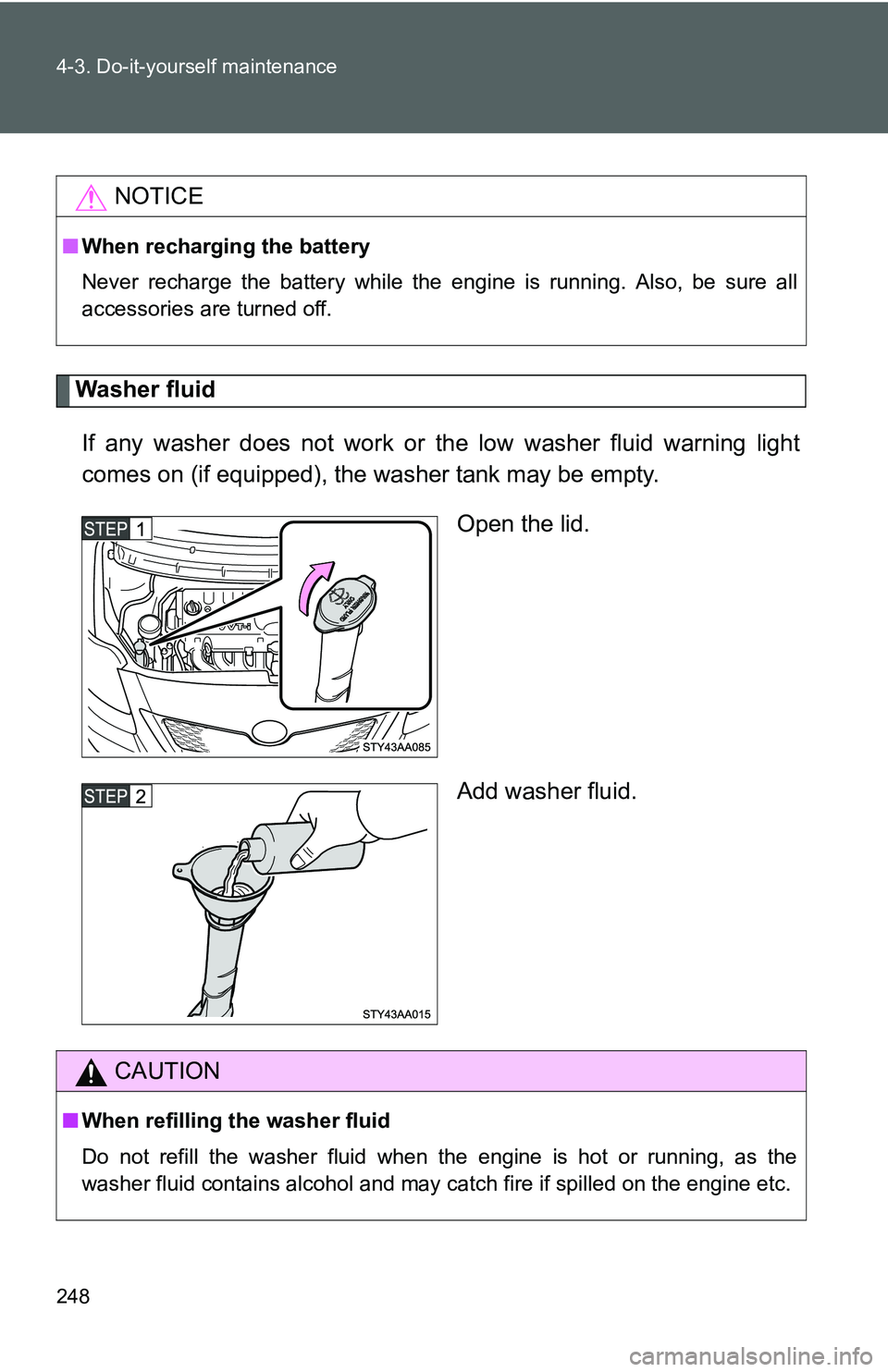
Washer fluidIf any washer does not work or the low washer fluid warning light
comes on (if equipped), the wa sher tank may be empty.
Open the lid.
Add washer fluid.
NOTICE
■When recharging the battery
Never recharge the battery while the engine is running. Also, be sure all
accessories are turned off.
CAUTION
■When refilling the washer fluid
Do not refill the washer fluid when the engine is hot or running, as the
washer fluid contains alcohol and may catch fire if spilled on the engine etc.
Page 260 of 406
249
4-3. Do-it-yourself maintenance
4
Maintenance and care
NOTICE
■
Do not use any fluid other than washer fluid
Do not use soapy water or engine antifreeze instead of washer fluid.
Doing so may cause streaking on the vehicle’s painted surfaces.
■ Diluting washer fluid
Dilute washer fluid with water as necessary.
Refer to the freezing temperatures listed on the washer fluid tank.
Page 273 of 406
262
4-3. Do-it-yourself maintenance
Air conditioning filter∗
∗: If equipped
The air conditioning filter must be changed regularly to maintain air
conditioning efficiency.
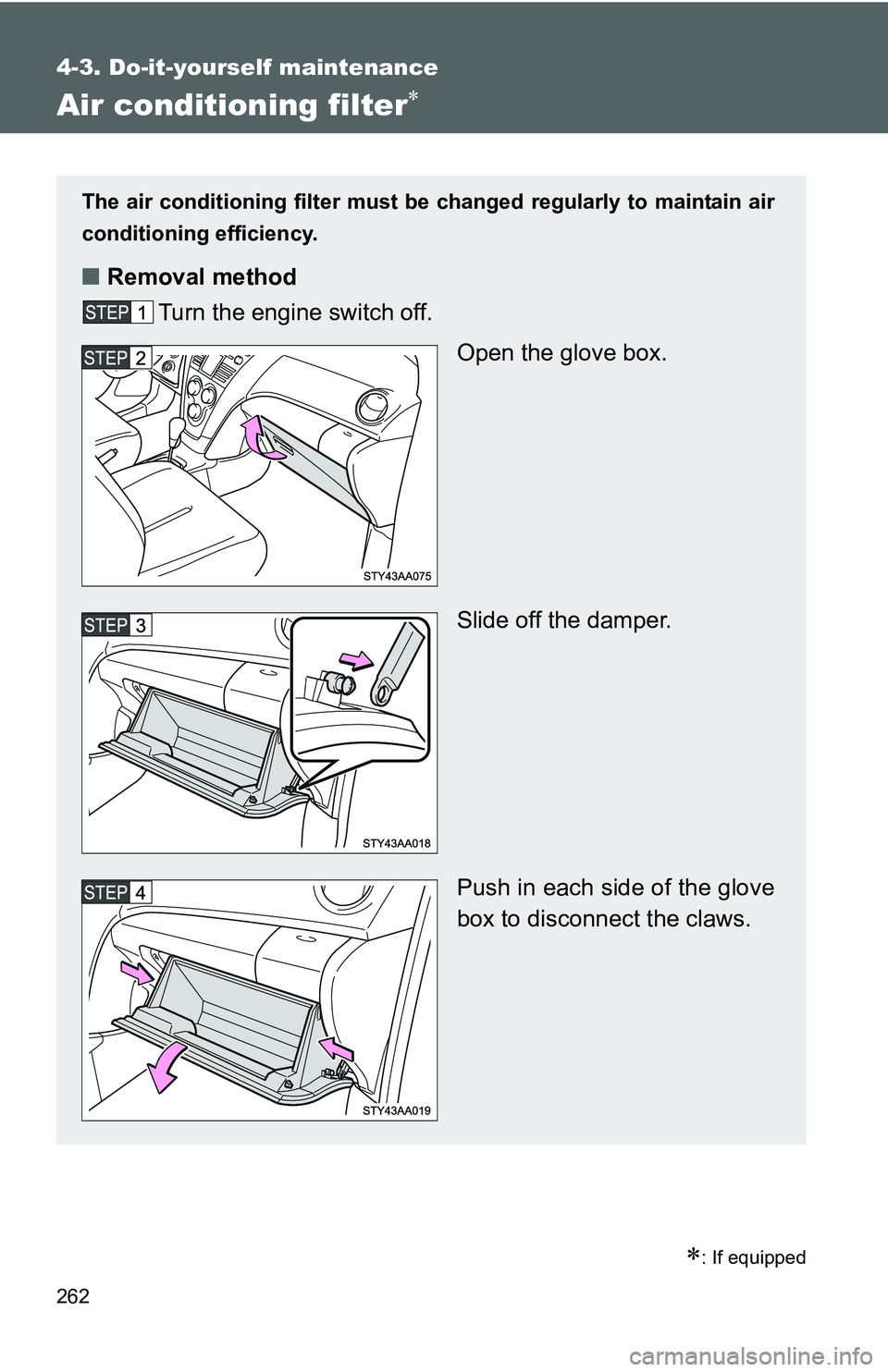
■ Removal method
Turn the engine switch off.
Open the glove box.
Slide off the damper.
Push in each side of the glove
box to disconnect the claws.
Page 278 of 406
267
4-3. Do-it-yourself maintenance
4
Maintenance and care
Checking and replacing fuses
If any of the electrical components do not operate, a fuse may have
blown. If this happens, check and replace the fuses as necessary.
Turn the engine switch off.
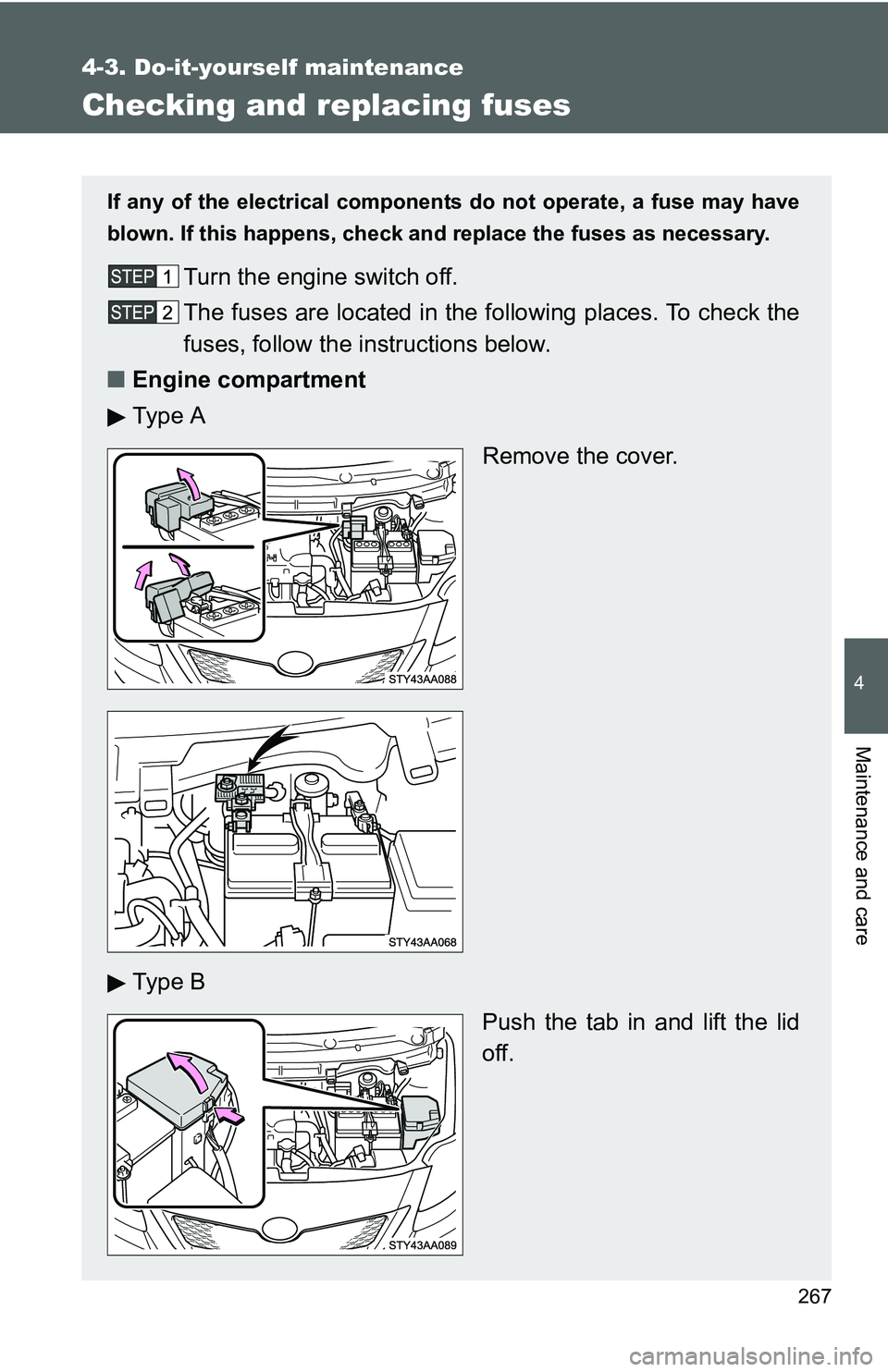
The fuses are located in the following places. To check the
fuses, follow the in structions below.
■ Engine compartment
Ty p e A
Remove the cover.
Ty p e B Push the tab in and lift the lid
off.
Page 282 of 406
271
4-3. Do-it-yourself maintenance
4
Maintenance and care
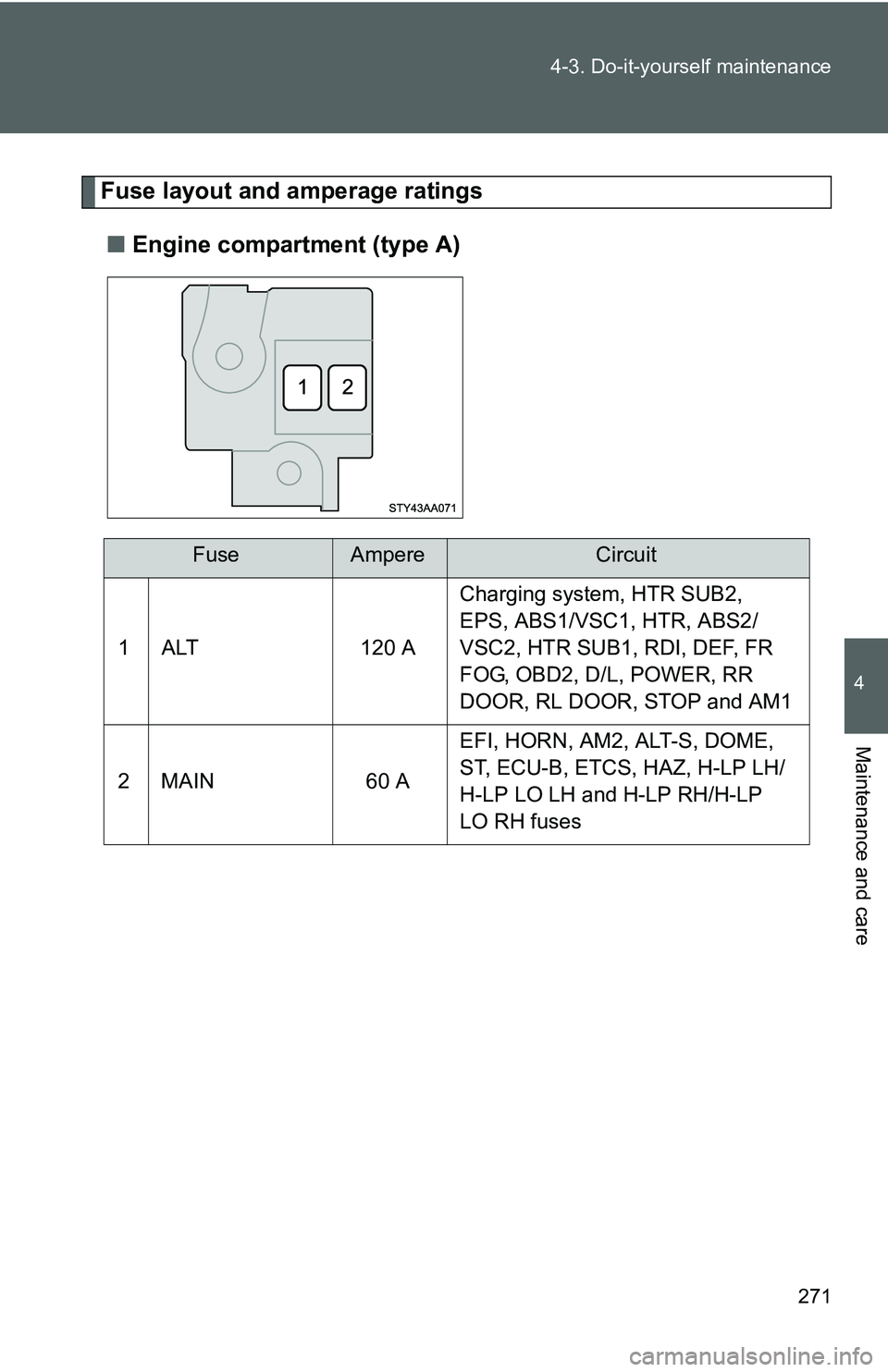
Fuse layout and amperage ratings
■ Engine compartment (type A)
FuseAmpereCircuit
1 ALT 120 A Charging system, HTR SUB2,
EPS, ABS1/VSC1, HTR, ABS2/
VSC2, HTR SUB1, RDI, DEF, FR
FOG, OBD2, D/L, POWER, RR
DOOR, RL DOOR, STOP and AM1
2 MAIN 60 A EFI, HORN, AM2, ALT-S, DOME,
ST, ECU-B, ETCS, HAZ, H-LP LH/
H-LP LO LH and H-LP RH/H-LP
LO RH fuses
Page 283 of 406
272 4-3. Do-it-yourself maintenance
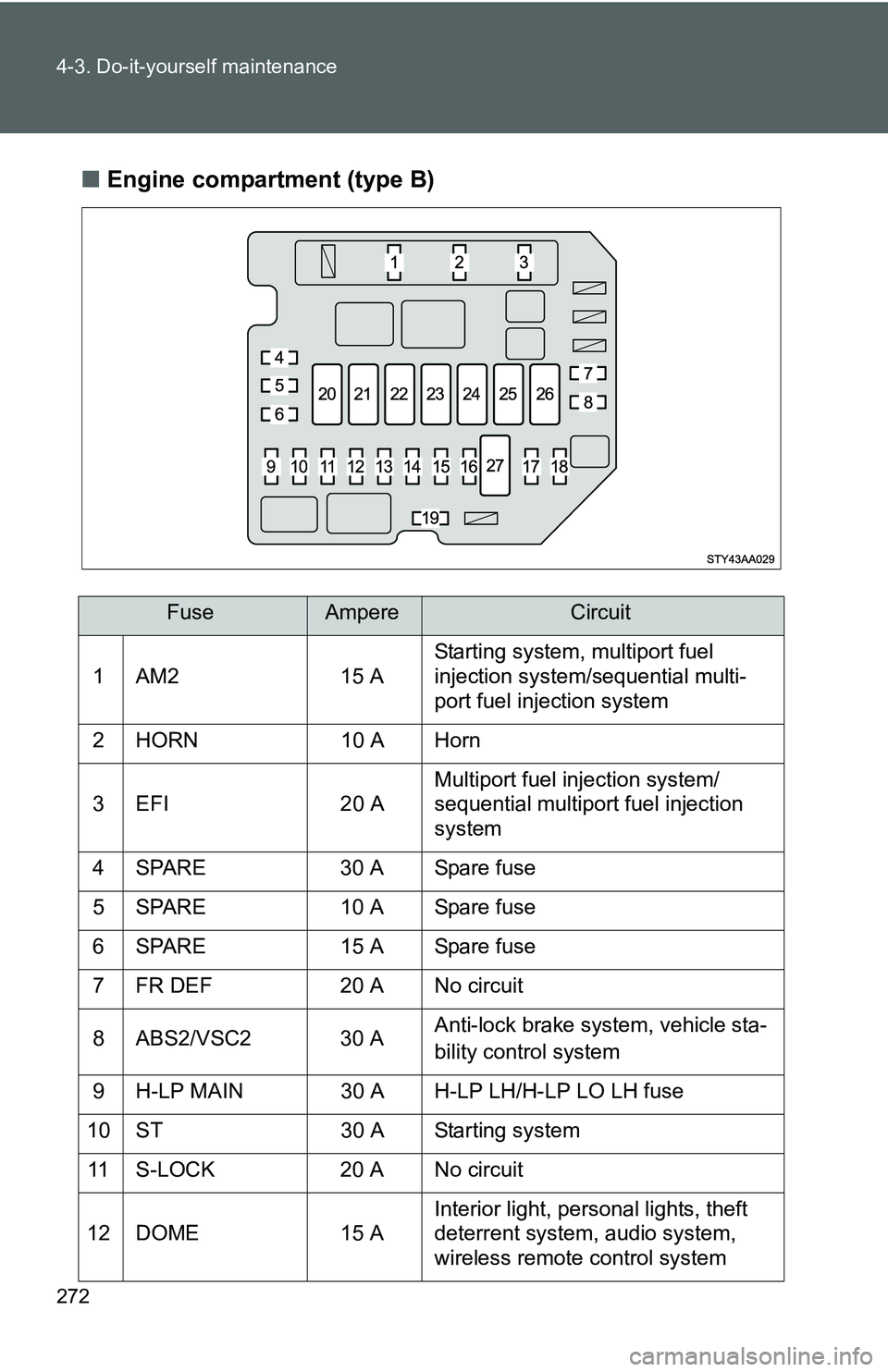
■Engine compartment (type B)
FuseAmpereCircuit
1 AM2 15 A Starting system, multiport fuel
injection system/sequential multi-
port fuel injection system
2 HORN 10 A Horn
3 EFI 20 A Multiport fuel injection system/
sequential multiport fuel injection
system
4 SPARE 30 A Spare fuse
5 SPARE 10 A Spare fuse
6 SPARE 15 A Spare fuse
7 FR DEF 20 A No circuit
8 ABS2/VSC2 30 A Anti-lock brake system, vehicle sta-
bility control system
9 H-LP MAIN 30 A H-LP LH/H-LP LO LH fuse
10 ST 30 A Starting system 11 S-LOCK 20 A No circuit
12 DOME 15 A Interior light, personal lights, theft
deterrent system, audio system,
wireless remote control system
Page 300 of 406
290
5-1. Essential information
Emergency flashers
NOTICE
nTo prevent battery discharge
Do not leave the emergency flashers on longer than necessary when the
engine is not running.
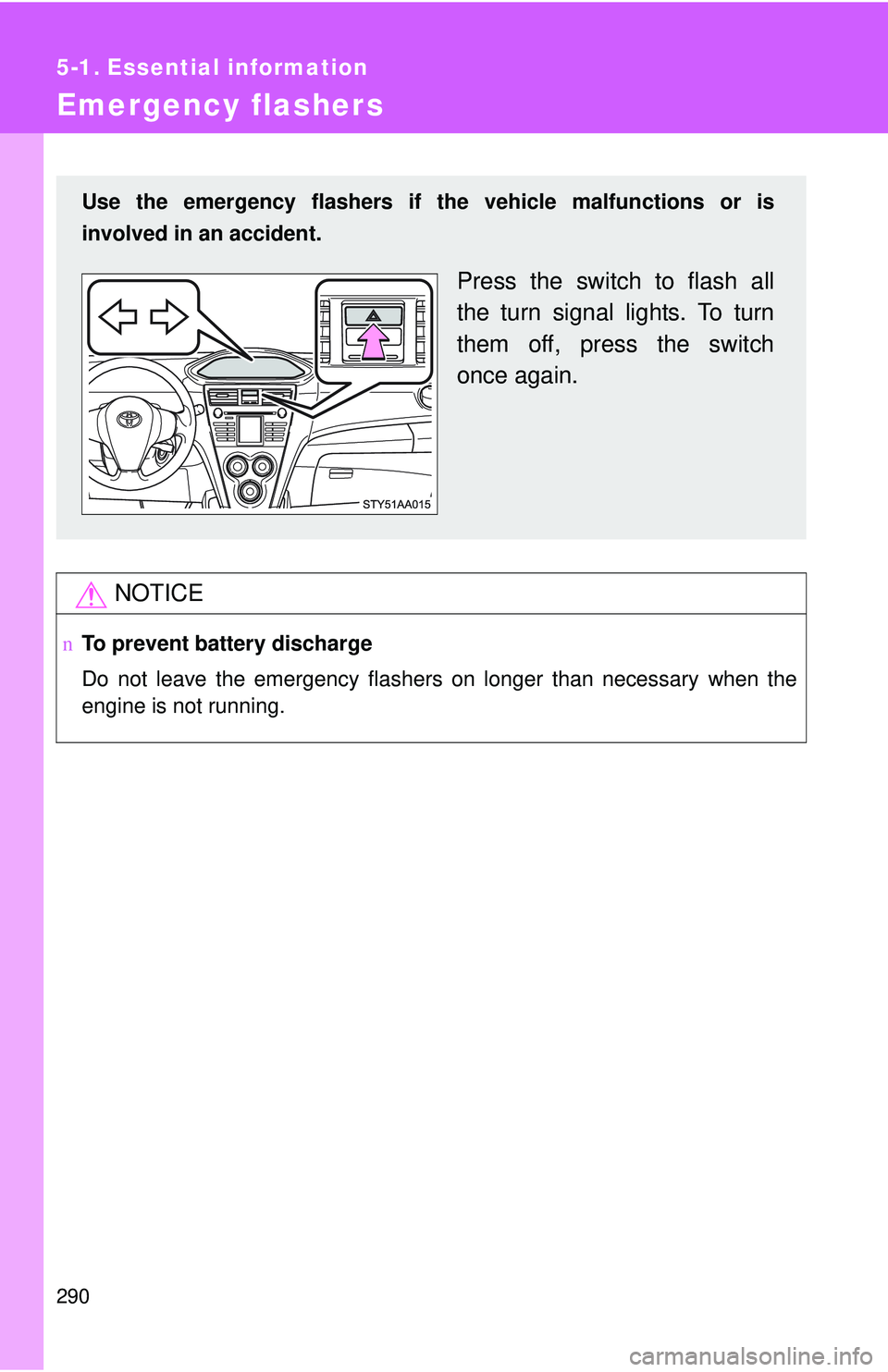
Use the emergency flashers if th e vehicle malfunctions or is
involved in an accident.
Press the switch to flash all
the turn signal lights. To turn
them off, press the switch
once again.
Page 301 of 406
5
When trouble arises
291
5-1. Essential information
If your vehicle needs to be towed
Before towingThe following may indicate a problem with your transmission. Contact
your Toyota dealer before towing.
l The engine is running, but the vehicle will not move.
l The vehicle makes an abnormal sound.
Emergency towing
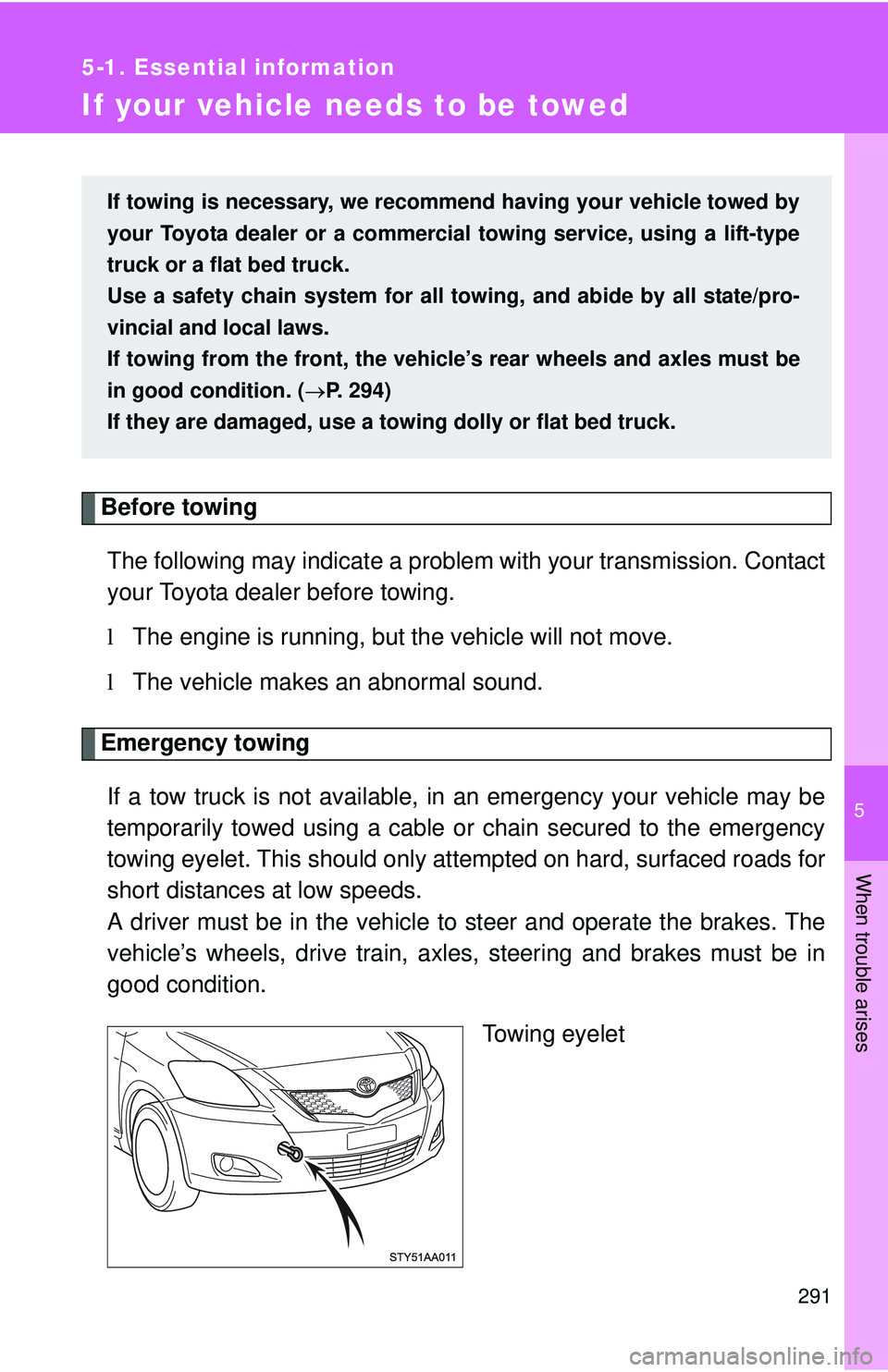
If a tow truck is not available, in an emergency your vehicle may be
temporarily towed using a cable or chain secured to the emergency
towing eyelet. This should only attempted on hard, surfaced roads for
short distances at low speeds.
A driver must be in the vehicle to steer and operate the brakes. The
vehicle’s wheels, drive train, axles, steering and brakes must be in
good condition.
Towing eyelet
If towing is necessary, we recommend having your vehicle towed by
your Toyota dealer or a commerci al towing service, using a lift-type
truck or a flat bed truck.
Use a safety chain system for all to wing, and abide by all state/pro-
vincial and local laws.
If towing from the front, the vehic le’s rear wheels and axles must be
in good condition. (→ P. 294)
If they are damaged, use a towing dolly or flat bed truck.