wheel VAUXHALL ADAM 2014 Repair Manual
[x] Cancel search | Manufacturer: VAUXHALL, Model Year: 2014, Model line: ADAM, Model: VAUXHALL ADAM 2014Pages: 217, PDF Size: 6.68 MB
Page 185 of 217

Vehicle care183
4.Lift the spare wheel holder a bit by
hand and unhook the catch.
5. Lower the spare wheel holder.
6. Lift the spare wheel holder a bit by
hand and detach the safety cable.
7. Lower holder all the way and remove spare wheel.
8. Change the wheel 3 179.
The damaged wheel has to be
secured in the load compartment,
see below.
9. Lift the empty spare wheel holder and insert the safety cable.
10. Lift the spare wheel holder farther
and engage in catch. The open
side of the catch must point in the
direction of travel.
11. Close the empty spare wheel holder by turning the hexagon boltclockwise successively using the
wheel wrench.
12. Stow wheel wrench and the jack in the tool box in vehicle floor.
13. Close the load compartment floor.
Stowing a damaged wheel in the
load compartment The spare wheel holder is not
designed for other tyre sizes than the
spare wheel.
A damaged wheel wider than the
spare wheel has to be stowed in the
load compartment and secured with a strap. Vehicle tools 3 169.Wheels with tyre size up to
195/55R16 1. Remove load compartment cover and lift up load compartment floor.
Stow both behind the raised up
backrests of the rear seats.
Page 186 of 217

184Vehicle care
2. Untwist wing nut and remove toolbox.
3. Position the damaged wheel to stand upright into the tool box
spare, facing to the front.4. Remove strap 1 from the tool box
and place the loop end of the strap
through the right side lashing eye.
5. Place the hook end of the strap through the loop and pull it until
the strap is fastened securely to
the lashing eye.6. Insert the strap through the spokes of the wheel as shown in
the illustration.
7. Mount the hook to the left side lashing eye.
8. Tighten the strap and secure it using the buckle.
Page 187 of 217
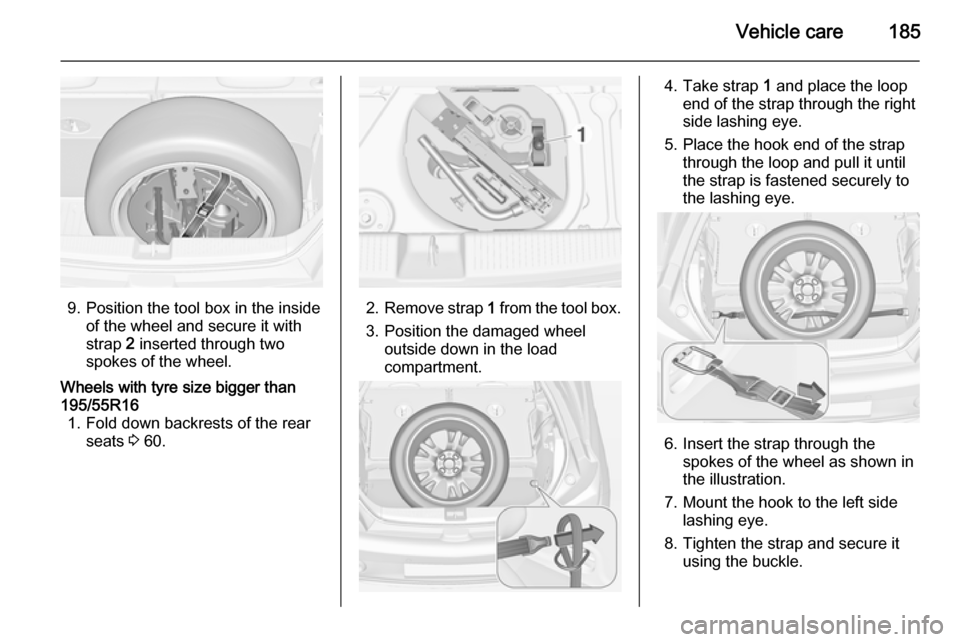
Vehicle care185
9. Position the tool box in the insideof the wheel and secure it with
strap 2 inserted through two
spokes of the wheel.
Wheels with tyre size bigger than
195/55R16 1. Fold down backrests of the rear seats 3 60.
2. Remove strap 1 from the tool box.
3. Position the damaged wheel outside down in the load
compartment.
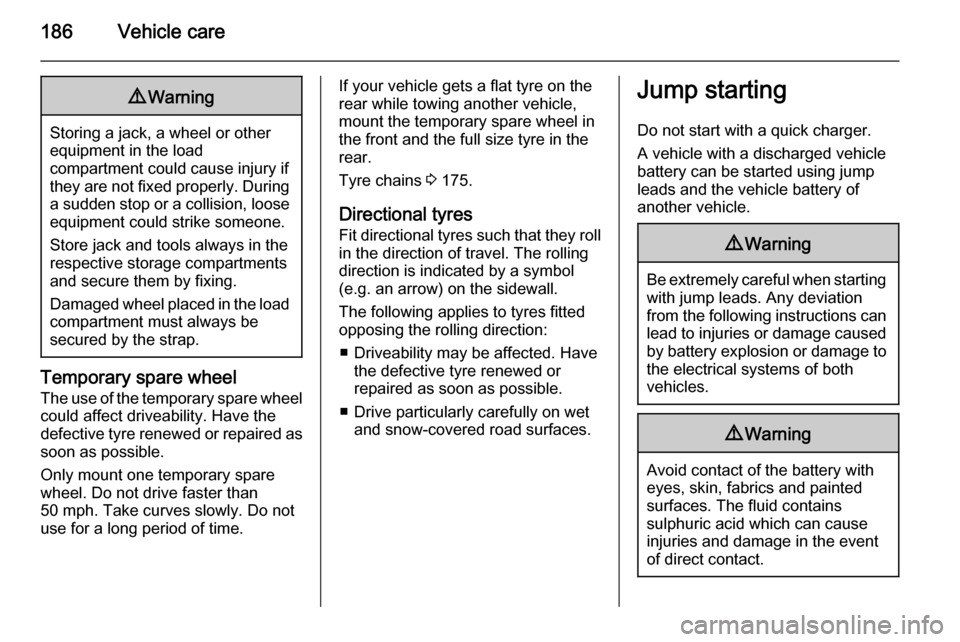
4. Take strap 1 and place the loop
end of the strap through the right
side lashing eye.
5. Place the hook end of the strap through the loop and pull it until
the strap is fastened securely to
the lashing eye.
6. Insert the strap through the spokes of the wheel as shown in
the illustration.
7. Mount the hook to the left side lashing eye.
8. Tighten the strap and secure it using the buckle.
Page 188 of 217
186Vehicle care9Warning
Storing a jack, a wheel or other
equipment in the load
compartment could cause injury if they are not fixed properly. During a sudden stop or a collision, looseequipment could strike someone.
Store jack and tools always in the
respective storage compartments
and secure them by fixing.
Damaged wheel placed in the load
compartment must always be
secured by the strap.
Temporary spare wheel
The use of the temporary spare wheel
could affect driveability. Have the
defective tyre renewed or repaired as soon as possible.
Only mount one temporary spare
wheel. Do not drive faster than
50 mph. Take curves slowly. Do not
use for a long period of time.
If your vehicle gets a flat tyre on the
rear while towing another vehicle,
mount the temporary spare wheel in the front and the full size tyre in the
rear.
Tyre chains 3 175.
Directional tyres
Fit directional tyres such that they roll in the direction of travel. The rolling
direction is indicated by a symbol
(e.g. an arrow) on the sidewall.
The following applies to tyres fitted
opposing the rolling direction:
■ Driveability may be affected. Have the defective tyre renewed or
repaired as soon as possible.
■ Drive particularly carefully on wet and snow-covered road surfaces.Jump starting
Do not start with a quick charger.
A vehicle with a discharged vehicle
battery can be started using jump
leads and the vehicle battery of
another vehicle.9 Warning
Be extremely careful when starting
with jump leads. Any deviation
from the following instructions can
lead to injuries or damage caused
by battery explosion or damage to the electrical systems of both
vehicles.
9 Warning
Avoid contact of the battery with
eyes, skin, fabrics and painted
surfaces. The fluid contains
sulphuric acid which can cause
injuries and damage in the event
of direct contact.
Page 190 of 217
188Vehicle care
4. Switch on electrical consumers(e.g. headlights, heated rear
window) of the vehicle receiving
the jump start.
5. Reverse above sequence exactly when removing leads.Towing
Towing the vehicle
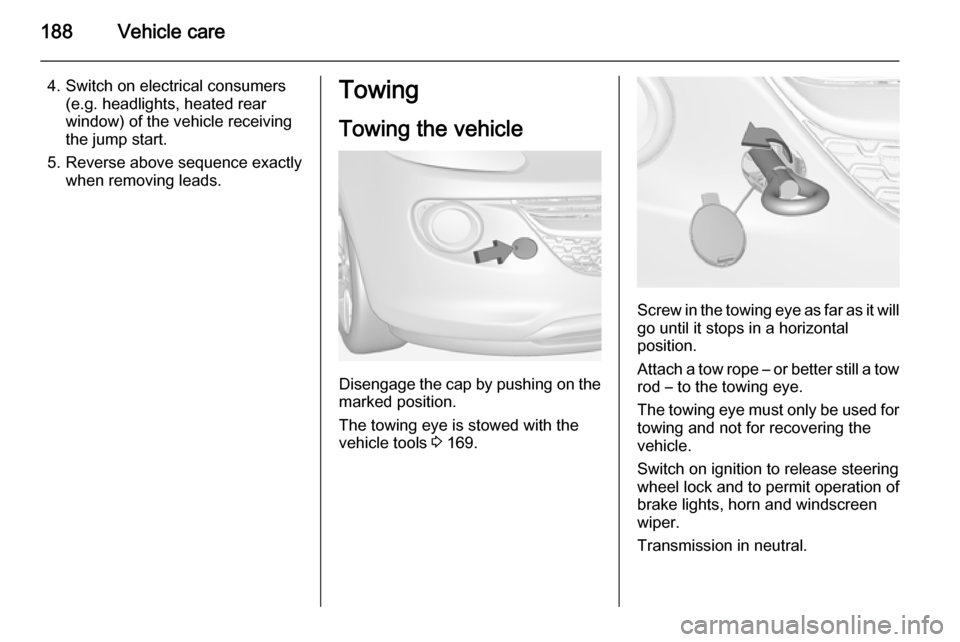
Disengage the cap by pushing on the
marked position.
The towing eye is stowed with the
vehicle tools 3 169.
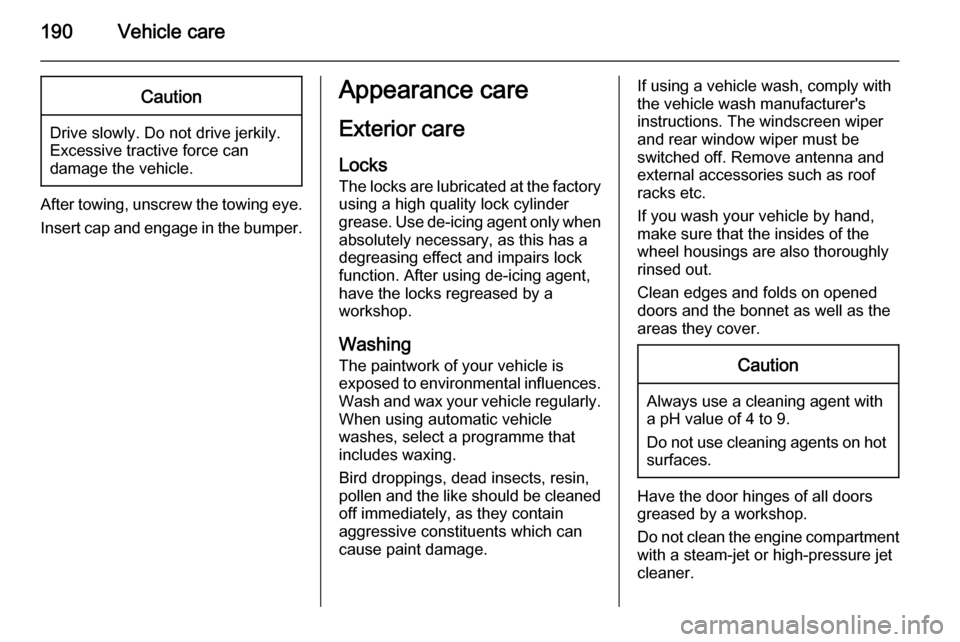
Screw in the towing eye as far as it will
go until it stops in a horizontal
position.
Attach a tow rope – or better still a tow
rod – to the towing eye.
The towing eye must only be used for
towing and not for recovering the
vehicle.
Switch on ignition to release steering wheel lock and to permit operation of
brake lights, horn and windscreen
wiper.
Transmission in neutral.
Page 192 of 217
190Vehicle careCaution
Drive slowly. Do not drive jerkily.
Excessive tractive force can
damage the vehicle.
After towing, unscrew the towing eye.
Insert cap and engage in the bumper.
Appearance care
Exterior care Locks
The locks are lubricated at the factory using a high quality lock cylinder
grease. Use de-icing agent only when absolutely necessary, as this has a
degreasing effect and impairs lock
function. After using de-icing agent,
have the locks regreased by a
workshop.
Washing The paintwork of your vehicle is
exposed to environmental influences.
Wash and wax your vehicle regularly.
When using automatic vehicle
washes, select a programme that
includes waxing.
Bird droppings, dead insects, resin,
pollen and the like should be cleaned
off immediately, as they contain
aggressive constituents which can
cause paint damage.If using a vehicle wash, comply with
the vehicle wash manufacturer's instructions. The windscreen wiperand rear window wiper must be
switched off. Remove antenna and
external accessories such as roof
racks etc.
If you wash your vehicle by hand,
make sure that the insides of the
wheel housings are also thoroughly
rinsed out.
Clean edges and folds on opened
doors and the bonnet as well as the
areas they cover.Caution
Always use a cleaning agent with
a pH value of 4 to 9.
Do not use cleaning agents on hot surfaces.
Have the door hinges of all doors
greased by a workshop.
Do not clean the engine compartment with a steam-jet or high-pressure jet
cleaner.
Page 193 of 217

Vehicle care191
On vehicles with emblem touchpad:
when cleaning with a high-pressure
jet cleaner ensure a minimum
distance of 30 cm when working
around the tailgate to prevent
unintended unlocking.
Thoroughly rinse and leather-off the
vehicle. Rinse leather frequently. Use
separate leathers for painted and
glass surfaces: remnants of wax on
the windows will impair vision.
Exterior lights Headlight and other light covers are
made of plastic. Do not use any
abrasive or caustic agents, do not use
an ice scraper, and do not clean them dry.
Polishing and waxing
Wax the vehicle regularly (at the
latest when water no longer beads).
Otherwise, the paintwork will dry out.
Polishing is necessary only if the paint
has become dull or if solid deposits
have become attached to it.Paintwork polish with silicone forms a
protective film, making waxing
unnecessary.
Plastic body parts must not be treated with wax or polishing agents.
Windows and windscreen wiper blades
Use a soft lint-free cloth or chamois leather together with window cleaner
and insect remover.
When cleaning the rear window from
inside, always wipe in parallel to the
heating element to prevent damage.
For mechanical removal of ice, use a
sharp-edged ice scraper. Press the
scraper firmly against the glass so
that no dirt can get under it and
scratch the glass.
Clean smearing wiper blades with a
soft cloth and window cleaner.Glass panel
Never clean with solvents or abrasive
agents, fuels, aggressive media (e.g.
paint cleaner, acetone-containing solutions etc.), acidic or highly
alkaline media or abrasive pads. Do
not apply wax or polishing agents to
the glass panel.
Wheels and tyres Do not use high-pressure jet
cleaners.
Clean rims with a pH-neutral wheel
cleaner.
Rims are painted and can be treated
with the same agents as the body.
Paintwork damageRectify minor paintwork damage with
a touch-up pen before rust forms. Have more extensive damage or rust
areas repaired by a workshop.
Underbody
Some areas of the vehicle underbody
have a PVC undercoating while other critical areas have a durable
protective wax coating.
Page 206 of 217
![VAUXHALL ADAM 2014 Repair Manual 204Technical data
Length of load compartment floor [mm]462Length of load compartment with folded rear seats [mm]1041Load compartment width [mm]954Load compartment height [mm]874Wheelbase [mm]2311Turni](/img/38/19286/w960_19286-205.png "VAUXHALL ADAM 2014 Repair Manual 204Technical data
Length of load compartment floor [mm]462Length of load compartment with folded rear seats [mm]1041Load compartment width [mm]954Load compartment height [mm]874Wheelbase [mm]2311Turni")
204Technical data
Length of load compartment floor [mm]462Length of load compartment with folded rear seats [mm]1041Load compartment width [mm]954Load compartment height [mm]874Wheelbase [mm]2311Turning circle diameter [m]10.1
Page 208 of 217
![VAUXHALL ADAM 2014 Repair Manual 206Technical dataTyre pressuresComfort with up to 3 peopleECO with up to 3 peopleWith full loadEngineTyresfrontrearfrontrearfrontrear[kPa/bar]
([psi])[kPa/bar]
([psi])[kPa/bar]
([psi])[kPa/bar]
([psi]](/img/38/19286/w960_19286-207.png "VAUXHALL ADAM 2014 Repair Manual 206Technical dataTyre pressuresComfort with up to 3 peopleECO with up to 3 peopleWith full loadEngineTyresfrontrearfrontrearfrontrear[kPa/bar]
([psi])[kPa/bar]
([psi])[kPa/bar]
([psi])[kPa/bar]
([psi]")
206Technical dataTyre pressuresComfort with up to 3 peopleECO with up to 3 peopleWith full loadEngineTyresfrontrearfrontrearfrontrear[kPa/bar]
([psi])[kPa/bar]
([psi])[kPa/bar]
([psi])[kPa/bar]
([psi])[kPa/bar]
([psi])[kPa/bar]
([psi])A12XEL,
A14XEL,
A14XER175/70 R14,
185/60 R15,
185/65 R15200/2.0 (29)240/2.4 (35)260/2.6 (38)320/3.2 (46)260/2.6 (38)320/3.2 (46)195/55 R16,
215/45 R17,
225/35 R18200/2.0 (29)260/2.6 (38)260/2.6 (38)320/3.2 (46)260/2.6 (38)320/3.2 (46)AllTemporary spare wheel420/4.2 (61)420/4.2 (61)––420/4.2 (61)420/4.2 (61)
Page 209 of 217

Customer information207Customer informationCustomer information................207
Vehicle data recording and pri‐
vacy ........................................... 207Customer information
Declaration of conformity
This vehicle has systems that
transmit and/or receive radio waves
subject to Directive 1999/5/EC.
These systems are in compliance
with the essential requirements and
other relevant provisions of Directive
1999/5/EC. Copies of the original
Declarations of Conformity can be
obtained on our website.Vehicle data recording
and privacy
Event data recorders
Data storage modules in the vehicle
A large number of electronic
components of your vehicle contain
data storage modules temporarily or
permanently storing technical data
about the condition of the vehicle,
events and errors. In general, this
technical information documents the
condition of parts, modules, systems
or the environment:
■ Operating conditions of system components (e.g. filling levels)
■ Status messages of the vehicle and
its single components (e.g. number
of wheel revolutions / rotational
speed, deceleration, lateral
acceleration)
■ Dysfunctions and defects in important system components